


ISO 21013-3:2006
(Main)Cryogenic vessels — Pressure-relief accessories for cryogenic service — Part 3: Sizing and capacity determination
Cryogenic vessels — Pressure-relief accessories for cryogenic service — Part 3: Sizing and capacity determination
ISO 21013-3:2006 provides separate calculation methods for determining the required mass flow to be relieved for each of the following specified conditions. Vacuum-insulated vessels with insulation system (outer jacket + insulating material) intact under normal vacuum; outer jacket at ambient temperature; inner vessel at temperature of the contents at the relieving pressure. Vacuum-insulated vessels with insulation system (outer jacket + insulating material) intact under normal vacuum; outer jacket at ambient temperature; inner vessel at temperature of the contents at the relieving pressure; pressure regulator of the pressure build-up system functioning at full potential. Vacuum-insulated vessels with insulation system remaining in place but with loss of vacuum, or non-vacuum-insulated vessels with insulation system intact; outer jacket at ambient temperature; inner vessel at temperature of the contents at the relieving pressure; vacuum or non-vacuum-insulated vessels with insulation system remaining fully or partially in place, but with loss of vacuum in the case of vacuum-insulated vessels, and fire engulfment; inner vessel at temperature of the contents at the relieving pressure. Vessels with insulation system totally lost and fire engulfment. Good engineering practice based on well-established theoretical physical science needs to be adopted to determine the required mass flow where an appropriate calculation method is not provided for an applicable condition.
Récipients cryogéniques — Dispositifs de sécurité pour le service cryogénique — Partie 3: Détermination de la taille et du volume
General Information
- Status
- Withdrawn
- Publication Date
- 08-Jan-2006
- Withdrawal Date
- 08-Jan-2006
- Technical Committee
- ISO/TC 220 - Cryogenic vessels
- Drafting Committee
- ISO/TC 220/WG 3 - Supporting standards
- Current Stage
- 9599 - Withdrawal of International Standard
- Start Date
- 12-May-2016
- Completion Date
- 14-Feb-2026
Relations
- Effective Date
- 10-Jul-2010
Get Certified
Connect with accredited certification bodies for this standard

Institut za varilstvo d.o.o. (Welding Institute)
Slovenia's leading welding institute since 1952. ISO 3834, EN 1090, pressure equipment certification, NDT personnel, welder qualification. Only IIW Au
Sponsored listings
Frequently Asked Questions
ISO 21013-3:2006 is a standard published by the International Organization for Standardization (ISO). Its full title is "Cryogenic vessels — Pressure-relief accessories for cryogenic service — Part 3: Sizing and capacity determination". This standard covers: ISO 21013-3:2006 provides separate calculation methods for determining the required mass flow to be relieved for each of the following specified conditions. Vacuum-insulated vessels with insulation system (outer jacket + insulating material) intact under normal vacuum; outer jacket at ambient temperature; inner vessel at temperature of the contents at the relieving pressure. Vacuum-insulated vessels with insulation system (outer jacket + insulating material) intact under normal vacuum; outer jacket at ambient temperature; inner vessel at temperature of the contents at the relieving pressure; pressure regulator of the pressure build-up system functioning at full potential. Vacuum-insulated vessels with insulation system remaining in place but with loss of vacuum, or non-vacuum-insulated vessels with insulation system intact; outer jacket at ambient temperature; inner vessel at temperature of the contents at the relieving pressure; vacuum or non-vacuum-insulated vessels with insulation system remaining fully or partially in place, but with loss of vacuum in the case of vacuum-insulated vessels, and fire engulfment; inner vessel at temperature of the contents at the relieving pressure. Vessels with insulation system totally lost and fire engulfment. Good engineering practice based on well-established theoretical physical science needs to be adopted to determine the required mass flow where an appropriate calculation method is not provided for an applicable condition.
ISO 21013-3:2006 provides separate calculation methods for determining the required mass flow to be relieved for each of the following specified conditions. Vacuum-insulated vessels with insulation system (outer jacket + insulating material) intact under normal vacuum; outer jacket at ambient temperature; inner vessel at temperature of the contents at the relieving pressure. Vacuum-insulated vessels with insulation system (outer jacket + insulating material) intact under normal vacuum; outer jacket at ambient temperature; inner vessel at temperature of the contents at the relieving pressure; pressure regulator of the pressure build-up system functioning at full potential. Vacuum-insulated vessels with insulation system remaining in place but with loss of vacuum, or non-vacuum-insulated vessels with insulation system intact; outer jacket at ambient temperature; inner vessel at temperature of the contents at the relieving pressure; vacuum or non-vacuum-insulated vessels with insulation system remaining fully or partially in place, but with loss of vacuum in the case of vacuum-insulated vessels, and fire engulfment; inner vessel at temperature of the contents at the relieving pressure. Vessels with insulation system totally lost and fire engulfment. Good engineering practice based on well-established theoretical physical science needs to be adopted to determine the required mass flow where an appropriate calculation method is not provided for an applicable condition.
ISO 21013-3:2006 is classified under the following ICS (International Classification for Standards) categories: 23.020.40 - Cryogenic vessels. The ICS classification helps identify the subject area and facilitates finding related standards.
ISO 21013-3:2006 has the following relationships with other standards: It is inter standard links to ISO 21013-3:2016. Understanding these relationships helps ensure you are using the most current and applicable version of the standard.
ISO 21013-3:2006 is available in PDF format for immediate download after purchase. The document can be added to your cart and obtained through the secure checkout process. Digital delivery ensures instant access to the complete standard document.
Standards Content (Sample)
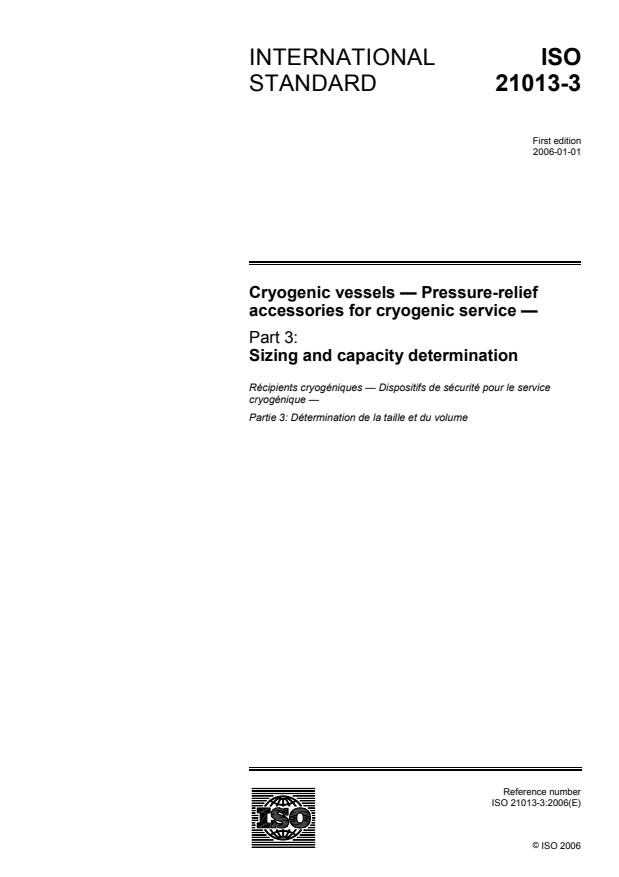
INTERNATIONAL ISO
STANDARD 21013-3
First edition
2006-01-01
Cryogenic vessels — Pressure-relief
accessories for cryogenic service —
Part 3:
Sizing and capacity determination
Récipients cryogéniques — Dispositifs de sécurité pour le service
cryogénique —
Partie 3: Détermination de la taille et du volume
Reference number
©
ISO 2006
PDF disclaimer
This PDF file may contain embedded typefaces. In accordance with Adobe's licensing policy, this file may be printed or viewed but
shall not be edited unless the typefaces which are embedded are licensed to and installed on the computer performing the editing. In
downloading this file, parties accept therein the responsibility of not infringing Adobe's licensing policy. The ISO Central Secretariat
accepts no liability in this area.
Adobe is a trademark of Adobe Systems Incorporated.
Details of the software products used to create this PDF file can be found in the General Info relative to the file; the PDF-creation
parameters were optimized for printing. Every care has been taken to ensure that the file is suitable for use by ISO member bodies. In
the unlikely event that a problem relating to it is found, please inform the Central Secretariat at the address given below.
© ISO 2006
All rights reserved. Unless otherwise specified, no part of this publication may be reproduced or utilized in any form or by any means,
electronic or mechanical, including photocopying and microfilm, without permission in writing from either ISO at the address below or
ISO's member body in the country of the requester.
ISO copyright office
Case postale 56 • CH-1211 Geneva 20
Tel. + 41 22 749 01 11
Fax + 41 22 749 09 47
E-mail copyright@iso.org
Web www.iso.org
Published in Switzerland
ii © ISO 2006 – All rights reserved
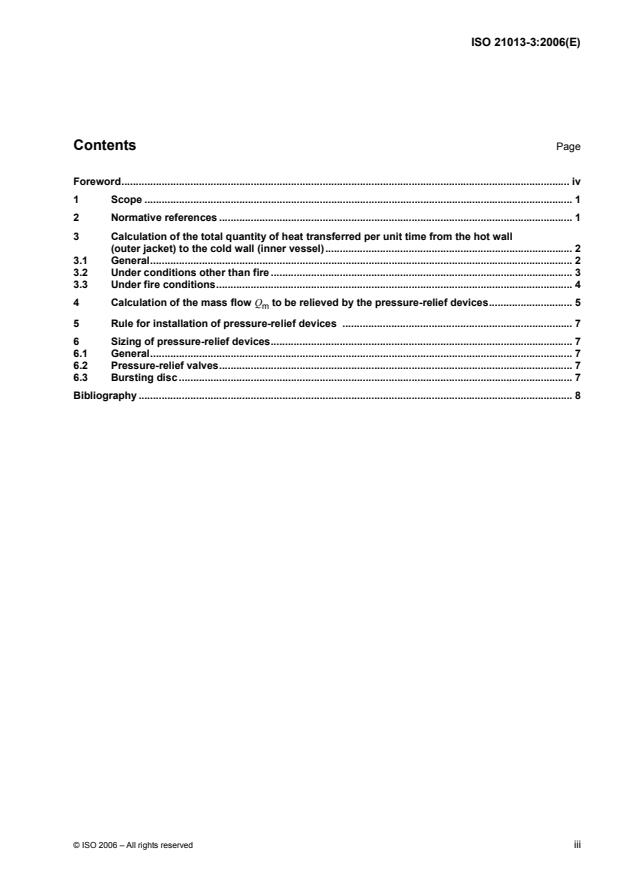
Contents Page
Foreword. iv
1 Scope . 1
2 Normative references . 1
3 Calculation of the total quantity of heat transferred per unit time from the hot wall
(outer jacket) to the cold wall (inner vessel). 2
3.1 General. 2
3.2 Under conditions other than fire . 3
3.3 Under fire conditions. 4
4 Calculation of the mass flow Q to be relieved by the pressure-relief devices. 5
m
5 Rule for installation of pressure-relief devices . 7
6 Sizing of pressure-relief devices. 7
6.1 General. 7
6.2 Pressure-relief valves. 7
6.3 Bursting disc . 7
Bibliography . 8
Foreword
ISO (the International Organization for Standardization) is a worldwide federation of national standards bodies
(ISO member bodies). The work of preparing International Standards is normally carried out through ISO
technical committees. Each member body interested in a subject for which a technical committee has been
established has the right to be represented on that committee. International organizations, governmental and
non-governmental, in liaison with ISO, also take part in the work. ISO collaborates closely with the
International Electrotechnical Commission (IEC) on all matters of electrotechnical standardization.
International Standards are drafted in accordance with the rules given in the ISO/IEC Directives, Part 2.
The main task of technical committees is to prepare International Standards. Draft International Standards
adopted by the technical committees are circulated to the member bodies for voting. Publication as an
International Standard requires approval by at least 75 % of the member bodies casting a vote.
Attention is drawn to the possibility that some of the elements of this document may be the subject of patent
rights. ISO shall not be held responsible for identifying any or all such patent rights.
ISO 21013-3 was prepared by Technical Committee ISO/TC 220, Cryogenic vessels.
ISO 21013 consists of the following parts, under the general title Cryogenic vessels — Pressure-relief
accessories for cryogenic service:
⎯ Part 1: Reclosable pressure-relief valves
⎯ Part 2: Non-reclosable pressure-relief devices
⎯ Part 3: Sizing and capacity determination
iv © ISO 2006 – All rights reserved
INTERNATIONAL STANDARD ISO 21013-3:2006(E)
Cryogenic vessels — Pressure-relief accessories for cryogenic
service —
Part 3:
Sizing and capacity determination
1 Scope
This part of ISO 21013 provides separate calculation methods for determining the required mass flow to be
relieved for each of the following specified conditions.
⎯ Vacuum-insulated vessels with insulation system (outer jacket + insulating material) intact under normal
vacuum; outer jacket at ambient temperature; inner vessel at temperature of the contents at the relieving
pressure.
⎯ Vacuum-insulated vessels with insulation system (outer jacket + insulating material) intact under normal
vacuum; outer jacket at ambient temperature; inner vessel at temperature of the contents at the relieving
pressure; pressure regulator of the pressure build-up system functioning at full potential.
⎯ Vacuum-insulated vessels with insulation system remaining in place but with loss of vacuum, or non-
vacuum-insulated vessels with insulation system intact; outer jacket at ambient temperature; inner vessel
at temperature of the contents at the relieving pressure; vacuum or non-vacuum-insulated vessels with
insulation system remaining fully or partially in place, but with loss of vacuum in the case of vacuum-
insulated vessels, and fire engulfment; inner vessel at temperature of the contents at the relieving
pressure.
⎯ Vessels with insulation system totally lost and fire engulfment.
Good engineering practice based on well-established theoretical physical science shall be adopted to
determine the required mass flow where an appropriate calculation method is not provided for an applicable
condition.
2 Normative references
The following referenced documents are indispensable for the application of this document. For dated
references, only the edition cited applies. For undated references, the latest edition of the referenced
document (including any amendments) applies.
ISO 4126-1, Safety devices for protection against excessive pressure — Part 1: Safety valves
ISO 4126-6:2003, Safety devices for protection against excessive pressure — Part 6: Application, selection
and installation of bursting disc safety devices
3 Calculation of the total quantity of heat transferred per unit time from the hot wall
(outer jacket) to the cold wall (inner vessel)
3.1 General
P (in bar abs) is the actual relieving pressure inside the vessel, which is used for calculating the required mass
flow through pressure-relief devices.
T (in K) is the maximum ambient temperature for conditions other than fire (as specified, for example, by a
a
regulation or standard).
T (in K) is the external environment temperature under fire conditions, which is taken to be 922 K in this part
f
of ISO 21013.
T (in K) is the relieving temperature in the vessel to be taken into account:
a) for subcritical fluids, T is the saturation temperature of the liquid at pressure P;
b) for critical or supercritical fluids, T is calculated from 4.3.
The quantity of heat transferred per unit time (in watts) by supports and piping located in the interspace to be
included in W , W and W is calculated as follows:
1 2 3
W = (T − T) (w + w + … + w + …)
c a 1 2 n
where
w is the heat leak per degree K contributed by one of the supports or the pipes, in W/K,
n
A
n
w = k
n n
l
n
where
k is the thermal conductivity of the support or pipe material between T and T , in W/(m⋅K);
n a
A is the support or pipe section area, in m ;
n
l is the support or pipe length in the vacuum interspace, in m.
n
2 © ISO 2006 – All rights reserved
...
Questions, Comments and Discussion
Ask us and Technical Secretary will try to provide an answer. You can facilitate discussion about the standard in here.
Loading comments...