


ISO 10303-101:1994
(Main)Industrial automation systems and integration — Product data representation and exchange — Part 101: Integrated application resources: Draughting
Industrial automation systems and integration — Product data representation and exchange — Part 101: Integrated application resources: Draughting
La présente partie de l'ISO 10303 spécifie les ressources élémentaires relatives à la représentation des informations propres aux dessins techniques. Les éléments suivants font partie du domaine d'application de la présente partie de l'ISO 10303 : l'information relative à la définition, à la description et à la gestion d'un dessin et des feuilles à dessin ; les annotations fondamentales propres aux dessins techniques et leur agrégation avec plus d'annotations générales pour le déchiffrage des faits et prescriptions relatifs au produit ou à l'interprétation d'un dessin ; les annotations de dessins techniques utilisées dans le déchiffrage des dimensions, tolérances et informations apparentées au mesurage de la dimension. Les éléments suivants ne figurent pas dans le domaine d'application de la présente partie de l'ISO 10303 : l'information de gestion, fournie dans l'ISO 10303-41, telle que les changements qui engendrent les différents dessins, les approbations, les contrats d'exécution des dessins techniques, la classification par critères de sécurité, les personnes responsables, ainsi que leur rôle ; les vues et le mécanisme de visualisation pour le déchiffrage de la forme, fournis dans l'ISO 10303-46 ; les annotations génériques de style (c'est-à-dire les courbes, symboles, textes et divisions (hachures)), fournies dans l'ISO 10303-46 ; les systèmes de coordonnée pour l'emplacement des annotations, et leurs relations, fournis dans l'ISO 10303-42 et l'ISO 10303-43.
Systèmes d'automatisation industrielle et intégration — Représentation et échange de données de produits — Partie 101: Ressources d'application intégrées: Dessins techniques
General Information
- Status
- Withdrawn
- Publication Date
- 21-Dec-1994
- Withdrawal Date
- 21-Dec-1994
- Technical Committee
- ISO/TC 184/SC 4 - Industrial data
- Drafting Committee
- ISO/TC 184/SC 4 - Industrial data
- Current Stage
- 9599 - Withdrawal of International Standard
- Start Date
- 14-Dec-2011
- Completion Date
- 14-Feb-2026
Relations
- Consolidated By
ISO 13397-2:2005 - Dentistry — Periodontal curettes, dental scalers and excavators — Part 2: Periodontal curettes of Gr-type - Effective Date
- 06-Jun-2022
- Effective Date
- 06-Jun-2022
- Effective Date
- 15-Apr-2008
Get Certified
Connect with accredited certification bodies for this standard

National Aerospace and Defense Contractors Accreditation Program (NADCAP)
Global cooperative program for special process quality in aerospace.
CARES (UK Certification Authority for Reinforcing Steels)
UK certification for reinforcing steels and construction.
DVS-ZERT GmbH
German welding certification society.
Sponsored listings
Frequently Asked Questions
ISO 10303-101:1994 is a standard published by the International Organization for Standardization (ISO). Its full title is "Industrial automation systems and integration — Product data representation and exchange — Part 101: Integrated application resources: Draughting". This standard covers: La présente partie de l'ISO 10303 spécifie les ressources élémentaires relatives à la représentation des informations propres aux dessins techniques. Les éléments suivants font partie du domaine d'application de la présente partie de l'ISO 10303 : l'information relative à la définition, à la description et à la gestion d'un dessin et des feuilles à dessin ; les annotations fondamentales propres aux dessins techniques et leur agrégation avec plus d'annotations générales pour le déchiffrage des faits et prescriptions relatifs au produit ou à l'interprétation d'un dessin ; les annotations de dessins techniques utilisées dans le déchiffrage des dimensions, tolérances et informations apparentées au mesurage de la dimension. Les éléments suivants ne figurent pas dans le domaine d'application de la présente partie de l'ISO 10303 : l'information de gestion, fournie dans l'ISO 10303-41, telle que les changements qui engendrent les différents dessins, les approbations, les contrats d'exécution des dessins techniques, la classification par critères de sécurité, les personnes responsables, ainsi que leur rôle ; les vues et le mécanisme de visualisation pour le déchiffrage de la forme, fournis dans l'ISO 10303-46 ; les annotations génériques de style (c'est-à-dire les courbes, symboles, textes et divisions (hachures)), fournies dans l'ISO 10303-46 ; les systèmes de coordonnée pour l'emplacement des annotations, et leurs relations, fournis dans l'ISO 10303-42 et l'ISO 10303-43.
La présente partie de l'ISO 10303 spécifie les ressources élémentaires relatives à la représentation des informations propres aux dessins techniques. Les éléments suivants font partie du domaine d'application de la présente partie de l'ISO 10303 : l'information relative à la définition, à la description et à la gestion d'un dessin et des feuilles à dessin ; les annotations fondamentales propres aux dessins techniques et leur agrégation avec plus d'annotations générales pour le déchiffrage des faits et prescriptions relatifs au produit ou à l'interprétation d'un dessin ; les annotations de dessins techniques utilisées dans le déchiffrage des dimensions, tolérances et informations apparentées au mesurage de la dimension. Les éléments suivants ne figurent pas dans le domaine d'application de la présente partie de l'ISO 10303 : l'information de gestion, fournie dans l'ISO 10303-41, telle que les changements qui engendrent les différents dessins, les approbations, les contrats d'exécution des dessins techniques, la classification par critères de sécurité, les personnes responsables, ainsi que leur rôle ; les vues et le mécanisme de visualisation pour le déchiffrage de la forme, fournis dans l'ISO 10303-46 ; les annotations génériques de style (c'est-à-dire les courbes, symboles, textes et divisions (hachures)), fournies dans l'ISO 10303-46 ; les systèmes de coordonnée pour l'emplacement des annotations, et leurs relations, fournis dans l'ISO 10303-42 et l'ISO 10303-43.
ISO 10303-101:1994 is classified under the following ICS (International Classification for Standards) categories: 25.040.40 - Industrial process measurement and control. The ICS classification helps identify the subject area and facilitates finding related standards.
ISO 10303-101:1994 has the following relationships with other standards: It is inter standard links to ISO 13397-2:2005, ISO 10303-101:1994/Cor 1:1999; is excused to ISO 10303-101:1994/Cor 1:1999. Understanding these relationships helps ensure you are using the most current and applicable version of the standard.
ISO 10303-101:1994 is available in PDF format for immediate download after purchase. The document can be added to your cart and obtained through the secure checkout process. Digital delivery ensures instant access to the complete standard document.
Standards Content (Sample)
INTERNATIONAL ISO
STANDARD 10303401
First edition
1994-12-15
Industrial automation Systems and
integration - Product data representation
and exchange -
Part 101:
Integrated application resources: Draughting
Sys temes d ‘automa tisa tion industrielle et in tegra tion - Reprksen ta tion
et khange de donnees de produits -
Partie 10 1: ßessources d ’application integrees: Dessins techniques
Reference number
ISO 10303-101 :1994(E)
ISO 10303=101:1994(E)
Page
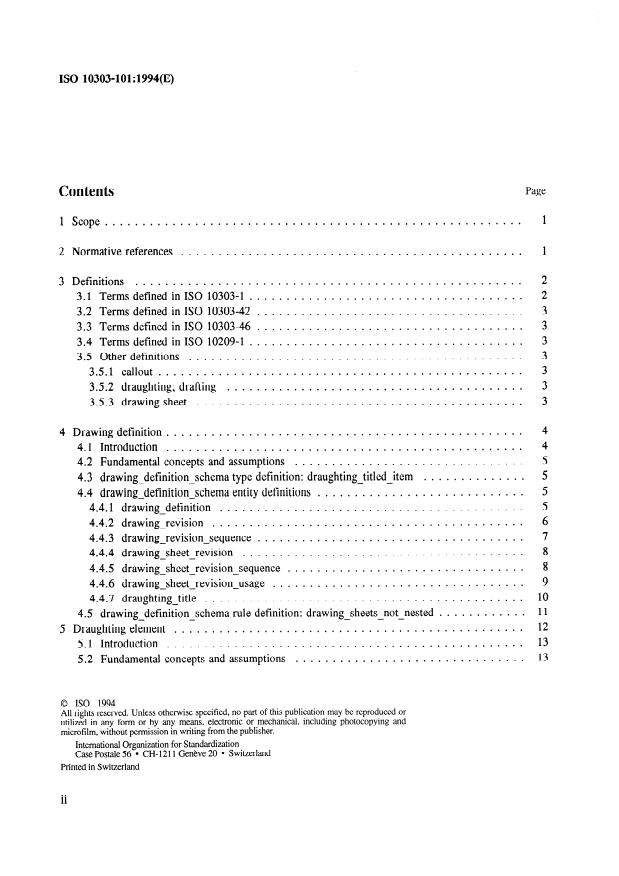
Contents
”
1 Scope.
2 Normative references . . . . . . . . . . . . . . . . . . . . . . . . . . . . . . . . . . . . . . . . . . . . . .
3 Definitions .
.....................................
3.1 Terms defined inIS0 10303-1
....................................
3.2 Terms defined in ISO 10303-42
....................................
3.3 Terms defined in ISO 10303-46
3.4 Terms defined in ISO 10209-1 .
.............................................
3.5 Other definitions
.................................................
3.51 callout
........................................
3.52 draughting; drafting
............................................
3.5.3 drawing sheet
4 Drawing definition . . . . . . . . . . . . . . . . . . . . . . . . . . . . . . . . . . . . . . . . . . . . . . . .
4.1 Introduction . . . . . . . . . . . . . . . . . . . . . . . . . . . . . . . . . . . . . . . . . . . . . . . .
4.2 Fundamental concepts and assumptions . . . . . . . . . . . . . . . . . . . . . . . . . . . . . . .
4.3 drawing definition Schema type definition: draughting titled item . . . . . . . . . . . . . .
- - - -
4.4 drawing definition Schema entity definitions . . . . . . . . . . . . . . . . . . . . . . . . . . . .
- -
4.4.1 drawing definition . . . . . . . . . . . . . . . . . . . . . . . . . . . . . . . . . . . . . . . . .
-
4.4.2 drawing revision . . . . . . . . . . . . . . . . . . . . . . . . . . . . . . . . . . . . . . . . . .
-
4.4.3 drawing revision sequence . . . . . . . . . . . . . . . . . . . . . . . . . . . . . . . . . . . .
- -
4.4.4 drawing sheet revision . . . . . . . . . . . . . . . . . . . . . . . . . . . . . . . . . . . . . .
- -
sequence . . . . . . . . . . . . . . . . . . . . . . . . . . . . . . . .
4.45 drawing sheet revision
- - -
4.4.6 drawing sheet revision usage . . . . . . . . . . . . . . . . . . . . . . . . . . . . . . . . . .
4.4.7 draughtiig title . . . . y . . . . . . . . . . . . . . . . . . . . . . . . . . . . . . . . . . . . . .
4.5 drawing definition Schema rule definition: drawing sheets not nested . . . . . . . . . . . .
- - -
5 Draughting element . . y. . . . . . . . . . . . . . . . . . . . . . . . . . . . . . . . . . . . . . . . . . . .
5.1 Introduction . . . . . . . . . . . . . . . . . . . . . . . . . . . . . . . . . . . . . . . . . . . . . . . .
5.2 Fundamental concepts and assumptions . . . . . . . . . . . . . . . . . . . . . . . . . . . . . . .
0 ISO 1994
All rights reserved. Unless otherwise specified, no part of this publication may be reproduced or
utilized in any form or by any means, electronie or mechanical, including photocopying and
microfilm, without permission in writing from the publisher.
International Organization for Standardization
Case Postale 56 l CH-121 1 Geneve 20 l Switzerland
Printed in Switzerland
ii
ISO 103039101:1994(E)
%O
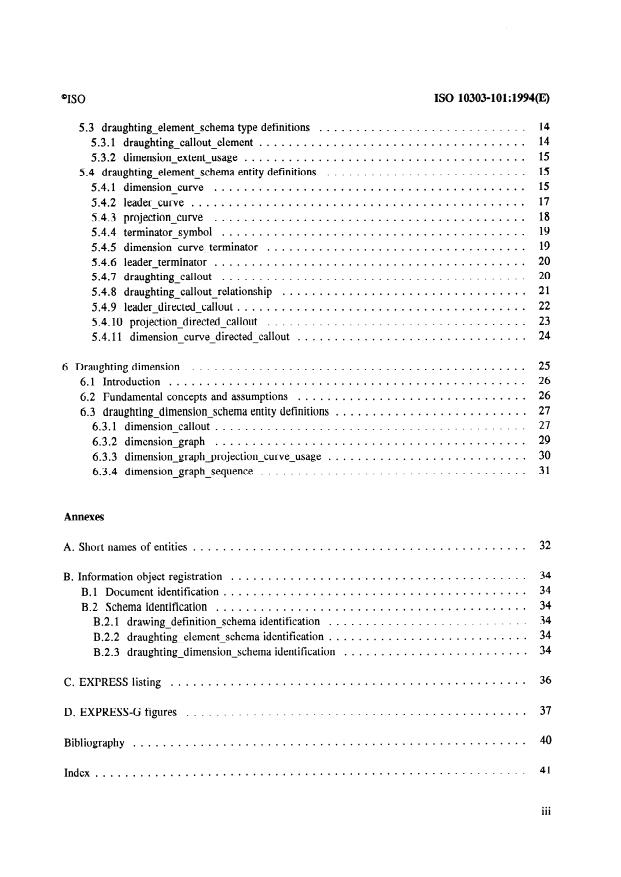
5.3 draughting element Schema type definitions . . . . . . . . . . . . . . . . . . . . . . . . . . . .
5.3.1 draughting callkt element . . . . . . . . . . . . . . . . . . . . . . . . . . . . . . . . . . . .
5.3.2 dimension extent isage . . . . . . . . . . . . . . . . . . . . . . . . . . . . . . . . . . . . . .
element Schema entity definitions . . . . . . . . . . . . . . . . . . . . . . . . . . .
5.4 draughting
-
5.4.1 dimension cu; . . . . . . . . . . . . . . . . . . . . . . . . . . . . . . . . . . . . . . . . . .
-
5.4.2 leader curve . . . . . . . . . . . . . . . . . . . . . . . . . . . . . . . . . . . . . . . . . . . . .
-
5.4.3 projection cuTve . . . . . . . . . . . . . . . . . . . . . . . . . . . . . . . . . . . . . . . . . .
5.4.4 terminator-Symbol
54.5 dirnension-cu~eterminator ’:::::::::::::::::::::::::::::::::::
5.4.6 leader terminator . . . . . . . . . . . . . . . . . . . . . . . . . . . . . . . . . . . . . . . . . .
5.4.7 draughting callout . . . . . . . . . . . . . . . . . . . . . . . . . . . . . . . . . . . . . . . . .
5.4.8 draughting-callout relationship . . . . . . . . . . . . . . . . . . . . . . . . . . . . . . . . .
5.4.9 leader directed caiout . . . . . . . . . . . . . . . . . . . . . . . . . . . . . . . . . . . . . . .
5.4.10 projection dirkted callout
5.4.11 dimension-curvedirectedcallo;t ’:::::::::::::::::::::::::::::::
-
- -
6 Draughting dimension . . . . . . . . . . . . . . . . . . . . . . . . . . . . . . . . . . . . . . . . . . . . .
6.1 Introduction . . . . . . . . . . . . . . . . . . . . . . . . . . . . . . . . . . . . . . . . . . . . . . . .
6.2 Fundamental concepts and assumptions . . . . . . . . . . . . . . . . . . . . . . . . . . . . . . .
6.3 draughting dimension Schema entity definitions . . . . . . . . . . . . . . . . . . . . . . . . . .
-
-
6.3.1 dimension callout . . . . . . . . . . . . . . . . . . . . . . . . . . . . . . . . . . . . . . . . . .
6.3.2 dimension-graph . . . . . . . . . . . . . . . . . . . . . . . . . . . . . . . . . . . . . . . . . .
6.3.3 dimensiongraphqrojection curve usage . . . . . . . . . . . . . . . . . . . . . . . . . . .
6.3.4 dimension-graph sequence y . . . T. . . . . . . . . . . . . . . . . . . . . . . . . . . . . . .
- -
Annexes
. . . . . 32
A. Short names of entities . . . . . . . . . . . . . . . . . . . . . . . . . . . . . . . . . . . . . . . .
. . . . . 34
...................................
B. Information Object registration
. . . . . 34
....................................
B.l Document identification
. . . . .
.....................................
B.2 Schema identification
. . . . . 34
.............
B.2.1 drawing definition Schema identification . . . . . . . . .
- -
. . . . . 34
.............
B.2.2 draughting element Schema identification . . . . . . . . .
-
-
. . . . . 34
.............
B.2.3 draughting dimension Schema identification . . . . . . .
- -
. . . . . . . . . . . . . . . . .
C. EXPRESS listing . . . . . . . . . . . . . . . . . . . . . . . . . . . . . .
. . . . . 37
,.* . . . . . . . . .
D. EXPRESS-G figures . . . . . . . . . . . . . . . . . . . . . . . . . . . .
. . . . . 40
. . . . . . . . . . . .
Bibliography . . . . . . . . . . . . . . . . . . . . . . . . . . . . . . . . . . .
. . . . .
. . . . . . . . . . . .
Index . . . . . . . . . . . . . . . . . . . . . . . . . . . . . . . . . . . . . . . .
. . .
OISO
ISO 10303=101:1994(E)
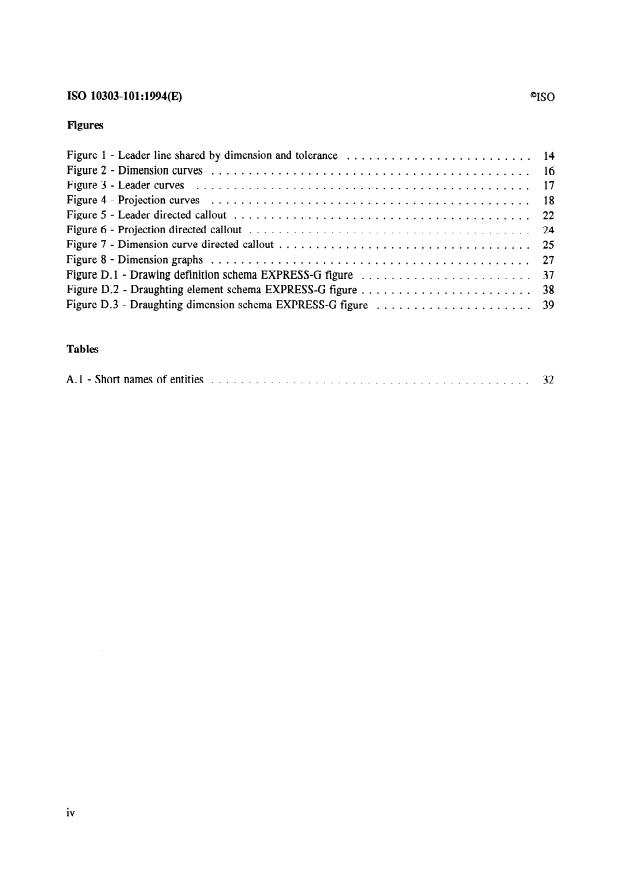
Figures
Figure 1 - Leader line shared by dimension and tolerante . 14
Figure 2 - Dimension curves 16
...........................................
Figure 3 - Leader curves .
Figure 4 - Projection curves .
Figure 5 - Leader directed callout 22
........................................
Figure 6 - Projection directed callout 24
......................................
Figure 7 - Dimension curve directed callout .
Figure 8 - Dimension graphs . 27
....................... 37
Figure D. 1 - Drawing definition Schema EXPRESS-G figure
Figure D.2 - Draughting element Schema EXPRESS-G figure .
Figure D.3 - Draughting dimension Schema EXPRESS-G figure . 39
Tables
A.l-Shortnamesofentities . . . . . . . . . . . . . . . . . . . . . . . . . . . . . . . . . . . . . . . . . . .
iv
ISO 10303=101:1994(E)
@ISO
Foreword
The International Organization for Standardization (ISO) is a worldwide federation of national Standards
The work of preparing International Standards is normally carried out
bodies (ISO member bodies).
through ISO technical committees. Esch member body interested in a subject for which a technical
committee has been established has the right to be represented on that committee. International
organizations, governmental and non-governmental, in liaison with ISO, also take part in the work. ISO
collaborates closely with the International Electrotechnical Commission (IEC) on all matters of
electrotechnical standardization.
Draft International Standards adopted by technical committees are circulated to the member bodies for
voting. Publication as an International Standard requires approval by at least 75% of the member bodies
casting a vote.
International Standard ISO 10303-101 was prepared by Technical Committee ISO/TC 184, Mustrial
automation systems and integration, Subcommittee SC4, Industrial data and global manufacturing
languages.
ISO 10303 consists of the following Parts under the general title Mustrial automation Systems and
integration - Product data representation and exchange:
- Part 1, Overview and fundamental principles;
- Part 11, Description methods: The EXPRESS language reference manual;
- Part 21, Implementation methods: Clear text encoding of the exchange structure;
Standard data access interface;
- Part 22, Implementation methods:
- Part 31, Conformance testing methodo ogy and framework: General concepts;
ogy and framework: Requirements on testing
- Part 32, Conformance testing methodo
laboratories and clients;
- Part 41, Integrated generic resources: Fundamentals of product description and support;
Geometrie and topological representation;
- Part 42, Integrated generic resources:
- Part 43, Integrated generic resources: Representation structures;
- Part 44, Integrated generic resources: Product structure configuration;
- Part 45, Integrated generic resources: Materials;
V
ISO 10303=101:1994(E) OISO
- Part 46, Integrated generic resources: Visual presentation;
- Part 47, Integrated generic resources: Shape Variation tolerantes;
- Part 49, Integrated generic resources: Process structure and properties;
- Part 101, Integrated application resources: Draughting;
- Part 104, Integrated application resources: Finite element analysis;
- Part 105, Integrated application resources: Kinematics;
- Part 201, Application protocol : Explicit draughting;
- Part 202, Application protocol: Associative draughting;
- Part 203, Application protocol: Configuration controlled design;
Sheet metal die planning and design;
- Part 207, Application protocol:
Printed circuit assembly product design data;
- Part 2 10, Application protocol:
Numerital control process Plans for machined Parts.
- Part 213, Application protocol:
The structure of this International Standard is described in ISO 10303-1. The numbering sf the Parts of
this International Standard reflects its structure:
- Part 11 specifies the description method;
- Parts 2 and 22 specify the implementation methods;
- Parts 3 and 32 specify the conformance testing methodology and framework;
- Parts 4 to 49 specify the integrated generic resources;
- Parts 101 to 105 specify the integrated application resources;
- Parts 201 to 2 13 specify the application protocols.
Should further Parts be published, they will follow the Same numbering Pattern.
Annexes A and B form an integral part of this part of ISO 10303. Annexes C, D, and E are for
information only.
OISO ISO 10303~101:1994(E)
Diskette
Users should note that this part of ISO 10303 comprises a diskette:
- the short names of entities given in annex A are also included on the diskette;
- the EXPRESS listings (annex C) are provided on the diskette only;
- a method to enable users to report errors in the documentation is given. Full detai s arc
provided in the file.
vii
ISO 10303=101:1994(E)
OISO
Introduction
ISO 10303 is an International Standard for the computer-interpretable representation and exchange of
product data. The objective is to provide a neutral mechanism capable of describing product data
throughout the life cycle of a product independent from any particular System.
The nature of this
description makes it suitable not only for neutral file exchange, but also as a basis for implementing and
sharing product databases and archiving.
This International Standard is organized as a series of Parts, each published separately. The Parts of ISO
10303 fall into one of the following series: description methods, integrated resources, application
protocols, abstract test suites, implementation methods, and conformance testing.
The series are
described in ISO 10303-1. This part of ISO 10303 is a member of the integrated resources series. Major
subdivisions of this part of the International Standard are:
- drawing definition which specifies the resources necessary for the identification, description,
organization, and administration of drawing and drawing sheet Versions;
- draughting element which specifies the resources representing basic draughting elements such as
dimension lines, projection lines, leader Iines and the use of these resources in combination with other
annotation curves, Symbols, and text to depict information found on the drawing sheet;
- draughting dimension which specifies the resources necessary for the use of basic draughting
elements, in combination with other annotation curves, Symbols, and text, to depict dimensions,
tolerantes, and dimension-related information on a drawing sheet.
The objective of this part is the system-independent representation of digital CAD data resulting from the
application of draughting practices in the drawing depiction of product definition data. This part provides
for the representation of draughting information not provided for in other integrated resource Parts of ISO
10303. Where necessary, it provides the draughting semantic extension to information represented in
those Parts.
Requirements and practices regarding the draughting-specific use, appearance, and specific aggregation
of curves, Symbols, and text are specified in draughting-practices Standards regarding technical drawings,
such as those compiled in ISO Standards Handbook 12.
. . .
Vlll
INTERNATIONAL STANDARD @ISO ISO 10303-101: 1994(E)
Industrial automation Systems and integration -
Product data representation and exchange -
Part 101:
Integrated application resources: Draughting
1 Scope
This part of ISO 10303 specifies the resource constructs for the representation of draughting information.
The following are within the scope of this part of ISO 10303:
- information regarding the definition, description, and administration of a drawing and the sheets
of a drawing;
- elementary draughting annotations and their aggregation with more general annotations for the
depiction of facts and requirements concerning the product or interpretation of a drawing;
- draughting annotations used in the depiction of dimensions, tolerantes, and related dimension-
measurement information.
The following are outside the scope of this part of ISO 10303:
- management information such as changes that create drawing Versions, approvals, contracts under
which draughting work is done, security classification, persons responsible, and the roles of
responsibility of these persons, provided in ISO 10303-41;
- views and the viewing mechanism for depiction of the shape, provided in ISO 1030346;
- styled generic annotations (i.e., curves, Symbols, text and sectioning (crosshatching)), provided in
ISO 10303-46;
- coordinate Systems for the location of annotations, and their relationships, provided in ISO 10303-
42 and ISO 10303-43.
2 Normative references
The following Standards contain provisions which, through reference in this text, constitute provisions
of this part of ISO 10303. At the time of publication, the editions indicated were valid. All Standards
are subject to revision, and Parties to agreements based on this part of ISO 10303 are encouraged to
OISO
ISO 10303=101:1994(E)
Members
investigate the possibility of applying the most recent editions of the Standards indicated below.
of IEC and ISO maintain registers of currently valid International Standards.
Vocabulary - Part 1: Terms relating to technical
ISO 10209- 1: 1992, Technical product documentation -
drawings: general and types of drawing.
Product data representation and
ISO 10303- 1: 1994, Industrial automation systems and integration -
exchange - Part 1: Overview andjundamental principles.
Product data representation and
ISO 10303-11: 1994, Mustrial automation Systems and integration -
exchange - Part 11: Description methods: The EXPRESS language reference manual.
Product data representation and
ISO 10303-4 1: 1994, Mustrial automation systems and integration -
exchange - Part 41: Integrated generic resources: Fundamentals of product description and support.
Product data representation and
ISO 10303-46: 1994, Mustrial automation systems and integration -
exchange - Part 46: Integrated generic resources: Visual presentation.
J , Information Technology - Open Systems Interconnection - Abstract Syntax Notation
ISO/IEC 8824-1:
One (ASN. 1) - Part 1: Spectjkation of Basic Notation.
3 Definitions
3,l Terms defined in ISO 103034
This part makes use of the following terms defined in ISO 10303-1.
icatio
- aPPl n;
- application protocol;
resource;
- appl ication
- data;
- formal;
- generic resource;
- information;
‘) To be published.
@ISO
ISO 10303=101:1994(E)
- integrated resource;
- product;
- product data;
- resource construct.
3.2 Terms defined in ISO 10303-42
This part makes use of the following term defined in ISO 1030342.
- curve.
3.3 Terms defined in ISO 10303-46
This part makes use of the following terms defined in ISO 10303-46.
- annotation;
- presentation.
3.4 Terms defined in ISO 10209-1
This part makes use of the following term defined in ISO 10209-1:
- drawing;
- technical drawing.
3.5 Other definitions
For the purposes of this part of ISO 10303, the following definitions apply:
3.5.1 callout: A depiction of requirements and information about a product.
3.5.2 draughting; drafting: An activity of selecting and configuring appropriate representations of
human-interpretable presentation in the
product data for the form of a drawing.
3.5.3 drawing sheet: A subdivision of a drawing having the Same identifier as the drawing and its own
sheet number . A drawing sheet may contain part or all of the text or pictorial presentations of the
drawing.
ISO 10303~101:1994(E) OISO
4 Drawing definition
The following EXPRESS declaration begins the drawing definition Schema and identifies the necessary
- -
external references.
EXPRESS specification:
*
SCHEMA drawing definition Schema;
-
REFERENCE FROM support resource Schema
- -
(label,
text,
identifier,
bag to Set);
- -
REFERENCE FROM representation Schema
-
(mapped item,
-
representation-relationship,
representation);
REFERENCE FROM presentation Organkation Schema
-
(area in set,
- -
presentation area,
presentation set,
-
presentation representation relationship);
- -
*
(
NOTE - The Schemas referenced above tan be found in the following Parts of ISO 10303:
ISO 10303-41
support-resource Schema
-
ISO 10303-43
representation Schema
-
ISO 10303-46
presentation Organkation Schema
- -
4.1 Introduction
drawing definition Schema is the identification, description, organization, and
The subject of the
-
It-identifies drawing revisions and drawing sheet revisions that
administration of drawing revisions.
It describes the relationship between revisions of drawings and sheets. In short,
comprise a drawing.
this Schema provides resources for the definition and management of the drawing.
NOTE - An EXPRESS-G diagram for this Schema appears in annex D.
OISO
ISO 103030101:1994(E)
4.2 Fundamental concepts and assumptions
A drawing is a draughting-specific presentation of information about a product including information used
to interpret the presentation. A drawing tan be partitioned or divided into a number of drawing sheets.
Drawings are configured and administered by Versions. Esch drawing, including its drawing sheets, may
have many Versions. Versions of drawings and drawing sheets are known as revisions. A drawing is
a revision whether it be initial or the result of Change. If any drawing sheet is added, changed, or
deleted, a new revision of the drawing may be established. The ability to identify and describe a drawing
revision is provided, independently of organizational practices.
A revised drawing or drawing sheet is considered a successor of the original drawing or drawing sheet.
The revisions of a drawing or drawing sheet may be sequentially ordered.
Drawing and drawing sheet revisions may have a draughting-specific title or description.
A draughting
title may Change for subsequent revisions of the drawing or drawing sheet.
4.3
drawing definition Schema type definition: draughting titled item
- - - -
A selection of items which may be given a draughting-specific title.
EXPRESS specification:
*
TYPE draughting titled item = SELECT
-
(drawing revision,
drawing sheet revision);
- -
END TYPE;
-
*
(
4.4 drawing definition Schema entity definitions
- -
4.4.1 drawing definition
-
A drawing definition identifies and categorizes, by type, a set of drawing Versions.
NOTE - When the need for a drawing is identified, a drawing definition begins its existente when the
Organkation assigns a drawing number.
EXPRESS specification:
*
)
ENTITY drawing definition;
-
drawing number : identifier;
drawing type : OPTIONAL label;
END ENTITY;
*
(
ISO 10303~101:1994(E) OISO
Attribute definitions:
drawing number: An identifier for the Versions of a drawing.
-
NOTE l- Drawing numbers themselves are often composed of Parts such as: a type prefix, a part
number Stern), and a suffix. Its composition is provided by the originating organization.
Nr
EXAMPLE 1 - “CK123456-789 ”, “DL-S12345 ”, ” lB5 102-04 ”) and ” lD555OO” are examples of drawing
number strings.
drawing type: A label used to describe the functional categorization of the drawing.
-
NOTE 2 - A type of drawing is used to communicate a specific Portion of the information about a
product. For a printed wiring assembly, the functional aspects are communicated by means of a schematic
diagram whereas the physical aspects are communicated by means of another drawing type.
EXAMPLE 2 - “SCHEMATIC DIAGRAM ”, “SITE PLAN ”, “DETAIL ”, and “ASSEMBLY (( are examples
of drawing-type labels. Additional examples for drawing-type labels may be found in clause 3 of ISO 10209-
1.
4.4.2 drawing revision
-
A drawing revision is a Version of a drawing, resulting from creation or Change.
EXPRESS sDecification:
*
ENTITY drawing revision
SUBTYPE OF (presentation-Set);
revision identifier : identifier;
-
drawing identifier : drawing definition;
-
-
intended scale : OPTIONAL text;
-
UNIQUE
URl: revision identifier, drawing identifier;
- -
END ENTITY;
*
(
Attribute definitions:
revision identifier: An identifier for the revision of the drawing.
-
Any limit or
NOTE - The values for this representation may be compriserl of any allowable characters.
restrictions must be specified in an Application Protocol. Typically the revision identifier is an alphanumeric
string.
QIso ISO 10303=101:1994(E)
EXAMPLE 3 - The revision identifier may be “An, “AA ”, “2.4 ”, or could be “3 1 ”.
drawing identifier: An identifier for the drawing.
-
intended scale: A text description of the intended drawing scale where the description is for information
-
only.
EXAMPLE 4 - “1/4 ”, “lOO:l ”, “NONE” are drawing scale examples.
Formal propositions:
URl: The identifier for a Version of a drawing shall he unique for that drawing.
EXAMPLE 5 - A drawing revision identified by the letter “A” is the only drawing revision identifkd by
that letter in the set of revisions of a particular drawing.
4.4.3 drawing revision sequence
- -
A drawing revision sequence is the successive relationship of one Version to another for the Same
drawing.
EXAMPLE 6 - If two drawing revisions were identified by revision identifiers equal to A and B successively,
identified by A would play the role of predecessor and the drawing revision identifkd
the drawing revision
by B would play the role of successor in the sequence of drawing revisions.
EXPRESS specification:
*
)
ENTITY drawing revision sequence;
- -
predecessor : drawing revision;
-
successor : drawing revision;
-
WHERE
WRl: predecessor :<>: successor;
END ENTITY;
-
*
(
Attribute definitions:
predecessor: A Version of a drawing which precedes another version of a drawing.
A Version of a drawing which succeeds another Version of a drawing.
successor:
NOTE - A drawing version (i.e., drawing revision) may precede or succeed another version of the same
-
not identifkd by the same drawingdefinition) in a logical
drawing or a version of a different drawing (i.e.,
sequence of drawings .
ISO 10303~101:1994(E)
Formal propositions:
WRl: A particular revision of a drawing shall not precede nor succeed itself.
4.4.4 drawing sheet revision
-
-
A drawing sheet revision is a Version of a drawing sheet. It may either be an initial Version or a
modification of a previous Version.
NOTE 1 - As a type of area in set, the drawing sheet revision provides the information necessary to
- - - -
present a version of a drawing sheet. It also specifies the administrative data used to manage a version of
a drawing sheet, with respect to the drawing revision.
EXPRESS specification:
*
ENTITY drawing sheet revision
- -
SUBTYPE OF (presentation area);
-
revision identifier : identifier;
-
WHERE
WRl: SIZEOF( QUERY(item <
* SELF\representation.items 1
('REPRESENTATION SCHEMA.MAPPED ITEM' IN (TYPEOF(item)))
-
AND
('DRAWING DEFINITION SCHEMA.DRAWING SHEET REVISION' IN
(TYPEOF(item\mapped Ttem.mapping source.mapped representation)))))=O;
- - -
END ENTITY;
*
(
Attribute definitions:
revision identifier: Identifier for the revision of a drawing sheet.
-
Formal propositions:
sheet revision shall not have another drawing sheet revision mapped into it.
WRl: A drawing
- - - -
NOTE 2 - For requirements regarding the mapped item see of ISO 10303-43.
-
4.4.5 drawing sheet revision sequence
- - -
A drawing sheet revision sequence is an association between two drawing sheet revisions that specifies
one as the successor of the other.
OISO
EXAMPLE 7 - An instance of drawing sheet revision sequence where rep 1 is an instance of
- - - -
with a revision-identifier of “A” and rep-2 is an instance of
drawing sheet revision
-
drawing sheet revision with a revision identifier of “B” represents the successive relationship between the
- - -
predecessor (revision ” A ”) and successor (revision “B “).
EXPRESS sPecification:
*
ENTITY drawing sheet revision sequence
-
-
SUBTYPE OF (representation relationship);
WHERE
WRl: SELF\representation-relationship.rep-1 :<>:
SELF\representation-relationshipxep-2;
wR2: 'DRAWING DEFINITION SCHEMA.DRAWING SHEET REVISION
- -
-
IN TYPEOF (SELF\representation_relationship.rep-1
WR3: 'DRAWING DEFINITION SCHEMA.DRAWING SHEET REVISION
- -
IN TYPEOF (SELF\representation_relationship.rep-2
END ENTITY;
-
*
(
Attribute definitions:
1: The drawing sheet revision that is the predecessor in the
SELArepresentation relationship.rep
- - - -
drawing sheet revision sequence.
- - -
SELF\representation relationship.rep 2: Tbc drawing sheet revision that is the successor in the
- - - -
sequence.
drawing sheet revision
- - -
Formal proDositions:
sheet revisions that are related shall be different instances.
WRl: Tbc drawing
- -
sheet revision.
WR2: rep 1 shall be a drawing
- - -
2 shall be a drawing sheet revision.
WR3: rep
- -
-
4.4.6 drawing sheet revision usage
- - -
revision
sheet revision usage entity relates a drawing sheet revision with a drawing
The drawing -
- -
- - -
sheet revision may be used in more than
and assigns a sheet number for this usage, where a drawing
- -
one drawing revision.
EXPRESS specification:
*
ENTITY drawin ,g sheet revis i on u sage
-
SUBTYPE OF (area-in-Set)
;
sheet number : identifier;
-
UNIQUE
URI: sheet number, in set;
-
WHERE
WRl: 'DRAWING DEFINITION SCHEMA.DRAWING SHEET REVISION' IN TYPEOF
(SELF\area in set.kea)AND'DRAWING DEFIkTION SCHEMA.DRAWING REVISION'
- - - - -
IN TYPEOF (SELF\area in set.in Set);
- - -
END ENTITY;
-
*
(
Attribute definitions:
sheet number: An identifier indicating the Position of a drawing sheet in a sequence of drawing sheets
-
which are part of a drawing.
NOTE - Drawing sheets are not restricted to being numbered contiguously. Sheet numbering is business
practice specific.
EXAMPLE 8 - Sheets numbered 1,2,4,5. where sheet 3 has been deleted is an example of a valid set of
drawing sheet numbers for a drawing revision.
SELAarea in set.area: The drawing sheet revision being used in a set of drawing sheet revisions for
- -
a particular drawing revision.
SELF\area in set.in set: The drawing revision in which a particular drawing sheet revision is used.
- - -
Formal propositions:
URl: No drawing revision shall have two drawing sheet revisions identified by the Same sheet
- - -
number .
WRl: Only drawing sheet revisions shall be used as a numbered sheet of a drawing revision and only
sheet revisions as a numbered sheet. -
drawing revisions shall us; drawing
- -
-
4.4.7 draughting title
-
It is draughting application-
A draughting title is brief text describing the contents of the drawing or drawing sheet.
specific, language-dependent, and may be applicable to more than one drawing or drawing sheet.
ISO 103039101:1994(E)
OISO
EXAMPLE 9 - A drawing containing the mechanical compatibility information for a safety switching device
may be given a text description such as “MECHANICAL COMPATIBILITY, SAFETY SWITCH ”, where
the language is English.
EXPRESS specification:
*
ENTITY draughting title;
items : SET [l:?] OF draughting titled item;
-
language : label;
contents : text;
END ENTITY;
*
(
Attribute definitions:
items: The drawing sheets or revisions to which the title applies.
language: A label indicating the language used for terms in the contents of the draughting title.
-
NOTE - The language label should be comprised of characters indicating the name of the language, such as
those specified in table 1 of ISO 639: 1988.
contents: The text of the title.
EXAMPLE 10 - “BRACKET - CABLE, ASSY OF” and “DISK - LPC, 4 STG” are examples of titles.
4.5 drawing definition Schema rule definition: drawing sheets not nested
- - - - -
sheet revision
This rule ensures that a drawing sh& revision shall not be related to another drawing
.- - - -
by transformation.
EXPRESS Specification:
*
I
(presentation representation relationship);
RULE drawing sheets not nested FOR
- - -
- -
WHERE
presentation representation relationship i
WRl: SIZEOF( QUERY(p-r-r <*
('DRAWING DEFINITION SCHEMA.DRAWI& SHEET REVISI&'
- - -
-
IN
(TYPEOF(p r r.rep 1))) AND
--
('DRAWING DEFINITION SCHEMA.DRAWING SHEET REVISION'
- -
- -
IN (TYPEOF( p r r.rep 2))))) = 0;
-e -
END RULE;
-
*
(
ISO 10303=101:1994(E) OISO
Formal ProDositions:
WRl: A drawing sheet revision shall not play the role of parent representation in a presentation -
-
- -
where the Child representation is also a drawing sheet revision.
representation relationship
- -
-
NOTE - For requirements regarding the presentation representation relationship, see ISO 10303-46.
- -
*
END SCHEMA; -- drawing definition Schema
-
*
(
5 Draughting element
element Schema and identifies the necessary
The following EXPRESS declaration begins the draughting
- -
external references.
EXPRESS Sr>ecification:
*
SCHEMA draughting element Schema;
-
-
REFERENCE FROM geometry-Schema (geometrie-representation-item);
REFERENCE FROM support resource Schema
- -
(label,
text);
REFERENCE FROM presentation definition Schema
- -
(annotation occurrence,
annotation curve occurrence,
- -
annotation text occurrence,
-
-
annotation-symbol-occurrence);
*
(
NOTE - The schemas referenced above tan be found in the following Parts of ISO 10303:
ISO 10303-42
geometry Schema
-
ISO 10303-41
support-resource-Schema
ISO 10303-46
presentation defini tion Schema
- -
@ISO ISO 10303=101:1994(E)
5.1 Introduction
The subjects of the draughting element Schema are the basic draughting elements used on drawings to
- -
convey information about the product being depicted. Text using draughting-specific fonts and Character
Sets is used to convey product and product-processing requirements and to make references to other
requirements documents. Curves with draughting-specific thicknesses (widths) and dash Patterns are used
to clarify the depiction of a product shape. Images of the shape are annotated with curves representing
feature centres, path of motion, and location of cutting planes. The draughting activity also uses many
Symbols to convey requirements for characteristics such as surface texture and welds. These draughting
curves, text, and Symbols are often combined to form a complete presentation of a requirement and are
referred to as a draughting callout.
Draughting often applies a requirement to a specific area of the depicted product shape. In such instances
other draughting curves, such as leader lines, projection lines, and dimension lines, are used to direct the
requirement to the place of application.
This Schema specifies the basic draughting elements and their combinations used to annotate the depicted
product shape and convey information regarding interpretation of the drawing.
NOTE - EXPRESS-G diagrams for this Schema appear in annex D.
5.2 Fundamental concepts and assumptions
The draughting activity, regardless of the engineering discipline, specializes generic annotation curves,
Symbols, and text. The specialization of annotation curves is based on the need to identify certain curves
according to existing draughting Standards. Further, the specialization makes it possible to assign curve
presentation styles according to those Same Standards. The specialization of generic annotation text is
based on the draughting need to specify draughting-specific fonts and Character Sets. The specialization
of generic annotation Symbols is based on the need for draughting Symbols to be comprised of draughting-
specific curves and text-
The three most common draughting-specific annotation curves are the dimension line, leader line, and
projection line (also known as an extension line or witness line). These draughting annotation curves are
A leader line referring to a feature on a drawing, such as a
not limited to their stated geometric type.
dimension, Object, or outline, is really a series of one-to-many curve Segments, not necessarily line
Segments. This fact is also true of the projection line and dimension line.
Dimension lines, leader lines, and projection lines tan be shared by more than one callout.
EXAMPLE i 1 - A Single instance of a leader line tan be used to direct (refer) a callout, containing a
dimension value and tolerante, while also directing a second callout, containing a geometric tolerante of
location, to the same feature of size (see Figure 1).
Dimension lines and leader lines cannot exist independently of a callout. Only the projection line tan
exist independently (without directing a callout).
ISO 103030101:1994(E) OISO
A callout directed by means of both a leader line and a projection line is both a leader-directed callout
and a projection-directed callout.
5.00 2 0.05
f
.
0.20 A B C
@.f
Figure 1 - Leader line shared by dimension and tolerante
A terminator Symbol (e.g., arrowhead) is another concept of existing draughting-practices Standards. A
terminator Symbol may be used to terminate a leader line, or it may be used to show the extent of the
dimension and the direction of measurement when placed along a dimension line. Although referred to
as an arrow or arrowhead, some draughting practices Standards specify other Symbols, such as a dot, box,
or slash to terminate a leader line or indicate a dimension extent. Therefore, this concept has been
generalized as a terminator Symbol.
A draughting callout is a collection of draughting- or presentation-specific annotation curves, text, and
Symbols depicting information or requirements about the product or drawing itself. This part of ISO
10303 supports callouts which may contain text, Symbols, or curves that are directed to a feature (a place
on a drawing) by a Ieader line, a projection line, a dimension line, or a combination of these. A callout
whose text, Symbols, or curves are directed by means of both a leader line and a projection line is both
a leader-directed callout and a projection callout.
Draughting Application Protocols may further specialize resources found in this Schema or in ISO 10303-
46 to obtain draughting concepts not explicitly provided.
5.3 element Schema type definitions
draughting
- -
5.3.1 draughting callout element
- -
A draughting callout element is either draughting text, Symbols, or curves which are a part of a
draughting callout.
ISO 10303=101:1994(E)
@ISO
EXPRESS specification:
*
TYPE draughting callout element = SELECT
-
(annotation text occurrence,
annotation Symbol occurrence,
-
annotation-curve-occurrence);
END TYPE;
*
(
5.3.2 dimension extent usage
- -
The dimension extent usage establishes the logical location of terminator Symbols on the dimension line.
The logical location is defined by an origin and a target.
EXPRESS specification:
*
)
TYPE dimension extent-usage = ENUMERATION OF
-
(origin,
target);
END TYPE;
-
*
(
Enumerated item definitions:
origin: The beginning of the dimension.
target: The end of the dimension.
5.4 draughting element Schema entity definitions
- -
5.4.1 dimension curve
-
A dimension curve is a draughting annotation curve with a draughting-specific appearance that, with
The dimension curve
related terminator Symbols, presents the direction and extent of a measurement.
is also used to direct the presentation of dimension-related information to the presentation of the
appl icable feature or features.
A dimension curve is used in a dimension curve directed callout to direct the other elements of the
- - -
-
callout to the presentation of the dimensioned feature or features.
NOTE 1 - Various forms of the dimension curve, also known as a dimension line, with their related
Dimension curves are combined with other draughting annotation
terminator Symbols are shown in Figure 2.
OISO
ISO 10303=101:1994(E)
and Symbols to form dimension curve directed callouts and
curves (e.g., extension lines), text,
- - -
dimension graphs according to 5.4.11 and 6.3.2.
-
Figure 2 - Dimension curves
NOTE 2 - Although the dimension curve is generally thin and continuous in nature, it may be broken for
the insertion of the dimension text and Symbols, making the dimension curve appear as two leader lines.
A break in the dimension curve is possible through use of resources provided by ISO 10303-46.
EXPRESS sPecification:
*
ENTITY dimension curve
-
SUBTYPE OF (annotation-curve_occurrence);
WHERE
WRl: SIZEOF( USEDIN( SELF, 'DRAUGHTING-ELEMENT-SCHEMA.'+
'DIMENSION CURVE TERMINATOR.ANNOTATED DIMENSION '+
- - - -
'CURVE')) <= 2;
WR2: SIZEOF(USEDIN(SELF, 'DRAUGHTING ELEMENT SCHEMA.'+
- -
'DIMENSION CURVE DIRECTED CALLOUT.CONTENTS')) >= 1;
- - -
WR3: (SIZEOF(QUERY(dct 1 <* USEDIN(SELF,'DRAUGHTING ELEMENT '+
- -
-
'SCHEMA DIMENSION CURVE TERMINATOR.ANNOTATED DIMENSION '+
- - - -
'CURVE' ( (dct l.role = origin))) <=l) AND
(SIZEOF QUERY(dct 2 <* USEDIN(SELF,'DRAUGHTING ELEMENT '+
-
- -
'SCHEMA DIMENSION CURVE TERMINATOR.ANNOTATED DIMENSION '+
- -
- -
f (dct 2.role = target))) <=l);
'CURVE'
-
END ENTITY;
-
*
(
Formal propositions:
Symbols annotating a dimension curve.
WRl: There may be Zero, one, or two terminator
-
WR2: A dimension-curve shall he used by at least one referencing dimension curve directed callout.
- - -
Curves
NOTE 3 - A dimension curve is used to direct information to the dimensioned feature or features.
-
which do not meet this requirement should be treated as annotation curves with referencing terminator
Symbols.
@ISO ISO 10303=101:1994(E)
WR3: A dimension curve shall not be annotated with more than one terminator Symbol indicating the
origin of a dimension extent, nor shall a dimension curve be annotated with more than one terminator
Symbol indicating the target of a dimension extent.
5.4.2 leader curve
-
A leader curve is a draughting annotation curve which directs the eye of the reader from presented
requirements or information to an intended place on the drawing. A leader curve itselfmay be annotated
with a terminator Symbol, such as an arrow, to indicate the Point of interest.
A leader curve is used in a leader directed callout to direct the other elements of the callout to an
- -
-
intended place or Point of interest on a drawing.
NOTE 1 - Generally, a leader curve, also known as a leader line, is a continuous thin Single or multiple
Segment curve with a terminator Symbol at one end, indicating the place of interest. Various forms of the
leader curve are shown in Figure 3. Style requirements are specified in other international and national
draughting practices Standards.
Figure 3 - Leader curves
EXPRESS sPecification:
*
ENTITY leader curve
SUBTYPE OF (annotation-curve-occurrence);
WHERE
WR1: SIZEOF( USEDIN( SELF, 'DRAUGHTING ELEMENT SCHEMA.'+
- -
'LEADER DIRECTED CALLOUT.CONTENTS')) >= 1;
-
END ENTITY;
*
(
Formal T>ronositions:
WRl: A leader curve shall be used by at least one referencing leader directed callout.
- -
-
ISO 10303=101:1994(E) @ISO
NOTE 2 - A leader curve always directs other information contained within a draughting callout to a place
- -
on a drawing. Curves which do not meet this requirement should be treated as annotation curves with a
referencing terminator Symbol.
5.4.3 projection curve
-
A projection curve is a draughting annotation curve which is the result of projecting a Point, curve, or
surface from an image of the product shape, to a Point outside that image.
NOTE 1 - A projection curve, also known as projection line,. extension line, or witness line, generally has
a presentation style which is thin and continuous. To accommodate various draughting practices, no
restriction on presentation style has been made.provides an example of the use of two projection curves.
Figure 4 - Projection curves
NOTE 2 - Figure 4 provides two examples of projection curves. Both proje
...
Questions, Comments and Discussion
Ask us and Technical Secretary will try to provide an answer. You can facilitate discussion about the standard in here.
Loading comments...