


ISO 5436-1:2000
(Main)Geometrical Product Specifications (GPS) — Surface texture: Profile method; Measurement standards — Part 1: Material measures
Geometrical Product Specifications (GPS) — Surface texture: Profile method; Measurement standards — Part 1: Material measures
Spécification géométrique des produits (GPS) — État de surface: Méthode du profil; Étalons — Partie 1: Mesures matérialisées
La présente partie de l'ISO 5436 spécifie les caractéristiques des mesures matérialisées utilisées comme étalons pour l'étalonnage des caractéristiques métrologiques des instruments de mesure d'état de surface par la méthode du profil, comme défini dans l'ISO 3274.
Specifikacija geometrijskih veličin izdelka - Tekstura površine: Profilna metoda; standardi za merjenje - 1. del: Meritve materiala
General Information
- Status
- Published
- Publication Date
- 08-Mar-2000
- Current Stage
- 9092 - International Standard to be revised
- Start Date
- 17-Mar-2025
- Completion Date
- 14-Feb-2026
Relations
- Effective Date
- 12-Feb-2026
- Effective Date
- 12-May-2008
- Revises
ISO 5436:1985 - Calibration specimens — Stylus instruments — Types, calibration and use of specimens - Effective Date
- 15-Apr-2008
Overview
ISO 5436-1:2000 - "Geometrical Product Specifications (GPS) - Surface texture: Profile method; Measurement standards - Part 1: Material measures" specifies the characteristics of material measures (formerly called calibration specimens) used as measurement standards for calibration of instruments that measure surface texture by the profile method. The standard defines design requirements, types of standards (A–E), metrological characteristics and the content of measurement standard certificates. It is a GPS standard intended to support traceable calibration and verification of stylus and profile-based instruments.
Key topics and requirements
- Design requirements
- Material must be hard enough for service life and have a smooth, flat surface so it does not affect evaluation.
- Measurement window must accommodate traversal length needed for calibration.
- Five measurement standard types (A–E) and their purposes:
- Type A - Depth measurement standards (A1: wide grooves with flat bottoms; A2: wide grooves with rounded bottoms) for vertical profile calibration.
- Type B - Tip condition standards (B1, B2, B3) to assess stylus tip condition and sensitivity (e.g., B3 can use fine protruding edges such as uncoated razor blades ~0.1 µm edge width).
- Type C - Spacing measurement standards with repetitive groove waveforms (sinusoidal, triangular, arcuate) to test transmission characteristics across spacings and amplitudes.
- Type D - Roughness measurement standards (D1, D2) for overall instrument calibration using irregular profiles.
- Type E - Profile coordinate standards (E1: precision sphere/hemisphere; E2: precision prism) to calibrate the profile coordinate system.
- Metrological characteristics: Descriptions of parameters (depth, radius, Ra, RSm, apex angles), the basis of assessment per type, and certificate content requirements.
- Normative references: Links to ISO 3274, 4287, 4288, 12085, ISO 5436-2 and uncertainty guidance (GUM, VIM).
Applications and practical value
- Ensures traceable calibration of profilometers, stylus instruments and other profile-based surface texture measurement systems.
- Helps laboratories and manufacturers validate vertical and horizontal profile components, stylus condition, spatial resolution, and overall roughness performance.
- Applicable in quality control, metrology laboratories, instrument manufacturers, and industries with tight surface texture requirements (precision manufacturing, automotive, aerospace, medical devices).
Who should use this standard
- Metrology and calibration laboratories
- Quality and process engineers responsible for surface texture verification
- Instrument manufacturers and service providers producing calibration artifacts
- Standards and compliance teams implementing GPS-based measurement chains
Related standards
- ISO 5436-2 (software measurement standards)
- ISO 3274, ISO 4287, ISO 4288, ISO 12085 (profile method and parameters)
- GUM and VIM for uncertainty and metrology vocabulary
Keywords: ISO 5436-1:2000, surface texture, profile method, measurement standards, material measures, calibration, stylus instruments, profilometer, GPS, roughness.
Buy Documents

ISO 5436-1:2000 - Geometrical Product Specifications (GPS) -- Surface texture: Profile method; Measurement standards
ISO 5436-1:2000 - Spécification géométrique des produits (GPS) -- État de surface: Méthode du profil; Étalons
Get Certified
Connect with accredited certification bodies for this standard

BSMI (Bureau of Standards, Metrology and Inspection)
Taiwan's standards and inspection authority.
Sponsored listings
Frequently Asked Questions
ISO 5436-1:2000 is a standard published by the International Organization for Standardization (ISO). Its full title is "Geometrical Product Specifications (GPS) — Surface texture: Profile method; Measurement standards — Part 1: Material measures". This standard covers: La présente partie de l'ISO 5436 spécifie les caractéristiques des mesures matérialisées utilisées comme étalons pour l'étalonnage des caractéristiques métrologiques des instruments de mesure d'état de surface par la méthode du profil, comme défini dans l'ISO 3274.
La présente partie de l'ISO 5436 spécifie les caractéristiques des mesures matérialisées utilisées comme étalons pour l'étalonnage des caractéristiques métrologiques des instruments de mesure d'état de surface par la méthode du profil, comme défini dans l'ISO 3274.
ISO 5436-1:2000 is classified under the following ICS (International Classification for Standards) categories: 17.040.30 - Measuring instruments. The ICS classification helps identify the subject area and facilitates finding related standards.
ISO 5436-1:2000 has the following relationships with other standards: It is inter standard links to EN ISO 5436-1:2000, SIST ISO 5436:2001, ISO 5436:1985. Understanding these relationships helps ensure you are using the most current and applicable version of the standard.
ISO 5436-1:2000 is available in PDF format for immediate download after purchase. The document can be added to your cart and obtained through the secure checkout process. Digital delivery ensures instant access to the complete standard document.
Standards Content (Sample)
2003-01.Slovenski inštitut za standardizacijo. Razmnoževanje celote ali delov tega standarda ni dovoljeno.Spécification géométrique des produits (GPS) -- État de surface: Méthode du profil; Étalons -- Partie 1: Mesures matérialiséesGeometrical Product Specifications (GPS) -- Surface texture: Profile method; Measurement standards -- Part 1: Material measures17.040.30MerilaMeasuring instrumentsICS:Ta slovenski standard je istoveten z:ISO 5436-1:2000SIST ISO 5436-1:2002en01-julij-2002SIST ISO 5436-1:2002SLOVENSKI
STANDARD
ReferencenumberISO5436-1:2000(E)©ISO2000INTERNATIONALSTANDARDISO5436-1Firstedition2000-03-15GeometricalProductSpecifications(GPS)—Surfacetexture:Profilemethod;Measurementstandards—Part1:MaterialmeasuresSpécificationgéométriquedesproduits(GPS)—Étatdesurface:Méthodeduprofil;Étalons—Partie1:MesuresmatérialiséesSIST ISO 5436-1:2002
ISO5436-1:2000(E)PDFdisclaimerThisPDFfilemaycontainembeddedtypefaces.InaccordancewithAdobe'slicensingpolicy,thisfilemaybeprintedorviewedbutshallnotbeeditedunlessthetypefaceswhichareembeddedarelicensedtoandinstalledonthecomputerperformingtheediting.Indownloadingthisfile,partiesacceptthereintheresponsibilityofnotinfringingAdobe'slicensingpolicy.TheISOCentralSecretariatacceptsnoliabilityinthisarea.AdobeisatrademarkofAdobeSystemsIncorporated.DetailsofthesoftwareproductsusedtocreatethisPDFfilecanbefoundintheGeneralInforelativetothefile;thePDF-creationparameterswereoptimizedforprinting.EverycarehasbeentakentoensurethatthefileissuitableforusebyISOmemberbodies.Intheunlikelyeventthataproblemrelatingtoitisfound,pleaseinformtheCentralSecretariatattheaddressgivenbelow.©ISO2000Allrightsreserved.Unlessotherwisespecified,nopartofthispublicationmaybereproducedorutilizedinanyformorbyanymeans,electronicormechanical,includingphotocopyingandmicrofilm,withoutpermissioninwritingfromeitherISOattheaddressbeloworISO'smemberbodyinthecountryoftherequester.ISOcopyrightofficeCasepostale56CH-1211Geneva20Tel.+41227490111Fax+41227341079E-mailcopyright@iso.chWebwww.iso.chPrintedinSwitzerlandii©ISO2000–AllrightsreservedSIST ISO 5436-1:2002
ISO5436-1:2000(E)©ISO2000–AllrightsreservediiiContentsPage1Scope.12Normativereferences.13Termsanddefinitions.14Designrequirements.24.1Material.24.2Sizeofmeasurementstandard.25Types,purposesandmetrologicalcharacteristicsofmeasurementstandards.25.1General.25.2TypeA—Depthmeasurementstandard.25.3TypeB—Tipconditionmeasurementstandard.35.4TypeC—Spacingmeasurementstandard.35.5TypeD—Roughnessmeasurementstandard.35.6TypeE—Profilecoordinatemeasurementstandard.46Measurementstandardrequirements.46.1TypeA—Depthmeasurementstandard.46.2TypeB—Tipconditionmeasurementstandard.56.3TypeC—Spacingmeasurementstandard.66.4TypeD—Roughnessmeasurementstandard.76.5TypeE—Profilecoordinatemeasurementstandard.87Definitionofthemeasurandsforthemeasurementstandards.97.1TypeA1.97.2TypeA2.107.3TypeB2.107.4TypeB3.107.5TypesC1toC4,andD.117.6TypeE1.117.7TypeE2.118Measurementstandardcertificate.12AnnexA(informative)RelationtotheGPSmatrixmodel.13Bibliography.14SIST ISO 5436-1:2002
ISO5436-1:2000(E)iv©ISO2000–AllrightsreservedForewordISO(theInternationalOrganizationforStandardization)isaworldwidefederationofnationalstandardsbodies(ISOmemberbodies).TheworkofpreparingInternationalStandardsisnormallycarriedoutthroughISOtechnicalcommittees.Eachmemberbodyinterestedinasubjectforwhichatechnicalcommitteehasbeenestablishedhastherighttoberepresentedonthatcommittee.Internationalorganizations,governmentalandnon-governmental,inliaisonwithISO,alsotakepartinthework.ISOcollaboratescloselywiththeInternationalElectrotechnicalCommission(IEC)onallmattersofelectrotechnicalstandardization.InternationalStandardsaredraftedinaccordancewiththerulesgivenintheISO/IECDirectives,Part3.DraftInternationalStandardsadoptedbythetechnicalcommitteesarecirculatedtothememberbodiesforvoting.PublicationasanInternationalStandardrequiresapprovalbyatleast75%ofthememberbodiescastingavote.AttentionisdrawntothepossibilitythatsomeoftheelementsofthispartofISO5436maybethesubjectofpatentrights.ISOshallnotbeheldresponsibleforidentifyinganyorallsuchpatentrights.InternationalStandardISO5436-1waspreparedbyTechnicalCommitteeISO/TC213,Dimensionalandgeometricalproductspecificationsandverification.ThisfirsteditionofISO5436-1,togetherwithISO5436-2,cancelsandreplaces(ISO5436:1985),whichhasbeentechnicallyrevised.ISO5436consistsofthefollowingparts,underthegeneraltitleGeometricalProductSpecifications(GPS)—Surfacetexture:Profilemethod;Measurementstandards:Part1:MaterialmeasuresPart2:SoftwaremeasurementstandardsAnnexAofthispartofISO5436isforinformationonly.SIST ISO 5436-1:2002
ISO5436-1:2000(E)©ISO2000–AllrightsreservedvIntroductionThispartofISO5436isageometricalproductspecification(GPS)standardandistoberegardedasageneralGPSstandard(seeISO/TR14638).Itinfluenceschainlink6ofthechainofstandardsonroughness,wavinessandprimaryprofile.FormoredetailedinformationoftherelationofthispartofISO5436totheGPSmatrixmodel,seeannexA.ThispartofISO5436introducesanewmeasurementstandard,namelyTypeE,tocalibratetheprofileco-ordinatesystem.NOTE"Measurementstandards"wereformerlyreferredtoas"calibrationspecimens".SIST ISO 5436-1:2002
INTERNATIONALSTANDARDISO5436-1:2000(E)©ISO2000–Allrightsreserved1GeometricalProductSpecifications(GPS)—Surfacetexture:Profilemethod;Measurementstandards—Part1:Materialmeasures1ScopeThispartofISO5436specifiesthecharacteristicsofmaterialmeasuresusedasmeasurementstandards(etalons)forthecalibrationofmetrologicalcharacteristicsofinstrumentsforthemeasurementofsurfacetexturebytheprofilemethodasdefinedinISO3274.2NormativereferencesThefollowingnormativedocumentscontainprovisionswhich,throughreferenceinthistext,constituteprovisionsofthispartofISO5436.Fordatedreferences,subsequentamendmentsto,orrevisionsof,anyofthesepublicationsdonotapply.However,partiestoagreementsbasedonthispartofISO5436areencouragedtoinvestigatethepossibilityofapplyingthemostrecenteditionsofthenormativedocumentsindicatedbelow.Forundatedreferences,thelatesteditionofthenormativedocumentreferredtoapplies.MembersofISOandIECmaintainregistersofcurrentlyvalidInternationalStandards.ISO3274:1996,GeometricalProductSpecifications(GPS)—Surfacetexture:Profilemethod—Nominalcharacteristicsofcontact(stylus)instruments.ISO4287:1997,GeometricalProductSpecifications(GPS)—Surfacetexture:Profilemethod—Terms,definitionsandsurfacetextureparameters.ISO4288:1996,GeometricalProductSpecifications(GPS)—Surfacetexture:Profilemethod—Rulesandproceduresfortheassessmentofsurfacetexture.ISO10012-1:1992,Qualityassurancerequirementsformeasuringequipment—Part1:Metrologicalconfirmationsystemformeasuringequipment.ISO12085:1996,GeometricalProductSpecifications(GPS)—Surfacetexture:Profilemethod—Motifparameters.ISO/TS14253-2:1999,GeometricalProductSpecifications(GPS)—Inspectionbymeasurementofworkpiecesandmeasuringequipment—Part2:GuidetotheestimationofuncertaintyinGPSmeasurement,incalibrationofmeasuringequipmentandinproductverification.BIPM,IEC,IFCC,ISO,IUPAC,IUPAP,OIML.Internationalvocabularyofbasicandgeneraltermsusedinmetrology(VIM),1993.BIPM,IECIFCC,ISO,IUPAC,IUPAP,OIML.Guidetotheexpressionofuncertaintyinmeasurement(GUM),1993.3TermsanddefinitionsForthepurposesofthispartofISO5436,thetermsanddefinitionsgiveninISO3274,ISO4287andVIMapply.SIST ISO 5436-1:2002
ISO5436-1:2000(E)2©ISO2000–Allrightsreserved4Designrequirements4.1MaterialThematerialusedformeasurementstandardsAtoEshallbehardenoughtoensureadequatelifeinrelationtocost(manufacturingandcalibration).Itssurfaceshallbesmoothandflatenoughnottoaffecttheevaluation.4.2SizeofmeasurementstandardThemeasurementwindowshallbelargeenoughtoprovideforthetotallengthoftraverserequiredforallintendeddeterminations.Themeasurementwindowconsistsofthatregionofthetotalsurfaceoverwhichcalibrationmeasurementsaremade.Oneormorekindsofmeasurementstandardsmaybeprovidedonasingleblock.Toensurethebestpossibleeconomicconditions,overalldimensionsofmeasurementstandardsarenotgiven.5Types,purposesandmetrologicalcharacteristicsofmeasurementstandards5.1GeneralThecalibrationoftheexistingwiderangeofinstrumentsinallmodesofoperationcallsformorethanonetypeofmeasurementstandard.Eachmeasurementstandardmayhavealimitedrangeofapplicationaccordingtoitsowncharacteristicsandthoseoftheinstrumenttobecalibrated.Thevalidityofthecalibrationofaninstrumentwillbedependentonthecorrectassociationofthesecharacteristics.Tocovertherangeofrequirements,fivetypesofmeasurementstandardsaredescribed,eachofwhichmayhaveanumberofvariants(seeTable1).Table1—TypesandnamesofmeasurementstandardsTypeNameADepthmeasurementstandardBTipconditionmeasurementstandardCSpacingmeasurementstandardDRoughnessmeasurementstandardEProfilecoordinatemeasurementstandard5.2TypeA—DepthmeasurementstandardThesemeasurementstandardsareforcalibratingtheverticalprofilecomponentofstylusinstruments.5.2.1TypeA1—WidegrooveswithflatbottomsThesemeasurementstandardshaveawidecalibratedgroovewithaflatbottom,aridgewithaflattop,oranumberofsuchseparatedfeaturesofequalorincreasingdepthorheight.Eachfeatureiswideenoughtobeinsensitivetotheshapeorconditionofthestylustip(seeFigure1).5.2.2TypeA2—WidegrooveswithroundedbottomsThesemeasurementstandardsaresimilartotypeA1,exceptthatthegrooveshaveroundedbottomsofsufficientradiustobeinsensitivetotheshapeorconditionofthestylustip(seeFigure2).SIST ISO 5436-1:2002
ISO5436-1:2000(E)©ISO2000–Allrightsreserved35.3TypeB—TipconditionmeasurementstandardThesemeasurementstandardsareprimarilyforcalibratingtheconditionofthestylustip.5.3.1TypeB1Thesemeasurementstandardshaveanarrowgrooveoranumberofseparatedgroovesproportionedtobeincreasinglysensitivetothedimensionsofthestylustip.Thenarrowgrooveshaveroundedbottomsofsufficientradiustobesensitivetotheshapeorconditionofthestylustip.5.3.2TypeB2ThesemeasurementstandardshavetwogroovepatternsofnominallyequalRavalues,onebeingsensitiveandtheotherinsensitivetothedimensionsofthestylustip(seeFigures3and4).5.3.3TypeB3Thesemeasurementstandardshaveafineprotrudingedge.Uncoatedrazorblades,forexample,haveedgewidthsofapproximately0,1µmorless.Thestylusconditionmaybeassessedbytraversingsuchaspecimenandrecordingthesurfaceprofile.5.4TypeC—SpacingmeasurementstandardThesemeasurements
...
INTERNATIONAL ISO
STANDARD 5436-1
First edition
2000-03-15
Geometrical Product Specifications
(GPS) — Surface texture: Profile method;
Measurement standards —
Part 1:
Material measures
Spécification géométrique des produits (GPS) — État de surface: Méthode
du profil; Étalons —
Partie 1: Mesures matérialisées
Reference number
©
ISO 2000
PDF disclaimer
This PDF file may contain embedded typefaces. In accordance with Adobe's licensing policy, this file may be printed or viewed but shall not
be edited unless the typefaces which are embedded are licensed to and installed on the computer performing the editing. In downloading this
file, parties accept therein the responsibility of not infringing Adobe's licensing policy. The ISO Central Secretariat accepts no liability in this
area.
Adobe is a trademark of Adobe Systems Incorporated.
Details of the software products used to create this PDF file can be found in the General Info relative to the file; the PDF-creation parameters
were optimized for printing. Every care has been taken to ensure that the file is suitable for use by ISO member bodies. In the unlikely event
that a problem relating to it is found, please inform the Central Secretariat at the address given below.
All rights reserved. Unless otherwise specified, no part of this publication may be reproduced or utilized in any form or by any means, electronic
or mechanical, including photocopying and microfilm, without permission in writing from either ISO at the address below or ISO's member body
in the country of the requester.
ISO copyright office
Case postale 56 � CH-1211 Geneva 20
Tel. + 41 22 749 01 11
Fax + 41 22 734 10 79
E-mail copyright@iso.ch
Web www.iso.ch
Printed in Switzerland
ii © ISO 2000 – All rights reserved
Contents Page
1 Scope .1
2 Normative references .1
3 Terms and definitions .1
4 Design requirements .2
4.1 Material .2
4.2 Size of measurement standard.2
5 Types, purposes and metrological characteristics of measurement standards .2
5.1 General.2
5.2 Type A — Depth measurement standard .2
5.3 Type B — Tip condition measurement standard.3
5.4 Type C — Spacing measurement standard .3
5.5 Type D — Roughness measurement standard.3
5.6 Type E — Profile coordinate measurement standard.4
6 Measurement standard requirements .4
6.1 Type A — Depth measurement standard .4
6.2 Type B — Tip condition measurement standard.5
6.3 Type C — Spacing measurement standard .6
6.4 Type D — Roughness measurement standard.7
6.5 Type E — Profile coordinate measurement standard.8
7 Definition of the measurands for the measurement standards .9
7.1 Type A1 .9
7.2 Type A2 .10
7.3 Type B2 .10
7.4 Type B3 .10
7.5 Types C1 to C4, and D.11
7.6 Type E1 .11
7.7 Type E2 .11
8 Measurement standard certificate .12
Annex A (informative) Relation to the GPS matrix model.13
Bibliography.14
Foreword
ISO (the International Organization for Standardization) is a worldwide federation of national standards bodies (ISO
member bodies). The work of preparing International Standards is normally carried out through ISO technical
committees. Each member body interested in a subject for which a technical committee has been established has
the right to be represented on that committee. International organizations, governmental and non-governmental, in
liaison with ISO, also take part in the work. ISO collaborates closely with the International Electrotechnical
Commission (IEC) on all matters of electrotechnical standardization.
International Standards are drafted in accordance with the rules given in the ISO/IEC Directives, Part 3.
Draft International Standards adopted by the technical committees are circulated to the member bodies for voting.
Publication as an International Standard requires approval by at least 75 % of the member bodies casting a vote.
Attention is drawn to the possibility that some of the elements of this part of ISO 5436 may be the subject of patent
rights. ISO shall not be held responsible for identifying any or all such patent rights.
International Standard ISO 5436-1 was prepared by Technical Committee ISO/TC 213, Dimensional and
geometrical product specifications and verification.
This first edition of ISO 5436-1, together with ISO 5436-2, cancels and replaces (ISO 5436:1985), which has been
technically revised.
ISO 5436 consists of the following parts, under the general title Geometrical Product Specifications (GPS) —
Surface texture: Profile method; Measurement standards:
� Part 1: Material measures
� Part 2: Software measurement standards
Annex A of this part of ISO 5436 is for information only.
iv © ISO 2000 – All rights reserved
Introduction
This part of ISO 5436 is a geometrical product specification (GPS) standard and is to be regarded as a general
GPS standard (see ISO/TR 14638). It influences chain link 6 of the chain of standards on roughness, waviness and
primary profile.
For more detailed information of the relation of this part of ISO 5436 to the GPS matrix model, see annex A.
This part of ISO 5436 introduces a new measurement standard, namely Type E, to calibrate the profile co-ordinate
system.
NOTE "Measurement standards" were formerly referred to as "calibration specimens".
INTERNATIONAL STANDARD ISO 5436-1:2000(E)
Geometrical Product Specifications (GPS) — Surface texture:
Profile method; Measurement standards —
Part 1:
Material measures
1 Scope
This part of ISO 5436 specifies the characteristics of material measures used as measurement standards (etalons)
for the calibration of metrological characteristics of instruments for the measurement of surface texture by the
profile method as defined in ISO 3274.
2 Normative references
The following normative documents contain provisions which, through reference in this text, constitute provisions of
this part of ISO 5436. For dated references, subsequent amendments to, or revisions of, any of these publications
do not apply. However, parties to agreements based on this part of ISO 5436 are encouraged to investigate the
possibility of applying the most recent editions of the normative documents indicated below. For undated
references, the latest edition of the normative document referred to applies. Members of ISO and IEC maintain
registers of currently valid International Standards.
ISO 3274:1996, Geometrical Product Specifications (GPS) — Surface texture: Profile method — Nominal
characteristics of contact (stylus) instruments.
ISO 4287:1997, Geometrical Product Specifications (GPS) — Surface texture: Profile method — Terms, definitions
and surface texture parameters.
ISO 4288:1996, Geometrical Product Specifications (GPS) — Surface texture: Profile method — Rules and
procedures for the assessment of surface texture.
ISO 10012-1:1992, Quality assurance requirements for measuring equipment — Part 1: Metrological confirmation
system for measuring equipment.
ISO 12085:1996, Geometrical Product Specifications (GPS) — Surface texture: Profile method — Motif parameters.
ISO/TS 14253-2:1999, Geometrical Product Specifications (GPS) — Inspection by measurement of workpieces
and measuring equipment — Part 2: Guide to the estimation of uncertainty in GPS measurement, in calibration of
measuring equipment and in product verification.
BIPM, IEC, IFCC, ISO, IUPAC, IUPAP, OIML. International vocabulary of basic and general terms used in
metrology (VIM), 1993.
BIPM,IEC IFCC,ISO,IUPAC,IUPAP,OIML. Guide to the expression of uncertainty in measurement (GUM), 1993.
3 Terms and definitions
For the purposes of this part of ISO 5436, the terms and definitions given in ISO 3274, ISO 4287 and VIM apply.
4 Design requirements
4.1 Material
The material used for measurement standards A to E shall be hard enough to ensure adequate life in relation to
cost (manufacturing and calibration). Its surface shall be smooth and flat enough not to affect the evaluation.
4.2 Size of measurement standard
The measurement window shall be large enough to provide for the total length of traverse required for all intended
determinations. The measurement window consists of that region of the total surface over which calibration
measurements are made. One or more kinds of measurement standards may be provided on a single block. To
ensure the best possible economic conditions, overall dimensions of measurement standards are not given.
5 Types, purposes and metrological characteristics of measurement standards
5.1 General
The calibration of the existing wide range of instruments in all modes of operation calls for more than one type of
measurement standard. Each measurement standard may have a limited range of application according to its own
characteristics and those of the instrument to be calibrated. The validity of the calibration of an instrument will be
dependent on the correct association of these characteristics.
To cover the range of requirements, five types of measurement standards are described, each of which may have a
number of variants (see Table 1).
Table 1 — Types and names of measurement standards
Type Name
A Depth measurement standard
B Tip condition measurement standard
C Spacing measurement standard
D Roughness measurement standard
E Profile coordinate measurement standard
5.2 Type A — Depth measurement standard
These measurement standards are for calibrating the vertical profile component of stylus instruments.
5.2.1 Type A1 — Wide grooves with flat bottoms
These measurement standards have a wide calibrated groove with a flat bottom, a ridge with a flat top, or a number
of such separated features of equal or increasing depth or height. Each feature is wide enough to be insensitive to
the shape or condition of the stylus tip (see Figure 1).
5.2.2 Type A2 — Wide grooves with rounded bottoms
These measurement standards are similar to type A1, except that the grooves have rounded bottoms of sufficient
radius to be insensitive to the shape or condition of the stylus tip (see Figure 2).
2 © ISO 2000 – All rights reserved
5.3 Type B — Tip condition measurement standard
These measurement standards are primarily for calibrating the condition of the stylus tip.
5.3.1 Type B1
These measurement standards have a narrow groove or a number of separated grooves proportioned to be
increasingly sensitive to the dimensions of the stylus tip. The narrow grooves have rounded bottoms of sufficient
radius to be sensitive to the shape or condition of the stylus tip.
5.3.2 Type B2
These measurement standards have two groove patterns of nominally equal Ra values, one being sensitive and the
other insensitive to the dimensions of the stylus tip (see Figures 3 and 4).
5.3.3 Type B3
These measurement standards have a fine protruding edge. Uncoated razor blades, for example, have edge
widths of approximately 0,1 μm or less. The stylus condition may be assessed by traversing such a specimen and
recording the surface profile.
5.4 Type C — Spacing measurement standard
These measurement standards are used primarily for calibrating vertical profile components. They may also be
used for calibrating horizontal profile components if the spacing of the groves is held within limits acceptable for this
purpose. The purpose of the series of measurement standards is to enable the transmission characteristics to be
checked for a number of spacings and amplitudes.
They have a grid of repetitive grooves of simple shape (either sinusoidal, triangular or arcuate).
An essential requirement of type C measurement standards is that standardized measurement standards of
differing waveform are nevertheless compatible, in the sense that they will all lead to the same state of instrument
calibration or verification, provided they are used correctly.
5.5 Type D — Roughness measurement standard
5.5.1 General
These measurement standards are for overall calibration of instruments.
NOTE The variation over the area of a type D standard is typically higher than th
...
NORME ISO
INTERNATIONALE 5436-1
Première édition
2000-03-15
Spécification géométrique des produits
(GPS) — État de surface: Méthode du profil;
Étalons —
Partie 1:
Mesures matérialisées
Geometrical Product Specifications (GPS) — Surface texture: Profile
method; Measurement standards —
Part 1: Material measures
Numéro de référence
©
ISO 2000
PDF – Exonération de responsabilité
Le présent fichier PDF peut contenir des polices de caractères intégrées. Conformément aux conditions de licence d'Adobe, ce fichier peut
être imprimé ou visualisé, mais ne doit pas être modifié à moins que l'ordinateur employé à cet effet ne bénéficie d'une licence autorisant
l'utilisation de ces polices et que celles-ci y soient installées. Lors du téléchargement de ce fichier, les parties concernées acceptent de fait la
responsabilité de ne pas enfreindre les conditions de licence d'Adobe. Le Secrétariat central de l'ISO décline toute responsabilité en la
matière.
Adobe est une marque déposée d'Adobe Systems Incorporated.
Les détails relatifs aux produits logiciels utilisés pour la création du présent fichier PDF sont disponibles dans la rubrique General Info du
fichier; les paramètres de création PDF ont été optimisés pour l'impression. Toutes les mesures ont été prises pour garantir l'exploitation de
ce fichier par les comités membres de l'ISO. Dans le cas peu probable où surviendrait un problème d'utilisation, veuillez en informer le
Secrétariat central à l'adresse donnée ci-dessous.
Droits de reproduction réservés. Sauf prescription différente, aucune partie de cette publication ne peut être reproduite ni utilisée sous quelque
forme que ce soit et par aucun procédé, électronique ou mécanique, y compris la photocopie et les microfilms, sans l'accord écrit de l’ISO à
l’adresse ci-après ou du comité membre de l’ISO dans le pays du demandeur.
ISO copyright office
Case postale 56 � CH-1211 Geneva 20
Tel. + 41 22 749 01 11
Fax. + 41 22 734 10 79
E-mail copyright@iso.ch
Web www.iso.ch
ImpriméenSuisse
ii © ISO 2000 – Tous droits réservés
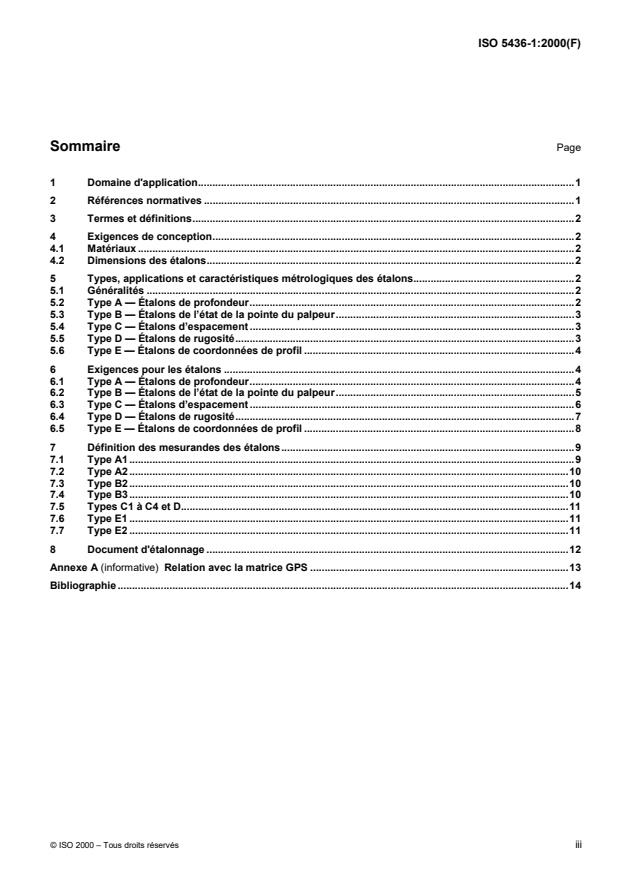
Sommaire Page
1 Domaine d'application.1
2 Références normatives .1
3 Termes et définitions.2
4 Exigences de conception.2
4.1 Matériaux .2
4.2 Dimensions des étalons.2
5 Types, applications et caractéristiques métrologiques des étalons.2
5.1 Généralités .2
5.2 Type A — Étalons de profondeur.2
5.3 Type B — Étalons de l’état de la pointe du palpeur.3
5.4 Type C — Étalons d’espacement .3
5.5 Type D — Étalons de rugosité.3
5.6 Type E — Étalons de coordonnées de profil .4
6 Exigences pour les étalons .4
6.1 Type A — Étalons de profondeur.4
6.2 Type B — Étalons de l’état de la pointe du palpeur.5
6.3 Type C — Étalons d’espacement .6
6.4 Type D — Étalons de rugosité.7
6.5 Type E — Étalons de coordonnées de profil .8
7 Définition des mesurandes des étalons.9
7.1 Type A1 .9
7.2 Type A2 .10
7.3 Type B2 .10
7.4 Type B3 .10
7.5 Types C1 à C4 et D.11
7.6 Type E1 .11
7.7 Type E2 .11
8 Document d'étalonnage .12
Annexe A (informative) Relation avec la matrice GPS .13
Bibliographie .14
Avant-propos
L'ISO (Organisation internationale de normalisation) est une fédération mondiale d'organismes nationaux de
normalisation (comités membres de l'ISO). L'élaboration des Normes internationales est en général confiée aux
comités techniques de l'ISO. Chaque comité membre intéressé par une étude a le droit de faire partie du comité
technique créé à cet effet. Les organisations internationales, gouvernementales et non gouvernementales, en
liaison avec l'ISO participent également aux travaux. L'ISO collabore étroitement avec la Commission
électrotechnique internationale (CEI) en ce qui concerne la normalisation électrotechnique.
Les Normes internationales sont rédigées conformément aux règles données dans les Directives ISO/CEI, Partie 3.
Les projets de Normes internationales adoptés par les comités techniques sont soumis aux comités membres pour
vote. Leur publication comme Normes internationales requiert l'approbation de 75 % au moins des comités
membres votants.
L’attention est appelée sur le fait que certains des éléments de la présente partie de l’ISO 5436 peuvent faire
l’objet de droits de propriété intellectuelle ou de droits analogues. L’ISO ne saurait être tenue pour responsable de
ne pas avoir identifié de tels droits de propriété et averti de leur existence.
La Norme internationale ISO 5436-1 a été élaborée par le comité technique ISO/TC 213, Spécifications et
vérification dimensionnelles et géométriques des produits.
Cette première édition de l'ISO 5436-1, ainsi que l'ISO 5436-2, annulent et remplacent l'ISO 5436:1985, dont elles
constituent une révision technique.
L'ISO 5436 comprend les parties suivantes, présentées sous le titre général Spécification géométrique des
produits (GPS) — État de surface: Méthode du profil; Étalons:
� Partie 1: Mesures matérialisées
� Partie 2: Étalons logiciels
L’annexe A de la présente partie de l’ISO 5436 est donnée uniquement à titre d’information.
iv © ISO 2000 – Tous droits réservés
Introduction
La présente partie de l’ISO 5436 qui traite de la spécification géométrique des produits (GPS) est considérée
comme une norme GPS générale (voir l'ISO/TR 14638). Elle influence le maillon 6 des chaînes de normes sur la
rugosité, l'ondulation et le profil primaire.
Pour de plus amples informations sur la relation de la présente partie de l’ISO 5436 avec les autres normes et la
matrice GPS, voir l'annexe A.
La présente partie de l’ISO 5436 introduit de nouveaux étalons, appelés Type E, pour étalonner le système de
coordonnées de profil.
NOTE Précédemment «étalons» étaient appelés «échantillons d'étalonnage».
NORME INTERNATIONALE ISO 5436-1:2000(F)
Spécification géométrique des produits (GPS) — État de surface:
Méthode du profil; Étalons —
Partie 1:
Mesures matérialisées
1 Domaine d'application
La présente partie de l’ISO 5436 spécifie les caractéristiques des mesures matérialisées utilisées comme étalons
pour l'étalonnage des caractéristiques métrologiques des instruments de mesure d'état de surface par la méthode
du profil, comme défini dans l'ISO 3274.
2 Références normatives
Les documents normatifs suivants contiennent des dispositions qui, par suite de la référence qui y est faite,
constituent des dispositions valables pour la présente partie de l'ISO 5436. Pour les références datées, les
amendements ultérieurs ou les révisions de ces publications ne s’appliquent pas. Toutefois, les parties prenantes
aux accords fondés sur la présente partie de l'ISO 5436 sont invitées à rechercher la possibilité d'appliquer les
éditions les plus récentes des documents normatifs indiqués ci-après. Pour les références non datées, la dernière
édition du document normatif en référence s’applique. Les membres de l'ISO et de la CEI possèdent le registre des
Normes internationales en vigueur.
ISO 3274:1996, Spécification géométrique des produits (GPS) — État de surface: Méthode du profil —
Caractéristiques nominales des appareils à contact (palpeur).
ISO 4287:1997, Spécification géométrique des produits (GPS) — État de surface: Méthode du profil — Termes,
définitions et paramètres d'état de surface.
ISO 4288:1996, Spécification géométrique des produits (GPS) — État de surface: Méthode du profil — Règles et
procédures pour l'évaluation de l'état de surface.
ISO 10012-1:1992, Exigences d'assurance de la qualité des équipements de mesure — Partie 1: Confirmation
métrologique de l'équipement de mesure.
ISO 12085:1998, Spécification géométrique des produits (GPS) — État de surface: Méthode du profil —
Paramètres liés aux motifs.
ISO/TS 14253-2:1999, Spécification géométrique des produits (GPS) — Vérification par la mesure des pièces et
des équipements de mesure — Partie 2: Guide pour l’estimation de l’incertitude dans les mesures GPS, dans
l’étalonnage des équipements de mesure et dans la vérification des produits.
re
Guide pour l'expression de l'incertitude de mesure (GUM),1 édition, 1995.
Vocabulaire international des termes fondamentaux et généraux de métrologie (VIM). BIPM, CEI, FICC, ISO,
e
OIML,UICPA,UIPPA, 2 édition, 1993.
3 Termes et définitions
Pour les besoins de la présente partie de l'ISO 5436, les termes et définitions donnés dans l'ISO 3274, l'ISO 4287
et le VIM s'appliquent.
4 Exigences de conception
4.1 Matériaux
Le matériau utilisé pour les étalons A à E doit être suffisamment dur pour assurer une durée de vie convenable par
rapport au coût (de fabrication et d’étalonnage). Sa surface doit être lisse et suffisamment plane pour ne pas avoir
d'influence lors de l'évaluation.
4.2 Dimensions des étalons
La zone de mesurage doit être suffisamment grande pour offrir la longueur totale de palpage requise pour toutes
les déterminations prévues. La zone de mesurage correspond à la région de la surface totale sur laquelle les
mesures d’étalonnage sont réalisées. Un seul et même bloc peut comporter un ou plusieurs types d'étalons. Pour
assurer des conditions économiques optimales, les dimensions hors tout des étalons ne sont pas données.
5 Types, applications et caractéristiques métrologiques des étalons
5.1 Généralités
L'étalonnage de la multitude d'instruments existants, dans leurs divers modes de fonctionnement, nécessite
plusieurs types d'étalons. Chacun des étalons peut avoir un domaine d'application limité en fonction de ses
caractéristiques propres et de celles de l'instrument à étalonner. La validité de l'étalonnage d'un instrument donné
est fonction de l'association correcte de ces caractéristiques.
Pour couvrir toute la gamme des besoins, cinq types sont décrits, dont chacun peut avoir un certain nombre de
variantes (voir Tableau 1).
Tableau 1 — Types et noms des étalons
Type Nom
A Étalon de profondeur
B Étalondel’étatdelapointedupalpeur
C Étalon d’espacement
D Étalon de rugosité
E Étalon de coordonnées de profil
5.2 Type A — Étalons de profondeur
Ces étalons servent à étalonner la composante verticale du profil des instruments à palpeur.
5.2.1 Type A1 — Rainures larges à fond plat
Ces étalons ont une large rainure étalonnée à fond plat, un rail à section rectangulaire ou un certain nombre de ces
éléments séparés de profondeur ou hauteur identique ou croissante, chaque élément étant assez large pour être
non sensible à la forme ou à l'état de la pointe du palpeur (voir Figure 1).
2 © ISO 2000 – Tous droits réservés
5.2.2 Type A2 — Rainures larges à fond arrondi
Ces étalons sont similaires à ceux du type A1, mais la ou les rainure(s) a (ont) un fond arrondi de rayon suffisant
pour être non sensible à la forme ou à l'état de la pointe du palpeur (voir Figure 2).
5.3 Type B — Étalons de l’état de la pointe du palpeur
Ces étalons servent essentiellement à étalonner l'état de la pointe du palpeur.
5.3.1 Type B1
Ces étalons ont une rainure étroite ou un certain nombre de rainures séparées, de proportions choisies pour être
sensibles de façon croissante aux dimensions de la touche du palpeur. La ou les rainure(s) a (ont) un fond arrondi
de rayon suffisant pour être sensible à la forme ou à l'état de la pointe du palpeur (voir Figures 3 et 4).
5.3.2 Type B2
Ces étalons présentent deux réseaux de rainures de valeurs Ra nominalement égales dont l'un est sensible et
l'autre non sensible aux dimensions de la pointe du palpeur (voir Figures 3 et 4).
5.3.3 Type B3
Ces étalons ont une fine arête protubérante. À titre d'exemple, des lames de rasoir non revêtues ont des largeurs
d'arête d'environ 0,1 �m ou moins. L'état du palpeur peut être évalué par le palpage d'un tel étalon et
l'enregistrement du profil de surface.
5.4 Type C — Étalons d’espacement
Ces étalons sont destinés principalement à l'étalonnage des composantes verticales du profil. Ils peuvent aussi
être utilisés pour l'étalonnage des composantes horizontales si l'espacement des rainures est dans des limites
acceptables pour cette application. L'objectif d'une série d'étalons est de pouvoir vérifier les caractéristiques de
transmission pour un certain nombre de pas et d'amplitudes.
Les étalons présentent un réseau de rainures répétitives de forme simple (sinusoïdale, triangulaire ou en arc de
cercle).
L'une des caractéristiques essentielles des étalons de type C est que des étalons normalisés de forme d'onde
différente sont néanmoins compatibles, au sens qu'ils conduisent tous à la même condition de vérification ou
d'étalonnage de l'instrument, pourvu qu'on les utilise correctement.
5.5 Type D — Étalons de rugosité
5.5.1 Généralités
Ces étalons sont destinés
...
Questions, Comments and Discussion
Ask us and Technical Secretary will try to provide an answer. You can facilitate discussion about the standard in here.
Loading comments...