

ISO 12179:2021
(Main)Geometrical product specifications (GPS) — Surface texture: Profile method — Calibration of contact (stylus) instruments
General Information
- Abstract
This document specifies the calibration and adjustment of the metrological characteristics of contact (stylus) instruments for the measurement of surface texture by the profile method as defined in ISO 3274. The calibration and adjustment is intended to be carried out with the aid of measurement standards. Annex B specifies the calibration and adjustment of metrological characteristics of simplified operator contact (stylus) instruments which do not conform with ISO 3274.
- Status
- Withdrawn
- Publication Date
- 19-Dec-2021
- Drafting Committee
- ISO/TC 213/WG 16 - Areal and profile surface texture
- Current Stage
- 9599 - Withdrawal of International Standard
- Start Date
- 08-May-2026
- Completion Date
- 29-Aug-2026
Buy Documents







ISO 12179:2021 - Geometrical product specifications (GPS) -- Surface texture: Profile method -- Calibration of contact (stylus) instruments


ISO 12179:2021 - Geometrical product specifications (GPS) — Surface texture: Profile method — Calibration of contact (stylus) instruments/20/2021


ISO 12179:2021 - Spécification géométrique des produits (GPS) -- État de surface: Méthode du profil -- Étalonnage des instruments à contact (palpeur)

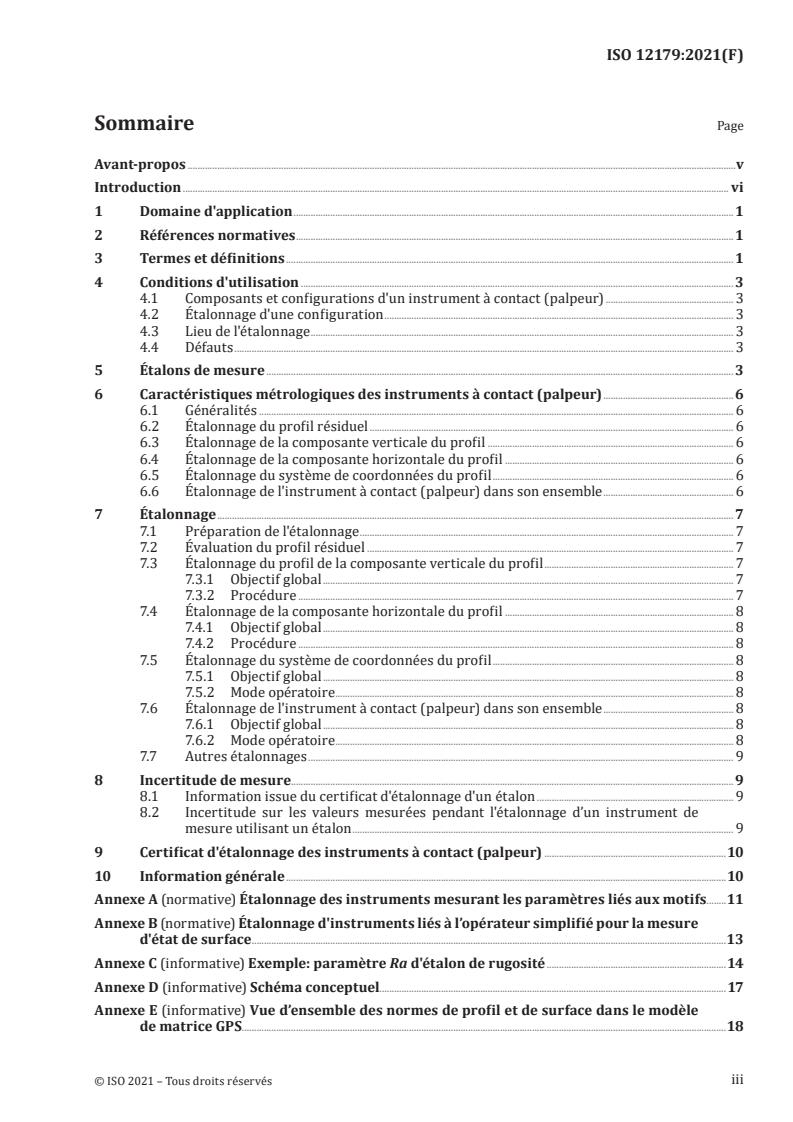

ISO 12179:2021 - Spécification géométrique des produits (GPS) — État de surface: Méthode du profil — Étalonnage des instruments à contact (palpeur)/20/2021
Overview
ISO 12179:2021 - Geometrical product specifications (GPS) - Surface texture: Profile method - Calibration of contact (stylus) instruments specifies how to calibrate and adjust the metrological characteristics of contact (stylus) profilometers used for surface texture measurement by the profile method (as defined in ISO 3274). The standard defines use of measurement standards (calibration specimens) to establish metrological traceability, document measurement uncertainty, and produce calibration certificates for instrument configurations.
Key topics and requirements
- Scope and applicability: Calibration and adjustment of contact (stylus) instruments for profile surface texture; includes simplified operator instruments (Annex B) that do not fully conform to ISO 3274.
- Components and configurations: Calibration applies to each instrumental configuration (basic equipment plus specific drive units and probes) separately.
- Measurement standards: Use of material measures and calibration specimens (see ISO 5436-1) to relate instrument indications to known quantity values.
- Metrological characteristics: Assessment and calibration of residual profile, vertical profile component, horizontal profile component, profile coordinate system and total instrument performance.
- Calibration procedures: Preparation, evaluation of residual profiles, stepwise calibration of vertical/horizontal components and whole instrument (see Clause 7).
- Task-related calibration and adjustment: Definitions and guidance on operations to achieve prescribed indications corresponding to known measurands.
- Uncertainty and traceability: Requirements for estimating measurement uncertainty (GUM/ISO/IEC Guide 98-3), documenting traceability and including uncertainty information on calibration certificates (Clauses 8–9).
- Defects and conditions of use: Consideration of measurement standard defects, place of calibration, and environmental/usage conditions influencing calibration results.
- Normative and informative annexes: Practical material on motifs method (Annex A), simplified instruments (Annex B), example parameters (Annex C: Ra), concept diagrams and GPS matrix relationships (Annexes D–F).
Applications and who uses ISO 12179:2021
- Calibration laboratories performing traceable calibration of profilometers and stylus instruments.
- Metrology and QC teams in manufacturing for surface roughness verification and process control.
- Instrument manufacturers for establishing calibration procedures and supplying calibration certificates.
- Inspection and conformity assessment bodies applying GPS standards for product verification.
- R&D and process engineering where validated surface texture measurements are required.
Practical uses include establishing instrument performance before production runs, periodic re-calibration, supporting measurement uncertainty budgets for surface roughness parameters (e.g., Ra), and ensuring compliance with GPS traceability requirements.
Related standards
- ISO 3274 (profile method - nominal characteristics of contact instruments)
- ISO 5436-1 (measurement standards - material measures)
- ISO 21920-2 (surface texture terms/parameters)
- ISO 10012, ISO 14253-1/2, ISO/IEC Guide 98-3 (GUM), VIM
Keywords: ISO 12179:2021, calibration of contact (stylus) instruments, surface texture, profile method, measurement standards, metrological traceability, calibration certificate, measurement uncertainty.
Relations
- Effective Date
- 12-Feb-2026
- Effective Date
- 06-Jun-2022
- Effective Date
- 18-Mar-2023
- Effective Date
- 10-Dec-2016
Buy Documents
ISO 12179:2021 - Geometrical product specifications (GPS) -- Surface texture: Profile method -- Calibration of contact (stylus) instruments
ISO 12179:2021 - Geometrical product specifications (GPS) — Surface texture: Profile method — Calibration of contact (stylus) instruments/20/2021
ISO 12179:2021 - Spécification géométrique des produits (GPS) -- État de surface: Méthode du profil -- Étalonnage des instruments à contact (palpeur)
ISO 12179:2021 - Spécification géométrique des produits (GPS) — État de surface: Méthode du profil — Étalonnage des instruments à contact (palpeur)/20/2021
Get Certified
Connect with accredited certification bodies for this standard

BSMI (Bureau of Standards, Metrology and Inspection)
Taiwan's standards and inspection authority.
Sponsored listings
Frequently Asked Questions
ISO 12179:2021 is a standard published by the International Organization for Standardization (ISO). Its full title is "Geometrical product specifications (GPS) — Surface texture: Profile method — Calibration of contact (stylus) instruments". This standard covers: This document specifies the calibration and adjustment of the metrological characteristics of contact (stylus) instruments for the measurement of surface texture by the profile method as defined in ISO 3274. The calibration and adjustment is intended to be carried out with the aid of measurement standards. Annex B specifies the calibration and adjustment of metrological characteristics of simplified operator contact (stylus) instruments which do not conform with ISO 3274.
This document specifies the calibration and adjustment of the metrological characteristics of contact (stylus) instruments for the measurement of surface texture by the profile method as defined in ISO 3274. The calibration and adjustment is intended to be carried out with the aid of measurement standards. Annex B specifies the calibration and adjustment of metrological characteristics of simplified operator contact (stylus) instruments which do not conform with ISO 3274.
ISO 12179:2021 is classified under the following ICS (International Classification for Standards) categories: 17.040.30 - Measuring instruments. The ICS classification helps identify the subject area and facilitates finding related standards.
ISO 12179:2021 has the following relationships with other standards: It is inter standard links to EN ISO 12179:2022, ISO/FDIS 11999-2, ISO 12179:2026, ISO 12179:2000. Understanding these relationships helps ensure you are using the most current and applicable version of the standard.
ISO 12179:2021 is available in PDF format for immediate download after purchase. The document can be added to your cart and obtained through the secure checkout process. Digital delivery ensures instant access to the complete standard document.
Standards Content (Sample)
SLOVENSKI STANDARD
01-april-2022
Specifikacija geometrijskih veličin izdelka - Tekstura površine: Profilna metoda -
Umerjanje kontaktnih (s tipalom) instrumentov
Geometrical product specifications (GPS) - Surface texture: Profile method - Calibration
of contact (stylus) instruments
Spécification géométrique des produits (GPS) - État de surface: Méthode du profil -
Étalonnage des instruments à contact (palpeur)
Ta slovenski standard je istoveten z: ISO 12179:2021
ICS:
17.040.30 Merila Measuring instruments
17.040.40 Specifikacija geometrijskih Geometrical Product
veličin izdelka (GPS) Specification (GPS)
2003-01.Slovenski inštitut za standardizacijo. Razmnoževanje celote ali delov tega standarda ni dovoljeno.
INTERNATIONAL ISO
STANDARD 12179
Second edition
2021-12
Geometrical product specifications
(GPS) — Surface texture: Profile
method — Calibration of contact
(stylus) instruments
Spécification géométrique des produits (GPS) — État de surface:
Méthode du profil — Étalonnage des instruments à contact (palpeur)
Reference number
© ISO 2021
All rights reserved. Unless otherwise specified, or required in the context of its implementation, no part of this publication may
be reproduced or utilized otherwise in any form or by any means, electronic or mechanical, including photocopying, or posting on
the internet or an intranet, without prior written permission. Permission can be requested from either ISO at the address below
or ISO’s member body in the country of the requester.
ISO copyright office
CP 401 • Ch. de Blandonnet 8
CH-1214 Vernier, Geneva
Phone: +41 22 749 01 11
Email: copyright@iso.org
Website: www.iso.org
Published in Switzerland
ii
Contents Page
Foreword .v
Introduction . vi
1 Scope . 1
2 Normative references . 1
3 Terms and definitions . 1
4 Conditions of use .3
4.1 Components and configurations of the contact (stylus) instrument . 3
4.2 Calibration of a configuration . 3
4.3 Place of calibration . 3
4.4 Defects . 3
5 Measurement standards . .3
6 Contact (stylus) instrument metrological characteristics . 6
6.1 General . 6
6.2 Residual profile calibration . 6
6.3 Vertical profile component calibration . 6
6.4 Horizontal profile component calibration . 6
6.5 Profile coordinate system calibration . 6
6.6 Total contact (stylus) instrument calibration . 6
7 Calibration .7
7.1 Preparation for calibration . 7
7.2 E valuation of the residual profile . 7
7.3 Calibration of the vertical profile component . 7
7.3.1 Overall objective . 7
7.3.2 Procedure . 7
7.4 Calibration of the horizontal profile component . . 8
7.4.1 Overall objective . 8
7.4.2 Procedure . 8
7.5 Calibration of the profile coordinate system . 8
7.5.1 Overall objective . 8
7.5.2 Procedure . 8
7.6 Calibration of the total contact (stylus) instrument . 8
7.6.1 Overall objective . 8
7.6.2 Procedure . 9
7.7 Other calibrations . 9
8 Measurement uncertainty .9
8.1 Information from the calibration certificate for a measurement standard . 9
8.2 The uncertainty of the values measured during calibration of a measuring
instrument using a measurement standard. 9
9 Contact (stylus) instrument calibration certificate .10
10 General information .10
Annex A (normative) Calibration of instruments measuring parameters of the motifs
method .11
Annex B (normative) Calibration of simplified operator instruments for the measurements
of surface texture .13
Annex C (informative) Example: roughness measurement standard parameter Ra .14
Annex D (informative) Concept diagram .17
Annex E (informative) Overview of profile and areal standards in the GPS matrix model .18
iii
Annex F (informative) Relation to the GPS matrix model .19
Bibliography .20
iv
Foreword
ISO (the International Organization for Standardization) is a worldwide federation of national standards
bodies (ISO member bodies). The work of preparing International Standards is normally carried out
through ISO technical committees. Each member body interested in a subject for which a technical
committee has been established has the right to be represented on that committee. International
organizations, governmental and non-governmental, in liaison with ISO, also take part in the work.
ISO collaborates closely with the International Electrotechnical Commission (IEC) on all matters of
electrotechnical standardization.
The procedures used to develop this document and those intended for its further maintenance are
described in the ISO/IEC Directives, Part 1. In particular, the different approval criteria needed for the
different types of ISO documents should be noted. This document was drafted in accordance with the
editorial rules of the ISO/IEC Directives, Part 2 (see www.iso.org/directives).
Attention is drawn to the possibility that some of the elements of this document may be the subject of
patent rights. ISO shall not be held responsible for identifying any or all such patent rights. Details of
any patent rights identified during the development of the document will be in the Introduction and/or
on the ISO list of patent declarations received (see www.iso.org/patents).
Any trade name used in this document is information given for the convenience of users and does not
constitute an endorsement.
For an explanation of the voluntary nature of standards, the meaning of ISO specific terms and
expressions related to conformity assessment, as well as information about ISO's adherence to
the World Trade Organization (WTO) principles in the Technical Barriers to Trade (TBT), see
www.iso.org/iso/foreword.html.
This document was prepared by Technical Committee ISO/TC 213, Dimensional and geometrical product
specifications and verification, in collaboration with the European Committee for Standardization (CEN)
Technical Committee CEN/TC 290, Dimensional and geometrical product specification and verification, in
accordance with the Agreement on technical cooperation between ISO and CEN (Vienna Agreement).
This second edition cancels and replaces the first edition (ISO 12179:2000), which has been technically
revised. It also incorporates Technical Corrigendum ISO 12179:2000/Cor. 1:2003.
The main changes to the previous edition are as follows:
— Annex C has been amended.
Any feedback or questions on this document should be directed to the user’s national standards body. A
complete listing of these bodies can be found at www.iso.org/members.html.
v
Introduction
This document is a geometrical product specification (GPS) standard and is to be regarded as a general
GPS standard (see ISO 14638). It influences chain link G of the chain of standards on profile surface
texture.
The ISO GPS matrix model is given in ISO 14638, For more detailed information on the relationship of
this document to the GPS matrix model, see Annex F. An overview of standards on profiles and areal
surface texture is given in Annex E.
This document introduces calibration of contact (stylus) instruments as defined in ISO 3274. The
calibration is carried out with the aid of measurement standards.
vi
INTERNATIONAL STANDARD ISO 12179:2021(E)
Geometrical product specifications (GPS) — Surface
texture: Profile method — Calibration of contact (stylus)
instruments
1 Scope
This document specifies the calibration and adjustment of the metrological characteristics of contact
(stylus) instruments for the measurement of surface texture by the profile method as defined in
ISO 3274. The calibration and adjustment is intended to be carried out with the aid of measurement
standards.
Annex B specifies the calibration and adjustment of metrological characteristics of simplified operator
contact (stylus) instruments which do not conform with ISO 3274.
2 Normative references
The following documents are referred to in the text in such a way that some or all of their content
constitutes requirements of this document. For dated references, only the edition cited applies. For
undated references, the latest edition of the referenced document (including any amendments) applies.
ISO 3274, Geometrical Product Specifications (GPS) — Surface texture: Profile method — Nominal
characteristics of contact (stylus) instruments
ISO 5436-1:2000, Geometrical Product Specifications (GPS) — Surface texture: Profile method;
Measurement standards — Part 1: Material measures
ISO 10012, Measurement management systems — Requirements for measurement processes and measuring
equipment
ISO 14253-1, Geometrical product specifications (GPS) — Inspection by measurement of workpieces and
measuring equipment — Part 1: Decision rules for verifying conformity or nonconformity with specifications
ISO 14253-2, Geometrical product specifications (GPS) — Inspection by measurement of workpieces
and measuring equipment — Part 2: Guidance for the estimation of uncertainty in GPS measurement, in
calibration of measuring equipment and in product verification
ISO 21920-2, Geometrical product specifications (GPS) — Surface texture: Profile — Part 2: Terms,
definitions and surface texture parameters
ISO 25178-73, Geometrical product specifications (GPS) — Surface texture: Areal — Part 73: Terms and
definitions for surface defects on material measures
ISO/IEC Guide 98-3, Uncertainty of measurement — Part 3: Guide to the expression of uncertainty in
measurement (GUM: 1995)
ISO/IEC Guide 99, International vocabulary of metrology — Basic and general concepts and associated
terms (VIM)
3 Terms and definitions
For the purposes of this document, the terms and definitions given in ISO 3274, ISO 14253-1, ISO 21920-2,
GUM and VIM and the following apply.
ISO and IEC maintain terminological databases for use in standardization at the following addresses:
— ISO Online browsing platform: available at https:// www .iso .org/ obp
— IEC Electropedia: available at http:// www .electropedia .org/
3.1
calibration
operation that, under specified conditions:
a) in a first step, establishes a relation between the quantity values with measurement uncertainties
provided by measurement standards and corresponding indications with associated measurement
uncertainties; and
b) in a second step, uses this information to establish a relation for obtaining a measurement result
from an indication
[SOURCE: ISO/IEC Guide 99:2007 (VIM), 2.39, modified — Notes to entry removed.]
3.2
task-related calibration
set of operations which establish, under specified conditions, the relationship between values of
quantities indicated by a measuring instrument and the corresponding known values of a limited
family of precisely defined measurands which constitute a subset of the measuring capabilities of the
measuring instrument
3.3
adjustment
adjustment of a measuring system
set of operations carried out on a measuring system so that it provides prescribed indications
corresponding to given values of a quantity to be measured
[SOURCE: ISO/IEC Guide 99:2007 (VIM), 3.11, modified — Notes to entry removed.]
3.4
measurement standard
etalon
realization of the definition of a given quantity, with stated quantity value and associated measurement
uncertainty, used as a reference
Note 1 to entry: Measurement standards are also referred to as “calibration specimens”.
[SOURCE: ISO/IEC Guide 99:2007 (VIM), 5.1, modified — Examples and Notes to entry removed.]
3.5
measurement uncertainty
uncertainty of measurement
uncertainty
non-negative parameter characterizing the dispersion of the quantity values being attributed to a
measurand, based on the information used
[SOURCE: ISO/IEC Guide 99:2007 (VIM), 2.26, modified — Notes to entry removed.]
3.6
metrological traceability
property of a measurement result whereby the result can be related to a reference through a
documented unbroken chain of calibrations, each contributing to the measurement uncertainty
[SOURCE: ISO/IEC Guide 99:2007 (VIM), 2.41, modified — Notes to entry removed.]
3.7
defect
part of the measurement standard’s geometrical feature (non-ideal surface) on
which the geometrical shape and geometrical dimensions deviate from those on the nominal feature
(ideal surface) either by an amount greater than some agreed or stated maximum value, or, in the
absence of any such agreed or stated maximum value, by an amount greater than what is typical or
characteristic for the processes used in manufacturing the measurement standard
[SOURCE: ISO 25178-73:2019, 3.1.2, modified — Notes to entry removed.]
4 Conditions of use
4.1 Components and configurations of the contact (stylus) instrument
The contact (stylus) instrument comprises the basic equipment, a drive unit, a probe and a profile
recorder (see ISO 3274). If the basic equipment is used with several drive units and probes, each of
these instrumental combinations (configurations) shall be calibrated separately.
4.2 Calibration of a configuration
The contact (stylus) instrument shall be calibrated when a change is made to the basic elements of the
system which intentionally or unintentionally modifies the measured profile or measuring result. Each
configuration of the contact (stylus) instrument shall be calibrated separately. For example, with a
change of probe, the contact (stylus) instrument is calibrated.
4.3 Place of calibration
The contact (stylus) instrument should be calibrated at the place of use with environmental conditions
similar to those present when in use for measurement to take into account external influence factors.
EXAMPLES Noise, temperature, vibration, air movement.
4.4 Defects
Geometrical defects that can be present on the surfaces of material measures and calibration specimens
shall be taken into consideration according to ISO 25178-73.
5 Measurement standards
The following measurement standards are applicable to the calibrations given in Clause 6:
— optical flat;
— depth measurement standard (see Figure 1): type A according to ISO 5436-1:2000;
— spacing measurement standard (see Figure 2): type C according to ISO 5436-1:2000;
— inclined optical flat (see Figure 3);
— profile coordinate measurement standard (consisting of a sphere or prism): type E according to
ISO 5436-1:2000;
— roughness measurement standard (see Figure 4): type D according to ISO 5436-1:2000.
It is recommended that a profile coordinate measurement standard be used on contact (stylus)
instruments where the stylus rotates at least plus and minus one half of a degree when moving through
its full range.
NOTE A type C periodic measurement standard is also useful for checking Ra as well as for checking Rsm.
Dimensions in millimetres
Figure 1 — Example of a depth measurement standard (type A)
Dimensions in millimetres
Figure 2 — Example of a spacing measurement standard (type C)
Dimensions in millimetres
Figure 3 — Example of an inclined optical flat and a measuring plan
Dimensions in millimetres
Figure 4 — Example of a roughness measurement standard (type D) and measuring plan
6 Contact (stylus) instrument metrological characteristics
6.1 General
Only those task-related contact (stylus) instrument metrological characteristics which are relevant
for the intended measurements should be selected for calibration and adjustment. For example, for the
measurement of spacing parameters, the vertical profile component need not be calibrated. Adjustment
(if required) of the metrological characteristic shall be carried out after calibration of the metrological
characteristic according to the instrument manufacturer’s procedures.
6.2 Residual profile calibration
The scratch-free optical flat reproduces the residual profile. For task-related calibrations use the
appropriate profile and parameters (e.g. the roughness profile with Ra, Rq or Rt; the waviness profile
with Wa, Wq or Wt, see ISO 21920-2).
NOTE By using this approach the effects of external guide straightness, environmental conditions and
instrument noise can be established.
6.3 Vertical profile component calibration
The depth measurement standard establishes a profile depth in order to measure the error of indication
of the vertical profile component of an instrument.
If no depth measurement standards are available, gauge blocks steps may be used. Care should be taken
concerning the uncertainty of the height difference when using gauge blocks steps.
6.4 Horizontal profile component calibration
The spacing measurement standard reproduces the mean width
...
INTERNATIONAL ISO
STANDARD 12179
Second edition
2021-12
Geometrical product specifications
(GPS) — Surface texture: Profile
method — Calibration of contact
(stylus) instruments
Spécification géométrique des produits (GPS) — État de surface:
Méthode du profil — Étalonnage des instruments à contact (palpeur)
Reference number
© ISO 2021
All rights reserved. Unless otherwise specified, or required in the context of its implementation, no part of this publication may
be reproduced or utilized otherwise in any form or by any means, electronic or mechanical, including photocopying, or posting on
the internet or an intranet, without prior written permission. Permission can be requested from either ISO at the address below
or ISO’s member body in the country of the requester.
ISO copyright office
CP 401 • Ch. de Blandonnet 8
CH-1214 Vernier, Geneva
Phone: +41 22 749 01 11
Email: copyright@iso.org
Website: www.iso.org
Published in Switzerland
ii
Contents Page
Foreword .v
Introduction . vi
1 Scope . 1
2 Normative references . 1
3 Terms and definitions . 1
4 Conditions of use .3
4.1 Components and configurations of the contact (stylus) instrument . 3
4.2 Calibration of a configuration . 3
4.3 Place of calibration . 3
4.4 Defects . 3
5 Measurement standards . .3
6 Contact (stylus) instrument metrological characteristics . 6
6.1 General . 6
6.2 Residual profile calibration . 6
6.3 Vertical profile component calibration . 6
6.4 Horizontal profile component calibration . 6
6.5 Profile coordinate system calibration . 6
6.6 Total contact (stylus) instrument calibration . 6
7 Calibration .7
7.1 Preparation for calibration . 7
7.2 E valuation of the residual profile . 7
7.3 Calibration of the vertical profile component . 7
7.3.1 Overall objective . 7
7.3.2 Procedure . 7
7.4 Calibration of the horizontal profile component . . 8
7.4.1 Overall objective . 8
7.4.2 Procedure . 8
7.5 Calibration of the profile coordinate system . 8
7.5.1 Overall objective . 8
7.5.2 Procedure . 8
7.6 Calibration of the total contact (stylus) instrument . 8
7.6.1 Overall objective . 8
7.6.2 Procedure . 9
7.7 Other calibrations . 9
8 Measurement uncertainty .9
8.1 Information from the calibration certificate for a measurement standard . 9
8.2 The uncertainty of the values measured during calibration of a measuring
instrument using a measurement standard. 9
9 Contact (stylus) instrument calibration certificate .10
10 General information .10
Annex A (normative) Calibration of instruments measuring parameters of the motifs
method .11
Annex B (normative) Calibration of simplified operator instruments for the measurements
of surface texture .13
Annex C (informative) Example: roughness measurement standard parameter Ra .14
Annex D (informative) Concept diagram .17
Annex E (informative) Overview of profile and areal standards in the GPS matrix model .18
iii
Annex F (informative) Relation to the GPS matrix model .19
Bibliography .20
iv
Foreword
ISO (the International Organization for Standardization) is a worldwide federation of national standards
bodies (ISO member bodies). The work of preparing International Standards is normally carried out
through ISO technical committees. Each member body interested in a subject for which a technical
committee has been established has the right to be represented on that committee. International
organizations, governmental and non-governmental, in liaison with ISO, also take part in the work.
ISO collaborates closely with the International Electrotechnical Commission (IEC) on all matters of
electrotechnical standardization.
The procedures used to develop this document and those intended for its further maintenance are
described in the ISO/IEC Directives, Part 1. In particular, the different approval criteria needed for the
different types of ISO documents should be noted. This document was drafted in accordance with the
editorial rules of the ISO/IEC Directives, Part 2 (see www.iso.org/directives).
Attention is drawn to the possibility that some of the elements of this document may be the subject of
patent rights. ISO shall not be held responsible for identifying any or all such patent rights. Details of
any patent rights identified during the development of the document will be in the Introduction and/or
on the ISO list of patent declarations received (see www.iso.org/patents).
Any trade name used in this document is information given for the convenience of users and does not
constitute an endorsement.
For an explanation of the voluntary nature of standards, the meaning of ISO specific terms and
expressions related to conformity assessment, as well as information about ISO's adherence to
the World Trade Organization (WTO) principles in the Technical Barriers to Trade (TBT), see
www.iso.org/iso/foreword.html.
This document was prepared by Technical Committee ISO/TC 213, Dimensional and geometrical product
specifications and verification, in collaboration with the European Committee for Standardization (CEN)
Technical Committee CEN/TC 290, Dimensional and geometrical product specification and verification, in
accordance with the Agreement on technical cooperation between ISO and CEN (Vienna Agreement).
This second edition cancels and replaces the first edition (ISO 12179:2000), which has been technically
revised. It also incorporates Technical Corrigendum ISO 12179:2000/Cor. 1:2003.
The main changes to the previous edition are as follows:
— Annex C has been amended.
Any feedback or questions on this document should be directed to the user’s national standards body. A
complete listing of these bodies can be found at www.iso.org/members.html.
v
Introduction
This document is a geometrical product specification (GPS) standard and is to be regarded as a general
GPS standard (see ISO 14638). It influences chain link G of the chain of standards on profile surface
texture.
The ISO GPS matrix model is given in ISO 14638, For more detailed information on the relationship of
this document to the GPS matrix model, see Annex F. An overview of standards on profiles and areal
surface texture is given in Annex E.
This document introduces calibration of contact (stylus) instruments as defined in ISO 3274. The
calibration is carried out with the aid of measurement standards.
vi
INTERNATIONAL STANDARD ISO 12179:2021(E)
Geometrical product specifications (GPS) — Surface
texture: Profile method — Calibration of contact (stylus)
instruments
1 Scope
This document specifies the calibration and adjustment of the metrological characteristics of contact
(stylus) instruments for the measurement of surface texture by the profile method as defined in
ISO 3274. The calibration and adjustment is intended to be carried out with the aid of measurement
standards.
Annex B specifies the calibration and adjustment of metrological characteristics of simplified operator
contact (stylus) instruments which do not conform with ISO 3274.
2 Normative references
The following documents are referred to in the text in such a way that some or all of their content
constitutes requirements of this document. For dated references, only the edition cited applies. For
undated references, the latest edition of the referenced document (including any amendments) applies.
ISO 3274, Geometrical Product Specifications (GPS) — Surface texture: Profile method — Nominal
characteristics of contact (stylus) instruments
ISO 5436-1:2000, Geometrical Product Specifications (GPS) — Surface texture: Profile method;
Measurement standards — Part 1: Material measures
ISO 10012, Measurement management systems — Requirements for measurement processes and measuring
equipment
ISO 14253-1, Geometrical product specifications (GPS) — Inspection by measurement of workpieces and
measuring equipment — Part 1: Decision rules for verifying conformity or nonconformity with specifications
ISO 14253-2, Geometrical product specifications (GPS) — Inspection by measurement of workpieces
and measuring equipment — Part 2: Guidance for the estimation of uncertainty in GPS measurement, in
calibration of measuring equipment and in product verification
ISO 21920-2, Geometrical product specifications (GPS) — Surface texture: Profile — Part 2: Terms,
definitions and surface texture parameters
ISO 25178-73, Geometrical product specifications (GPS) — Surface texture: Areal — Part 73: Terms and
definitions for surface defects on material measures
ISO/IEC Guide 98-3, Uncertainty of measurement — Part 3: Guide to the expression of uncertainty in
measurement (GUM: 1995)
ISO/IEC Guide 99, International vocabulary of metrology — Basic and general concepts and associated
terms (VIM)
3 Terms and definitions
For the purposes of this document, the terms and definitions given in ISO 3274, ISO 14253-1, ISO 21920-2,
GUM and VIM and the following apply.
ISO and IEC maintain terminological databases for use in standardization at the following addresses:
— ISO Online browsing platform: available at https:// www .iso .org/ obp
— IEC Electropedia: available at http:// www .electropedia .org/
3.1
calibration
operation that, under specified conditions:
a) in a first step, establishes a relation between the quantity values with measurement uncertainties
provided by measurement standards and corresponding indications with associated measurement
uncertainties; and
b) in a second step, uses this information to establish a relation for obtaining a measurement result
from an indication
[SOURCE: ISO/IEC Guide 99:2007 (VIM), 2.39, modified — Notes to entry removed.]
3.2
task-related calibration
set of operations which establish, under specified conditions, the relationship between values of
quantities indicated by a measuring instrument and the corresponding known values of a limited
family of precisely defined measurands which constitute a subset of the measuring capabilities of the
measuring instrument
3.3
adjustment
adjustment of a measuring system
set of operations carried out on a measuring system so that it provides prescribed indications
corresponding to given values of a quantity to be measured
[SOURCE: ISO/IEC Guide 99:2007 (VIM), 3.11, modified — Notes to entry removed.]
3.4
measurement standard
etalon
realization of the definition of a given quantity, with stated quantity value and associated measurement
uncertainty, used as a reference
Note 1 to entry: Measurement standards are also referred to as “calibration specimens”.
[SOURCE: ISO/IEC Guide 99:2007 (VIM), 5.1, modified — Examples and Notes to entry removed.]
3.5
measurement uncertainty
uncertainty of measurement
uncertainty
non-negative parameter characterizing the dispersion of the quantity values being attributed to a
measurand, based on the information used
[SOURCE: ISO/IEC Guide 99:2007 (VIM), 2.26, modified — Notes to entry removed.]
3.6
metrological traceability
property of a measurement result whereby the result can be related to a reference through a
documented unbroken chain of calibrations, each contributing to the measurement uncertainty
[SOURCE: ISO/IEC Guide 99:2007 (VIM), 2.41, modified — Notes to entry removed.]
3.7
defect
part of the measurement standard’s geometrical feature (non-ideal surface) on
which the geometrical shape and geometrical dimensions deviate from those on the nominal feature
(ideal surface) either by an amount greater than some agreed or stated maximum value, or, in the
absence of any such agreed or stated maximum value, by an amount greater than what is typical or
characteristic for the processes used in manufacturing the measurement standard
[SOURCE: ISO 25178-73:2019, 3.1.2, modified — Notes to entry removed.]
4 Conditions of use
4.1 Components and configurations of the contact (stylus) instrument
The contact (stylus) instrument comprises the basic equipment, a drive unit, a probe and a profile
recorder (see ISO 3274). If the basic equipment is used with several drive units and probes, each of
these instrumental combinations (configurations) shall be calibrated separately.
4.2 Calibration of a configuration
The contact (stylus) instrument shall be calibrated when a change is made to the basic elements of the
system which intentionally or unintentionally modifies the measured profile or measuring result. Each
configuration of the contact (stylus) instrument shall be calibrated separately. For example, with a
change of probe, the contact (stylus) instrument is calibrated.
4.3 Place of calibration
The contact (stylus) instrument should be calibrated at the place of use with environmental conditions
similar to those present when in use for measurement to take into account external influence factors.
EXAMPLES Noise, temperature, vibration, air movement.
4.4 Defects
Geometrical defects that can be present on the surfaces of material measures and calibration specimens
shall be taken into consideration according to ISO 25178-73.
5 Measurement standards
The following measurement standards are applicable to the calibrations given in Clause 6:
— optical flat;
— depth measurement standard (see Figure 1): type A according to ISO 5436-1:2000;
— spacing measurement standard (see Figure 2): type C according to ISO 5436-1:2000;
— inclined optical flat (see Figure 3);
— profile coordinate measurement standard (consisting of a sphere or prism): type E according to
ISO 5436-1:2000;
— roughness measurement standard (see Figure 4): type D according to ISO 5436-1:2000.
It is recommended that a profile coordinate measurement standard be used on contact (stylus)
instruments where the stylus rotates at least plus and minus one half of a degree when moving through
its full range.
NOTE A type C periodic measurement standard is also useful for checking Ra as well as for checking Rsm.
Dimensions in millimetres
Figure 1 — Example of a depth measurement standard (type A)
Dimensions in millimetres
Figure 2 — Example of a spacing measurement standard (type C)
Dimensions in millimetres
Figure 3 — Example of an inclined optical flat and a measuring plan
Dimensions in millimetres
Figure 4 — Example of a roughness measurement standard (type D) and measuring plan
6 Contact (stylus) instrument metrological characteristics
6.1 General
Only those task-related contact (stylus) instrument metrological characteristics which are relevant
for the intended measurements should be selected for calibration and adjustment. For example, for the
measurement of spacing parameters, the vertical profile component need not be calibrated. Adjustment
(if required) of the metrological characteristic shall be carried out after calibration of the metrological
characteristic according to the instrument manufacturer’s procedures.
6.2 Residual profile calibration
The scratch-free optical flat reproduces the residual profile. For task-related calibrations use the
appropriate profile and parameters (e.g. the roughness profile with Ra, Rq or Rt; the waviness profile
with Wa, Wq or Wt, see ISO 21920-2).
NOTE By using this approach the effects of external guide straightness, environmental conditions and
instrument noise can be established.
6.3 Vertical profile component calibration
The depth measurement standard establishes a profile depth in order to measure the error of indication
of the vertical profile component of an instrument.
If no depth measurement standards are available, gauge blocks steps may be used. Care should be taken
concerning the uncertainty of the height difference when using gauge blocks steps.
6.4 Horizontal profile component calibration
The spacing measurement standard reproduces the mean width of profile element, PSm, in order to
measure the error of indication of the horizontal profile component.
6.5 Profile coordinate system calibration
The inclined optical flat reproduces:
— the least-squares-best-fit angle in degrees;
— the total height of the primary profile, Pt, see ISO 21920-2, after removal of the least-squares-best-
fit straight line,
thus establishing the error of the linked horizontal and vertical coordinates (e.g. variation in traverse
speed, nonlinearities in scales).
The profil
...
INTERNATIONAL ISO
STANDARD 12179
Second edition
2021-12
Geometrical product specifications
(GPS) — Surface texture: Profile
method — Calibration of contact
(stylus) instruments
Spécification géométrique des produits (GPS) — État de surface:
Méthode du profil — Étalonnage des instruments à contact (palpeur)
Reference number
© ISO 2021
All rights reserved. Unless otherwise specified, or required in the context of its implementation, no part of this publication may
be reproduced or utilized otherwise in any form or by any means, electronic or mechanical, including photocopying, or posting on
the internet or an intranet, without prior written permission. Permission can be requested from either ISO at the address below
or ISO’s member body in the country of the requester.
ISO copyright office
CP 401 • Ch. de Blandonnet 8
CH-1214 Vernier, Geneva
Phone: +41 22 749 01 11
Email: copyright@iso.org
Website: www.iso.org
Published in Switzerland
ii
Contents Page
Foreword .v
Introduction . vi
1 Scope . 1
2 Normative references . 1
3 Terms and definitions . 1
4 Conditions of use .3
4.1 Components and configurations of the contact (stylus) instrument . 3
4.2 Calibration of a configuration . 3
4.3 Place of calibration . 3
4.4 Defects . 3
5 Measurement standards . .3
6 Contact (stylus) instrument metrological characteristics . 6
6.1 General . 6
6.2 Residual profile calibration . 6
6.3 Vertical profile component calibration . 6
6.4 Horizontal profile component calibration . 6
6.5 Profile coordinate system calibration . 6
6.6 Total contact (stylus) instrument calibration . 6
7 Calibration .7
7.1 Preparation for calibration . 7
7.2 E valuation of the residual profile . 7
7.3 Calibration of the vertical profile component . 7
7.3.1 Overall objective . 7
7.3.2 Procedure . 7
7.4 Calibration of the horizontal profile component . . 8
7.4.1 Overall objective . 8
7.4.2 Procedure . 8
7.5 Calibration of the profile coordinate system . 8
7.5.1 Overall objective . 8
7.5.2 Procedure . 8
7.6 Calibration of the total contact (stylus) instrument . 8
7.6.1 Overall objective . 8
7.6.2 Procedure . 9
7.7 Other calibrations . 9
8 Measurement uncertainty .9
8.1 Information from the calibration certificate for a measurement standard . 9
8.2 The uncertainty of the values measured during calibration of a measuring
instrument using a measurement standard. 9
9 Contact (stylus) instrument calibration certificate .10
10 General information .10
Annex A (normative) Calibration of instruments measuring parameters of the motifs
method .11
Annex B (normative) Calibration of simplified operator instruments for the measurements
of surface texture .13
Annex C (informative) Example: roughness measurement standard parameter Ra .14
Annex D (informative) Concept diagram .17
Annex E (informative) Overview of profile and areal standards in the GPS matrix model .18
iii
Annex F (informative) Relation to the GPS matrix model .19
Bibliography .20
iv
Foreword
ISO (the International Organization for Standardization) is a worldwide federation of national standards
bodies (ISO member bodies). The work of preparing International Standards is normally carried out
through ISO technical committees. Each member body interested in a subject for which a technical
committee has been established has the right to be represented on that committee. International
organizations, governmental and non-governmental, in liaison with ISO, also take part in the work.
ISO collaborates closely with the International Electrotechnical Commission (IEC) on all matters of
electrotechnical standardization.
The procedures used to develop this document and those intended for its further maintenance are
described in the ISO/IEC Directives, Part 1. In particular, the different approval criteria needed for the
different types of ISO documents should be noted. This document was drafted in accordance with the
editorial rules of the ISO/IEC Directives, Part 2 (see www.iso.org/directives).
Attention is drawn to the possibility that some of the elements of this document may be the subject of
patent rights. ISO shall not be held responsible for identifying any or all such patent rights. Details of
any patent rights identified during the development of the document will be in the Introduction and/or
on the ISO list of patent declarations received (see www.iso.org/patents).
Any trade name used in this document is information given for the convenience of users and does not
constitute an endorsement.
For an explanation of the voluntary nature of standards, the meaning of ISO specific terms and
expressions related to conformity assessment, as well as information about ISO's adherence to
the World Trade Organization (WTO) principles in the Technical Barriers to Trade (TBT), see
www.iso.org/iso/foreword.html.
This document was prepared by Technical Committee ISO/TC 213, Dimensional and geometrical product
specifications and verification, in collaboration with the European Committee for Standardization (CEN)
Technical Committee CEN/TC 290, Dimensional and geometrical product specification and verification, in
accordance with the Agreement on technical cooperation between ISO and CEN (Vienna Agreement).
This second edition cancels and replaces the first edition (ISO 12179:2000), which has been technically
revised. It also incorporates Technical Corrigendum ISO 12179:2000/Cor. 1:2003.
The main changes to the previous edition are as follows:
— Annex C has been amended.
Any feedback or questions on this document should be directed to the user’s national standards body. A
complete listing of these bodies can be found at www.iso.org/members.html.
v
Introduction
This document is a geometrical product specification (GPS) standard and is to be regarded as a general
GPS standard (see ISO 14638). It influences chain link G of the chain of standards on profile surface
texture.
The ISO GPS matrix model is given in ISO 14638, For more detailed information on the relationship of
this document to the GPS matrix model, see Annex F. An overview of standards on profiles and areal
surface texture is given in Annex E.
This document introduces calibration of contact (stylus) instruments as defined in ISO 3274. The
calibration is carried out with the aid of measurement standards.
vi
INTERNATIONAL STANDARD ISO 12179:2021(E)
Geometrical product specifications (GPS) — Surface
texture: Profile method — Calibration of contact (stylus)
instruments
1 Scope
This document specifies the calibration and adjustment of the metrological characteristics of contact
(stylus) instruments for the measurement of surface texture by the profile method as defined in
ISO 3274. The calibration and adjustment is intended to be carried out with the aid of measurement
standards.
Annex B specifies the calibration and adjustment of metrological characteristics of simplified operator
contact (stylus) instruments which do not conform with ISO 3274.
2 Normative references
The following documents are referred to in the text in such a way that some or all of their content
constitutes requirements of this document. For dated references, only the edition cited applies. For
undated references, the latest edition of the referenced document (including any amendments) applies.
ISO 3274, Geometrical Product Specifications (GPS) — Surface texture: Profile method — Nominal
characteristics of contact (stylus) instruments
ISO 5436-1:2000, Geometrical Product Specifications (GPS) — Surface texture: Profile method;
Measurement standards — Part 1: Material measures
ISO 10012, Measurement management systems — Requirements for measurement processes and measuring
equipment
ISO 14253-1, Geometrical product specifications (GPS) — Inspection by measurement of workpieces and
measuring equipment — Part 1: Decision rules for verifying conformity or nonconformity with specifications
ISO 14253-2, Geometrical product specifications (GPS) — Inspection by measurement of workpieces
and measuring equipment — Part 2: Guidance for the estimation of uncertainty in GPS measurement, in
calibration of measuring equipment and in product verification
ISO 21920-2, Geometrical product specifications (GPS) — Surface texture: Profile — Part 2: Terms,
definitions and surface texture parameters
ISO 25178-73, Geometrical product specifications (GPS) — Surface texture: Areal — Part 73: Terms and
definitions for surface defects on material measures
ISO/IEC Guide 98-3, Uncertainty of measurement — Part 3: Guide to the expression of uncertainty in
measurement (GUM: 1995)
ISO/IEC Guide 99, International vocabulary of metrology — Basic and general concepts and associated
terms (VIM)
3 Terms and definitions
For the purposes of this document, the terms and definitions given in ISO 3274, ISO 14253-1, ISO 21920-2,
GUM and VIM and the following apply.
ISO and IEC maintain terminological databases for use in standardization at the following addresses:
— ISO Online browsing platform: available at https:// www .iso .org/ obp
— IEC Electropedia: available at http:// www .electropedia .org/
3.1
calibration
operation that, under specified conditions:
a) in a first step, establishes a relation between the quantity values with measurement uncertainties
provided by measurement standards and corresponding indications with associated measurement
uncertainties; and
b) in a second step, uses this information to establish a relation for obtaining a measurement result
from an indication
[SOURCE: ISO/IEC Guide 99:2007 (VIM), 2.39, modified — Notes to entry removed.]
3.2
task-related calibration
set of operations which establish, under specified conditions, the relationship between values of
quantities indicated by a measuring instrument and the corresponding known values of a limited
family of precisely defined measurands which constitute a subset of the measuring capabilities of the
measuring instrument
3.3
adjustment
adjustment of a measuring system
set of operations carried out on a measuring system so that it provides prescribed indications
corresponding to given values of a quantity to be measured
[SOURCE: ISO/IEC Guide 99:2007 (VIM), 3.11, modified — Notes to entry removed.]
3.4
measurement standard
etalon
realization of the definition of a given quantity, with stated quantity value and associated measurement
uncertainty, used as a reference
Note 1 to entry: Measurement standards are also referred to as “calibration specimens”.
[SOURCE: ISO/IEC Guide 99:2007 (VIM), 5.1, modified — Examples and Notes to entry removed.]
3.5
measurement uncertainty
uncertainty of measurement
uncertainty
non-negative parameter characterizing the dispersion of the quantity values being attributed to a
measurand, based on the information used
[SOURCE: ISO/IEC Guide 99:2007 (VIM), 2.26, modified — Notes to entry removed.]
3.6
metrological traceability
property of a measurement result whereby the result can be related to a reference through a
documented unbroken chain of calibrations, each contributing to the measurement uncertainty
[SOURCE: ISO/IEC Guide 99:2007 (VIM), 2.41, modified — Notes to entry removed.]
3.7
defect
part of the measurement standard’s geometrical feature (non-ideal surface) on
which the geometrical shape and geometrical dimensions deviate from those on the nominal feature
(ideal surface) either by an amount greater than some agreed or stated maximum value, or, in the
absence of any such agreed or stated maximum value, by an amount greater than what is typical or
characteristic for the processes used in manufacturing the measurement standard
[SOURCE: ISO 25178-73:2019, 3.1.2, modified — Notes to entry removed.]
4 Conditions of use
4.1 Components and configurations of the contact (stylus) instrument
The contact (stylus) instrument comprises the basic equipment, a drive unit, a probe and a profile
recorder (see ISO 3274). If the basic equipment is used with several drive units and probes, each of
these instrumental combinations (configurations) shall be calibrated separately.
4.2 Calibration of a configuration
The contact (stylus) instrument shall be calibrated when a change is made to the basic elements of the
system which intentionally or unintentionally modifies the measured profile or measuring result. Each
configuration of the contact (stylus) instrument shall be calibrated separately. For example, with a
change of probe, the contact (stylus) instrument is calibrated.
4.3 Place of calibration
The contact (stylus) instrument should be calibrated at the place of use with environmental conditions
similar to those present when in use for measurement to take into account external influence factors.
EXAMPLES Noise, temperature, vibration, air movement.
4.4 Defects
Geometrical defects that can be present on the surfaces of material measures and calibration specimens
shall be taken into consideration according to ISO 25178-73.
5 Measurement standards
The following measurement standards are applicable to the calibrations given in Clause 6:
— optical flat;
— depth measurement standard (see Figure 1): type A according to ISO 5436-1:2000;
— spacing measurement standard (see Figure 2): type C according to ISO 5436-1:2000;
— inclined optical flat (see Figure 3);
— profile coordinate measurement standard (consisting of a sphere or prism): type E according to
ISO 5436-1:2000;
— roughness measurement standard (see Figure 4): type D according to ISO 5436-1:2000.
It is recommended that a profile coordinate measurement standard be used on contact (stylus)
instruments where the stylus rotates at least plus and minus one half of a degree when moving through
its full range.
NOTE A type C periodic measurement standard is also useful for checking Ra as well as for checking Rsm.
Dimensions in millimetres
Figure 1 — Example of a depth measurement standard (type A)
Dimensions in millimetres
Figure 2 — Example of a spacing measurement standard (type C)
Dimensions in millimetres
Figure 3 — Example of an inclined optical flat and a measuring plan
Dimensions in millimetres
Figure 4 — Example of a roughness measurement standard (type D) and measuring plan
6 Contact (stylus) instrument metrological characteristics
6.1 General
Only those task-related contact (stylus) instrument metrological characteristics which are relevant
for the intended measurements should be selected for calibration and adjustment. For example, for the
measurement of spacing parameters, the vertical profile component need not be calibrated. Adjustment
(if required) of the metrological characteristic shall be carried out after calibration of the metrological
characteristic according to the instrument manufacturer’s procedures.
6.2 Residual profile calibration
The scratch-free optical flat reproduces the residual profile. For task-related calibrations use the
appropriate profile and parameters (e.g. the roughness profile with Ra, Rq or Rt; the waviness profile
with Wa, Wq or Wt, see ISO 21920-2).
NOTE By using this approach the effects of external guide straightness, environmental conditions and
instrument noise can be established.
6.3 Vertical profile component calibration
The depth measurement standard establishes a profile depth in order to measure the error of indication
of the vertical profile component of an instrument.
If no depth measurement standards are available, gauge blocks steps may be used. Care should be taken
concerning the uncertainty of the height difference when using gauge blocks steps.
6.4 Horizontal profile component calibration
The spacing measurement standard reproduces the mean width of profile element, PSm, in order to
measure the error of indication of the horizontal profile component.
6.5 Profile coordinate system calibration
The inclined optical flat reproduces:
— the least-squares-best-fit angle in degrees;
— the total height of the primary profile, Pt, see ISO 21920-2, after removal of the least-squares-best-
fit straight line,
thus establishing the error of the linked horizontal and vertical coordinates (e.g. variation in traverse
speed, nonlinearities in scales).
The profil
...
NORME ISO
INTERNATIONALE 12179
Deuxième édition
2021-12
Spécification géométrique des
produits (GPS) — État de surface:
Méthode du profil — Étalonnage des
instruments à contact (palpeur)
Geometrical product specifications (GPS) — Surface texture: Profile
method — Calibration of contact (stylus) instruments
Numéro de référence
DOCUMENT PROTÉGÉ PAR COPYRIGHT
© ISO 2021
Tous droits réservés. Sauf prescription différente ou nécessité dans le contexte de sa mise en œuvre, aucune partie de cette
publication ne peut être reproduite ni utilisée sous quelque forme que ce soit et par aucun procédé, électronique ou mécanique,
y compris la photocopie, ou la diffusion sur l’internet ou sur un intranet, sans autorisation écrite préalable. Une autorisation peut
être demandée à l’ISO à l’adresse ci-après ou au comité membre de l’ISO dans le pays du demandeur.
ISO copyright office
Case postale 401 • Ch. de Blandonnet 8
CH-1214 Vernier, Genève
Tél.: +41 22 749 01 11
E-mail: copyright@iso.org
Web: www.iso.org
Publié en Suisse
ii
Sommaire Page
Avant-propos .v
Introduction . vi
1 Domaine d'application .1
2 Références normatives .1
3 Termes et définitions .1
4 Conditions d'utilisation .3
4.1 Composants et configurations d'un instrument à contact (palpeur) . 3
4.2 Étalonnage d'une configuration . 3
4.3 Lieu de l'étalonnage . 3
4.4 Défauts . 3
5 Étalons de mesure .3
6 Caractéristiques métrologiques des instruments à contact (palpeur) .6
6.1 Généralités . 6
6.2 Étalonnage du profil résiduel . 6
6.3 Étalonnage de la composante verticale du profil . 6
6.4 Étalonnage de la composante horizontale du profil . 6
6.5 Étalonnage du système de coordonnées du profil . 6
6.6 Étalonnage de l'instrument à contact (palpeur) dans son ensemble . 6
7 Étalonnage .7
7.1 Préparation de l'étalonnage . 7
7.2 Évaluation du profil résiduel . 7
7.3 Étalonnage du profil de la composante verticale du profil . 7
7.3.1 Objectif global . 7
7.3.2 Procédure . 7
7.4 Étalonnage de la composante horizontale du profil . 8
7.4.1 Objectif global . 8
7.4.2 Procédure . 8
7.5 Étalonnage du système de coordonnées du profil . 8
7.5.1 Objectif global . 8
7.5.2 Mode opératoire . 8
7.6 Étalonnage de l'instrument à contact (palpeur) dans son ensemble . 8
7.6.1 Objectif global . 8
7.6.2 Mode opératoire . 8
7.7 Autres étalonnages . 9
8 Incertitude de mesure.9
8.1 Information issue du certificat d'étalonnage d'un étalon . 9
8.2 Incertitude sur les valeurs mesurées pendant l'étalonnage d’un instrument de
mesure utilisant un étalon . 9
9 Certificat d'étalonnage des instruments à contact (palpeur) .10
10 Information générale .10
Annexe A (normative) Étalonnage des instruments mesurant les paramètres liés aux motifs .11
Annexe B (normative) Étalonnage d'instruments liés à l’opérateur simplifié pour la mesure
d'état de surface .13
Annexe C (informative) Exemple: paramètre Ra d'étalon de rugosité .14
Annexe D (informative) Schéma conceptuel.17
Annexe E (informative) Vue d’ensemble des normes de profil et de surface dans le modèle
de matrice GPS . .18
iii
Annexe F (informative) Relation avec le modèle de matrice GPS .19
Bibliographie .20
iv
Avant-propos
L'ISO (Organisation internationale de normalisation) est une fédération mondiale d'organismes
nationaux de normalisation (comités membres de l'ISO). L'élaboration des Normes internationales est
en général confiée aux comités techniques de l'ISO. Chaque comité membre intéressé par une étude
a le droit de faire partie du comité technique créé à cet effet. Les organisations internationales,
gouvernementales et non gouvernementales, en liaison avec l'ISO participent également aux travaux.
L'ISO collabore étroitement avec la Commission électrotechnique internationale (IEC) en ce qui
concerne la normalisation électrotechnique.
Les procédures utilisées pour élaborer le présent document et celles destinées à sa mise à jour sont
décrites dans les Directives ISO/IEC, Partie 1. Il convient, en particulier, de prendre note des différents
critères d'approbation requis pour les différents types de documents ISO. Le présent document a
été rédigé conformément aux règles de rédaction données dans les Directives ISO/IEC, Partie 2 (voir
www.iso.org/directives).
L'attention est attirée sur le fait que certains des éléments du présent document peuvent faire l'objet de
droits de propriété intellectuelle ou de droits analogues. L'ISO ne saurait être tenue pour responsable
de ne pas avoir identifié de tels droits de propriété et averti de leur existence. Les détails concernant
les références aux droits de propriété intellectuelle ou autres droits analogues identifiés lors de
l'élaboration du document sont indiqués dans l'Introduction et/ou dans la liste des déclarations de
brevets reçues par l'ISO (voir www.iso.org/brevets).
Les appellations commerciales éventuellement mentionnées dans le présent document sont données
pour information, par souci de commodité, à l’intention des utilisateurs et ne sauraient constituer un
engagement.
Pour une explication de la nature volontaire des normes, la signification des termes et expressions
spécifiques de l'ISO liés à l'évaluation de la conformité, ou pour toute information au sujet de l'adhésion
de l'ISO aux principes de l’Organisation mondiale du commerce (OMC) concernant les obstacles
techniques au commerce (OTC), voir www.iso.org/avant-propos.
Le présent document a été élaboré par le comité technique ISO/TC 213, Spécifications et vérification
dimensionnelles et géométriques des produits, en collaboration avec le comité technique CEN/TC 290,
Spécification dimensionnelle et géométrique des produits, et vérification correspondante, du Comité
européen de normalisation (CEN) conformément à l’Accord de coopération technique entre l’ISO et le
CEN (Accord de Vienne).
Cette deuxième édition annule et remplace la première édition (ISO 12179:2000), qui a fait l’objet d’une
révision technique. Elle incorpore également le Rectificatif technique ISO 12179:2000/Cor. 1:2003.
Les principales modifications sont les suivantes:
— l'Annexe C a été amendée.
Il convient que l’utilisateur adresse tout retour d’information ou toute question concernant le présent
document à l’organisme national de normalisation de son pays. Une liste exhaustive desdits organismes
se trouve à l’adresse www.iso.org/fr/members.html.
v
Introduction
Le présent document est une norme de spécification géométrique des produits (GPS) et doit être
considérée comme une norme GPS générale (voir l'ISO 14638). Il influence le maillon G des chaînes de
normes sur la rugosité, l'ondulation et le profil primaire.
Le modèle de matrice ISO/GPS est donné dans l'ISO 14638. Pour de plus amples informations sur la
relation du présent document avec le modèle de matrice GPS, voir l'Annexe F. Une vue d’ensemble des
normes relatives aux profils et à l’état de surface est donnée dans l'Annexe E.
Le présent document introduit l'étalonnage des instruments à contact (palpeur) comme défini dans
l'ISO 3274. L'étalonnage est effectué à l'aide d'étalons de mesure.
vi
NORME INTERNATIONALE ISO 12179:2021(F)
Spécification géométrique des produits (GPS) — État de
surface: Méthode du profil — Étalonnage des instruments
à contact (palpeur)
1 Domaine d'application
Le présent document spécifie l'étalonnage et l’ajustage des caractéristiques métrologiques des
instruments à contact (stylet) pour le mesurage de l'état de surface par la méthode du profil comme
défini dans l'ISO 3274. L'étalonnage et et l’ajustage s’effectuent à l'aide d'étalons de mesure.
L'Annexe B spécifie l'étalonnage et le réglage des caractéristiques métrologiques des instruments à
contact (stylet) à utilisation simplifiée qui ne sont pas conformes à l'ISO 3274.
2 Références normatives
Les documents suivants sont cités dans le texte de sorte qu’ils constituent, pour tout ou partie de leur
contenu, des exigences du présent document. Pour les références datées, seule l’édition citée s’applique.
Pour les références non datées, la dernière édition du document de référence s'applique (y compris les
éventuels amendements).
ISO 3274, Spécification géométrique des produits (GPS) — État de surface: Méthode du profil —
Caractéristiques nominales des appareils à contact (palpeur)
ISO 5436-1:2000, Spécification géométrique des produits (GPS) — État de surface: Méthode du profil;
Étalons — Partie 1: Mesures matérialisées
ISO 10012, Systèmes de management de la mesure — Exigences pour les processus et les équipements de
mesure
ISO 14253-1, Spécification géométrique des produits (GPS) — Vérification par la mesure des pièces et des
équipements de mesure — Partie 1: Règles de décision pour contrôler la conformité ou la non-conformité à
la spécification
ISO 14253-2, Spécification géométrique des produits (GPS) — Vérification par la mesure des pièces et des
équipements de mesure — Partie 2: Lignes directrices pour l'estimation de l'incertitude dans les mesures
GPS, dans l'étalonnage des équipements de mesure et dans la vérification des produits
ISO 21920-2, Spécification géométrique des produits (GPS) — État de surface: Méthode du profil — Partie
2: Termes, définitions et paramètres d’état de surface
ISO 25178-73, Spécification géométrique des produits (GPS) — État de surface: surfacique — Partie 73:
Termes et définitions pour les défauts de surface sur les mesures matérialisées
Guide ISO/IEC 98-3, Incertitude de mesure — Partie 3: Guide pour l’expression de l’incertitude de mesure
(GUM: 1995)
Guide ISO/IEC 99, Vocabulaire international de métrologie — Concepts fondamentaux et généraux et
termes associés (VIM)
3 Termes et définitions
Pour les besoins du présent document, les termes et les définitions de l’ISO 3274, l’ISO 14253-1,
l'ISO 21920-2, le GUM et le VIM ainsi que les suivants s’appliquent.
L’ISO et l’IEC tiennent à jour des bases de données terminologiques destinées à être utilisées en
normalisation, consultables aux adresses suivantes:
— ISO Online browsing platform: disponible à l’adresse https:// www .iso .org/ obp
— IEC Electropedia: disponible à l’adresse https:// www .electropedia .org/
3.1
étalonnage
opération qui, dans des conditions spécifiées,
a) établit en une première étape une relation entre les valeurs et les incertitudes de mesure associées
qui sont fournies par des étalons et les indications correspondantes avec les incertitudes associées,
et,
b) utilise en une seconde étape cette information pour établir une relation permettant d'obtenir un
résultat de mesure à partir d'une indication
[SOURCE: ISO/IEC Guide 99:2007 (VIM), 2.39, modifiée — Notes à l’article retirées.]
3.2
étalonnage relatif à une tâche donnée
ensemble des opérations qui établissent, dans des conditions spécifiées, la relation entre les valeurs
des grandeurs indiquées par un instrument de mesure et les valeurs correspondantes connues d'une
famille limitée de mesurandes définis de façon précise, qui constitue un sous-ensemble des aptitudes
de mesure d'un instrument de mesure
3.3
ajustage
ajustage (d'un instrument de mesure)
ensemble d'opérations réalisées sur un système de mesure pour qu'il fournisse des indications
prescrites correspondant à des valeurs données des grandeurs à mesurer
[SOURCE: ISO/IEC Guide 99:2007 (VIM), 3.11, modifiée — Notes à l’article retirées.]
3.4
étalon de mesure
étalon
réalisation de la définition d'une grandeur donnée, avec une valeur déterminée et une incertitude de
mesure associée, utilisée comme référence
[SOURCE: ISO/IEC Guide 99:2007 (VIM), 5.1, modifiée — Exemples et Notes à l’article retirées]
Note 1 à l'article: “étalons de mesure” étaient appelés “échantillons d'étalonnage”.
3.5
incertitude de mesure
incertitude
paramètre non négatif qui caractérise la dispersion des valeurs attribuées à un mesurande, à partir des
informations utilisées
[SOURCE: ISO/IEC Guide 99:2007 (VIM), 2.26, modifiée — Notes à l’article retirées.]
3.6
traçabilité métrologique
propriété d'un résultat de mesure selon laquelle ce résultat peut être relié à une référence par
l'intermédiaire d'une chaine ininterrompue et documentée d'étalonnages dont chacun contribue à
l'incertitude de mesure
[SOURCE: ISO/IEC Guide 99:2007 (VIM), 2.41, modifiée — Notes à l’article retirées.]
3.7
défaut
partie de l’élément géométrique d’un étalon de mesure (surface non idéale) sur laquelle la forme
géométrique et les dimensions géométriques s’écartent de celles d’un élément nominal (surface idéale)
soit d’une quantité supérieure à une valeur maximale convenue ou déclarée, soit, en l’absence d’un tel
accord ou d’une telle valeur maximale déclarée, d’une quantité supérieure à celle qui est typique ou
caractéristique des procédés utilisés pour la fabrication de l’étalon de mesure
[SOURCE: ISO 25178-73:2019, 3.1.2, modifiée — Notes à l’article retirées.]
4 Conditions d'utilisation
4.1 Composants et configurations d'un instrument à contact (palpeur)
L'instrument à contact (palpeur) comprend l'équipement de base, une unité d'avance, un capteur et un
enregistreur de profil (voir ISO 3274). Si l'équipement de base est utilisé avec plusieurs unités d'avance
et capteurs, chacune des combinaisons instrumentales (configurations) doit être étalonnée séparément.
4.2 Étalonnage d'une configuration
L'instrument à contact (palpeur) doit être étalonné à chaque modification des éléments de base
du système, qui modifie intentionnellement ou non le profil mesuré/résultat de mesure. Chaque
configuration de l'instrument à contact (palpeur) doit être étalonnée séparément.
EXEMPLE L'instrument doit être étalonné lors d'un changement de palpeur.
4.3 Lieu de l'étalonnage
Il est recommandé que l'instrument à contact (palpeur) soit étalonné sur le lieu d'utilisation, avec des
conditions environnementales similaires à celles qui existent lors des mesurages, pour tenir compte
des facteurs d'influence externes.
EXEMPLES Bruit, température, vibrations, courants d'air, etc.
4.4 Défauts
Les défauts géométriques qui peuvent être présents sur les surfaces des mesures matérialisées et des
échantillons d'étalonnage doivent être pris en compte conformément à l'ISO 25178-73.
5 Étalons de mesure
Les étalons de mesure suivants conviennent aux étalonnages indiqués à l’Article 6:
— verre plan;
— étalon de profondeur (voir Figure 1): type A conformément à l'ISO 5436-1:2000;
— étalon d’espacement (voir Figure 2): type C conformément à l'ISO 5436-1:2000;
— verre plan incliné (voir Figure 3);
— étalon de coordonnées de profil (consistant en une sphère ou un prisme): type E conformément à
l'ISO 5436-1:2000;
— étalon de rugosité (Figure 4): type D conformément à l'ISO 5436-1:2000.
Il est recommandé d'utiliser un étalon de coordonnées de profil pour les instruments à contact (palpeur)
où le palpeur effectue au moins une rotation de plus et moins un demi-degré lors du déplacement sur
toute l'étendue.
NOTE Un étalon de mesure périodique de type C est également utile pour vérifier Ra ainsi que pour vérifier
Rsm.
Dimensions en millimètres
Figure 1 — Exemple d'étalon de profondeur (type A)
Dimensions en millimètres
Figure 2 — Exemple d'étalon d’espacement (type C)
Dimensions en millimètres
Figure 3 — Exemple de verre plan incliné et de plan de mesure
Dimensions en millimètres
Figure 4 — Exemple d'étalon de rugosité (type D) et de plan de mesure
6 Caractéristiques métrologiques des instruments à contact (palpeur)
6.1 Généralités
Il convient de ne choisir pour l'étalonnage que les caractéristiques métrologiques de l'instrument
relatives à la tâche donnée, appropriées au mesurage et ajustage prévus. Par exemple, pour le mesurage
de paramètres d'espacement, il n'est pas nécessaire d'étalonner la composante verticale du profil.
L’ajustage (si nécessaire) de la caractéristique métrologique doit être effectué après l'étalonnage de la
caractéristique métrologique selon les modes opératoires du fabricant de l'instrument.
6.2 Étalonnage du profil résiduel
Le verre plan exempt de rayures reproduit le profil résiduel. Pour des étalonnages relatifs à une tâche
donnée, utiliser les profils et paramètres appropriés (par exemple le profil de rugosité avec Ra, Rq ou
Rt; le profil d'ondulation avec Wa, Wq ou Wt, voir ISO 21920-2).
NOTE Avec cette approche, il est possible d'établir les effets de la rectitude de la référence externe, des
conditions environnementales et du bruit de l'instrument.
6.3 Étalonnage de la composante verticale du profil
L'étalon de profondeur reproduit la profondeur du profil afin de mesurer l'erreur d'indication de la
composante verticale du profil d'un instrument.
NOTE En l'absence d'étalon de profondeur, il est possible d'utiliser des cales-étalons. Il convient de faire
attention dans ce cas à l'incertitude sur la différence de hauteur en utilisant les cales-étalons.
6.4 Étalonnage de la composante horizontale du profil
L'étalon d’espacement reproduit la largeur moyenne d'un élément de profil, PSm, afin de mesurer
l'erreur d'indication de la composante horizontale du profil.
6.5 Étalonnage du système de coordonnées du profil
Le verre plan incliné reproduit:
— l'angle des moindres carrés en degrés;
— la hauteur totale du profil primaire, Pt, voir ISO 21920-2, après retrait de la droite des moindres
carrés,
établissant ainsi l'erreur sur les co
...
NORME ISO
INTERNATIONALE 12179
Deuxième édition
2021-12
Spécification géométrique des
produits (GPS) — État de surface:
Méthode du profil — Étalonnage des
instruments à contact (palpeur)
Geometrical product specifications (GPS) — Surface texture: Profile
method — Calibration of contact (stylus) instruments
Numéro de référence
DOCUMENT PROTÉGÉ PAR COPYRIGHT
© ISO 2021
Tous droits réservés. Sauf prescription différente ou nécessité dans le contexte de sa mise en œuvre, aucune partie de cette
publication ne peut être reproduite ni utilisée sous quelque forme que ce soit et par aucun procédé, électronique ou mécanique,
y compris la photocopie, ou la diffusion sur l’internet ou sur un intranet, sans autorisation écrite préalable. Une autorisation peut
être demandée à l’ISO à l’adresse ci-après ou au comité membre de l’ISO dans le pays du demandeur.
ISO copyright office
Case postale 401 • Ch. de Blandonnet 8
CH-1214 Vernier, Genève
Tél.: +41 22 749 01 11
E-mail: copyright@iso.org
Web: www.iso.org
Publié en Suisse
ii
Sommaire Page
Avant-propos .v
Introduction . vi
1 Domaine d'application .1
2 Références normatives .1
3 Termes et définitions .1
4 Conditions d'utilisation .3
4.1 Composants et configurations d'un instrument à contact (palpeur) . 3
4.2 Étalonnage d'une configuration . 3
4.3 Lieu de l'étalonnage . 3
4.4 Défauts . 3
5 Étalons de mesure .3
6 Caractéristiques métrologiques des instruments à contact (palpeur) .6
6.1 Généralités . 6
6.2 Étalonnage du profil résiduel . 6
6.3 Étalonnage de la composante verticale du profil . 6
6.4 Étalonnage de la composante horizontale du profil . 6
6.5 Étalonnage du système de coordonnées du profil . 6
6.6 Étalonnage de l'instrument à contact (palpeur) dans son ensemble . 6
7 Étalonnage .7
7.1 Préparation de l'étalonnage . 7
7.2 Évaluation du profil résiduel . 7
7.3 Étalonnage du profil de la composante verticale du profil . 7
7.3.1 Objectif global . 7
7.3.2 Procédure . 7
7.4 Étalonnage de la composante horizontale du profil . 8
7.4.1 Objectif global . 8
7.4.2 Procédure . 8
7.5 Étalonnage du système de coordonnées du profil . 8
7.5.1 Objectif global . 8
7.5.2 Mode opératoire . 8
7.6 Étalonnage de l'instrument à contact (palpeur) dans son ensemble . 8
7.6.1 Objectif global . 8
7.6.2 Mode opératoire . 8
7.7 Autres étalonnages . 9
8 Incertitude de mesure.9
8.1 Information issue du certificat d'étalonnage d'un étalon . 9
8.2 Incertitude sur les valeurs mesurées pendant l'étalonnage d’un instrument de
mesure utilisant un étalon . 9
9 Certificat d'étalonnage des instruments à contact (palpeur) .10
10 Information générale .10
Annexe A (normative) Étalonnage des instruments mesurant les paramètres liés aux motifs .11
Annexe B (normative) Étalonnage d'instruments liés à l’opérateur simplifié pour la mesure
d'état de surface .13
Annexe C (informative) Exemple: paramètre Ra d'étalon de rugosité .14
Annexe D (informative) Schéma conceptuel.17
Annexe E (informative) Vue d’ensemble des normes de profil et de surface dans le modèle
de matrice GPS . .18
iii
Annexe F (informative) Relation avec le modèle de matrice GPS .19
Bibliographie .20
iv
Avant-propos
L'ISO (Organisation internationale de normalisation) est une fédération mondiale d'organismes
nationaux de normalisation (comités membres de l'ISO). L'élaboration des Normes internationales est
en général confiée aux comités techniques de l'ISO. Chaque comité membre intéressé par une étude
a le droit de faire partie du comité technique créé à cet effet. Les organisations internationales,
gouvernementales et non gouvernementales, en liaison avec l'ISO participent également aux travaux.
L'ISO collabore étroitement avec la Commission électrotechnique internationale (IEC) en ce qui
concerne la normalisation électrotechnique.
Les procédures utilisées pour élaborer le présent document et celles destinées à sa mise à jour sont
décrites dans les Directives ISO/IEC, Partie 1. Il convient, en particulier, de prendre note des différents
critères d'approbation requis pour les différents types de documents ISO. Le présent document a
été rédigé conformément aux règles de rédaction données dans les Directives ISO/IEC, Partie 2 (voir
www.iso.org/directives).
L'attention est attirée sur le fait que certains des éléments du présent document peuvent faire l'objet de
droits de propriété intellectuelle ou de droits analogues. L'ISO ne saurait être tenue pour responsable
de ne pas avoir identifié de tels droits de propriété et averti de leur existence. Les détails concernant
les références aux droits de propriété intellectuelle ou autres droits analogues identifiés lors de
l'élaboration du document sont indiqués dans l'Introduction et/ou dans la liste des déclarations de
brevets reçues par l'ISO (voir www.iso.org/brevets).
Les appellations commerciales éventuellement mentionnées dans le présent document sont données
pour information, par souci de commodité, à l’intention des utilisateurs et ne sauraient constituer un
engagement.
Pour une explication de la nature volontaire des normes, la signification des termes et expressions
spécifiques de l'ISO liés à l'évaluation de la conformité, ou pour toute information au sujet de l'adhésion
de l'ISO aux principes de l’Organisation mondiale du commerce (OMC) concernant les obstacles
techniques au commerce (OTC), voir www.iso.org/avant-propos.
Le présent document a été élaboré par le comité technique ISO/TC 213, Spécifications et vérification
dimensionnelles et géométriques des produits, en collaboration avec le comité technique CEN/TC 290,
Spécification dimensionnelle et géométrique des produits, et vérification correspondante, du Comité
européen de normalisation (CEN) conformément à l’Accord de coopération technique entre l’ISO et le
CEN (Accord de Vienne).
Cette deuxième édition annule et remplace la première édition (ISO 12179:2000), qui a fait l’objet d’une
révision technique. Elle incorpore également le Rectificatif technique ISO 12179:2000/Cor. 1:2003.
Les principales modifications sont les suivantes:
— l'Annexe C a été amendée.
Il convient que l’utilisateur adresse tout retour d’information ou toute question concernant le présent
document à l’organisme national de normalisation de son pays. Une liste exhaustive desdits organismes
se trouve à l’adresse www.iso.org/fr/members.html.
v
Introduction
Le présent document est une norme de spécification géométrique des produits (GPS) et doit être
considérée comme une norme GPS générale (voir l'ISO 14638). Il influence le maillon G des chaînes de
normes sur la rugosité, l'ondulation et le profil primaire.
Le modèle de matrice ISO/GPS est donné dans l'ISO 14638. Pour de plus amples informations sur la
relation du présent document avec le modèle de matrice GPS, voir l'Annexe F. Une vue d’ensemble des
normes relatives aux profils et à l’état de surface est donnée dans l'Annexe E.
Le présent document introduit l'étalonnage des instruments à contact (palpeur) comme défini dans
l'ISO 3274. L'étalonnage est effectué à l'aide d'étalons de mesure.
vi
NORME INTERNATIONALE ISO 12179:2021(F)
Spécification géométrique des produits (GPS) — État de
surface: Méthode du profil — Étalonnage des instruments
à contact (palpeur)
1 Domaine d'application
Le présent document spécifie l'étalonnage et l’ajustage des caractéristiques métrologiques des
instruments à contact (stylet) pour le mesurage de l'état de surface par la méthode du profil comme
défini dans l'ISO 3274. L'étalonnage et et l’ajustage s’effectuent à l'aide d'étalons de mesure.
L'Annexe B spécifie l'étalonnage et le réglage des caractéristiques métrologiques des instruments à
contact (stylet) à utilisation simplifiée qui ne sont pas conformes à l'ISO 3274.
2 Références normatives
Les documents suivants sont cités dans le texte de sorte qu’ils constituent, pour tout ou partie de leur
contenu, des exigences du présent document. Pour les références datées, seule l’édition citée s’applique.
Pour les références non datées, la dernière édition du document de référence s'applique (y compris les
éventuels amendements).
ISO 3274, Spécification géométrique des produits (GPS) — État de surface: Méthode du profil —
Caractéristiques nominales des appareils à contact (palpeur)
ISO 5436-1:2000, Spécification géométrique des produits (GPS) — État de surface: Méthode du profil;
Étalons — Partie 1: Mesures matérialisées
ISO 10012, Systèmes de management de la mesure — Exigences pour les processus et les équipements de
mesure
ISO 14253-1, Spécification géométrique des produits (GPS) — Vérification par la mesure des pièces et des
équipements de mesure — Partie 1: Règles de décision pour contrôler la conformité ou la non-conformité à
la spécification
ISO 14253-2, Spécification géométrique des produits (GPS) — Vérification par la mesure des pièces et des
équipements de mesure — Partie 2: Lignes directrices pour l'estimation de l'incertitude dans les mesures
GPS, dans l'étalonnage des équipements de mesure et dans la vérification des produits
ISO 21920-2, Spécification géométrique des produits (GPS) — État de surface: Méthode du profil — Partie
2: Termes, définitions et paramètres d’état de surface
ISO 25178-73, Spécification géométrique des produits (GPS) — État de surface: surfacique — Partie 73:
Termes et définitions pour les défauts de surface sur les mesures matérialisées
Guide ISO/IEC 98-3, Incertitude de mesure — Partie 3: Guide pour l’expression de l’incertitude de mesure
(GUM: 1995)
Guide ISO/IEC 99, Vocabulaire international de métrologie — Concepts fondamentaux et généraux et
termes associés (VIM)
3 Termes et définitions
Pour les besoins du présent document, les termes et les définitions de l’ISO 3274, l’ISO 14253-1,
l'ISO 21920-2, le GUM et le VIM ainsi que les suivants s’appliquent.
L’ISO et l’IEC tiennent à jour des bases de données terminologiques destinées à être utilisées en
normalisation, consultables aux adresses suivantes:
— ISO Online browsing platform: disponible à l’adresse https:// www .iso .org/ obp
— IEC Electropedia: disponible à l’adresse https:// www .electropedia .org/
3.1
étalonnage
opération qui, dans des conditions spécifiées,
a) établit en une première étape une relation entre les valeurs et les incertitudes de mesure associées
qui sont fournies par des étalons et les indications correspondantes avec les incertitudes associées,
et,
b) utilise en une seconde étape cette information pour établir une relation permettant d'obtenir un
résultat de mesure à partir d'une indication
[SOURCE: ISO/IEC Guide 99:2007 (VIM), 2.39, modifiée — Notes à l’article retirées.]
3.2
étalonnage relatif à une tâche donnée
ensemble des opérations qui établissent, dans des conditions spécifiées, la relation entre les valeurs
des grandeurs indiquées par un instrument de mesure et les valeurs correspondantes connues d'une
famille limitée de mesurandes définis de façon précise, qui constitue un sous-ensemble des aptitudes
de mesure d'un instrument de mesure
3.3
ajustage
ajustage (d'un instrument de mesure)
ensemble d'opérations réalisées sur un système de mesure pour qu'il fournisse des indications
prescrites correspondant à des valeurs données des grandeurs à mesurer
[SOURCE: ISO/IEC Guide 99:2007 (VIM), 3.11, modifiée — Notes à l’article retirées.]
3.4
étalon de mesure
étalon
réalisation de la définition d'une grandeur donnée, avec une valeur déterminée et une incertitude de
mesure associée, utilisée comme référence
[SOURCE: ISO/IEC Guide 99:2007 (VIM), 5.1, modifiée — Exemples et Notes à l’article retirées]
Note 1 à l'article: “étalons de mesure” étaient appelés “échantillons d'étalonnage”.
3.5
incertitude de mesure
incertitude
paramètre non négatif qui caractérise la dispersion des valeurs attribuées à un mesurande, à partir des
informations utilisées
[SOURCE: ISO/IEC Guide 99:2007 (VIM), 2.26, modifiée — Notes à l’article retirées.]
3.6
traçabilité métrologique
propriété d'un résultat de mesure selon laquelle ce résultat peut être relié à une référence par
l'intermédiaire d'une chaine ininterrompue et documentée d'étalonnages dont chacun contribue à
l'incertitude de mesure
[SOURCE: ISO/IEC Guide 99:2007 (VIM), 2.41, modifiée — Notes à l’article retirées.]
3.7
défaut
partie de l’élément géométrique d’un étalon de mesure (surface non idéale) sur laquelle la forme
géométrique et les dimensions géométriques s’écartent de celles d’un élément nominal (surface idéale)
soit d’une quantité supérieure à une valeur maximale convenue ou déclarée, soit, en l’absence d’un tel
accord ou d’une telle valeur maximale déclarée, d’une quantité supérieure à celle qui est typique ou
caractéristique des procédés utilisés pour la fabrication de l’étalon de mesure
[SOURCE: ISO 25178-73:2019, 3.1.2, modifiée — Notes à l’article retirées.]
4 Conditions d'utilisation
4.1 Composants et configurations d'un instrument à contact (palpeur)
L'instrument à contact (palpeur) comprend l'équipement de base, une unité d'avance, un capteur et un
enregistreur de profil (voir ISO 3274). Si l'équipement de base est utilisé avec plusieurs unités d'avance
et capteurs, chacune des combinaisons instrumentales (configurations) doit être étalonnée séparément.
4.2 Étalonnage d'une configuration
L'instrument à contact (palpeur) doit être étalonné à chaque modification des éléments de base
du système, qui modifie intentionnellement ou non le profil mesuré/résultat de mesure. Chaque
configuration de l'instrument à contact (palpeur) doit être étalonnée séparément.
EXEMPLE L'instrument doit être étalonné lors d'un changement de palpeur.
4.3 Lieu de l'étalonnage
Il est recommandé que l'instrument à contact (palpeur) soit étalonné sur le lieu d'utilisation, avec des
conditions environnementales similaires à celles qui existent lors des mesurages, pour tenir compte
des facteurs d'influence externes.
EXEMPLES Bruit, température, vibrations, courants d'air, etc.
4.4 Défauts
Les défauts géométriques qui peuvent être présents sur les surfaces des mesures matérialisées et des
échantillons d'étalonnage doivent être pris en compte conformément à l'ISO 25178-73.
5 Étalons de mesure
Les étalons de mesure suivants conviennent aux étalonnages indiqués à l’Article 6:
— verre plan;
— étalon de profondeur (voir Figure 1): type A conformément à l'ISO 5436-1:2000;
— étalon d’espacement (voir Figure 2): type C conformément à l'ISO 5436-1:2000;
— verre plan incliné (voir Figure 3);
— étalon de coordonnées de profil (consistant en une sphère ou un prisme): type E conformément à
l'ISO 5436-1:2000;
— étalon de rugosité (Figure 4): type D conformément à l'ISO 5436-1:2000.
Il est recommandé d'utiliser un étalon de coordonnées de profil pour les instruments à contact (palpeur)
où le palpeur effectue au moins une rotation de plus et moins un demi-degré lors du déplacement sur
toute l'étendue.
NOTE Un étalon de mesure périodique de type C est également utile pour vérifier Ra ainsi que pour vérifier
Rsm.
Dimensions en millimètres
Figure 1 — Exemple d'étalon de profondeur (type A)
Dimensions en millimètres
Figure 2 — Exemple d'étalon d’espacement (type C)
Dimensions en millimètres
Figure 3 — Exemple de verre plan incliné et de plan de mesure
Dimensions en millimètres
Figure 4 — Exemple d'étalon de rugosité (type D) et de plan de mesure
6 Caractéristiques métrologiques des instruments à contact (palpeur)
6.1 Généralités
Il convient de ne choisir pour l'étalonnage que les caractéristiques métrologiques de l'instrument
relatives à la tâche donnée, appropriées au mesurage et ajustage prévus. Par exemple, pour le mesurage
de paramètres d'espacement, il n'est pas nécessaire d'étalonner la composante verticale du profil.
L’ajustage (si nécessaire) de la caractéristique métrologique doit être effectué après l'étalonnage de la
caractéristique métrologique selon les modes opératoires du fabricant de l'instrument.
6.2 Étalonnage du profil résiduel
Le verre plan exempt de rayures reproduit le profil résiduel. Pour des étalonnages relatifs à une tâche
donnée, utiliser les profils et paramètres appropriés (par exemple le profil de rugosité avec Ra, Rq ou
Rt; le profil d'ondulation avec Wa, Wq ou Wt, voir ISO 21920-2).
NOTE Avec cette approche, il est possible d'établir les effets de la rectitude de la référence externe, des
conditions environnementales et du bruit de l'instrument.
6.3 Étalonnage de la composante verticale du profil
L'étalon de profondeur reproduit la profondeur du profil afin de mesurer l'erreur d'indication de la
composante verticale du profil d'un instrument.
NOTE En l'absence d'étalon de profondeur, il est possible d'utiliser des cales-étalons. Il convient de faire
attention dans ce cas à l'incertitude sur la différence de hauteur en utilisant les cales-étalons.
6.4 Étalonnage de la composante horizontale du profil
L'étalon d’espacement reproduit la largeur moyenne d'un élément de profil, PSm, afin de mesurer
l'erreur d'indication de la composante horizontale du profil.
6.5 Étalonnage du système de coordonnées du profil
Le verre plan incliné reproduit:
— l'angle des moindres carrés en degrés;
— la hauteur totale du profil primaire, Pt, voir ISO 21920-2, après retrait de la droite des moindres
carrés,
établissant ainsi l'erreur sur les co
...