

ISO 13687-3:2017
(Main)Tourism and related services — Yacht harbours — Part 3: Minimum requirements for high service level harbours
General Information
- Abstract
ISO 13687-3:2017 establishes minimum requirements for commercial and non-commercial harbours for leisure craft in order to define the high level to deliver services to the boating community for all types of recreational boating activities, excluding the standardization of sports activities. The scope does not cover specifics of boat yards, dry stacks, dry-docking areas, dry storages, fuel stations and nearby beaches. ISO 13687-3:2017 does not cover risks in case of abnormal weather conditions above windforce 9 on the Beaufort scale and extreme sea conditions or rogue waves.
- Status
- Published
- Publication Date
- 09-Jul-2017
- Technical Committee
- ISO/TC 228 - Tourism and related services
- Drafting Committee
- ISO/TC 228/WG 8 - Yacht harbors
- Current Stage
- 9093 - International Standard confirmed
- Start Date
- 18-Jan-2023
- Completion Date
- 29-Aug-2026
Buy Documents

ISO 13687-3:2017 - Tourism and related services -- Yacht harbours
ISO 13687-3:2017 - Tourism and related services — Yacht harbours — Part 3: Minimum requirements for high service level harbours/10/2017
Overview
ISO 13687-3:2017 - Tourism and related services - Yacht harbours - Part 3 defines minimum requirements for high service level harbours for leisure craft. It builds on ISO 13687‑1 (basic level) and ISO 13687‑2 (intermediate level); a high service level harbour must meet parts 1 and 2 plus the additional requirements in this part. The standard targets commercial and non‑commercial marinas and yacht harbours, focusing on operational quality, safety and environmental protection for recreational boating. It explicitly excludes detailed standardization of sports activities, specifics of boat yards, dry stacks, dry‑docking areas, dry storage, fuel station technical details and nearby beaches, and does not address extreme weather above Beaufort force 9.
Key topics and technical requirements
- Staffing and office: office staff available at least 12 hours/day; staff competent to assist mooring and auxiliary craft; ≥50% of each shift trained in first aid; annual staff evaluations and harbour manager with relevant professional qualifications; organization chart reviewed at least every three years.
- Safety: requirements for first‑aid kits, firefighting equipment, lifesaving appliances, illumination, emergency action plans and regular drills.
- Environmental management: waste control (including collection/disposal of waste oil and fuel), oil and fuel spill procedures, management of black water, bilge and hazardous substances, and an environmental code of conduct.
- Services & visitor facilities: minimum expectations for fresh water, toilets, showers, electricity, Wi‑Fi, laundry, chandler services, concierge/transportation assistance, auxiliary craft and embarkation aids. The standard lists fuelling as a service topic but does not prescribe technical design for fuel stations.
- Maintenance, cleaning & security: documented maintenance programmes, inspections and testing schedules, cleaning standards and security arrangements for personnel and visitors.
- Signage & information: graphical symbols, information points and entrance wayfinding to harmonize user information across harbours.
Applications and who uses it
- Marina and harbour operators: to structure operations, staffing, safety and environmental programs and to raise service quality to a high level.
- Port authorities & local governments: as an objective reference for licensing, tourism development and regulatory guidance.
- Designers, consultants and facility planners: to define user requirements when renovating or expanding marinas.
- Auditors and certifiers: for gap analysis, internal audits and conformity checks.
- Tourism agencies and operators: to promote harmonized marina services and visitor expectations.
Related standards
- ISO 13687‑1:2017 - Minimum requirements for basic service level harbours
- ISO 13687‑2:2017 - Minimum requirements for intermediate service level harbours
- Developed by ISO/TC 228 (Tourism and related services)
Keywords: ISO 13687-3:2017, yacht harbours standard, marina standards, high service level harbours, recreational boating, marina operations, environmental requirements, safety requirements.
Relations
- Effective Date
- 14-May-2016
Buy Documents
ISO 13687-3:2017 - Tourism and related services -- Yacht harbours
ISO 13687-3:2017 - Tourism and related services — Yacht harbours — Part 3: Minimum requirements for high service level harbours/10/2017
Get Certified
Connect with accredited certification bodies for this standard

Great Wall Tianjin Quality Assurance Center
Established 1993, first batch to receive national accreditation with IAF recognition.
Hong Kong Quality Assurance Agency (HKQAA)
Hong Kong's leading certification body.

Innovative Quality Certifications Pvt. Ltd. (IQCPL)
Known for integrity, providing ethical & impartial Assessment & Certification. CMMI Institute Partner.
Sponsored listings
Frequently Asked Questions
ISO 13687-3:2017 is a standard published by the International Organization for Standardization (ISO). Its full title is "Tourism and related services — Yacht harbours — Part 3: Minimum requirements for high service level harbours". This standard covers: ISO 13687-3:2017 establishes minimum requirements for commercial and non-commercial harbours for leisure craft in order to define the high level to deliver services to the boating community for all types of recreational boating activities, excluding the standardization of sports activities. The scope does not cover specifics of boat yards, dry stacks, dry-docking areas, dry storages, fuel stations and nearby beaches. ISO 13687-3:2017 does not cover risks in case of abnormal weather conditions above windforce 9 on the Beaufort scale and extreme sea conditions or rogue waves.
ISO 13687-3:2017 establishes minimum requirements for commercial and non-commercial harbours for leisure craft in order to define the high level to deliver services to the boating community for all types of recreational boating activities, excluding the standardization of sports activities. The scope does not cover specifics of boat yards, dry stacks, dry-docking areas, dry storages, fuel stations and nearby beaches. ISO 13687-3:2017 does not cover risks in case of abnormal weather conditions above windforce 9 on the Beaufort scale and extreme sea conditions or rogue waves.
ISO 13687-3:2017 is classified under the following ICS (International Classification for Standards) categories: 03.080.30 - Services for consumers; 03.200 - Leisure. Tourism; 03.200.99 - Other standards relating to leisure and tourism. The ICS classification helps identify the subject area and facilitates finding related standards.
ISO 13687-3:2017 has the following relationships with other standards: It is inter standard links to ISO 13687:2014. Understanding these relationships helps ensure you are using the most current and applicable version of the standard.
ISO 13687-3:2017 is available in PDF format for immediate download after purchase. The document can be added to your cart and obtained through the secure checkout process. Digital delivery ensures instant access to the complete standard document.
Standards Content (Sample)
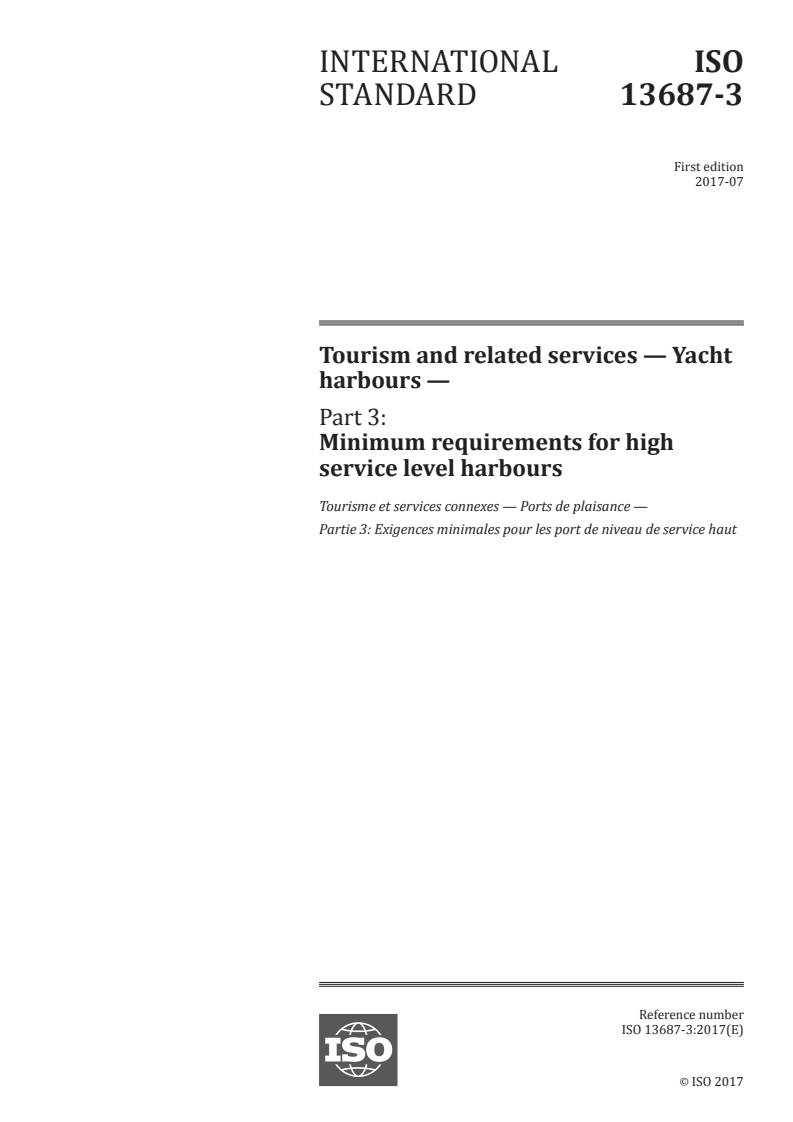
INTERNATIONAL ISO
STANDARD 13687-3
First edition
2017-07
Tourism and related services — Yacht
harbours —
Part 3:
Minimum requirements for high
service level harbours
Tourisme et services connexes — Ports de plaisance —
Partie 3: Exigences minimales pour les port de niveau de service haut
Reference number
©
ISO 2017
© ISO 2017, Published in Switzerland
All rights reserved. Unless otherwise specified, no part of this publication may be reproduced or utilized otherwise in any form
or by any means, electronic or mechanical, including photocopying, or posting on the internet or an intranet, without prior
written permission. Permission can be requested from either ISO at the address below or ISO’s member body in the country of
the requester.
ISO copyright office
Ch. de Blandonnet 8 • CP 401
CH-1214 Vernier, Geneva, Switzerland
Tel. +41 22 749 01 11
Fax +41 22 749 09 47
copyright@iso.org
www.iso.org
ii © ISO 2017 – All rights reserved
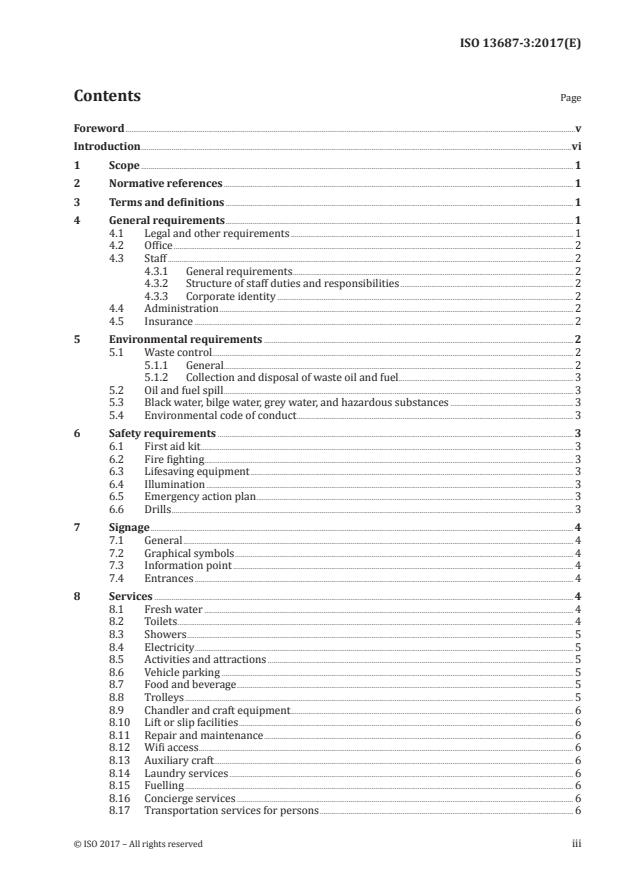
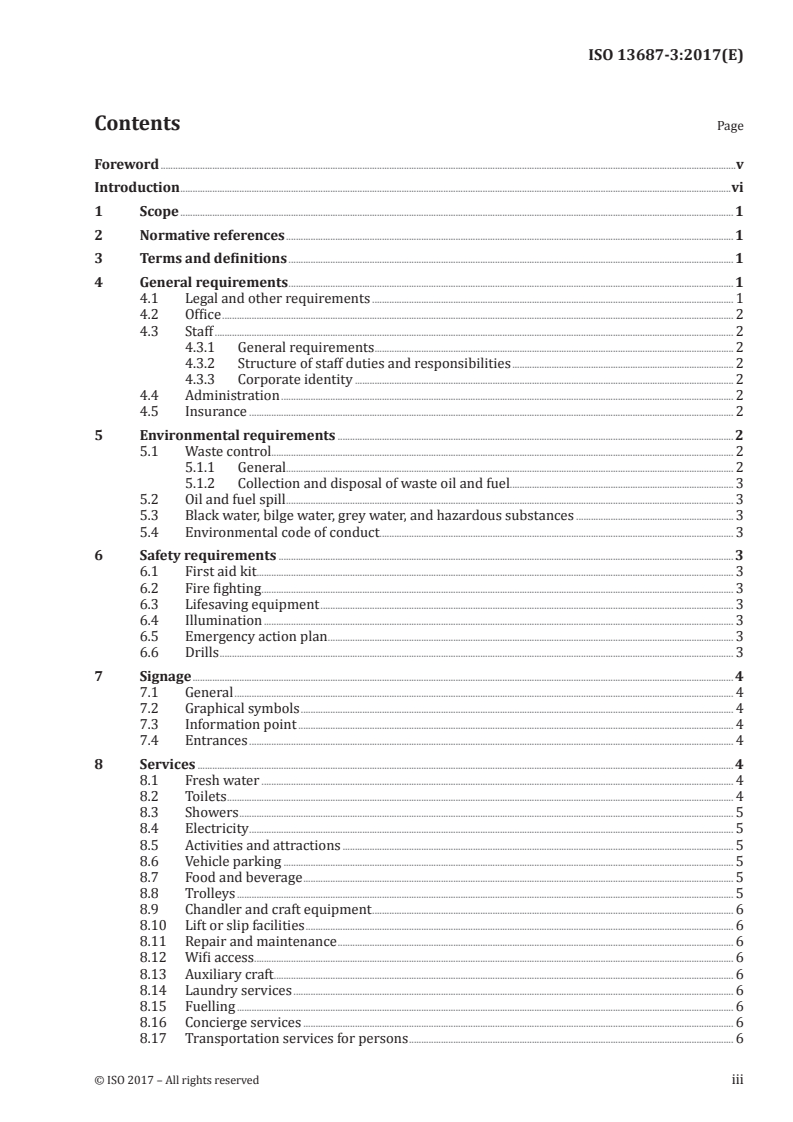
Contents Page
Foreword .v
Introduction .vi
1 Scope . 1
2 Normative references . 1
3 Terms and definitions . 1
4 General requirements . 1
4.1 Legal and other requirements . 1
4.2 Office . 2
4.3 Staff . 2
4.3.1 General requirements . 2
4.3.2 Structure of staff duties and responsibilities . 2
4.3.3 Corporate identity . 2
4.4 Administration . 2
4.5 Insurance . 2
5 Environmental requirements . 2
5.1 Waste control. 2
5.1.1 General. 2
5.1.2 Collection and disposal of waste oil and fuel. 3
5.2 Oil and fuel spill . 3
5.3 Black water, bilge water, grey water, and hazardous substances . 3
5.4 Environmental code of conduct. 3
6 Safety requirements . 3
6.1 First aid kit. 3
6.2 Fire fighting . 3
6.3 Lifesaving equipment . 3
6.4 Illumination . 3
6.5 Emergency action plan . 3
6.6 Drills . 3
7 Signage . 4
7.1 General . 4
7.2 Graphical symbols . 4
7.3 Information point . 4
7.4 Entrances . 4
8 Services . 4
8.1 Fresh water . 4
8.2 Toilets . 4
8.3 Showers . 5
8.4 Electricity . 5
8.5 Activities and attractions . 5
8.6 Vehicle parking . 5
8.7 Food and beverage . 5
8.8 Trolleys . 5
8.9 Chandler and craft equipment . 6
8.10 Lift or slip facilities . 6
8.11 Repair and maintenance . 6
8.12 Wifi access . 6
8.13 Auxiliary craft. 6
8.14 Laundry services . 6
8.15 Fuelling . 6
8.16 Concierge services . 6
8.17 Transportation services for persons . 6
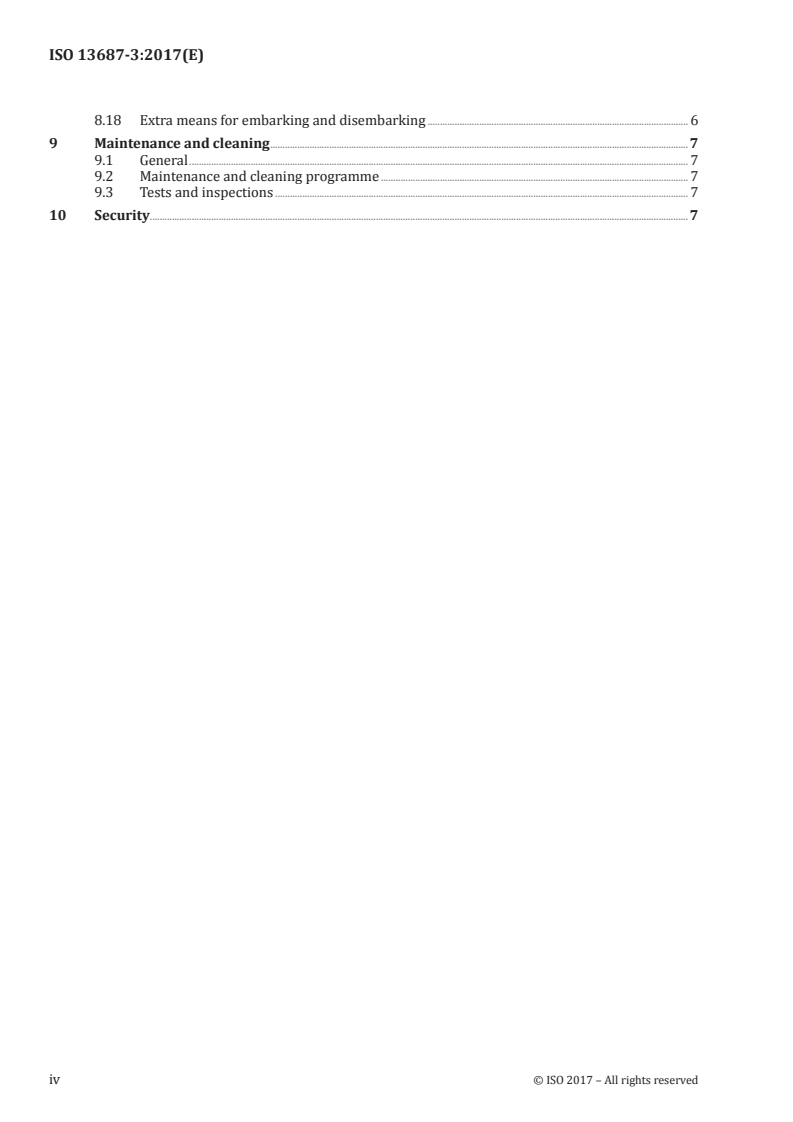
8.18 Extra means for embarking and disembarking . 6
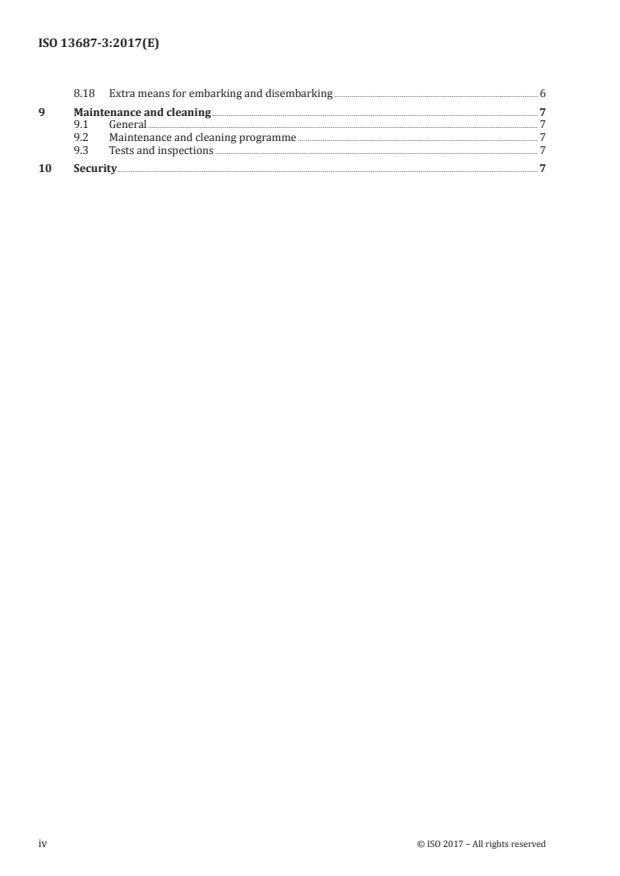
9 Maintenance and cleaning . 7
9.1 General . 7
9.2 Maintenance and cleaning programme . 7
9.3 Tests and inspections . 7
10 Security. 7
iv © ISO 2017 – All rights reserved
Foreword
ISO (the International Organization for Standardization) is a worldwide federation of national standards
bodies (ISO member bodies). The work of preparing International Standards is normally carried out
through ISO technical committees. Each member body interested in a subject for which a technical
committee has been established has the right to be represented on that committee. International
organizations, governmental and non-governmental, in liaison with ISO, also take part in the work.
ISO collaborates closely with the International Electrotechnical Commission (IEC) on all matters of
electrotechnical standardization.
The procedures used to develop this document and those intended for its further maintenance are
described in the ISO/IEC Directives, Part 1. In particular the different approval criteria needed for the
different types of ISO documents should be noted. This document was drafted in accordance with the
editorial rules of the ISO/IEC Directives, Part 2 (see www .iso .org/ directives).
Attention is drawn to the possibility that some of the elements of this document may be the subject of
patent rights. ISO shall not be held responsible for identifying any or all such patent rights. Details of
any patent rights identified during the development of the document will be in the Introduction and/or
on the ISO list of patent declarations received (see www .iso .org/ patents).
Any trade name used in this document is information given for the convenience of users and does not
constitute an endorsement.
For an explanation on the voluntary nature of standards, the meaning of ISO specific terms and
expressions related to conformity assessment, as well as information about ISO’s adherence to the
World Trade Organization (WTO) principles in the Technical Barriers to Trade (TBT) see the following
URL: w w w . i s o .org/ iso/ foreword .html.
This document was prepared by Technical
...
INTERNATIONAL ISO
STANDARD 13687-3
First edition
2017-07
Tourism and related services — Yacht
harbours —
Part 3:
Minimum requirements for high
service level harbours
Tourisme et services connexes — Ports de plaisance —
Partie 3: Exigences minimales pour les port de niveau de service haut
Reference number
©
ISO 2017
© ISO 2017, Published in Switzerland
All rights reserved. Unless otherwise specified, no part of this publication may be reproduced or utilized otherwise in any form
or by any means, electronic or mechanical, including photocopying, or posting on the internet or an intranet, without prior
written permission. Permission can be requested from either ISO at the address below or ISO’s member body in the country of
the requester.
ISO copyright office
Ch. de Blandonnet 8 • CP 401
CH-1214 Vernier, Geneva, Switzerland
Tel. +41 22 749 01 11
Fax +41 22 749 09 47
copyright@iso.org
www.iso.org
ii © ISO 2017 – All rights reserved
Contents Page
Foreword .v
Introduction .vi
1 Scope . 1
2 Normative references . 1
3 Terms and definitions . 1
4 General requirements . 1
4.1 Legal and other requirements . 1
4.2 Office . 2
4.3 Staff . 2
4.3.1 General requirements . 2
4.3.2 Structure of staff duties and responsibilities . 2
4.3.3 Corporate identity . 2
4.4 Administration . 2
4.5 Insurance . 2
5 Environmental requirements . 2
5.1 Waste control. 2
5.1.1 General. 2
5.1.2 Collection and disposal of waste oil and fuel. 3
5.2 Oil and fuel spill . 3
5.3 Black water, bilge water, grey water, and hazardous substances . 3
5.4 Environmental code of conduct. 3
6 Safety requirements . 3
6.1 First aid kit. 3
6.2 Fire fighting . 3
6.3 Lifesaving equipment . 3
6.4 Illumination . 3
6.5 Emergency action plan . 3
6.6 Drills . 3
7 Signage . 4
7.1 General . 4
7.2 Graphical symbols . 4
7.3 Information point . 4
7.4 Entrances . 4
8 Services . 4
8.1 Fresh water . 4
8.2 Toilets . 4
8.3 Showers . 5
8.4 Electricity . 5
8.5 Activities and attractions . 5
8.6 Vehicle parking . 5
8.7 Food and beverage . 5
8.8 Trolleys . 5
8.9 Chandler and craft equipment . 6
8.10 Lift or slip facilities . 6
8.11 Repair and maintenance . 6
8.12 Wifi access . 6
8.13 Auxiliary craft. 6
8.14 Laundry services . 6
8.15 Fuelling . 6
8.16 Concierge services . 6
8.17 Transportation services for persons . 6
8.18 Extra means for embarking and disembarking . 6
9 Maintenance and cleaning . 7
9.1 General . 7
9.2 Maintenance and cleaning programme . 7
9.3 Tests and inspections . 7
10 Security. 7
iv © ISO 2017 – All rights reserved
Foreword
ISO (the International Organization for Standardization) is a worldwide federation of national standards
bodies (ISO member bodies). The work of preparing International Standards is normally carried out
through ISO technical committees. Each member body interested in a subject for which a technical
committee has been established has the right to be represented on that committee. International
organizations, governmental and non-governmental, in liaison with ISO, also take part in the work.
ISO collaborates closely with the International Electrotechnical Commission (IEC) on all matters of
electrotechnical standardization.
The procedures used to develop this document and those intended for its further maintenance are
described in the ISO/IEC Directives, Part 1. In particular the different approval criteria needed for the
different types of ISO documents should be noted. This document was drafted in accordance with the
editorial rules of the ISO/IEC Directives, Part 2 (see www .iso .org/ directives).
Attention is drawn to the possibility that some of the elements of this document may be the subject of
patent rights. ISO shall not be held responsible for identifying any or all such patent rights. Details of
any patent rights identified during the development of the document will be in the Introduction and/or
on the ISO list of patent declarations received (see www .iso .org/ patents).
Any trade name used in this document is information given for the convenience of users and does not
constitute an endorsement.
For an explanation on the voluntary nature of standards, the meaning of ISO specific terms and
expressions related to conformity assessment, as well as information about ISO’s adherence to the
World Trade Organization (WTO) principles in the Technical Barriers to Trade (TBT) see the following
URL: w w w . i s o .org/ iso/ foreword .html.
This document was prepared by Technical
...