

ISO 5398-2:2009
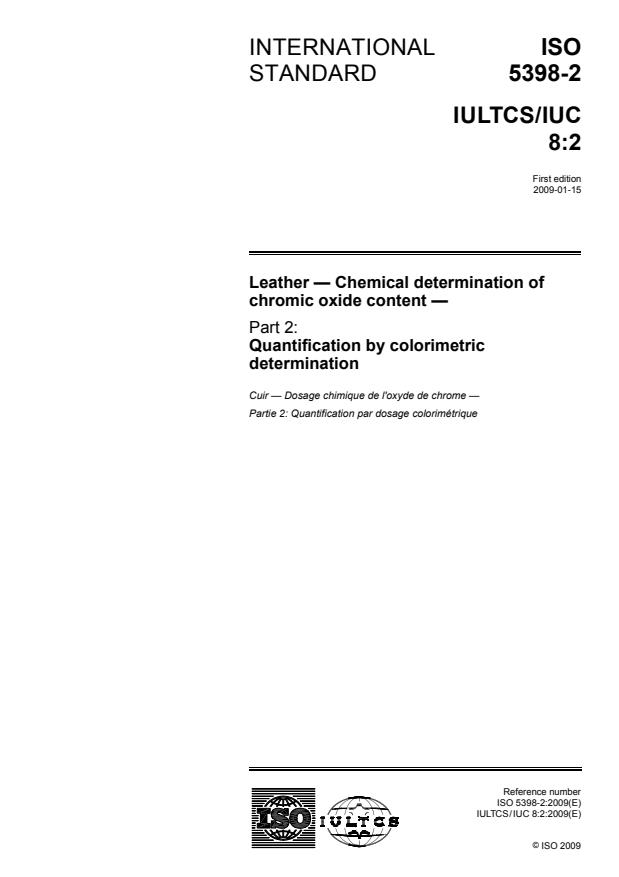
(Main)Leather — Chemical determination of chromic oxide content — Part 2: Quantification by colorimetric determination
General Information
- Abstract
ISO 5398-2:2009 describes the determination of chrome by colorimetric means. It is applicable to leathers which are expected to have chromic oxide contents in excess of 0,05 %. This is an analysis for total chromium in leather; it is not compound specific or specific to its oxidation state.
- Status
- Published
- Publication Date
- 06-Jan-2009
- Technical Committee
- IULTCS - International Union of Leather Technologists and Chemists Societies
- Current Stage
- 9093 - International Standard confirmed
- Start Date
- 19-Jun-2026
- Completion Date
- 29-Aug-2026
Buy Documents
ISO 5398-2:2009 - Leather — Chemical determination of chromic oxide content — Part 2: Quantification by colorimetric determination Released:1/7/2009
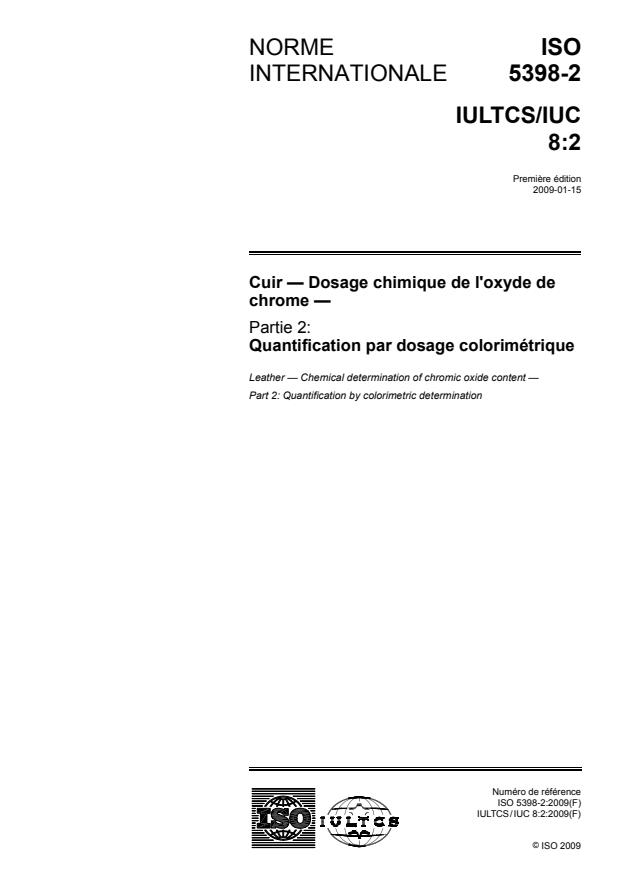
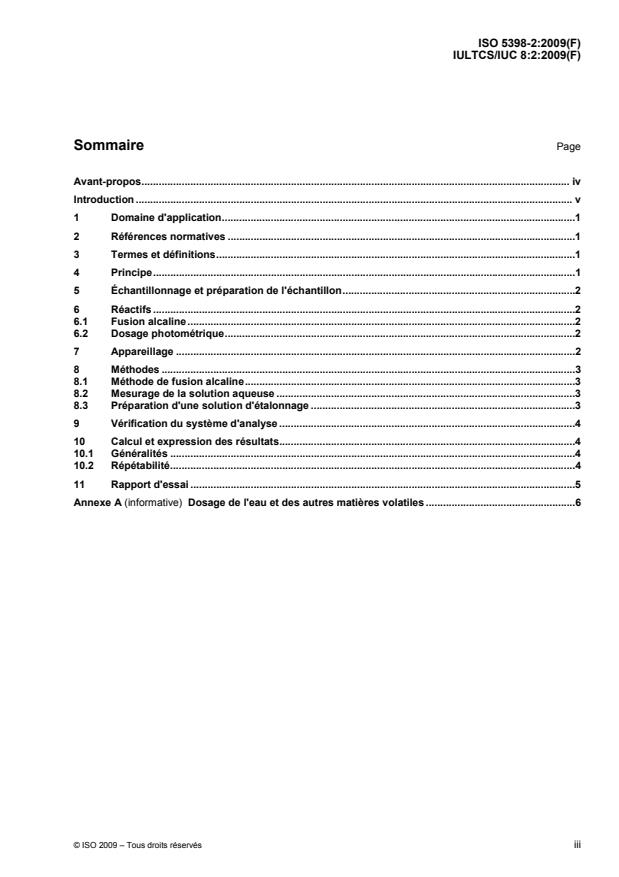
ISO 5398-2:2009 - Cuir — Dosage chimique de l'oxyde de chrome — Partie 2: Quantification par dosage colorimétrique Released:1/7/2009
Overview
ISO 5398-2:2009 is an international standard establishing a colorimetric method for the chemical determination of chromic oxide content in leather. This method is specifically designed for leathers expected to contain chromic oxide in excess of 0.05%. It provides a standardized approach for quantifying total chromium content without differentiating chromium compounds or oxidation states.
The standard complements other parts of ISO 5398, which cover titration, atomic absorption spectrometry, and inductively coupled plasma optical emission spectrometry methods. ISO 5398-2 focuses on practical colorimetric analysis using spectrophotometry, making it suitable for industrial and laboratory applications where chromic oxide levels need reliable and accurate determination.
Key Topics
- Scope: Quantifies total chromium, expressed as chromic oxide (Cr₂O₃), in dry leather via colorimetric determination.
- Sampling and Preparation: Requires grinding leather samples and accurate weighing (typically 0.75 g) following ISO 2418 (sampling location) and ISO 4044 (sample preparation).
- Analytical Principle:
- Leather ash is fused using an alkaline mixture.
- Chromium is solubilized in hexavalent form and reacts with 1,5-diphenyl carbazide.
- The resulting colored complex is measured photometrically at 540 nm.
- Reagents: Use of high-grade chemicals including sodium and potassium carbonates, sodium tetraborate for fusion; sulfuric acid; potassium dichromate as standard; and diphenyl carbazide as the color reagent.
- Apparatus: Standard laboratory equipment such as a muffle furnace, porcelain or platinum crucibles, spectrophotometer capable of precise absorbance readings, and filtration devices.
- Method Steps:
- Ashing leather samples at ~750 °C.
- Alkaline fusion of ash.
- Dissolution, acidification, and preparation of the test solution.
- Colorimetric reaction by addition of diphenyl carbazide.
- Absorbance measurement against calibration standards.
- Calibration and Validation: Construction of a calibration curve through potassium dichromate standards; routine system checks to ensure method accuracy.
- Calculation: Determining chromic oxide content considering sample mass, dilution factors, and volatile matter content (corrected by ISO 4684).
- Repeatability: Duplicate tests should vary by no more than 0.1% Cr₂O₃, ensuring method reliability.
- Reporting: Test reports must include standard reference, leather description, methodology details, volatile matter content, test results with appropriate precision, and any procedural deviations.
Applications
- Leather Industry Quality Control: Enables tanneries and leather manufacturers to monitor chromium content in raw and processed leathers, ensuring compliance with product specifications and regulatory limits.
- Environmental and Health Compliance: Accurate chromium quantification helps assess potential environmental impacts and occupational safety related to chromium in leather goods.
- Research and Development: Supports development of new leather treatments and testing protocols by providing a reliable chemical analysis method for chromium content.
- Standardized Testing Laboratories: Provides laboratories with a validated procedure that aligns with international standards for chromic oxide determination.
Related Standards
ISO 5398-1: Chemical determination of chromic oxide content - Quantification by titration
An alternate method focusing on titrimetric analysis of chromium in leather.ISO 5398-3: Chemical determination of chromic oxide content - Quantification by atomic absorption spectrometry
A more sensitive instrumentation-based technique using atomic absorption.ISO 5398-4: Chemical determination of chromic oxide content - Quantification by ICP-OES
Employs inductively coupled plasma optical emission spectroscopy for chromium quantification.ISO 2418: Leather - Chemical, physical and mechanical and fastness tests - Sampling location
Guidance on appropriate leather sampling for testing.ISO 4044: Leather - Chemical tests - Preparation of chemical test samples
Defines preparation methods of leather samples for chemical analysis.ISO 4684: Leather - Chemical tests - Determination of volatile matter
Method for determining moisture and volatile components in leather samples.ISO 3696:1987: Water for analytical laboratory use - Specification and test methods
Specifies water quality requirements for analytical reagents and processes.
Keywords: ISO 5398-2, chromic oxide content, leather chemical analysis, colorimetric determination, chromium quantification, leather testing standards, spectrophotometric analysis, leather quality control, chromium in leather, leather testing methods.
Relations
- Effective Date
- 25-Aug-2026
- Effective Date
- 12-Feb-2026
- Consolidates
ISO 8974:1997 - Plastics — Phenolic resins — Determination of residual phenol content by gas chromatography - Effective Date
- 06-Jun-2022
Buy Documents
ISO 5398-2:2009 - Leather — Chemical determination of chromic oxide content — Part 2: Quantification by colorimetric determination Released:1/7/2009
ISO 5398-2:2009 - Cuir — Dosage chimique de l'oxyde de chrome — Partie 2: Quantification par dosage colorimétrique Released:1/7/2009
Get Certified
Connect with accredited certification bodies for this standard

Control Union Certifications
Global certification for agriculture and sustainability.

Hohenstein Institut
Textile testing and certification.

Bureau Veritas Bangladesh
Bureau Veritas certification services in Bangladesh.
Sponsored listings
Frequently Asked Questions
ISO 5398-2:2009 is a standard published by the International Organization for Standardization (ISO). Its full title is "Leather — Chemical determination of chromic oxide content — Part 2: Quantification by colorimetric determination". This standard covers: ISO 5398-2:2009 describes the determination of chrome by colorimetric means. It is applicable to leathers which are expected to have chromic oxide contents in excess of 0,05 %. This is an analysis for total chromium in leather; it is not compound specific or specific to its oxidation state.
ISO 5398-2:2009 describes the determination of chrome by colorimetric means. It is applicable to leathers which are expected to have chromic oxide contents in excess of 0,05 %. This is an analysis for total chromium in leather; it is not compound specific or specific to its oxidation state.
ISO 5398-2:2009 is classified under the following ICS (International Classification for Standards) categories: 59.140.30 - Leather and furs. The ICS classification helps identify the subject area and facilitates finding related standards.
ISO 5398-2:2009 has the following relationships with other standards: It is inter standard links to EN ISO 20137:2017, EN ISO 5398-2:2009, ISO 8974:1997. Understanding these relationships helps ensure you are using the most current and applicable version of the standard.
ISO 5398-2:2009 is available in PDF format for immediate download after purchase. The document can be added to your cart and obtained through the secure checkout process. Digital delivery ensures instant access to the complete standard document.
Standards Content (Sample)
INTERNATIONAL ISO
STANDARD 5398-2
IULTCS/IUC
8:2
First edition
2009-01-15
Leather — Chemical determination of
chromic oxide content —
Part 2:
Quantification by colorimetric
determination
Cuir — Dosage chimique de l'oxyde de chrome —
Partie 2: Quantification par dosage colorimétrique
Reference number
IULTCS/IUC 8:2:2009(E)
©
ISO 2009
IULTCS/IUC 8:2:2009(E)
PDF disclaimer
This PDF file may contain embedded typefaces. In accordance with Adobe's licensing policy, this file may be printed or viewed but
shall not be edited unless the typefaces which are embedded are licensed to and installed on the computer performing the editing. In
downloading this file, parties accept therein the responsibility of not infringing Adobe's licensing policy. The ISO Central Secretariat
accepts no liability in this area.
Adobe is a trademark of Adobe Systems Incorporated.
Details of the software products used to create this PDF file can be found in the General Info relative to the file; the PDF-creation
parameters were optimized for printing. Every care has been taken to ensure that the file is suitable for use by ISO member bodies. In
the unlikely event that a problem relating to it is found, please inform the Central Secretariat at the address given below.
© ISO 2009
All rights reserved. Unless otherwise specified, no part of this publication may be reproduced or utilized in any form or by any means,
electronic or mechanical, including photocopying and microfilm, without permission in writing from either ISO at the address below or
ISO's member body in the country of the requester.
ISO copyright office
Case postale 56 • CH-1211 Geneva 20
Tel. + 41 22 749 01 11
Fax + 41 22 749 09 47
E-mail copyright@iso.org
Web www.iso.org
Published in Switzerland
ii © ISO 2009 – All rights reserved
IULTCS/IUC 8:2:2009(E)
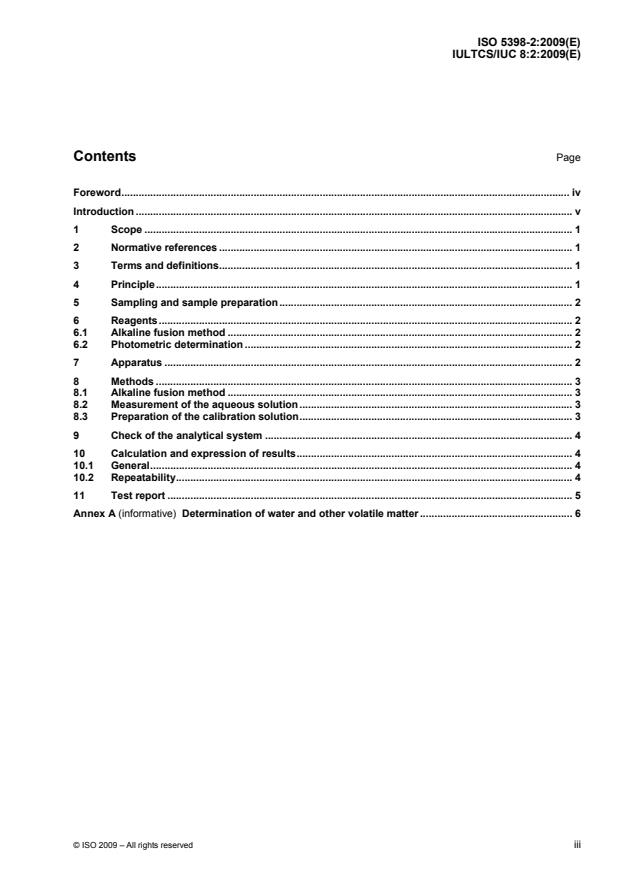
Contents Page
Foreword. iv
Introduction . v
1 Scope . 1
2 Normative references . 1
3 Terms and definitions. 1
4 Principle. 1
5 Sampling and sample preparation. 2
6 Reagents. 2
6.1 Alkaline fusion method . 2
6.2 Photometric determination . 2
7 Apparatus . 2
8 Methods . 3
8.1 Alkaline fusion method . 3
8.2 Measurement of the aqueous solution. 3
8.3 Preparation of the calibration solution. 3
9 Check of the analytical system . 4
10 Calculation and expression of results. 4
10.1 General. 4
10.2 Repeatability. 4
11 Test report . 5
Annex A (informative) Determination of water and other volatile matter . 6
IULTCS/IUC 8:2:2009(E)
Foreword
ISO (the International Organization for Standardization) is a worldwide federation of national standards bodies
(ISO member bodies). The work of preparing International Standards is normally carried out through ISO
technical committees. Each member body interested in a subject for which a technical committee has been
established has the right to be represented on that committee. International organizations, governmental and
non-governmental, in liaison with ISO, also take part in the work. ISO collaborates closely with the
International Electrotechnical Commission (IEC) on all matters of electrotechnical standardization.
International Standards are drafted in accordance with the rules given in the ISO/IEC Directives, Part 2.
The main task of technical committees is to prepare International Standards. Draft International Standards
adopted by the technical committees are circulated to the member bodies for voting. Publication as an
International Standard requires approval by at least 75 % of the member bodies casting a vote.
Attention is drawn to the possibility that some of the elements of this document may be the subject of patent
rights. ISO shall not be held responsible for identifying any or all such patent rights.
ISO 5398-2 was prepared by the European Committee for Standardization (CEN) Technical Committee
CEN/TC 289, Leather, in collaboration with the Chemical Tests Commission of the International Union of
Leather Technologists and Chemists Societies (IUC Commission, IULTCS), in accordance with the
Agreement on technical cooperation between ISO and CEN (Vienna Agreement). It is based on IUC 8
originally published in J. Soc. Leather Tech. Chem., 49, p. 17, 1965, and declared an official method of the
IULTCS in 1965.
IULTCS, originally formed in 1897, is a world-wide organization of professional leather societies to further the
advancement of leather science and technology. IULTCS has three Commissions, which are responsible for
establishing international methods for the sampling and testing of leather. ISO recognizes IULTCS as an
international standardizing body for the preparation of test methods for leather.
ISO 5398 consists of the following parts, under the general title Leather — Chemical determination of chromic
oxide content:
⎯ Part 1: Quantification by titration
⎯ Part 2: Quantification by colorimetric determination
⎯ Part 3: Quantification by atomic absorption spectrometry
⎯ Part 4: Quantification by inductively coupled plasma — optical emission spectrometer (ICP-OES)
iv © ISO 2009 – All rights reserved
IULTCS/IUC 8:2:2009(E)
Introduction
ISO 5398 has been split into four parts, each describing methods suitable for the determination of the chromic
oxide content in leather. The different techniques have been described to reflect the variations in industrial
practice compared with the more sensitive analytical equipment available for test laboratories. Variations also
exist in the range of chromic oxide that the methods are deemed suitable to quantify.
ISO 5398-2 describes a colorimetric technique that requires the use of a spectrophotometer.
INTERNATIONAL STANDARD
IULTCS/IUC 8:2:2009(E)
Leather — Chemical determination of chromic oxide content —
Part 2:
Quantification by colorimetric determination
1 Scope
This part of ISO 5398 describes the determination of chrome by colorimetric means. It is applicable to leathers
which are expected to have chromic oxide contents in excess of 0,05 %.
This is an analysis for total chromium in leather; it is not compound specific or specific to its oxidation state.
2 Normative references
The following referenced documents are indispensable for the application of this document. For dated
references, only the edition cited applies. For undated references, the latest edition of the referenced
document (including any amendments) applies.
ISO 2418, Leather — Chemical, physical and mechanical and fastness tests — Sampling location
ISO 3696:1987, Water for analytical laboratory use — Specification and test methods
...
NORME ISO
INTERNATIONALE 5398-2
IULTCS/IUC
8:2
Première édition
2009-01-15
Cuir — Dosage chimique de l'oxyde de
chrome —
Partie 2:
Quantification par dosage colorimétrique
Leather — Chemical determination of chromic oxide content —
Part 2: Quantification by colorimetric determination
Numéro de référence
IULTCS/IUC 8:2:2009(F)
©
ISO 2009
IULTCS/IUC 8:2:2009(F)
PDF – Exonération de responsabilité
Le présent fichier PDF peut contenir des polices de caractères intégrées. Conformément aux conditions de licence d'Adobe, ce fichier
peut être imprimé ou visualisé, mais ne doit pas être modifié à moins que l'ordinateur employé à cet effet ne bénéficie d'une licence
autorisant l'utilisation de ces polices et que celles-ci y soient installées. Lors du téléchargement de ce fichier, les parties concernées
acceptent de fait la responsabilité de ne pas enfreindre les conditions de licence d'Adobe. Le Secrétariat central de l'ISO décline toute
responsabilité en la matière.
Adobe est une marque déposée d'Adobe Systems Incorporated.
Les détails relatifs aux produits logiciels utilisés pour la création du présent fichier PDF sont disponibles dans la rubrique General Info
du fichier; les paramètres de création PDF ont été optimisés pour l'impression. Toutes les mesures ont été prises pour garantir
l'exploitation de ce fichier par les comités membres de l'ISO. Dans le cas peu probable où surviendrait un problème d'utilisation,
veuillez en informer le Secrétariat central à l'adresse donnée ci-dessous.
DOCUMENT PROTÉGÉ PAR COPYRIGHT
© ISO 2009
Droits de reproduction réservés. Sauf prescription différente, aucune partie de cette publication ne peut être reproduite ni utilisée sous
quelque forme que ce soit et par aucun procédé, électronique ou mécanique, y compris la photocopie et les microfilms, sans l'accord écrit
de l'ISO à l'adresse ci-après ou du comité membre de l'ISO dans le pays du demandeur.
ISO copyright office
Case postale 56 • CH-1211 Geneva 20
Tel. + 41 22 749 01 11
Fax + 41 22 749 09 47
E-mail copyright@iso.org
Web www.iso.org
Publié en Suisse
ii © ISO 2009 – Tous droits réservés
IULTCS/IUC 8:2:2009(F)
Sommaire Page
Avant-propos. iv
Introduction . v
1 Domaine d'application.1
2 Références normatives .1
3 Termes et définitions.1
4 Principe.1
5 Échantillonnage et préparation de l'échantillon.2
6 Réactifs .2
6.1 Fusion alcaline.2
6.2 Dosage photométrique.2
7 Appareillage .2
8 Méthodes .3
8.1 Méthode de fusion alcaline.3
8.2 Mesurage de la solution aqueuse .3
8.3 Préparation d'une solution d'étalonnage .3
9 Vérification du système d'analyse .4
10 Calcul et expression des résultats.4
10.1 Généralités .4
10.2 Répétabilité.4
11 Rapport d'essai .5
Annexe A (informative) Dosage de l'eau et des autres matières volatiles .6
IULTCS/IUC 8:2:2009(F)
Avant-propos
L'ISO (Organisation internationale de normalisation) est une fédération mondiale d'organismes nationaux de
normalisation (comités membres de l'ISO). L'élaboration des Normes internationales est en général confiée
aux comités techniques de l'ISO. Chaque comité membre intéressé par une étude a le droit de faire partie du
comité technique créé à cet effet. Les organisations internationales, gouvernementales et non
gouvernementales, en liaison avec l'ISO participent également aux travaux. L'ISO collabore étroitement avec
la Commission électrotechnique internationale (CEI) en ce qui concerne la normalisation électrotechnique.
Les Normes internationales sont rédigées conformément aux règles données dans les Directives ISO/CEI,
Partie 2.
La tâche principale des comités techniques est d'élaborer les Normes internationales. Les projets de Normes
internationales adoptés par les comités techniques sont soumis aux comités membres pour vote. Leur
publication comme Normes internationales requiert l'approbation de 75 % au moins des comités membres
votants.
L'attention est appelée sur le fait que certains des éléments du présent document peuvent faire l'objet de
droits de propriété intellectuelle ou de droits analogues. L'ISO ne saurait être tenue pour responsable de ne
pas avoir identifié de tels droits de propriété et averti de leur existence.
La présente partie de l'ISO 5398 a été élaborée par le comité technique CEN/TC 289, Cuir, du Comité
européen de normalisation (CEN), en collaboration avec la Commission d'essais chimiques de l'Union
internationale des sociétés de techniciens et chimistes du cuir (commission IUC, IULTCS), conformément à
l'Accord de coopération technique entre l'ISO et le CEN (Accord de Vienne). Elle est fondée sur l'IUC 8
publiée dans le J. Soc. Leather Tech. Chem., 49, p. 17, 1965, et déclarée méthode officielle de l'IULTCS en
1965.
L'IULTCS est une organisation mondiale de sociétés professionnelles des industries du cuir fondée en 1897
ayant pour mission de favoriser l'avancement des sciences et technologies du cuir. L'IULTCS a trois
commissions, qui sont responsables de l'établissement des méthodes internationales d'échantillonnage et
d'essai des cuirs. L'ISO reconnaît l'IULTCS en tant qu'organisme international à activités normatives pour
l'élaboration de méthodes d'essai relatives au cuir.
L'ISO 5398 comprend les parties suivantes, présentées sous le titre général Cuir — Dosage chimique de
l'oxyde de chrome:
⎯ Partie 1: Quantification par titrage
⎯ Partie 2: Quantification par dosage colorimétrique
⎯ Partie 3: Quantification par spectrométrie d'absorption atomique
⎯ Partie 4: Quantification par plasma à couplage inductif - spectromètre d'émission optique (ICP-OES)
iv © ISO 2009 – Tous droits réservés
IULTCS/IUC 8:2:2009(F)
Introduction
L'ISO 5398 a été divisée en quatre parties qui décrivent chacune des méthodes adaptées au dosage de
l'oxyde de chrome dans le cuir. Ces différentes techniques ont été décrites pour illustrer les variations existant
dans la pratique industrielle par rapport à l'équipement d'analyse plus sensible, disponible pour les essais en
laboratoire. Différentes gammes de teneur en oxyde de chrome peuvent être quantifiées par ces méthodes.
L'ISO 5398-2 décrit une technique colorimétrique nécessitant l'utilisation d'un spectrophotomètre.
NORME INTERNATIONALE
IULTCS/IUC 8:2:2009(F)
Cuir — Dosage chimique de l'oxyde de chrome —
Partie 2:
Quantification par dosage colorimétrique
1 Domaine d'application
La présente partie de l'ISO 5398 décrit le dosage du chrome par des moyens colorimétriques. Elle est
applicable aux cuirs susceptibles d'avoir des teneurs en oxyde de chrome supérieures à 0,05 %.
Il s'agit d'une analyse du chrome total dans le cuir qui n'est spécifique ni d'un composant particulier ni de l'état
d'oxydation.
2 Références normatives
Les documents de référence suivants sont indispensables pour l'application du présent document. Pour les
références datées, seule l'édition citée s'applique. Pour les références non datées, la dernière édition du
document de référence s'applique (y compris les éventuels amendements).
ISO 2418, Cuir — Essais chimiques, physiques, mécaniques et de solidité — Emplacement de
l'échantillonnage
ISO 3696:1987, Eau pour laboratoire à usage analytique — Spécification et méthodes d'essai
ISO 4044, Cuir — Essais chimiques — Préparation des échantillons pour essais chimiques
ISO 4684, Cuir — Essais chimiques — Détermination des matières volatiles
3 Termes et définitions
Pour les besoins du présent document, les termes et définitions suivants s'appliquent.
...