

ISO/IEC 23092-3:2025
(Main)Information technology — Genomic information representation — Part 3: Metadata and application programming interfaces (APIs)
General Information
- Abstract
This document specifies information metadata, metrics metadata, clinical data linkage metadata, auxiliary fields, SAM interoperability, protection metadata and programming interfaces of genomic information. It defines: — metadata storage and interpretation for the different encapsulation levels as specified in ISO/IEC 23092-1 (in REF Section_sec_6 \r \h Clause 6 08D0C9EA79F9BACE118C8200AA004BA90B02000000080000000E000000530065006300740069006F006E005F007300650063005F0036000000 ); — metrics metadata containing sequencing data metrics at the dataset and access unit levels as specified in ISO/IEC 23092-1 (in REF Section_sec_7 \r \h Clause 7 08D0C9EA79F9BACE118C8200AA004BA90B02000000080000000E000000530065006300740069006F006E005F007300650063005F0037000000 ); — clinical data linkage metadata stored at the dataset group, dataset and annotation table levels as specified in ISO/IEC 23092-1 (in REF Section_sec_8 \r \h Clause 8 08D0C9EA79F9BACE118C8200AA004BA90B02000000080000000E000000530065006300740069006F006E005F007300650063005F0038000000 ); — protection elements providing confidentiality, integrity and privacy rules at the different encapsulation levels as specified in ISO/IEC 23092-1 (in REF Section_sec_9 \r \h Clause 9 08D0C9EA79F9BACE118C8200AA004BA90B02000000080000000E000000530065006300740069006F006E005F007300650063005F0039000000 ); — how to associate auxiliary fields to encoded reads (in REF Section_sec_10 \r \h Clause 10 08D0C9EA79F9BACE118C8200AA004BA90B02000000080000000F000000530065006300740069006F006E005F007300650063005F00310030000000 ); — interfaces to access genomic information coded in compliance with ISO/IEC 23092-1 and ISO/IEC 23092-2 (in REF Section_sec_12 \r \h Clause 12 08D0C9EA79F9BACE118C8200AA004BA90B02000000080000000F000000530065006300740069006F006E005F007300650063005F00310032000000 ); — mechanisms for backward compatibility with existing SAM content, and exportation to this format (in Annex E).
- Status
- Published
- Publication Date
- 22-May-2025
- Current Stage
- 6060 - International Standard published
- Start Date
- 23-May-2025
- Due Date
- 24-Jan-2025
- Completion Date
- 23-May-2025

Overview
ISO/IEC 23092-3:2025 - "Information technology - Genomic information representation - Part 3: Metadata and application programming interfaces (APIs)" - defines the metadata model, protection metadata and APIs for representing genomic information. This part complements ISO/IEC 23092-1 and ISO/IEC 23092-2 by specifying how to store, interpret and access dataset-group, dataset and annotation-table metadata; sequencing metrics; clinical data linkage; auxiliary fields; SAM interoperability; and confidentiality, integrity and privacy controls. It also provides API specifications for programmatic access and mechanisms for backward compatibility and export to SAM.
Key technical topics and requirements
- Metadata structures: Standardized metadata for dataset groups, datasets, references and annotation tables, including analytics, linkages and history fields.
- Metrics metadata: Sequencing and dataset-level metrics to support quality assessment and provenance tracking.
- Clinical data linkage (CDL): Metadata constructs to link genomic datasets to clinical records while supporting controlled access.
- Protection metadata: Definitions for encryption parameters, digital signatures and privacy rules applicable at multiple encapsulation levels (dataset group, dataset, annotation table).
- Auxiliary fields & read association: Mechanisms to attach auxiliary fields to encoded reads (genAux, genAuxRecord, genTag) to preserve additional per-read information.
- APIs: Detailed programming interfaces (data types, return codes, filters, output structures) for accessing genomic information compliant with ISO/IEC 23092-1/-2.
- Decoding and compatibility: Procedures for decoding metadata, extension mechanisms, metadata profiles (e.g., run-level profiles), and Annex E guidance for SAM interoperability and export.
- Security & privacy: Encryption/decryption flows, key retrieval, signature handling and privacy rule examples to ensure confidentiality and integrity of genomic data.
Practical applications
- Implementing standardized genomic data repositories and archives with interoperable metadata.
- Building bioinformatics tools and pipelines that read/write ISO/IEC 23092-compliant files and use the provided APIs.
- Integrating genomic datasets with electronic health records (EHRs) via clinical data linkage metadata while enforcing privacy controls.
- Enabling secure data sharing, encryption, and digital signing workflows for clinical genomics, research consortia and public health genomics.
- Migrating or exporting legacy SAM-format data to an ISO/IEC 23092 representation and maintaining backward compatibility.
Who should use this standard
- Bioinformatics engineers and software developers implementing genomic data formats and APIs
- Sequencing centers and clinical laboratories managing large genomic datasets
- Data repository architects, genomic data stewards and research consortia
- Healthcare IT integrators linking genomics to clinical systems while ensuring privacy and security
- Standards organizations and vendors building interoperable genomics tools
Related standards
- ISO/IEC 23092-1 (encapsulation levels and core format)
- ISO/IEC 23092-2 (compression and coding)
- SAM/Sequence Alignment/Map (interoperability and export guidance in Annex E)
Keywords: ISO/IEC 23092-3:2025, genomic information representation, metadata, APIs, protection metadata, metrics metadata, clinical data linkage, SAM interoperability, genomic data security.
Relations
- Effective Date
- 12-Aug-2023
Get Certified
Connect with accredited certification bodies for this standard

BSI Group
BSI (British Standards Institution) is the business standards company that helps organizations make excellence a habit.

NYCE
Mexican standards and certification body.
Sponsored listings
Frequently Asked Questions
ISO/IEC 23092-3:2025 is a standard published by the International Organization for Standardization (ISO). Its full title is "Information technology — Genomic information representation — Part 3: Metadata and application programming interfaces (APIs)". This standard covers: This document specifies information metadata, metrics metadata, clinical data linkage metadata, auxiliary fields, SAM interoperability, protection metadata and programming interfaces of genomic information. It defines: — metadata storage and interpretation for the different encapsulation levels as specified in ISO/IEC 23092-1 (in REF Section_sec_6 \r \h Clause 6 08D0C9EA79F9BACE118C8200AA004BA90B02000000080000000E000000530065006300740069006F006E005F007300650063005F0036000000 ); — metrics metadata containing sequencing data metrics at the dataset and access unit levels as specified in ISO/IEC 23092-1 (in REF Section_sec_7 \r \h Clause 7 08D0C9EA79F9BACE118C8200AA004BA90B02000000080000000E000000530065006300740069006F006E005F007300650063005F0037000000 ); — clinical data linkage metadata stored at the dataset group, dataset and annotation table levels as specified in ISO/IEC 23092-1 (in REF Section_sec_8 \r \h Clause 8 08D0C9EA79F9BACE118C8200AA004BA90B02000000080000000E000000530065006300740069006F006E005F007300650063005F0038000000 ); — protection elements providing confidentiality, integrity and privacy rules at the different encapsulation levels as specified in ISO/IEC 23092-1 (in REF Section_sec_9 \r \h Clause 9 08D0C9EA79F9BACE118C8200AA004BA90B02000000080000000E000000530065006300740069006F006E005F007300650063005F0039000000 ); — how to associate auxiliary fields to encoded reads (in REF Section_sec_10 \r \h Clause 10 08D0C9EA79F9BACE118C8200AA004BA90B02000000080000000F000000530065006300740069006F006E005F007300650063005F00310030000000 ); — interfaces to access genomic information coded in compliance with ISO/IEC 23092-1 and ISO/IEC 23092-2 (in REF Section_sec_12 \r \h Clause 12 08D0C9EA79F9BACE118C8200AA004BA90B02000000080000000F000000530065006300740069006F006E005F007300650063005F00310032000000 ); — mechanisms for backward compatibility with existing SAM content, and exportation to this format (in Annex E).
This document specifies information metadata, metrics metadata, clinical data linkage metadata, auxiliary fields, SAM interoperability, protection metadata and programming interfaces of genomic information. It defines: — metadata storage and interpretation for the different encapsulation levels as specified in ISO/IEC 23092-1 (in REF Section_sec_6 \r \h Clause 6 08D0C9EA79F9BACE118C8200AA004BA90B02000000080000000E000000530065006300740069006F006E005F007300650063005F0036000000 ); — metrics metadata containing sequencing data metrics at the dataset and access unit levels as specified in ISO/IEC 23092-1 (in REF Section_sec_7 \r \h Clause 7 08D0C9EA79F9BACE118C8200AA004BA90B02000000080000000E000000530065006300740069006F006E005F007300650063005F0037000000 ); — clinical data linkage metadata stored at the dataset group, dataset and annotation table levels as specified in ISO/IEC 23092-1 (in REF Section_sec_8 \r \h Clause 8 08D0C9EA79F9BACE118C8200AA004BA90B02000000080000000E000000530065006300740069006F006E005F007300650063005F0038000000 ); — protection elements providing confidentiality, integrity and privacy rules at the different encapsulation levels as specified in ISO/IEC 23092-1 (in REF Section_sec_9 \r \h Clause 9 08D0C9EA79F9BACE118C8200AA004BA90B02000000080000000E000000530065006300740069006F006E005F007300650063005F0039000000 ); — how to associate auxiliary fields to encoded reads (in REF Section_sec_10 \r \h Clause 10 08D0C9EA79F9BACE118C8200AA004BA90B02000000080000000F000000530065006300740069006F006E005F007300650063005F00310030000000 ); — interfaces to access genomic information coded in compliance with ISO/IEC 23092-1 and ISO/IEC 23092-2 (in REF Section_sec_12 \r \h Clause 12 08D0C9EA79F9BACE118C8200AA004BA90B02000000080000000F000000530065006300740069006F006E005F007300650063005F00310032000000 ); — mechanisms for backward compatibility with existing SAM content, and exportation to this format (in Annex E).
ISO/IEC 23092-3:2025 is classified under the following ICS (International Classification for Standards) categories: 35.040.99 - Other standards related to information coding. The ICS classification helps identify the subject area and facilitates finding related standards.
ISO/IEC 23092-3:2025 has the following relationships with other standards: It is inter standard links to ISO/IEC 23092-3:2022. Understanding these relationships helps ensure you are using the most current and applicable version of the standard.
ISO/IEC 23092-3:2025 is available in PDF format for immediate download after purchase. The document can be added to your cart and obtained through the secure checkout process. Digital delivery ensures instant access to the complete standard document.
Standards Content (Sample)
International
Standard
ISO/IEC 23092-3
Third edition
Information technology — Genomic
2025-05
information representation —
Part 3:
Metadata and application
programming interfaces (APIs)
Technologie de l'information — Représentation des informations
génomiques —
Partie 3: Métadonnées et interfaces de programmation
d'application (API)
Reference number
© ISO/IEC 2025
All rights reserved. Unless otherwise specified, or required in the context of its implementation, no part of this publication may
be reproduced or utilized otherwise in any form or by any means, electronic or mechanical, including photocopying, or posting on
the internet or an intranet, without prior written permission. Permission can be requested from either ISO at the address below
or ISO’s member body in the country of the requester.
ISO copyright office
CP 401 • Ch. de Blandonnet 8
CH-1214 Vernier, Geneva
Phone: +41 22 749 01 11
Email: copyright@iso.org
Website: www.iso.org
Published in Switzerland
© ISO/IEC 2025 – All rights reserved
ii
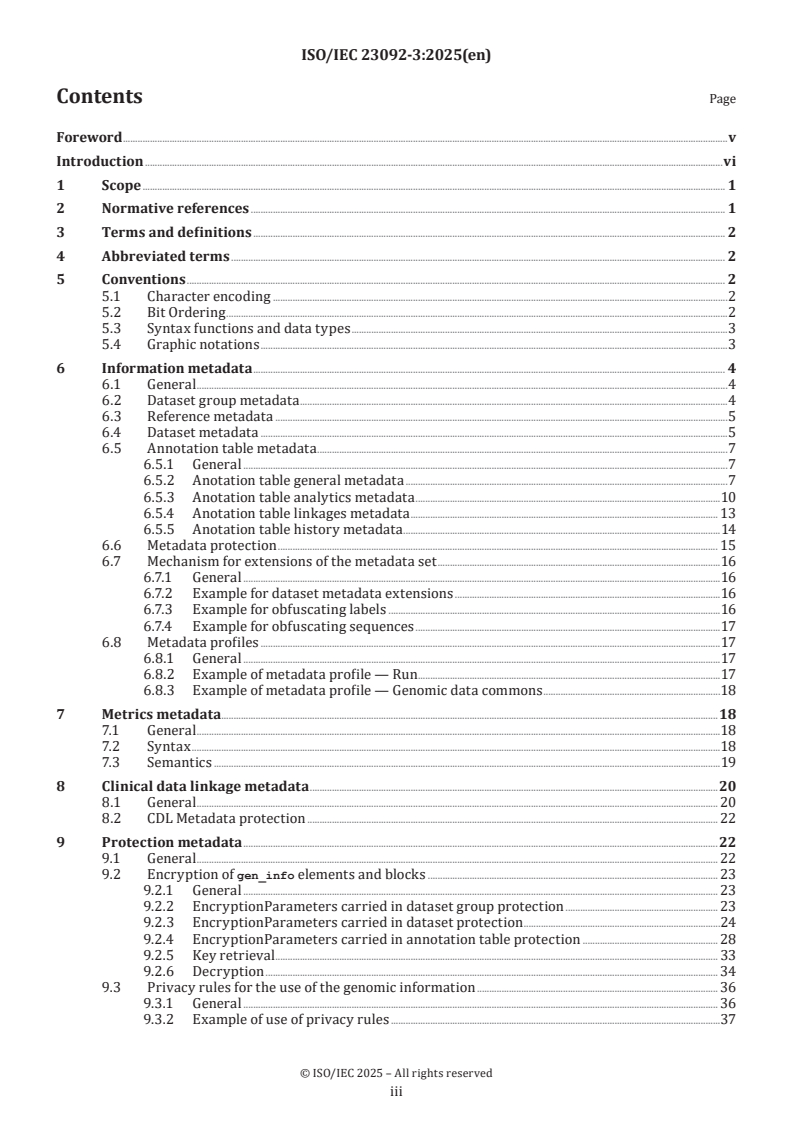
Contents Page
Foreword .v
Introduction .vi
1 Scope . 1
2 Normative references . 1
3 Terms and definitions . 2
4 Abbreviated terms . 2
5 Conventions . 2
5.1 Character encoding .2
5.2 Bit Ordering .2
5.3 Syntax functions and data types .3
5.4 Graphic notations .3
6 Information metadata . 4
6.1 General .4
6.2 Dataset group metadata .4
6.3 Reference metadata .5
6.4 Dataset metadata .5
6.5 Annotation table metadata .7
6.5.1 General .7
6.5.2 Anotation table general metadata .7
6.5.3 Anotation table analytics metadata .10
6.5.4 Anotation table linkages metadata . 13
6.5.5 Anotation table history metadata .14
6.6 Metadata protection . 15
6.7 Mechanism for extensions of the metadata set .16
6.7.1 General .16
6.7.2 Example for dataset metadata extensions .16
6.7.3 Example for obfuscating labels .16
6.7.4 Example for obfuscating sequences .17
6.8 Metadata profiles .17
6.8.1 General .17
6.8.2 Example of metadata profile — Run.17
6.8.3 Example of metadata profile — Genomic data commons .18
7 Metrics metadata.18
7.1 General .18
7.2 Syntax .18
7.3 Semantics .19
8 Clinical data linkage metadata .20
8.1 General . 20
8.2 CDL Metadata protection . 22
9 Protection metadata .22
9.1 General . 22
9.2 Encryption of gen_info elements and blocks . 23
9.2.1 General . 23
9.2.2 EncryptionParameters carried in dataset group protection . 23
9.2.3 EncryptionParameters carried in dataset protection .24
9.2.4 EncryptionParameters carried in annotation table protection . 28
9.2.5 Key retrieval . 33
9.2.6 Decryption . 34
9.3 Privacy rules for the use of the genomic information . 36
9.3.1 General . 36
9.3.2 Example of use of privacy rules .37
© ISO/IEC 2025 – All rights reserved
iii
9.4 Digital signature of gen_info elements and blocks . 38
9.4.1 General . 38
9.4.2 Signatures carried in dataset group protection . . 38
9.4.3 Signatures carried in dataset protection . 38
9.4.4 Signatures carried in annotation table protection . 40
9.4.5 Signatures carried in descriptor stream protection .42
10 Access unit information .42
10.1 General .42
10.2 genAuxRecord .43
10.3 genAux . 44
10.4 genTag . 44
11 Decoding process for metadata .45
11.1 General .45
11.2 Initialization of parameters .47
11.2.1 General .47
11.2.2 Properties .47
11.2.3 Parameters . 48
11.2.4 Constants . 48
11.2.5 Process . 49
11.3 Macros .51
11.4 Decoding process . 53
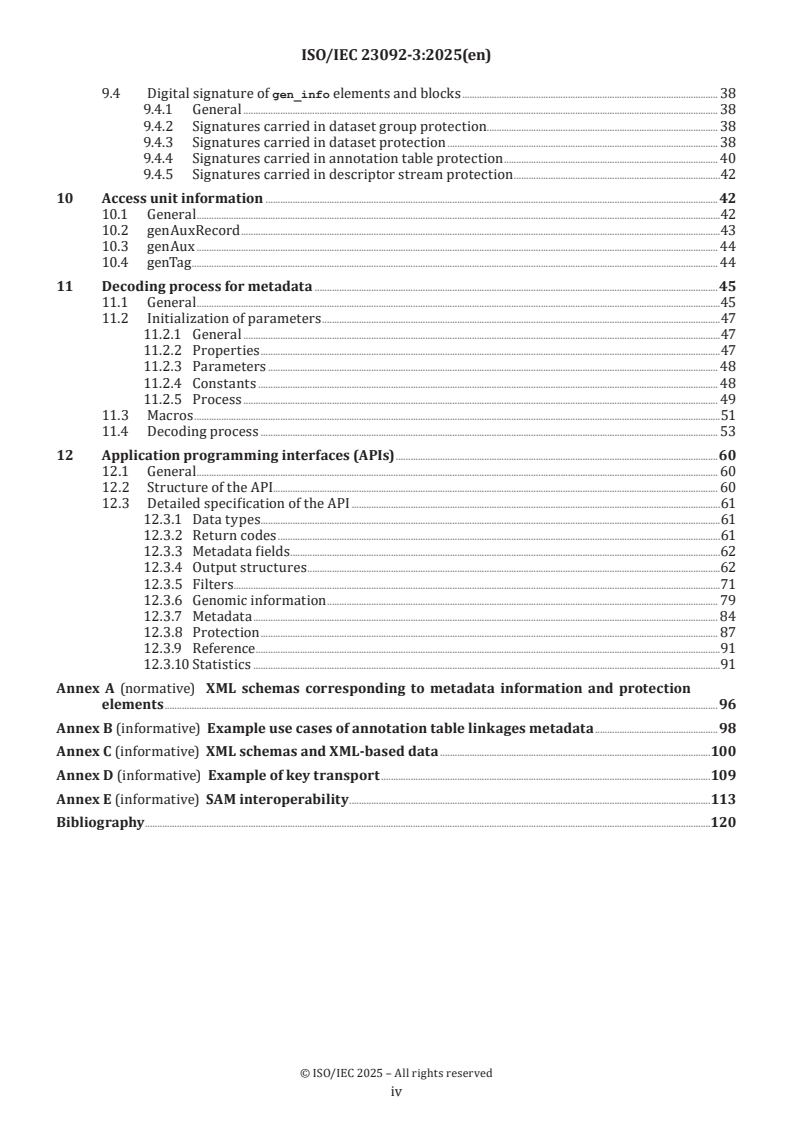
12 Application programming interfaces (APIs) .60
12.1 General . 60
12.2 Structure of the API. 60
12.3 Detailed specification of the API .61
12.3.1 Data types .61
12.3.2 Return codes .61
12.3.3 Metadata fields . .62
12.3.4 Output structures .62
12.3.5 Filters.71
12.3.6 Genomic information . 79
12.3.7 Metadata . 84
12.3.8 Protection . 87
12.3.9 Reference .91
12.3.10 Statistics .91
Annex A (normative) XML schemas corresponding to metadata information and protection
elements .96
Annex B (informative) Example use cases of annotation table linkages metadata .98
Annex C (informative) XML schemas and XML-based data .100
Annex D (informative) Example of key transport .109
Annex E (informative) SAM interoperability .113
Bibliography .120
© ISO/IEC 2025 – All rights reserved
iv
Foreword
ISO (the International Organization for Standardization) and IEC (the International Electrotechnical
Commission) form the specialized system for worldwide standardization. National bodies that are
members of ISO or IEC participate in the development of International Standards through technical
committees established by the respective organization to deal with particular fields of technical activity.
ISO and IEC technical committees collaborate in fields of mutual interest. Other international organizations,
governmental and non-governmental, in liaison with ISO and IEC, also take part in the work.
The procedures used to develop this document and those intended for its further maintenance are described
in the ISO/IEC Directives, Part 1. In particular, the different approval criteria needed for the different types
of document should be noted. This document was drafted in accordance with the editorial rules of the ISO/
IEC Directives, Part 2 (see www.iso.org/directives or www.iec.ch/members_experts/refdocs).
ISO and IEC draw attention to the possibility that the implementation of this document may involve the
use of (a) patent(s). ISO and IEC take no position concerning the evidence, validity or applicability of any
claimed patent rights in respect thereof. As of the date of publication of this document, ISO and IEC had
received notice of (a) patent(s) which may be required to implement this document. However, implementers
are cautioned that this may not represent the latest information, which may be obtained from the patent
database available at www.iso.org/patents and https://patents.iec.ch. ISO and IEC shall not be held
responsible for identifying any or all such patent rights.
Any trade name used in this document is information given for the convenience of users and does not
constitute an endorsement.
For an explanation of the voluntary nature of standards, the meaning of ISO specific terms and expressions
related to conformity assessment, as well as information about ISO's adherence to the World Trade
Organization (WTO) principles in the Technical Barriers to Trade (TBT) see www.iso.org/iso/foreword.html.
In the IEC, see www.iec.ch/understanding-standards.
This document was prepared by Joint Technical Committee ISO/IEC JTC 1, Information technology,
Subcommittee SC 29, Coding of audio, picture, multimedia and hypermedia information.
This third edition cancels and replaces the second edition (ISO/IEC 23092-3:2022), which has been
technically revised.
The main changes are as follows:
― addition of annotation table metadata (subclause 6.5) that contains general, analytics, linkages and
access history information associated with an annotation table;
― addition of metrics metadata (Clause 7) that contains pre-computed sequencing data metrics associated
with a dataset or an access unit;
― addition of clinical data linkage metadata (Clause 8) that contains linkage information for enabling
clinical data interchange (CDI) with external data sources;
― addition of annotation table protection metadata, including encryption parameters (subclause 9.2.4) and
digital signatures (subclause 9.4.4), and updates to the decryption process (subclause 9.2.6) and privacy
rules (subclause 9.3) for enabling the selective protection of annotation data;
― extension of the APIs (Clause 12) for supporting the random access and query of annotation data, the
retrieval of pre-computed sequencing data statistics, and the return of only the number of matching
records without the actual data.
A list of all parts in the ISO/IEC 23092 series can be found on the ISO and IEC websites.
Any feedback or questions on this document should be directed to the user’s national standards
body. A complete listing of these bodies can be found at www.iso.org/members.html and
www.iec.ch/national-committees.
© ISO/IEC 2025 – All rights reserved
v
Introduction
The advent of high-throughput sequencing (HTS) technologies has the potential to boost the adoption of
genomic information in everyday practice, ranging from biological research to personalized genomic
medicine in the clinic. As a consequence, the volume of generated data has increased dramatically during the
last few years, and an even more pronounced growth is expected in the near future.
At the moment, genomic information is mostly exchanged through a variety of data formats, such as
FASTA/FASTQ for unaligned sequencing reads and SAM/BAM/CRAM for aligned reads. With respect to
such formats, the ISO/IEC 23092 series provides a new solution for the representation and compression of
genome sequencing information by:
— specifying an abstract representation of the sequencing data rather than a specific format with its direct
implementation;
— being designed at a time point when technologies and use cases are more mature. This permits the
addressing of one limitation of the textual SAM format, for which incremental ad-hoc addition of features
followed along the years, resulting in an overall redundant and suboptimal format which at the same
time results not general and unnecessarily complicated;
— normatively separating free-field user-defined information with no clear semantics from the normative
genomic data representation. This allows a fully interoperable and automatic exchange of information
between different data producers;
— allowing multiplexing of relevant metadata information with the data since data and metadata are
partitioned at different conceptual levels;
— following a strict and supervised development process which has proven successful in the last 30 years
in the domain of digital media for the transport format, the file format, the compressed representation
and the application program interfaces.
This document provides the enabling technology that will allow the community to create an ecosystem of
novel, interoperable solutions in the field of genomic information processing. In particular, it offers:
— consistent, general and properly designed format definitions and data structures to store sequencing and
alignment information. A robust framework which can be used as a foundation to implement different
compression algorithms;
— speed and flexibility in the selective access to coded data, by means of newly designed data clustering
and optimized storage methodologies;
— low latency in data transmission and consequent fast availability at remote locations, based on
transmission protocols inspired by real-time application domains;
— built-in privacy and protection of sensitive information, thanks to a flexible framework which allows
customizable secured access at all layers of the data hierarchy;
— reliability of the technology and interoperability among tools and systems, owing to the provision of a
normative procedure to assess conformance to the standard on an exhaustive dataset;
— support to the implementation of a complete ecosystem of compliant devices and applications, through
the availability of a normative reference implementation covering the totality of the specification.
The fundamental structure of the ISO/IEC 23092 series data representation is the genomic record. The
genomic record is a data structure consisting of either a single sequence read, or a paired sequence read, and
its associated sequencing and alignment information; it may contain detailed mapping and alignment data, a
single or paired read identifier (read name) and quality values.
Without breaking traditional approaches, the genomic record introduced in the ISO/IEC 23092 series
provides a more compact, simpler and manageable data structure grouping all the information related to a
single DNA template, from simple sequencing data to sophisticated alignment information.
© ISO/IEC 2025 – All rights reserved
vi
The genomic record, although it is an appropriate logic data structure for interaction and manipulation of
coded information, is not a suitable atomic data structure for compression. To achieve high compression
ratios, it is necessary to group genomic records into clusters and to transform the information of the same
type into sets of descriptors structured into homogeneous blocks. Furthermore, when dealing with selective
data access, the genomic record is a too small unit to allow effective and fast information retrieval.
For these reasons, this document introduces the concept of access unit, which is the fundamental structure
for coding and access to information in the compressed domain.
The access unit is the smallest data structure that can be decoded by a decoder confirming to ISO/IEC 23092-2.
An access unit is composed of one block for each descriptor used to represent the information of its genomic
records; therefore, a block payload is the coded representation of all the data of the same type (i.e. a
descriptor) in a cluster.
In addition to clusters of genomic records compressed into access units, reads are further classified in six
data classes: five classes are defined according to the result of their alignment against one or more reference
sequences; the sixth class contains either reads that could not be mapped or raw sequencing data. The
classification of sequence reads into classes enables to develop powerful selective data access. In fact, access
units inherit a specific data characterization (e.g. perfect matches in Class P, substitutions in Class M, indels
in Class I, half-mapped reads in Class HM) from the genomic records composing them, and thus constitute a
data structure capable of providing powerful filtering capability for the efficient support of many different
use cases.
Access units are the fundamental, finest grain data structure in terms of content protection and in terms
of metadata association. In other words, each access unit can be protected individually and independently.
Figure 1 shows how access units, blocks and genomic records relate to each other in the ISO/IEC 23092
series data structure.
Figure 1 — Access units, blocks and genomic records
© ISO/IEC 2025 – All rights reserved
vii
Figure 2 — High-level data structure: datasets and dataset group
A dataset is a coded data structure containing headers and one or more access units. Typical datasets can,
for example, contain the complete sequencing of an individual, or a portion of it. Other datasets can contain,
for example, a reference genome or a subset of its chromosomes. Datasets are grouped in dataset groups, as
shown in Figure 2.
A simplified diagram of the dataset decoding process is shown in Figure 3.
Figure 3 — Decoding process
© ISO/IEC 2025 – All rights reserved
viii
International Standard ISO/IEC 23092-3:2025(en)
Information technology — Genomic information
representation —
Part 3:
Metadata and application programming interfaces (APIs)
1 Scope
This document specifies information metadata, metrics metadata, clinical data linkage metadata, auxiliary
fields, SAM interoperability, protection metadata and programming interfaces of genomic information. It
defines:
— metadata storage and interpretation for the different encapsulation levels as specified in ISO/IEC 23092-1
(in Clause 6);
— metrics metadata containing sequencing data metrics at the dataset and access unit levels as specified in
ISO/IEC 23092-1 (in Clause 7);
— clinical data linkage metadata stored at the dataset group, dataset and annotation table levels as specified
in ISO/IEC 23092-1 (in Clause 8);
— protection elements providing confidentiality, integrity and privacy rules at the different encapsulation
levels as specified in ISO/IEC 23092-1 (in Clause 9);
— how to associate auxiliary fields to encoded reads (in Clause 10);
— interfaces to access genomic information coded in compliance with ISO/IEC 23092-1 and ISO/IEC 23092-2
(in Clause 12);
— mechanisms for backward compatibility with existing SAM content, and exportation to this format (in
Annex E).
2 Normative references
The following documents are referred to in the text in such a way that some or all of their content constitutes
requirements of this document. For dated references, only the edition cited applies. For undated references,
the latest edition of the referenced document (including any amendments) applies.
ISO/IEC 23092-1, Information technology — Genomic information representation — Part 1: Transport and
storage of genomic information
ISO/IEC 23092-2, Information technology — Genomic information representation — Part 2: Coding of genomic
information
ISO/IEC 23092-6, Information technology — Genomic information representation — Part 6: Coding of genomic
annotations
OASIS. eXtensible Access Control Markup Language (XACML) Version 3.0, 2013, Available: http:// docs .oasis
-open .org/ xacml/ 3 .0/ xacml -3 .0 -core -spec -cs -01 -en .pdf
W3C, XML Path Language (XPath), Version 1.0, 16 November 1999, Available: https:// www .w3 .org/ TR/
xpath -10/
© ISO/IEC 2025 – All rights reserved
IEEE. 754-2008, IEEE Standard for Floating-Point Arithmetic, August 2008, Available: https:// ieeexplore
.ieee .org/ document/ 4610935
3 Terms and definitions
For the purposes of this document, the terms and definitions in ISO/IEC 23092-1, ISO/IEC 23092-2 and the
following apply.
ISO and IEC maintain terminology databases for use in standardization at the following addresses:
— ISO Online browsing platform: available at https:// www .iso .org/ obp
— IEC Electropedia: available at https:// www .electropedia .org/
3.1
BAM
compressed binary version of SAM
3.2
dataset group
collection of one or more datasets
Note 1 to entry: Which information is represented varies depending on the genomic information representation.
4 Abbreviated terms
AAU annotation access unit
AU access unit
AUC access unit contiguity
DSC descriptor stream contiguity
EBI European Bioinformatics Institute
EGA European Genome Archive
ENA European Nucleotide Archive
LSB least significant bit
NCBI National Center for Biotechnology Information
SRA sequence read archive
URN uniform resource name
5 Conventions
5.1 Character encoding
The implementation of the specifications described in this document shall use UTF-8 character encoding.
5.2 Bit Ordering
The bit order of syntax fields in the syntax tables is specified to start with the most significant bit (MSB) and
proceed to the least significant bit (LSB).
© ISO/IEC 2025 – All rights reserved
5.3 Syntax functions and data types
The functions presented here are used in the syntactical description. These functions are expressed in
terms of the value of a bitstream pointer that indicates the position of the next bit to be read by the decoding
process from the bitstream.
byte_aligned( ) is specified as follows:
— If the current position in the bitstream is on a byte boundary, i.e. the next bit in the bitstream is the first
bit in a byte, the return value of byte_aligned( ) is equal to TRUE.
— Otherwise, the return value of byte_aligned( ) is equal to FALSE.
read_bits( n ) reads the next n bits from the bitstream and advances the bitstream pointer by n bit positions.
When n is equal to 0, read_bits( n ) is specified to return a value equal to 0 and to not advance the bitstream
pointer.
Size(array_name[]) returns the number of elements contained in the array named array_name.
The following data types specify the parsing process of each syntax element:
— f(n): fixed-pattern bit string using n bits written (from left to right) with the left bit first. The parsing
process for this data type is specified by the return value of the function read_bits( n ).
— st(v): null-terminated string encoded as universal coded character set (UCS) transmission format-8
(UTF-8) characters as specified in ISO/IEC 10646. The parsing process is specified as follows: st(v) begins
at a byte-aligned position in the bitstream and reads and returns a series of bytes from the bitstream,
beginning at the current position and continuing up to but not including the next byte-aligned byte that
is equal to 0x00, and advances the bitstream pointer by ( stringLength + 1 ) * 8 bit positions, where
stringLength is equal to the number of bytes returned.
NOTE The st(v) syntax data type is only used in this document when the current position in the bitstream is
a byte-aligned position.
— i(n): signed integer using n bits. When n is "v" in the syntax table, the number of bits varies in a manner
dependent on the value of other syntax elements. The parsing process for this data type is specified by
the return value of the function read_bits( n ) interpreted as a two's complement integer representation
with most significant bit written first.
— u(n): unsigned integer using n bits. When n is "v" in the syntax table, the number of bits varies in a manner
dependent on the value of other syntax elements. The parsing process for this data type is specified by
the return value of the function read_bits( n ) interpreted as a binary representation of an unsigned
integer with most significant bit written first.
— F32: 32 bit single precision floating-point as specified by IEEE 754-2008. The parsing process is specified
as follows: u(1) is used for the sign value, followed by an u(8) used for the exponent value, followed by an
u(23) used for the fraction value.
— F64: 64 bit double precision floating-point as specified by IEEE 754-2008. The parsing process is specified
as follows: u(1) is used for the sign value, followed by an u(11) used for the exponent value, followed by
an u(52) used for the fraction value.
— c(n): sequence of n ASCII characters.
5.4 Graphic notations
The notation -> (arrow) is used in this document to indicate the access to a member of a data structure.
The notations | |= are used in this document to indicate the bitwise OR operation and assignment,
respectively. a |= b is equivalent to a = a | b.
© ISO/IEC 2025 – All rights reserved
The notations & &= are used in this document to indicate the bitwise AND operation and assignment,
respectively. a &= b is equivalent to a = a & b.
The notation return_error()is used in this document to indicate that the decoding process has to stop due
to a decoding error which cannot be handled.
The notation continue is used in this document within for and while statements to signal that the process
shall continue to the next iteration without executing any further statement in the current iteration.
The notation *(ptr) is used in this document to access the data/value in the memory that the pointer ptr
points to - the contents of the address with that numerical index. The operator * is said to dereference the
pointer ptr.
The notation strncmp(str1, str2, n) is used in this document to indicate if first n characters of two strings
str1 and str2 match with each other. If all n characters match, then it returns 0, otherwise 1.
6 Information metadata
6.1 General
This clause defines a minimum core set of metadata elements, which users and applications can then
extend by including extra information elements. Metadata sets are specified for dataset groups, datasets,
references and annotation tables, as specified in ISO/IEC 23092-1. The structure of these metadata sets and
their elements is specified using XML v1.1.
Extensions to (i.e. new elements for) the metadata sets specified in this clause are represented with an
identifier of the extension type in the form of a URI, a value and a pointer to a resource documenting the
semantics of the extension type.
Metadata profiles are specific subsets of metadata sets specified using mechanisms provided in this
document. A metadata profile specified in this document may correspond to well-known metadata sets
[1] [2]
specified or used out of the ISO/IEC 23092 series, such as those in ENA or EGA and NCBI specifications.
This allows easy interoperability with already existing systems. A metadata profile includes a subset of (or
all) core elements described in subclauses 6.2 and 6.4, and a set of new elements specified with the extension
mechanism specified in subclause 6.7.
The rest of clauses specify dataset group metadata (see subclause 6.2), reference metadata (see
subclause 6.3), dataset metadata (see subclause 6.4), annotation table metadata (see subclause 6.5),
extensions (see subclause 6.7) and profiles (see subclause 6.8).
6.2 Dataset group metadata
Compressed dataset group metadata are stored within the DG_metadata_value element of the DG_metadata
box (with key dgmd), as specified in ISO/IEC 23092-1. The decoding process of DG_metadata_value is
specified in Clause 11. The output of the decoding process is an XML document, where the root node is
DatasetGroupMetadata. Annex A.1 provides the XML schema for a decoded dataset group metadata.
As previously introduced in subclause 6.1, an extensions type is the combination of three elements: the value,
the identifier of the extension, and a link to a resource documenting the interpretation of the extenstion. In
the XML schema, this is translated as an element with three child elements: the Type element (of type URI),
the Documentation (of type URI) and the value which is represented as the element taking the place of the
element any in the schema. Additionally, for extensions belonging to the dataset group, the Boolean element
Inheritable (as specified in Annex A.1) of the extension element indicates if the extension is only relevant to
the dataset group, or if the dataset also inherits it. The resource documentation can be human readable, and
the extensions parsing is not required.
© ISO/IEC 2025 – All rights reserved
6.3 Reference metadata
Compressed reference metadata are stored within the reference metadata box, as specified in
ISO/IEC 23092-1, in the reference_metadata_value field. Clause 11 specifies the decoding process of
reference_metadata_value. The output of the decoding process is an XML document, with a root element
ReferenceMetadata. Annex A.7 provides the related XML schema. Table 1 specifies the semantics of the fields.
Table 1 — Semantics of reference sequence's fields
Tag name Description
a
length Length in base pairs of the sequence
alternative_locus_location The sequence is an alternative locus from an unknown region. A child
element chromosome_name identifies on which chromosome the
sequence has an alternative locus. If present, a child element position
indicates the start and end position of the alternative locus.
alternative_sequence_name List of alternative names
genome_assembly_identifier Genome assembly identifier
description Human readable textual description
species Name of the species
URI URI of the sequence
a
In this document, "base" or "base pair" is used as a synonym for "nucleotide".
6.4 Dataset metadata
Compressed dataset metadata are stored within the DT_metadata_value field of the DT_metadata box
(marked as dtmd), as specified in ISO/IEC 23092-1. Clause 11 specifies the decoding process of DT_metadata_
value. The output of the decoding process is an XML document with an element DatasetMetadata as root.
Annex A.2 provides the XML schema for dataset metadata. A dataset metadata element overwrites the
corresponding element whose values differ from the one indicated at the dataset group level (i.e. the new
value in the dataset is a specialization of the value at the dataset group level).
Table 2 defines the process to obtain the dataset metadata with inherited elements, where the following
notations are used.
— .has(): the function returns true if the element has a child element with an unqualified name equal to the
parameter given, and false otherwise.
— .get(): the function returns the content of the child element with an unqualified name equal to the
parameter given, as an array of characters.
— .getElement(): the function returns the content of the child element with an unqualified name equal to
the parameter given.
th
— .getByIndex(): the function returns the content of the i child element with an unqualified name equal
to the first parameter given and i equal to the second parameter given, as an array of characters.
— .getEncoding(): the function returns the content of the element as an array of characters.
— .set(): the function sets the content of the child element with an unqualified name equal to the first
parameter given, to the array of charac
...