

ISO 8121:2007
(Main)Textile machinery — Knitting machines — Nameplate information
General Information
- Abstract
ISO 8121:2007 specifies the minimum information for the nameplates on knitting machines used in the textile industry.
- Status
- Withdrawn
- Publication Date
- 29-Jul-2007
- Current Stage
- 9599 - Withdrawal of International Standard
- Start Date
- 18-Nov-2024
- Completion Date
- 29-Aug-2026

Overview
ISO 8121:2007 is an international standard established by the International Organization for Standardization (ISO) that specifies the minimum information required on nameplates for knitting machines used in the textile industry. This standard ensures uniformity and clarity in the identification details provided on knitting machinery, facilitating better traceability, machine management, and maintenance across global textile manufacturing operations.
This second edition, published in 2007, replaces the first edition from 1986 and reflects technical revisions to improve nameplate content specifications. It covers both flat knitting machines and circular knitting machines, setting out essential data points to be displayed on their respective nameplates.
Key Topics
Minimum Nameplate Information: ISO 8121:2007 mandates that all knitting machines must display certain fundamental details on their nameplates to allow easy and precise identification.
General Requirements for All Knitting Machines:
- Manufacturer's name and address
- Type of machine
- Unique machine number
- Year of construction
Specific Requirements for Flat Knitting Machines:
- Nominal width (as specified in ISO 11675 or ISO 8640-1), expressed in millimeters with an optional inch value in brackets
- Pitch in accordance with ISO 8188, with the gauge value optionally added in brackets
Specific Requirements for Circular Knitting Machines:
- Nominal diameter in millimeters per ISO 8117, with the characteristic value optionally noted
- Number of needles per needle carrier, especially for machines with large nominal diameters, per ISO 8122
- Needle pitch in millimeters according to ISO 8188, with gauge value optionally given
Normative References: The standard incorporates related ISO standards critical for defining dimensions and machine features, including ISO 8117, ISO 8122, ISO 8188, ISO 8640-1, and ISO 11675.
Applications
ISO 8121:2007 applies broadly within the textile machinery sector, particularly impacting:
Textile Manufacturing Facilities: Ensures that knitting machines across production lines have consistent and comprehensive nameplate data, aiding machine tracking and maintenance routines.
Machine Manufacturers: Provides a clear guideline for the information to display on new knitting machines, ensuring compliance with international standards.
Quality Control and Management: Facilitates record-keeping and traceability by standardizing machine identification information, which is critical for warranty, service, and regulatory compliance.
Equipment Resale and Trading: Supports the resale and purchase of knitting machines by guaranteeing clear and standardized machine identification, making the transfer of ownership transparent.
Maintenance and Repair Services: Improves serviceability by ensuring that technicians have immediate access to essential machine data on the nameplate, optimizing repair efficiency.
Related Standards
ISO 8121:2007 is closely linked with several other ISO standards that detail textile machinery characteristics and measurements:
- ISO 8117: Specifies nominal diameters of circular knitting machines.
- ISO 8122: Defines the number of needles for circular knitting machines with large diameters.
- ISO 8188: Covers needle pitch and gauge for knitting machines.
- ISO 8640-1: Provides vocabulary and definitions related to flat warp knitting machines.
- ISO 11675: Gives vocabulary specifics for flatbed knitting machines.
These related standards complement ISO 8121:2007 by providing the technical definitions necessary for precise nameplate information and ensuring comprehensive and interoperable documentation within the textile machinery industry.
By adhering to ISO 8121:2007, manufacturers and users of knitting machines can achieve improved operational consistency, enhanced safety, and better communication across the global textile industry. This standard plays a vital role in supporting the effective management and regulation of textile machinery assets.
Relations
- Effective Date
- 15-Apr-2008
- Effective Date
- 15-Apr-2008
Get Certified
Connect with accredited certification bodies for this standard

Control Union Certifications
Global certification for agriculture and sustainability.

Hohenstein Institut
Textile testing and certification.

Bureau Veritas Bangladesh
Bureau Veritas certification services in Bangladesh.
Sponsored listings
Frequently Asked Questions
ISO 8121:2007 is a standard published by the International Organization for Standardization (ISO). Its full title is "Textile machinery — Knitting machines — Nameplate information". This standard covers: ISO 8121:2007 specifies the minimum information for the nameplates on knitting machines used in the textile industry.
ISO 8121:2007 specifies the minimum information for the nameplates on knitting machines used in the textile industry.
ISO 8121:2007 is classified under the following ICS (International Classification for Standards) categories: 59.120.40 - Knitting machines. The ICS classification helps identify the subject area and facilitates finding related standards.
ISO 8121:2007 has the following relationships with other standards: It is inter standard links to ISO 8121:1986, ISO 8121:1986/Cor 1:1992. Understanding these relationships helps ensure you are using the most current and applicable version of the standard.
ISO 8121:2007 is available in PDF format for immediate download after purchase. The document can be added to your cart and obtained through the secure checkout process. Digital delivery ensures instant access to the complete standard document.
Standards Content (Sample)
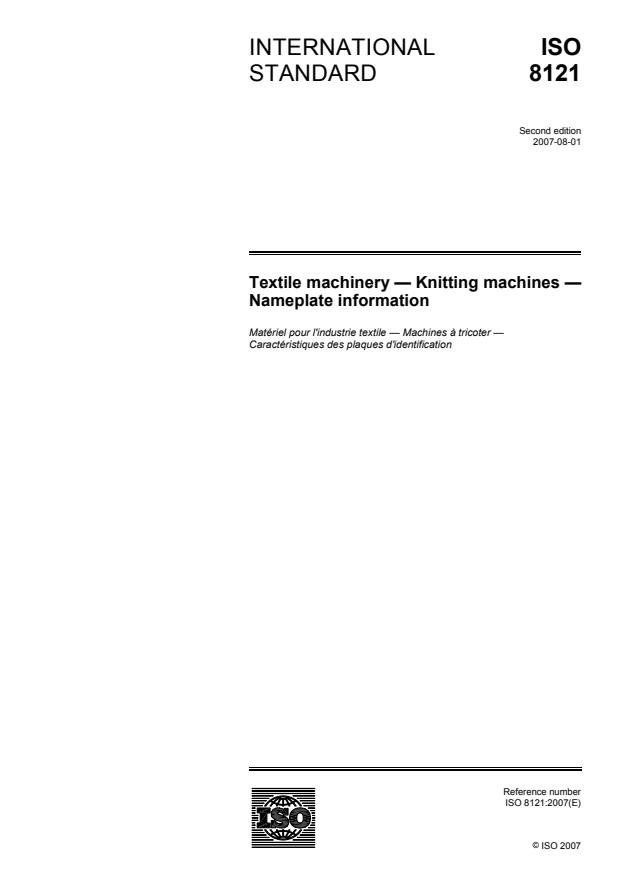
INTERNATIONAL ISO
STANDARD 8121
Second edition
2007-08-01
Textile machinery — Knitting machines —
Nameplate information
Matériel pour l'industrie textile — Machines à tricoter —
Caractéristiques des plaques d'identification
Reference number
©
ISO 2007
PDF disclaimer
This PDF file may contain embedded typefaces. In accordance with Adobe's licensing policy, this file may be printed or viewed but
shall not be edited unless the typefaces which are embedded are licensed to and installed on the computer performing the editing. In
downloading this file, parties accept therein the responsibility of not infringing Adobe's licensing policy. The ISO Central Secretariat
accepts no liability in this area.
Adobe is a trademark of Adobe Systems Incorporated.
Details of the software products used to create this PDF file can be found in the General Info relative to the file; the PDF-creation
parameters were optimized for printing. Every care has been taken to ensure that the file is suitable for use by ISO member bodies. In
the unlikely event that a problem relating to it is found, please inform the Central Secretariat at the address given below.
© ISO 2007
All rights reserved. Unless otherwise specified, no part of this publication may be reproduced or utilized in any form or by any means,
electronic or mechanical, including photocopying and microfilm, without permission in writing from either ISO at the address below or
ISO's member body in the country of the requester.
ISO copyright office
Case postale 56 • CH-1211 Geneva 20
Tel. + 41 22 749 01 11
Fax + 41 22 749 09 47
E-mail copyright@iso.org
Web www.iso.org
Published in Switzerland
ii © ISO 2007 – All rights reserved
Foreword
ISO (the International Organization for Standardization) is a worldwide federation of national standards bodies
(ISO member bodies). The work of preparing International Standards is normally carried out through ISO
technical committees. Each member body interested in a subject for which a technical committee has been
established has the right to be represented on that committee. International organizations, governmental and
non-governmental, in liaison with ISO, also take part in the work. ISO collaborates closely with the
International Electrotechnical Commission (IEC) on all matters of electrotechnical standardization.
International Standards are drafted in accordance with the rules given in the ISO/IEC Directives, Part 2.
The main task of technical committees is to prepare International Standards. Draft International Standards
adopted by the technical committees are circulated to the member bodies for voting. Publication as an
International Standard requires approval by at least 75 % of t
...