

ISO 21007-2:2015
(Main)Gas cylinders — Identification and marking using radio frequency identification technology — Part 2: Numbering schemes for radio frequency identification
General Information
- Abstract
ISO 21007-2:2015 establishes a common flexible framework for data structure to enable the unambiguous identification in gas cylinder (GC) applications and for other common data elements in this sector. ISO 21007-2:2015 enables a structure to allow some harmonization between different systems. However, it does not prescribe any one system and has been written in a non-mandatory style so as not to make it obsolete as technology changes. The main body of this part of ISO 21007 excludes any data elements that form any part of transmission or storage protocols such as headers and checksums. For details on cylinder/tag operations, see Annex A.
- Status
- Published
- Publication Date
- 02-Dec-2015
- Technical Committee
- ISO/TC 58/SC 4 - Operational requirements for gas cylinders
- Drafting Committee
- ISO/TC 58/SC 4/WG 6 - Cylinder identification
- Current Stage
- 9093 - International Standard confirmed
- Start Date
- 05-May-2026
- Completion Date
- 29-Aug-2026
Buy Documents

ISO 21007-2:2015 - Gas cylinders -- Identification and marking using radio frequency identification technology

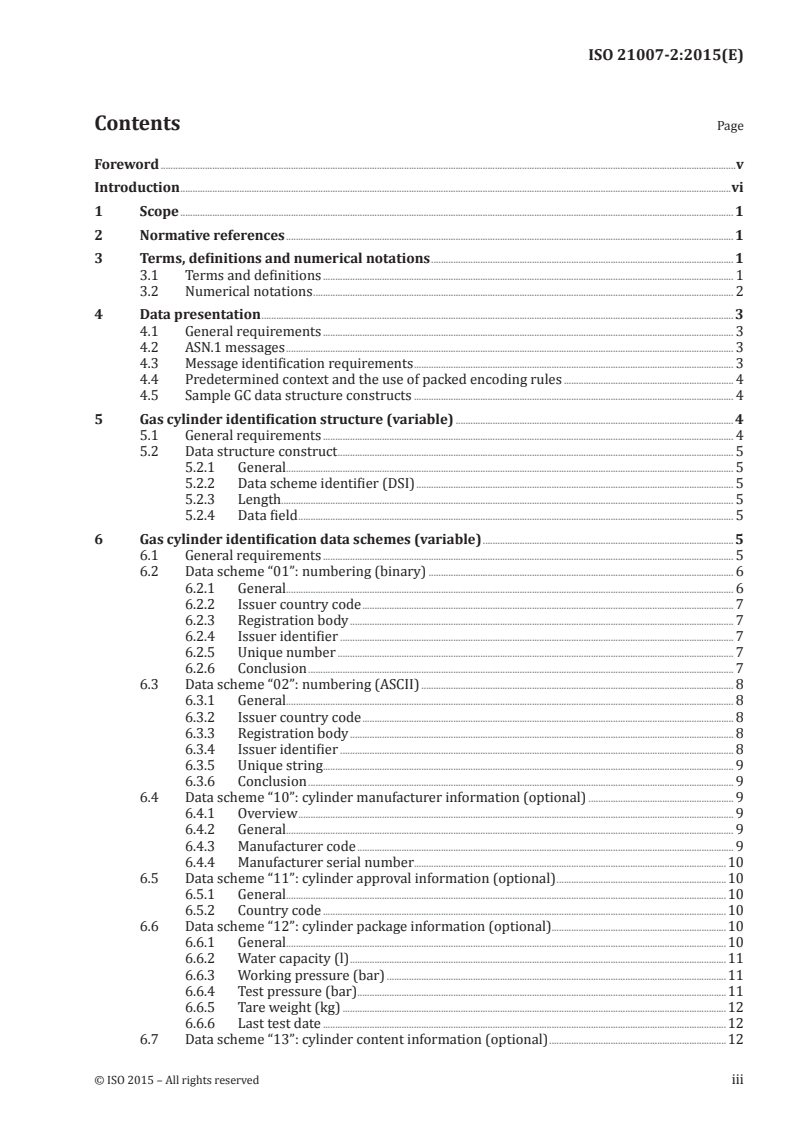
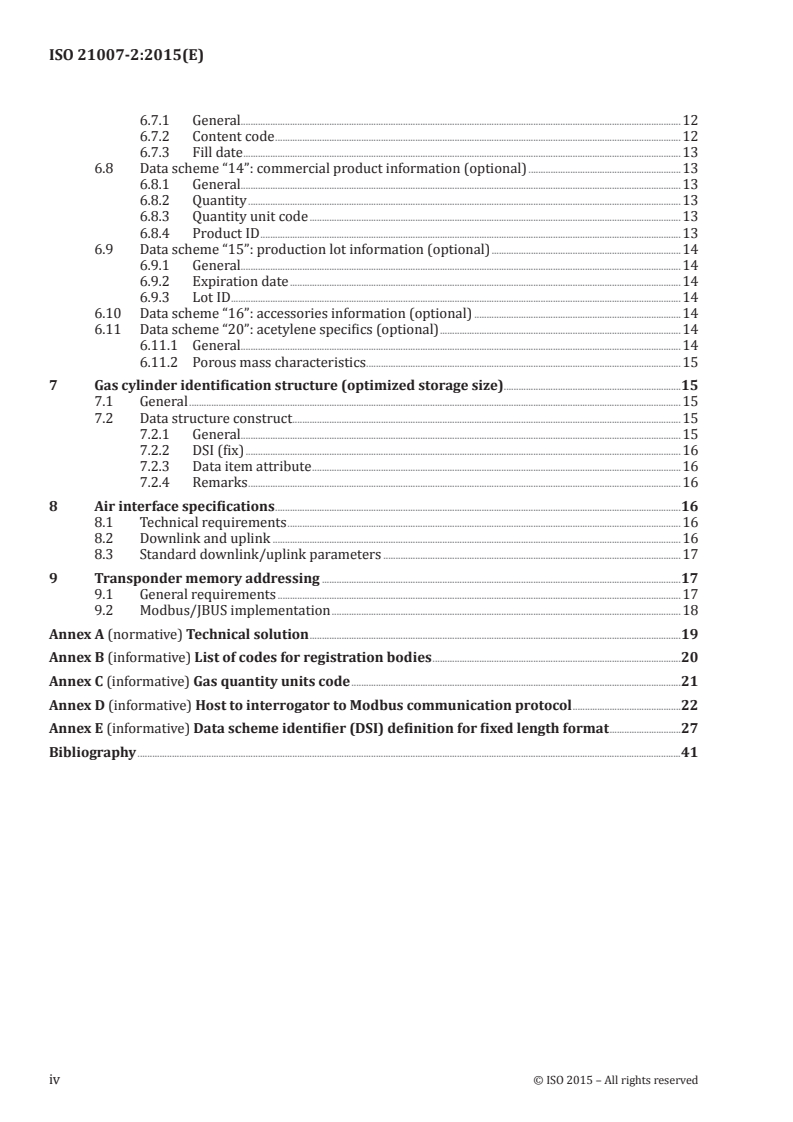
ISO 21007-2:2015 - Gas cylinders — Identification and marking using radio frequency identification technology — Part 2: Numbering schemes for radio frequency identification/3/2015

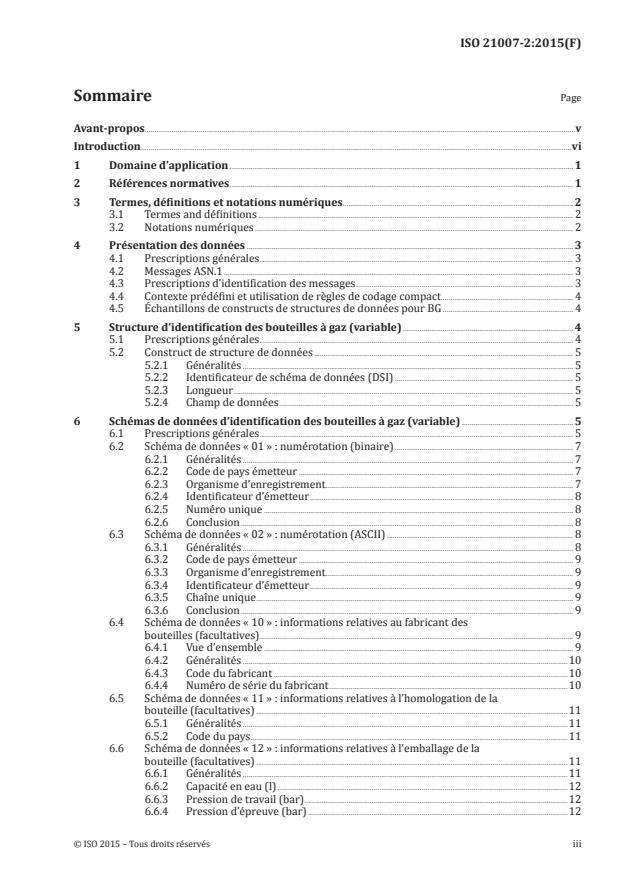
ISO 21007-2:2015 - Bouteilles à gaz -- Identification et marquage à l'aide de la technologie d'identification par radiofréquences

ISO 21007-2:2015 - Bouteilles à gaz — Identification et marquage à l'aide de la technologie d'identification par radiofréquences — Partie 2: Schémas de numérotage pour identification par radiofréquences/3/2015
Overview
ISO 21007-2:2015 - Gas cylinders - Identification and marking using radio frequency identification technology - Part 2: Numbering schemes for radio frequency identification - defines a flexible, technology‑neutral framework for structuring RFID data used to unambiguously identify gas cylinders. The standard specifies data presentation and numbering schemes (both binary and ASCII) and optional data schemes for cylinder metadata while deliberately not prescribing any single RFID system or transmission/storage protocol. It is written in a non‑mandatory style to remain robust as technology evolves.
Key topics
- Data structure and presentation
- Framework for gas cylinder identification structures (variable and optimized fixed formats).
- Use of Data Scheme Identifier (DSI), length fields and data fields to create interoperable tags.
- Numbering schemes
- Data scheme "01": numbering (binary) - includes issuer country code, registration body, issuer identifier and unique number.
- Data scheme "02": numbering (ASCII) - similar elements expressed as printable characters.
- Optional data schemes
- Manufacturer info, approval data, package specs, content and fill dates, commercial product info, lot/expiration, accessories and acetylene specifics.
- Message and encoding considerations
- ASN.1 message references and message identification requirements for structured exchanges.
- Guidance on predetermined contexts and packed encoding rules for efficient storage.
- Air interface and memory
- Air interface technical requirements, uplink/downlink parameters, and transponder memory addressing.
- Implementation guidance for Modbus/JBUS communication between host/interrogator.
- Supporting annexes
- Annex A for cylinder/tag operations and technical solution; Annex B list of registration bodies; Annex C/D/E cover units, communication protocol and fixed-length DSI definitions.
Applications
- Asset tracking and lifecycle management of gas cylinders (manufacturers, distributors, rental fleets).
- Safety and regulatory compliance - reliable identification for inspection, approval and testing records.
- Logistics and inventory control - automated reading at refilling stations, warehouses and in-transit checks.
- Integration with SCADA, ERP or maintenance systems using Modbus/JBUS and standardized data schemes.
- Use cases: cylinder serialization, content tracking, refill history, expiration/lot management and automated billing.
Who should use it
- Gas cylinder manufacturers and cylinder marking/labeling vendors.
- Cylinder fleet operators, distributors and refilling stations.
- RFID system integrators, software developers and automation engineers implementing cylinder tracking.
- Regulators and conformity assessment bodies seeking interoperable identification approaches.
Related standards
- ISO 21007 (other parts) for overall RFID marking of gas cylinders.
- ISO/TR 17329 (referenced for additional manufacturer code information).
- ISO/IEC and industry standards for RFID air interface and encoding (as applicable).
ISO 21007-2:2015 provides a practical, interoperable foundation for gas cylinder RFID numbering - enabling asset visibility, safety compliance and integration across diverse systems without locking implementers into a single technology.
Relations
- Effective Date
- 12-Feb-2026
- Effective Date
- 06-Jun-2022
- Effective Date
- 24-Nov-2012
Buy Documents
ISO 21007-2:2015 - Gas cylinders -- Identification and marking using radio frequency identification technology
ISO 21007-2:2015 - Gas cylinders — Identification and marking using radio frequency identification technology — Part 2: Numbering schemes for radio frequency identification/3/2015
ISO 21007-2:2015 - Bouteilles à gaz -- Identification et marquage à l'aide de la technologie d'identification par radiofréquences
ISO 21007-2:2015 - Bouteilles à gaz — Identification et marquage à l'aide de la technologie d'identification par radiofréquences — Partie 2: Schémas de numérotage pour identification par radiofréquences/3/2015
Get Certified
Connect with accredited certification bodies for this standard

Institut za varilstvo d.o.o. (Welding Institute)
Slovenia's leading welding institute since 1952. ISO 3834, EN 1090, pressure equipment certification, NDT personnel, welder qualification. Only IIW Au
Sponsored listings
Frequently Asked Questions
ISO 21007-2:2015 is a standard published by the International Organization for Standardization (ISO). Its full title is "Gas cylinders — Identification and marking using radio frequency identification technology — Part 2: Numbering schemes for radio frequency identification". This standard covers: ISO 21007-2:2015 establishes a common flexible framework for data structure to enable the unambiguous identification in gas cylinder (GC) applications and for other common data elements in this sector. ISO 21007-2:2015 enables a structure to allow some harmonization between different systems. However, it does not prescribe any one system and has been written in a non-mandatory style so as not to make it obsolete as technology changes. The main body of this part of ISO 21007 excludes any data elements that form any part of transmission or storage protocols such as headers and checksums. For details on cylinder/tag operations, see Annex A.
ISO 21007-2:2015 establishes a common flexible framework for data structure to enable the unambiguous identification in gas cylinder (GC) applications and for other common data elements in this sector. ISO 21007-2:2015 enables a structure to allow some harmonization between different systems. However, it does not prescribe any one system and has been written in a non-mandatory style so as not to make it obsolete as technology changes. The main body of this part of ISO 21007 excludes any data elements that form any part of transmission or storage protocols such as headers and checksums. For details on cylinder/tag operations, see Annex A.
ISO 21007-2:2015 is classified under the following ICS (International Classification for Standards) categories: 23.020.30 - Pressure vessels, gas cylinders; 23.020.35 - Gas cylinders. The ICS classification helps identify the subject area and facilitates finding related standards.
ISO 21007-2:2015 has the following relationships with other standards: It is inter standard links to EN ISO 21007-2:2015, ISO 13478:2007, ISO 21007-2:2013. Understanding these relationships helps ensure you are using the most current and applicable version of the standard.
ISO 21007-2:2015 is available in PDF format for immediate download after purchase. The document can be added to your cart and obtained through the secure checkout process. Digital delivery ensures instant access to the complete standard document.
Standards Content (Sample)
INTERNATIONAL ISO
STANDARD 21007-2
Third edition
2015-12-15
Gas cylinders — Identification and
marking using radio frequency
identification technology —
Part 2:
Numbering schemes for radio
frequency identification
Bouteilles à gaz — Identification et marquage à l’aide de la
technologie d’identification par radiofréquences —
Partie 2: Schémas de numérotage pour identification par
radiofréquences
Reference number
©
ISO 2015
© ISO 2015, Published in Switzerland
All rights reserved. Unless otherwise specified, no part of this publication may be reproduced or utilized otherwise in any form
or by any means, electronic or mechanical, including photocopying, or posting on the internet or an intranet, without prior
written permission. Permission can be requested from either ISO at the address below or ISO’s member body in the country of
the requester.
ISO copyright office
Ch. de Blandonnet 8 • CP 401
CH-1214 Vernier, Geneva, Switzerland
Tel. +41 22 749 01 11
Fax +41 22 749 09 47
copyright@iso.org
www.iso.org
ii © ISO 2015 – All rights reserved
Contents Page
Foreword .v
Introduction .vi
1 Scope . 1
2 Normative references . 1
3 Terms, definitions and numerical notations . 1
3.1 Terms and definitions . 1
3.2 Numerical notations . 2
4 Data presentation . 3
4.1 General requirements . 3
4.2 ASN.1 messages . 3
4.3 Message identification requirements . 3
4.4 Predetermined context and the use of packed encoding rules . 4
4.5 Sample GC data structure constructs . 4
5 Gas cylinder identification structure (variable) . 4
5.1 General requirements . 4
5.2 Data structure construct . 5
5.2.1 General. 5
5.2.2 Data scheme identifier (DSI) . 5
5.2.3 Length. 5
5.2.4 Data field . 5
6 Gas cylinder identification data schemes (variable) . 5
6.1 General requirements . 5
6.2 Data scheme “01”: numbering (binary) . 6
6.2.1 General. 6
6.2.2 Issuer country code . 7
6.2.3 Registration body . 7
6.2.4 Issuer identifier . 7
6.2.5 Unique number . 7
6.2.6 Conclusion . 7
6.3 Data scheme “02”: numbering (ASCII) . 8
6.3.1 General. 8
6.3.2 Issuer country code . 8
6.3.3 Registration body . 8
6.3.4 Issuer identifier . 8
6.3.5 Unique string . 9
6.3.6 Conclusion . 9
6.4 Data scheme “10”: cylinder manufacturer information (optional) . 9
6.4.1 Overview . 9
6.4.2 General. 9
6.4.3 Manufacturer code . 9
6.4.4 Manufacturer serial number.10
6.5 Data scheme “11”: cylinder approval information (optional) .10
6.5.1 General.10
6.5.2 Country code .10
6.6 Data scheme “12”: cylinder package information (optional).10
6.6.1 General.10
6.6.2 Water capacity (l) .11
6.6.3 Working pressure (bar) .11
6.6.4 Test pressure (bar).11
6.6.5 Tare weight (kg) .12
6.6.6 Last test date .12
6.7 Data scheme “13”: cylinder content information (optional) .12
6.7.1 General.12
6.7.2 Content code .12
6.7.3 Fill date .13
6.8 Data scheme “14”: commercial product information (optional) .13
6.8.1 General.13
6.8.2 Quantity .13
6.8.3 Quantity unit code .13
6.8.4 Product ID .13
6.9 Data scheme “15”: production lot information (optional) .14
6.9.1 General.14
6.9.2 Expiration date .14
6.9.3 Lot ID .14
6.10 Data scheme “16”: accessories information (optional) .14
6.11 Data scheme “20”: acetylene specifics (optional) .14
6.11.1 General.14
6.11.2 Porous mass characteristics .15
7 Gas cylinder identification structure (optimized storage size) .15
7.1 General .15
7.2 Data structure construct .15
7.2.1 General.15
7.2.2 DSI (fix) .16
7.2.3 Data item attribute .16
7.2.4 Remarks .16
8 Air interface specifications .16
8.1 Technical requirements .16
8.2 Downlink and uplink .16
8.3 Standard downlink/uplink parameters .17
9 Transponder memory addressing .17
9.1 General requirements .17
9.2 Modbus/JBUS implementation .18
Annex A (normative) Technical solution .19
Annex B (informative) List of codes for registration bodies .20
Annex C (informative) Gas quantity units code .21
Annex D (informative) Host to interrogator to Modbus communication protocol .22
Annex E (informative) Data scheme identifier (DSI) definition for fixed length format .27
Bibliography .41
iv © ISO 2015 – All rights reserved
Foreword
ISO (the International Organization for Standardization) is a worldwide federation of national standards
bodies (ISO member bodies). The work of preparing International Standards is normally carried out
through ISO technical committees. Each member body interested in a subject for which a technical
committee has been established has the right to be represented on that committee. International
organizations, governmental and non-governmental, in liaison with ISO, also take part in the work.
ISO collaborates closely with the International Electrotechnical Commission (IEC) on all matters of
electrotechnical standardization.
The procedures used to develop this document and those intended for its further maintenance are
described in the ISO/IEC Directives, Part 1. In particular the different approval criteria needed for the
different types of ISO documents should be noted. This document was drafted in accordance with the
editorial rules of the ISO/IEC Directives, Part 2 (see www.iso.org/directives).
Attention is drawn to the possibility that some of the elements of this document may be the subject of
patent rights. ISO shall not be held responsible for identifying any or all such patent rights. Details of
any patent rights identified during the development of the document will be in the Introduction and/or
on the ISO list of patent declarations received (see www.iso.org/patents).
Any trade name used in this document is information given for the convenience of users and does not
constitute an endorsement.
For an explanation on the meaning of ISO specific terms and expressions related to conformity
assessment, as well as information about ISO’s adherence to the WTO principles in the Technical
Barriers to Trade (TBT) see the following URL: Foreword - Supplementary information
The committee responsible for this document is ISO/TC 58, Gas cylinders, Subcommittee SC 4,
Operational requirements for gas cylinders.
This third edition cancels and replaces the second edition (ISO 21007-2:2013), which has been
technically revised with the following changes:
— a new registration body has been added to Annex B;
— a new Annex E has been added;
— the former Annex C, which provided a list of RFID codes, as well as marks for gas cylinder
manufacturers, has been removed from this part of ISO 21007 and will be published in a separate
document, ISO/TR 17329.
ISO 21007 consists of the following parts, under the general title Gas cylinders — Identification and
marking using radio frequency identification technology:
— Part 1: Reference architecture and terminology
— Part 2: Numbering schemes for radio frequency identification
Introduction
Cylinders can contain a wide variety of gases, and identification is of paramount importance. It
could be desirable to identify not only the type of gas or liquid contained in the GC, but also such
details as the filling station where the cylinder was filled, the batch of cylinders filled and the date
the cylinder was filled.
Various methods and technologies such as physical identification through indentation; paper, card,
metal and plastic labelling; colour code identification; bar coding and, in some circumstances, vision
systems are already used to make or assist such identifications.
The technology of radio frequency identification (RFID) involves a reader/interrogator station
that transmits a predetermined signal of inductive, radio or microwave energy to one or many
transponders located within a read zone. The transponder returns the signal in a modified form to the
reader/interrogator and the data are decoded. The data component in a portable gas or liquid cylinder
environment provides the basis for unambiguous identification of the transponder and also can
provide a medium for a bi-directional interactive exchange of data between the reader/interrogator
and transponder. The signal can be modulated or unmodulated according to architecture of the system.
Recently, RFID has started using new, higher frequencies called ultra high frequency (UHF). These
higher frequencies facilitate a faster reading and writing process and deliver longer reading/writing
distances. Therefore, the UHF band frequency has been included in this part of ISO 21007. The aim of
this part of ISO 21007 is to provide the data structure respectively suitable for all frequency bands
including UHF.
In many cases, it is necessary or desirable to use one air carrier frequency and protocol; however,
this will not always be the case. Within a global market, different applications could require different
solutions for the carrier frequency (e.g. reading distance and velocity) and protocols (e.g. security,
company rule).
However, there is benefit in using a standard common core data structure that is capable of upwards
integration and expandable from the simplest low-cost cylinder identification system to more complex
functions. Such a structure will have to be flexible and enabling rather than prescriptive, thus enabling
different systems degrees of interoperability within and between their host systems.
The use of Abstract Syntax Notation One (ASN.1, as defined in the ISO/IEC 8824 series) from
ISO/IEC 8824-1 as a notation to specify data and its associated Packed Encoding Rules (PER) from
ISO/IEC 8825-2 is widely used and gaining popularity. Its usage will provide maximum interoperability
and conformance to existing standards and will meet the specifically defined requirements for a generic
standard model for gas cylinder identification in that it
— enables and uses existing standard coding,
— is adaptable and expandable,
— does not include unnecessary information for a specific application, and
— has a minimum of overhead in storage and transmission.
RFID standards other than ASN.1, for definition of frequencies and protocols, have been developed
within recent years [see ISO/IEC 18000 (all parts)].
ISO 21007-1 provides a framework reference architecture for such systems. This part of ISO 21007 is a
supporting part to ISO 21007-1 and provides a standardized yet flexible and interoperable framework
for numbering schemes. This part of ISO 21007 details individual numbering schemes within the
framework for the automatic identification of gas cylinders.
Central to the effective use of many of the constructs is a structure to provide unambiguous
identification. This part of ISO 21007 provides a standardized data element construct for the automatic
identification of gas cylinders.
vi © ISO 2015 – All rights reserved
The inconvenience of such a flexible concept is that a large storage memory is needed, particularly if a
large amount of information has to be stored and read directly from the RFID tag.
The following two alternatives could be used to address this issue:
— limit the information directly accessible on the RFID tag and obtain the additional information from
the host (ERP system);
— use a fixed data structure and length as shown in Annex E, as this can minimize the storage demand.
This part of ISO 21007 is intended to be used under a variety of national regulatory regimes, but has
[1]
been written so that it is suitable for the application of the UN Model Regulations. Attention is drawn
to requirements in the relevant national regulations of the country (countries) where the cylinders are
intended to be used that might override the requirements given in this part of ISO 21007. Where there
is any conflict between this part of ISO 21007 and any applicable regulation, the regulation always
takes precedence.
INTERNATIONAL STANDARD ISO 21007-2:2015(E)
Gas cylinders — Identification and marking using radio
frequency identification technology —
Part 2:
Numbering schemes for radio frequency identification
1 Scope
This part of ISO 21007 establishes a common flexible framework for data structure to enable the
unambiguous identification in gas cylinder (GC) applications and for other common data elements
in this sector.
This part of ISO 21007 enables a structure to allow some harmonization between different systems.
However, it does not prescribe any one system and has been written in a non-mandatory style so as not
to make it obsolete as technology changes.
The main body of this part of ISO 21007 excludes any data elements that form any part of transmission
or storage protocols such as headers and checksums.
For details on cylinder/tag operations, see Annex A.
2 Normative references
The following documents, in whole or in part, are normatively referenced in this document and are
indispensable for its application. For dated references, only the edition cited applies. For undated
references, the latest edition of the referenced document (including any amendments) applies.
ISO 3166-1, Codes for the representation of names of countries and their subdivisions — Part 1: Country codes
ISO 13769, Gas cylinders — Stamp marking
ISO/TR 17329, Gas cylinders — Identification of gas cylinder manufacturer marks and their assigned radio
frequency identification (RFID) codes
ISO 21007-1:2005, Gas cylinders — Identification and marking using radio frequency identification
technology — Part 1: Reference architecture and terminology
ISO/IEC 8824-1:2008, Information technology — Abstract Syntax Notation One (ASN.1): Specification of
basic notation — Part 1
ISO/IEC 8825-2, Information technology — ASN.1 encoding rules: Specification of Packed Encoding Rules
(PER)
ISO/IEC 18000-6, Information technology — Radio frequency identification for item management —
Part 6: Parameters for air interface communications at 860 MHz to 960 MHz General
3 Terms, definitions and numerical notations
3.1 Terms and definitions
For the purposes of this document, the terms and definitions given in ISO 21007-1 and the following apply.
3.1.1
bit rates
number of bits per second, independent of the data coding
3.1.2
carrier frequency
centre frequency of the downlink/uplink band
3.1.3
construct
one or more primitive constructs to form an ASN.1 message
3.1.4
data coding
coding that determines the baseband signal presentation, i.e., a mapping of logical bits to physical signals
Note 1 to entry: Examples are bi-phase schemes (Manchester, Miller, FM0, FM1, differential Manchester),
NRZ and NRZ1.
3.1.5
modulation
keying of the carrier wave by coded data described in accordance with commonly understood
methodologies (amplitude shift keying, frequency shift keying)
3.1.6
octet
set of eight binary digits (bits)
3.1.7
power limits within communication zone
limits that determine the minimum and maximum values of incident power referred to a 0 dB antenna
in front of the tag
Note 1 to entry: These two values also specify the dynamic range of the tag receiver. Power values are measured
without any additional losses due to rain or misalignment.
3.1.8
registration body
organization entitled to issue and keep track of issuer identification
Note 1 to entry: For examples, see Annex B.
3.1.9
tolerance of carrier frequency
maximum deviation of the carrier frequency expressed as a percentage
3.2 Numerical notations
The numerical notations used in this part of ISO 21007 are as follows:
— decimal (“normal”) notation has no subscript, e.g. 127;
— hexadecimal numbers are noted by subscript 16, e.g. 7F ;
— binary numbers are noted by subscript 2, e.g. 01111111 .
2 © ISO 2015 – All rights reserved
4 Data presentation
4.1 General requirements
The data element construct determined in this part of ISO 21007 is an “enabling” structure. It is designed
to accommodate within its framework, data element constructs for a variety of GC applications,
from simple GC identification to more complex transactions with a wide variety of uses, and to allow
combinations of data elements to be used in a composite data construct. It is designed to allow as much
interoperability of the data elements within an electronic data interchange/electronic data transfer
(EDI/EDT) environment as is possible and has to provide a capability for a significant expansion of the
number of GC applications in the future.
This part of ISO 21007 takes cognizance of and accommodates the operation of systems of different
capabilities and will enable within its structure the interoperability of one transponder in any
country, even though the operator systems themselves may be significantly different, so long as there
is a common air interface (at reference point Delta) and protocol. Even where information has to be
collected by a separate interrogator because air carrier compatibility does not exist, the data once
collected is in a commonly interoperable format and so may be used accurately and effectively within
an EDI/EDT environment.
The data element structure defined in this part of ISO 21007 specifies the general presentation rules for
transfer of ASN.1 data schemes. It is also the purpose of this part of ISO 21007 to determine how ASN.1
will be used for data transmission in GC applications.
Excluding transfers in a predefined context, the first level of identification required in ASN.1 messages
identifies the context of the message. This part of ISO 21007 determines that in GC applications this is
achieved by using an object identifier that shall be determined in accordance with an arc determined in
ISO/IEC 8824-1:2008, Annex B.
The objective of this part of ISO 21007 is therefore to establish a basis where the message can always
be identified simply by reference to the relevant standard and without the requirement of central
registration authorities (except where those are specifically required in the referred-to document).
4.2 ASN.1 messages
Where there is a simple message where no further subdivision according to ASN.1 rules is possible, the
message is called an ASN.1 “primitive message”. Such messages will have only one identification and
length statement. The GC identification structure defined in ISO 21007-1:2005, Clause 3 is an ASN.1
primitive message.
4.3 Message identification requirements
The data constructs shall conform to ISO/IEC 8824-1.
With the exception of transfers in a predetermined context (see 4.4):
— All GC standard ASN.1 messages shall commence with a unique object identifier that shall be
determined in accordance with the arc 2 (joint ITU-T), followed by the object class indicating a
standard arc 0, followed by the reference to the standard:
{ ITU-T)(2) standard(0) standardxxx(yyy) }
— Where the data content relates to standards produced by other identified organizations, they shall
commence with a unique object identifier that shall be determined in accordance with the arc 2
(joint ITU-T), followed by the identification of an identified organization arc 3, followed by the
identification of the identified organization (as provided in Annex B), followed by the object class
indicating a standard arc 0, followed by the reference to the standard:
{ ITU-T(2) identified-organization (3) organization-identity(xxx) standard(0) standardxxx(zzz) }
4.4 Predetermined context and the use of packed encoding rules
Where the context of a transfer is known, the data constructs determined in this part of ISO 21007 may
be assumed to be in accordance with the rules determined in ISO/IEC 8825-2.
In respect of any identification of an item using an ISO ASN.1 message, the data necessary for unambiguous
identification shall reside on the on-board equipment associated with the item being identified.
4.5 Sample GC data structure constructs
The ISO complete ASN.1 format is as follows:
octet 0 octet 1 octet 2 octet 3–4 octet 5-xx
02 20 00 ISO standard reference GC identification structure
16 16 16
The predetermined GC context follows:
octet 0-yy
GC identification structure
5 Gas cylinder identification structure (variable)
5.1 General requirements
The general requirement of the structure proposed shall be that it is constructed from one or more data
elements to form an ASN.1 message.
Each of these data elements shall be preceded by 2 octets that identify
a) the data scheme identifier (also referred to as DSI), and
b) the length of the data field.
Data scheme identifier (1 octet) Length of data field (1 octet) Data field
This part of ISO 21007 has been designed by adopting the principles of ISO/IEC 8824-1 and ISO/IEC 8825-
2, which utilize octets (bytes) of data elements to provide an application identifier, a coding identifier
and a length/use identifier in an “abstract syntax notation” for “open systems interconnection”.
By adopting the ISO/IEC 8824-1 and ISO/IEC 8825-2 abstract syntax notation with the inclusion of a
data element length indicator, the flexibility is provided for data elements of any length to be supported.
This data structure standard is itself given a migration path so that as technological developments allow
further capabilities, subsequent standards may provide additional data fields for use in all or some sector-
specific applications while maintaining the upwards compatibility from and to this part of ISO 21007.
The structure enables the chaining of multiple data elements from different application sectors to build
complex data element constructs. For example, a GC identification shall be followed by an ISO country
code, or perhaps a GC identification followed by a transient data set of the current contents, fill date and
location followed by a country identifier, etc.
It is expected that several data element structures will start with a GC identification data element.
4 © ISO 2015 – All rights reserved
5.2 Data structure construct
5.2.1 General
The data structure construct is as follows:
Data scheme Length of data Data field Data scheme Length of data Data field
identifier field identifier field
5.2.2 Data scheme identifier (DSI)
The octet used for the data scheme identifier shall be used to identify to which of the standardized GC
coding scheme data formats the data element construct conforms.
Each number issued shall be supported by an ISO format standard detailing the data scheme that is to
be used within that format.
NOTE Clause 6 details the initial list of primitive data scheme allocations.
5.2.3 Length
The length octet shall determine the number of octets in the subsequent data fields. It shall be a length
indicator as defined in ISO/IEC 8825-2.
For coding, this field will be kept to less than 127, i.e. 1-byte length is expected. For constructs, the
extension bit may be used to signify a 3-byte length indicator.
5.2.4 Data field
The data field shall follow the number of octets of data that comprises the data field as determined in
the previous octet.
The data structure of the data field shall be defined in a series of standard data formats issued and
published by the gas cylinder data scheme issuing authority and forming subordinate standards in
support of this part of ISO 21007.
This field may also contain constructs of primitives as defined in ISO/IEC 8824-1 and ISO/IEC 8825-2.
6 Gas cylinder identification data schemes (variable)
6.1 General requirements
The essence of the general requirement of GC systems is constructed around a basic core unambiguous
identification. This GC identification numbering scheme provides a “fixed” core unambiguous
identification element.
It is envisaged that this core element of unambiguous identification will form the first data set of one or
many data sets in a GC environment using data structures that comply with the structure established
in ISO 21007-1.
Either data scheme “01” or data scheme “02” shall be used in accordance with 6.2 or 6.3, respectively. In
addition, data schemes “10”, “11”, “12”, etc., may optionally be used (see Table 1).
This data structure is designed to be used not only as a form for simple GC identification, but to form the
GC identification element of all standard GC messages where GC identification is a component. To this
extent, while this part of ISO 21007 has been primarily designed for use in a transponder/interrogator
environment, it is expected that other GC systems, while they use different transmission media and
effect similar data exchanges, shall adopt this standard numbering scheme.
Table 1 — GC primitive data scheme identifiers
Data scheme number Data scheme identifier GC data scheme
0 40 Non-standard scheme
01 41 GC numbering scheme (binary)
02 42 GC numbering scheme (ASCII)
10 4A GC manufacturer information
11 4B GC approval information
12 4C GC package information
13 4D GC content information
14 4E GC commercial product information
15 4F GC production lot information
16 50 GC accessories information
20 54 GC acetylene specifics
This compact numbering data scheme can be replaced or combined with a more versatile identification
scheme allowing the use of existing non-numeric gas cylinder identifications. This alternate
unambiguous identification data set will be given the DSI appellation: data scheme “02”.
Other data schemes concerning the package and content of gas cylinders proposed in 6.4 to 6.11 provide
capability for other applications that simplify GC identification.
The data scheme identifier (DSI) is described in Table 1; the length is the number of bits of the
information field. 6.2 to 6.11 give some examples for the content of these data schemes. 6.2 and 6.3
describe the minimum definition for the unique identification number of a GC. The choice is between a
binary (6.2) and an ASCII (6.3) version. All other definitions in 6.4 to 6.11 are optional.
Figure 1 — Flow chart for principles of 6.2 to 6.11
6.2 Data scheme “01”: numbering (binary)
6.2.1 General
If data scheme “01” is used, the unique number shall be coded in binary format as indicated below.
The format provides a transponder code mandatory field providing specific adaptation to the
requirements for GC identification in the GC environment.
The code length is 64 bits or more and will be preceded by 2 octets that identify, respectively, the GC
DSI (i.e. 41 primitive) and the code length in octets (i.e. 08 or more).
16 16
6 © ISO 2015 – All rights reserved
The data scheme “01” structure is as follows:
Data scheme identifier Length Unique number data field
41 08 or more
16 16
The third field contains the GC unambiguous identification number.
The following structure details the elements and content of the unambiguous data structure and is to
be read in conjunction with the notes shown following the structure.
To allow a large number of unique cylinder numbers, the unique number data field shall have the
following structure:
ISO 3166-1 issuer country code Registration body Issuer identifier Service number/unique number
6.2.2 Issuer country code
The issuer country code as specified by ISO 3166-1 is as follows:
Bits Variables Type
(binary 0–4 095) 12 4 096 Binary
e.g., 276 for Germany.
6.2.3 Registration body
The registration body is as follows:
Bits Variables Type
(binary 0–15) 4 16 Binary
e.g., 02 for EIGA (see Annex B).
6.2.4 Issuer identifier
The issuer identifier is as follows:
Bits Variables Type
(binary 0–16 772 215) 24 16 772 216 Binary
e.g., 123 for gas supplier 123.
6.2.5 Unique number
A unique number within each country specified by ISO 3166-1 shall be allocated by a registration body
(see Annex B).
Bits Variables Type
(binary 0–16 772 215 or more) 24 16 772 216 or more Binary
e.g., 12345678.
6.2.6 Conclusion
In the above example, the minimum information for the gas cylinder would be:
2760212312345678.
6.3 Data scheme “02”: numbering (ASCII)
6.3.1 General
If data scheme “02” is used, the unique number shall be coded in ASCII format as indicated below.
The format provides a transponder code mandatory field providing specific adaptation to the
requirements for GC identification in the GC environment.
The code length is 40 bits plus unique string length and will be preceded by 2 octets that identify,
respectively, the GC DSI (i.e. 42 primitive) and the code length in octets (i.e. 05 plus string length).
16 16
The data scheme “02” structure is as follows:
Data scheme identifier Length Unique number data field
42 05 + string length
16 16
The third field contains the GC unambiguous identification number.
The following structure details the elements and content of the unambiguous data structure and is to
be read in conjunction with the notes following the structure.
The unique number data field is as follows:
ISO 3166-1 issuer country code Registration body Issuer identifier Service number/unique number
6.3.2 Issuer country code
The issuer country code as specified by ISO 3166-1 is as follows:
Bits Variables Type
(binary 0–4 095) 12 4 096 Binary
6.3.3 Registration body
The registration body is as follows:
Bits Variables Type
(binary 0–15) 4 16 Binary
6.3.4 Issuer identifier
The issuer identifier is as follows:
Bits Variables Type
(binary 0–16 772 215) 24 16 772 216 Binary
A unique number within each country specified by ISO 3166-1 shall be allocated by a registration body
(see Annex B).
8 © ISO 2015 – All rights reserved
6.3.5 Unique string
A unique string provides a unique service/number issued by the operator. Strings should include
alphanumeric characters only, excluding accented characters or special symbols such as “-” or blank [i.e.
26 roman uppercase alphabetic letters (A to Z) plus 10 (0 to 9) numeric characters] and shall be as follows:
Bits Variables Type
(8 bit characters ASCII string) 96 2 176 782 336 or more ASCII
6.3.6 Conclusion
This concept would deliver a similar minimum data field as defined in 6.2, but could have ASCII strings
at the end. An example would be:
27602123ABCDEFGH.
6.4 Data scheme “10”: cylinder manufacturer information (optional)
6.4.1 Overview
6.2 and 6.3 provide examples for the minimum identification of a gas cylinder. Typically, additional
information is provided as outlined below.
6.4.2 General
Data scheme “10” determines the form of the data field content, for GC identification for DSI 10 of
ISO 21007-1. The data scheme “10” structure is as follows:
Data scheme identifier Length Cylinder manufacturer information data field
4A 40 or more
16 16
This part of ISO 21007 defines the content for the third field as the following:
— the cylinder manufacturer identification number;
— the manufacturing serial number of the cylinder.
The following structure details the
...
INTERNATIONAL ISO
STANDARD 21007-2
Third edition
2015-12-15
Gas cylinders — Identification and
marking using radio frequency
identification technology —
Part 2:
Numbering schemes for radio
frequency identification
Bouteilles à gaz — Identification et marquage à l’aide de la
technologie d’identification par radiofréquences —
Partie 2: Schémas de numérotage pour identification par
radiofréquences
Reference number
©
ISO 2015
© ISO 2015, Published in Switzerland
All rights reserved. Unless otherwise specified, no part of this publication may be reproduced or utilized otherwise in any form
or by any means, electronic or mechanical, including photocopying, or posting on the internet or an intranet, without prior
written permission. Permission can be requested from either ISO at the address below or ISO’s member body in the country of
the requester.
ISO copyright office
Ch. de Blandonnet 8 • CP 401
CH-1214 Vernier, Geneva, Switzerland
Tel. +41 22 749 01 11
Fax +41 22 749 09 47
copyright@iso.org
www.iso.org
ii © ISO 2015 – All rights reserved
Contents Page
Foreword .v
Introduction .vi
1 Scope . 1
2 Normative references . 1
3 Terms, definitions and numerical notations . 1
3.1 Terms and definitions . 1
3.2 Numerical notations . 2
4 Data presentation . 3
4.1 General requirements . 3
4.2 ASN.1 messages . 3
4.3 Message identification requirements . 3
4.4 Predetermined context and the use of packed encoding rules . 4
4.5 Sample GC data structure constructs . 4
5 Gas cylinder identification structure (variable) . 4
5.1 General requirements . 4
5.2 Data structure construct . 5
5.2.1 General. 5
5.2.2 Data scheme identifier (DSI) . 5
5.2.3 Length. 5
5.2.4 Data field . 5
6 Gas cylinder identification data schemes (variable) . 5
6.1 General requirements . 5
6.2 Data scheme “01”: numbering (binary) . 6
6.2.1 General. 6
6.2.2 Issuer country code . 7
6.2.3 Registration body . 7
6.2.4 Issuer identifier . 7
6.2.5 Unique number . 7
6.2.6 Conclusion . 7
6.3 Data scheme “02”: numbering (ASCII) . 8
6.3.1 General. 8
6.3.2 Issuer country code . 8
6.3.3 Registration body . 8
6.3.4 Issuer identifier . 8
6.3.5 Unique string . 9
6.3.6 Conclusion . 9
6.4 Data scheme “10”: cylinder manufacturer information (optional) . 9
6.4.1 Overview . 9
6.4.2 General. 9
6.4.3 Manufacturer code . 9
6.4.4 Manufacturer serial number.10
6.5 Data scheme “11”: cylinder approval information (optional) .10
6.5.1 General.10
6.5.2 Country code .10
6.6 Data scheme “12”: cylinder package information (optional).10
6.6.1 General.10
6.6.2 Water capacity (l) .11
6.6.3 Working pressure (bar) .11
6.6.4 Test pressure (bar).11
6.6.5 Tare weight (kg) .12
6.6.6 Last test date .12
6.7 Data scheme “13”: cylinder content information (optional) .12
6.7.1 General.12
6.7.2 Content code .12
6.7.3 Fill date .13
6.8 Data scheme “14”: commercial product information (optional) .13
6.8.1 General.13
6.8.2 Quantity .13
6.8.3 Quantity unit code .13
6.8.4 Product ID .13
6.9 Data scheme “15”: production lot information (optional) .14
6.9.1 General.14
6.9.2 Expiration date .14
6.9.3 Lot ID .14
6.10 Data scheme “16”: accessories information (optional) .14
6.11 Data scheme “20”: acetylene specifics (optional) .14
6.11.1 General.14
6.11.2 Porous mass characteristics .15
7 Gas cylinder identification structure (optimized storage size) .15
7.1 General .15
7.2 Data structure construct .15
7.2.1 General.15
7.2.2 DSI (fix) .16
7.2.3 Data item attribute .16
7.2.4 Remarks .16
8 Air interface specifications .16
8.1 Technical requirements .16
8.2 Downlink and uplink .16
8.3 Standard downlink/uplink parameters .17
9 Transponder memory addressing .17
9.1 General requirements .17
9.2 Modbus/JBUS implementation .18
Annex A (normative) Technical solution .19
Annex B (informative) List of codes for registration bodies .20
Annex C (informative) Gas quantity units code .21
Annex D (informative) Host to interrogator to Modbus communication protocol .22
Annex E (informative) Data scheme identifier (DSI) definition for fixed length format .27
Bibliography .41
iv © ISO 2015 – All rights reserved
Foreword
ISO (the International Organization for Standardization) is a worldwide federation of national standards
bodies (ISO member bodies). The work of preparing International Standards is normally carried out
through ISO technical committees. Each member body interested in a subject for which a technical
committee has been established has the right to be represented on that committee. International
organizations, governmental and non-governmental, in liaison with ISO, also take part in the work.
ISO collaborates closely with the International Electrotechnical Commission (IEC) on all matters of
electrotechnical standardization.
The procedures used to develop this document and those intended for its further maintenance are
described in the ISO/IEC Directives, Part 1. In particular the different approval criteria needed for the
different types of ISO documents should be noted. This document was drafted in accordance with the
editorial rules of the ISO/IEC Directives, Part 2 (see www.iso.org/directives).
Attention is drawn to the possibility that some of the elements of this document may be the subject of
patent rights. ISO shall not be held responsible for identifying any or all such patent rights. Details of
any patent rights identified during the development of the document will be in the Introduction and/or
on the ISO list of patent declarations received (see www.iso.org/patents).
Any trade name used in this document is information given for the convenience of users and does not
constitute an endorsement.
For an explanation on the meaning of ISO specific terms and expressions related to conformity
assessment, as well as information about ISO’s adherence to the WTO principles in the Technical
Barriers to Trade (TBT) see the following URL: Foreword - Supplementary information
The committee responsible for this document is ISO/TC 58, Gas cylinders, Subcommittee SC 4,
Operational requirements for gas cylinders.
This third edition cancels and replaces the second edition (ISO 21007-2:2013), which has been
technically revised with the following changes:
— a new registration body has been added to Annex B;
— a new Annex E has been added;
— the former Annex C, which provided a list of RFID codes, as well as marks for gas cylinder
manufacturers, has been removed from this part of ISO 21007 and will be published in a separate
document, ISO/TR 17329.
ISO 21007 consists of the following parts, under the general title Gas cylinders — Identification and
marking using radio frequency identification technology:
— Part 1: Reference architecture and terminology
— Part 2: Numbering schemes for radio frequency identification
Introduction
Cylinders can contain a wide variety of gases, and identification is of paramount importance. It
could be desirable to identify not only the type of gas or liquid contained in the GC, but also such
details as the filling station where the cylinder was filled, the batch of cylinders filled and the date
the cylinder was filled.
Various methods and technologies such as physical identification through indentation; paper, card,
metal and plastic labelling; colour code identification; bar coding and, in some circumstances, vision
systems are already used to make or assist such identifications.
The technology of radio frequency identification (RFID) involves a reader/interrogator station
that transmits a predetermined signal of inductive, radio or microwave energy to one or many
transponders located within a read zone. The transponder returns the signal in a modified form to the
reader/interrogator and the data are decoded. The data component in a portable gas or liquid cylinder
environment provides the basis for unambiguous identification of the transponder and also can
provide a medium for a bi-directional interactive exchange of data between the reader/interrogator
and transponder. The signal can be modulated or unmodulated according to architecture of the system.
Recently, RFID has started using new, higher frequencies called ultra high frequency (UHF). These
higher frequencies facilitate a faster reading and writing process and deliver longer reading/writing
distances. Therefore, the UHF band frequency has been included in this part of ISO 21007. The aim of
this part of ISO 21007 is to provide the data structure respectively suitable for all frequency bands
including UHF.
In many cases, it is necessary or desirable to use one air carrier frequency and protocol; however,
this will not always be the case. Within a global market, different applications could require different
solutions for the carrier frequency (e.g. reading distance and velocity) and protocols (e.g. security,
company rule).
However, there is benefit in using a standard common core data structure that is capable of upwards
integration and expandable from the simplest low-cost cylinder identification system to more complex
functions. Such a structure will have to be flexible and enabling rather than prescriptive, thus enabling
different systems degrees of interoperability within and between their host systems.
The use of Abstract Syntax Notation One (ASN.1, as defined in the ISO/IEC 8824 series) from
ISO/IEC 8824-1 as a notation to specify data and its associated Packed Encoding Rules (PER) from
ISO/IEC 8825-2 is widely used and gaining popularity. Its usage will provide maximum interoperability
and conformance to existing standards and will meet the specifically defined requirements for a generic
standard model for gas cylinder identification in that it
— enables and uses existing standard coding,
— is adaptable and expandable,
— does not include unnecessary information for a specific application, and
— has a minimum of overhead in storage and transmission.
RFID standards other than ASN.1, for definition of frequencies and protocols, have been developed
within recent years [see ISO/IEC 18000 (all parts)].
ISO 21007-1 provides a framework reference architecture for such systems. This part of ISO 21007 is a
supporting part to ISO 21007-1 and provides a standardized yet flexible and interoperable framework
for numbering schemes. This part of ISO 21007 details individual numbering schemes within the
framework for the automatic identification of gas cylinders.
Central to the effective use of many of the constructs is a structure to provide unambiguous
identification. This part of ISO 21007 provides a standardized data element construct for the automatic
identification of gas cylinders.
vi © ISO 2015 – All rights reserved
The inconvenience of such a flexible concept is that a large storage memory is needed, particularly if a
large amount of information has to be stored and read directly from the RFID tag.
The following two alternatives could be used to address this issue:
— limit the information directly accessible on the RFID tag and obtain the additional information from
the host (ERP system);
— use a fixed data structure and length as shown in Annex E, as this can minimize the storage demand.
This part of ISO 21007 is intended to be used under a variety of national regulatory regimes, but has
[1]
been written so that it is suitable for the application of the UN Model Regulations. Attention is drawn
to requirements in the relevant national regulations of the country (countries) where the cylinders are
intended to be used that might override the requirements given in this part of ISO 21007. Where there
is any conflict between this part of ISO 21007 and any applicable regulation, the regulation always
takes precedence.
INTERNATIONAL STANDARD ISO 21007-2:2015(E)
Gas cylinders — Identification and marking using radio
frequency identification technology —
Part 2:
Numbering schemes for radio frequency identification
1 Scope
This part of ISO 21007 establishes a common flexible framework for data structure to enable the
unambiguous identification in gas cylinder (GC) applications and for other common data elements
in this sector.
This part of ISO 21007 enables a structure to allow some harmonization between different systems.
However, it does not prescribe any one system and has been written in a non-mandatory style so as not
to make it obsolete as technology changes.
The main body of this part of ISO 21007 excludes any data elements that form any part of transmission
or storage protocols such as headers and checksums.
For details on cylinder/tag operations, see Annex A.
2 Normative references
The following documents, in whole or in part, are normatively referenced in this document and are
indispensable for its application. For dated references, only the edition cited applies. For undated
references, the latest edition of the referenced document (including any amendments) applies.
ISO 3166-1, Codes for the representation of names of countries and their subdivisions — Part 1: Country codes
ISO 13769, Gas cylinders — Stamp marking
ISO/TR 17329, Gas cylinders — Identification of gas cylinder manufacturer marks and their assigned radio
frequency identification (RFID) codes
ISO 21007-1:2005, Gas cylinders — Identification and marking using radio frequency identification
technology — Part 1: Reference architecture and terminology
ISO/IEC 8824-1:2008, Information technology — Abstract Syntax Notation One (ASN.1): Specification of
basic notation — Part 1
ISO/IEC 8825-2, Information technology — ASN.1 encoding rules: Specification of Packed Encoding Rules
(PER)
ISO/IEC 18000-6, Information technology — Radio frequency identification for item management —
Part 6: Parameters for air interface communications at 860 MHz to 960 MHz General
3 Terms, definitions and numerical notations
3.1 Terms and definitions
For the purposes of this document, the terms and definitions given in ISO 21007-1 and the following apply.
3.1.1
bit rates
number of bits per second, independent of the data coding
3.1.2
carrier frequency
centre frequency of the downlink/uplink band
3.1.3
construct
one or more primitive constructs to form an ASN.1 message
3.1.4
data coding
coding that determines the baseband signal presentation, i.e., a mapping of logical bits to physical signals
Note 1 to entry: Examples are bi-phase schemes (Manchester, Miller, FM0, FM1, differential Manchester),
NRZ and NRZ1.
3.1.5
modulation
keying of the carrier wave by coded data described in accordance with commonly understood
methodologies (amplitude shift keying, frequency shift keying)
3.1.6
octet
set of eight binary digits (bits)
3.1.7
power limits within communication zone
limits that determine the minimum and maximum values of incident power referred to a 0 dB antenna
in front of the tag
Note 1 to entry: These two values also specify the dynamic range of the tag receiver. Power values are measured
without any additional losses due to rain or misalignment.
3.1.8
registration body
organization entitled to issue and keep track of issuer identification
Note 1 to entry: For examples, see Annex B.
3.1.9
tolerance of carrier frequency
maximum deviation of the carrier frequency expressed as a percentage
3.2 Numerical notations
The numerical notations used in this part of ISO 21007 are as follows:
— decimal (“normal”) notation has no subscript, e.g. 127;
— hexadecimal numbers are noted by subscript 16, e.g. 7F ;
— binary numbers are noted by subscript 2, e.g. 01111111 .
2 © ISO 2015 – All rights reserved
4 Data presentation
4.1 General requirements
The data element construct determined in this part of ISO 21007 is an “enabling” structure. It is designed
to accommodate within its framework, data element constructs for a variety of GC applications,
from simple GC identification to more complex transactions with a wide variety of uses, and to allow
combinations of data elements to be used in a composite data construct. It is designed to allow as much
interoperability of the data elements within an electronic data interchange/electronic data transfer
(EDI/EDT) environment as is possible and has to provide a capability for a significant expansion of the
number of GC applications in the future.
This part of ISO 21007 takes cognizance of and accommodates the operation of systems of different
capabilities and will enable within its structure the interoperability of one transponder in any
country, even though the operator systems themselves may be significantly different, so long as there
is a common air interface (at reference point Delta) and protocol. Even where information has to be
collected by a separate interrogator because air carrier compatibility does not exist, the data once
collected is in a commonly interoperable format and so may be used accurately and effectively within
an EDI/EDT environment.
The data element structure defined in this part of ISO 21007 specifies the general presentation rules for
transfer of ASN.1 data schemes. It is also the purpose of this part of ISO 21007 to determine how ASN.1
will be used for data transmission in GC applications.
Excluding transfers in a predefined context, the first level of identification required in ASN.1 messages
identifies the context of the message. This part of ISO 21007 determines that in GC applications this is
achieved by using an object identifier that shall be determined in accordance with an arc determined in
ISO/IEC 8824-1:2008, Annex B.
The objective of this part of ISO 21007 is therefore to establish a basis where the message can always
be identified simply by reference to the relevant standard and without the requirement of central
registration authorities (except where those are specifically required in the referred-to document).
4.2 ASN.1 messages
Where there is a simple message where no further subdivision according to ASN.1 rules is possible, the
message is called an ASN.1 “primitive message”. Such messages will have only one identification and
length statement. The GC identification structure defined in ISO 21007-1:2005, Clause 3 is an ASN.1
primitive message.
4.3 Message identification requirements
The data constructs shall conform to ISO/IEC 8824-1.
With the exception of transfers in a predetermined context (see 4.4):
— All GC standard ASN.1 messages shall commence with a unique object identifier that shall be
determined in accordance with the arc 2 (joint ITU-T), followed by the object class indicating a
standard arc 0, followed by the reference to the standard:
{ ITU-T)(2) standard(0) standardxxx(yyy) }
— Where the data content relates to standards produced by other identified organizations, they shall
commence with a unique object identifier that shall be determined in accordance with the arc 2
(joint ITU-T), followed by the identification of an identified organization arc 3, followed by the
identification of the identified organization (as provided in Annex B), followed by the object class
indicating a standard arc 0, followed by the reference to the standard:
{ ITU-T(2) identified-organization (3) organization-identity(xxx) standard(0) standardxxx(zzz) }
4.4 Predetermined context and the use of packed encoding rules
Where the context of a transfer is known, the data constructs determined in this part of ISO 21007 may
be assumed to be in accordance with the rules determined in ISO/IEC 8825-2.
In respect of any identification of an item using an ISO ASN.1 message, the data necessary for unambiguous
identification shall reside on the on-board equipment associated with the item being identified.
4.5 Sample GC data structure constructs
The ISO complete ASN.1 format is as follows:
octet 0 octet 1 octet 2 octet 3–4 octet 5-xx
02 20 00 ISO standard reference GC identification structure
16 16 16
The predetermined GC context follows:
octet 0-yy
GC identification structure
5 Gas cylinder identification structure (variable)
5.1 General requirements
The general requirement of the structure proposed shall be that it is constructed from one or more data
elements to form an ASN.1 message.
Each of these data elements shall be preceded by 2 octets that identify
a) the data scheme identifier (also referred to as DSI), and
b) the length of the data field.
Data scheme identifier (1 octet) Length of data field (1 octet) Data field
This part of ISO 21007 has been designed by adopting the principles of ISO/IEC 8824-1 and ISO/IEC 8825-
2, which utilize octets (bytes) of data elements to provide an application identifier, a coding identifier
and a length/use identifier in an “abstract syntax notation” for “open systems interconnection”.
By adopting the ISO/IEC 8824-1 and ISO/IEC 8825-2 abstract syntax notation with the inclusion of a
data element length indicator, the flexibility is provided for data elements of any length to be supported.
This data structure standard is itself given a migration path so that as technological developments allow
further capabilities, subsequent standards may provide additional data fields for use in all or some sector-
specific applications while maintaining the upwards compatibility from and to this part of ISO 21007.
The structure enables the chaining of multiple data elements from different application sectors to build
complex data element constructs. For example, a GC identification shall be followed by an ISO country
code, or perhaps a GC identification followed by a transient data set of the current contents, fill date and
location followed by a country identifier, etc.
It is expected that several data element structures will start with a GC identification data element.
4 © ISO 2015 – All rights reserved
5.2 Data structure construct
5.2.1 General
The data structure construct is as follows:
Data scheme Length of data Data field Data scheme Length of data Data field
identifier field identifier field
5.2.2 Data scheme identifier (DSI)
The octet used for the data scheme identifier shall be used to identify to which of the standardized GC
coding scheme data formats the data element construct conforms.
Each number issued shall be supported by an ISO format standard detailing the data scheme that is to
be used within that format.
NOTE Clause 6 details the initial list of primitive data scheme allocations.
5.2.3 Length
The length octet shall determine the number of octets in the subsequent data fields. It shall be a length
indicator as defined in ISO/IEC 8825-2.
For coding, this field will be kept to less than 127, i.e. 1-byte length is expected. For constructs, the
extension bit may be used to signify a 3-byte length indicator.
5.2.4 Data field
The data field shall follow the number of octets of data that comprises the data field as determined in
the previous octet.
The data structure of the data field shall be defined in a series of standard data formats issued and
published by the gas cylinder data scheme issuing authority and forming subordinate standards in
support of this part of ISO 21007.
This field may also contain constructs of primitives as defined in ISO/IEC 8824-1 and ISO/IEC 8825-2.
6 Gas cylinder identification data schemes (variable)
6.1 General requirements
The essence of the general requirement of GC systems is constructed around a basic core unambiguous
identification. This GC identification numbering scheme provides a “fixed” core unambiguous
identification element.
It is envisaged that this core element of unambiguous identification will form the first data set of one or
many data sets in a GC environment using data structures that comply with the structure established
in ISO 21007-1.
Either data scheme “01” or data scheme “02” shall be used in accordance with 6.2 or 6.3, respectively. In
addition, data schemes “10”, “11”, “12”, etc., may optionally be used (see Table 1).
This data structure is designed to be used not only as a form for simple GC identification, but to form the
GC identification element of all standard GC messages where GC identification is a component. To this
extent, while this part of ISO 21007 has been primarily designed for use in a transponder/interrogator
environment, it is expected that other GC systems, while they use different transmission media and
effect similar data exchanges, shall adopt this standard numbering scheme.
Table 1 — GC primitive data scheme identifiers
Data scheme number Data scheme identifier GC data scheme
0 40 Non-standard scheme
01 41 GC numbering scheme (binary)
02 42 GC numbering scheme (ASCII)
10 4A GC manufacturer information
11 4B GC approval information
12 4C GC package information
13 4D GC content information
14 4E GC commercial product information
15 4F GC production lot information
16 50 GC accessories information
20 54 GC acetylene specifics
This compact numbering data scheme can be replaced or combined with a more versatile identification
scheme allowing the use of existing non-numeric gas cylinder identifications. This alternate
unambiguous identification data set will be given the DSI appellation: data scheme “02”.
Other data schemes concerning the package and content of gas cylinders proposed in 6.4 to 6.11 provide
capability for other applications that simplify GC identification.
The data scheme identifier (DSI) is described in Table 1; the length is the number of bits of the
information field. 6.2 to 6.11 give some examples for the content of these data schemes. 6.2 and 6.3
describe the minimum definition for the unique identification number of a GC. The choice is between a
binary (6.2) and an ASCII (6.3) version. All other definitions in 6.4 to 6.11 are optional.
Figure 1 — Flow chart for principles of 6.2 to 6.11
6.2 Data scheme “01”: numbering (binary)
6.2.1 General
If data scheme “01” is used, the unique number shall be coded in binary format as indicated below.
The format provides a transponder code mandatory field providing specific adaptation to the
requirements for GC identification in the GC environment.
The code length is 64 bits or more and will be preceded by 2 octets that identify, respectively, the GC
DSI (i.e. 41 primitive) and the code length in octets (i.e. 08 or more).
16 16
6 © ISO 2015 – All rights reserved
The data scheme “01” structure is as follows:
Data scheme identifier Length Unique number data field
41 08 or more
16 16
The third field contains the GC unambiguous identification number.
The following structure details the elements and content of the unambiguous data structure and is to
be read in conjunction with the notes shown following the structure.
To allow a large number of unique cylinder numbers, the unique number data field shall have the
following structure:
ISO 3166-1 issuer country code Registration body Issuer identifier Service number/unique number
6.2.2 Issuer country code
The issuer country code as specified by ISO 3166-1 is as follows:
Bits Variables Type
(binary 0–4 095) 12 4 096 Binary
e.g., 276 for Germany.
6.2.3 Registration body
The registration body is as follows:
Bits Variables Type
(binary 0–15) 4 16 Binary
e.g., 02 for EIGA (see Annex B).
6.2.4 Issuer identifier
The issuer identifier is as follows:
Bits Variables Type
(binary 0–16 772 215) 24 16 772 216 Binary
e.g., 123 for gas supplier 123.
6.2.5 Unique number
A unique number within each country specified by ISO 3166-1 shall be allocated by a registration body
(see Annex B).
Bits Variables Type
(binary 0–16 772 215 or more) 24 16 772 216 or more Binary
e.g., 12345678.
6.2.6 Conclusion
In the above example, the minimum information for the gas cylinder would be:
2760212312345678.
6.3 Data scheme “02”: numbering (ASCII)
6.3.1 General
If data scheme “02” is used, the unique number shall be coded in ASCII format as indicated below.
The format provides a transponder code mandatory field providing specific adaptation to the
requirements for GC identification in the GC environment.
The code length is 40 bits plus unique string length and will be preceded by 2 octets that identify,
respectively, the GC DSI (i.e. 42 primitive) and the code length in octets (i.e. 05 plus string length).
16 16
The data scheme “02” structure is as follows:
Data scheme identifier Length Unique number data field
42 05 + string length
16 16
The third field contains the GC unambiguous identification number.
The following structure details the elements and content of the unambiguous data structure and is to
be read in conjunction with the notes following the structure.
The unique number data field is as follows:
ISO 3166-1 issuer country code Registration body Issuer identifier Service number/unique number
6.3.2 Issuer country code
The issuer country code as specified by ISO 3166-1 is as follows:
Bits Variables Type
(binary 0–4 095) 12 4 096 Binary
6.3.3 Registration body
The registration body is as follows:
Bits Variables Type
(binary 0–15) 4 16 Binary
6.3.4 Issuer identifier
The issuer identifier is as follows:
Bits Variables Type
(binary 0–16 772 215) 24 16 772 216 Binary
A unique number within each country specified by ISO 3166-1 shall be allocated by a registration body
(see Annex B).
8 © ISO 2015 – All rights reserved
6.3.5 Unique string
A unique string provides a unique service/number issued by the operator. Strings should include
alphanumeric characters only, excluding accented characters or special symbols such as “-” or blank [i.e.
26 roman uppercase alphabetic letters (A to Z) plus 10 (0 to 9) numeric characters] and shall be as follows:
Bits Variables Type
(8 bit characters ASCII string) 96 2 176 782 336 or more ASCII
6.3.6 Conclusion
This concept would deliver a similar minimum data field as defined in 6.2, but could have ASCII strings
at the end. An example would be:
27602123ABCDEFGH.
6.4 Data scheme “10”: cylinder manufacturer information (optional)
6.4.1 Overview
6.2 and 6.3 provide examples for the minimum identification of a gas cylinder. Typically, additional
information is provided as outlined below.
6.4.2 General
Data scheme “10” determines the form of the data field content, for GC identification for DSI 10 of
ISO 21007-1. The data scheme “10” structure is as follows:
Data scheme identifier Length Cylinder manufacturer information data field
4A 40 or more
16 16
This part of ISO 21007 defines the content for the third field as the following:
— the cylinder manufacturer identification number;
— the manufacturing serial number of the cylinder.
The following structure details the
...
NORME ISO
INTERNATIONALE 21007-2
Troisième édition
2015-12-15
Bouteilles à gaz — Identification
et marquage à l’aide de la
technologie d’identification par
radiofréquences —
Partie 2:
Schémas de numérotage pour
identification par radiofréquences
Gas cylinders — Identification and marking using radio frequency
identification technology —
Part 2: Numbering schemes for radio frequency identification
Numéro de référence
©
ISO 2015
DOCUMENT PROTÉGÉ PAR COPYRIGHT
© ISO 2015, Publié en Suisse
Droits de reproduction réservés. Sauf indication contraire, aucune partie de cette publication ne peut être reproduite ni utilisée
sous quelque forme que ce soit et par aucun procédé, électronique ou mécanique, y compris la photocopie, l’affichage sur
l’internet ou sur un Intranet, sans autorisation écrite préalable. Les demandes d’autorisation peuvent être adressées à l’ISO à
l’adresse ci-après ou au comité membre de l’ISO dans le pays du demandeur.
ISO copyright office
Ch. de Blandonnet 8 • CP 401
CH-1214 Vernier, Geneva, Switzerland
Tel. +41 22 749 01 11
Fax +41 22 749 09 47
copyright@iso.org
www.iso.org
ii © ISO 2015 – Tous droits réservés
Sommaire Page
Avant-propos .v
Introduction .vi
1 Domaine d’application . 1
2 Références normatives . 1
3 Termes, définitions et notations numériques . 2
3.1 Termes and définitions . 2
3.2 Notations numériques . 2
4 Présentation des données . 3
4.1 Prescriptions générales . 3
4.2 Messages ASN.1 . 3
4.3 Prescriptions d’identification des messages . 3
4.4 Contexte prédéfini et utilisation de règles de codage compact . 4
4.5 Échantillons de constructs de structures de données pour BG . 4
5 Structure d’identification des bouteilles à gaz (variable) . 4
5.1 Prescriptions générales . 4
5.2 Construct de structure de données . 5
5.2.1 Généralités . 5
5.2.2 Identificateur de schéma de données (DSI) . 5
5.2.3 Longueur . 5
5.2.4 Champ de données . 5
6 Schémas de données d’identification des bouteilles à gaz (variable) .5
6.1 Prescriptions générales . 5
6.2 Schéma de données « 01 » : numérotation (binaire) . 7
6.2.1 Généralités . 7
6.2.2 Code de pays émetteur . 7
6.2.3 Organisme d’enregistrement. 7
6.2.4 Identificateur d’émetteur . 8
6.2.5 Numéro unique . 8
6.2.6 Conclusion . 8
6.3 Schéma de données « 02 » : numérotation (ASCII) . 8
6.3.1 Généralités . 8
6.3.2 Code de pays émetteur . 9
6.3.3 Organisme d’enregistrement. 9
6.3.4 Identificateur d’émetteur . 9
6.3.5 Chaîne unique . 9
6.3.6 Conclusion . 9
6.4 Schéma de données « 10 » : informations relatives au fabricant des
bouteilles (facultatives) . 9
6.4.1 Vue d’ensemble . 9
6.4.2 Généralités .10
6.4.3 Code du fabricant .10
6.4.4 Numéro de série du fabricant .10
6.5 Schéma de données « 11 » : informations relatives à l’homologation de la
bouteille (facultatives) .11
6.5.1 Généralités .11
6.5.2 Code du pays .11
6.6 Schéma de données « 12 » : informations relatives à l’emballage de la
bouteille (facultatives) .11
6.6.1 Généralités .11
6.6.2 Capacité en eau (l) .12
6.6.3 Pression de travail (bar) .12
6.6.4 Pression d’épreuve (bar) .12
6.6.5 Masse à vide (kg) .12
6.6.6 Date du dernier essai .12
6.7 Schéma de données « 13 » : informations relatives au contenu de la
bouteille (facultatives) .13
6.7.1 Généralités .13
6.7.2 Code de contenu .13
6.7.3 Date de remplissage .13
6.8 Schéma de données « 14 » : informations relatives au produit commercial (facultatives) 14
6.8.1 Généralités .14
6.8.2 Quantité .14
6.8.3 Code d’unité de quantité .14
6.8.4 Identification du produit.14
6.9 Schéma de données « 15 » : informations relatives au lot de production (facultatives) .15
6.9.1 Généralités .15
6.9.2 Date d’expiration .15
6.9.3 Identification du lot .15
6.10 Schéma de données « 16 » : informations relatives aux accessoires (facultatives) .15
6.11 Schéma de données « 20 » : caractéristiques particulières de l’acétylène (facultatives) .16
6.11.1 Généralités .16
6.11.2 Caractéristiques de la masse poreuse .16
7 Structure d’identification des bouteilles à gaz (capacité de mémoire optimisée) .16
7.1 Généralités .16
7.2 Constructs de structures de données .17
7.2.1 Généralités .17
7.2.2 DSI (fixe) .17
7.2.3 Attribut des éléments de données .17
7.2.4 Remarques .17
8 Spécifications relatives à l’interface hertzienne .18
8.1 Prescriptions techniques .18
8.2 Communication descendante et ascendante .18
8.3 Paramètres normalisés de liaison descendante/ascendante .18
9 Adressage de mémoire de transpondeur.19
9.1 Prescriptions générales .19
9.2 Mise en œuvre Modbus/JBUS.19
Annexe A (normative) Solution technique .20
Annexe B (informative) Liste de codes pour les organismes d’enregistrement .21
Annexe C (informative) Code des unités techniques des gaz .22
Annexe D (informative) Protocole de communication Modbus entre système hôte
et interrogateur .23
Annexe E (informative) Définition de l’identificateur de schéma de données (DSI) pour
format en longueur fixe .28
Bibliographie .42
iv © ISO 2015 – Tous droits réservés
Avant-propos
L’ISO (Organisation internationale de normalisation) est une fédération mondiale d’organismes
nationaux de normalisation (comités membres de l’ISO). L’élaboration des Normes internationales est
en général confiée aux comités techniques de l’ISO. Chaque comité membre intéressé par une étude
a le droit de faire partie du comité technique créé à cet effet. Les organisations internationales,
gouvernementales et non gouvernementales, en liaison avec l’ISO participent également aux travaux.
L’ISO collabore étroitement avec la Commission électrotechnique internationale (IEC) en ce qui
concerne la normalisation électrotechnique.
Les procédures utilisées pour élaborer le présent document et celles destinées à sa mise à jour sont
décrites dans les Directives ISO/IEC, Partie 1. Il convient, en particulier de prendre note des différents
critères d’approbation requis pour les différents types de documents ISO. Le présent document a été
rédigé conformément aux règles de rédaction données dans les Directives ISO/IEC, Partie 2 (voir www.
iso.org/directives).
L’attention est appelée sur le fait que certains des éléments du présent document peuvent faire l’objet de
droits de propriété intellectuelle ou de droits analogues. L’ISO ne saurait être tenue pour responsable
de ne pas avoir identifié de tels droits de propriété et averti de leur existence. Les détails concernant
les références aux droits de propriété intellectuelle ou autres droits analogues identifiés lors de
l’élaboration du document sont indiqués dans l’Introduction et/ou dans la liste des déclarations de
brevets reçues par l’ISO (voir www.iso.org/brevets).
Les appellations commerciales éventuellement mentionnées dans le présent document sont données
pour information, par souci de commodité, à l’intention des utilisateurs et ne sauraient constituer
un engagement.
Pour une explication de la signification des termes et expressions spécifiques de l’ISO liés à
l’évaluation de la conformité, ou pour toute information au sujet de l’adhésion de l’ISO aux principes
de l’OMC concernant les obstacles techniques au commerce (OTC), voir le lien suivant: Avant-propos —
Informations supplémentaires.
Le comité chargé de l’élaboration du présent document est l’ISO/TC 58, Bouteilles à gaz, sous-comité
SC 4, Contraintes de service des bouteilles à gaz.
Cette troisième édition annule et remplace la deuxième édition (ISO 21007-2:2013) qui a fait l’objet
d’une révision techniques en vue d’apporter les modifications suivantes :
— un nouvel organisme d’enregistrement a été ajouté à l’Annexe B ;
— une nouvelle Annexe E a été ajoutée ;
— la précédente Annexe C, qui fournissait une liste de codes RFID, ainsi que les marques des fabricants
de bouteilles de gaz, a été supprimée de la présente partie de l’ISO 21007 et sera publiée dans un
document distinct, l’ISO/TR 17329.
L’ISO 21007 comprend les parties suivantes, présentées sous le titre général Bouteilles à gaz —
Identification et marquage à l’aide de la technologie d’identification par radiofréquences :
— Partie 1 : Architecture de référence et terminologie
— Partie 2 : Schémas de numérotage pour identification par radiofréquences
Introduction
Les bouteilles à gaz peuvent contenir une grande variété de gaz, dont l’identification revêt une
importance primordiale. Il est souhaitable d’identifier non seulement le type de gaz ou de liquide
contenu dans la bouteille à gaz (BG), mais également de fournir des informations concernant, par
exemple, la station de remplissage où la bouteille a été remplie, le lot de bouteilles remplies et la date de
remplissage de la bouteille.
Diverses méthodes et techniques, telles que l’identification physique par poinçonnage, par apposition
d’étiquettes en papier, carton, métal, et plastique, l’identification par des codes de couleurs, des codes
à barres et, dans certains cas, par des systèmes de vision, sont déjà utilisées pour réaliser de telles
identifications ou pour y contribuer.
La technologie d’identification par radiofréquences (RFID) implique l’utilisation d’un
lecteur/interrogateur qui transmet un signal prédéfini d’énergie inductive, radiofréquence ou micro-
onde à un ou plusieurs transpondeurs situés dans une zone de lecture. Le transpondeur renvoie le
signal sous une forme modifiée au lecteur/interrogateur et les données sont décodées. Les éléments
d’informations dans un environnement de bouteilles à gaz ou à liquides transportables fournissent la
base pour une identification non ambiguë du transpondeur et peuvent également fournir un support
pour un échange interactif bidirectionnel de données entre le lecteur/interrogateur et le transpondeur.
En fonction de l’architecture du système, le signal peut être modulé ou non modulé.
Récemment, la technologie d’identification par radiofréquences (RFID) a commencé à utiliser de
nouvelles fréquences plus élevées, appelées ultra hautes fréquences (UHF). Ces fréquences plus
élevées facilitent un mode de lecture/écriture plus rapide et offrent des portées de lecture/écriture à
plus longue distance. Par conséquent, la bande de fréquence UHF a été incluse dans la présente partie
de l’ISO 21007. La présente partie de l’ISO 21007 a pour objet de fournir la structure des données
appropriée pour toutes les bandes de fréquences respectivement, y compris la bande UHF.
Dans de nombreux cas, il est nécessaire ou souhaitable d’utiliser une fréquence porteuse hertzienne
et un protocole ; cependant, cela ne sera pas toujours le cas. Dans un marché mondial, des applications
différentes pourraient nécessiter des solutions différentes pour la fréquence porteuse (par exemple,
distance et vitesse de lecture) et pour les protocoles (par exemple, sécurité, règles propres aux sociétés).
Cependant, il y a un avantage à utiliser une structure commune normalisée de données de base qui
soit capable d’assurer une intégration ascendante et qui puisse s’étendre depuis le plus simple système
d’identification de bouteilles à faible coût jusqu’à des fonctions plus complexes. Une telle structure
devra être souple et habilitante plutôt que prescriptive, permettant ainsi à divers systèmes d’atteindre
des niveaux d’interopérabilité dans et entre leurs systèmes hôtes.
Déjà largement utilisée, la notation de syntaxe abstraite numéro un (ASN.1, telle que définie dans la
série de normes ISO/IEC 8824), présentée dans l’ISO/IEC 8824-1 comme une notation pour spécifier
les données et ses règles de codage compact (PER) définies dans l’ISO/IEC 8825-2, connaît un succès
grandissant. Grâce à ses atouts présentés ci-dessous, cette notation garantira une interopérabilité
maximale et la conformité aux normes existantes et répondra aux exigences définies de manière
spécifique pour un modèle normalisé générique pour l’identification des bouteilles à gaz :
— elle valide et utilise un codage normalisé existant ;
— elle est adaptable et extensible ;
— elle ne comporte pas d’informations superflues pour une application spécifique ; et
— elle a un surdébit minimal en termes de stockage et transmission.
Des normes RFID, autres que celles relatives à la notation de syntaxe abstraite numéro un (ASN.1), pour
la définition des fréquences et des protocoles, ont été élaborées au cours de ces dernières années [voir
l’ISO/IEC 18000 (toutes les parties)].
vi © ISO 2015 – Tous droits réservés
L’ISO 21007-1 fournit une architecture de référence cadre pour de tels systèmes. La présente partie 2
complémentaire fournit un cadre normalisé toujours souple et interopérable pour les schémas de
numérotation. La présente partie de l’ISO 21007 définit en détail des schémas de numérotation
individuels pour l’identification des bouteilles à gaz.
L’utilisation efficace de bon nombre de constructs s’articule autour d’une structure destinée à assurer
une identification non ambiguë. La présente partie de l’ISO 21007 spécifie un construct normalisé
d’éléments de données pour l’identification des bouteilles à gaz.
L’inconvénient d’un concept aussi souple réside dans le fait qu’il nécessite une grande capacité
de mémoire, en particulier lorsqu’une grande quantité d’informations doit être mémorisée et lue
directement sur l’étiquette RFID.
Pour traiter cette question, il est possible d’envisager les deux solutions suivantes :
— limiter les informations directement accessibles sur l’étiquette RFID et obtenir des informations
supplémentaires de l’hôte (système ERP) ; ou
— utiliser une structure et une longueur fixes de données, comme indiqué dans l’Annexe E, comme
moyen de réduire les besoins de stockage.
Si la présente partie de l’ISO 21007 est prévue pour être utilisée dans le cadre de régimes réglementaires
nationaux différents, elle a néanmoins été rédigée de manière à convenir à l’application du Règlement
[1]
type des Nations Unies. L’attention est attirée sur le fait que les prescriptions fournies dans les
réglementations nationales applicables spécifiées du pays (des pays) dans lequel (lesquels) l’utilisation
des bouteilles est prévue peuvent prendre le pas sur les prescriptions données dans la présente partie
de l’ISO 21007. S’il existe un conflit entre la présente partie de l’ISO 21007 et toute réglementation
applicable, c’est toujours la réglementation qui prévaut.
NORME INTERNATIONALE ISO 21007-2:2015(F)
Bouteilles à gaz — Identification et marquage à l’aide de la
technologie d’identification par radiofréquences —
Partie 2:
Schémas de numérotage pour identification par
radiofréquences
1 Domaine d’application
La présente partie de l’ISO 21007 définit un cadre commun souple pour la structure des données destiné
à permettre l’identification non ambiguë dans les applications de bouteilles à gaz (BG) et pour d’autres
éléments de données communs dans ce secteur.
La présente partie de l’ISO 21007 permet à une structure d’instaurer une certaine harmonisation
entre différents systèmes. Cependant, elle ne prescrit aucun système et le caractère non obligatoire
de son style rédactionnel a pour but de ne pas la rendre obsolète au fur et à mesure des évolutions
technologiques.
Le corps du texte de la présente partie de l’ISO 21007 exclut les éléments de données faisant partie de
protocoles de transmission ou de stockage, tels qu’en-têtes et sommes de contrôle.
Pour les détails des opérations bouteilles/étiquettes, voir l’Annexe A.
2 Références normatives
Les documents ci-après, dans leur intégralité ou non, sont des références normatives indispensables à
l’application du présent document. Pour les références datées, seule l’édition citée s’applique. Pour les
références non datées, la dernière édition du document de référence s’applique (y compris les éventuels
amendements).
ISO 3166-1, Codes pour la représentation des noms de pays et de leurs subdivisions — Partie 1: Codes de pays
ISO 13769, Bouteilles à gaz — Marquage
ISO/TR 17329, Bouteilles à gaz — Identification des marques de fabricant de la bouteille de gaz et leurs
codes d’identification (RFID) de fréquences radio
ISO 21007-1:2005, Bouteilles à gaz — Identification et marquage à l’aide de la technologie d’identification
par radiofréquences — Partie 1: Architecture de référence et terminologie
ISO/IEC 8824-1:2008, Technologies de l’information — Notation de syntaxe abstraite numéro un (ASN.1):
Spécification de la notation de base — Partie 1
ISO/IEC 8825-2, Technologies de l’information — Règles de codage ASN.1 : Spécification des règles de
codage compact (PER)
ISO/IEC 18000-6, Technologies de l’information — Identification par radiofréquence (RFID) pour la gestion
d’objets — Partie 6: Paramètres de communications d’une interface radio entre 860 MHz et 960 MHz, Général
3 Termes, définitions et notations numériques
3.1 Termes and définitions
Pour les besoins du présent document, les termes et définitions donnés dans l’ISO 21007-1 ainsi que les
suivants s’appliquent.
3.1.1
débit binaire
nombre de bits par seconde, indépendamment du codage de données
3.1.2
fréquence porteuse
fréquence centrale de la bande en voie descendante/voie montante
3.1.3
construct
un ou plusieurs constructs primitifs pour former un message ASN.1
3.1.4
codage de données
codage qui détermine la présentation des signaux de la bande de base, c’est-à-dire une transformation
des bits logiques en signaux physiques
Note 1 à l’article: à l’article : Parmi les exemples, on peut citer les schémas de codage biphase (Manchester,
Miller, FM0, FM1, Manchester différentiel), NRZ et NRZ1.
3.1.5
modulation
modulation de la fréquence de porteuse par des données codées décrites conformément à des
méthodologies convenues (modulation par changement d’amplitude, modulation par déplacement
de fréquence)
3.1.6
octet
multiplet composé de huit éléments binaires (bits)
3.1.7
limites de puissance dans la zone de communication
limites qui déterminent les valeurs minimale et maximale de la puissance rapportée à une antenne de
0 dB en face de l’étiquette
Note 1 à l’article: à l’article : Ces deux valeurs spécifient également la gamme dynamique du récepteur
d’étiquettes. Les valeurs de puissance sont mesurées sans aucune perte supplémentaire due à la pluie ou à un
défaut d’alignement.
3.1.8
organisme d’enregistrement
organisme habilité à émettre et à conserver une trace de l’identification de l’émetteur
Note 1 à l’article: à l’article : Pour des exemples, voir l’Annexe B.
3.1.9
tolérance de la fréquence porteuse
écart maximal de la fréquence porteuse exprimé en pourcentage
3.2 Notations numériques
Les notations numériques utilisées dans la présente partie de l’ISO 21007 sont les suivantes :
— la notation décimale (« normale ») qui ne porte aucun indice, par exemple 127 ;
2 © ISO 2015 – Tous droits réservés
— les nombres hexadécimaux qui portent l’indice 16, par exemple 7F ;
— les nombres binaires qui portent l’indice 2, par exemple 01111111 .
4 Présentation des données
4.1 Prescriptions générales
Le construct d’éléments de données déterminé dans la présente partie de l’ISO 21007 est une structure
« habilitante ». Celle-ci est destinée à recevoir dans son cadre des constructs d’éléments de données pour
une grande variété d’applications BG, allant de la simple identification des BG jusqu’à des transactions
plus complexes portant sur une grande variété d’utilisations ; elle est également destinée à permettre
des combinaisons d’éléments de données devant être utilisées dans un construct de données composite.
Elle est destinée à améliorer autant que possible l’interopérabilité des éléments de données dans un
environnement d’échange de données informatisé/transfert de données électroniques (EDI/EDT) et à
donner ultérieurement la possibilité d’accroître considérablement le nombre d’applications BG.
La présente partie de l’ISO 21007 traite du fonctionnement de systèmes de capacités différentes et
validera, au sein de sa structure, l’interopérabilité d’un transpondeur dans n’importe quel pays, même
lorsque les systèmes des opérateurs eux-mêmes peuvent être considérablement différents, pour
autant qu’il y ait une interface hertzienne commune (au point de référence Delta) et un protocole.
Même lorsque les informations doivent être collectées par un interrogateur distinct en raison de
l’absence de compatibilité entre porteuses hertziennes, les données collectées sont dans un format
interopérable dans un cadre commun et peuvent donc être utilisées de manière précise et efficace dans
un environnement EDI/EDT.
La structure des éléments de données définie dans la présente partie de l’ISO 21007 spécifie les
règles de présentation générale pour le transfert de schémas de données ASN.1. La présente partie de
l’ISO 21007 a également pour objectif de déterminer la manière dont la notation ASN.1 sera utilisée
pour la transmission de données dans des applications BG.
À l’exclusion des transferts dans un contexte prédéfini, le premier niveau d’identification requis dans
les messages ASN.1 identifie le contexte du message. La présente partie de l’ISO 21007 détermine que,
dans des applications BG, cette identification est effectuée à l’aide d’un identificateur d’objet qui doit
être déterminé conformément à un arc défini dans l’Annexe B de l’ISO/IEC 8824-1:2008.
La présente partie de l’ISO 21007 a donc pour objectif d’établir une base dans laquelle le message peut
toujours être identifié simplement par référence à la norme correspondante et sans exigence concernant
les autorités centrales d’enregistrement (hormis celles qui sont spécifiquement mentionnées dans le
document cité en référence).
4.2 Messages ASN.1
Lorsqu’il s’agit d’un simple message où aucune autre subdivision selon les règles ASN.1 n’est
possible, le message est appelé « message primitif » ASN.1. De tels messages n’auront qu’une
déclaration d’identification et de longueur. La structure d’identification BG définie dans l’Article 3 de
l’ISO 21007-1:2005 est un message primitif ASN.1.
4.3 Prescriptions d’identification des messages
Les constructs de données doivent être conformes à l’ISO/IEC 8824-1.
À l’exception des transferts dans un contexte prédéfini (voir 4.4) :
— tous les messages normalisés ASN.1 relatifs aux BG doivent commencer par un identificateur unique
d’objet qui doit être déterminé conformément à l’arc 2 (voir ITU-T), suivi de la classe d’objet indiquant
un arc 0 normalisé, suivi de la référence à la norme :
{ ITU-T)(2) norme(0) normexxx(yyy) }
— si le contenu des données se rapporte à des normes élaborées par d’autres organisations identifiées,
elles doivent commencer par un identificateur unique d’objet qui doit être déterminé conformément
à l’arc 2 (voir ITU-T) suivi de l’identification d’un arc 3 d’une organisation identifiée, suivi de
l’identification de l’organisation identifiée (comme indiqué dans l’Annexe B), suivi de la classe d’objet
indiquant un arc 0 normalisé, suivi de la référence à la norme :
{ ITU-T(2) organisation-identifiée (3) identité-organisation(xxx) norme(0) normexxx(zzz) }
4.4 Contexte prédéfini et utilisation de règles de codage compact
Lorsque le contexte d’un transfert est connu, les constructs de données déterminés dans la présente partie
de l’ISO 21007 peuvent être considérés comme conformes aux règles définies dans l’ISO/IEC 8825-2.
Pour toute identification d’un article à l’aide d’un message ASN.1 ISO, les données nécessaires
pour une identification non ambiguë doivent se trouver sur l’équipement associé à l’article en cours
d’identification.
4.5 Échantillons de constructs de structures de données pour BG
Le format ASN.1 complet de l’ISO est le suivant :
octet 0 octet 1 octet 2 octet 3-4 octet 5-xx
02 20 00 référence à la norme ISO structure d’identification BG
16 16 16
Le contexte BG prédéfini vient à la suite :
octet 0-yy
structure d’identification BG
5 Structure d’identification des bouteilles à gaz (variable)
5.1 Prescriptions générales
Les prescriptions générales de la structure proposée doivent être celles qui ont servi à sa construction
à partir d’un ou de plusieurs éléments de données pour former un message ASN.1.
Chacun de ces éléments de données doit être précédé de 2 octets qui déterminent :
a) l’identificateur de schéma de données (également désigné par DSI) ; et
b) la longueur du champ de données.
Identificateur de schéma de données (1 octet) Longueur de champ de données (1 octet) Champ de données
La présente partie de l’ISO 21007 a été conçue en adoptant les principes de ISO/IEC 8824-1 et de
l’ISO/IEC 8825-2 qui utilisent des octets d’éléments de données pour fournir un identificateur
d’application, un identificateur de codage et un identificateur de longueur/utilisation dans une
« notation de syntaxe abstraite » pour « interconnexion des systèmes ouverts ».
L’adoption de la notation de syntaxe abstraite de l’ISO/IEC 8824-1 et de l’ISO/IEC 8825-2 et l’inclusion
d’un indicateur de longueur d’éléments de données procurent la souplesse nécessaire pour permettre la
prise en charge d’éléments de données de toute longueur. Cette norme de structures de données suit elle-
même un chemin de migration afin qu’au fur et à mesure que les évolutions technologiques introduisent
d’autres fonctionnalités, les normes ultérieures puissent fournir des champs de données supplémentaires
qui seront utilisés dans toutes les applications ou dans certaines applications spécifiques à un secteur
tout en préservant la compatibilité amont depuis et vers la présente partie de l’ISO 21007.
4 © ISO 2015 – Tous droits réservés
La structure permet le chaînage de nombreux éléments de données issus de divers secteurs d’applications
pour réaliser des constructs d’éléments de données complexes. Par exemple, l’identification BG doit être
suivie d’un code de pays ISO, ou peut-être d’une identification BG suivie d’un ensemble de données non-
résidentes, d’une date de remplissage suivie d’un identificateur de pays, etc.
Il est probable que plusieurs structures d’éléments de données commenceront par un élément de
donnée d’identification BG.
5.2 Construct de structure de données
5.2.1 Généralités
Le construct de la structure de données est le suivant :
Identificateur de sché- Longueur de champ Champ de Identificateur de Longueur de champ Champ de don-
ma de données de données données schéma de données de données nées
5.2.2 Identificateur de schéma de données (DSI)
L’octet utilisé pour l’identificateur de schéma de données doit servir à déterminer le format de données
de schéma de codage BG normalisé auquel le construct d’éléments de données est conforme.
Chaque numéro émis doit être appuyé par une norme de format ISO détaillant le schéma de données qui
doit être utilisé dans ce format.
NOTE L’Article 6 fournit la liste initiale détaillée des attributions des schémas de données primitives.
5.2.3 Longueur
L’octet longueur doit déterminer le nombre d’octets dans les champs de données suivants. Il doit s’agir
d’un indicateur de longueur tel que défini dans l’ISO/IEC 8825-2.
Pour le codage, ce champ doit être maintenu à moins de 127, c’est-à-dire qu’une longueur de 1 octet
est prévue. Pour les constructs, le bit d’extension peut être utilisé pour signifier un indicateur d’une
longueur égale à 3 octets.
5.2.4 Champ de données
Le champ de données suit le nombre d’octets de données qui comprend le champ de données déterminé
dans l’octet précédent.
La structure des données du champ de données doit être définie dans une série de formats de données
normalisés qui sont émis et publiés par l’autorité émettrice des schémas de données relatifs aux bouteilles
à gaz et qui constituent des normes subordonnées venant à l’appui de la présente partie de l’ISO 21007.
Ce champ peut également contenir des constructs primitifs tels que définis dans l’ISO/IEC 8824-1 et
dans l’ISO/IEC 8825-2.
6 Schémas de données d’identification des bouteilles à gaz (variable)
6.1 Prescriptions générales
L’objet essentiel de la prescription générale des systèmes BG est construit autour d’une identification
non ambiguë d’éléments de base. Ce schéma de numérotation d’identification BG fournit un élément de
base « fixe » pour l’identification non ambiguë.
Il est prévu que cet élément de base pour l’identification non ambiguë constitue le premier ensemble de
données d’un ou de plusieurs ensembles de données dans un environnement BG utilisant des structures
de données conformes à la structure établie dans l’ISO 21007-1.
Il est nécessaire d’utiliser respectivement le schéma de données « 01 » ou le schéma de données « 02 »
conformément à 6.2 ou 6.3. De plus, les schémas de données « 10 », « 11 », « 12 », etc. peuvent être
utilisés en option (voir Tableau 1).
Cette structure de données est destinée à être utilisée non seulement sous une forme permettant
une simple identification BG, mais également pour former l’élément d’identification BG de tous les
messages BG normalisés où l’identification BG est un composant. Jusque-là, bien que la présente
partie de l’ISO 21007 soit principalement destinée à être utilisée dans un environnement de
transpondeur/interrogateur, il est prévu que d’autres systèmes BG, qui utilisent pourtant des supports
de transmission différents et effectuent des échanges de données similaires, adoptent ce schéma de
numérotation normalisé.
Tableau 1 — Identificateurs de schémas de données primitives BG
Numéro de schéma de don- Identificateur de schéma
Schéma de données BG
nées de données
0 40 Schéma non normalisé
01 41 Schéma de numérotation des BG (binaire)
02 42 Schéma de numérotation des BG (ASCII)
10 4A Informations relatives au fabricant de BG
11 4B Informations relatives à l’homologation des BG
12 4C Informations relatives à l’emballage des BG
13 4D Informations relatives au contenu des BG
14 4E Informations relatives au produit commercial BG
15 4F Informations relatives aux lots de production de BG
16 50 Informations relatives aux accessoires des BG
20 54 Caractéristiques particulières de l’acétylène des BG
Le présent schéma de données de numérotation compacte peut être remplacé ou combiné avec un
schéma d’identification plus polyvalent permettant l’utilisation d’identifications non numériques des
BG. L’appellation DSI suivante sera attribuée à cette variante d’ensemble de données d’identification
non ambiguë : schéma de données « 02 ».
D’autres schémas de données concernant l’emballage et le contenu des bouteilles à gaz, proposés de 6.4
à 6.11, donnent la possibilité de simplifier l’identification BG pour d’autres applications.
L’identificateur de schéma de données (DSI) est décrit dans le Tableau 1 ; la longueur est le nombre
de bits de la zone de données. Les paragraphes 6.2 à 6.11 donnent quelques exemples concernant le
contenu de ces schémas de données. Les paragraphes 6.2 et 6.3 décrivent la définition minimale pour le
numéro d’identification unique d’une BG. Il s’agit de faire le choix entre une version binaire (6.2) et une
version ASCII (6.3). Toutes les autres définitions données de 6.4 à 6.11 sont facultatives.
6 © ISO 2015 – Tous droits réservés
Figure 1 — Organigramme relatif aux principes énoncés de 6.2 à 6.11
6.2 Schéma de données « 01 » : numérotation (binaire)
6.2.1 Généralités
Si le schéma de données « 01 » est utilisé, le numéro unique doit être codé en format binaire comme
indiqué ci-dessous.
Le format fournit un champ obligatoire de code de transpondeur assurant une adaptation spécifique
aux prescriptions relatives à l’identification des BG dans l’environnement BG.
La longueur du code est de 64
...
NORME ISO
INTERNATIONALE 21007-2
Troisième édition
2015-12-15
Bouteilles à gaz — Identification
et marquage à l’aide de la
technologie d’identification par
radiofréquences —
Partie 2:
Schémas de numérotage pour
identification par radiofréquences
Gas cylinders — Identification and marking using radio frequency
identification technology —
Part 2: Numbering schemes for radio frequency identification
Numéro de référence
©
ISO 2015
DOCUMENT PROTÉGÉ PAR COPYRIGHT
© ISO 2015, Publié en Suisse
Droits de reproduction réservés. Sauf indication contraire, aucune partie de cette publication ne peut être reproduite ni utilisée
sous quelque forme que ce soit et par aucun procédé, électronique ou mécanique, y compris la photocopie, l’affichage sur
l’internet ou sur un Intranet, sans autorisation écrite préalable. Les demandes d’autorisation peuvent être adressées à l’ISO à
l’adresse ci-après ou au comité membre de l’ISO dans le pays du demandeur.
ISO copyright office
Ch. de Blandonnet 8 • CP 401
CH-1214 Vernier, Geneva, Switzerland
Tel. +41 22 749 01 11
Fax +41 22 749 09 47
copyright@iso.org
www.iso.org
ii © ISO 2015 – Tous droits réservés
Sommaire Page
Avant-propos .v
Introduction .vi
1 Domaine d’application . 1
2 Références normatives . 1
3 Termes, définitions et notations numériques . 2
3.1 Termes and définitions . 2
3.2 Notations numériques . 2
4 Présentation des données . 3
4.1 Prescriptions générales . 3
4.2 Messages ASN.1 . 3
4.3 Prescriptions d’identification des messages . 3
4.4 Contexte prédéfini et utilisation de règles de codage compact . 4
4.5 Échantillons de constructs de structures de données pour BG . 4
5 Structure d’identification des bouteilles à gaz (variable) . 4
5.1 Prescriptions générales . 4
5.2 Construct de structure de données . 5
5.2.1 Généralités . 5
5.2.2 Identificateur de schéma de données (DSI) . 5
5.2.3 Longueur . 5
5.2.4 Champ de données . 5
6 Schémas de données d’identification des bouteilles à gaz (variable) .5
6.1 Prescriptions générales . 5
6.2 Schéma de données « 01 » : numérotation (binaire) . 7
6.2.1 Généralités . 7
6.2.2 Code de pays émetteur . 7
6.2.3 Organisme d’enregistrement. 7
6.2.4 Identificateur d’émetteur . 8
6.2.5 Numéro unique . 8
6.2.6 Conclusion . 8
6.3 Schéma de données « 02 » : numérotation (ASCII) . 8
6.3.1 Généralités . 8
6.3.2 Code de pays émetteur . 9
6.3.3 Organisme d’enregistrement. 9
6.3.4 Identificateur d’émetteur . 9
6.3.5 Chaîne unique . 9
6.3.6 Conclusion . 9
6.4 Schéma de données « 10 » : informations relatives au fabricant des
bouteilles (facultatives) . 9
6.4.1 Vue d’ensemble . 9
6.4.2 Généralités .10
6.4.3 Code du fabricant .10
6.4.4 Numéro de série du fabricant .10
6.5 Schéma de données « 11 » : informations relatives à l’homologation de la
bouteille (facultatives) .11
6.5.1 Généralités .11
6.5.2 Code du pays .11
6.6 Schéma de données « 12 » : informations relatives à l’emballage de la
bouteille (facultatives) .11
6.6.1 Généralités .11
6.6.2 Capacité en eau (l) .12
6.6.3 Pression de travail (bar) .12
6.6.4 Pression d’épreuve (bar) .12
6.6.5 Masse à vide (kg) .12
6.6.6 Date du dernier essai .12
6.7 Schéma de données « 13 » : informations relatives au contenu de la
bouteille (facultatives) .13
6.7.1 Généralités .13
6.7.2 Code de contenu .13
6.7.3 Date de remplissage .13
6.8 Schéma de données « 14 » : informations relatives au produit commercial (facultatives) 14
6.8.1 Généralités .14
6.8.2 Quantité .14
6.8.3 Code d’unité de quantité .14
6.8.4 Identification du produit.14
6.9 Schéma de données « 15 » : informations relatives au lot de production (facultatives) .15
6.9.1 Généralités .15
6.9.2 Date d’expiration .15
6.9.3 Identification du lot .15
6.10 Schéma de données « 16 » : informations relatives aux accessoires (facultatives) .15
6.11 Schéma de données « 20 » : caractéristiques particulières de l’acétylène (facultatives) .16
6.11.1 Généralités .16
6.11.2 Caractéristiques de la masse poreuse .16
7 Structure d’identification des bouteilles à gaz (capacité de mémoire optimisée) .16
7.1 Généralités .16
7.2 Constructs de structures de données .17
7.2.1 Généralités .17
7.2.2 DSI (fixe) .17
7.2.3 Attribut des éléments de données .17
7.2.4 Remarques .17
8 Spécifications relatives à l’interface hertzienne .18
8.1 Prescriptions techniques .18
8.2 Communication descendante et ascendante .18
8.3 Paramètres normalisés de liaison descendante/ascendante .18
9 Adressage de mémoire de transpondeur.19
9.1 Prescriptions générales .19
9.2 Mise en œuvre Modbus/JBUS.19
Annexe A (normative) Solution technique .20
Annexe B (informative) Liste de codes pour les organismes d’enregistrement .21
Annexe C (informative) Code des unités techniques des gaz .22
Annexe D (informative) Protocole de communication Modbus entre système hôte
et interrogateur .23
Annexe E (informative) Définition de l’identificateur de schéma de données (DSI) pour
format en longueur fixe .28
Bibliographie .42
iv © ISO 2015 – Tous droits réservés
Avant-propos
L’ISO (Organisation internationale de normalisation) est une fédération mondiale d’organismes
nationaux de normalisation (comités membres de l’ISO). L’élaboration des Normes internationales est
en général confiée aux comités techniques de l’ISO. Chaque comité membre intéressé par une étude
a le droit de faire partie du comité technique créé à cet effet. Les organisations internationales,
gouvernementales et non gouvernementales, en liaison avec l’ISO participent également aux travaux.
L’ISO collabore étroitement avec la Commission électrotechnique internationale (IEC) en ce qui
concerne la normalisation électrotechnique.
Les procédures utilisées pour élaborer le présent document et celles destinées à sa mise à jour sont
décrites dans les Directives ISO/IEC, Partie 1. Il convient, en particulier de prendre note des différents
critères d’approbation requis pour les différents types de documents ISO. Le présent document a été
rédigé conformément aux règles de rédaction données dans les Directives ISO/IEC, Partie 2 (voir www.
iso.org/directives).
L’attention est appelée sur le fait que certains des éléments du présent document peuvent faire l’objet de
droits de propriété intellectuelle ou de droits analogues. L’ISO ne saurait être tenue pour responsable
de ne pas avoir identifié de tels droits de propriété et averti de leur existence. Les détails concernant
les références aux droits de propriété intellectuelle ou autres droits analogues identifiés lors de
l’élaboration du document sont indiqués dans l’Introduction et/ou dans la liste des déclarations de
brevets reçues par l’ISO (voir www.iso.org/brevets).
Les appellations commerciales éventuellement mentionnées dans le présent document sont données
pour information, par souci de commodité, à l’intention des utilisateurs et ne sauraient constituer
un engagement.
Pour une explication de la signification des termes et expressions spécifiques de l’ISO liés à
l’évaluation de la conformité, ou pour toute information au sujet de l’adhésion de l’ISO aux principes
de l’OMC concernant les obstacles techniques au commerce (OTC), voir le lien suivant: Avant-propos —
Informations supplémentaires.
Le comité chargé de l’élaboration du présent document est l’ISO/TC 58, Bouteilles à gaz, sous-comité
SC 4, Contraintes de service des bouteilles à gaz.
Cette troisième édition annule et remplace la deuxième édition (ISO 21007-2:2013) qui a fait l’objet
d’une révision techniques en vue d’apporter les modifications suivantes :
— un nouvel organisme d’enregistrement a été ajouté à l’Annexe B ;
— une nouvelle Annexe E a été ajoutée ;
— la précédente Annexe C, qui fournissait une liste de codes RFID, ainsi que les marques des fabricants
de bouteilles de gaz, a été supprimée de la présente partie de l’ISO 21007 et sera publiée dans un
document distinct, l’ISO/TR 17329.
L’ISO 21007 comprend les parties suivantes, présentées sous le titre général Bouteilles à gaz —
Identification et marquage à l’aide de la technologie d’identification par radiofréquences :
— Partie 1 : Architecture de référence et terminologie
— Partie 2 : Schémas de numérotage pour identification par radiofréquences
Introduction
Les bouteilles à gaz peuvent contenir une grande variété de gaz, dont l’identification revêt une
importance primordiale. Il est souhaitable d’identifier non seulement le type de gaz ou de liquide
contenu dans la bouteille à gaz (BG), mais également de fournir des informations concernant, par
exemple, la station de remplissage où la bouteille a été remplie, le lot de bouteilles remplies et la date de
remplissage de la bouteille.
Diverses méthodes et techniques, telles que l’identification physique par poinçonnage, par apposition
d’étiquettes en papier, carton, métal, et plastique, l’identification par des codes de couleurs, des codes
à barres et, dans certains cas, par des systèmes de vision, sont déjà utilisées pour réaliser de telles
identifications ou pour y contribuer.
La technologie d’identification par radiofréquences (RFID) implique l’utilisation d’un
lecteur/interrogateur qui transmet un signal prédéfini d’énergie inductive, radiofréquence ou micro-
onde à un ou plusieurs transpondeurs situés dans une zone de lecture. Le transpondeur renvoie le
signal sous une forme modifiée au lecteur/interrogateur et les données sont décodées. Les éléments
d’informations dans un environnement de bouteilles à gaz ou à liquides transportables fournissent la
base pour une identification non ambiguë du transpondeur et peuvent également fournir un support
pour un échange interactif bidirectionnel de données entre le lecteur/interrogateur et le transpondeur.
En fonction de l’architecture du système, le signal peut être modulé ou non modulé.
Récemment, la technologie d’identification par radiofréquences (RFID) a commencé à utiliser de
nouvelles fréquences plus élevées, appelées ultra hautes fréquences (UHF). Ces fréquences plus
élevées facilitent un mode de lecture/écriture plus rapide et offrent des portées de lecture/écriture à
plus longue distance. Par conséquent, la bande de fréquence UHF a été incluse dans la présente partie
de l’ISO 21007. La présente partie de l’ISO 21007 a pour objet de fournir la structure des données
appropriée pour toutes les bandes de fréquences respectivement, y compris la bande UHF.
Dans de nombreux cas, il est nécessaire ou souhaitable d’utiliser une fréquence porteuse hertzienne
et un protocole ; cependant, cela ne sera pas toujours le cas. Dans un marché mondial, des applications
différentes pourraient nécessiter des solutions différentes pour la fréquence porteuse (par exemple,
distance et vitesse de lecture) et pour les protocoles (par exemple, sécurité, règles propres aux sociétés).
Cependant, il y a un avantage à utiliser une structure commune normalisée de données de base qui
soit capable d’assurer une intégration ascendante et qui puisse s’étendre depuis le plus simple système
d’identification de bouteilles à faible coût jusqu’à des fonctions plus complexes. Une telle structure
devra être souple et habilitante plutôt que prescriptive, permettant ainsi à divers systèmes d’atteindre
des niveaux d’interopérabilité dans et entre leurs systèmes hôtes.
Déjà largement utilisée, la notation de syntaxe abstraite numéro un (ASN.1, telle que définie dans la
série de normes ISO/IEC 8824), présentée dans l’ISO/IEC 8824-1 comme une notation pour spécifier
les données et ses règles de codage compact (PER) définies dans l’ISO/IEC 8825-2, connaît un succès
grandissant. Grâce à ses atouts présentés ci-dessous, cette notation garantira une interopérabilité
maximale et la conformité aux normes existantes et répondra aux exigences définies de manière
spécifique pour un modèle normalisé générique pour l’identification des bouteilles à gaz :
— elle valide et utilise un codage normalisé existant ;
— elle est adaptable et extensible ;
— elle ne comporte pas d’informations superflues pour une application spécifique ; et
— elle a un surdébit minimal en termes de stockage et transmission.
Des normes RFID, autres que celles relatives à la notation de syntaxe abstraite numéro un (ASN.1), pour
la définition des fréquences et des protocoles, ont été élaborées au cours de ces dernières années [voir
l’ISO/IEC 18000 (toutes les parties)].
vi © ISO 2015 – Tous droits réservés
L’ISO 21007-1 fournit une architecture de référence cadre pour de tels systèmes. La présente partie 2
complémentaire fournit un cadre normalisé toujours souple et interopérable pour les schémas de
numérotation. La présente partie de l’ISO 21007 définit en détail des schémas de numérotation
individuels pour l’identification des bouteilles à gaz.
L’utilisation efficace de bon nombre de constructs s’articule autour d’une structure destinée à assurer
une identification non ambiguë. La présente partie de l’ISO 21007 spécifie un construct normalisé
d’éléments de données pour l’identification des bouteilles à gaz.
L’inconvénient d’un concept aussi souple réside dans le fait qu’il nécessite une grande capacité
de mémoire, en particulier lorsqu’une grande quantité d’informations doit être mémorisée et lue
directement sur l’étiquette RFID.
Pour traiter cette question, il est possible d’envisager les deux solutions suivantes :
— limiter les informations directement accessibles sur l’étiquette RFID et obtenir des informations
supplémentaires de l’hôte (système ERP) ; ou
— utiliser une structure et une longueur fixes de données, comme indiqué dans l’Annexe E, comme
moyen de réduire les besoins de stockage.
Si la présente partie de l’ISO 21007 est prévue pour être utilisée dans le cadre de régimes réglementaires
nationaux différents, elle a néanmoins été rédigée de manière à convenir à l’application du Règlement
[1]
type des Nations Unies. L’attention est attirée sur le fait que les prescriptions fournies dans les
réglementations nationales applicables spécifiées du pays (des pays) dans lequel (lesquels) l’utilisation
des bouteilles est prévue peuvent prendre le pas sur les prescriptions données dans la présente partie
de l’ISO 21007. S’il existe un conflit entre la présente partie de l’ISO 21007 et toute réglementation
applicable, c’est toujours la réglementation qui prévaut.
NORME INTERNATIONALE ISO 21007-2:2015(F)
Bouteilles à gaz — Identification et marquage à l’aide de la
technologie d’identification par radiofréquences —
Partie 2:
Schémas de numérotage pour identification par
radiofréquences
1 Domaine d’application
La présente partie de l’ISO 21007 définit un cadre commun souple pour la structure des données destiné
à permettre l’identification non ambiguë dans les applications de bouteilles à gaz (BG) et pour d’autres
éléments de données communs dans ce secteur.
La présente partie de l’ISO 21007 permet à une structure d’instaurer une certaine harmonisation
entre différents systèmes. Cependant, elle ne prescrit aucun système et le caractère non obligatoire
de son style rédactionnel a pour but de ne pas la rendre obsolète au fur et à mesure des évolutions
technologiques.
Le corps du texte de la présente partie de l’ISO 21007 exclut les éléments de données faisant partie de
protocoles de transmission ou de stockage, tels qu’en-têtes et sommes de contrôle.
Pour les détails des opérations bouteilles/étiquettes, voir l’Annexe A.
2 Références normatives
Les documents ci-après, dans leur intégralité ou non, sont des références normatives indispensables à
l’application du présent document. Pour les références datées, seule l’édition citée s’applique. Pour les
références non datées, la dernière édition du document de référence s’applique (y compris les éventuels
amendements).
ISO 3166-1, Codes pour la représentation des noms de pays et de leurs subdivisions — Partie 1: Codes de pays
ISO 13769, Bouteilles à gaz — Marquage
ISO/TR 17329, Bouteilles à gaz — Identification des marques de fabricant de la bouteille de gaz et leurs
codes d’identification (RFID) de fréquences radio
ISO 21007-1:2005, Bouteilles à gaz — Identification et marquage à l’aide de la technologie d’identification
par radiofréquences — Partie 1: Architecture de référence et terminologie
ISO/IEC 8824-1:2008, Technologies de l’information — Notation de syntaxe abstraite numéro un (ASN.1):
Spécification de la notation de base — Partie 1
ISO/IEC 8825-2, Technologies de l’information — Règles de codage ASN.1 : Spécification des règles de
codage compact (PER)
ISO/IEC 18000-6, Technologies de l’information — Identification par radiofréquence (RFID) pour la gestion
d’objets — Partie 6: Paramètres de communications d’une interface radio entre 860 MHz et 960 MHz, Général
3 Termes, définitions et notations numériques
3.1 Termes and définitions
Pour les besoins du présent document, les termes et définitions donnés dans l’ISO 21007-1 ainsi que les
suivants s’appliquent.
3.1.1
débit binaire
nombre de bits par seconde, indépendamment du codage de données
3.1.2
fréquence porteuse
fréquence centrale de la bande en voie descendante/voie montante
3.1.3
construct
un ou plusieurs constructs primitifs pour former un message ASN.1
3.1.4
codage de données
codage qui détermine la présentation des signaux de la bande de base, c’est-à-dire une transformation
des bits logiques en signaux physiques
Note 1 à l’article: à l’article : Parmi les exemples, on peut citer les schémas de codage biphase (Manchester,
Miller, FM0, FM1, Manchester différentiel), NRZ et NRZ1.
3.1.5
modulation
modulation de la fréquence de porteuse par des données codées décrites conformément à des
méthodologies convenues (modulation par changement d’amplitude, modulation par déplacement
de fréquence)
3.1.6
octet
multiplet composé de huit éléments binaires (bits)
3.1.7
limites de puissance dans la zone de communication
limites qui déterminent les valeurs minimale et maximale de la puissance rapportée à une antenne de
0 dB en face de l’étiquette
Note 1 à l’article: à l’article : Ces deux valeurs spécifient également la gamme dynamique du récepteur
d’étiquettes. Les valeurs de puissance sont mesurées sans aucune perte supplémentaire due à la pluie ou à un
défaut d’alignement.
3.1.8
organisme d’enregistrement
organisme habilité à émettre et à conserver une trace de l’identification de l’émetteur
Note 1 à l’article: à l’article : Pour des exemples, voir l’Annexe B.
3.1.9
tolérance de la fréquence porteuse
écart maximal de la fréquence porteuse exprimé en pourcentage
3.2 Notations numériques
Les notations numériques utilisées dans la présente partie de l’ISO 21007 sont les suivantes :
— la notation décimale (« normale ») qui ne porte aucun indice, par exemple 127 ;
2 © ISO 2015 – Tous droits réservés
— les nombres hexadécimaux qui portent l’indice 16, par exemple 7F ;
— les nombres binaires qui portent l’indice 2, par exemple 01111111 .
4 Présentation des données
4.1 Prescriptions générales
Le construct d’éléments de données déterminé dans la présente partie de l’ISO 21007 est une structure
« habilitante ». Celle-ci est destinée à recevoir dans son cadre des constructs d’éléments de données pour
une grande variété d’applications BG, allant de la simple identification des BG jusqu’à des transactions
plus complexes portant sur une grande variété d’utilisations ; elle est également destinée à permettre
des combinaisons d’éléments de données devant être utilisées dans un construct de données composite.
Elle est destinée à améliorer autant que possible l’interopérabilité des éléments de données dans un
environnement d’échange de données informatisé/transfert de données électroniques (EDI/EDT) et à
donner ultérieurement la possibilité d’accroître considérablement le nombre d’applications BG.
La présente partie de l’ISO 21007 traite du fonctionnement de systèmes de capacités différentes et
validera, au sein de sa structure, l’interopérabilité d’un transpondeur dans n’importe quel pays, même
lorsque les systèmes des opérateurs eux-mêmes peuvent être considérablement différents, pour
autant qu’il y ait une interface hertzienne commune (au point de référence Delta) et un protocole.
Même lorsque les informations doivent être collectées par un interrogateur distinct en raison de
l’absence de compatibilité entre porteuses hertziennes, les données collectées sont dans un format
interopérable dans un cadre commun et peuvent donc être utilisées de manière précise et efficace dans
un environnement EDI/EDT.
La structure des éléments de données définie dans la présente partie de l’ISO 21007 spécifie les
règles de présentation générale pour le transfert de schémas de données ASN.1. La présente partie de
l’ISO 21007 a également pour objectif de déterminer la manière dont la notation ASN.1 sera utilisée
pour la transmission de données dans des applications BG.
À l’exclusion des transferts dans un contexte prédéfini, le premier niveau d’identification requis dans
les messages ASN.1 identifie le contexte du message. La présente partie de l’ISO 21007 détermine que,
dans des applications BG, cette identification est effectuée à l’aide d’un identificateur d’objet qui doit
être déterminé conformément à un arc défini dans l’Annexe B de l’ISO/IEC 8824-1:2008.
La présente partie de l’ISO 21007 a donc pour objectif d’établir une base dans laquelle le message peut
toujours être identifié simplement par référence à la norme correspondante et sans exigence concernant
les autorités centrales d’enregistrement (hormis celles qui sont spécifiquement mentionnées dans le
document cité en référence).
4.2 Messages ASN.1
Lorsqu’il s’agit d’un simple message où aucune autre subdivision selon les règles ASN.1 n’est
possible, le message est appelé « message primitif » ASN.1. De tels messages n’auront qu’une
déclaration d’identification et de longueur. La structure d’identification BG définie dans l’Article 3 de
l’ISO 21007-1:2005 est un message primitif ASN.1.
4.3 Prescriptions d’identification des messages
Les constructs de données doivent être conformes à l’ISO/IEC 8824-1.
À l’exception des transferts dans un contexte prédéfini (voir 4.4) :
— tous les messages normalisés ASN.1 relatifs aux BG doivent commencer par un identificateur unique
d’objet qui doit être déterminé conformément à l’arc 2 (voir ITU-T), suivi de la classe d’objet indiquant
un arc 0 normalisé, suivi de la référence à la norme :
{ ITU-T)(2) norme(0) normexxx(yyy) }
— si le contenu des données se rapporte à des normes élaborées par d’autres organisations identifiées,
elles doivent commencer par un identificateur unique d’objet qui doit être déterminé conformément
à l’arc 2 (voir ITU-T) suivi de l’identification d’un arc 3 d’une organisation identifiée, suivi de
l’identification de l’organisation identifiée (comme indiqué dans l’Annexe B), suivi de la classe d’objet
indiquant un arc 0 normalisé, suivi de la référence à la norme :
{ ITU-T(2) organisation-identifiée (3) identité-organisation(xxx) norme(0) normexxx(zzz) }
4.4 Contexte prédéfini et utilisation de règles de codage compact
Lorsque le contexte d’un transfert est connu, les constructs de données déterminés dans la présente partie
de l’ISO 21007 peuvent être considérés comme conformes aux règles définies dans l’ISO/IEC 8825-2.
Pour toute identification d’un article à l’aide d’un message ASN.1 ISO, les données nécessaires
pour une identification non ambiguë doivent se trouver sur l’équipement associé à l’article en cours
d’identification.
4.5 Échantillons de constructs de structures de données pour BG
Le format ASN.1 complet de l’ISO est le suivant :
octet 0 octet 1 octet 2 octet 3-4 octet 5-xx
02 20 00 référence à la norme ISO structure d’identification BG
16 16 16
Le contexte BG prédéfini vient à la suite :
octet 0-yy
structure d’identification BG
5 Structure d’identification des bouteilles à gaz (variable)
5.1 Prescriptions générales
Les prescriptions générales de la structure proposée doivent être celles qui ont servi à sa construction
à partir d’un ou de plusieurs éléments de données pour former un message ASN.1.
Chacun de ces éléments de données doit être précédé de 2 octets qui déterminent :
a) l’identificateur de schéma de données (également désigné par DSI) ; et
b) la longueur du champ de données.
Identificateur de schéma de données (1 octet) Longueur de champ de données (1 octet) Champ de données
La présente partie de l’ISO 21007 a été conçue en adoptant les principes de ISO/IEC 8824-1 et de
l’ISO/IEC 8825-2 qui utilisent des octets d’éléments de données pour fournir un identificateur
d’application, un identificateur de codage et un identificateur de longueur/utilisation dans une
« notation de syntaxe abstraite » pour « interconnexion des systèmes ouverts ».
L’adoption de la notation de syntaxe abstraite de l’ISO/IEC 8824-1 et de l’ISO/IEC 8825-2 et l’inclusion
d’un indicateur de longueur d’éléments de données procurent la souplesse nécessaire pour permettre la
prise en charge d’éléments de données de toute longueur. Cette norme de structures de données suit elle-
même un chemin de migration afin qu’au fur et à mesure que les évolutions technologiques introduisent
d’autres fonctionnalités, les normes ultérieures puissent fournir des champs de données supplémentaires
qui seront utilisés dans toutes les applications ou dans certaines applications spécifiques à un secteur
tout en préservant la compatibilité amont depuis et vers la présente partie de l’ISO 21007.
4 © ISO 2015 – Tous droits réservés
La structure permet le chaînage de nombreux éléments de données issus de divers secteurs d’applications
pour réaliser des constructs d’éléments de données complexes. Par exemple, l’identification BG doit être
suivie d’un code de pays ISO, ou peut-être d’une identification BG suivie d’un ensemble de données non-
résidentes, d’une date de remplissage suivie d’un identificateur de pays, etc.
Il est probable que plusieurs structures d’éléments de données commenceront par un élément de
donnée d’identification BG.
5.2 Construct de structure de données
5.2.1 Généralités
Le construct de la structure de données est le suivant :
Identificateur de sché- Longueur de champ Champ de Identificateur de Longueur de champ Champ de don-
ma de données de données données schéma de données de données nées
5.2.2 Identificateur de schéma de données (DSI)
L’octet utilisé pour l’identificateur de schéma de données doit servir à déterminer le format de données
de schéma de codage BG normalisé auquel le construct d’éléments de données est conforme.
Chaque numéro émis doit être appuyé par une norme de format ISO détaillant le schéma de données qui
doit être utilisé dans ce format.
NOTE L’Article 6 fournit la liste initiale détaillée des attributions des schémas de données primitives.
5.2.3 Longueur
L’octet longueur doit déterminer le nombre d’octets dans les champs de données suivants. Il doit s’agir
d’un indicateur de longueur tel que défini dans l’ISO/IEC 8825-2.
Pour le codage, ce champ doit être maintenu à moins de 127, c’est-à-dire qu’une longueur de 1 octet
est prévue. Pour les constructs, le bit d’extension peut être utilisé pour signifier un indicateur d’une
longueur égale à 3 octets.
5.2.4 Champ de données
Le champ de données suit le nombre d’octets de données qui comprend le champ de données déterminé
dans l’octet précédent.
La structure des données du champ de données doit être définie dans une série de formats de données
normalisés qui sont émis et publiés par l’autorité émettrice des schémas de données relatifs aux bouteilles
à gaz et qui constituent des normes subordonnées venant à l’appui de la présente partie de l’ISO 21007.
Ce champ peut également contenir des constructs primitifs tels que définis dans l’ISO/IEC 8824-1 et
dans l’ISO/IEC 8825-2.
6 Schémas de données d’identification des bouteilles à gaz (variable)
6.1 Prescriptions générales
L’objet essentiel de la prescription générale des systèmes BG est construit autour d’une identification
non ambiguë d’éléments de base. Ce schéma de numérotation d’identification BG fournit un élément de
base « fixe » pour l’identification non ambiguë.
Il est prévu que cet élément de base pour l’identification non ambiguë constitue le premier ensemble de
données d’un ou de plusieurs ensembles de données dans un environnement BG utilisant des structures
de données conformes à la structure établie dans l’ISO 21007-1.
Il est nécessaire d’utiliser respectivement le schéma de données « 01 » ou le schéma de données « 02 »
conformément à 6.2 ou 6.3. De plus, les schémas de données « 10 », « 11 », « 12 », etc. peuvent être
utilisés en option (voir Tableau 1).
Cette structure de données est destinée à être utilisée non seulement sous une forme permettant
une simple identification BG, mais également pour former l’élément d’identification BG de tous les
messages BG normalisés où l’identification BG est un composant. Jusque-là, bien que la présente
partie de l’ISO 21007 soit principalement destinée à être utilisée dans un environnement de
transpondeur/interrogateur, il est prévu que d’autres systèmes BG, qui utilisent pourtant des supports
de transmission différents et effectuent des échanges de données similaires, adoptent ce schéma de
numérotation normalisé.
Tableau 1 — Identificateurs de schémas de données primitives BG
Numéro de schéma de don- Identificateur de schéma
Schéma de données BG
nées de données
0 40 Schéma non normalisé
01 41 Schéma de numérotation des BG (binaire)
02 42 Schéma de numérotation des BG (ASCII)
10 4A Informations relatives au fabricant de BG
11 4B Informations relatives à l’homologation des BG
12 4C Informations relatives à l’emballage des BG
13 4D Informations relatives au contenu des BG
14 4E Informations relatives au produit commercial BG
15 4F Informations relatives aux lots de production de BG
16 50 Informations relatives aux accessoires des BG
20 54 Caractéristiques particulières de l’acétylène des BG
Le présent schéma de données de numérotation compacte peut être remplacé ou combiné avec un
schéma d’identification plus polyvalent permettant l’utilisation d’identifications non numériques des
BG. L’appellation DSI suivante sera attribuée à cette variante d’ensemble de données d’identification
non ambiguë : schéma de données « 02 ».
D’autres schémas de données concernant l’emballage et le contenu des bouteilles à gaz, proposés de 6.4
à 6.11, donnent la possibilité de simplifier l’identification BG pour d’autres applications.
L’identificateur de schéma de données (DSI) est décrit dans le Tableau 1 ; la longueur est le nombre
de bits de la zone de données. Les paragraphes 6.2 à 6.11 donnent quelques exemples concernant le
contenu de ces schémas de données. Les paragraphes 6.2 et 6.3 décrivent la définition minimale pour le
numéro d’identification unique d’une BG. Il s’agit de faire le choix entre une version binaire (6.2) et une
version ASCII (6.3). Toutes les autres définitions données de 6.4 à 6.11 sont facultatives.
6 © ISO 2015 – Tous droits réservés
Figure 1 — Organigramme relatif aux principes énoncés de 6.2 à 6.11
6.2 Schéma de données « 01 » : numérotation (binaire)
6.2.1 Généralités
Si le schéma de données « 01 » est utilisé, le numéro unique doit être codé en format binaire comme
indiqué ci-dessous.
Le format fournit un champ obligatoire de code de transpondeur assurant une adaptation spécifique
aux prescriptions relatives à l’identification des BG dans l’environnement BG.
La longueur du code est de 64
...