

ISO 18119:2018
(Main)Gas cylinders — Seamless steel and seamless aluminium-alloy gas cylinders and tubes — Periodic inspection and testing
General Information
- Abstract
This document specifies the requirements for periodic inspection and testing to verify the integrity of cylinders and tubes to be re-introduced into service for a further period of time. This document is applicable to seamless steel and seamless aluminium-alloy transportable gas cylinders (single or those that comprise a bundle) intended for compressed and liquefied gases under pressure, of water capacity from 0,5 l up to 150 l and to seamless steel and seamless aluminium-alloy transportable gas tubes (single or those that comprise a bundle) intended for compressed and liquefied gases under pressure, of water capacity greater than 150 l. It also applies, as far as practical, to cylinders of less than 0,5 l water capacity. This document does not apply to the periodic inspection and maintenance of acetylene cylinders or to the periodic inspection and testing of composite cylinders. NOTE Unless noted by exception, the use of the word "cylinder" in this document refers to both cylinders and tubes.
- Status
- Published
- Publication Date
- 24-May-2018
- Technical Committee
- ISO/TC 58/SC 4 - Operational requirements for gas cylinders
- Drafting Committee
- ISO/TC 58/SC 4 - Operational requirements for gas cylinders
- Current Stage
- 9092 - International Standard to be revised
- Start Date
- 26-Mar-2024
- Completion Date
- 29-Aug-2026
Buy Documents

ISO 18119:2018 - Gas cylinders -- Seamless steel and seamless aluminium-alloy gas cylinders and tubes -- Periodic inspection and testing

ISO 18119:2018 - Gas cylinders — Seamless steel and seamless aluminium-alloy gas cylinders and tubes — Periodic inspection and testing/25/2018

ISO 18119:2018 - Bouteilles a gaz -- Bouteilles et tubes a gaz en acier et en alliages d'aluminium, sans soudure -- Contrôles et essais périodiques

ISO 18119:2018 - Bouteilles à gaz — Bouteilles et tubes à gaz en acier et en alliages d'aluminium, sans soudure — Contrôles et essais périodiques/25/2018
Overview - ISO 18119:2018 (Gas cylinders periodic inspection and testing)
ISO 18119:2018 specifies requirements for the periodic inspection and testing of seamless steel and seamless aluminium‑alloy gas cylinders and tubes to verify integrity before re‑introduction into service. It applies to transportable gas cylinders (single or in bundles) intended for compressed and liquefied gases - generally for water capacities from 0.5 L up to 150 L (cylinders) and >150 L (tubes), and, where practical, to cylinders below 0.5 L. The standard excludes acetylene cylinders and composite cylinders. Its principal aim is safe requalification through documented inspection, testing and marking.
Key topics and technical requirements
ISO 18119 covers the full periodic requalification process, including:
- Inspection intervals and procedures - defined requirements for timing and sequence of periodic inspections and tests.
- Preparation and depressurization / de‑valving - safe procedures to prepare cylinders for inspection.
- External and internal visual inspection - examination of body, neck, threads, footrings and internal surfaces.
- Neck and thread inspection - assessment of valve threads and neck conditions, plus remedies for damaged threads.
- Non‑destructive testing (NDT) - ultrasonic testing (UT) procedures, calibration, performance and interpretation; guidance for cylinders with footrings or convex bases.
- Pressure tests - proof pressure and hydraulic volumetric expansion tests, plus acceptance criteria and test equipment requirements.
- Supplementary tests - specific checks for heat‑damaged aluminium‑alloy cylinders, hammer tests on footrings, cleaning procedures.
- Valve and accessory inspection - examination, replacement and re‑valving practices.
- Repair, rejection and decommissioning - definitions of defects, repair limits, rejection criteria and processes to render cylinders unserviceable.
- Final operations and records - drying, painting/coating, retest marking, stamping, next inspection date and record keeping.
- Informative annexes - guidance on test periods, defect evaluation, corrosive gases list, volumetric expansion testing, test date rings and aluminium cleaning.
Practical applications and users
ISO 18119 is intended for organizations responsible for cylinder maintenance, safety and transport compliance:
- Cylinder inspection and testing facilities and service centers
- Gas suppliers and distributors managing cylinder fleets and bundles
- Fleet managers, rental companies and industrial gas users
- Regulatory authorities and transport safety inspectors
- Manufacturers and technical personnel developing inspection procedures
Using ISO 18119 helps ensure safe requalification, consistent periodic inspection and testing, regulatory compliance, and traceable records for return to service.
Related standards
- Replaces and consolidates earlier ISO 6406 and ISO 10461 series (and associated amendment).
- Suitable for reference in UN Model Regulations and for alignment with national transport and pressure‑vessel requirements.
Relations
- Effective Date
- 25-Aug-2026
- Effective Date
- 25-Aug-2026
- Effective Date
- 25-Aug-2026
- Effective Date
- 01-Apr-2026
- Effective Date
- 12-Feb-2026
- Effective Date
- 25-Feb-2023
- Effective Date
- 23-Apr-2020
- Revises
ISO 6406:2005 - Gas cylinders — Seamless steel gas cylinders — Periodic inspection and testing - Effective Date
- 11-Feb-2012
- Effective Date
- 11-Feb-2012
- Effective Date
- 11-Feb-2012
Buy Documents
ISO 18119:2018 - Gas cylinders -- Seamless steel and seamless aluminium-alloy gas cylinders and tubes -- Periodic inspection and testing
ISO 18119:2018 - Gas cylinders — Seamless steel and seamless aluminium-alloy gas cylinders and tubes — Periodic inspection and testing/25/2018
ISO 18119:2018 - Bouteilles a gaz -- Bouteilles et tubes a gaz en acier et en alliages d'aluminium, sans soudure -- Contrôles et essais périodiques
ISO 18119:2018 - Bouteilles à gaz — Bouteilles et tubes à gaz en acier et en alliages d'aluminium, sans soudure — Contrôles et essais périodiques/25/2018
Get Certified
Connect with accredited certification bodies for this standard

Institut za varilstvo d.o.o. (Welding Institute)
Slovenia's leading welding institute since 1952. ISO 3834, EN 1090, pressure equipment certification, NDT personnel, welder qualification. Only IIW Au
Sponsored listings
Frequently Asked Questions
ISO 18119:2018 is a standard published by the International Organization for Standardization (ISO). Its full title is "Gas cylinders — Seamless steel and seamless aluminium-alloy gas cylinders and tubes — Periodic inspection and testing". This standard covers: This document specifies the requirements for periodic inspection and testing to verify the integrity of cylinders and tubes to be re-introduced into service for a further period of time. This document is applicable to seamless steel and seamless aluminium-alloy transportable gas cylinders (single or those that comprise a bundle) intended for compressed and liquefied gases under pressure, of water capacity from 0,5 l up to 150 l and to seamless steel and seamless aluminium-alloy transportable gas tubes (single or those that comprise a bundle) intended for compressed and liquefied gases under pressure, of water capacity greater than 150 l. It also applies, as far as practical, to cylinders of less than 0,5 l water capacity. This document does not apply to the periodic inspection and maintenance of acetylene cylinders or to the periodic inspection and testing of composite cylinders. NOTE Unless noted by exception, the use of the word "cylinder" in this document refers to both cylinders and tubes.
This document specifies the requirements for periodic inspection and testing to verify the integrity of cylinders and tubes to be re-introduced into service for a further period of time. This document is applicable to seamless steel and seamless aluminium-alloy transportable gas cylinders (single or those that comprise a bundle) intended for compressed and liquefied gases under pressure, of water capacity from 0,5 l up to 150 l and to seamless steel and seamless aluminium-alloy transportable gas tubes (single or those that comprise a bundle) intended for compressed and liquefied gases under pressure, of water capacity greater than 150 l. It also applies, as far as practical, to cylinders of less than 0,5 l water capacity. This document does not apply to the periodic inspection and maintenance of acetylene cylinders or to the periodic inspection and testing of composite cylinders. NOTE Unless noted by exception, the use of the word "cylinder" in this document refers to both cylinders and tubes.
ISO 18119:2018 is classified under the following ICS (International Classification for Standards) categories: 23.020.30 - Pressure vessels, gas cylinders; 23.020.35 - Gas cylinders. The ICS classification helps identify the subject area and facilitates finding related standards.
ISO 18119:2018 has the following relationships with other standards: It is inter standard links to EN ISO 16148:2016, EN ISO 11623:2023, EN ISO 20475:2020, EN 17278:2021, EN ISO 18119:2018, ISO 18119:2018/Amd 2:2024, ISO 18119:2018/Amd 1:2021, ISO 6406:2005, ISO 10461:2005/Amd 1:2006, ISO 10461:2005. Understanding these relationships helps ensure you are using the most current and applicable version of the standard.
ISO 18119:2018 is available in PDF format for immediate download after purchase. The document can be added to your cart and obtained through the secure checkout process. Digital delivery ensures instant access to the complete standard document.
Standards Content (Sample)
INTERNATIONAL ISO
STANDARD 18119
First edition
2018-05
Gas cylinders — Seamless steel
and seamless aluminium-alloy gas
cylinders and tubes — Periodic
inspection and testing
Bouteilles à gaz — Bouteilles et tubes à gaz en acier et en alliages
d'aluminium, sans soudure — Contrôles et essais périodiques
Reference number
©
ISO 2018
© ISO 2018
All rights reserved. Unless otherwise specified, or required in the context of its implementation, no part of this publication may
be reproduced or utilized otherwise in any form or by any means, electronic or mechanical, including photocopying, or posting
on the internet or an intranet, without prior written permission. Permission can be requested from either ISO at the address
below or ISO’s member body in the country of the requester.
ISO copyright office
CP 401 • Ch. de Blandonnet 8
CH-1214 Vernier, Geneva
Phone: +41 22 749 01 11
Fax: +41 22 749 09 47
Email: copyright@iso.org
Website: www.iso.org
Published in Switzerland
ii © ISO 2018 – All rights reserved
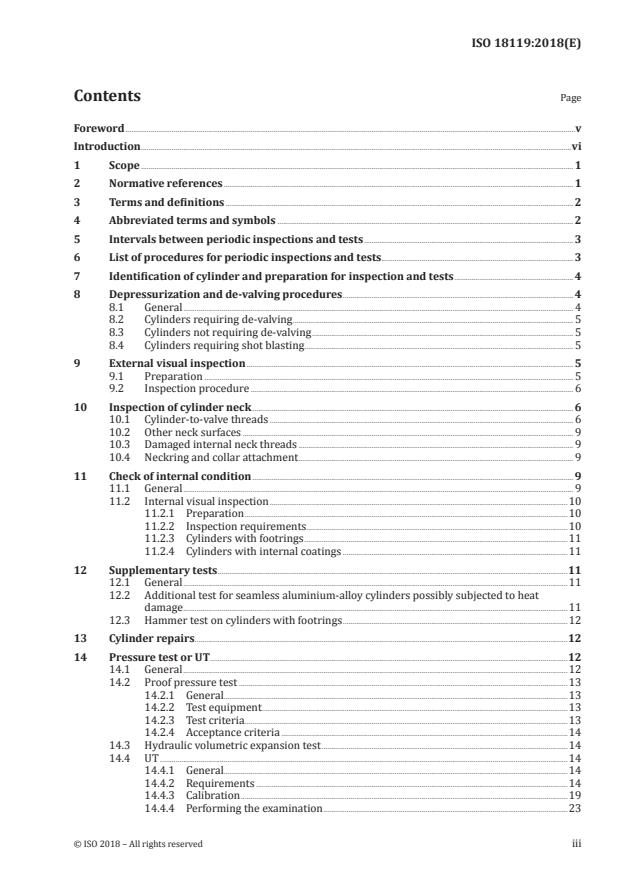
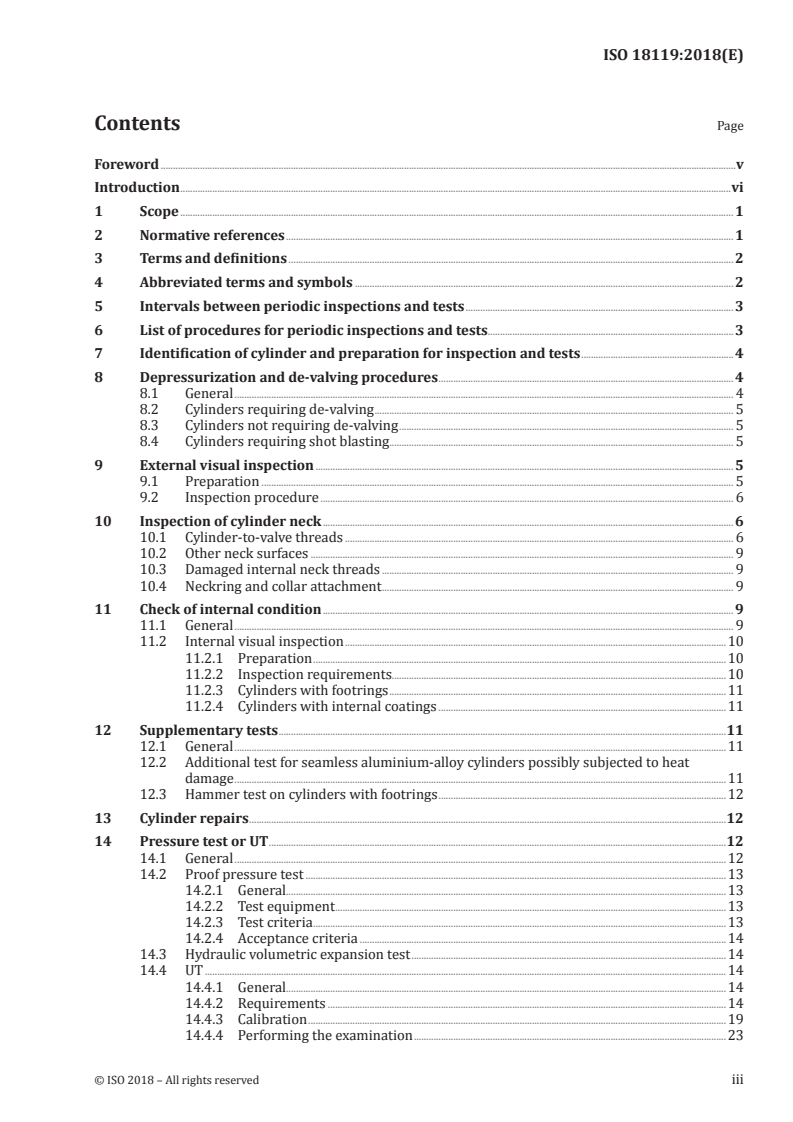
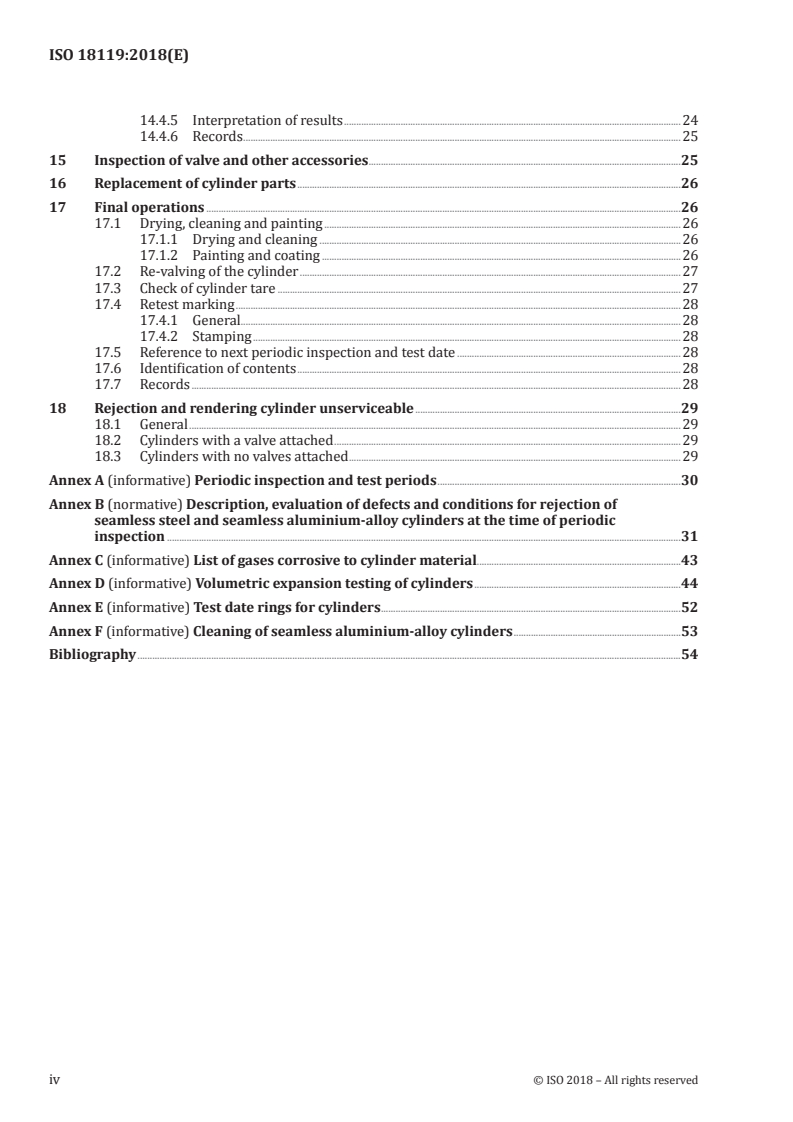
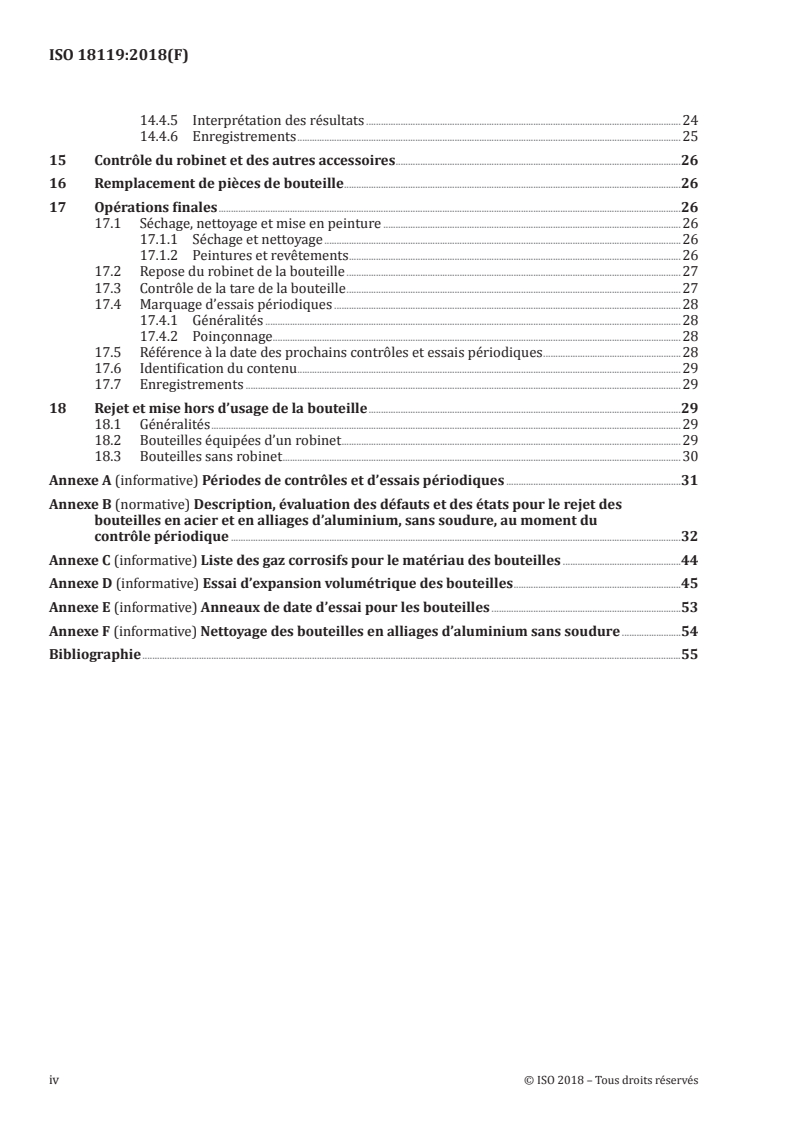
Contents Page
Foreword .v
Introduction .vi
1 Scope . 1
2 Normative references . 1
3 Terms and definitions . 2
4 Abbreviated terms and symbols . 2
5 Intervals between periodic inspections and tests . 3
6 List of procedures for periodic inspections and tests. 3
7 Identification of cylinder and preparation for inspection and tests .4
8 Depressurization and de-valving procedures . 4
8.1 General . 4
8.2 Cylinders requiring de-valving . 5
8.3 Cylinders not requiring de-valving . 5
8.4 Cylinders requiring shot blasting. 5
9 External visual inspection . 5
9.1 Preparation . 5
9.2 Inspection procedure . 6
10 Inspection of cylinder neck . 6
10.1 Cylinder-to-valve threads . 6
10.2 Other neck surfaces . 9
10.3 Damaged internal neck threads . 9
10.4 Neckring and collar attachment . 9
11 Check of internal condition . 9
11.1 General . 9
11.2 Internal visual inspection .10
11.2.1 Preparation .10
11.2.2 Inspection requirements.10
11.2.3 Cylinders with footrings .11
11.2.4 Cylinders with internal coatings .11
12 Supplementary tests .11
12.1 General .11
12.2 Additional test for seamless aluminium-alloy cylinders possibly subjected to heat
damage .11
12.3 Hammer test on cylinders with footrings .12
13 Cylinder repairs .12
14 Pressure test or UT .12
14.1 General .12
14.2 Proof pressure test .13
14.2.1 General.13
14.2.2 Test equipment .13
14.2.3 Test criteria .13
14.2.4 Acceptance criteria .14
14.3 Hydraulic volumetric expansion test .14
14.4 UT .14
14.4.1 General.14
14.4.2 Requirements .14
14.4.3 Calibration .19
14.4.4 Performing the examination .23
14.4.5 Interpretation of results .24
14.4.6 Records .25
15 Inspection of valve and other accessories .25
16 Replacement of cylinder parts .26
17 Final operations .26
17.1 Drying, cleaning and painting .26
17.1.1 Drying and cleaning .26
17.1.2 Painting and coating .26
17.2 Re-valving of the cylinder .27
17.3 Check of cylinder tare .27
17.4 Retest marking .28
17.4.1 General.28
17.4.2 Stamping .28
17.5 Reference to next periodic inspection and test date .28
17.6 Identification of contents .28
17.7 Records .28
18 Rejection and rendering cylinder unserviceable .29
18.1 General .29
18.2 Cylinders with a valve attached .29
18.3 Cylinders with no valves attached .29
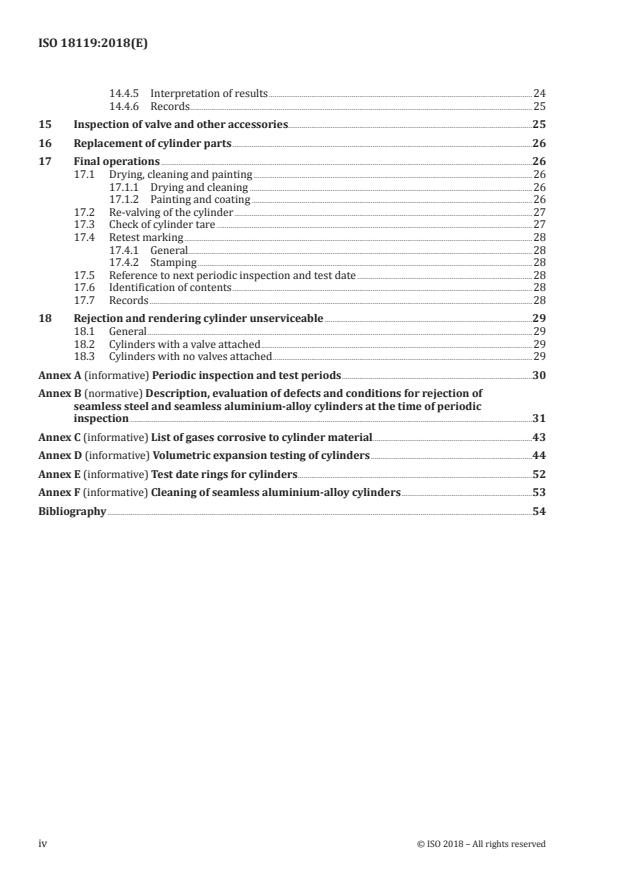
Annex A (informative) Periodic inspection and test periods .30
Annex B (normative) Description, evaluation of defects and conditions for rejection of
seamless steel and seamless aluminium-alloy cylinders at the time of periodic
inspection .31
Annex C (informative) List of gases corrosive to cylinder material .43
Annex D (informative) Volumetric expansion testing of cylinders .44
Annex E (informative) Test date rings for cylinders .52
Annex F (informative) Cleaning of seamless aluminium-alloy cylinders .53
Bibliography .54
iv © ISO 2018 – All rights reserved
Foreword
ISO (the International Organization for Standardization) is a worldwide federation of national standards
bodies (ISO member bodies). The work of preparing International Standards is normally carried out
through ISO technical committees. Each member body interested in a subject for which a technical
committee has been established has the right to be represented on that committee. International
organizations, governmental and non-governmental, in liaison with ISO, also take part in the work.
ISO collaborates closely with the International Electrotechnical Commission (IEC) on all matters of
electrotechnical standardization.
The procedures used to develop this document and those intended for its further maintenance are
described in the ISO/IEC Directives, Part 1. In particular the different approval criteria needed for the
different types of ISO documents should be noted. This document was drafted in accordance with the
editorial rules of the ISO/IEC Directives, Part 2 (see www .iso .org/directives).
Attention is drawn to the possibility that some of the elements of this document may be the subject of
patent rights. ISO shall not be held responsible for identifying any or all such patent rights. Details of
any patent rights identified during the development of the document will be in the Introduction and/or
on the ISO list of patent declarations received (see www .iso .org/patents).
Any trade name used in this document is information given for the convenience of users and does not
constitute an endorsement.
For an explanation on the voluntary nature of standards, the meaning of ISO specific terms and
expressions related to conformity assessment, as well as information about ISO's adherence to the
World Trade Organization (WTO) principles in the Technical Barriers to Trade (TBT) see the following
URL: www .iso .org/iso/foreword .html.
This document was prepared by ISO/TC 58, Gas cylinders, Subcommittee SC 4, Operational requirements
for gas cylinders.
This first edition cancels and replaces ISO 6406:2005 and ISO 10461:2005, which have been technically
revised. It also incorporates the Amendment ISO 10461:2005/Amd 1:2006.
The main changes are:
— a section has been added for symbols used in the document;
— a detailed account of steps to be taken if the actual cylinder wall thickness is less than the minimum
design wall thickness has been added;
— a clearer way to ultrasonically test cylinders with a built-in footring, especially for seamless steel
cylinders with a convex base, has been added;
— improved guidelines have been added for dealing with the effects of heating of seamless aluminium-
alloy cylinders.
Introduction
This document provides information and procedures for the periodic inspection and testing of seamless
steel and seamless aluminium-alloy cylinders and the condition of the test equipment. The principal
aim of periodic inspection and testing is that at the completion of the test the cylinders have been
requalified and are suitable to be reintroduced into service for a further period of time.
This document requires that well-trained and competent personnel undertake the work as described
in this document, who consult the cylinder’s manufacturer if there are doubts about aspects of the
document, so that the cylinder manufacturer's current recommendations are taken into account.
[23]
This document has been written so that it is suitable to be referenced in the UN Model Regulations .
vi © ISO 2018 – All rights reserved
INTERNATIONAL STANDARD ISO 18119:2018(E)
Gas cylinders — Seamless steel and seamless
aluminium-alloy gas cylinders and tubes — Periodic
inspection and testing
CAUTION — Some of the tests specified in this document involve the use of processes that could
lead to a hazardous situation.
1 Scope
This document specifies the requirements for periodic inspection and testing to verify the integrity of
cylinders and tubes to be re-introduced into service for a further period of time.
This document is applicable to seamless steel and seamless aluminium-alloy transportable gas cylinders
(single or those that comprise a bundle) intended for compressed and liquefied gases under pressure, of
water capacity from 0,5 l up to 150 l and to seamless steel and seamless aluminium-alloy transportable
gas tubes (single or those that comprise a bundle) intended for compressed and liquefied gases under
pressure, of water capacity greater than 150 l. It also applies, as far as practical, to cylinders of less than
0,5 l water capacity.
This document does not apply to the periodic inspection and maintenance of acetylene cylinders or to
the periodic inspection and testing of composite cylinders.
NOTE Unless noted by exception, the use of the word “cylinder” in this document refers to both cylinders
and tubes.
2 Normative references
The following documents are referred to in the text in such a way that some or all of their content
constitutes requirements of this document. For dated references, only the edition cited applies. For
undated references, the latest edition of the referenced document (including any amendments) applies.
ISO 6506-1, Metallic materials — Brinell hardness test — Part 1: Test method
ISO 7866, Gas cylinders — Refillable seamless aluminium alloy gas cylinders — Design, construction
and testing
ISO 9712, Non-destructive testing — Qualification and certification of NDT personnel
ISO 9809-1, Gas cylinders — Refillable seamless steel gas cylinders — Design, construction and testing —
Part 1: Quenched and tempered steel cylinders with tensile strength less than 1 100 MPa
ISO 10286, Gas cylinders — Terminology
ISO 11621, Gas cylinders — Procedures for change of gas service
1)
ISO 13769 , Gas cylinders — Stamp marking
ISO 22434, Transportable gas cylinders — Inspection and maintenance of cylinder valves
ISO 25760, Gas cylinders — Operational procedures for the safe removal of valves from gas cylinders
1) To be published. Stage at the time of publication: ISO/FDIS 13769:2018.
3 Terms and definitions
For the purposes of this document, the terms and definitions given in ISO 10286 and the following apply.
ISO and IEC maintain terminological databases for use in standardization at the following addresses:
— IEC Electropedia: available at http: //www .electropedia .org/
— ISO Online browsing platform: available at https: //www .iso .org/obp
3.1
liquefied gas
gas, which, when packaged under pressure, is partially liquid at temperatures above −50 °C
Note 1 to entry: A distinction is made between
a) high pressure liquefied gas: a gas with a critical temperature between −50 °C and 65 °C, and
b) low pressure liquefied gas: a gas with a critical temperature above 65 °C.
3.2
rejected cylinder
cylinder not fit for service
3.3
competent authority
any national body or authority designated or otherwise recognized as such, having jurisdiction for the
transport of dangerous goods and the approval of gas cylinders
[23]
Note 1 to entry: Adapted from UN Model Regulations .
3.4
minimum design wall thickness
thickness of the cylinder wall calculated from the design standard, taking into account the material
properties and dimensions at time of manufacture
3.5
stove
treat by heating in a stove or an oven in order to apply a desired surface coating
4 Abbreviated terms and symbols
FBH flat bottom hole
PE permanent expansion
SBT sidewall-to-base transition region
UT ultrasonic testing
−1
C compressibility (expressed in m²/N or Pa )
D depth of notch in ultrasonic test sample (expressed in mm)
K factor for individual temperature (listed in Table C.1)
L length of notch in ultrasonic test sample (expressed in mm)
P pressure (expressed in bar)
V cylinder water capacity (expressed in l)
2 © ISO 2018 – All rights reserved
W width of notch in ultrasonic test sample (expressed in mm)
X flaw length (expressed in mm)
Y flaw depth ratio
t minimum measured wall thickness of the calibration specimen (expressed in mm)
mc
t minimum design wall thickness (expressed in mm)
m
5 Intervals between periodic inspections and tests
A cylinder shall be due for periodic inspection and testing on its first receipt by a filler following the
expiry of the established interval or, in the absence of regulations, in accordance with the UN Model
[23] th
Regulations . Annex A lists the intervals for period inspection and testing as outlined in the 19
revised edition of the UN Model Regulations. The expiry date is based on the last test date shown on the
cylinder. Other means of indicating the expiry date may be used.
Provided the cylinder has not been subjected to abusive and abnormal conditions such as being
involved in an accident, heat exposure or other severe conditions that would render it unsafe, there is
no requirement for the user to return a cylinder before the contents have been used even though the
periodic inspection and testing interval has lapsed. However, cylinders, particularly those containing
corrosive gases, should be retested within a period not exceeding twice the time interval.
Seamless steel or seamless aluminium-alloy cylinders used for self-contained breathing apparatus or
self-contained underwater breathing apparatus that are not covered by transport regulations may be
submitted for inspection within the interval shown in Table A.1.
6 List of procedures for periodic inspections and tests
Assessment of conformity to this document shall be carried out in accordance with the applicable
regulations of the countries of use.
Tests and examinations performed to demonstrate compliance shall be conducted using instruments
calibrated before being put into service and thereafter according to an established programme.
Each cylinder shall be submitted to periodic inspections and tests. The following procedures, when
applicable, form the requirements for such inspections and tests and are explained more fully in
subsequent clauses:
a) identification of cylinder and preparation for inspection and tests (see Clause 7);
b) depressurization and de-valving procedures (see Clause 8);
c) external visual inspection (see Clause 9);
d) inspection of cylinder neck (see Clause 10);
e) check of internal condition (see Clause 11);
f) supplementary tests (see Clause 12);
g) cylinder repairs (see Clause 13);
h) pressure test or UT (see Clause 14);
i) inspection of valve and other accessories (see Clause 15);
j) replacement of cylinder parts (see Clause 16);
k) final operations (see Clause 17);
l) rejection and rendering cylinder unserviceable (see Clause 18).
These procedures should be performed in the sequence listed in order to improve the safety of the
operation and to detect potential harmful damage. In particular, the external visual inspection (see
Clause 9) shall be carried out before the internal visual inspection (when required) (see Clause 11), the
pressure test, or UT (see Clause 14).
When a cylinder passes the above listed procedures but the condition of the cylinder remains in doubt,
additional, supplementary tests shall be performed to confirm its suitability for continued service (see
Clause 12) or the cylinder shall be rendered unserviceable in accordance with Clause 18.
Depending on the reason for rejection, some cylinders may be recovered in accordance with Annex B.
Mechanical properties of seamless steel and seamless aluminium-alloy cylinders can be affected by
heat exposure. Therefore, the maximum temperature for any operation shall be limited in accordance
with the manufacturer's recommendation (for seamless aluminium-alloy cylinders, see 17.1.2.3).
Cylinders that fail an inspection or test and cannot be recovered shall be rendered unserviceable in
accordance with Clause 18.
The eyesight acuity of operators is critical and should be checked by an optician on a yearly basis.
7 Identification of cylinder and preparation for inspection and tests
The labelling and permanent markings on the cylinder shall be checked and the information recorded
before carrying out any further work. When a toxic, flammable or pyrophoric gas is involved, the
owner or the individual presenting the cylinder for retest shall inform the testing facility accordingly.
Cylinders with incorrect or illegible markings or unknown gas contents shall be set aside for special
handling.
Cylinders intended for a change of gas service shall be evaluated in accordance with ISO 11621.
For seamless steel cylinders, the following applies in addition:
If the contents are identified as hydrogen or other embrittling gas, only those cylinders manufactured
or qualified as hydrogen cylinders shall be used for that service. Check that the cylinder is compatible
for hydrogen service, i.e. with respect to the maximum tensile strength and internal surface condition.
Seamless steel cylinders marked in accordance with ISO 13769 are stamped “H”. Seamless steel cylinders
that have not been checked or are not stamped “H” shall not be reintroduced into hydrogen service.
Their suitability for their new, intended service shall be evaluated in accordance with ISO 11621.
8 Depressurization and de-valving procedures
8.1 General
Cylinders that require an internal visual inspection shall be depressurized and emptied in a safe,
controlled manner and de-valved prior to inspection in accordance with ISO 25760.
Particular attention shall be given to cylinders containing flammable, oxidizing, corrosive or toxic gases
to eliminate risks at the internal inspection stage. See Annex C for a list of gases that are corrosive to
cylinder material.
Cylinders (other than those with a footring) to be ultrasonically inspected may be examined without
being depressurized or having the valve removed.
WARNING — The uncontrolled opening and/or removal of valves from cylinders can lead to
injury, death and/or property damage.
4 © ISO 2018 – All rights reserved
When ultrasonically testing cylinders that are under pressure, care shall be taken to ensure the safety
of personnel and property (e.g. by placing a valve protection device over the valve or by depressurizing
the cylinder to 5 bar or less).
8.2 Cylinders requiring de-valving
All cylinders received for testing for which an internal visual inspection is required shall be safely de-
valved in accordance with ISO 25760.
Cylinders with a footring shall be de-valved for internal inspection and may be subsequently
evaluated by UT.
8.3 Cylinders not requiring de-valving
Cylinders without a footring that are to be evaluated by UT do not require the valves to be removed
unless otherwise specified in this document.
8.4 Cylinders requiring shot blasting
Cylinders that require shot blasting shall be depressurized before processing.
9 External visual inspection
9.1 Preparation
If a cylinder's external condition prevents or hinders a proper visual inspection of the surface, then the
cylinder shall be prepared before the inspection. If any welded or brazed attachment (e.g. neckring) is
seen, the cylinder shall be rendered unserviceable in accordance with Clause 18.
The cylinder shall be cleaned and have all loose coatings, labels, corrosion products, tar, oil or other
foreign matter removed from its external surface. The cylinder shall not at this stage be brushed or
blasted until after the external visual inspection has been completed in order to not remove signs of
previous damage. Seamless aluminium-alloy cylinders should be prepared for visual examination (see
Annex F). They shall not be shot blasted using steel media; however, blasting may be conducted with
other appropriate media (e.g. walnut shells, dry ice pellets, etc.).
The method used to clean the cylinder shall be a validated, controlled process. Care shall be taken at all
times to avoid damaging the cylinder taking into account the information provided in Annex B.
If fused nylon, polyethylene or a similar coating has been applied and it is damaged or prevents proper
inspection, then this coating shall be removed. If the coating has been removed by the application of
heat, then care shall be taken that the applied temperature has not altered the mechanical properties of
the cylinder material. The temperatures at which damage occurs are as follows:
a) For seamless steel cylinders: in no case shall the temperature of the cylinder have exceeded 300 °C.
b) For seamless aluminium-alloy cylinders: in no case shall the temperature of the cylinder have
exceeded the limits specified in 17.1.2.3.
For both seamless steel and seamless aluminium-alloy cylinders, contact the manufacturer if there is
doubt about heat exposure. If the manufacturer cannot be consulted, the cylinder shall be rendered
unserviceable in accordance with Clause 18.
9.2 Inspection procedure
The external surface of each cylinder shall be inspected for the following in accordance with Table B.1,
Table B.2 or Table B.3 as applicable:
a) dents, cuts, gouges, bulges, cracks, laminations or excessive base wear;
b) heat damage, torch damage or electric arc burns;
c) corrosion;
d) other defects such as illegible, incorrect or unauthorized stamp markings, or unauthorized
additions or modifications;
e) integrity of all permanent attachments;
f) vertical stability.
Corrosion is likely to occur in the footring area, especially the transition area cylindrical part/footring,
and the gap-area convex base/footring. When inspecting cylinders with footrings, extra attention shall
be given to these areas.
At this stage, the cylinder shall be visually inspected for signs of corrosion (see Table B.2 for rejection
criteria). Attention shall be given to areas where water can be trapped. These areas include the entire
base area and the neckring. If corrosion is detected, then the corrosion products and paint shall be
removed (e.g. shot blasted), particularly where the corrosion appears on the cylinder shell. If the extent
of the corrosion cannot be determined, including doubt about the remaining wall thickness, then the
cylinder shall be rejected.
Rejection criteria shall be in accordance with Annex B. Cylinders no longer suitable for future service
shall be rendered unserviceable in accordance with Clause 18.
10 Inspection of cylinder neck
10.1 Cylinder-to-valve threads
After the valve is removed, the cylinder-to-valve threads shall be examined to identify the type of
thread (e.g. see ISO 11363-2) and to ensure that they are:
— clean and of full form, and
— free of damage (e.g. burrs, cracks, cross-threading, corrosion, etc.).
Cylinders in toxic or corrosive gas service shall have their threads gauged for wear and ovality using a
plug gauge (see Figures 1, 2 and 3). The threads of cylinders in other gas services may be verified using
appropriate gauges in cases of doubt.
6 © ISO 2018 – All rights reserved
Figure 1 — Example of a calibrated upper thread plug gauge (thread failed)
Key
1 maximum
2 minimum
Figure 2 — Example of a “Go/no-go” plug gauge (thread passed)
Key
1 oval thread in cylinder neck
2 plain taper plug gauge
a
Large movement.
b
Small movement.
Figure 3 — Ovality check
Neck cracks manifest themselves as lines that run down the thread across the thread faces (see
Figure 4). Special attention should be paid to look for the presence of cracks in the area at the bottom of
the last thread. They should not be confused with tap marks (tap stop marks). See Figure 5.
Key
1 neck crack
2 propagated crack in the neck
Figure 4 — Neck cracks
8 © ISO 2018 – All rights reserved
Key
1 tap marks
Figure 5 — Tap marks
10.2 Other neck surfaces
Other surfaces of the neck (e.g. face, O-ring seat, external neck surface, etc.) shall also be examined to
ensure they are free from cracks and imperfections in accordance with Annex B.
When a tube is removed from its mounting, external neck threads shall be gauged.
10.3 Damaged internal neck threads
When necessary, threads may be re-tapped to clean and rectify the appropriate number of effective
threads. After re-tapping, the threads shall be checked using the applicable thread gauge (e.g.
ISO 11363-2). Neck wall thickness shall remain unchanged after re-tapping.
10.4 Neckring and collar attachment
When a neckring/collar is attached, an examination shall be carried out to ensure that it is secure and
to inspect for external thread damage. A neckring shall only be changed using a procedure approved
by the cylinder manufacturer or, if they are unavailable, approved by the competent authority. The new
neckring shall be checked to ensure that it is secure by following the minimum requirements for pull-
off force and axial rotation torque in accordance with ISO 9809-1 or ISO 7866, as applicable.
Threads shall be gauged and inspected after this change. If damage to the cylinder material has occurred
by replacement of the neckring/collar, the cylinder shall be rendered unserviceable in accordance with
Clause 18.
11 Check of internal condition
11.1 General
If the cylinder is not to be evaluated by UT in accordance with 14.4, then it shall be subjected to an
internal visual inspection. An internal inspection shall be performed for cylinders requiring UT and
when the valve is removed.
Prior to carrying out an internal visual inspection, the cylinder shall be depressurized and, if necessary,
purged in accordance with ISO 25760.
For seamless aluminium-alloy cylinders susceptible to sustained-load cracking (e.g. those manufactured
from AA 6351 or AA 6082 alloy), the internal side of the shoulder shall be examined visually and the
neck area shall be examined using a non-destructive examination method such as eddy current testing.
11.2 Internal visual inspection
11.2.1 Preparation
11.2.1.1 General
Whenever the internal surface of a cylinder is not adequately visible, a suitable cleaning method shall
be applied.
The method used to clean the cylinder shall be a validated, controlled process. Care shall be taken at all
times to avoid damaging the cylinder taking into account the information provided in Annex B.
11.2.1.2 Suitable cleaning methods for seamless steel cylinders
If necessary, suitable cleaning methods such as shot-blasting, water jet abrasive cleaning, flailing, steam
jet, hot water jet, rumbling, chemical cleaning or others may be used on seamless steel cylinders.
If the cylinder has been cleaned by one of the above methods, it shall be inspected after the cleaning
operation.
11.2.1.3 Suitable cleaning methods for seamless aluminium-alloy cylinders
If necessary, suitable cleaning methods such as water jet abrasive cleaning, flailing, steam jet, hot
water jet, chemical cleaning, blasting with glass beads or others may be used on seamless aluminium-
alloy cylinders (see Annex F or consult the cylinder manufacturer). Cleaning with material other than
alumina or glass beads, etc. shall be avoided. Hard media can embed itself in the aluminium alloy.
Alkaline solutions and paint strippers that are harmful to aluminium and its alloys shall not be used.
If the cylinder has been cleaned by one of the above methods, it shall be dried immediately after being
cleaned and inspected.
Ensure that any aqueous liquid does not stay in the cylinder for more than two hours.
11.2.2 Inspection requirements
Internal visual inspections shall be conducted in good lighting on a cylinder that is both clean and dry,
suitable enough for proper inspection of all surfaces to identify any imperfections similar to those
listed in 9.2 a) and 9.2 c). These inspections may be augmented by the use of a boroscope, dental mirror
or another suitable device. When magnification is used, the final assessment of the imperfection shall
be carried out as if no magnification had been used.
When needed, the severity of a detected imperfection may be further evaluated by using other devices
or methods.
Precautions shall be taken to ensure that the method of illumination presents no risks to the tester
while performing the operation (e.g. use of a filament lamp in a potentially explosive environment shall
be avoided).
Any cylinder showing presence of foreign matter or signs of more than light surface corrosion shall be
cleaned internally (see 11.2.1).
10 © ISO 2018 – All rights reserved
Alternative methods may be substituted for the internal visual inspection for cylinders that contain
non-corrosive gases that have a water capacity less than 0,5 l and an internal neck diameter less than
9 mm. These alternative methods include:
— looking for free moisture at the time of depressurizing after the cylinder has been in an inverted
position for at least one minute and prior to valve removal;
— looking for contamination (e.g. rust in the test medium following the hydraulic volumetric
expansion test).
If any moisture is present upon inversion of the cylinder or if rust contamination is observed in the
hydraulic volumetric expansion test medium, the cylinder shall be either re-examined after cleaning in
accordance with 11.2.1.1 or rendered unserviceable in accordance with Clause 18.
11.2.3 Cylinders with footrings
Special attention shall be given to inspect cylinders with footrings for defects in critical areas, i.e. the
transition (footring) zone and the cylinder base.
11.2.4 Cylinders with internal coatings
Cylinders used in certain applications (e.g. corrosive gases) can have an internal coating such as an
electrochemical deposit, cladding, paint or a film to inhibit corrosion.
Since the hydraulic volumetric expansion test medium can affect the coating, the manufacturer shall be
contacted in case of doubt to determine the correct type of testing to be used.
Care shall be taken when a coating might contain flammable components, e.g. hydrocarbons in paint or
a corrosion inhibitor.
A damaged coating shall be removed to allow for a complete visual inspection. When the damaged
coating (e.g. cladding) cannot be removed, the manufacturer shall be consulted for guidance on how to
prepare the cylinder for periodic inspection and testing.
If the manufacturer cannot be consulted, the cylinder shall be rendered unserviceable in accordance
with Clause 18.
12 Supplementary tests
12.1 General
Evaluation of the type and/or severity of an imperfection found on visual inspection may require
additional tests or methods of examination, e.g. ultrasonic techniques, check weighing or other non-
destructive tests.
After satisfactory evaluation, the cylinder may be further processed in accordance with Annex B.
12.2 Additional test for seamless aluminium-alloy cylinders possibly subjected to
heat damage
If it is suspected that the cylinder has been exposed to high temperature, a hardness test in accordance
with ISO 6506-1 or a conductivity test as performed during manufacture shall be carried out. Test
results shall meet the required design values at the time of manufacture.
All hardness tests shall be performed in the suspected heat-damaged area of the cylinder taking
adequate care to ensure deep impressions are not formed.
12.3 Hammer test on cylinders with footrings
Cylinders with footrings shall be suspended freely for the hammer test. The minimum hammer weight
shall be 0,25 kg.
The footring shall have a tight fit to the cylinder. The hammer test gives an indication regarding the
fitting of the footring to the cylinder and the condition of the area where the footring is shrunk-on.
After hitting the footring with a hammer, the resulting sound shall be clear/bell-like.
If the sound is dull or flat, it is an indication that the footring is not tight to the cylinder and/or corrosion
could have built up between the footring and the cylinder. In the latter case, the footring shall be
replaced or the cylinder shall be rendered unserviceable in accordance with Clause 18.
13 Cylinder repairs
Operations that can result in loss of cylinder wall thickness (e.g. external and/or internal shot blasting,
repair of notches) shall be completed before t
...
INTERNATIONAL ISO
STANDARD 18119
First edition
2018-05
Gas cylinders — Seamless steel
and seamless aluminium-alloy gas
cylinders and tubes — Periodic
inspection and testing
Bouteilles à gaz — Bouteilles et tubes à gaz en acier et en alliages
d'aluminium, sans soudure — Contrôles et essais périodiques
Reference number
©
ISO 2018
© ISO 2018
All rights reserved. Unless otherwise specified, or required in the context of its implementation, no part of this publication may
be reproduced or utilized otherwise in any form or by any means, electronic or mechanical, including photocopying, or posting
on the internet or an intranet, without prior written permission. Permission can be requested from either ISO at the address
below or ISO’s member body in the country of the requester.
ISO copyright office
CP 401 • Ch. de Blandonnet 8
CH-1214 Vernier, Geneva
Phone: +41 22 749 01 11
Fax: +41 22 749 09 47
Email: copyright@iso.org
Website: www.iso.org
Published in Switzerland
ii © ISO 2018 – All rights reserved
Contents Page
Foreword .v
Introduction .vi
1 Scope . 1
2 Normative references . 1
3 Terms and definitions . 2
4 Abbreviated terms and symbols . 2
5 Intervals between periodic inspections and tests . 3
6 List of procedures for periodic inspections and tests. 3
7 Identification of cylinder and preparation for inspection and tests .4
8 Depressurization and de-valving procedures . 4
8.1 General . 4
8.2 Cylinders requiring de-valving . 5
8.3 Cylinders not requiring de-valving . 5
8.4 Cylinders requiring shot blasting. 5
9 External visual inspection . 5
9.1 Preparation . 5
9.2 Inspection procedure . 6
10 Inspection of cylinder neck . 6
10.1 Cylinder-to-valve threads . 6
10.2 Other neck surfaces . 9
10.3 Damaged internal neck threads . 9
10.4 Neckring and collar attachment . 9
11 Check of internal condition . 9
11.1 General . 9
11.2 Internal visual inspection .10
11.2.1 Preparation .10
11.2.2 Inspection requirements.10
11.2.3 Cylinders with footrings .11
11.2.4 Cylinders with internal coatings .11
12 Supplementary tests .11
12.1 General .11
12.2 Additional test for seamless aluminium-alloy cylinders possibly subjected to heat
damage .11
12.3 Hammer test on cylinders with footrings .12
13 Cylinder repairs .12
14 Pressure test or UT .12
14.1 General .12
14.2 Proof pressure test .13
14.2.1 General.13
14.2.2 Test equipment .13
14.2.3 Test criteria .13
14.2.4 Acceptance criteria .14
14.3 Hydraulic volumetric expansion test .14
14.4 UT .14
14.4.1 General.14
14.4.2 Requirements .14
14.4.3 Calibration .19
14.4.4 Performing the examination .23
14.4.5 Interpretation of results .24
14.4.6 Records .25
15 Inspection of valve and other accessories .25
16 Replacement of cylinder parts .26
17 Final operations .26
17.1 Drying, cleaning and painting .26
17.1.1 Drying and cleaning .26
17.1.2 Painting and coating .26
17.2 Re-valving of the cylinder .27
17.3 Check of cylinder tare .27
17.4 Retest marking .28
17.4.1 General.28
17.4.2 Stamping .28
17.5 Reference to next periodic inspection and test date .28
17.6 Identification of contents .28
17.7 Records .28
18 Rejection and rendering cylinder unserviceable .29
18.1 General .29
18.2 Cylinders with a valve attached .29
18.3 Cylinders with no valves attached .29
Annex A (informative) Periodic inspection and test periods .30
Annex B (normative) Description, evaluation of defects and conditions for rejection of
seamless steel and seamless aluminium-alloy cylinders at the time of periodic
inspection .31
Annex C (informative) List of gases corrosive to cylinder material .43
Annex D (informative) Volumetric expansion testing of cylinders .44
Annex E (informative) Test date rings for cylinders .52
Annex F (informative) Cleaning of seamless aluminium-alloy cylinders .53
Bibliography .54
iv © ISO 2018 – All rights reserved
Foreword
ISO (the International Organization for Standardization) is a worldwide federation of national standards
bodies (ISO member bodies). The work of preparing International Standards is normally carried out
through ISO technical committees. Each member body interested in a subject for which a technical
committee has been established has the right to be represented on that committee. International
organizations, governmental and non-governmental, in liaison with ISO, also take part in the work.
ISO collaborates closely with the International Electrotechnical Commission (IEC) on all matters of
electrotechnical standardization.
The procedures used to develop this document and those intended for its further maintenance are
described in the ISO/IEC Directives, Part 1. In particular the different approval criteria needed for the
different types of ISO documents should be noted. This document was drafted in accordance with the
editorial rules of the ISO/IEC Directives, Part 2 (see www .iso .org/directives).
Attention is drawn to the possibility that some of the elements of this document may be the subject of
patent rights. ISO shall not be held responsible for identifying any or all such patent rights. Details of
any patent rights identified during the development of the document will be in the Introduction and/or
on the ISO list of patent declarations received (see www .iso .org/patents).
Any trade name used in this document is information given for the convenience of users and does not
constitute an endorsement.
For an explanation on the voluntary nature of standards, the meaning of ISO specific terms and
expressions related to conformity assessment, as well as information about ISO's adherence to the
World Trade Organization (WTO) principles in the Technical Barriers to Trade (TBT) see the following
URL: www .iso .org/iso/foreword .html.
This document was prepared by ISO/TC 58, Gas cylinders, Subcommittee SC 4, Operational requirements
for gas cylinders.
This first edition cancels and replaces ISO 6406:2005 and ISO 10461:2005, which have been technically
revised. It also incorporates the Amendment ISO 10461:2005/Amd 1:2006.
The main changes are:
— a section has been added for symbols used in the document;
— a detailed account of steps to be taken if the actual cylinder wall thickness is less than the minimum
design wall thickness has been added;
— a clearer way to ultrasonically test cylinders with a built-in footring, especially for seamless steel
cylinders with a convex base, has been added;
— improved guidelines have been added for dealing with the effects of heating of seamless aluminium-
alloy cylinders.
Introduction
This document provides information and procedures for the periodic inspection and testing of seamless
steel and seamless aluminium-alloy cylinders and the condition of the test equipment. The principal
aim of periodic inspection and testing is that at the completion of the test the cylinders have been
requalified and are suitable to be reintroduced into service for a further period of time.
This document requires that well-trained and competent personnel undertake the work as described
in this document, who consult the cylinder’s manufacturer if there are doubts about aspects of the
document, so that the cylinder manufacturer's current recommendations are taken into account.
[23]
This document has been written so that it is suitable to be referenced in the UN Model Regulations .
vi © ISO 2018 – All rights reserved
INTERNATIONAL STANDARD ISO 18119:2018(E)
Gas cylinders — Seamless steel and seamless
aluminium-alloy gas cylinders and tubes — Periodic
inspection and testing
CAUTION — Some of the tests specified in this document involve the use of processes that could
lead to a hazardous situation.
1 Scope
This document specifies the requirements for periodic inspection and testing to verify the integrity of
cylinders and tubes to be re-introduced into service for a further period of time.
This document is applicable to seamless steel and seamless aluminium-alloy transportable gas cylinders
(single or those that comprise a bundle) intended for compressed and liquefied gases under pressure, of
water capacity from 0,5 l up to 150 l and to seamless steel and seamless aluminium-alloy transportable
gas tubes (single or those that comprise a bundle) intended for compressed and liquefied gases under
pressure, of water capacity greater than 150 l. It also applies, as far as practical, to cylinders of less than
0,5 l water capacity.
This document does not apply to the periodic inspection and maintenance of acetylene cylinders or to
the periodic inspection and testing of composite cylinders.
NOTE Unless noted by exception, the use of the word “cylinder” in this document refers to both cylinders
and tubes.
2 Normative references
The following documents are referred to in the text in such a way that some or all of their content
constitutes requirements of this document. For dated references, only the edition cited applies. For
undated references, the latest edition of the referenced document (including any amendments) applies.
ISO 6506-1, Metallic materials — Brinell hardness test — Part 1: Test method
ISO 7866, Gas cylinders — Refillable seamless aluminium alloy gas cylinders — Design, construction
and testing
ISO 9712, Non-destructive testing — Qualification and certification of NDT personnel
ISO 9809-1, Gas cylinders — Refillable seamless steel gas cylinders — Design, construction and testing —
Part 1: Quenched and tempered steel cylinders with tensile strength less than 1 100 MPa
ISO 10286, Gas cylinders — Terminology
ISO 11621, Gas cylinders — Procedures for change of gas service
1)
ISO 13769 , Gas cylinders — Stamp marking
ISO 22434, Transportable gas cylinders — Inspection and maintenance of cylinder valves
ISO 25760, Gas cylinders — Operational procedures for the safe removal of valves from gas cylinders
1) To be published. Stage at the time of publication: ISO/FDIS 13769:2018.
3 Terms and definitions
For the purposes of this document, the terms and definitions given in ISO 10286 and the following apply.
ISO and IEC maintain terminological databases for use in standardization at the following addresses:
— IEC Electropedia: available at http: //www .electropedia .org/
— ISO Online browsing platform: available at https: //www .iso .org/obp
3.1
liquefied gas
gas, which, when packaged under pressure, is partially liquid at temperatures above −50 °C
Note 1 to entry: A distinction is made between
a) high pressure liquefied gas: a gas with a critical temperature between −50 °C and 65 °C, and
b) low pressure liquefied gas: a gas with a critical temperature above 65 °C.
3.2
rejected cylinder
cylinder not fit for service
3.3
competent authority
any national body or authority designated or otherwise recognized as such, having jurisdiction for the
transport of dangerous goods and the approval of gas cylinders
[23]
Note 1 to entry: Adapted from UN Model Regulations .
3.4
minimum design wall thickness
thickness of the cylinder wall calculated from the design standard, taking into account the material
properties and dimensions at time of manufacture
3.5
stove
treat by heating in a stove or an oven in order to apply a desired surface coating
4 Abbreviated terms and symbols
FBH flat bottom hole
PE permanent expansion
SBT sidewall-to-base transition region
UT ultrasonic testing
−1
C compressibility (expressed in m²/N or Pa )
D depth of notch in ultrasonic test sample (expressed in mm)
K factor for individual temperature (listed in Table C.1)
L length of notch in ultrasonic test sample (expressed in mm)
P pressure (expressed in bar)
V cylinder water capacity (expressed in l)
2 © ISO 2018 – All rights reserved
W width of notch in ultrasonic test sample (expressed in mm)
X flaw length (expressed in mm)
Y flaw depth ratio
t minimum measured wall thickness of the calibration specimen (expressed in mm)
mc
t minimum design wall thickness (expressed in mm)
m
5 Intervals between periodic inspections and tests
A cylinder shall be due for periodic inspection and testing on its first receipt by a filler following the
expiry of the established interval or, in the absence of regulations, in accordance with the UN Model
[23] th
Regulations . Annex A lists the intervals for period inspection and testing as outlined in the 19
revised edition of the UN Model Regulations. The expiry date is based on the last test date shown on the
cylinder. Other means of indicating the expiry date may be used.
Provided the cylinder has not been subjected to abusive and abnormal conditions such as being
involved in an accident, heat exposure or other severe conditions that would render it unsafe, there is
no requirement for the user to return a cylinder before the contents have been used even though the
periodic inspection and testing interval has lapsed. However, cylinders, particularly those containing
corrosive gases, should be retested within a period not exceeding twice the time interval.
Seamless steel or seamless aluminium-alloy cylinders used for self-contained breathing apparatus or
self-contained underwater breathing apparatus that are not covered by transport regulations may be
submitted for inspection within the interval shown in Table A.1.
6 List of procedures for periodic inspections and tests
Assessment of conformity to this document shall be carried out in accordance with the applicable
regulations of the countries of use.
Tests and examinations performed to demonstrate compliance shall be conducted using instruments
calibrated before being put into service and thereafter according to an established programme.
Each cylinder shall be submitted to periodic inspections and tests. The following procedures, when
applicable, form the requirements for such inspections and tests and are explained more fully in
subsequent clauses:
a) identification of cylinder and preparation for inspection and tests (see Clause 7);
b) depressurization and de-valving procedures (see Clause 8);
c) external visual inspection (see Clause 9);
d) inspection of cylinder neck (see Clause 10);
e) check of internal condition (see Clause 11);
f) supplementary tests (see Clause 12);
g) cylinder repairs (see Clause 13);
h) pressure test or UT (see Clause 14);
i) inspection of valve and other accessories (see Clause 15);
j) replacement of cylinder parts (see Clause 16);
k) final operations (see Clause 17);
l) rejection and rendering cylinder unserviceable (see Clause 18).
These procedures should be performed in the sequence listed in order to improve the safety of the
operation and to detect potential harmful damage. In particular, the external visual inspection (see
Clause 9) shall be carried out before the internal visual inspection (when required) (see Clause 11), the
pressure test, or UT (see Clause 14).
When a cylinder passes the above listed procedures but the condition of the cylinder remains in doubt,
additional, supplementary tests shall be performed to confirm its suitability for continued service (see
Clause 12) or the cylinder shall be rendered unserviceable in accordance with Clause 18.
Depending on the reason for rejection, some cylinders may be recovered in accordance with Annex B.
Mechanical properties of seamless steel and seamless aluminium-alloy cylinders can be affected by
heat exposure. Therefore, the maximum temperature for any operation shall be limited in accordance
with the manufacturer's recommendation (for seamless aluminium-alloy cylinders, see 17.1.2.3).
Cylinders that fail an inspection or test and cannot be recovered shall be rendered unserviceable in
accordance with Clause 18.
The eyesight acuity of operators is critical and should be checked by an optician on a yearly basis.
7 Identification of cylinder and preparation for inspection and tests
The labelling and permanent markings on the cylinder shall be checked and the information recorded
before carrying out any further work. When a toxic, flammable or pyrophoric gas is involved, the
owner or the individual presenting the cylinder for retest shall inform the testing facility accordingly.
Cylinders with incorrect or illegible markings or unknown gas contents shall be set aside for special
handling.
Cylinders intended for a change of gas service shall be evaluated in accordance with ISO 11621.
For seamless steel cylinders, the following applies in addition:
If the contents are identified as hydrogen or other embrittling gas, only those cylinders manufactured
or qualified as hydrogen cylinders shall be used for that service. Check that the cylinder is compatible
for hydrogen service, i.e. with respect to the maximum tensile strength and internal surface condition.
Seamless steel cylinders marked in accordance with ISO 13769 are stamped “H”. Seamless steel cylinders
that have not been checked or are not stamped “H” shall not be reintroduced into hydrogen service.
Their suitability for their new, intended service shall be evaluated in accordance with ISO 11621.
8 Depressurization and de-valving procedures
8.1 General
Cylinders that require an internal visual inspection shall be depressurized and emptied in a safe,
controlled manner and de-valved prior to inspection in accordance with ISO 25760.
Particular attention shall be given to cylinders containing flammable, oxidizing, corrosive or toxic gases
to eliminate risks at the internal inspection stage. See Annex C for a list of gases that are corrosive to
cylinder material.
Cylinders (other than those with a footring) to be ultrasonically inspected may be examined without
being depressurized or having the valve removed.
WARNING — The uncontrolled opening and/or removal of valves from cylinders can lead to
injury, death and/or property damage.
4 © ISO 2018 – All rights reserved
When ultrasonically testing cylinders that are under pressure, care shall be taken to ensure the safety
of personnel and property (e.g. by placing a valve protection device over the valve or by depressurizing
the cylinder to 5 bar or less).
8.2 Cylinders requiring de-valving
All cylinders received for testing for which an internal visual inspection is required shall be safely de-
valved in accordance with ISO 25760.
Cylinders with a footring shall be de-valved for internal inspection and may be subsequently
evaluated by UT.
8.3 Cylinders not requiring de-valving
Cylinders without a footring that are to be evaluated by UT do not require the valves to be removed
unless otherwise specified in this document.
8.4 Cylinders requiring shot blasting
Cylinders that require shot blasting shall be depressurized before processing.
9 External visual inspection
9.1 Preparation
If a cylinder's external condition prevents or hinders a proper visual inspection of the surface, then the
cylinder shall be prepared before the inspection. If any welded or brazed attachment (e.g. neckring) is
seen, the cylinder shall be rendered unserviceable in accordance with Clause 18.
The cylinder shall be cleaned and have all loose coatings, labels, corrosion products, tar, oil or other
foreign matter removed from its external surface. The cylinder shall not at this stage be brushed or
blasted until after the external visual inspection has been completed in order to not remove signs of
previous damage. Seamless aluminium-alloy cylinders should be prepared for visual examination (see
Annex F). They shall not be shot blasted using steel media; however, blasting may be conducted with
other appropriate media (e.g. walnut shells, dry ice pellets, etc.).
The method used to clean the cylinder shall be a validated, controlled process. Care shall be taken at all
times to avoid damaging the cylinder taking into account the information provided in Annex B.
If fused nylon, polyethylene or a similar coating has been applied and it is damaged or prevents proper
inspection, then this coating shall be removed. If the coating has been removed by the application of
heat, then care shall be taken that the applied temperature has not altered the mechanical properties of
the cylinder material. The temperatures at which damage occurs are as follows:
a) For seamless steel cylinders: in no case shall the temperature of the cylinder have exceeded 300 °C.
b) For seamless aluminium-alloy cylinders: in no case shall the temperature of the cylinder have
exceeded the limits specified in 17.1.2.3.
For both seamless steel and seamless aluminium-alloy cylinders, contact the manufacturer if there is
doubt about heat exposure. If the manufacturer cannot be consulted, the cylinder shall be rendered
unserviceable in accordance with Clause 18.
9.2 Inspection procedure
The external surface of each cylinder shall be inspected for the following in accordance with Table B.1,
Table B.2 or Table B.3 as applicable:
a) dents, cuts, gouges, bulges, cracks, laminations or excessive base wear;
b) heat damage, torch damage or electric arc burns;
c) corrosion;
d) other defects such as illegible, incorrect or unauthorized stamp markings, or unauthorized
additions or modifications;
e) integrity of all permanent attachments;
f) vertical stability.
Corrosion is likely to occur in the footring area, especially the transition area cylindrical part/footring,
and the gap-area convex base/footring. When inspecting cylinders with footrings, extra attention shall
be given to these areas.
At this stage, the cylinder shall be visually inspected for signs of corrosion (see Table B.2 for rejection
criteria). Attention shall be given to areas where water can be trapped. These areas include the entire
base area and the neckring. If corrosion is detected, then the corrosion products and paint shall be
removed (e.g. shot blasted), particularly where the corrosion appears on the cylinder shell. If the extent
of the corrosion cannot be determined, including doubt about the remaining wall thickness, then the
cylinder shall be rejected.
Rejection criteria shall be in accordance with Annex B. Cylinders no longer suitable for future service
shall be rendered unserviceable in accordance with Clause 18.
10 Inspection of cylinder neck
10.1 Cylinder-to-valve threads
After the valve is removed, the cylinder-to-valve threads shall be examined to identify the type of
thread (e.g. see ISO 11363-2) and to ensure that they are:
— clean and of full form, and
— free of damage (e.g. burrs, cracks, cross-threading, corrosion, etc.).
Cylinders in toxic or corrosive gas service shall have their threads gauged for wear and ovality using a
plug gauge (see Figures 1, 2 and 3). The threads of cylinders in other gas services may be verified using
appropriate gauges in cases of doubt.
6 © ISO 2018 – All rights reserved
Figure 1 — Example of a calibrated upper thread plug gauge (thread failed)
Key
1 maximum
2 minimum
Figure 2 — Example of a “Go/no-go” plug gauge (thread passed)
Key
1 oval thread in cylinder neck
2 plain taper plug gauge
a
Large movement.
b
Small movement.
Figure 3 — Ovality check
Neck cracks manifest themselves as lines that run down the thread across the thread faces (see
Figure 4). Special attention should be paid to look for the presence of cracks in the area at the bottom of
the last thread. They should not be confused with tap marks (tap stop marks). See Figure 5.
Key
1 neck crack
2 propagated crack in the neck
Figure 4 — Neck cracks
8 © ISO 2018 – All rights reserved
Key
1 tap marks
Figure 5 — Tap marks
10.2 Other neck surfaces
Other surfaces of the neck (e.g. face, O-ring seat, external neck surface, etc.) shall also be examined to
ensure they are free from cracks and imperfections in accordance with Annex B.
When a tube is removed from its mounting, external neck threads shall be gauged.
10.3 Damaged internal neck threads
When necessary, threads may be re-tapped to clean and rectify the appropriate number of effective
threads. After re-tapping, the threads shall be checked using the applicable thread gauge (e.g.
ISO 11363-2). Neck wall thickness shall remain unchanged after re-tapping.
10.4 Neckring and collar attachment
When a neckring/collar is attached, an examination shall be carried out to ensure that it is secure and
to inspect for external thread damage. A neckring shall only be changed using a procedure approved
by the cylinder manufacturer or, if they are unavailable, approved by the competent authority. The new
neckring shall be checked to ensure that it is secure by following the minimum requirements for pull-
off force and axial rotation torque in accordance with ISO 9809-1 or ISO 7866, as applicable.
Threads shall be gauged and inspected after this change. If damage to the cylinder material has occurred
by replacement of the neckring/collar, the cylinder shall be rendered unserviceable in accordance with
Clause 18.
11 Check of internal condition
11.1 General
If the cylinder is not to be evaluated by UT in accordance with 14.4, then it shall be subjected to an
internal visual inspection. An internal inspection shall be performed for cylinders requiring UT and
when the valve is removed.
Prior to carrying out an internal visual inspection, the cylinder shall be depressurized and, if necessary,
purged in accordance with ISO 25760.
For seamless aluminium-alloy cylinders susceptible to sustained-load cracking (e.g. those manufactured
from AA 6351 or AA 6082 alloy), the internal side of the shoulder shall be examined visually and the
neck area shall be examined using a non-destructive examination method such as eddy current testing.
11.2 Internal visual inspection
11.2.1 Preparation
11.2.1.1 General
Whenever the internal surface of a cylinder is not adequately visible, a suitable cleaning method shall
be applied.
The method used to clean the cylinder shall be a validated, controlled process. Care shall be taken at all
times to avoid damaging the cylinder taking into account the information provided in Annex B.
11.2.1.2 Suitable cleaning methods for seamless steel cylinders
If necessary, suitable cleaning methods such as shot-blasting, water jet abrasive cleaning, flailing, steam
jet, hot water jet, rumbling, chemical cleaning or others may be used on seamless steel cylinders.
If the cylinder has been cleaned by one of the above methods, it shall be inspected after the cleaning
operation.
11.2.1.3 Suitable cleaning methods for seamless aluminium-alloy cylinders
If necessary, suitable cleaning methods such as water jet abrasive cleaning, flailing, steam jet, hot
water jet, chemical cleaning, blasting with glass beads or others may be used on seamless aluminium-
alloy cylinders (see Annex F or consult the cylinder manufacturer). Cleaning with material other than
alumina or glass beads, etc. shall be avoided. Hard media can embed itself in the aluminium alloy.
Alkaline solutions and paint strippers that are harmful to aluminium and its alloys shall not be used.
If the cylinder has been cleaned by one of the above methods, it shall be dried immediately after being
cleaned and inspected.
Ensure that any aqueous liquid does not stay in the cylinder for more than two hours.
11.2.2 Inspection requirements
Internal visual inspections shall be conducted in good lighting on a cylinder that is both clean and dry,
suitable enough for proper inspection of all surfaces to identify any imperfections similar to those
listed in 9.2 a) and 9.2 c). These inspections may be augmented by the use of a boroscope, dental mirror
or another suitable device. When magnification is used, the final assessment of the imperfection shall
be carried out as if no magnification had been used.
When needed, the severity of a detected imperfection may be further evaluated by using other devices
or methods.
Precautions shall be taken to ensure that the method of illumination presents no risks to the tester
while performing the operation (e.g. use of a filament lamp in a potentially explosive environment shall
be avoided).
Any cylinder showing presence of foreign matter or signs of more than light surface corrosion shall be
cleaned internally (see 11.2.1).
10 © ISO 2018 – All rights reserved
Alternative methods may be substituted for the internal visual inspection for cylinders that contain
non-corrosive gases that have a water capacity less than 0,5 l and an internal neck diameter less than
9 mm. These alternative methods include:
— looking for free moisture at the time of depressurizing after the cylinder has been in an inverted
position for at least one minute and prior to valve removal;
— looking for contamination (e.g. rust in the test medium following the hydraulic volumetric
expansion test).
If any moisture is present upon inversion of the cylinder or if rust contamination is observed in the
hydraulic volumetric expansion test medium, the cylinder shall be either re-examined after cleaning in
accordance with 11.2.1.1 or rendered unserviceable in accordance with Clause 18.
11.2.3 Cylinders with footrings
Special attention shall be given to inspect cylinders with footrings for defects in critical areas, i.e. the
transition (footring) zone and the cylinder base.
11.2.4 Cylinders with internal coatings
Cylinders used in certain applications (e.g. corrosive gases) can have an internal coating such as an
electrochemical deposit, cladding, paint or a film to inhibit corrosion.
Since the hydraulic volumetric expansion test medium can affect the coating, the manufacturer shall be
contacted in case of doubt to determine the correct type of testing to be used.
Care shall be taken when a coating might contain flammable components, e.g. hydrocarbons in paint or
a corrosion inhibitor.
A damaged coating shall be removed to allow for a complete visual inspection. When the damaged
coating (e.g. cladding) cannot be removed, the manufacturer shall be consulted for guidance on how to
prepare the cylinder for periodic inspection and testing.
If the manufacturer cannot be consulted, the cylinder shall be rendered unserviceable in accordance
with Clause 18.
12 Supplementary tests
12.1 General
Evaluation of the type and/or severity of an imperfection found on visual inspection may require
additional tests or methods of examination, e.g. ultrasonic techniques, check weighing or other non-
destructive tests.
After satisfactory evaluation, the cylinder may be further processed in accordance with Annex B.
12.2 Additional test for seamless aluminium-alloy cylinders possibly subjected to
heat damage
If it is suspected that the cylinder has been exposed to high temperature, a hardness test in accordance
with ISO 6506-1 or a conductivity test as performed during manufacture shall be carried out. Test
results shall meet the required design values at the time of manufacture.
All hardness tests shall be performed in the suspected heat-damaged area of the cylinder taking
adequate care to ensure deep impressions are not formed.
12.3 Hammer test on cylinders with footrings
Cylinders with footrings shall be suspended freely for the hammer test. The minimum hammer weight
shall be 0,25 kg.
The footring shall have a tight fit to the cylinder. The hammer test gives an indication regarding the
fitting of the footring to the cylinder and the condition of the area where the footring is shrunk-on.
After hitting the footring with a hammer, the resulting sound shall be clear/bell-like.
If the sound is dull or flat, it is an indication that the footring is not tight to the cylinder and/or corrosion
could have built up between the footring and the cylinder. In the latter case, the footring shall be
replaced or the cylinder shall be rendered unserviceable in accordance with Clause 18.
13 Cylinder repairs
Operations that can result in loss of cylinder wall thickness (e.g. external and/or internal shot blasting,
repair of notches) shall be completed before t
...
NORME ISO
INTERNATIONALE 18119
Première édition
2018-05
Bouteilles à gaz — Bouteilles et
tubes à gaz en acier et en alliages
d'aluminium, sans soudure —
Contrôles et essais périodiques
Gas cylinders — Seamless steel and seamless aluminium-alloy gas
cylinders and tubes — Periodic inspection and testing
Numéro de référence
©
ISO 2018
DOCUMENT PROTÉGÉ PAR COPYRIGHT
© ISO 2018
Tous droits réservés. Sauf prescription différente ou nécessité dans le contexte de sa mise en oeuvre, aucune partie de cette
publication ne peut être reproduite ni utilisée sous quelque forme que ce soit et par aucun procédé, électronique ou mécanique,
y compris la photocopie, ou la diffusion sur l’internet ou sur un intranet, sans autorisation écrite préalable. Une autorisation peut
être demandée à l’ISO à l’adresse ci-après ou au comité membre de l’ISO dans le pays du demandeur.
ISO copyright office
Case postale 401 • Ch. de Blandonnet 8
CH-1214 Vernier, Geneva
Tél.: +41 22 749 01 11
Fax: +41 22 749 09 47
E-mail: copyright@iso.org
Web: www.iso.org
Publié en Suisse
ii © ISO 2018 – Tous droits réservés
Sommaire Page
Avant-propos .v
Introduction .vi
1 Domaine d’application . 1
2 Références normatives . 1
3 Termes et définitions . 2
4 Abréviations et symboles . 2
5 Intervalles entre les contrôles et essais périodiques . 3
6 Liste des modes opératoires pour les contrôles et essais périodiques .3
7 Identification de la bouteille et préparation pour contrôle et essais .4
8 Modes opératoires de dépressurisation et de dépose du robinet .5
8.1 Généralités . 5
8.2 Bouteilles dont le robinet doit être déposé . 5
8.3 Bouteilles dont le robinet n’a pas besoin d’être déposé . 5
8.4 Bouteilles nécessitant un grenaillage . 5
9 Inspection visuelle externe . 5
9.1 Préparation . 5
9.2 Mode opératoire de contrôle . 6
10 Contrôle du goulot de la bouteille . 7
10.1 Filetage de la bouteille au robinet . 7
10.2 Autres surfaces du goulot . 9
10.3 Filetage interne du goulot endommagé . . 9
10.4 Bague de goulot et collerette . 9
11 Contrôle de l’état interne . 9
11.1 Généralités . 9
11.2 Inspection visuelle interne .10
11.2.1 Préparation .10
11.2.2 Exigences en matière d’inspection .10
11.2.3 Bouteilles avec frette de pied .11
11.2.4 Bouteilles avec revêtement interne .11
12 Essais complémentaires .11
12.1 Généralités .11
12.2 Essais complémentaires pour les bouteilles en alliages d’aluminium sans soudure
potentiellement endommagées par la chaleur .12
12.3 Essai au marteau sur des bouteilles avec frette de pied.12
13 Réparations sur une bouteille .12
14 Essai de pression ou contrôle UT .12
14.1 Généralités .12
14.2 Essai à la pression d’épreuve .13
14.2.1 Généralités .13
14.2.2 Matériel d’essai .13
14.2.3 Critères d’essai .14
14.2.4 Critères d’acceptation . .14
14.3 Essai d’expansion volumétrique hydraulique .14
14.4 UT .15
14.4.1 Généralités .15
14.4.2 Exigences .15
14.4.3 Étalonnage .19
14.4.4 Réalisation de l’examen .23
14.4.5 Interprétation des résultats .24
14.4.6 Enregistrements .25
15 Contrôle du robinet et des autres accessoires .26
16 Remplacement de pièces de bouteille .26
17 Opérations finales .26
17.1 Séchage, nettoyage et mise en peinture .26
17.1.1 Séchage et nettoyage .26
17.1.2 Peintures et revêtements .26
17.2 Repose du robinet de la bouteille .27
17.3 Contrôle de la tare de la bouteille .27
17.4 Marquage d’essais périodiques .28
17.4.1 Généralités .28
17.4.2 Poinçonnage . .28
17.5 Référence à la date des prochains contrôles et essais périodiques .28
17.6 Identification du contenu .29
17.7 Enregistrements .29
18 Rejet et mise hors d’usage de la bouteille .29
18.1 Généralités .29
18.2 Bouteilles équipées d’un robinet .29
18.3 Bouteilles sans robinet .30
Annexe A (informative) Périodes de contrôles et d’essais périodiques .31
Annexe B (normative) Description, évaluation des défauts et des états pour le rejet des
bouteilles en acier et en alliages d’aluminium, sans soudure, au moment du
contrôle périodique .32
Annexe C (informative) Liste des gaz corrosifs pour le matériau des bouteilles .44
Annexe D (informative) Essai d’expansion volumétrique des bouteilles .45
Annexe E (informative) Anneaux de date d’essai pour les bouteilles .53
Annexe F (informative) Nettoyage des bouteilles en alliages d’aluminium sans soudure .54
Bibliographie .55
iv © ISO 2018 – Tous droits réservés
Avant-propos
L'ISO (Organisation internationale de normalisation) est une fédération mondiale d'organismes
nationaux de normalisation (comités membres de l'ISO). L'élaboration des Normes internationales est
en général confiée aux comités techniques de l'ISO. Chaque comité membre intéressé par une étude
a le droit de faire partie du comité technique créé à cet effet. Les organisations internationales,
gouvernementales et non gouvernementales, en liaison avec l'ISO participent également aux travaux.
L'ISO collabore étroitement avec la Commission électrotechnique internationale (IEC) en ce qui
concerne la normalisation électrotechnique.
Les procédures utilisées pour élaborer le présent document et celles destinées à sa mise à jour sont
décrites dans les Directives ISO/IEC, Partie 1. Il convient, en particulier de prendre note des différents
critères d'approbation requis pour les différents types de documents ISO. Le présent document a été
rédigé conformément aux règles de rédaction données dans les Directives ISO/IEC, Partie 2 (voir www
.iso .org/directives).
L'attention est attirée sur le fait que certains des éléments du présent document peuvent faire l'objet de
droits de propriété intellectuelle ou de droits analogues. L'ISO ne saurait être tenue pour responsable
de ne pas avoir identifié de tels droits de propriété et averti de leur existence. Les détails concernant
les références aux droits de propriété intellectuelle ou autres droits analogues identifiés lors de
l'élaboration du document sont indiqués dans l'Introduction et/ou dans la liste des déclarations de
brevets reçues par l'ISO (voir www .iso .org/brevets).
Les appellations commerciales éventuellement mentionnées dans le présent document sont données
pour information, par souci de commodité, à l’intention des utilisateurs et ne sauraient constituer un
engagement.
Pour une explication de la nature volontaire des normes, la signification des termes et expressions
spécifiques de l'ISO liés à l'évaluation de la conformité, ou pour toute information au sujet de l'adhésion
de l'ISO aux principes de l’Organisation mondiale du commerce (OMC) concernant les obstacles
techniques au commerce (OTC), voir le lien suivant: www .iso .org/avant -propos.
Le présent document a été élaboré par le comité technique ISO/TC 58, Bouteilles à gaz, sous-comité SC 4,
Contraintes de service des bouteilles à gaz.
Cette première édition annule et remplace l’ISO 6406:2005 et l’ISO 10461:2005, qui ont fait l’objet d’une
révision technique. Elle incorpore également l’Amendement ISO 10461:2005/Amd 1:2006.
Les principales modifications sont les suivantes:
— ajout d’une section pour les symboles utilisés dans le document;
— ajout d’un exposé détaillé des mesures à prendre lorsque l’épaisseur réelle de la paroi de la bouteille
est inférieure à l’épaisseur de conception minimale de la paroi;
— ajout d’une manière plus claire d’effectuer des essais par ultrasons sur les bouteilles avec frette de
pied intégrée, notamment sur les bouteilles en acier sans soudure à base convexe;
— ajout de lignes directrices améliorées pour le traitement des effets d’une élévation de la température
des bouteilles en alliages d’aluminium sans soudure.
Introduction
Le présent document fournit des informations et décrit des modes opératoires pour les contrôles et
essais périodiques des bouteilles en acier et en alliages d’aluminium sans soudure, ainsi que l’état du
matériel d’essai. Les contrôles et essais périodiques ont essentiellement pour objet de faire en sorte,
une fois les essais terminés, que les bouteilles soient requalifiées et aptes à être remises en service pour
une nouvelle période d’utilisation.
Le présent document exige que les travaux décrits ici soient réalisés par des personnels bien formés et
compétents qui, en cas de doute sur certains aspects de ce document, consultent le constructeur de la
bouteille afin de prendre en compte les recommandations les plus récentes de ce dernier.
Le présent document a été rédigé de manière à pouvoir être référencé dans le Règlement type de
[23]
l’ONU .
vi © ISO 2018 – Tous droits réservés
NORME INTERNATIONALE ISO 18119:2018(F)
Bouteilles à gaz — Bouteilles et tubes à gaz en acier et en
alliages d'aluminium, sans soudure — Contrôles et essais
périodiques
ATTENTION — Certains des essais spécifiés dans le présent document impliquent l’utilisation de
processus susceptibles de donner lieu à une situation dangereuse.
1 Domaine d’application
Le présent document spécifie les exigences en matière de contrôles et d’essais périodiques destinés
à vérifier l’intégrité des bouteilles et tubes avant leur remise en service pour une nouvelle période
d’utilisation.
Le présent document est applicable aux bouteilles à gaz transportables en acier et en alliages
d’aluminium sans soudure (seules ou comprenant un cadre) prévues pour des gaz comprimés et
liquéfiés sous pression, d’une contenance en eau de 0,5 l à 150 l, ainsi qu’aux tubes à gaz transportables,
en acier et en alliages d’aluminium sans soudure (seuls ou comprenant un cadre) prévus pour des gaz
comprimés et liquéfiés sous pression, d’une contenance en eau supérieure à 150 l. Dans la mesure du
possible, il s’applique également aux bouteilles d’une contenance en eau inférieure à 0,5 l.
Le présent document ne s’applique pas au contrôle et à la maintenance périodiques des bouteilles
d’acétylène ni aux contrôles et essais périodiques des bouteilles en matériaux composites.
NOTE Sauf mention contraire, le terme «bouteille» désigne aussi bien une bouteille qu’un tube dans le
présent document.
2 Références normatives
Les documents suivants cités dans le texte constituent, pour tout ou partie de leur contenu, des
exigences du présent document. Pour les références datées, seule l’édition citée s’applique. Pour les
références non datées, la dernière édition du document de référence s’applique (y compris les éventuels
amendements).
ISO 6506-1, Matériaux métalliques — Essai de dureté Brinell — Partie 1: Méthode d'essai
ISO 7866, Bouteilles à gaz — Bouteilles à gaz sans soudure en alliage d'aluminium destinées à être
rechargées — Conception, construction et essais
ISO 9712, Essais non destructifs — Qualification et certification du personnel END
ISO 9809-1, Bouteilles à gaz — Bouteilles à gaz rechargeables en acier sans soudure — Conception,
construction et essais — Partie 1: Bouteilles en acier trempé et revenu ayant une résistance à la traction
inférieure à 1 100 MPa
ISO 10286, Bouteilles à gaz — Terminologie
ISO 11621, Bouteilles à gaz — Mode opératoire pour le changement de service de gaz
1)
ISO 13769 ,Bouteilles à gaz — Marquage
ISO 22434, Bouteilles à gaz transportables — Contrôle et maintenance des robinets de bouteilles
ISO 25760, Bouteilles à gaz — Modes opératoires de dépose en toute sécurité des robinets de bouteilles à gaz
1) En cours de préparation. Stade au moment de la publication: ISO/FDIS 13769:2018.
3 Termes et définitions
Pour les besoins du présent document, les termes et définitions de l’ISO 10286 ainsi que les suivants,
s’appliquent.
L’ISO et l’IEC tiennent à jour des bases de données terminologiques destinées à être utilisées en
normalisation, consultables aux adresses suivantes:
— IEC Electropedia: disponible à l’adresse http: //www .electropedia .org/
— ISO Online browsing platform: disponible à l’adresse https: //www .iso .org/obp
3.1
gaz liquéfié
gaz qui, lorsqu’il est conditionné sous pression, est partiellement liquide aux températures supérieures
à –50 °C
Note 1 à l'article: On distingue:
a) le gaz liquéfié à haute pression: gaz ayant une température critique située entre −50 °C et 65 °C; et
b) le gaz liquéfié à basse pression: gaz ayant une température critique supérieure à 65 °C.
3.2
bouteille rejetée
bouteille impropre au service
3.3
autorité compétente
toute autorité ou tout organisme national ou autrement reconnu comme tel, compétent en matière de
transport des marchandises dangereuses et de validation des bouteilles de gaz
[23]
Note 1 à l'article: Définition adaptée du Règlement type de l’ONU .
3.4
épaisseur de conception minimale de la paroi
épaisseur de la paroi de la bouteille calculée d’après la norme de conception en tenant compte des
propriétés du matériau et de ses dimensions au moment de la fabrication
3.5
mettre en étuvage
soumettre à la chaleur dans une étuve ou un four afin d’appliquer le revêtement de surface souhaité
4 Abréviations et symboles
FBH trou à fond plat
EP expansion permanente
SBT zone de transition entre la paroi cylindrique et la base
UT contrôle par ultrasons
2 −1
C compressibilité (exprimée en m /N ou Pa )
D profondeur de l’entaille dans l’échantillon d’essai ultrasonique (exprimée en mm)
K coefficient de température individuel (donné dans le Tableau C.1)
L longueur de l’entaille dans l’échantillon d’essai ultrasonique (exprimée en mm)
2 © ISO 2018 – Tous droits réservés
P pression (exprimée en bars)
V contenance en eau de la bouteille (exprimée en l)
W largeur de l’entaille dans l’échantillon d’essai ultrasonique (exprimée en mm)
X longueur du défaut (exprimée en mm)
Y ratio de profondeur du défaut
t épaisseur minimale mesurée de la paroi de l’éprouvette d’étalonnage (exprimée en mm)
mc
t épaisseur de conception minimale de la paroi (exprimée en mm)
m
5 Intervalles entre les contrôles et essais périodiques
Les contrôles et essais périodiques sur une bouteille doivent être effectués la première fois que cette
bouteille est réceptionnée par un remplisseur après l’expiration de l’intervalle défini ou, en l’absence de
[23]
réglementation, conformément au Règlement type de l’ONU . L’Annexe A donne la liste des intervalles
e
pour les contrôles et essais périodiques tels qu’indiqués dans la 19 édition révisée du Règlement type
de l’ONU. La date d’expiration est déterminée en fonction de la date des derniers essais figurant sur la
bouteille. D’autres moyens peuvent être employés pour indiquer la date d’expiration.
Sous réserve que la bouteille n’ait pas été soumise à des conditions excessives ou anormales (accident,
exposition à la chaleur ou toute autre situation susceptible de la rendre dangereuse à utiliser), il n’est
pas obligatoire que l’utilisateur rende une bouteille avant qu’elle ait été vidée de son contenu même
lorsque le délai entre deux contrôles et essais périodiques est écoulé. Toutefois, il convient que les
bouteilles, notamment celles qui contiennent des gaz corrosifs, soient de nouveau soumises à l’essai
dans un délai n’excédant pas deux fois l’intervalle entre deux contrôles et essais périodiques.
Les bouteilles en acier ou en alliages d’aluminium sans soudure utilisées pour des appareils respiratoires
autonomes ou des scaphandres autonomes et qui ne sont pas couvertes par les réglementations relatives
au transport peuvent être soumises aux contrôles dans l’intervalle indiqué par le Tableau A.1.
6 Liste des modes opératoires pour les contrôles et essais périodiques
L’évaluation de la conformité au présent document doit être effectuée conformément à la réglementation
applicable des pays d’utilisation.
Les essais et examens réalisés pour démontrer la conformité doivent être conduits au moyen
d’instruments ayant été étalonnés avant leur mise en service, puis conformément à un programme défini.
Chaque bouteille doit être soumise à des contrôles et essais périodiques. Les modes opératoires
suivants, lorsqu’ils sont applicables, représentent les exigences pour de tels contrôles et essais. Ils sont
expliqués plus en détail dans les articles suivants:
a) identification de la bouteille et préparation pour les contrôles et essais (voir Article 7);
b) modes opératoires de dépressurisation et de dépose du robinet (voir Article 8);
c) inspection visuelle externe (voir Article 9);
d) contrôle du goulot de la bouteille (voir Article 10);
e) contrôle de l’état interne (voir Article 11);
f) essais complémentaires (voir Article 12);
g) réparations de la bouteille (voir Article 13);
h) essai de pression ou contrôle UT (voir Article 14);
i) contrôle du robinet et des autres accessoires (voir Article 15);
j) remplacement de pièces de la bouteille (voir Article 16);
k) opérations finales (voir Article 17);
l) rejet et mise hors d’usage de la bouteille (voir Article 18).
Afin d’améliorer la sécurité des opérations et de déceler les avaries potentiellement dangereuses,
il convient de respecter l’ordre indiqué pour ces modes opératoires. En particulier, l’inspection
visuelle externe (voir Article 9) doit être réalisée avant l’inspection visuelle interne (si nécessaire)
(voir Article 11), l’essai de pression ou le contrôle UT (voir Article 14).
Dans le cas où une bouteille passe avec succès les modes opératoires énumérés ci-dessus mais qu’il
demeure un doute quant à son intégrité, des essais complémentaires doivent être effectués afin de
confirmer son aptitude à l’emploi (voir Article 12). À défaut, la bouteille doit être mise hors d’usage
conformément à l’Article 18.
En fonction de la raison du rejet, certaines bouteilles peuvent être récupérées conformément à
l’Annexe B.
L’exposition à la chaleur peut détériorer les propriétés mécaniques des bouteilles en acier et en
alliages d’aluminium sans soudure. Pour cette raison, la température maximale de toute opération
doit être limitée conformément aux recommandations du constructeur (pour les bouteilles en alliages
d’aluminium sans soudure, voir 17.1.2.3).
Les bouteilles qui échouent à un contrôle ou un essai et qui ne peuvent pas être récupérées doivent être
mises hors d’usage conformément à l’Article 18.
L’acuité visuelle des opérateurs est primordiale et il convient qu’elle soit vérifiée par un opticien une
fois par an.
7 Identification de la bouteille et préparation pour contrôle et essais
Avant de procéder à toute autre opération, l’étiquetage et le marquage permanent de la bouteille doivent
être vérifiés et les informations consignées. Si la bouteille contient un gaz toxique, inflammable ou
pyrophorique, le propriétaire ou la personne qui présente la bouteille pour la réépreuve doit en informer
l’installation d’essais. Les bouteilles dont le marquage est incorrect ou illisible ou qui contiennent un
gaz de nature inconnue doivent être mises à l’écart pour manutention spéciale.
Les bouteilles prévues pour un changement de service de gaz doivent être évaluées conformément à
l’ISO 11621.
De plus, pour les bouteilles en acier sans soudure, les exigences suivantes s’appliquent:
S’il apparaît que le contenu est de l’hydrogène ou tout autre gaz fragilisant, seules les bouteilles
fabriquées ou homologuées pour contenir de l’hydrogène doivent être utilisées. Vérifier la compatibilité
de la bouteille avec le remplissage à l’hydrogène, notamment en termes de résistance maximale à la
traction et d’état de surface interne. Les bouteilles en acier sans soudure marquées conformément à
l’ISO 13769 sont gravées «H». Les bouteilles en acier sans soudure qui n’ont pas été vérifiées ou qui
ne sont pas gravées «H» ne doivent pas être réutilisées avec de l’hydrogène. Leur aptitude au nouveau
service prévu doit être évaluée conformément à l’ISO 11621.
4 © ISO 2018 – Tous droits réservés
8 Modes opératoires de dépressurisation et de dépose du robinet
8.1 Généralités
Les bouteilles qui doivent faire l’objet d’une inspection visuelle interne doivent être dépressurisées et
vidées de manière sécurisée et maîtrisée et leur robinet doit être déposé avant contrôle conformément
à l’ISO 25760.
Une attention particulière doit être portée aux bouteilles contenant des gaz inflammables, oxydants
corrosifs ou toxiques, afin d’éliminer les risques lors de la phase d’inspection interne. L’Annexe C donne
une liste des gaz qui sont corrosifs pour le matériau des bouteilles.
Les bouteilles (autres que celles avec frette de pied) prévues pour un contrôle ultrasons peuvent être
examinées sans dépressurisation ou dépose du robinet.
ATTENTION — L’ouverture ou la dépose non maîtrisée du robinet d’une bouteille peut provoquer
des blessures, la mort ou des dégâts matériels.
Pendant l’essai par ultrasons des bouteilles sous pression, des précautions doivent être prises pour
garantir la sécurité des personnes et des biens (par exemple en plaçant un dispositif de protection sur
le robinet ou en dépressurisant la bouteille à 5 bar ou moins).
8.2 Bouteilles dont le robinet doit être déposé
Pour toutes les bouteilles reçues pour essai et qui doivent subir une inspection visuelle interne, le
robinet doit être déposé de manière sécurisée conformément à l’ISO 25760.
Pour les bouteilles avec frette de pied, le robinet doit être déposé pour le contrôle interne. Ces bouteilles
peuvent par la suite faire l’objet d’un contrôle UT.
8.3 Bouteilles dont le robinet n’a pas besoin d’être déposé
Sauf indication contraire dans le présent document, il n’est pas nécessaire de déposer les robinets des
bouteilles sans frette de pied prévues pour faire l’objet d’un contrôle UT.
8.4 Bouteilles nécessitant un grenaillage
Les bouteilles qui nécessitent un grenaillage doivent être dépressurisées au préalable.
9 Inspection visuelle externe
9.1 Préparation
Si l’état externe de la bouteille empêche ou gêne l’inspection visuelle correcte de sa surface, la bouteille
doit être préparée avant ladite inspection. Si un accessoire soudé ou brasé comme une bague de goulot
est visible, la bouteille doit être mise hors d’usage conformément à l’Article 18.
La bouteille doit être nettoyée, notamment en éliminant de sa surface externe toute trace de revêtements
non adhérents, étiquettes, produits de corrosion, goudron, huile ou tout autre corps étranger. La
bouteille ne doit pas, à cette étape, faire l’objet d’un brossage ni d’un grenaillage tant que l’inspection
visuelle externe n’est pas terminée, afin de ne pas faire disparaître les traces d’endommagement
produites antérieurement. Il convient de préparer les bouteilles en alliages d’aluminium sans soudure
pour l’examen visuel (voir l’Annexe F). Leur grenaillage ne doit pas utiliser des grenailles en acier.
Toutefois, il peut être effectué à l’aide d’autres agents appropriés comme des coques de noix, des billes
de glace sèche, etc.
Le nettoyage de la bouteille doit respecter une méthode validée et maîtrisée. Toutes les précautions
doivent être prises afin de ne pas endommager la bouteille, en tenant compte des informations fournies
à l’Annexe B.
Lorsqu’un revêtement à base de nylon fondu, de polyéthylène ou d’une matière similaire a été appliqué
sur la bouteille et qu’il est endommagé ou empêche une inspection correcte, ce revêtement doit être
enlevé. Si le décollement du revêtement s’effectue par un procédé thermique, il faut vérifier que la
chaleur appliquée n’a pas altéré les propriétés mécaniques du matériau de la bouteille. Les températures
à partir desquelles une détérioration est susceptible de se produire sont les suivantes:
a) pour les bouteilles en acier sans soudure: la température de la bouteille ne doit en aucun cas avoir
dépassé 300 °C;
b) pour les bouteilles en alliages d’aluminium sans soudure: la température de la bouteille ne doit en
aucun cas avoir dépassé les seuils spécifiés en 17.1.2.3.
En cas de doute sur l’exposition à la chaleur des bouteilles en acier ou en alliages d’aluminium sans
soudure, le constructeur doit être contacté. Si cela est impossible, la bouteille doit être mise hors d’usage
conformément à l’Article 18.
9.2 Mode opératoire de contrôle
La surface externe de chaque bouteille doit être contrôlée conformément au Tableau B.1, au Tableau B.2
ou au Tableau B.3 selon le cas, afin d’identifier les défauts suivants:
a) bosses, entailles, rainures, fissures, dédoublure ou usure excessive de la base de la bouteille;
b) endommagement dus à la chaleur, aux brûlures au chalumeau ou au coup d’arc électrique;
c) corrosion;
d) autres défauts comme marquages illisibles, incorrects ou non autorisés ou encore ajouts ou
modifications non autorisés;
e) intégrité de tous les accessoires permanents;
f) stabilité verticale.
De la corrosion est susceptible d’apparaître dans la zone de frette de pied et particulièrement dans la
zone de transition entre la paroi cylindrique et la frette de pied ainsi que dans l’espace entre la frette de
pied et la partie convexe de la base. Pendant le contrôle des bouteilles munies d’une frette de pied, une
attention particulière doit être portée à ces zones.
À ce stade, la bouteille doit être visuellement inspectée à la recherche de signes de corrosion (voir
le Tableau B.2 pour les critères de rejet). Une attention particulière doit être apportée aux endroits
susceptibles de piéger l’eau, notamment l’ensemble de la base et la bague de goulot. Si des traces de
corrosion sont décelées, les produits de corrosion ainsi que la peinture doivent être éliminés (par
grenaillage par exemple), notamment aux endroits où la corrosion apparaît sur l’enveloppe de la
bouteille. S’il est impossible de déterminer l’étendue de la corrosion, et notamment s’il existe des doutes
quant à l’épaisseur restante de la paroi, la bouteille doit être rejetée.
Les critères de rejet doivent être conformes à l’Annexe B. Les bouteilles qui ne sont plus aptes au service
doivent être mises hors d’usage conformément à l’Article 18.
6 © ISO 2018 – Tous droits réservés
10 Contrôle du goulot de la bouteille
10.1 Filetage de la bouteille au robinet
Après dépose du robinet, le filetage de la bouteille au robinet doit être inspecté afin de déterminer le
type de filetage (voir par exemple l’ISO 11363-2) et de vérifier qu’il est:
— propre et parfaitement formé; et
— sans endommagement (ébarbures, fissures, déformation, corrosion, etc.).
L’usure et l’ovalité du filetage des bouteilles destinées au service de gaz toxiques ou corrosifs doivent
être contrôlées à l’aide d’un tampon lisse de contrôle (voir Figures 1, 2 et 3). Le filetage des bouteilles
pour les autres services de gaz peut être vérifié à l’aide d’un tampon lisse de contrôle approprié en cas
de doute.
Figure 1 — Exemple de tampon lisse de contrôle étalonné pour contrôler le haut du filetage
(filetage non conforme)
Légende
1 maximum
2 minimum
Figure 2 — Exemple de tampon lisse de contrôle de type «passe/ne passe pas»
(filetage conforme)
Légende
1 filetage ovale dans le goulot de la bouteille
2 tampon lisse de contrôle ordinaire
a
Déplacement important.
b
Petit déplacement.
Figure 3 — Contrôle de l’ovalité
Les fissures du goulot se manifestent sous la forme de lignes qui descendent le long des faces du filet
(voir la Figure 4). Il convient d’accorder une attention particulière à la présence de fissures dans la
partie inférieure du dernier filet et de ne pas les confondre avec les marques de tarauds (marques
d’arrêt de taraudage). Voir la Figure 5.
Légende
1 fissures au niveau du goulot
2 propagation de la fissure dans le goulot
Figure 4 — Fissures au niveau du goulot
8 © ISO 2018 – Tous droits réservés
Légende
1 marques de tarauds
Figure 5 — Marques de tarauds
10.2 Autres surfaces du goulot
D’autres surfaces du goulot (face, siège du joint torique, surface externe du goulot, etc.) doivent
également être examinées à la recherche de fissures et d’imperfections conformément à l’Annexe B.
Lorsqu’un tube est sorti de son cadre, le filetage extérieur du goulot doit être contrôlé.
10.3 Filetage interne du goulot endommagé
Si nécessaire, le filetage peut être taraudé de nouveau pour le nettoyer et rectifier le nombre correct
de filets utiles. Après taraudage, le filetage doit être vérifié à l’aide du gabarit applicable (par exemple
ISO 11363-2). L’épaisseur de la paroi du goulot doit demeurer inchangée après taraudage.
10.4 Bague de goulot et collerette
Si une bague de goulot ou une collerette est présente, l’examen doit permettre de vérifier qu’elle est
solidement fixée et que le filetage externe est en bon état. La bague de goulot ne doit être remplacée
qu’en suivant un mode opératoire agréé par le constructeur de la bouteille ou, si celui-ci ne peut pas être
contacté, par une méthode homologuée par l’autorité compétente. La solidité de la fixation de la nouvelle
bague de goulot doit être vérifiée en respectant les exigences minimales de force d’arrachement et de
couple de rotation axiale conformément à l’ISO 9809-1 ou à l’ISO 7866, suivant le cas.
Les filetages doivent être mesurés et inspectés après ce remplacement. Si le matériau de la bouteille a
été endommagé par le remplacement de la bague de goulot ou de la collerette, la bouteille doit être mise
hors d’usage conformément à l’Article 18.
11 Contrôle de l’état interne
11.1 Généralités
Si la bouteille ne doit pas faire l’objet d’un contrôle UT dans les conditions décrites par 14.4, elle doit
être soumise à une inspection visuelle interne. Un contrôle interne doit être effectué, une fois le robinet
déposé, pour les bouteilles qui doivent subir un contrôle UT.
Avant l’inspection visuelle interne, la bouteille doit être dépressurisée et, si nécessaire, purgée
conformément à l’ISO 25760.
Pour les bouteilles en alliages d’aluminium sans soudure susceptibles de présenter des fissures sous
charge comme celles en alliage AA 6351 ou AA 6082, la partie interne de l’ogive doit être soumise à une
inspection visuelle et la zone du goulot doit être inspectée par une méthode non destructive, telle qu’un
essai aux courants de Foucault.
11.2 Inspection visuelle interne
11.2.1 Préparation
11.2.1.1 Généralités
Chaque fois que la surface interne de la bouteille n’est pas correctement visible, il faut procéder à un
nettoyage à l’aide d’une méthode appropriée.
Le nettoyage de la bouteille doit respecter une méthode validée et maîtrisée. Toutes les précautions
doivent être prises afin de ne pas endommager la bouteille, en tenant compte des informations fournies
à l’Annexe B.
11.2.1.2 Méthodes de nettoyage appropriées pour les bouteilles en acier sans soudure
Si nécessaire, des méthodes appropriées de nettoyage telles qu’un grenaillage, un jet d’eau abrasif, un
brossage, un jet de vapeur, un jet d’eau chaude, des ultrasons basse fréquence, un nettoyage chimique,
peuvent être utilisées sur les bouteilles en acier sans soudure.
Si la bouteille a été nettoyée par l’une des méthodes ci-dessus, elle doit être inspectée après l’opération
de nettoyage.
11.2.1.3 Méthodes de nettoyage appropriées pour les bouteilles en alliages d’aluminium
sans soudure
Si nécessaire, des méthodes appropriées de nettoyage telles qu’un jet d’eau abrasif, un brossage, un
jet de vapeur, un jet d’eau chaude, un nettoyage chimique, un grenaillage aux billes de verre, peuvent
être utilisées sur les bouteilles en alliages d’aluminium sans soudure (voir l’Annexe F ou consulter le
fabricant de la bouteille). Le nettoyage à l’aide de matériaux autres que l’alumine, les billes de verre,
etc. doit être évité. Les supports d’une grande dureté peuvent s’incruster dans l’alliage d’aluminium.
Les solutions alcalines et les décapants pour peintures susceptibles d’endommager l’aluminium et ses
alliages ne doivent pas être utilisés.
Si la bouteille a été nettoyée par l’une des méthodes ci-dessus, elle doit être séchée immédiatement
après l’opération de nettoyage et inspectée.
Veiller à ce qu’aucun liquide aqueux ne reste dans la bouteille pendant plus de deux heures.
11.2.2 Exigences en matière d’inspection
Les inspections visuelles internes doivent être menées dans de bonnes conditions d’éclairage sur des
bouteilles à la fois propres, sèches et en état de subir une inspection correcte de toutes leurs surfaces
afin de déceler d’éventuelles imperfections similaires à celles énumérées dans 9.2 a) et 9.2 c). Pour plus
d’efficacité, un boroscope, un miroir de dentiste ou tout autre dispositif adapté peut être utilisé pour
ces inspections. En cas de recours à un système de grossissement, l’évaluation finale du défaut doit être
réalisée comme si aucun grossissement n’avait été employé.
Si nécessaire, la gravité du défaut peut être évaluée de manière plus précise en utilisant d’autres
dispositifs ou méthodes.
10 © ISO 2018 – Tous droits réservés
Des précautions doivent être prises pour veiller à ce que la méthode d’éclairage ne présente aucun risque
pour le contrôleur pendant qu’il procède à l’opération: par exemple, l’emploi d’une lampe à filament doit
être évité dans un environnement potentiellement explosif.
Si une bouteille présente des traces de matériau étranger ou des signes d’une corrosion de surface autre
que légère, l’intérieur doit être nettoyé (voir 11.2.1).
L’inspection visuelle interne peut être effectuée pa
...
NORME ISO
INTERNATIONALE 18119
Première édition
2018-05
Bouteilles à gaz — Bouteilles et
tubes à gaz en acier et en alliages
d'aluminium, sans soudure —
Contrôles et essais périodiques
Gas cylinders — Seamless steel and seamless aluminium-alloy gas
cylinders and tubes — Periodic inspection and testing
Numéro de référence
©
ISO 2018
DOCUMENT PROTÉGÉ PAR COPYRIGHT
© ISO 2018
Tous droits réservés. Sauf prescription différente ou nécessité dans le contexte de sa mise en oeuvre, aucune partie de cette
publication ne peut être reproduite ni utilisée sous quelque forme que ce soit et par aucun procédé, électronique ou mécanique,
y compris la photocopie, ou la diffusion sur l’internet ou sur un intranet, sans autorisation écrite préalable. Une autorisation peut
être demandée à l’ISO à l’adresse ci-après ou au comité membre de l’ISO dans le pays du demandeur.
ISO copyright office
Case postale 401 • Ch. de Blandonnet 8
CH-1214 Vernier, Geneva
Tél.: +41 22 749 01 11
Fax: +41 22 749 09 47
E-mail: copyright@iso.org
Web: www.iso.org
Publié en Suisse
ii © ISO 2018 – Tous droits réservés
Sommaire Page
Avant-propos .v
Introduction .vi
1 Domaine d’application . 1
2 Références normatives . 1
3 Termes et définitions . 2
4 Abréviations et symboles . 2
5 Intervalles entre les contrôles et essais périodiques . 3
6 Liste des modes opératoires pour les contrôles et essais périodiques .3
7 Identification de la bouteille et préparation pour contrôle et essais .4
8 Modes opératoires de dépressurisation et de dépose du robinet .5
8.1 Généralités . 5
8.2 Bouteilles dont le robinet doit être déposé . 5
8.3 Bouteilles dont le robinet n’a pas besoin d’être déposé . 5
8.4 Bouteilles nécessitant un grenaillage . 5
9 Inspection visuelle externe . 5
9.1 Préparation . 5
9.2 Mode opératoire de contrôle . 6
10 Contrôle du goulot de la bouteille . 7
10.1 Filetage de la bouteille au robinet . 7
10.2 Autres surfaces du goulot . 9
10.3 Filetage interne du goulot endommagé . . 9
10.4 Bague de goulot et collerette . 9
11 Contrôle de l’état interne . 9
11.1 Généralités . 9
11.2 Inspection visuelle interne .10
11.2.1 Préparation .10
11.2.2 Exigences en matière d’inspection .10
11.2.3 Bouteilles avec frette de pied .11
11.2.4 Bouteilles avec revêtement interne .11
12 Essais complémentaires .11
12.1 Généralités .11
12.2 Essais complémentaires pour les bouteilles en alliages d’aluminium sans soudure
potentiellement endommagées par la chaleur .12
12.3 Essai au marteau sur des bouteilles avec frette de pied.12
13 Réparations sur une bouteille .12
14 Essai de pression ou contrôle UT .12
14.1 Généralités .12
14.2 Essai à la pression d’épreuve .13
14.2.1 Généralités .13
14.2.2 Matériel d’essai .13
14.2.3 Critères d’essai .14
14.2.4 Critères d’acceptation . .14
14.3 Essai d’expansion volumétrique hydraulique .14
14.4 UT .15
14.4.1 Généralités .15
14.4.2 Exigences .15
14.4.3 Étalonnage .19
14.4.4 Réalisation de l’examen .23
14.4.5 Interprétation des résultats .24
14.4.6 Enregistrements .25
15 Contrôle du robinet et des autres accessoires .26
16 Remplacement de pièces de bouteille .26
17 Opérations finales .26
17.1 Séchage, nettoyage et mise en peinture .26
17.1.1 Séchage et nettoyage .26
17.1.2 Peintures et revêtements .26
17.2 Repose du robinet de la bouteille .27
17.3 Contrôle de la tare de la bouteille .27
17.4 Marquage d’essais périodiques .28
17.4.1 Généralités .28
17.4.2 Poinçonnage . .28
17.5 Référence à la date des prochains contrôles et essais périodiques .28
17.6 Identification du contenu .29
17.7 Enregistrements .29
18 Rejet et mise hors d’usage de la bouteille .29
18.1 Généralités .29
18.2 Bouteilles équipées d’un robinet .29
18.3 Bouteilles sans robinet .30
Annexe A (informative) Périodes de contrôles et d’essais périodiques .31
Annexe B (normative) Description, évaluation des défauts et des états pour le rejet des
bouteilles en acier et en alliages d’aluminium, sans soudure, au moment du
contrôle périodique .32
Annexe C (informative) Liste des gaz corrosifs pour le matériau des bouteilles .44
Annexe D (informative) Essai d’expansion volumétrique des bouteilles .45
Annexe E (informative) Anneaux de date d’essai pour les bouteilles .53
Annexe F (informative) Nettoyage des bouteilles en alliages d’aluminium sans soudure .54
Bibliographie .55
iv © ISO 2018 – Tous droits réservés
Avant-propos
L'ISO (Organisation internationale de normalisation) est une fédération mondiale d'organismes
nationaux de normalisation (comités membres de l'ISO). L'élaboration des Normes internationales est
en général confiée aux comités techniques de l'ISO. Chaque comité membre intéressé par une étude
a le droit de faire partie du comité technique créé à cet effet. Les organisations internationales,
gouvernementales et non gouvernementales, en liaison avec l'ISO participent également aux travaux.
L'ISO collabore étroitement avec la Commission électrotechnique internationale (IEC) en ce qui
concerne la normalisation électrotechnique.
Les procédures utilisées pour élaborer le présent document et celles destinées à sa mise à jour sont
décrites dans les Directives ISO/IEC, Partie 1. Il convient, en particulier de prendre note des différents
critères d'approbation requis pour les différents types de documents ISO. Le présent document a été
rédigé conformément aux règles de rédaction données dans les Directives ISO/IEC, Partie 2 (voir www
.iso .org/directives).
L'attention est attirée sur le fait que certains des éléments du présent document peuvent faire l'objet de
droits de propriété intellectuelle ou de droits analogues. L'ISO ne saurait être tenue pour responsable
de ne pas avoir identifié de tels droits de propriété et averti de leur existence. Les détails concernant
les références aux droits de propriété intellectuelle ou autres droits analogues identifiés lors de
l'élaboration du document sont indiqués dans l'Introduction et/ou dans la liste des déclarations de
brevets reçues par l'ISO (voir www .iso .org/brevets).
Les appellations commerciales éventuellement mentionnées dans le présent document sont données
pour information, par souci de commodité, à l’intention des utilisateurs et ne sauraient constituer un
engagement.
Pour une explication de la nature volontaire des normes, la signification des termes et expressions
spécifiques de l'ISO liés à l'évaluation de la conformité, ou pour toute information au sujet de l'adhésion
de l'ISO aux principes de l’Organisation mondiale du commerce (OMC) concernant les obstacles
techniques au commerce (OTC), voir le lien suivant: www .iso .org/avant -propos.
Le présent document a été élaboré par le comité technique ISO/TC 58, Bouteilles à gaz, sous-comité SC 4,
Contraintes de service des bouteilles à gaz.
Cette première édition annule et remplace l’ISO 6406:2005 et l’ISO 10461:2005, qui ont fait l’objet d’une
révision technique. Elle incorpore également l’Amendement ISO 10461:2005/Amd 1:2006.
Les principales modifications sont les suivantes:
— ajout d’une section pour les symboles utilisés dans le document;
— ajout d’un exposé détaillé des mesures à prendre lorsque l’épaisseur réelle de la paroi de la bouteille
est inférieure à l’épaisseur de conception minimale de la paroi;
— ajout d’une manière plus claire d’effectuer des essais par ultrasons sur les bouteilles avec frette de
pied intégrée, notamment sur les bouteilles en acier sans soudure à base convexe;
— ajout de lignes directrices améliorées pour le traitement des effets d’une élévation de la température
des bouteilles en alliages d’aluminium sans soudure.
Introduction
Le présent document fournit des informations et décrit des modes opératoires pour les contrôles et
essais périodiques des bouteilles en acier et en alliages d’aluminium sans soudure, ainsi que l’état du
matériel d’essai. Les contrôles et essais périodiques ont essentiellement pour objet de faire en sorte,
une fois les essais terminés, que les bouteilles soient requalifiées et aptes à être remises en service pour
une nouvelle période d’utilisation.
Le présent document exige que les travaux décrits ici soient réalisés par des personnels bien formés et
compétents qui, en cas de doute sur certains aspects de ce document, consultent le constructeur de la
bouteille afin de prendre en compte les recommandations les plus récentes de ce dernier.
Le présent document a été rédigé de manière à pouvoir être référencé dans le Règlement type de
[23]
l’ONU .
vi © ISO 2018 – Tous droits réservés
NORME INTERNATIONALE ISO 18119:2018(F)
Bouteilles à gaz — Bouteilles et tubes à gaz en acier et en
alliages d'aluminium, sans soudure — Contrôles et essais
périodiques
ATTENTION — Certains des essais spécifiés dans le présent document impliquent l’utilisation de
processus susceptibles de donner lieu à une situation dangereuse.
1 Domaine d’application
Le présent document spécifie les exigences en matière de contrôles et d’essais périodiques destinés
à vérifier l’intégrité des bouteilles et tubes avant leur remise en service pour une nouvelle période
d’utilisation.
Le présent document est applicable aux bouteilles à gaz transportables en acier et en alliages
d’aluminium sans soudure (seules ou comprenant un cadre) prévues pour des gaz comprimés et
liquéfiés sous pression, d’une contenance en eau de 0,5 l à 150 l, ainsi qu’aux tubes à gaz transportables,
en acier et en alliages d’aluminium sans soudure (seuls ou comprenant un cadre) prévus pour des gaz
comprimés et liquéfiés sous pression, d’une contenance en eau supérieure à 150 l. Dans la mesure du
possible, il s’applique également aux bouteilles d’une contenance en eau inférieure à 0,5 l.
Le présent document ne s’applique pas au contrôle et à la maintenance périodiques des bouteilles
d’acétylène ni aux contrôles et essais périodiques des bouteilles en matériaux composites.
NOTE Sauf mention contraire, le terme «bouteille» désigne aussi bien une bouteille qu’un tube dans le
présent document.
2 Références normatives
Les documents suivants cités dans le texte constituent, pour tout ou partie de leur contenu, des
exigences du présent document. Pour les références datées, seule l’édition citée s’applique. Pour les
références non datées, la dernière édition du document de référence s’applique (y compris les éventuels
amendements).
ISO 6506-1, Matériaux métalliques — Essai de dureté Brinell — Partie 1: Méthode d'essai
ISO 7866, Bouteilles à gaz — Bouteilles à gaz sans soudure en alliage d'aluminium destinées à être
rechargées — Conception, construction et essais
ISO 9712, Essais non destructifs — Qualification et certification du personnel END
ISO 9809-1, Bouteilles à gaz — Bouteilles à gaz rechargeables en acier sans soudure — Conception,
construction et essais — Partie 1: Bouteilles en acier trempé et revenu ayant une résistance à la traction
inférieure à 1 100 MPa
ISO 10286, Bouteilles à gaz — Terminologie
ISO 11621, Bouteilles à gaz — Mode opératoire pour le changement de service de gaz
1)
ISO 13769 ,Bouteilles à gaz — Marquage
ISO 22434, Bouteilles à gaz transportables — Contrôle et maintenance des robinets de bouteilles
ISO 25760, Bouteilles à gaz — Modes opératoires de dépose en toute sécurité des robinets de bouteilles à gaz
1) En cours de préparation. Stade au moment de la publication: ISO/FDIS 13769:2018.
3 Termes et définitions
Pour les besoins du présent document, les termes et définitions de l’ISO 10286 ainsi que les suivants,
s’appliquent.
L’ISO et l’IEC tiennent à jour des bases de données terminologiques destinées à être utilisées en
normalisation, consultables aux adresses suivantes:
— IEC Electropedia: disponible à l’adresse http: //www .electropedia .org/
— ISO Online browsing platform: disponible à l’adresse https: //www .iso .org/obp
3.1
gaz liquéfié
gaz qui, lorsqu’il est conditionné sous pression, est partiellement liquide aux températures supérieures
à –50 °C
Note 1 à l'article: On distingue:
a) le gaz liquéfié à haute pression: gaz ayant une température critique située entre −50 °C et 65 °C; et
b) le gaz liquéfié à basse pression: gaz ayant une température critique supérieure à 65 °C.
3.2
bouteille rejetée
bouteille impropre au service
3.3
autorité compétente
toute autorité ou tout organisme national ou autrement reconnu comme tel, compétent en matière de
transport des marchandises dangereuses et de validation des bouteilles de gaz
[23]
Note 1 à l'article: Définition adaptée du Règlement type de l’ONU .
3.4
épaisseur de conception minimale de la paroi
épaisseur de la paroi de la bouteille calculée d’après la norme de conception en tenant compte des
propriétés du matériau et de ses dimensions au moment de la fabrication
3.5
mettre en étuvage
soumettre à la chaleur dans une étuve ou un four afin d’appliquer le revêtement de surface souhaité
4 Abréviations et symboles
FBH trou à fond plat
EP expansion permanente
SBT zone de transition entre la paroi cylindrique et la base
UT contrôle par ultrasons
2 −1
C compressibilité (exprimée en m /N ou Pa )
D profondeur de l’entaille dans l’échantillon d’essai ultrasonique (exprimée en mm)
K coefficient de température individuel (donné dans le Tableau C.1)
L longueur de l’entaille dans l’échantillon d’essai ultrasonique (exprimée en mm)
2 © ISO 2018 – Tous droits réservés
P pression (exprimée en bars)
V contenance en eau de la bouteille (exprimée en l)
W largeur de l’entaille dans l’échantillon d’essai ultrasonique (exprimée en mm)
X longueur du défaut (exprimée en mm)
Y ratio de profondeur du défaut
t épaisseur minimale mesurée de la paroi de l’éprouvette d’étalonnage (exprimée en mm)
mc
t épaisseur de conception minimale de la paroi (exprimée en mm)
m
5 Intervalles entre les contrôles et essais périodiques
Les contrôles et essais périodiques sur une bouteille doivent être effectués la première fois que cette
bouteille est réceptionnée par un remplisseur après l’expiration de l’intervalle défini ou, en l’absence de
[23]
réglementation, conformément au Règlement type de l’ONU . L’Annexe A donne la liste des intervalles
e
pour les contrôles et essais périodiques tels qu’indiqués dans la 19 édition révisée du Règlement type
de l’ONU. La date d’expiration est déterminée en fonction de la date des derniers essais figurant sur la
bouteille. D’autres moyens peuvent être employés pour indiquer la date d’expiration.
Sous réserve que la bouteille n’ait pas été soumise à des conditions excessives ou anormales (accident,
exposition à la chaleur ou toute autre situation susceptible de la rendre dangereuse à utiliser), il n’est
pas obligatoire que l’utilisateur rende une bouteille avant qu’elle ait été vidée de son contenu même
lorsque le délai entre deux contrôles et essais périodiques est écoulé. Toutefois, il convient que les
bouteilles, notamment celles qui contiennent des gaz corrosifs, soient de nouveau soumises à l’essai
dans un délai n’excédant pas deux fois l’intervalle entre deux contrôles et essais périodiques.
Les bouteilles en acier ou en alliages d’aluminium sans soudure utilisées pour des appareils respiratoires
autonomes ou des scaphandres autonomes et qui ne sont pas couvertes par les réglementations relatives
au transport peuvent être soumises aux contrôles dans l’intervalle indiqué par le Tableau A.1.
6 Liste des modes opératoires pour les contrôles et essais périodiques
L’évaluation de la conformité au présent document doit être effectuée conformément à la réglementation
applicable des pays d’utilisation.
Les essais et examens réalisés pour démontrer la conformité doivent être conduits au moyen
d’instruments ayant été étalonnés avant leur mise en service, puis conformément à un programme défini.
Chaque bouteille doit être soumise à des contrôles et essais périodiques. Les modes opératoires
suivants, lorsqu’ils sont applicables, représentent les exigences pour de tels contrôles et essais. Ils sont
expliqués plus en détail dans les articles suivants:
a) identification de la bouteille et préparation pour les contrôles et essais (voir Article 7);
b) modes opératoires de dépressurisation et de dépose du robinet (voir Article 8);
c) inspection visuelle externe (voir Article 9);
d) contrôle du goulot de la bouteille (voir Article 10);
e) contrôle de l’état interne (voir Article 11);
f) essais complémentaires (voir Article 12);
g) réparations de la bouteille (voir Article 13);
h) essai de pression ou contrôle UT (voir Article 14);
i) contrôle du robinet et des autres accessoires (voir Article 15);
j) remplacement de pièces de la bouteille (voir Article 16);
k) opérations finales (voir Article 17);
l) rejet et mise hors d’usage de la bouteille (voir Article 18).
Afin d’améliorer la sécurité des opérations et de déceler les avaries potentiellement dangereuses,
il convient de respecter l’ordre indiqué pour ces modes opératoires. En particulier, l’inspection
visuelle externe (voir Article 9) doit être réalisée avant l’inspection visuelle interne (si nécessaire)
(voir Article 11), l’essai de pression ou le contrôle UT (voir Article 14).
Dans le cas où une bouteille passe avec succès les modes opératoires énumérés ci-dessus mais qu’il
demeure un doute quant à son intégrité, des essais complémentaires doivent être effectués afin de
confirmer son aptitude à l’emploi (voir Article 12). À défaut, la bouteille doit être mise hors d’usage
conformément à l’Article 18.
En fonction de la raison du rejet, certaines bouteilles peuvent être récupérées conformément à
l’Annexe B.
L’exposition à la chaleur peut détériorer les propriétés mécaniques des bouteilles en acier et en
alliages d’aluminium sans soudure. Pour cette raison, la température maximale de toute opération
doit être limitée conformément aux recommandations du constructeur (pour les bouteilles en alliages
d’aluminium sans soudure, voir 17.1.2.3).
Les bouteilles qui échouent à un contrôle ou un essai et qui ne peuvent pas être récupérées doivent être
mises hors d’usage conformément à l’Article 18.
L’acuité visuelle des opérateurs est primordiale et il convient qu’elle soit vérifiée par un opticien une
fois par an.
7 Identification de la bouteille et préparation pour contrôle et essais
Avant de procéder à toute autre opération, l’étiquetage et le marquage permanent de la bouteille doivent
être vérifiés et les informations consignées. Si la bouteille contient un gaz toxique, inflammable ou
pyrophorique, le propriétaire ou la personne qui présente la bouteille pour la réépreuve doit en informer
l’installation d’essais. Les bouteilles dont le marquage est incorrect ou illisible ou qui contiennent un
gaz de nature inconnue doivent être mises à l’écart pour manutention spéciale.
Les bouteilles prévues pour un changement de service de gaz doivent être évaluées conformément à
l’ISO 11621.
De plus, pour les bouteilles en acier sans soudure, les exigences suivantes s’appliquent:
S’il apparaît que le contenu est de l’hydrogène ou tout autre gaz fragilisant, seules les bouteilles
fabriquées ou homologuées pour contenir de l’hydrogène doivent être utilisées. Vérifier la compatibilité
de la bouteille avec le remplissage à l’hydrogène, notamment en termes de résistance maximale à la
traction et d’état de surface interne. Les bouteilles en acier sans soudure marquées conformément à
l’ISO 13769 sont gravées «H». Les bouteilles en acier sans soudure qui n’ont pas été vérifiées ou qui
ne sont pas gravées «H» ne doivent pas être réutilisées avec de l’hydrogène. Leur aptitude au nouveau
service prévu doit être évaluée conformément à l’ISO 11621.
4 © ISO 2018 – Tous droits réservés
8 Modes opératoires de dépressurisation et de dépose du robinet
8.1 Généralités
Les bouteilles qui doivent faire l’objet d’une inspection visuelle interne doivent être dépressurisées et
vidées de manière sécurisée et maîtrisée et leur robinet doit être déposé avant contrôle conformément
à l’ISO 25760.
Une attention particulière doit être portée aux bouteilles contenant des gaz inflammables, oxydants
corrosifs ou toxiques, afin d’éliminer les risques lors de la phase d’inspection interne. L’Annexe C donne
une liste des gaz qui sont corrosifs pour le matériau des bouteilles.
Les bouteilles (autres que celles avec frette de pied) prévues pour un contrôle ultrasons peuvent être
examinées sans dépressurisation ou dépose du robinet.
ATTENTION — L’ouverture ou la dépose non maîtrisée du robinet d’une bouteille peut provoquer
des blessures, la mort ou des dégâts matériels.
Pendant l’essai par ultrasons des bouteilles sous pression, des précautions doivent être prises pour
garantir la sécurité des personnes et des biens (par exemple en plaçant un dispositif de protection sur
le robinet ou en dépressurisant la bouteille à 5 bar ou moins).
8.2 Bouteilles dont le robinet doit être déposé
Pour toutes les bouteilles reçues pour essai et qui doivent subir une inspection visuelle interne, le
robinet doit être déposé de manière sécurisée conformément à l’ISO 25760.
Pour les bouteilles avec frette de pied, le robinet doit être déposé pour le contrôle interne. Ces bouteilles
peuvent par la suite faire l’objet d’un contrôle UT.
8.3 Bouteilles dont le robinet n’a pas besoin d’être déposé
Sauf indication contraire dans le présent document, il n’est pas nécessaire de déposer les robinets des
bouteilles sans frette de pied prévues pour faire l’objet d’un contrôle UT.
8.4 Bouteilles nécessitant un grenaillage
Les bouteilles qui nécessitent un grenaillage doivent être dépressurisées au préalable.
9 Inspection visuelle externe
9.1 Préparation
Si l’état externe de la bouteille empêche ou gêne l’inspection visuelle correcte de sa surface, la bouteille
doit être préparée avant ladite inspection. Si un accessoire soudé ou brasé comme une bague de goulot
est visible, la bouteille doit être mise hors d’usage conformément à l’Article 18.
La bouteille doit être nettoyée, notamment en éliminant de sa surface externe toute trace de revêtements
non adhérents, étiquettes, produits de corrosion, goudron, huile ou tout autre corps étranger. La
bouteille ne doit pas, à cette étape, faire l’objet d’un brossage ni d’un grenaillage tant que l’inspection
visuelle externe n’est pas terminée, afin de ne pas faire disparaître les traces d’endommagement
produites antérieurement. Il convient de préparer les bouteilles en alliages d’aluminium sans soudure
pour l’examen visuel (voir l’Annexe F). Leur grenaillage ne doit pas utiliser des grenailles en acier.
Toutefois, il peut être effectué à l’aide d’autres agents appropriés comme des coques de noix, des billes
de glace sèche, etc.
Le nettoyage de la bouteille doit respecter une méthode validée et maîtrisée. Toutes les précautions
doivent être prises afin de ne pas endommager la bouteille, en tenant compte des informations fournies
à l’Annexe B.
Lorsqu’un revêtement à base de nylon fondu, de polyéthylène ou d’une matière similaire a été appliqué
sur la bouteille et qu’il est endommagé ou empêche une inspection correcte, ce revêtement doit être
enlevé. Si le décollement du revêtement s’effectue par un procédé thermique, il faut vérifier que la
chaleur appliquée n’a pas altéré les propriétés mécaniques du matériau de la bouteille. Les températures
à partir desquelles une détérioration est susceptible de se produire sont les suivantes:
a) pour les bouteilles en acier sans soudure: la température de la bouteille ne doit en aucun cas avoir
dépassé 300 °C;
b) pour les bouteilles en alliages d’aluminium sans soudure: la température de la bouteille ne doit en
aucun cas avoir dépassé les seuils spécifiés en 17.1.2.3.
En cas de doute sur l’exposition à la chaleur des bouteilles en acier ou en alliages d’aluminium sans
soudure, le constructeur doit être contacté. Si cela est impossible, la bouteille doit être mise hors d’usage
conformément à l’Article 18.
9.2 Mode opératoire de contrôle
La surface externe de chaque bouteille doit être contrôlée conformément au Tableau B.1, au Tableau B.2
ou au Tableau B.3 selon le cas, afin d’identifier les défauts suivants:
a) bosses, entailles, rainures, fissures, dédoublure ou usure excessive de la base de la bouteille;
b) endommagement dus à la chaleur, aux brûlures au chalumeau ou au coup d’arc électrique;
c) corrosion;
d) autres défauts comme marquages illisibles, incorrects ou non autorisés ou encore ajouts ou
modifications non autorisés;
e) intégrité de tous les accessoires permanents;
f) stabilité verticale.
De la corrosion est susceptible d’apparaître dans la zone de frette de pied et particulièrement dans la
zone de transition entre la paroi cylindrique et la frette de pied ainsi que dans l’espace entre la frette de
pied et la partie convexe de la base. Pendant le contrôle des bouteilles munies d’une frette de pied, une
attention particulière doit être portée à ces zones.
À ce stade, la bouteille doit être visuellement inspectée à la recherche de signes de corrosion (voir
le Tableau B.2 pour les critères de rejet). Une attention particulière doit être apportée aux endroits
susceptibles de piéger l’eau, notamment l’ensemble de la base et la bague de goulot. Si des traces de
corrosion sont décelées, les produits de corrosion ainsi que la peinture doivent être éliminés (par
grenaillage par exemple), notamment aux endroits où la corrosion apparaît sur l’enveloppe de la
bouteille. S’il est impossible de déterminer l’étendue de la corrosion, et notamment s’il existe des doutes
quant à l’épaisseur restante de la paroi, la bouteille doit être rejetée.
Les critères de rejet doivent être conformes à l’Annexe B. Les bouteilles qui ne sont plus aptes au service
doivent être mises hors d’usage conformément à l’Article 18.
6 © ISO 2018 – Tous droits réservés
10 Contrôle du goulot de la bouteille
10.1 Filetage de la bouteille au robinet
Après dépose du robinet, le filetage de la bouteille au robinet doit être inspecté afin de déterminer le
type de filetage (voir par exemple l’ISO 11363-2) et de vérifier qu’il est:
— propre et parfaitement formé; et
— sans endommagement (ébarbures, fissures, déformation, corrosion, etc.).
L’usure et l’ovalité du filetage des bouteilles destinées au service de gaz toxiques ou corrosifs doivent
être contrôlées à l’aide d’un tampon lisse de contrôle (voir Figures 1, 2 et 3). Le filetage des bouteilles
pour les autres services de gaz peut être vérifié à l’aide d’un tampon lisse de contrôle approprié en cas
de doute.
Figure 1 — Exemple de tampon lisse de contrôle étalonné pour contrôler le haut du filetage
(filetage non conforme)
Légende
1 maximum
2 minimum
Figure 2 — Exemple de tampon lisse de contrôle de type «passe/ne passe pas»
(filetage conforme)
Légende
1 filetage ovale dans le goulot de la bouteille
2 tampon lisse de contrôle ordinaire
a
Déplacement important.
b
Petit déplacement.
Figure 3 — Contrôle de l’ovalité
Les fissures du goulot se manifestent sous la forme de lignes qui descendent le long des faces du filet
(voir la Figure 4). Il convient d’accorder une attention particulière à la présence de fissures dans la
partie inférieure du dernier filet et de ne pas les confondre avec les marques de tarauds (marques
d’arrêt de taraudage). Voir la Figure 5.
Légende
1 fissures au niveau du goulot
2 propagation de la fissure dans le goulot
Figure 4 — Fissures au niveau du goulot
8 © ISO 2018 – Tous droits réservés
Légende
1 marques de tarauds
Figure 5 — Marques de tarauds
10.2 Autres surfaces du goulot
D’autres surfaces du goulot (face, siège du joint torique, surface externe du goulot, etc.) doivent
également être examinées à la recherche de fissures et d’imperfections conformément à l’Annexe B.
Lorsqu’un tube est sorti de son cadre, le filetage extérieur du goulot doit être contrôlé.
10.3 Filetage interne du goulot endommagé
Si nécessaire, le filetage peut être taraudé de nouveau pour le nettoyer et rectifier le nombre correct
de filets utiles. Après taraudage, le filetage doit être vérifié à l’aide du gabarit applicable (par exemple
ISO 11363-2). L’épaisseur de la paroi du goulot doit demeurer inchangée après taraudage.
10.4 Bague de goulot et collerette
Si une bague de goulot ou une collerette est présente, l’examen doit permettre de vérifier qu’elle est
solidement fixée et que le filetage externe est en bon état. La bague de goulot ne doit être remplacée
qu’en suivant un mode opératoire agréé par le constructeur de la bouteille ou, si celui-ci ne peut pas être
contacté, par une méthode homologuée par l’autorité compétente. La solidité de la fixation de la nouvelle
bague de goulot doit être vérifiée en respectant les exigences minimales de force d’arrachement et de
couple de rotation axiale conformément à l’ISO 9809-1 ou à l’ISO 7866, suivant le cas.
Les filetages doivent être mesurés et inspectés après ce remplacement. Si le matériau de la bouteille a
été endommagé par le remplacement de la bague de goulot ou de la collerette, la bouteille doit être mise
hors d’usage conformément à l’Article 18.
11 Contrôle de l’état interne
11.1 Généralités
Si la bouteille ne doit pas faire l’objet d’un contrôle UT dans les conditions décrites par 14.4, elle doit
être soumise à une inspection visuelle interne. Un contrôle interne doit être effectué, une fois le robinet
déposé, pour les bouteilles qui doivent subir un contrôle UT.
Avant l’inspection visuelle interne, la bouteille doit être dépressurisée et, si nécessaire, purgée
conformément à l’ISO 25760.
Pour les bouteilles en alliages d’aluminium sans soudure susceptibles de présenter des fissures sous
charge comme celles en alliage AA 6351 ou AA 6082, la partie interne de l’ogive doit être soumise à une
inspection visuelle et la zone du goulot doit être inspectée par une méthode non destructive, telle qu’un
essai aux courants de Foucault.
11.2 Inspection visuelle interne
11.2.1 Préparation
11.2.1.1 Généralités
Chaque fois que la surface interne de la bouteille n’est pas correctement visible, il faut procéder à un
nettoyage à l’aide d’une méthode appropriée.
Le nettoyage de la bouteille doit respecter une méthode validée et maîtrisée. Toutes les précautions
doivent être prises afin de ne pas endommager la bouteille, en tenant compte des informations fournies
à l’Annexe B.
11.2.1.2 Méthodes de nettoyage appropriées pour les bouteilles en acier sans soudure
Si nécessaire, des méthodes appropriées de nettoyage telles qu’un grenaillage, un jet d’eau abrasif, un
brossage, un jet de vapeur, un jet d’eau chaude, des ultrasons basse fréquence, un nettoyage chimique,
peuvent être utilisées sur les bouteilles en acier sans soudure.
Si la bouteille a été nettoyée par l’une des méthodes ci-dessus, elle doit être inspectée après l’opération
de nettoyage.
11.2.1.3 Méthodes de nettoyage appropriées pour les bouteilles en alliages d’aluminium
sans soudure
Si nécessaire, des méthodes appropriées de nettoyage telles qu’un jet d’eau abrasif, un brossage, un
jet de vapeur, un jet d’eau chaude, un nettoyage chimique, un grenaillage aux billes de verre, peuvent
être utilisées sur les bouteilles en alliages d’aluminium sans soudure (voir l’Annexe F ou consulter le
fabricant de la bouteille). Le nettoyage à l’aide de matériaux autres que l’alumine, les billes de verre,
etc. doit être évité. Les supports d’une grande dureté peuvent s’incruster dans l’alliage d’aluminium.
Les solutions alcalines et les décapants pour peintures susceptibles d’endommager l’aluminium et ses
alliages ne doivent pas être utilisés.
Si la bouteille a été nettoyée par l’une des méthodes ci-dessus, elle doit être séchée immédiatement
après l’opération de nettoyage et inspectée.
Veiller à ce qu’aucun liquide aqueux ne reste dans la bouteille pendant plus de deux heures.
11.2.2 Exigences en matière d’inspection
Les inspections visuelles internes doivent être menées dans de bonnes conditions d’éclairage sur des
bouteilles à la fois propres, sèches et en état de subir une inspection correcte de toutes leurs surfaces
afin de déceler d’éventuelles imperfections similaires à celles énumérées dans 9.2 a) et 9.2 c). Pour plus
d’efficacité, un boroscope, un miroir de dentiste ou tout autre dispositif adapté peut être utilisé pour
ces inspections. En cas de recours à un système de grossissement, l’évaluation finale du défaut doit être
réalisée comme si aucun grossissement n’avait été employé.
Si nécessaire, la gravité du défaut peut être évaluée de manière plus précise en utilisant d’autres
dispositifs ou méthodes.
10 © ISO 2018 – Tous droits réservés
Des précautions doivent être prises pour veiller à ce que la méthode d’éclairage ne présente aucun risque
pour le contrôleur pendant qu’il procède à l’opération: par exemple, l’emploi d’une lampe à filament doit
être évité dans un environnement potentiellement explosif.
Si une bouteille présente des traces de matériau étranger ou des signes d’une corrosion de surface autre
que légère, l’intérieur doit être nettoyé (voir 11.2.1).
L’inspection visuelle interne peut être effectuée pa
...