

ISO 23190:2021
(Main)Traditional Chinese medicine — Determination of aristolochic acids in natural products by high-performance liquid chromatography (HPLC)
General Information
- Abstract
This document specifies a method for using high-performance liquid chromatography (HPLC) to determine the presence of aristolochic acid I in natural products.
- Status
- Published
- Publication Date
- 08-Jun-2021
- Technical Committee
- ISO/TC 249 - Traditional Chinese medicine
- Drafting Committee
- ISO/TC 249/WG 2 - Quality and safety of manufactured TCM products
- Current Stage
- 9060 - Close of review
- Completion Date
- 02-Dec-2031
Buy Documents


ISO 23190:2021 - Traditional Chinese medicine -- Determination of aristolochic acids in natural products by high-performance liquid chromatography (HPLC)
ISO 23190:2021 - Traditional Chinese medicine — Determination of aristolochic acids in natural products by high-performance liquid chromatography (HPLC)/9/2021
Overview
ISO 23190:2021 specifies a standardized HPLC (high-performance liquid chromatography) method for the qualitative and semi-quantitative determination of aristolochic acid I in natural products used in Traditional Chinese Medicine (TCM). The standard provides sample preparation procedures, chromatographic conditions, system suitability criteria and guidance on method validation and result evaluation to help laboratories detect this nephrotoxic and carcinogenic compound.
Key topics and technical requirements
- Scope: Detection of aristolochic acid I in raw herbal materials and manufactured herbal products using HPLC-DAD.
- Principle: HPLC with a quaternary pump, degasser, autosampler, column compartment and diode array detector (DAD); UV detection at 254 nm.
- Column and mobile phases: Stationary phase - octadecylsilyl bonded silica (C18) or equivalent; mobile phase A - acetonitrile; mobile phase B - 0.05% phosphoric acid. (See Annex A for typical chromatographic conditions.)
- Standards and reagents: Stock standard prepared by dissolving 2 mg aristolochic acid I in methanol (store at 4 °C); working standard ~0.25 µg/ml. Use chromatographic-grade solvents and high-purity water.
- Sample preparation: Two test solutions are described:
- Test solution I for raw herbal material: 0.5 g powder extracted with 70–80% methanol, ultrasonication 40 min, filtration (0.45 µm).
- Test solution II for extracts/solid formulations: equivalent extraction, evaporation and reconstitution to a defined concentration (20 mg raw material per ml), filtration.
- Procedure and acceptance criteria: Inject 10–20 µl of standard and test solutions; compare retention time and UV spectra. Relative standard deviation of retention time ≤ 5.0%. Recovery of sample/blank between 70% and 125% for reliable results.
- Confirmation & validation: Recommend LC‑MS (Annex B) to validate positive findings. Method validation should address LOD, repeatability, sensitivity, stability and RSD.
Applications and users
ISO 23190:2021 is intended for:
- Quality control laboratories in TCM and herbal-product manufacturing
- Regulatory and public‑health agencies performing safety surveillance
- Pharmacopoeial bodies and conformity assessment laboratories
- Research groups studying herbal safety and contamination
Practical uses include screening raw materials and finished herbal products for aristolochic acid I, supporting product release testing, preventing accidental or fraudulent inclusion of prohibited aristolochic-acid-containing species, and providing forensic evidence for safety investigations.
Related standards and references
- Cites World Health Organization - Quality control methods for herbal materials (2011) for sampling guidance.
- Developed under ISO/TC 249 (Traditional Chinese medicine) and complemented by LC‑MS confirmation procedures (Annex B).
Keywords: ISO 23190:2021, aristolochic acid I, HPLC, Traditional Chinese medicine, herbal safety, DAD, LC‑MS, method validation, sample preparation.
Buy Documents
ISO 23190:2021 - Traditional Chinese medicine -- Determination of aristolochic acids in natural products by high-performance liquid chromatography (HPLC)
ISO 23190:2021 - Traditional Chinese medicine — Determination of aristolochic acids in natural products by high-performance liquid chromatography (HPLC)/9/2021
Get Certified
Connect with accredited certification bodies for this standard

BSI Group
BSI (British Standards Institution) is the business standards company that helps organizations make excellence a habit.

TÜV Rheinland
TÜV Rheinland is a leading international provider of technical services.

TÜV SÜD
TÜV SÜD is a trusted partner of choice for safety, security and sustainability solutions.
Sponsored listings
Frequently Asked Questions
ISO 23190:2021 is a standard published by the International Organization for Standardization (ISO). Its full title is "Traditional Chinese medicine — Determination of aristolochic acids in natural products by high-performance liquid chromatography (HPLC)". This standard covers: This document specifies a method for using high-performance liquid chromatography (HPLC) to determine the presence of aristolochic acid I in natural products.
This document specifies a method for using high-performance liquid chromatography (HPLC) to determine the presence of aristolochic acid I in natural products.
ISO 23190:2021 is classified under the following ICS (International Classification for Standards) categories: 11.120.10 - Medicaments. The ICS classification helps identify the subject area and facilitates finding related standards.
ISO 23190:2021 is available in PDF format for immediate download after purchase. The document can be added to your cart and obtained through the secure checkout process. Digital delivery ensures instant access to the complete standard document.
Standards Content (Sample)
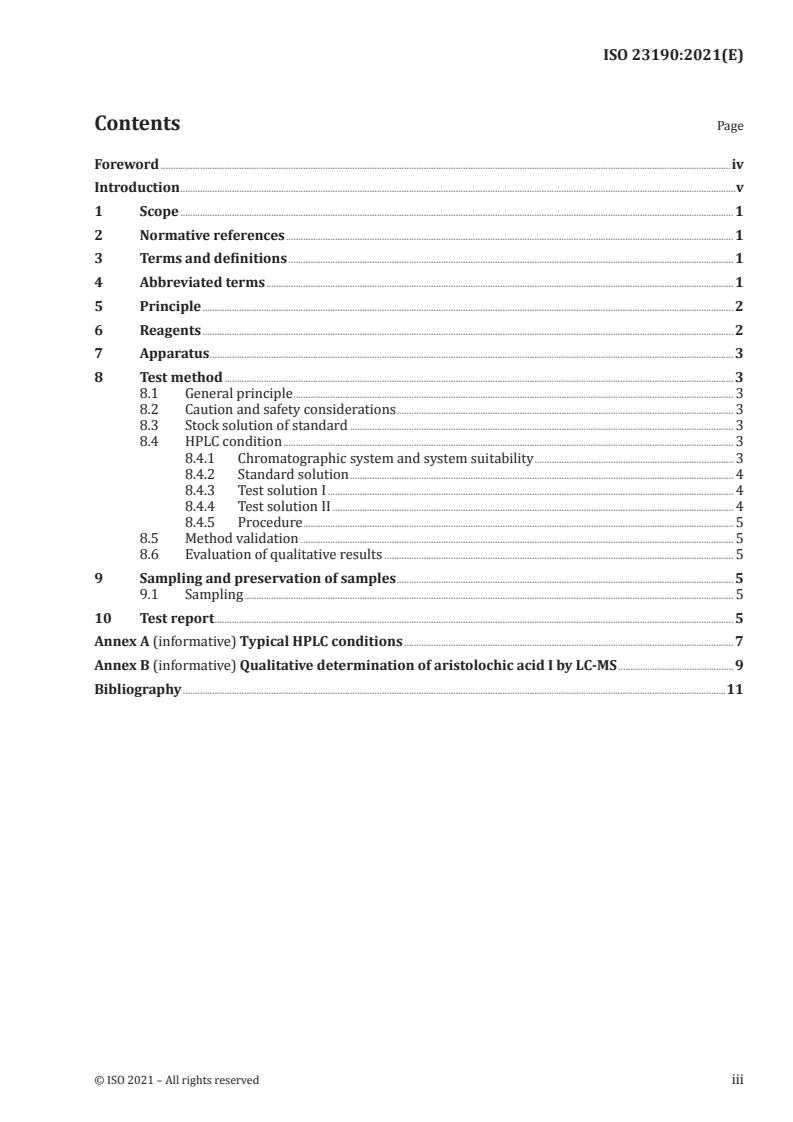
INTERNATIONAL ISO
STANDARD 23190
First edition
2021-06
Traditional Chinese medicine —
Determination of aristolochic acids in
natural products by high-performance
liquid chromatography (HPLC)
Médecine traditionnelle chinoise — Dosage des acides aristolochiques
dans les produits naturels par chromatographie liquide haute
performance (CLHP)
Reference number
©
ISO 2021
© ISO 2021
All rights reserved. Unless otherwise specified, or required in the context of its implementation, no part of this publication may
be reproduced or utilized otherwise in any form or by any means, electronic or mechanical, including photocopying, or posting
on the internet or an intranet, without prior written permission. Permission can be requested from either ISO at the address
below or ISO’s member body in the country of the requester.
ISO copyright office
CP 401 • Ch. de Blandonnet 8
CH-1214 Vernier, Geneva
Phone: +41 22 749 01 11
Email: copyright@iso.org
Website: www.iso.org
Published in Switzerland
ii © ISO 2021 – All rights reserved
Contents Page
Foreword .iv
Introduction .v
1 Scope . 1
2 Normative references . 1
3 Terms and definitions . 1
4 Abbreviated terms . 1
5 Principle . 2
6 Reagents . 2
7 Apparatus . 3
8 Test method . 3
8.1 General principle . 3
8.2 Caution and safety considerations . 3
8.3 Stock solution of standard . 3
8.4 HPLC condition . 3
8.4.1 Chromatographic system and system suitability . 3
8.4.2 Standard solution . 4
8.4.3 Test solution I . 4
8.4.4 Test solution II . 4
8.4.5 Procedure . 5
8.5 Method validation . 5
8.6 Evaluation of qualitative results . 5
9 Sampling and preservation of samples . 5
9.1 Sampling . 5
10 Test report . 5
Annex A (informative) Typical HPLC conditions . 7
Annex B (informative) Qualitative determination of aristolochic acid I by LC-MS .9
Bibliography .11
Foreword
ISO (the International Organization for Standardization) is a worldwide federation of national standards
bodies (ISO member bodies). The work of preparing International Standards is normally carried out
through ISO technical committees. Each member body interested in a subject for which a technical
committee has been established has the right to be represented on that committee. International
organizations, governmental and non-governmental, in liaison with ISO, also take part in the work.
ISO collaborates closely with the International Electrotechnical Commission (IEC) on all matters of
electrotechnical standardization.
The procedures used to develop this document and those intended for its further maintenance are
described in the ISO/IEC Directives, Part 1. In particular, the different approval criteria needed for the
different types of ISO documents should be noted. This document was drafted in accordance with the
editorial rules of the ISO/IEC Directives, Part 2 (see www .iso .org/ directives).
Attention is drawn to the possibility that some of the elements of this document may be the subject of
patent rights. ISO shall not be held responsible for identifying any or all such patent rights. Details of
any patent rights identified during the development of the document will be in the Introduction and/or
on the ISO list of patent declarations received (see www .iso .org/ patents).
Any trade name used in this document is information given for the convenience of users and does not
constitute an endorsement.
For an explanation of the voluntary nature of standards, the meaning of ISO specific terms and
expressions related to conformity assessment, as well as information about ISO's adherence to the
World Trade Organization (WTO) principles in the Technical Barriers to Trade (TBT), see www .iso .org/
iso/ foreword .html.
This document was prepared by Technical Committee ISO/TC 249, Traditional Chinese medicine.
Any feedback or questions on this document should be directed to the user’s national standards body. A
complete listing of these bodies can be found at www .iso .org/ members .html.
iv © ISO 2021 – All rights reserved
Introduction
Aristolochic acids, a class of chemical compounds with renal toxicity, carcinogenic and mutagenic
toxicity, are widely distributed in over 350 species of plant from around the world, many of which have
been used as natural products to treat gout, arthritis, rheumatism and acute inflammation of the skin;
some species from North America have been used to treat snake bites. Clinical practice and research
have confirmed that long-term use of natural products containing aristolochic acids can cause chronic
renal failure and renal tubules, and natural products containing aristolochic acids have been prohibited
and restricted to use in clinics in many counties. Aristolochic acid toxicity is of great concern worldwide.
Safety and efficacy are basic requirements for the use of natural medicines. Although many natural
products containing aristolochic acids have been strictly controlled in clinics, some are still used as
raw herbal materials or to produce manufactured products such as asarum, Kaempfer dutchmanspipe
root, Herba Aristolochiae mollissimae, German birthwort, American snakeroot and Indian Aristolochia
tagala. In addition, some prohibited plant medicines are easily confused or misused during
manufacturing, which can cause large safety concerns in the application of natural products.
This document is beneficial for effectively supervising and reducing the toxic side effects of natural-
medicine-derived products and ensuring their safety and efficacy in clinical use.
The high-performance liquid chromatography (HPLC) method is applied in organizations in such places
as Europe, China, the United States of America, Japan and the Republic of Korea for the determination
of aristolochic acid I, both qualitatively and quantitatively. The HPLC method is recommended
internationally for the qualitative determination of aristolochic acid I in natural products.
INTERNATIONAL STANDARD ISO 23190:2021(E)
Traditional Chinese medicine — Determination of
aristolochic acids in natural products by high-performance
liquid chromatography (HPLC)
1 Scope
This document specifies a method for using high-performance liquid chromatography (HPLC) to
determine the presence of aristolochic acid I in natural products.
2 Normative references
The following documents are referred to in the text in such a way that some or all of their content
constitutes requirements of this document. For dated references, only the edition cited applies. For
undated references, the latest edition of the referenced document (including any amendments) applies.
World Health Organization, Quality control methods for herbal materials. World Health Organization,
3 Terms and definitions
For the purposes of this document, the following terms and definitions apply.
ISO and IEC maintain terminological databases for use in standardization at the following addresses:
— ISO Online browsing platform: available at https:// www .iso .org/ obp
— IEC Electropedia: available at http:// www .electropedia .org/
3.1
raw herbal material
medicinal part of medicinal plants after preliminary processing (3.2)
3.2
preliminary processing
physical technique of converting medicinal part of medicinal plants into raw herbal material (3.1)
3.3
extract
preparation containing the active ingredient of a substance from raw herbal material (3.1) in
concentrated form based on the standardized production process and meeting certain quality
standards
4 Abbreviated terms
DAD diode array detector
HPLC high-performance liquid chromatography
UV ultraviolet absorption
LC-MS liquid chromatography-mass spectrometry
5 Principle
The HPLC method is employed to determine the presence of aristolochic acid I. The HPLC system
consists of a quaternary pump, continuous vacuum degasser, thermostated auto-sampler and column
compartment coupled to a variable wavelength diode array detector (DAD).
The aristolochic acid I determinable by this method is shown in Table 1. The chemical structure of
aristolochic acid I is given in Figure 1.
Table 1 — Aristolochic acid I determinable by this method
a
CA determinable S
Analyte Molecular formula Molar mass
No.
Aristolochic acid I C H NO 313–67–7 341,27
17 11 7
Figure 1 — Chemical structure of aristolochic acid I
6 Reagents
All reagents shall be of recognized chromatographic or analytical grade. The purity of the reagents used
shall be checked by running a blank determination. The chromatogram obtained from the solvents sh
...
INTERNATIONAL ISO
STANDARD 23190
First edition
2021-06
Traditional Chinese medicine —
Determination of aristolochic acids in
natural products by high-performance
liquid chromatography (HPLC)
Médecine traditionnelle chinoise — Dosage des acides aristolochiques
dans les produits naturels par chromatographie liquide haute
performance (CLHP)
Reference number
©
ISO 2021
© ISO 2021
All rights reserved. Unless otherwise specified, or required in the context of its implementation, no part of this publication may
be reproduced or utilized otherwise in any form or by any means, electronic or mechanical, including photocopying, or posting
on the internet or an intranet, without prior written permission. Permission can be requested from either ISO at the address
below or ISO’s member body in the country of the requester.
ISO copyright office
CP 401 • Ch. de Blandonnet 8
CH-1214 Vernier, Geneva
Phone: +41 22 749 01 11
Email: copyright@iso.org
Website: www.iso.org
Published in Switzerland
ii © ISO 2021 – All rights reserved
Contents Page
Foreword .iv
Introduction .v
1 Scope . 1
2 Normative references . 1
3 Terms and definitions . 1
4 Abbreviated terms . 1
5 Principle . 2
6 Reagents . 2
7 Apparatus . 3
8 Test method . 3
8.1 General principle . 3
8.2 Caution and safety considerations . 3
8.3 Stock solution of standard . 3
8.4 HPLC condition . 3
8.4.1 Chromatographic system and system suitability . 3
8.4.2 Standard solution . 4
8.4.3 Test solution I . 4
8.4.4 Test solution II . 4
8.4.5 Procedure . 5
8.5 Method validation . 5
8.6 Evaluation of qualitative results . 5
9 Sampling and preservation of samples . 5
9.1 Sampling . 5
10 Test report . 5
Annex A (informative) Typical HPLC conditions . 7
Annex B (informative) Qualitative determination of aristolochic acid I by LC-MS .9
Bibliography .11
Foreword
ISO (the International Organization for Standardization) is a worldwide federation of national standards
bodies (ISO member bodies). The work of preparing International Standards is normally carried out
through ISO technical committees. Each member body interested in a subject for which a technical
committee has been established has the right to be represented on that committee. International
organizations, governmental and non-governmental, in liaison with ISO, also take part in the work.
ISO collaborates closely with the International Electrotechnical Commission (IEC) on all matters of
electrotechnical standardization.
The procedures used to develop this document and those intended for its further maintenance are
described in the ISO/IEC Directives, Part 1. In particular, the different approval criteria needed for the
different types of ISO documents should be noted. This document was drafted in accordance with the
editorial rules of the ISO/IEC Directives, Part 2 (see www .iso .org/ directives).
Attention is drawn to the possibility that some of the elements of this document may be the subject of
patent rights. ISO shall not be held responsible for identifying any or all such patent rights. Details of
any patent rights identified during the development of the document will be in the Introduction and/or
on the ISO list of patent declarations received (see www .iso .org/ patents).
Any trade name used in this document is information given for the convenience of users and does not
constitute an endorsement.
For an explanation of the voluntary nature of standards, the meaning of ISO specific terms and
expressions related to conformity assessment, as well as information about ISO's adherence to the
World Trade Organization (WTO) principles in the Technical Barriers to Trade (TBT), see www .iso .org/
iso/ foreword .html.
This document was prepared by Technical Committee ISO/TC 249, Traditional Chinese medicine.
Any feedback or questions on this document should be directed to the user’s national standards body. A
complete listing of these bodies can be found at www .iso .org/ members .html.
iv © ISO 2021 – All rights reserved
Introduction
Aristolochic acids, a class of chemical compounds with renal toxicity, carcinogenic and mutagenic
toxicity, are widely distributed in over 350 species of plant from around the world, many of which have
been used as natural products to treat gout, arthritis, rheumatism and acute inflammation of the skin;
some species from North America have been used to treat snake bites. Clinical practice and research
have confirmed that long-term use of natural products containing aristolochic acids can cause chronic
renal failure and renal tubules, and natural products containing aristolochic acids have been prohibited
and restricted to use in clinics in many counties. Aristolochic acid toxicity is of great concern worldwide.
Safety and efficacy are basic requirements for the use of natural medicines. Although many natural
products containing aristolochic acids have been strictly controlled in clinics, some are still used as
raw herbal materials or to produce manufactured products such as asarum, Kaempfer dutchmanspipe
root, Herba Aristolochiae mollissimae, German birthwort, American snakeroot and Indian Aristolochia
tagala. In addition, some prohibited plant medicines are easily confused or misused during
manufacturing, which can cause large safety concerns in the application of natural products.
This document is beneficial for effectively supervising and reducing the toxic side effects of natural-
medicine-derived products and ensuring their safety and efficacy in clinical use.
The high-performance liquid chromatography (HPLC) method is applied in organizations in such places
as Europe, China, the United States of America, Japan and the Republic of Korea for the determination
of aristolochic acid I, both qualitatively and quantitatively. The HPLC method is recommended
internationally for the qualitative determination of aristolochic acid I in natural products.
INTERNATIONAL STANDARD ISO 23190:2021(E)
Traditional Chinese medicine — Determination of
aristolochic acids in natural products by high-performance
liquid chromatography (HPLC)
1 Scope
This document specifies a method for using high-performance liquid chromatography (HPLC) to
determine the presence of aristolochic acid I in natural products.
2 Normative references
The following documents are referred to in the text in such a way that some or all of their content
constitutes requirements of this document. For dated references, only the edition cited applies. For
undated references, the latest edition of the referenced document (including any amendments) applies.
World Health Organization, Quality control methods for herbal materials. World Health Organization,
3 Terms and definitions
For the purposes of this document, the following terms and definitions apply.
ISO and IEC maintain terminological databases for use in standardization at the following addresses:
— ISO Online browsing platform: available at https:// www .iso .org/ obp
— IEC Electropedia: available at http:// www .electropedia .org/
3.1
raw herbal material
medicinal part of medicinal plants after preliminary processing (3.2)
3.2
preliminary processing
physical technique of converting medicinal part of medicinal plants into raw herbal material (3.1)
3.3
extract
preparation containing the active ingredient of a substance from raw herbal material (3.1) in
concentrated form based on the standardized production process and meeting certain quality
standards
4 Abbreviated terms
DAD diode array detector
HPLC high-performance liquid chromatography
UV ultraviolet absorption
LC-MS liquid chromatography-mass spectrometry
5 Principle
The HPLC method is employed to determine the presence of aristolochic acid I. The HPLC system
consists of a quaternary pump, continuous vacuum degasser, thermostated auto-sampler and column
compartment coupled to a variable wavelength diode array detector (DAD).
The aristolochic acid I determinable by this method is shown in Table 1. The chemical structure of
aristolochic acid I is given in Figure 1.
Table 1 — Aristolochic acid I determinable by this method
a
CA determinable S
Analyte Molecular formula Molar mass
No.
Aristolochic acid I C H NO 313–67–7 341,27
17 11 7
Figure 1 — Chemical structure of aristolochic acid I
6 Reagents
All reagents shall be of recognized chromatographic or analytical grade. The purity of the reagents used
shall be checked by running a blank determination. The chromatogram obtained from the solvents sh
...