

ISO 6791:2026
(Main)Carbonaceous materials for the production of aluminium — Pitch for electrodes — Determination of contents of quinoline-insoluble material
- Abstract
This document specifies a conventional gravimetric method for the determination of the content of quinoline insoluble material in pitch used in the production of aluminium.
- Status
- Published
- Publication Date
- 10-Nov-2026
- Technical Committee
- ISO/TC 226 - Materials for the production of primary aluminium
- Drafting Committee
- ISO/TC 226/WG 1 - Carbonaceous binders, including pitch
- Current Stage
- 6060 - International Standard published
- Start Date
- 11-Nov-2026
- Completion Date
- 11-Nov-2026
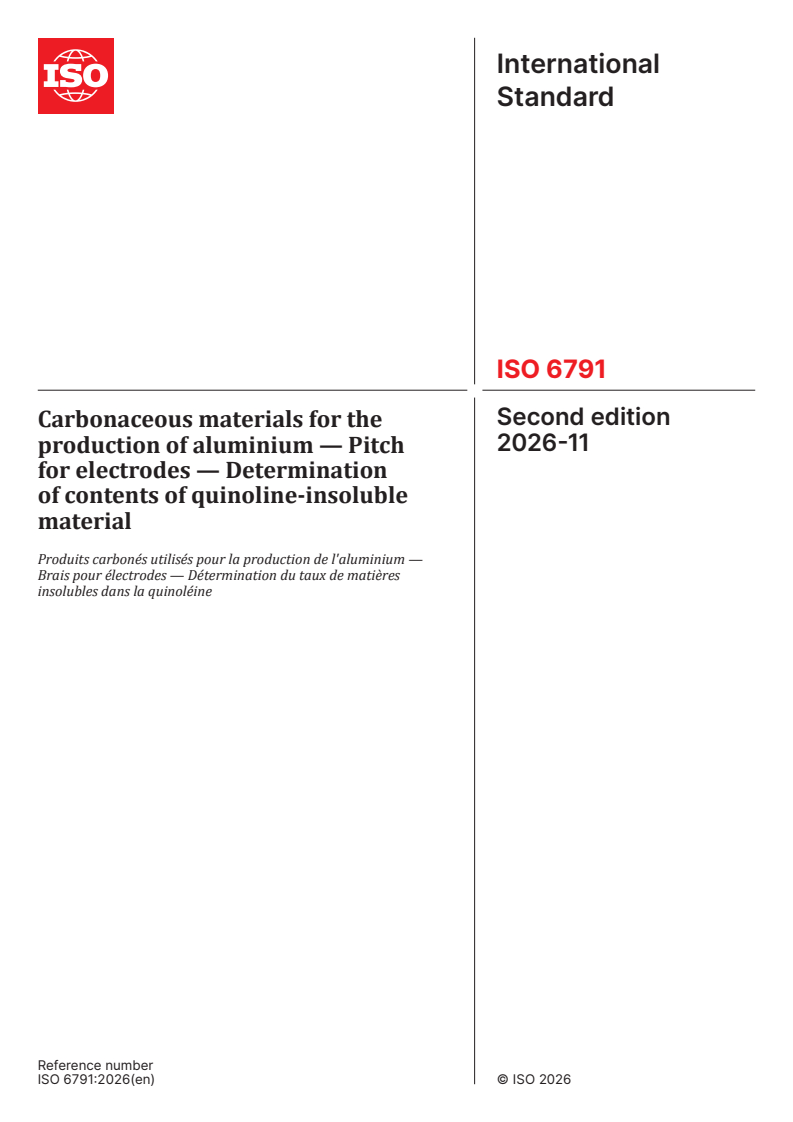
ISO 6791:2026 is an International Standard from ISO for the determination of quinoline-insoluble material in pitch used in the production of aluminium. It specifies a conventional gravimetric method for measuring that insoluble fraction in pitch for electrodes, so laboratories can assess pitch quality on a common basis. The document is aimed at people who prepare, test, buy, or control pitch for aluminium production.
What does ISO 6791:2026 specify?
ISO 6791:2026 specifies a conventional gravimetric method for determining the content of quinoline-insoluble material in pitch used in aluminium production. The method is organized into 10 clauses covering scope, references, terms, principle, reagents and materials, apparatus, sample preparation, procedure, expression of results, and test report.
In practice, the standard tells a laboratory how to extract the insoluble fraction with quinoline, isolate it on a filter pad, and report the result as a mass percentage. That makes the method suitable for routine quality control and for comparing results between laboratories.
What are the key requirements of ISO 6791:2026?
ISO 6791:2026 focuses on careful sample handling, controlled extraction, and traceable weighing. The main requirement is to recover and weigh the material that remains insoluble after treatment with quinoline.
Principle and reagents
Clause 4 states that the result comes from weighing the pitch fraction that does not dissolve in quinoline after extraction under specified conditions. Clause 5 requires analytical-grade reagents and identifies quinoline, toluene, and a mineral filter aid as the key materials.
This matters because reagent quality, filtration aid, and safe handling all affect the recovery of the residue and the reliability of the result. The clause also warns about the hazards associated with quinoline and toluene, so the work must be done with proper laboratory ventilation and care.
Apparatus and sample preparation
Clause 6 specifies the use of a controlled water bath, a Hartley funnel or equivalent, glass-fibre filter pads, and a drying oven. Clause 7 requires the sample to follow ISO 6257 and to be prepared immediately before testing, with grinding for hard pitch or controlled melting and mixing for soft pitch.
This means the sample must be representative and handled in a way that does not change its condition before the test. The apparatus requirements matter because temperature control and good filtration reduce losses and help keep the residue on the pad.
Procedure, calculation, and reporting
Clause 8 gives the working sequence: weigh the test portion, prepare the filter pad, extract the pitch in hot quinoline, filter the insoluble matter, wash the residue, dry it, and weigh it to constant mass. Clause 9 gives the calculation for quinoline-insoluble material and states the precision data, including repeatability and reproducibility. Clause 10 lists the items that must appear in the test report.
For users, this means the method is not just a single weighing step - it is a controlled sequence with defined cleaning, washing, drying, and reporting steps. The report must identify the sample, name the standard, give the date, state the result, and note any deviations or unusual observations.
What terms does ISO 6791:2026 define?
ISO 6791:2026 uses several key terms in the method and introduction.
- Quinoline-insoluble material - the pitch fraction that does not dissolve in quinoline and is measured by weighing the residue.
- Primary QI - quinoline insoluble material formed in the coke oven; the introduction notes that it is beneficial to carbon anode quality.
- Secondary QI - also called mesophase; the introduction says it is formed by additional heat treatment and may be neutral or harmful to anode quality.
- Test portion - the weighed portion of sample used for the determination.
- Hartley funnel - the funnel assembly used with the filter pad to collect the insoluble residue.
Who uses ISO 6791:2026?
ISO 6791:2026 is used by laboratories, quality control teams, and buyers involved in carbonaceous materials for aluminium production. It is relevant in carbon paste plants, pitch suppliers, and aluminium production sites where pitch for electrodes must be checked against a consistent test method.
The standard is practical for analysts who run the extraction and weighing steps, for quality managers who need comparable test reports, and for purchasing or technical staff who need a defined result when comparing pitch lots.
What changed in ISO 6791:2026 from the previous edition?
ISO 6791:2026 cancels and replaces ISO 6791:1981. The stated changes are added analysis procedure details to help run the analysis, corrected text to formal SI formatting, and an updated test report description.
Which standards are used with ISO 6791:2026?
ISO 6257, Carbonaceous materials used in the production of aluminium - Pitch for electrodes - Sampling, supports ISO 6791:2026 by providing the sampling rules for the pitch before the quinoline-insoluble test is performed.
What does the ISO 6791:2026 document contain?
ISO 6791:2026 contains front matter, an introduction, and clauses 1 to 10. Clause 6 includes Figure 1 showing details of the Hartley funnel, which helps users understand the filtration setup.
Clause 9 contains the calculation formula for reporting quinoline-insoluble material, and Clause 9.2 gives precision information for repeatability and reproducibility. Clause 10 gives the test report contents, so the document supports both laboratory execution and documented reporting.
Relations
- Effective Date
- 04-Nov-2023
Get Certified
Connect with accredited certification bodies for this standard

ECOCERT
Organic and sustainability certification.

Eurofins Food Testing Global
Global leader in food, environment, and pharmaceutical product testing.

Intertek Bangladesh
Intertek certification and testing services in Bangladesh.
Sponsored listings
Frequently Asked Questions
ISO 6791:2026 is a standard published by the International Organization for Standardization (ISO). Its full title is "Carbonaceous materials for the production of aluminium — Pitch for electrodes — Determination of contents of quinoline-insoluble material". This standard covers: This document specifies a conventional gravimetric method for the determination of the content of quinoline insoluble material in pitch used in the production of aluminium.
This document specifies a conventional gravimetric method for the determination of the content of quinoline insoluble material in pitch used in the production of aluminium.
ISO 6791:2026 is classified under the following ICS (International Classification for Standards) categories: 71.100.10 - Materials for aluminium production. The ICS classification helps identify the subject area and facilitates finding related standards.
ISO 6791:2026 has the following relationships with other standards: It is inter standard links to ISO 6791:1981. Understanding these relationships helps ensure you are using the most current and applicable version of the standard.
ISO 6791:2026 is available in PDF format for immediate download after purchase. The document can be added to your cart and obtained through the secure checkout process. Digital delivery ensures instant access to the complete standard document.
Standards Content (Sample)
International
Standard
ISO 6791
Second edition
Carbonaceous materials for the
2026-11
production of aluminium — Pitch
for electrodes — Determination
of contents of quinoline-insoluble
material
Produits carbonés utilisés pour la production de l'aluminium —
Brais pour électrodes — Détermination du taux de matières
insolubles dans la quinoléine
Reference number
© ISO 2026
All rights reserved.
This ISO publication is protected by copyright and is owned by ISO and/or its licensors.
The content of this ISO publication is provided under licence, not sold. Use is subject to the applicable licence terms issued by ISO,
an ISO member body, or an authorized third-party distributor.
Except as required for implementation or expressly permitted by a separate licence, no part of this ISO publication may be
reproduced, distributed, modified, used, or made available in any form or by any means – electronic or mechanical, including
photocopying, scanning, recording, or posting on internal or external digital platforms.
Any use beyond the scope of the granted rights is prohibited and may result in legal action.
ISO copyright office
CP 401 • CH-1214 Vernier, Geneva
Phone: +41 22 749 01 11
Email: copyright@iso.org
Website: www.iso.org
Published in Switzerland
ii
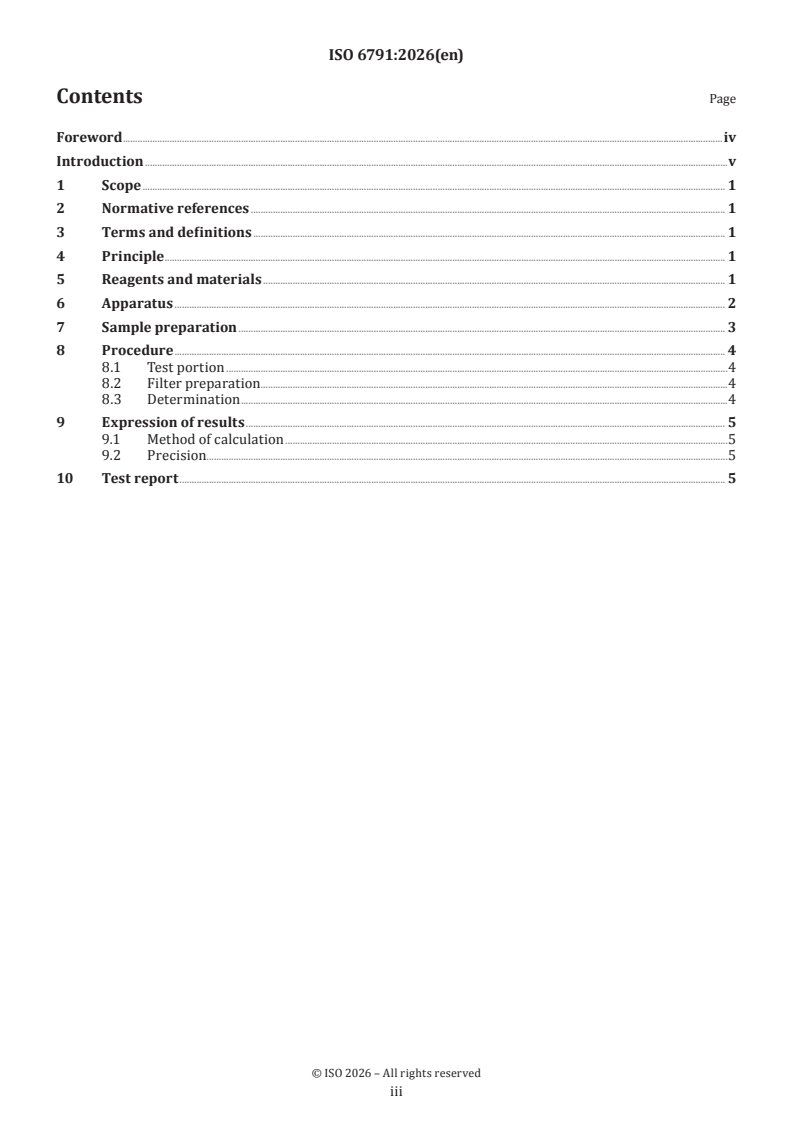
Contents Page
Foreword .iv
Introduction .v
1 Scope . 1
2 Normative references . 1
3 Terms and definitions . 1
4 Principle . 1
5 Reagents and materials . 1
6 Apparatus . 2
7 Sample preparation . 3
8 Procedure . 4
8.1 Test portion .4
8.2 Filter preparation . .4
8.3 Determination .4
9 Expression of results . 5
9.1 Method of calculation .5
9.2 Precision . . .5
10 Test report . 5
iii
Foreword
ISO (the International Organization for Standardization) is a worldwide federation of national standards
bodies (ISO member bodies). The work of preparing International Standards is normally carried out through
ISO technical committees. Each member body interested in a subject for which a technical committee
has been established has the right to be represented on that committee. International organizations,
governmental and non-governmental, in liaison with ISO, also take part in the work. ISO collaborates closely
with the International Electrotechnical Commission (IEC) on all matters of electrotechnical standardization.
The procedures used to develop this document and those intended for its further maintenance are described
in the ISO/IEC Directives, Part 1. In particular, the different approval criteria needed for the different types
of ISO document should be noted. This document was drafted in accordance with the editorial rules of the
ISO/IEC Directives, Part 2 (see www.iso.org/directives).
ISO draws attention to the possibility that the implementation of this document may involve the use of (a)
patent(s). ISO takes no position concerning the evidence, validity or applicability of any claimed patent
rights in respect thereof. As of the date of publication of this document, ISO had not received notice of (a)
patent(s) which may be required to implement this document. However, implementers are cautioned that
this may not represent the latest information, which may be obtained from the patent database available at
www.iso.org/patents. ISO shall not be held responsible for identifying any or all such patent rights.
Any trade name used in this document is information given for the convenience of users and does not
constitute an endorsement.
For an explanation of the voluntary nature of standards, the meaning of ISO specific terms and expressions
related to conformity assessment, as well as information about ISO's adherence to the World Trade
Organization (WTO) principles in the Technical Barriers to Trade (TBT), see www.iso.org/iso/foreword.html.
This document was prepared by Technical Committee ISO/TC 226, Materials for the primary production of
aluminium.
This second edition cancels and replaces the first edition (ISO 6791:1981), which has been technically
revised.
The main changes are as follows:
— added analysis procedure details to help run the analysis;
— corrected text to formal SI formatting;
— updated test report description.
Any feedback or questions on this document should be directed to the user’s national standards body. A
complete listing of these bodies can be found at www.iso.org/members.html.
iv
Introduction
In a carbon paste plant, the pitch content needs to be optimized amongst other factors according to the
quinoline insoluble content of the pitch. Two types of quinoline insoluble (QI) exist: primary and secondary.
Primary QI are formed in the coke oven and are beneficial to the carbon anode quality. Secondary QI (or
mesophase) are formed by additional heat treatment of the pitch and are either neutral or harmful to the
anode quality. Primary QI material is very dense and leads to h
...