

ISO 11713:2025
(Main)Carbonaceous materials used in the production of aluminium — Cathode blocks and baked anodes — Determination of the specific electrical resistivity at ambient temperature
General Information
- Abstract
This document specifies a method for the determination of the specific electrical resistivity of cathode blocks and baked anodes used in the production of aluminium, using samples at ambient temperature.
- Status
- Published
- Publication Date
- 22-May-2025
- Technical Committee
- ISO/TC 226 - Materials for the production of primary aluminium
- Drafting Committee
- ISO/TC 226 - Materials for the production of primary aluminium
- Current Stage
- 6060 - International Standard published
- Start Date
- 23-May-2025
- Due Date
- 28-Feb-2025
- Completion Date
- 23-May-2025
Overview
ISO 11713:2025 specifies a laboratory method for determining the specific electrical resistivity of carbonaceous cathode blocks and baked anodes used in aluminium production. The test is carried out at ambient temperature on prepared cylindrical or cuboid samples. The measured resistivity is used to characterise electrical performance in reduction cells, monitor quality (including detection of microcracks), and support process and materials optimisation.
Keywords: ISO 11713:2025, specific electrical resistivity, cathode blocks, baked anodes, aluminium production, carbonaceous materials, resistivity measurement.
Key topics and technical requirements
- Principle: A fixed direct current is passed through the specimen; the voltage drop between voltage sensors is measured to calculate resistivity using the specimen cross-sectional area and sensor spacing.
- Sample preparation:
- Minimum dimensions: Ø 30 mm (cylinder) or 30 × 30 mm (square); length ≥ 100 mm.
- Cross-section variation in the measuring zone: ≤ 0.5% relative.
- Drying: oven at (100 ± 5) °C for at least 2 hours, then cool before testing.
- Apparatus & tolerances:
- Drill and cutter with diamond tooling; slide caliper accurate to ±0.1 mm.
- Ammeter ±0.002 A, voltmeter/potentiometer ±0.001 V.
- Sample clamping device with current contactor and voltage sensors (point or blade sensors radius ≥ 200 µm).
- Contact forces: current contactor ≥ 50 N, voltage sensors ≥ 0.5 N.
- Oven capability: 110 ± 5 °C.
- Geometric placement: sensor distances specified relative to sample width/diameter (e.g., sensors ≥ 0.8 D apart and ≥ 40 mm).
- Measurement conditions:
- Current density limited to 10 000 A/m ± 20 A/m.
- Measure on four orientations (rotate sample 90°) to detect anisotropy or horizontal cracks.
- Calculation & reporting:
- Resistivity calculated from measured voltage (U), current (I), cross-sectional area (A) and sensor spacing (l); results expressed in µΩ·m with rounding rules (nearest integer > 20 µΩ·m, one decimal < 20 µΩ·m).
- Precision: repeatability r = 1.2 µΩ·m, reproducibility R = 1.5 µΩ·m.
- Test report must identify the sample, reference ISO 11713:2025, method, date, results, deviations and unusual observations.
Applications and users
- Aluminium smelters and reduction cell operators for energy-consumption and performance optimisation.
- Quality control and materials testing laboratories verifying cathode and anode electrical properties.
- Carbonaceous material manufacturers and R&D teams developing low-resistivity anodes/cathodes.
- Third‑party conformity and failure analysis labs investigating microcracks and manufacturing defects.
Related standards
- ISO 8007-1 (sampling: cathode blocks) and ISO 8007-2 (sampling: prebaked anodes) - referenced for sampling plans and specimen extraction.
- Developed by ISO/TC 226 (Materials for the production of primary aluminium).
This standard helps ensure consistent, reproducible resistivity testing of anodes and cathodes-vital data for process control, product specification, and energy-efficiency measures in aluminium production.
Relations
- Effective Date
- 04-Mar-2023
Get Certified
Connect with accredited certification bodies for this standard

ECOCERT
Organic and sustainability certification.

Eurofins Food Testing Global
Global leader in food, environment, and pharmaceutical product testing.

Intertek Bangladesh
Intertek certification and testing services in Bangladesh.
Sponsored listings
Frequently Asked Questions
ISO 11713:2025 is a standard published by the International Organization for Standardization (ISO). Its full title is "Carbonaceous materials used in the production of aluminium — Cathode blocks and baked anodes — Determination of the specific electrical resistivity at ambient temperature". This standard covers: This document specifies a method for the determination of the specific electrical resistivity of cathode blocks and baked anodes used in the production of aluminium, using samples at ambient temperature.
This document specifies a method for the determination of the specific electrical resistivity of cathode blocks and baked anodes used in the production of aluminium, using samples at ambient temperature.
ISO 11713:2025 is classified under the following ICS (International Classification for Standards) categories: 71.100.10 - Materials for aluminium production. The ICS classification helps identify the subject area and facilitates finding related standards.
ISO 11713:2025 has the following relationships with other standards: It is inter standard links to ISO 11713:2000. Understanding these relationships helps ensure you are using the most current and applicable version of the standard.
ISO 11713:2025 is available in PDF format for immediate download after purchase. The document can be added to your cart and obtained through the secure checkout process. Digital delivery ensures instant access to the complete standard document.
Standards Content (Sample)
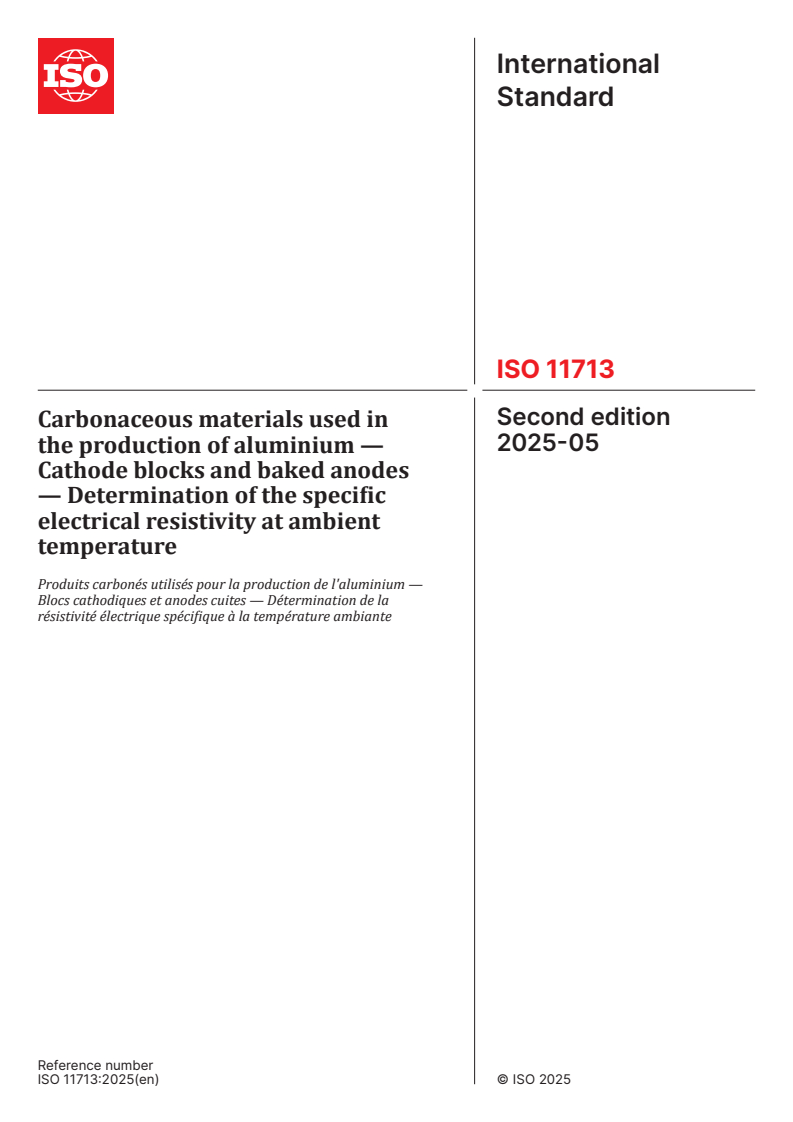
International
Standard
ISO 11713
Second edition
Carbonaceous materials used in
2025-05
the production of aluminium —
Cathode blocks and baked anodes
— Determination of the specific
electrical resistivity at ambient
temperature
Produits carbonés utilisés pour la production de l'aluminium —
Blocs cathodiques et anodes cuites — Détermination de la
résistivité électrique spécifique à la température ambiante
Reference number
© ISO 2025
All rights reserved. Unless otherwise specified, or required in the context of its implementation, no part of this publication may
be reproduced or utilized otherwise in any form or by any means, electronic or mechanical, including photocopying, or posting on
the internet or an intranet, without prior written permission. Permission can be requested from either ISO at the address below
or ISO’s member body in the country of the requester.
ISO copyright office
CP 401 • Ch. de Blandonnet 8
CH-1214 Vernier, Geneva
Phone: +41 22 749 01 11
Email: copyright@iso.org
Website: www.iso.org
Published in Switzerland
ii
Contents Page
Foreword .iv
Introduction .v
1 Scope . 1
2 Normative references . 1
3 Terms and definitions . 1
4 Principle . 1
5 Apparatus . 1
5.1 General Apparatus .1
5.2 Dimensions and apparatus layout .2
6 Sampling . 3
7 Procedure . 3
7.1 Preparation of specimens .3
7.2 Determination .3
8 Calculation . 3
9 Precision . 4
9.1 Repeatability, r.4
9.2 Reproducibility, R .4
10 Test report . 4
iii
Foreword
ISO (the International Organization for Standardization) is a worldwide federation of national standards
bodies (ISO member bodies). The work of preparing International Standards is normally carried out through
ISO technical committees. Each member body interested in a subject for which a technical committee
has been established has the right to be represented on that committee. International organizations,
governmental and non-governmental, in liaison with ISO, also take part in the work. ISO collaborates closely
with the International Electrotechnical Commission (IEC) on all matters of electrotechnical standardization.
The procedures used to develop this document and those intended for its further maintenance are described
in the ISO/IEC Directives, Part 1. In particular, the different approval criteria needed for the different types
of ISO document should be noted. This document was drafted in accordance with the editorial rules of the
ISO/IEC Directives, Part 2 (see www.iso.org/directives).
ISO draws attention to the possibility that the implementation of this document may involve the use of (a)
patent(s). ISO takes no position concerning the evidence, validity or applicability of any claimed patent
rights in respect thereof. As of the date of publication of this document, ISO had not received notice of (a)
patent(s) which may be required to implement this document. However, implementers are cautioned that
this may not represent the latest information, which may be obtained from the patent database available at
www.iso.org/patents. ISO shall not be held responsible for identifying any or all such patent rights.
Any trade name used in this document is information given for the convenience of users and does not
constitute an endorsement.
For an explanation of the voluntary nature of standards, the meaning of ISO specific terms and expressions
related to conformity assessment, as well as information about ISO's adherence to the World Trade
Organization (WTO) principles in the Technical Barriers to Trade (TBT), see www.iso.org/iso/foreword.html.
This document was prepared by Technical Committee ISO/TC 226, Materials for the production of primary
aluminium.
This second edition cancels and replaces the first edition (ISO 11713:2000), which has been technically
revised.
The main changes are as follows:
— Introduction revised;
— Clause 5 has been reworded, requirements are clearly expressed;
th 2
...