

ISO 17499:2023
(Main)Carbonaceous materials used in the production of aluminium — Determination of baking level expressed by equivalent temperature
General Information
- Abstract
This document specifies the determination of the equivalent temperature of one anode or cathode in a baking furnace and the calculation of the overall baking level in a section in a baking furnace.
- Status
- Published
- Publication Date
- 19-Mar-2023
- Technical Committee
- ISO/TC 226 - Materials for the production of primary aluminium
- Drafting Committee
- ISO/TC 226/WG 6 - Anodes and coke
- Current Stage
- 6060 - International Standard published
- Start Date
- 20-Mar-2023
- Due Date
- 15-Oct-2022
- Completion Date
- 20-Mar-2023
Overview
ISO 17499:2023 - "Carbonaceous materials used in the production of aluminium - Determination of baking level expressed by equivalent temperature" specifies a laboratory and field method to quantify the baking level of carbon anodes and cathodes used in aluminium production. The standard defines the concept of equivalent temperature (°E), describes preparation and use of a reference green coke, and explains how to determine equivalent temperature from the mean crystallite height (Lc) measured by X‑ray diffraction.
Key topics and requirements
- Principle: Embed a graphite container with a test portion of reference green coke in a stub‑hole of an anode or cathode; after baking, recover and analyze the calcined coke to determine Lc and convert to equivalent temperature using a calibration curve.
- Reference coke: Use a single‑source, low‑sulfur green petroleum coke (–4 mm grains, dried at 110 °C). Batch control and mixing by splitting/recombining are recommended.
- Calibration curve: Prepare by heat‑treating multiple reference samples (rapid heating, 2 h hold time, quench) at different hold temperatures and measuring Lc. A third‑order polynomial fit (Tc = a·Lc^3 + b·Lc^2 + c·Lc + d) is used. New reference batches can be calibrated against an existing calibrated coke; calibration should cover about 1 050 °E to 1 400 °E.
- Apparatus & sampling:
- Small furnace able to heat 15–30 g to ~1 000–1 500 °C in 6–8 min (inert gas).
- Graphite crucible (typical: outer Ø 40 mm, inner Ø 20 mm, length 90 mm) with vented lid.
- Swing mill for grinding; X‑ray diffractometer for Lc measurement per ISO 20203.
- Typical test portion: ~15 g.
- Test procedure: Place crucible in anode/cathode before baking; recover carefully to avoid graphite contamination; grind and analyze; convert Lc to °E via calibration curve.
- Expression of results: Rules for duplicate/quadruple parallels and reporting averages and standard deviation for section mapping are specified.
- Precision: Precision figures are reported based on an ISO interlaboratory comparison (referenced in the standard).
Applications and users
ISO 17499:2023 is intended for:
- Aluminium smelter quality control and furnace process engineers monitoring bake uniformity.
- Materials and metallurgical laboratories performing anode/cathode characterization.
- R&D and test laboratories comparing bake cycles, furnace designs, or reference anode samples.
- Suppliers of carbonaceous materials needing to validate baking performance.
Practical applications include furnace mapping, process control, comparative testing of anodes/cathodes, and ensuring consistent calcination conditions for production reliability.
Related standards
- ISO 20203 - Determination of crystallite size of calcined petroleum coke by X‑ray diffraction (referenced for Lc measurement).
- Developed by ISO/TC 226 (Materials for the production of primary aluminium).
Keywords: ISO 17499:2023, equivalent temperature, baking level, carbonaceous materials, aluminium production, reference coke, calibration curve, X‑ray diffractometer, anode baking.
Relations
- Effective Date
- 26-Nov-2021
Get Certified
Connect with accredited certification bodies for this standard

ECOCERT
Organic and sustainability certification.

Eurofins Food Testing Global
Global leader in food, environment, and pharmaceutical product testing.

Intertek Bangladesh
Intertek certification and testing services in Bangladesh.
Sponsored listings
Frequently Asked Questions
ISO 17499:2023 is a standard published by the International Organization for Standardization (ISO). Its full title is "Carbonaceous materials used in the production of aluminium — Determination of baking level expressed by equivalent temperature". This standard covers: This document specifies the determination of the equivalent temperature of one anode or cathode in a baking furnace and the calculation of the overall baking level in a section in a baking furnace.
This document specifies the determination of the equivalent temperature of one anode or cathode in a baking furnace and the calculation of the overall baking level in a section in a baking furnace.
ISO 17499:2023 is classified under the following ICS (International Classification for Standards) categories: 71.100.10 - Materials for aluminium production. The ICS classification helps identify the subject area and facilitates finding related standards.
ISO 17499:2023 has the following relationships with other standards: It is inter standard links to ISO 17499:2006. Understanding these relationships helps ensure you are using the most current and applicable version of the standard.
ISO 17499:2023 is available in PDF format for immediate download after purchase. The document can be added to your cart and obtained through the secure checkout process. Digital delivery ensures instant access to the complete standard document.
Standards Content (Sample)
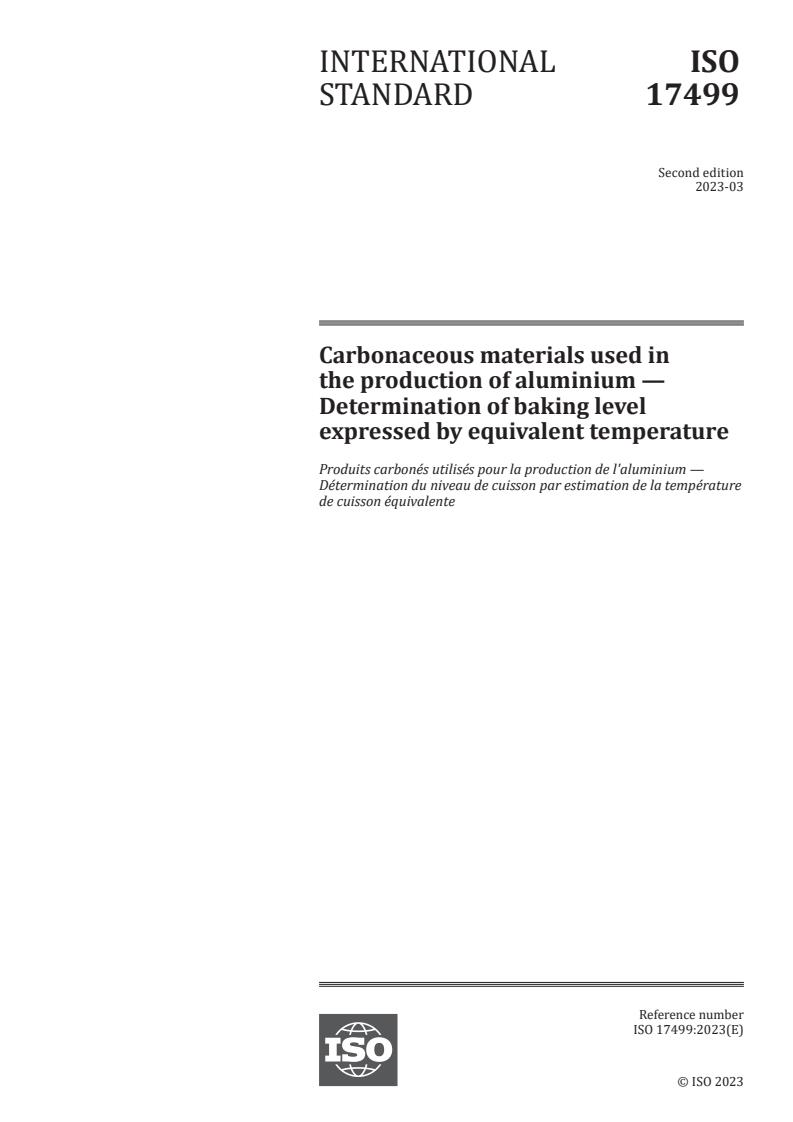
INTERNATIONAL ISO
STANDARD 17499
Second edition
2023-03
Carbonaceous materials used in
the production of aluminium —
Determination of baking level
expressed by equivalent temperature
Produits carbonés utilisés pour la production de l'aluminium —
Détermination du niveau de cuisson par estimation de la température
de cuisson équivalente
Reference number
© ISO 2023
All rights reserved. Unless otherwise specified, or required in the context of its implementation, no part of this publication may
be reproduced or utilized otherwise in any form or by any means, electronic or mechanical, including photocopying, or posting on
the internet or an intranet, without prior written permission. Permission can be requested from either ISO at the address below
or ISO’s member body in the country of the requester.
ISO copyright office
CP 401 • Ch. de Blandonnet 8
CH-1214 Vernier, Geneva
Phone: +41 22 749 01 11
Email: copyright@iso.org
Website: www.iso.org
Published in Switzerland
ii
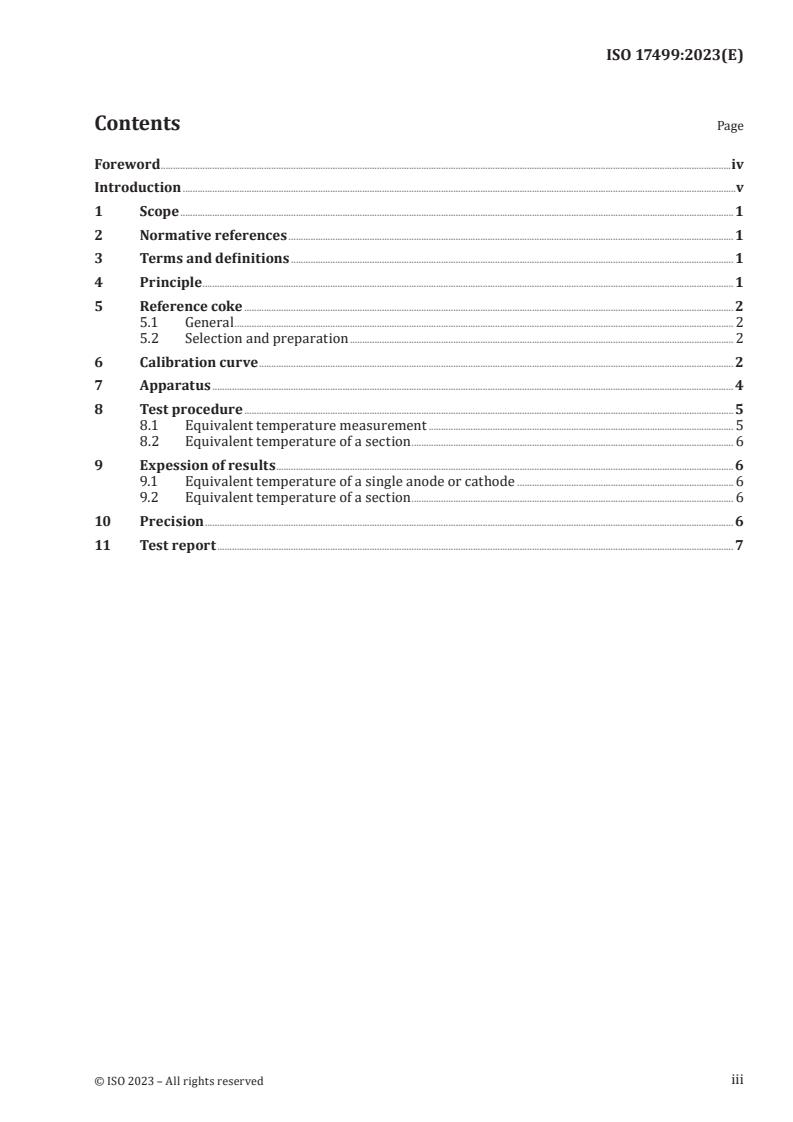
Contents Page
Foreword .iv
Introduction .v
1 Scope . 1
2 Normative references . 1
3 Terms and definitions . 1
4 Principle . 1
5 Reference coke . 2
5.1 General . 2
5.2 Selection and preparation . 2
6 Calibration curve . 2
7 Apparatus . 4
8 Test procedure .5
8.1 Equivalent temperature measurement . 5
8.2 Equivalent temperature of a section . 6
9 Expession of results .6
9.1 Equivalent temperature of a single anode or cathode . 6
9.2 Equivalent temperature of a section . 6
10 Precision . 6
11 Test report . 7
iii
Foreword
ISO (the International Organization for Standardization) is a worldwide federation of national standards
bodies (ISO member bodies). The work of preparing International Standards is normally carried out
through ISO technical committees. Each member body interested in a subject for which a technical
committee has been established has the right to be represented on that committee. International
organizations, governmental and non-governmental, in liaison with ISO, also take part in the work.
ISO collaborates closely with the International Electrotechnical Commission (IEC) on all matters of
electrotechnical standardization.
The procedures used to develop this document and those intended for its further maintenance are
described in the ISO/IEC Directives, Part 1. In particular, the different approval criteria needed for the
different types of ISO documents should be noted. This document was drafted in accordance with the
editorial rules of the ISO/IEC Directives, Part 2 (see www.iso.org/directives).
Attention is drawn to the possibility that some of the elements of this document may be the subject of
patent rights. ISO shall not be held responsible for identifying any or all such patent rights. Details of
any patent rights identified during the development of the document will be in the Introduction and/or
on the ISO list of patent declarations received (see www.iso.org/patents).
Any trade name used in this document is information given for the convenience of users and does not
constitute an endorsement.
For an explanation of the voluntary nature of standards, the meaning of ISO specific terms and
expressions related to conformity assessment, as well as information about ISO's adherence to
the World Trade Organization (WTO) principles in the Technical Barriers to Trade (TBT), see
www.iso.org/iso/foreword.html.
This document was prepared by Technical Committee ISO/TC 226, Materials for the production of
primary aluminium.
This second edition cancels and replaces the first edition (ISO 17499:2006), which has been technically
revised.
The main changes are as follows:
— technical description errors have been corrected in 3.2, 5.1, 5.2 and 7.3;
— technical details relating to procedure have been clarified in Clause 4 and 8.1;
— the precision statement text has been corrected and reformulated (without changing the precision
values) in Clause 10;
— the description of the graphite crucible with a drawing has been moved from the appendix into the
body text as 7.3;
— some editorial corrections have been made.
Any feedback or questions on this document should be directed to the user’s national standards body. A
complete listing of these bodies can be found at www.iso.org/members.html.
iv
Introduction
The equivalent temperature is used to express the baking level of a single anode or cathode, or the
overall baking level and distribution of a section of any type of baking furnace constructed for baking
carbon anodes or cathodes for the production of aluminium.
The equivalent temperature is also useful for monitoring and comparing the baking level of laboratory
test anodes or cathodes and other samples.
v
INTERNATIONAL STANDARD ISO 17499:2023(E)
Carbonaceous materials used in the production of
aluminium — Determination of baking level expressed by
equivalent temperature
1 Scope
This document specifies the determination of the equivalent temperature of one anode or cathode in a
baking furnace and the calculation of the overall baking level in a section in a baking furnace.
2 Normative references
The following documents are referred to in the text in such a way that some or all of their content
constitutes requirements of this document. For dated references, only the edition cited applies. For
undated references, the latest edition of the referenced document (including any amendments) applies.
ISO 20203, Carbonaceous materials used in the production of aluminium — Calcined coke — Determination
of crystallite size of calcined petroleum coke by X-ray diffraction
3 Terms and definitions
For the purposes of this document, the following terms and definitions apply.
ISO and IEC maintain terminology databases for use in standardization at the following addresses:
— ISO Online browsing platform: available at https:// www .iso .org/ obp
— IEC Electropedia: available at https:// www .electropedia .org/
3.1
equivalent temperature
baking level of an anode or cathode measured by the heat treatment of a reference coke attached to or
placed with the anode or cathode and quantified in equivalent degrees, °E, determined from the mean
crystallite height, L , of the reference coke using a calibration curve
c
Note 1 to entry: The calibration curve is derived by subjecting a series of separate samples of the green reference
coke to a 2 h heat treatment at different hold temperatures, in degrees Celsius, and measuring the mean crystallite
height, L . The equivalent temperature, T , is numerically equal to the temperatures, in degrees Celsius, plotted
c eq
on the calibration curve.
3.2
reference green coke
raw unprocessed petroleum coke from a refinery coker unit
Note 1 to entry: For use as a reference coke, the green coke should be a single source, low sulfur, anode grade
coke,
...