

ISO 7061:2024
(Main)Ships and marine technology — Aluminium shore gangways for seagoing vessels
General Information
- Abstract
This document specifies requirements and guidance for aluminium shore gangways. This document applies to gangways designed to be carried on board ships, to provide a lightweight, convenient and safe means of access from ship to shore, for use primarily by the ship’s crew. These gangways can also be used for access from ship to ship when conditions are favourable. The gangways to which this document applies are not intended to carry wheeled traffic such as loaded trolleys.
- Status
- Published
- Publication Date
- 08-Oct-2024
- Technical Committee
- ISO/TC 8/SC 1 - Maritime safety
- Drafting Committee
- ISO/TC 8/SC 1 - Maritime safety
- Current Stage
- 6060 - International Standard published
- Start Date
- 09-Oct-2024
- Due Date
- 10-Jan-2025
- Completion Date
- 09-Oct-2024


Overview
ISO 7061:2024 - Ships and marine technology - Aluminium shore gangways for seagoing vessels - specifies requirements and guidance for aluminium shore gangways carried on board ships. It covers design types, dimensions, materials, manufacturing quality, tests and inspection criteria to ensure a lightweight, convenient and safe means of access from ship to shore (and ship-to-ship under favourable conditions). The standard replaces the 2015 edition and updates test methods and marking to align with IMO guidance.
Key topics and technical requirements
- Types:
- Type A (decking plate) - flat topped decking with anti-slip steps; usable up to 30° inclination.
- Type B (arc-shaped steps) - arc-shaped load-bearing steps; usable up to 55° inclination.
- Dimensions:
- Overall length: minimum 2 m, incremental options up to and beyond 9 m.
- Net width: 600 mm minimum, up to 1 000 mm (increments of 50 mm on request).
- Step spacing: Type A - 300–400 mm longitudinally; Type B - 300–350 mm when horizontal.
- Handrail height: top handrail ≥ 1 000 mm above decking/step surface; two intermediate guard rails required.
- Stanchion spacing: ≤ 1 500 mm.
- Geometry: Type B arc degree when horizontal: 55°–65°.
- Design & construction: Guidance on side frames, cross-members, decking, steps, stanchions, handrails, toe-boards, lifting lugs, rollers/wheels and securing devices. Includes requirements for design loading and factor of safety.
- Materials & manufacture: Main materials referenced to a materials table (see standard). Emphasis on corrosion resistance and marine suitability for aluminium components.
- Testing & inspection: Type and individual acceptance tests (lifting, initial sag and deflection under load are specified); manufacturing tolerances, surface finish and marking requirements included.
- Limitations: Not intended to carry wheeled traffic (e.g., loaded trolleys).
Applications and users
ISO 7061:2024 is intended for anyone specifying, designing, manufacturing, certifying or operating aluminium shore gangways:
- Shipbuilders and naval architects specifying crew-access gangways
- Marine equipment manufacturers and fabricators
- Shipowners, ship operators and port operators responsible for safe embarkation/disembarkation
- Classification societies and inspection bodies performing acceptance tests and surveys
- Procurement teams seeking compliant gangways for seagoing vessels
Using ISO 7061 helps reduce risk, improve safety, standardize sizing and testing, and facilitate procurement and regulatory compliance.
Related standards and guidance
- IMO MSC.1/Circ.1331 (marking alignment noted in ISO 7061:2024)
- ISO/TC 8 (Technical Committee responsible for maritime safety standards)
Keywords: ISO 7061:2024, aluminium shore gangways, ships and marine technology, gangway dimensions, design loading, handrail height, marine safety, gangway testing.
Relations
- Effective Date
- 14-Jan-2023
Get Certified
Connect with accredited certification bodies for this standard

DNV
DNV is an independent assurance and risk management provider.

Lloyd's Register
Lloyd's Register is a global professional services organisation specialising in engineering and technology.

FSC International
Forest Stewardship Council certification.
Sponsored listings
Frequently Asked Questions
ISO 7061:2024 is a standard published by the International Organization for Standardization (ISO). Its full title is "Ships and marine technology — Aluminium shore gangways for seagoing vessels". This standard covers: This document specifies requirements and guidance for aluminium shore gangways. This document applies to gangways designed to be carried on board ships, to provide a lightweight, convenient and safe means of access from ship to shore, for use primarily by the ship’s crew. These gangways can also be used for access from ship to ship when conditions are favourable. The gangways to which this document applies are not intended to carry wheeled traffic such as loaded trolleys.
This document specifies requirements and guidance for aluminium shore gangways. This document applies to gangways designed to be carried on board ships, to provide a lightweight, convenient and safe means of access from ship to shore, for use primarily by the ship’s crew. These gangways can also be used for access from ship to ship when conditions are favourable. The gangways to which this document applies are not intended to carry wheeled traffic such as loaded trolleys.
ISO 7061:2024 is classified under the following ICS (International Classification for Standards) categories: 47.040 - Seagoing vessels. The ICS classification helps identify the subject area and facilitates finding related standards.
ISO 7061:2024 has the following relationships with other standards: It is inter standard links to ISO 7061:2015. Understanding these relationships helps ensure you are using the most current and applicable version of the standard.
ISO 7061:2024 is available in PDF format for immediate download after purchase. The document can be added to your cart and obtained through the secure checkout process. Digital delivery ensures instant access to the complete standard document.
Standards Content (Sample)
International
Standard
ISO 7061
Fourth edition
Ships and marine technology —
2024-10
Aluminium shore gangways for
seagoing vessels
Navires et technologie maritime — Planchons en aluminium pour
navires de haute mer
Reference number
© ISO 2024
All rights reserved. Unless otherwise specified, or required in the context of its implementation, no part of this publication may
be reproduced or utilized otherwise in any form or by any means, electronic or mechanical, including photocopying, or posting on
the internet or an intranet, without prior written permission. Permission can be requested from either ISO at the address below
or ISO’s member body in the country of the requester.
ISO copyright office
CP 401 • Ch. de Blandonnet 8
CH-1214 Vernier, Geneva
Phone: +41 22 749 01 11
Email: copyright@iso.org
Website: www.iso.org
Published in Switzerland
ii
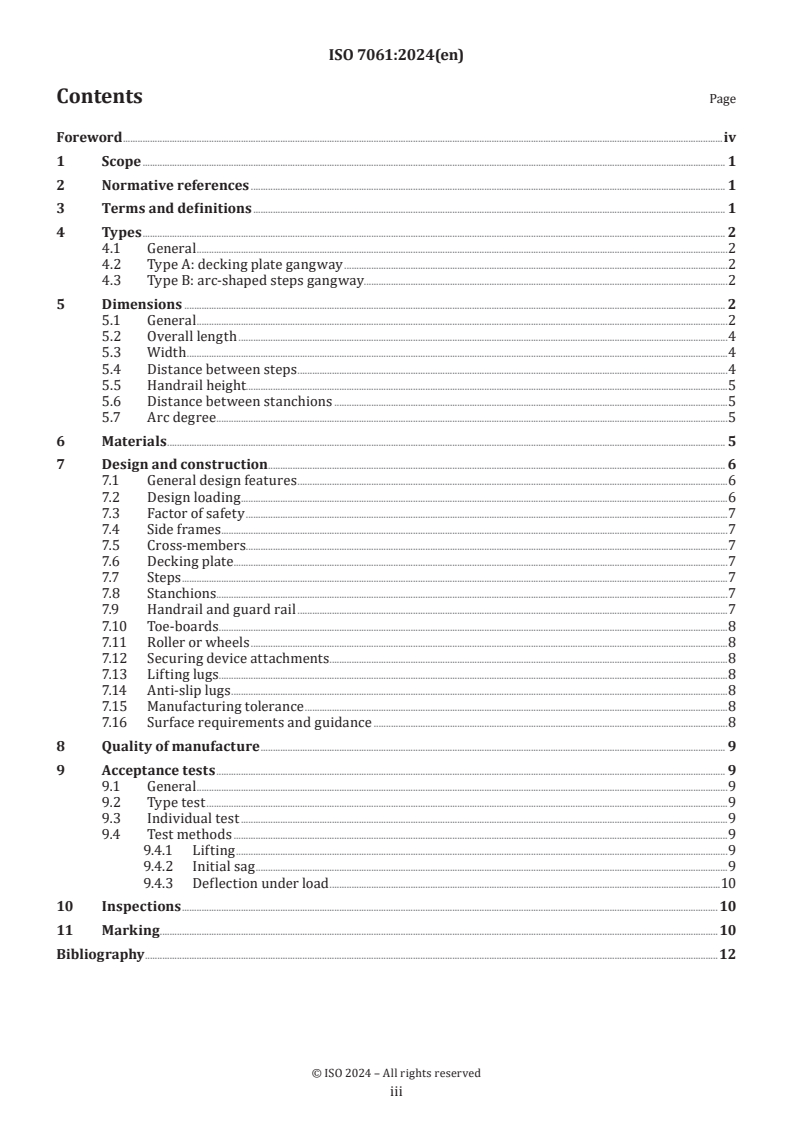
Contents Page
Foreword .iv
1 Scope . 1
2 Normative references . 1
3 Terms and definitions . 1
4 Types . 2
4.1 General .2
4.2 Type A: decking plate gangway .2
4.3 Type B: arc-shaped steps gangway.2
5 Dimensions . 2
5.1 General .2
5.2 Overall length .4
5.3 Width .4
5.4 Distance between steps .4
5.5 Handrail height.5
5.6 Distance between stanchions .5
5.7 Arc degree . .5
6 Materials . 5
7 Design and construction . 6
7.1 General design features .6
7.2 Design loading .6
7.3 Factor of safety .7
7.4 Side frames .7
7.5 Cross-members.7
7.6 Decking plate . .7
7.7 Steps .7
7.8 Stanchions.7
7.9 Handrail and guard rail .7
7.10 Toe-boards.8
7.11 Roller or wheels .8
7.12 Securing device attachments.8
7.13 Lifting lugs.8
7.14 Anti-slip lugs .8
7.15 Manufacturing tolerance .8
7.16 Surface requirements and guidance .8
8 Quality of manufacture . 9
9 Acceptance tests . 9
9.1 General .9
9.2 Type test .9
9.3 Individual test .9
9.4 Test methods .9
9.4.1 Lifting .9
9.4.2 Initial sag .9
9.4.3 Deflection under load .10
10 Inspections . 10
11 Marking . .10
Bibliography .12
iii
Foreword
ISO (the International Organization for Standardization) is a worldwide federation of national standards
bodies (ISO member bodies). The work of preparing International Standards is normally carried out through
ISO technical committees. Each member body interested in a subject for which a technical committee
has been established has the right to be represented on that committee. International organizations,
governmental and non-governmental, in liaison with ISO, also take part in the work. ISO collaborates closely
with the International Electrotechnical Commission (IEC) on all matters of electrotechnical standardization.
The procedures used to develop this document and those intended for its further maintenance are described
in the ISO/IEC Directives, Part 1. In particular, the different approval criteria needed for the different types
of ISO document should be noted. This document was drafted in accordance with the editorial rules of the
ISO/IEC Directives, Part 2 (see www.iso.org/directives).
ISO draws attention to the possibility that the implementation of this document may involve the use of (a)
patent(s). ISO takes no position concerning the evidence, validity or applicability of any claimed patent
rights in respect thereof. As of the date of publication of this document, ISO had not received notice of (a)
patent(s) which may be required to implement this document. However, implementers are cautioned that
this may not represent the latest information, which may be obtained from the patent database available at
www.iso.org/patents. ISO shall not be held responsible for identifying any or all such patent rights.
Any trade name used in this document is information given for the convenience of users and does not
constitute an endorsement.
For an explanation of the voluntary nature of standards, the meaning of ISO specific terms and expressions
related to conformity assessment, as well as information about ISO's adherence to the World Trade
Organization (WTO) principles in the Technical Barriers to Trade (TBT), see www.iso.org/iso/foreword.html.
This document was prepared by Technical Committee ISO/TC 8, Ships and marine technology, Subcommittee
SC 1, Maritime Safety.
This fourth edition cancels and replaces the third edition (ISO 7061:2015), which has been technically
revised.
The main changes are as follows:
— the inclination angle text has been corrected,
— the test methods have been updated, and
[1]
— the marking has been corrected to align with IMO MSC.1/Circ.1331.
Any feedback or questions on this document should be directed to the user’s national standards body. A
complete listing of these bodies can be found at www.iso.org/members.html.
iv
International Standard ISO 7061:2024(en)
Ships and marine technology — Aluminium shore gangways
for seagoing vessels
1 Scope
This document specifies requirements and guidance for aluminium shore gangways.
This document applies to gangways designed to be carried on board ships, to provide a lightweight,
convenient and safe means of access from ship to shore, for use primarily by the ship’s crew. These gangways
can also be used for access from ship to ship when conditions are favourable.
The gangways to which this document applies are not intended to carry wheeled traffic such as loaded
trolleys.
2 Normative references
There are no normative references in this document.
3 Terms and definitions
For the purposes of this document, the following terms and definitions apply.
ISO and IEC maintain terminology databases for use in standardization at the following addresses:
— ISO Online browsing platform: available at https:// www .iso .org/ obp
— IEC Electropedia: available at https:// www .electropedia .org/
3.1
gangway
bridge structure to allow safe embarkation and disembarkation from ship to shore or access to another ship
3.2
side frame
longitudinal-strength member of the gangway (3.1) to which the cross-members (3.3), stanchions, roller or
wheels and the lifting lugs, etc. are attached
3.3
cross-member
part that holds the side frame (3.2) in position and provides support for the decking plate (3.4)
3.4
decking plate
flat-topped corrugated section or plate serving as the type A gangway floor
3.5
step
batten or small section fitted on the decking plate (3.4), or arc-shaped material fixed directly at both side
frames (3.2) to give better foot grip when the gangway (3.1) is inclined from the horizontal position
3.6
guard rail
hand and intermediate guide, supported by stanchions, to prevent people falling from the gangway (3.1)
3.7
anti-slip securing part
hook plate, eye pad or angle section at the upper end of the gangway (3.1) to ensure that the gangway is
firmly connected to shipboard structure to prevent slipping
3.8
removable connection part
part that disconnects and connects two parted sections of the gangway body, so as to connect firmly the
two parted sections of the gangway body to one complete gangway (3.1), or to disconnect the one complete
gangway into two sections
4 Types
4.1 General
A gangway can be designed into two types: decking plate gangway and arc-shaped steps gangway. The
gangway body can be designed as one section, which can also be designed as two sections as required.
4.2 Type A: decking plate gangway
The type A gangway has the decking plate with anti-slip steps and is used horizontally or with an inclination
angle of up to 30° from the horizontal (see Figure 1).
4.3 Type B: arc-shaped steps gangway
The type B gangway has arc-shaped steps that support loading, and the maximum inclination angle of use is
55° from the horizontal (see Figure 2).
5 Dimensions
5.1 General
The dimensions of the type A gangway shall be in accordance with Figure 1.
The dimensions of the type B gangway shall be in accordance with Figure 2.
Dimen
...