

ISO 18948:2018
(Main)Imaging materials — Photo books — Test methods for permanence and durability
General Information
- Abstract
This document specifies test methods to assess the permanence and durability of photo books, including cover and pages. This document is applicable to photo books which contain reflection colour prints made with colour hardcopy materials of all types, including those from either traditional analogue printing or modern digital printing processes. The same performance test methods apply, regardless of the printing process. Because of the large number of combinations of sizes, cover materials, binding options and printing processes, testing of all possible combinations is not within the scope of this document. Instead, a representative selection of printed pages, cover materials and binding options that are used in the makeup of the photo book are tested.
- Status
- Withdrawn
- Publication Date
- 12-Nov-2018
- Technical Committee
- ISO/TC 42 - Photography
- Current Stage
- 9599 - Withdrawal of International Standard
- Start Date
- 26-Feb-2025
- Completion Date
- 29-Aug-2026
Buy Documents
ISO 18948:2018 - Imaging materials — Photo books — Test methods for permanence and durability/13/2018
ISO 18948:2018 - Imaging materials -- Photo books -- Test methods for permanence and durability
Overview
ISO 18948:2018 - Imaging materials - Photo books - Test methods for permanence and durability - defines standardized test methods to assess the permanence and durability of photo books, including both covers and pages. It applies to photo books containing reflective colour prints from any printing route (traditional analogue or modern digital). Because of the many combinations of sizes, cover materials and bindings, the standard requires testing a representative selection of printed pages, cover materials and binding options rather than every possible combination.
Key technical topics and requirements
ISO 18948:2018 organizes test methods across image stability and physical book integrity. Major technical topics include:
- Image permanence tests for covers and pages: procedures for evaluating degradation risks to printed images during storage and use.
- Thermal stability (long-term dark storage): assessing image and material stability under elevated temperature/storage conditions.
- Light, ozone and humidity stability: standardized methods to evaluate the effects of light exposure, atmospheric ozone and varying humidity on both pages and covers.
- Book integrity tests: mechanical tests for binding durability such as page-pull, peeling/delamination, internal bond strength and laminate adhesion.
- Heat durability and book-block attachment: tests that assess how attachment methods hold up to thermal stress and repeated opening/closing.
- Book blocking and deformation: methods to test blocking (transfer/adhesion between pages), page waviness and cover warp caused by humidity or storage.
- Test sample preparation, ageing conditions, reporting: guidance on specimen selection, conditioning, test environments and standardized reporting practices.
- Informative annexes on abrasion, extreme photo book tests, sandwich thermal testing and normative lamination/delamination procedures.
Practical applications and who uses this standard
ISO 18948 is used for:
- Quality assurance and specification development by photo book manufacturers, print service providers and publishers.
- Product development and R&D for material suppliers (paper, laminates, adhesives, covers) to validate durability claims.
- Conservation professionals, archivists and libraries assessing long‑term storage behaviour of modern photo books.
- Independent testing laboratories performing standardized durability and permanence testing.
- Procurement and compliance teams specifying durability requirements for consumer and professional photo products.
Using ISO 18948 helps ensure consistent, comparable durability data, supports material selection, reduces product failures in use or storage, and enables credible marketing claims about photo book permanence.
Related standards
- ISO 18920 (storage conditions guidance)
- ISO 18937 and ISO 18941 (testing for light and ozone effects on photo books)
Relations
- Revised
ISO 18948:2025 - Imaging materials — Photo books — Test methods for permanence and durability - Effective Date
- 08-Jun-2024
Buy Documents
ISO 18948:2018 - Imaging materials — Photo books — Test methods for permanence and durability/13/2018
ISO 18948:2018 - Imaging materials -- Photo books -- Test methods for permanence and durability
Frequently Asked Questions
ISO 18948:2018 is a standard published by the International Organization for Standardization (ISO). Its full title is "Imaging materials — Photo books — Test methods for permanence and durability". This standard covers: This document specifies test methods to assess the permanence and durability of photo books, including cover and pages. This document is applicable to photo books which contain reflection colour prints made with colour hardcopy materials of all types, including those from either traditional analogue printing or modern digital printing processes. The same performance test methods apply, regardless of the printing process. Because of the large number of combinations of sizes, cover materials, binding options and printing processes, testing of all possible combinations is not within the scope of this document. Instead, a representative selection of printed pages, cover materials and binding options that are used in the makeup of the photo book are tested.
This document specifies test methods to assess the permanence and durability of photo books, including cover and pages. This document is applicable to photo books which contain reflection colour prints made with colour hardcopy materials of all types, including those from either traditional analogue printing or modern digital printing processes. The same performance test methods apply, regardless of the printing process. Because of the large number of combinations of sizes, cover materials, binding options and printing processes, testing of all possible combinations is not within the scope of this document. Instead, a representative selection of printed pages, cover materials and binding options that are used in the makeup of the photo book are tested.
ISO 18948:2018 is classified under the following ICS (International Classification for Standards) categories: 37.040.99 - Other standards related to photography. The ICS classification helps identify the subject area and facilitates finding related standards.
ISO 18948:2018 has the following relationships with other standards: It is inter standard links to ISO 18948:2025. Understanding these relationships helps ensure you are using the most current and applicable version of the standard.
ISO 18948:2018 is available in PDF format for immediate download after purchase. The document can be added to your cart and obtained through the secure checkout process. Digital delivery ensures instant access to the complete standard document.
Standards Content (Sample)
INTERNATIONAL ISO
STANDARD 18948
First edition
2018-11
Imaging materials — Photo books —
Test methods for permanence and
durability
Matériaux pour l’image — Albums photos — Méthodes d’essai de
permanence et de durabilité
Reference number
©
ISO 2018
© ISO 2018
All rights reserved. Unless otherwise specified, or required in the context of its implementation, no part of this publication may
be reproduced or utilized otherwise in any form or by any means, electronic or mechanical, including photocopying, or posting
on the internet or an intranet, without prior written permission. Permission can be requested from either ISO at the address
below or ISO’s member body in the country of the requester.
ISO copyright office
CP 401 • Ch. de Blandonnet 8
CH-1214 Vernier, Geneva
Phone: +41 22 749 01 11
Fax: +41 22 749 09 47
Email: copyright@iso.org
Website: www.iso.org
Published in Switzerland
ii © ISO 2018 – All rights reserved
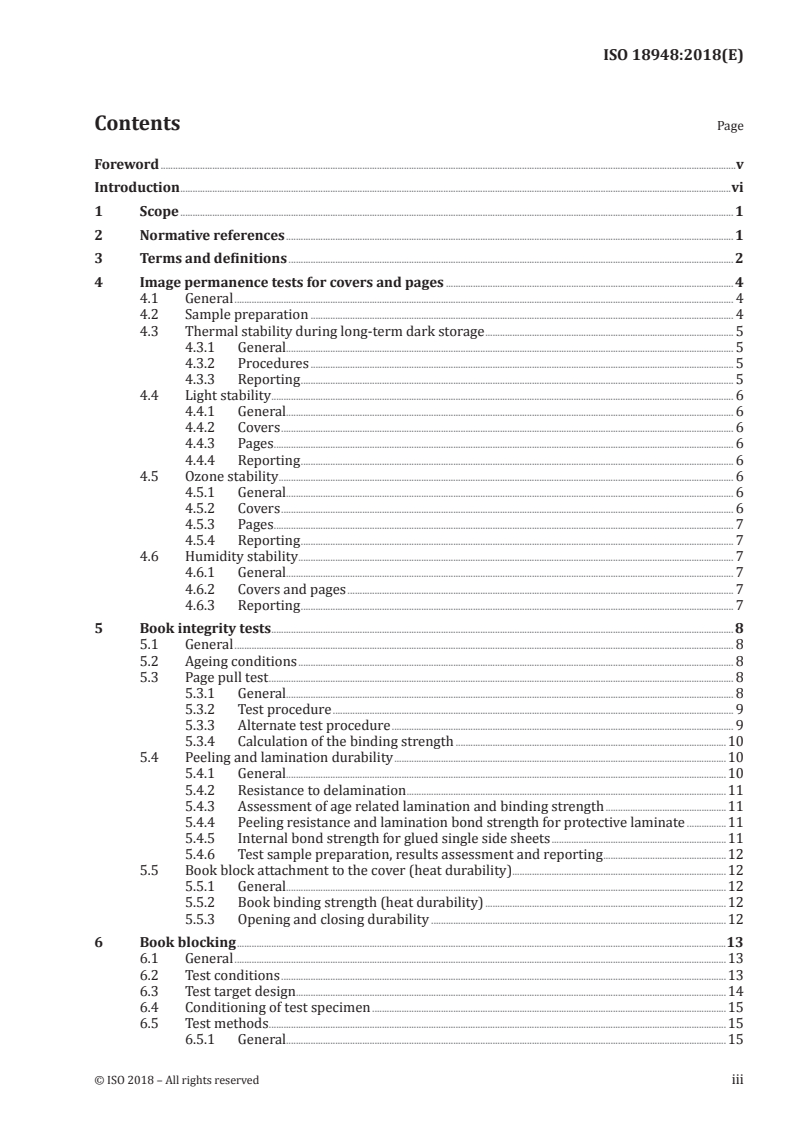
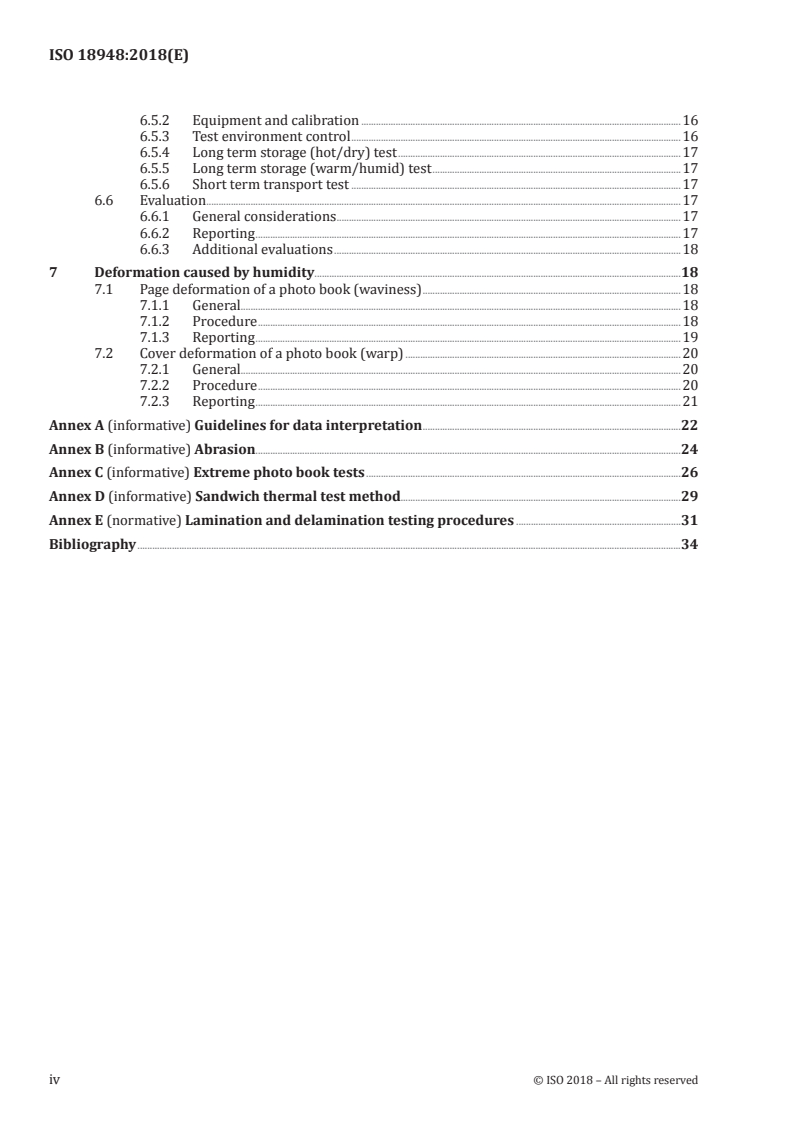
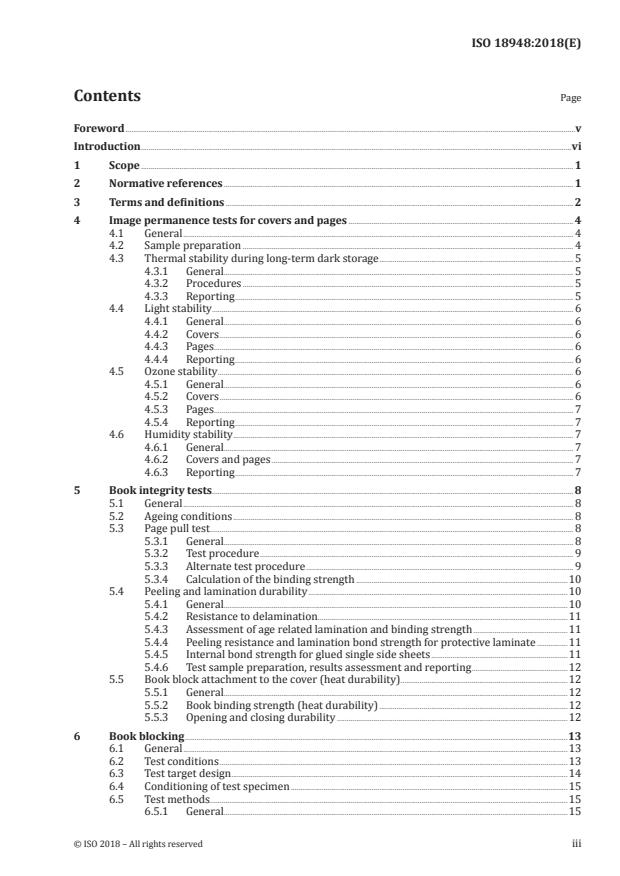
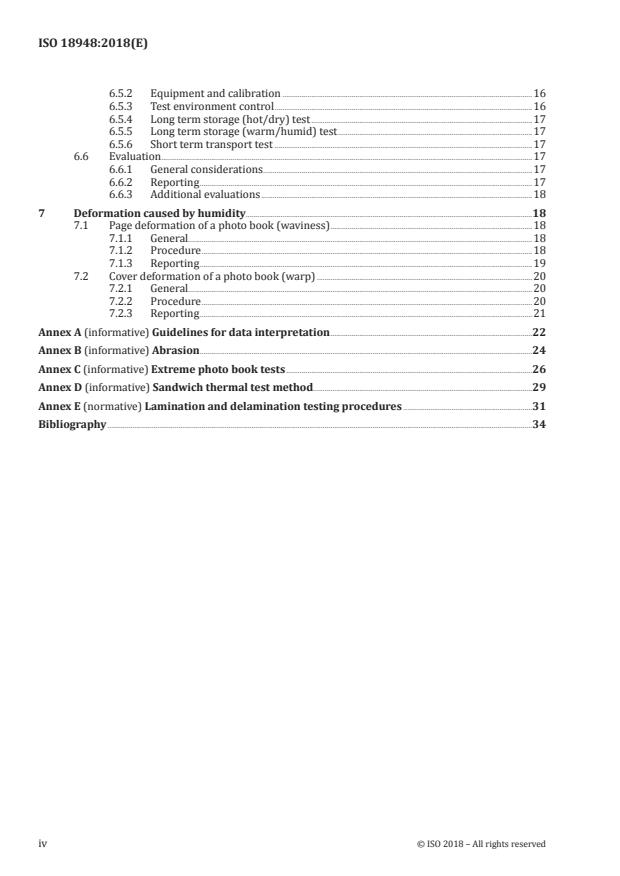
Contents Page
Foreword .v
Introduction .vi
1 Scope . 1
2 Normative references . 1
3 Terms and definitions . 2
4 Image permanence tests for covers and pages . 4
4.1 General . 4
4.2 Sample preparation . 4
4.3 Thermal stability during long-term dark storage . 5
4.3.1 General. 5
4.3.2 Procedures . 5
4.3.3 Reporting . 5
4.4 Light stability . 6
4.4.1 General. 6
4.4.2 Covers . 6
4.4.3 Pages . 6
4.4.4 Reporting . 6
4.5 Ozone stability . 6
4.5.1 General. 6
4.5.2 Covers . 6
4.5.3 Pages . 7
4.5.4 Reporting . 7
4.6 Humidity stability . 7
4.6.1 General. 7
4.6.2 Covers and pages . 7
4.6.3 Reporting . 7
5 Book integrity tests . 8
5.1 General . 8
5.2 Ageing conditions . 8
5.3 Page pull test . 8
5.3.1 General. 8
5.3.2 Test procedure . 9
5.3.3 Alternate test procedure . 9
5.3.4 Calculation of the binding strength .10
5.4 Peeling and lamination durability .10
5.4.1 General.10
5.4.2 Resistance to delamination .11
5.4.3 Assessment of age related lamination and binding strength .11
5.4.4 Peeling resistance and lamination bond strength for protective laminate .11
5.4.5 Internal bond strength for glued single side sheets .11
5.4.6 Test sample preparation, results assessment and reporting .12
5.5 Book block attachment to the cover (heat durability) .12
5.5.1 General.12
5.5.2 Book binding strength (heat durability) .12
5.5.3 Opening and closing durability .12
6 Book blocking .13
6.1 General .13
6.2 Test conditions .13
6.3 Test target design .14
6.4 Conditioning of test specimen .15
6.5 Test methods .15
6.5.1 General.15
6.5.2 Equipment and calibration .16
6.5.3 Test environment control .16
6.5.4 Long term storage (hot/dry) test .17
6.5.5 Long term storage (warm/humid) test .17
6.5.6 Short term transport test .17
6.6 Evaluation .17
6.6.1 General considerations .17
6.6.2 Reporting .17
6.6.3 Additional evaluations .18
7 Deformation caused by humidity .18
7.1 Page deformation of a photo book (waviness) .18
7.1.1 General.18
7.1.2 Procedure .18
7.1.3 Reporting .19
7.2 Cover deformation of a photo book (warp) .20
7.2.1 General.20
7.2.2 Procedure .20
7.2.3 Reporting .21
Annex A (informative) Guidelines for data interpretation .22
Annex B (informative) Abrasion .24
Annex C (informative) Extreme photo book tests .26
Annex D (informative) Sandwich thermal test method.29
Annex E (normative) Lamination and delamination testing procedures .31
Bibliography .34
iv © ISO 2018 – All rights reserved
Foreword
ISO (the International Organization for Standardization) is a worldwide federation of national standards
bodies (ISO member bodies). The work of preparing International Standards is normally carried out
through ISO technical committees. Each member body interested in a subject for which a technical
committee has been established has the right to be represented on that committee. International
organizations, governmental and non-governmental, in liaison with ISO, also take part in the work.
ISO collaborates closely with the International Electrotechnical Commission (IEC) on all matters of
electrotechnical standardization.
The procedures used to develop this document and those intended for its further maintenance are
described in the ISO/IEC Directives, Part 1. In particular the different approval criteria needed for the
different types of ISO documents should be noted. This document was drafted in accordance with the
editorial rules of the ISO/IEC Directives, Part 2 (see www .iso .org/directives).
Attention is drawn to the possibility that some of the elements of this document may be the subject of
patent rights. ISO shall not be held responsible for identifying any or all such patent rights. Details of
any patent rights identified during the development of the document will be in the Introduction and/or
on the ISO list of patent declarations received (see www .iso .org/patents).
Any trade name used in this document is information given for the convenience of users and does not
constitute an endorsement.
For an explanation on the voluntary nature of standards, the meaning of ISO specific terms and
expressions related to conformity assessment, as well as information about ISO's adherence to the
World Trade Organization (WTO) principles in the Technical Barriers to Trade (TBT) see the following
URL: www .iso .org/iso/foreword .html.
This document was prepared by Technical Committee ISO/TC 42, Photography.
Any feedback or questions on this document should be directed to the user’s national standards body. A
complete listing of these bodies can be found at www .iso .org/members .html.
Introduction
Photo books are bound books with printed pages comprised of integrated photos, along with artwork
and text, designed by and usually dedicated to a limited group of people.
Like photographic prints, photo books are produced on the widest available spectrum of production,
from large run commercial facilities to one-off home kits. Their expected permanence and durability
can cover a similarly broad range. Careful consideration should be given to the materials used in the
[32]
construction of photo books to insure high permanence of the printed images and of the books
[33]
themselves .
Photo books are typically stored in a closed condition, either in a stack or on a book shelf; consequently
environmental factors that may adversely affect displayed prints, such as light and ozone, may not be
applicable to the preservation of the inside pages of a photo book. The user is cautioned that these
factors may become relevant if the photo book is displayed or otherwise exposed to light or other
environmental factors for an extended period of time. ISO 18937 and ISO 18941 provide guidelines on
testing for the effect of light and ozone on photo books.
The test methods included in this document assume that the photo book will be stored and used in
environments that may or may not be climate controlled. For this reason, it includes test conditions
designed to assess the adverse effects of humidity and temperature that may be outside of recommended
long-term and medium-term storage conditions as described in ISO 18920. It also includes test
conditions intended to simulate short duration exposure of photo books to the interior of a hot vehicle.
This document contains many specific tests for various binding systems and printing processes. It
is not the intention of this document to require that all possible combinations be tested. Testing all
combinations of sizes, cover materials, binding options and printing processes is not possible due
to the large number of combinations. However, testing representative combinations of materials is
encouraged.
vi © ISO 2018 – All rights reserved
INTERNATIONAL STANDARD ISO 18948:2018(E)
Imaging materials — Photo books — Test methods for
permanence and durability
1 Scope
This document specifies test methods to assess the permanence and durability of photo books, including
cover and pages.
This document is applicable to photo books which contain reflection colour prints made with colour
hardcopy materials of all types, including those from either traditional analogue printing or modern
digital printing processes. The same performance test methods apply, regardless of the printing
process. Because of the large number of combinations of sizes, cover materials, binding options and
printing processes, testing of all possible combinations is not within the scope of this document.
Instead, a representative selection of printed pages, cover materials and binding options that are used
in the makeup of the photo book are tested.
2 Normative references
The following documents are referred to in the text in such a way that some or all of their content
constitutes requirements of this document. For dated references, only the edition cited applies. For
undated references, the latest edition of the referenced document (including any amendments) applies.
ISO 527-3, Plastics — Determination of tensile properties — Part 3: Test conditions for films and sheets
ISO 11800:1998, Information and documentation — Requirements for binding materials and methods used
in the manufacture of books
ISO 18913, Imaging materials — Permanence — Vocabulary
ISO 18924, Imaging materials — Test method for Arrhenius-type predictions
ISO 18931, Imaging materials — Recommendations for humidity measurement and control
ISO 18936, Imaging materials — Processed colour photographs — Methods for measuring thermal stability
ISO 18937, Imaging materials — Photographic reflection prints — Methods for measuring indoor light
stability
ISO 18941:2017, Imaging materials — Colour reflection prints — Test method for ozone gas fading stability
ISO 18946, Imaging materials — Reflection colour photographic prints — Method for testing humidity
fastness
1)
ISO 18949 , Imaging Materials — Reflection colour photographic prints — Method for testing stability
under low humidity conditions
ISO 19594, Graphic technology — Test method for the determination of the binding strength for perfect-
bound products — Page-pull test working upwards
ASTM F904, Standard Test Method for Comparison of Bond Strength or Ply Adhesion of Similar Laminates
Made from Flexible Materials
1) Under preparation. Stage at the time of publication: ISO/DIS 18949:2018.
3 Terms and definitions
For the purposes of this document, the terms and definitions given in ISO 18913 and the following apply.
ISO and IEC maintain terminological databases for use in standardization at the following addresses:
— ISO Online browsing platform: available at https: //www .iso .org/obp
— IEC Electropedia: available at http: //www .electropedia .org/
3.1
photo book
bound book with printed pages comprised of integrated personal photos along with artwork and text,
designed by and usually dedicated to a limited group of people
3.2
cover
protective covering on the front, back, and spine of a book, including any associated adhesives, binding
boards, liners, and laminates
3.3
blister
localized delamination of a multilayer assembly that looks like a bubble
3.4
delamination
separation of a laminated assembly into its constituent layers, either in whole or in part
3.5
laminate
layer of material that goes over one or both sides of a printed page
Note 1 to entry: Usually the laminate layer provides moisture barrier and abrasion resistance, as well as UV
shielding, to add protection to the photo images from physical damage and colour fading.
3.6
laminate
clear polymeric layer applied using thermosetting or pressure-sensitive adhesive to one or both
surfaces of a print to improve durability
3.7
laminate
water-based, solvent-based, or UV-curable liquid protective coating applied to one or
both surfaces of a print to improve durability
3.8
laminated assembly
multilayer structure typically comprising a paper support, one or more barrier layers, an imaging layer,
and a protective laminate top layer
Note 1 to entry: Laminated assemblies include films or coatings adhered to the surface of pages or covers, prints
adhered back-to-back to each other forming a completed page.
3.9
lay-flat
binding that allows for an uninterrupted image across the binding, either by using flexible, hinged
pages or by adhering the front and reverse sides of each page together
2 © ISO 2018 – All rights reserved
3.10
sandwich sample holder
metal fixture intended to hold three components in a flattened, pressed-together position so that
airflow to the printed areas of the middle component is restricted as a function of the permeability of
the two outer components
Note 1 to entry: This type of sample holder is suitable for sandwich thermal test method written in Annex D.
3.11
sample sandwich thermal test method
thermal stability test method that complies with ISO 18936 except that the sandwich sample holder is
used in place of the free hanging sample holding method
3.12
blocking
undesired adhesion between sheets of printed material that occurs under moderate pressure, high
temperature, or high humidity, while in storage or in use that leads to undesirable effects such as
delamination, paper splitting, tearing, ferrotyping, colourant transfer, or edge deformation
3.13
sticking
temporary adhesion of prints in a stack or pages in a photo book but without physical damage when
adjacent prints or pages are separated
3.14
ferrotyping
changes in surface gloss resulting from intimate contact with another surface, often associated with
high humidity
Note 1 to entry: The term ferrotyping is derived from a historical term associated with silver halide photography.
It is a process used to produce a very high gloss surface on a gelatine silver halide print in which a damp print is
placed in contact with a highly polished surface, such as chromium-plated steel, and dried under conditions of
elevated temperature and pressure.
3.15
bleeding
lateral migration of colourant
3.16
colourant transfer
transfer of colourant from one sheet to the other sheet, when both sheets are placed in direct contact
3.17
curling
physical deformation of a page, a cover, a stack of prints or a bound photo book resulting in departure
from physical flatness with the tendency to curve into a concave or convex shape
3.18
wrinkling
physical deformation of a page or a cover of a photo book resulting in departure from physical flatness
with the tendency to make furrows, crinkles, folds, ridges or creases
3.19
warp
distortion of the front and/or back covers of a bound book, so that the covers do not lie flat against the
book block
3.20
book block
text block, including the endpapers and other materials added by the binder, before casing in
3.21
waviness
physical deformation of a page or a cover of a photo book resulting in departure from physical flatness
with the tendency to curve alternately in opposite directions, resembling or suggesting waves
3.23
cockle
planar distortion in flat materials, especially paper or vellum, that is characterized by puckering, waves,
or rippling
3.24
edge fluting
wave-shaped deformation along the edges of cut sheets and may be caused by an expansion of the edge
of the material, which is exposed to greater variations in temperature and humidity than the centre
4 Image permanence tests for covers and pages
4.1 General
Although the individual pages of most photo books are not typically exposed to light and pollutants
in the ambient environment for long periods of time, it is useful to know how stable the printed pages
are if the book were to be left open to the environment for extended periods of time. Therefore, the
tests described in this clause are intended to be carried out on individual printed sheets or pages of a
photo book. In addition, these tests are also intended for photo book covers. Different use profiles are
addressed in specification documents.
Thermal stability, light stability, ozone resistance and humidity resistance of printed sheets and covers
may be evaluated according to the test methods given in ISO 18936, ISO 18937 (indoor home lighting
condition), ISO 18941, and ISO 18946, respectively.
Light stability and ozone resistance, as measured according to ISO 18937 and ISO 18941 will reflect the
performance that can be expected for a cover that contains pictures or for the underlying printed sheets,
if a cover has a window opening that shows the first page, or if the book is displayed or otherwise left in
an open state for long periods of time. However the most important issue regarding image permanence
of photo books is generally dark storage.
NOTE Information regarding physical abrasion testing is provided in Annex B.
4.2 Sample preparation
The samples shall consist of the parts of a photo book, including pages, liner and end sheets, and covers,
separated into individual page size components. Printable components, including a printable cover —
if applicable — shall be printed with a test target. These parts are then bound in the same process
(time and machine settings) as the book for which the test is intended. At least two replicate samples
are recommended. Alternatively, test specimens shall be cut off from the book. For general testing
purposes, users of this document are free to choose whatever target patches and starting densities they
feel are appropriate for their testing needs. An example of such a target is included in ISO 18944 along
with requirements and recommendations for sample preparation. Applicable International Standard(s)
for specification of print life may require the use of specific targets. If a protective lamination film or
varnish coating is applied to the photo book, either on the book cover or in its inner sheets, the same
protective film or varnish coating shall be applied on the test samples. The photo book components
shall be conditioned at 23 °C and 50 % RH for 24 h prior to testing.
NOTE Be aware that different starting densities of the test prints may yield different test results in terms
of fading rate. Once a test sample density is chosen, it is important to be consistent across all test samples for
comparison. If testing is being done according to a standard that uses specific starting densities those densities
need to be adhered to.
4 © ISO 2018 – All rights reserved
At least two replicate samples of each photo book component part are required, both printed and
unprinted. Replicates of each photo book component part shall be located in different regions of the
respective test chambers (light, ozone, etc.).
The measurement and sample holding conditions and measurement procedures given in ISO 18936
shall be followed. In particular, care shall be taken to use consistent ambient light levels and hold times
in each iteration of the sample holding and measurement process. Density shall be measured for printed
patch areas, and colorimetric values shall be measured in the D (minimum density) patch areas of
min
the printable components and in the centre, of each unprinted component. Density and colorimetric
values from the replicate samples shall be averaged before calculations are performed.
4.3 Thermal stability during long-term dark storage
4.3.1 General
Long term stability shall be evaluated in accordance with ISO 18936, the test method, and ISO 18924,
the Arrhenius analysis. It should be noted that the test results of the short term high temperature test
may not correspond to the long term stability.
4.3.2 Procedures
The sealed bag method, as detailed in ISO 18936, shall be used to test individual pages or covers. In
addition to the required sealed bag method, the ‘free hanging’ method, also detailed in ISO 18936, may
be used to minimize page or cover interactions; it does not, however, reflect the actual storage conditions
of the photo book. The ‘free hanging’ test does not simulate interactions between components that may
be present in a photo book, such as between the cover and the first page. To simulate those interactions
the user may conduct a “sandwich” type thermal ageing test as described in Annex D.
During actual storage of photo books the temperature and humidity will fluctuate, including potentially
large fluctuations depending on the differences in seasons. The testing shall be done at a relative
humidity (RH) of 50 %. However, because the effects of humidity on image stability can differ markedly
from one product to another, it is useful to evaluate its effect. This is done by means of a temperature
test series carried out at different relative humidity. If the relative humidity during storage is expected
to be significantly lower than 50 % RH, such as when stored in accordance with some conditions
specified in ISO 18911, ISO 18920 or in an arid climate, or significantly higher, as in a tropical climate,
the relative humidity selected for the test should correspond to the storage conditions. Such tests are
often conducted at conditions of various % RH levels, such 20 % RH to pick up low humidity effects and
70 % RH to pick up high humidity effects. In order to make use of the Arrhenius method in ISO 18924,
the temperatures used shall span a minimum range of 20 °C.
4.3.3 Reporting
Reporting shall comply with the reporting requirements of ISO 18936. The results of these tests
are reported as temperatures and time for thermal testing to reach the observed losses in optical
densities, together with the percentage of optical density losses, or the amount of densitometric and/
or colorimetric change observed for a given temperature and time. Reporting shall include results for
each tested photo book component, printed and unprinted. For each photo book component, reporting
shall also include the presence or absence of physical and biological changes including, but not limited
to, delamination, adhesive failure, mould growth, and blocking. In particular, if a sample photo book
component held in the interior of a three layer sandwich in the sandwich sample holder adheres to or
transfers colourant to the materials comprising the outer layers of the three layer sandwich, this failure
shall be reported. In addition, visible edge yellowing, differentiating the component edge region from
the interior shall be reported.
4.4 Light stability
4.4.1 General
The test method for “simulated indoor daylight typical home display” according to ISO 18937, shall be
used. For general testing purposes, users of this document are free to choose whatever target patches
and starting densities they feel are appropriate for their testing needs. An example of such a target is
included in ISO 18944 along with requirements and recommendations for sample preparation.
NOTE Be aware that different starting densities of the test prints can yield different test results in terms
of fading rate. Once a test sample density is chosen, it is important to be consistent across all test samples for
comparison. If testing is being done according to a standard that uses specific starting densities those densities
need to be adhered to.
4.4.2 Covers
The total cumulative exposure shall be 20 Mlx·h. Data may also be collected at lower and higher
cumulative exposures if applicable to the usage case.
4.4.3 Pages
The total cumulative exposure shall be 2 Mlx·h. Data may also be collected at lower and higher
cumulative exposures if applicable to the usage case.
NOTE The total cumulative exposure of 20 Mlx·h corresponds to 25 y exposure assuming that 12 h a day at a
light level of 200 lx. 200 lx is the light level for book shelves at library which is described in ISO 8995. The pages are
typically not exposed to as much light as the covers, and it is estimated to be less than ten percent of the cover value.
4.4.4 Reporting
Reporting shall comply with the reporting requirements of ISO 18937. The results of these tests are
reported as the amount of densitometric or colorimetric change observed for a given cumulative
exposure (lx·h) together with the percentage losses in optical densities. If multiple exposures are used,
the results are reported as the cumulative exposure to reach the observed densitometric or colorimetric
change together with the percentage losses in optical densities.
4.5 Ozone stability
4.5.1 General
The test method described in ISO 18941 shall be used. For general testing purposes, users of this
document are free to choose whatever target patches and starting densities they feel are appropriate
for their testing needs. An example of such a target is included in ISO 18944 along with requirements
and recommendations for sample preparation.
NOTE Be aware that different starting densities of the test prints can yield different test results in terms
of fading rate. Once a test sample density is chosen, it is important to be consistent across all test samples for
comparison. If testing is being done according to a standard that uses specific starting densities those densities
need to be adhered to.
4.5.2 Covers
The total cumulative exposure shall be 1 450 μl/l·h. Data may also be collected at lower and higher
cumulative exposures if applicable to the usage case. Unless otherwise specified, the test shall be carried
out at 1,0 μl/l, with an operational uniformity of ±0,1 μl/l ozone as specified in ISO 18941:2017, 9.4.
Other optional concentrations, such as 0,5 μl/l or 5,0 μl/l, may be useful for testing. If concentrations
other than 1,0 μl/l are used, the operational uniformity tolerances shall be ±10 % of aim or the best
achievable with the test equipment. If greater than ±10 %, the actual tolerance shall be reported. If
optional concentrations are used, the tester should evaluate the materials for ozone reciprocity
6 © ISO 2018 – All rights reserved
behaviour before making any comparative conclusions. For testing at ozone concentrations greater
than 1,0 μl/l, reciprocity testing shall be conducted at an ozone concentration of 1,0 μl/l or lower (as
discussed in ISO 18941:2017, Annex B).
−6
NOTE 1 μl/l = 1 ppm (1 × 10 ) and is measured in terms of volume.
4.5.3 Pages
The total cumulative exposure shall be 145 μl/l·h. Data may also be collected at lower and higher
cumulative exposures if applicable to the usage case. Unless otherwise specified, the test shall be
carried out at 1,0 μl/l, with an operational uniformity of ±0,1 μl/l ozone as specified in ISO 18941:2017,
9.4. Other optional concentrations, such as 0,5 μl/l or 5,0 μl/l, may be useful for testing. If concentrations
other than 1,0 μl/l are used, the operational uniformity tolerances shall be ±10 % of aim or the best
achievable with the test equipment. If greater than ±10 %, the actual tolerance shall be reported. If
optional concentrations are used, the tester should evaluate the materials for ozone reciprocity
behaviour before making any comparative conclusions. For testing at ozone concentrations greater
than 1,0 μl/l, reciprocity testing shall be conducted at an ozone concentration of 1,0 μl/l or lower (as
discussed in ISO 18941:2017, Annex B).
NOTE The total cumulative exposure of 1 450 μl/l·h corresponds to 25 y exposure to ozone gas of 6,6 nl/l
concentration. Median ambient indoor ozone concentrations of 9 nl/l and 4,5 nl/l were determined for different
regions worldwide. The 6,6 nl/l is the half point of the discussion. The pages are typically not exposed to as much
ozone as the covers, and it is estimated to be less than ten percent of the cover value.
4.5.4 Reporting
Reporting shall comply with the reporting requirements of ISO 18941:2017, Clause 10. The results of
these tests are reported as the amount of densitometric or colorimetric change observed for a given
cumulative exposure (μl/l·h) together with the percentage losses in optical densities. If multiple
exposures are used, the results are reported as the cumulative exposure to reach the observed
densitometric or colorimetric change together with the percentage losses in optical densities.
4.6 Humidity stability
4.6.1 General
The test method and target patches described in ISO 18946 and ISO 18949 shall be used.
4.6.2 Covers and pages
The tests of Method A of ISO 18946 (high humidity) and ISO 18949 (low humidity) shall be run and
results reported as described in ISO 18946 and ISO 18949.
4.6.3 Reporting
Reporting shall comply with the reporting requirements of ISO 18946 and ISO 18949. Reporting the
specific humidity fastness test result (Method A of ISO 18946 and ISO 18949) shall include reporting of
the humidity (% RH) and temperature test conditions, the test time duration and the delta E resulting
over the test duration. For each photo book component, reporting shall also include the presence or
absence of physical and biological changes including, but not limited to, delamination, adhesive failure,
mould growth, and blocking.
5 Book integrity tests
5.1 General
Testing the book integrity of a photo book is conducted by a set of mechanical durability tests, which
are related to transportation, usage, and storage on a bookshelf.
In general, some material used as binding or lamination may degrade gradually with age. Therefore,
each mechanical durability test is performed on a photo book in its initial state and after a period of
short term ageing.
Test methods of book integrity consist of page-pull test, peeling and delamination tests (including for
covers and pages), and book block attachment to the cover.
NOTE 1 Page adhesion of a photo book caused by heat and humidity is addressed in Clause 6.
NOTE 2 Deformation of a photo book caused by heat and humidity is addressed in Clause 7.
NOTE 3 Information in extreme tests for photo book integrity is provided in Annex C.
5.2 Ageing conditions
Parameters of accelerated sample ageing for assessing the changes in ageing related mechanical
integrity include: temperature range, relative humidity set point and total test duration. Users of this
document are encouraged to select a proper set of test conditions based on their application needs and
the expected storage environment in the life-cycle of the photo book products for the market they are
serving.
As a typical condition of short term ageing, the temperature cycling protocol of ISO 11800:1998,
Annex C shall be applied. Mechanical integrity of the photo book shall be measured both before and
after the following sequence of exposures:
a) 72 h exposure to 54 °C ± 3 °C;
b) 72 h exposure to −6 °C ± 3 °C;
c) 6 h exposure to 24 °C ± 6 °C.
NOTE 1 With certain hot melt adhesives with low glass transition temperature or softening temperature, (for
example certain ethylene vinyl acetate adhesives with lower softening temperature than 54 °C) some failure
issues can occur during the book integrity tests. However, those issues can or cannot occur in actual room
temperature storage.
NOTE 2 If a single ageing chamber is used for temperature cycling, add 2h to 3h of transition time between the
two temperature extremes.
5.3 Page pull test
5.3.1 General
The tensile page-pull test measures initial strength of page attachment. Page attachment ensures that
photo book pages remain an integral part of the completed photo book. Poorly attached pages may
become separated and lost or damaged. The aim of the testing of book blocks is to identify possible
weaknesses of the binding quality. The test method described in ISO 19594 or that described below in
5.3.3 shall be used.
NOTE The scope of ISO 19594 is for adhesive-bound books only, but the methods described in this document
can be applied for other book block constructions as well.
The binding strength is evaluated by pulling out a single sheet from the book block using a material
testing system and a specified test fixture. The test is performed in such a way that the test sheet is
8 © ISO 2018 – All rights reserved
clamped on the complete fore edge while the opened book block is fixed at the specimen holder with a
...
INTERNATIONAL ISO
STANDARD 18948
First edition
2018-11
Imaging materials — Photo books —
Test methods for permanence and
durability
Matériaux pour l’image — Albums photos — Méthodes d’essai de
permanence et de durabilité
Reference number
©
ISO 2018
© ISO 2018
All rights reserved. Unless otherwise specified, or required in the context of its implementation, no part of this publication may
be reproduced or utilized otherwise in any form or by any means, electronic or mechanical, including photocopying, or posting
on the internet or an intranet, without prior written permission. Permission can be requested from either ISO at the address
below or ISO’s member body in the country of the requester.
ISO copyright office
CP 401 • Ch. de Blandonnet 8
CH-1214 Vernier, Geneva
Phone: +41 22 749 01 11
Fax: +41 22 749 09 47
Email: copyright@iso.org
Website: www.iso.org
Published in Switzerland
ii © ISO 2018 – All rights reserved
Contents Page
Foreword .v
Introduction .vi
1 Scope . 1
2 Normative references . 1
3 Terms and definitions . 2
4 Image permanence tests for covers and pages . 4
4.1 General . 4
4.2 Sample preparation . 4
4.3 Thermal stability during long-term dark storage . 5
4.3.1 General. 5
4.3.2 Procedures . 5
4.3.3 Reporting . 5
4.4 Light stability . 6
4.4.1 General. 6
4.4.2 Covers . 6
4.4.3 Pages . 6
4.4.4 Reporting . 6
4.5 Ozone stability . 6
4.5.1 General. 6
4.5.2 Covers . 6
4.5.3 Pages . 7
4.5.4 Reporting . 7
4.6 Humidity stability . 7
4.6.1 General. 7
4.6.2 Covers and pages . 7
4.6.3 Reporting . 7
5 Book integrity tests . 8
5.1 General . 8
5.2 Ageing conditions . 8
5.3 Page pull test . 8
5.3.1 General. 8
5.3.2 Test procedure . 9
5.3.3 Alternate test procedure . 9
5.3.4 Calculation of the binding strength .10
5.4 Peeling and lamination durability .10
5.4.1 General.10
5.4.2 Resistance to delamination .11
5.4.3 Assessment of age related lamination and binding strength .11
5.4.4 Peeling resistance and lamination bond strength for protective laminate .11
5.4.5 Internal bond strength for glued single side sheets .11
5.4.6 Test sample preparation, results assessment and reporting .12
5.5 Book block attachment to the cover (heat durability) .12
5.5.1 General.12
5.5.2 Book binding strength (heat durability) .12
5.5.3 Opening and closing durability .12
6 Book blocking .13
6.1 General .13
6.2 Test conditions .13
6.3 Test target design .14
6.4 Conditioning of test specimen .15
6.5 Test methods .15
6.5.1 General.15
6.5.2 Equipment and calibration .16
6.5.3 Test environment control .16
6.5.4 Long term storage (hot/dry) test .17
6.5.5 Long term storage (warm/humid) test .17
6.5.6 Short term transport test .17
6.6 Evaluation .17
6.6.1 General considerations .17
6.6.2 Reporting .17
6.6.3 Additional evaluations .18
7 Deformation caused by humidity .18
7.1 Page deformation of a photo book (waviness) .18
7.1.1 General.18
7.1.2 Procedure .18
7.1.3 Reporting .19
7.2 Cover deformation of a photo book (warp) .20
7.2.1 General.20
7.2.2 Procedure .20
7.2.3 Reporting .21
Annex A (informative) Guidelines for data interpretation .22
Annex B (informative) Abrasion .24
Annex C (informative) Extreme photo book tests .26
Annex D (informative) Sandwich thermal test method.29
Annex E (normative) Lamination and delamination testing procedures .31
Bibliography .34
iv © ISO 2018 – All rights reserved
Foreword
ISO (the International Organization for Standardization) is a worldwide federation of national standards
bodies (ISO member bodies). The work of preparing International Standards is normally carried out
through ISO technical committees. Each member body interested in a subject for which a technical
committee has been established has the right to be represented on that committee. International
organizations, governmental and non-governmental, in liaison with ISO, also take part in the work.
ISO collaborates closely with the International Electrotechnical Commission (IEC) on all matters of
electrotechnical standardization.
The procedures used to develop this document and those intended for its further maintenance are
described in the ISO/IEC Directives, Part 1. In particular the different approval criteria needed for the
different types of ISO documents should be noted. This document was drafted in accordance with the
editorial rules of the ISO/IEC Directives, Part 2 (see www .iso .org/directives).
Attention is drawn to the possibility that some of the elements of this document may be the subject of
patent rights. ISO shall not be held responsible for identifying any or all such patent rights. Details of
any patent rights identified during the development of the document will be in the Introduction and/or
on the ISO list of patent declarations received (see www .iso .org/patents).
Any trade name used in this document is information given for the convenience of users and does not
constitute an endorsement.
For an explanation on the voluntary nature of standards, the meaning of ISO specific terms and
expressions related to conformity assessment, as well as information about ISO's adherence to the
World Trade Organization (WTO) principles in the Technical Barriers to Trade (TBT) see the following
URL: www .iso .org/iso/foreword .html.
This document was prepared by Technical Committee ISO/TC 42, Photography.
Any feedback or questions on this document should be directed to the user’s national standards body. A
complete listing of these bodies can be found at www .iso .org/members .html.
Introduction
Photo books are bound books with printed pages comprised of integrated photos, along with artwork
and text, designed by and usually dedicated to a limited group of people.
Like photographic prints, photo books are produced on the widest available spectrum of production,
from large run commercial facilities to one-off home kits. Their expected permanence and durability
can cover a similarly broad range. Careful consideration should be given to the materials used in the
[32]
construction of photo books to insure high permanence of the printed images and of the books
[33]
themselves .
Photo books are typically stored in a closed condition, either in a stack or on a book shelf; consequently
environmental factors that may adversely affect displayed prints, such as light and ozone, may not be
applicable to the preservation of the inside pages of a photo book. The user is cautioned that these
factors may become relevant if the photo book is displayed or otherwise exposed to light or other
environmental factors for an extended period of time. ISO 18937 and ISO 18941 provide guidelines on
testing for the effect of light and ozone on photo books.
The test methods included in this document assume that the photo book will be stored and used in
environments that may or may not be climate controlled. For this reason, it includes test conditions
designed to assess the adverse effects of humidity and temperature that may be outside of recommended
long-term and medium-term storage conditions as described in ISO 18920. It also includes test
conditions intended to simulate short duration exposure of photo books to the interior of a hot vehicle.
This document contains many specific tests for various binding systems and printing processes. It
is not the intention of this document to require that all possible combinations be tested. Testing all
combinations of sizes, cover materials, binding options and printing processes is not possible due
to the large number of combinations. However, testing representative combinations of materials is
encouraged.
vi © ISO 2018 – All rights reserved
INTERNATIONAL STANDARD ISO 18948:2018(E)
Imaging materials — Photo books — Test methods for
permanence and durability
1 Scope
This document specifies test methods to assess the permanence and durability of photo books, including
cover and pages.
This document is applicable to photo books which contain reflection colour prints made with colour
hardcopy materials of all types, including those from either traditional analogue printing or modern
digital printing processes. The same performance test methods apply, regardless of the printing
process. Because of the large number of combinations of sizes, cover materials, binding options and
printing processes, testing of all possible combinations is not within the scope of this document.
Instead, a representative selection of printed pages, cover materials and binding options that are used
in the makeup of the photo book are tested.
2 Normative references
The following documents are referred to in the text in such a way that some or all of their content
constitutes requirements of this document. For dated references, only the edition cited applies. For
undated references, the latest edition of the referenced document (including any amendments) applies.
ISO 527-3, Plastics — Determination of tensile properties — Part 3: Test conditions for films and sheets
ISO 11800:1998, Information and documentation — Requirements for binding materials and methods used
in the manufacture of books
ISO 18913, Imaging materials — Permanence — Vocabulary
ISO 18924, Imaging materials — Test method for Arrhenius-type predictions
ISO 18931, Imaging materials — Recommendations for humidity measurement and control
ISO 18936, Imaging materials — Processed colour photographs — Methods for measuring thermal stability
ISO 18937, Imaging materials — Photographic reflection prints — Methods for measuring indoor light
stability
ISO 18941:2017, Imaging materials — Colour reflection prints — Test method for ozone gas fading stability
ISO 18946, Imaging materials — Reflection colour photographic prints — Method for testing humidity
fastness
1)
ISO 18949 , Imaging Materials — Reflection colour photographic prints — Method for testing stability
under low humidity conditions
ISO 19594, Graphic technology — Test method for the determination of the binding strength for perfect-
bound products — Page-pull test working upwards
ASTM F904, Standard Test Method for Comparison of Bond Strength or Ply Adhesion of Similar Laminates
Made from Flexible Materials
1) Under preparation. Stage at the time of publication: ISO/DIS 18949:2018.
3 Terms and definitions
For the purposes of this document, the terms and definitions given in ISO 18913 and the following apply.
ISO and IEC maintain terminological databases for use in standardization at the following addresses:
— ISO Online browsing platform: available at https: //www .iso .org/obp
— IEC Electropedia: available at http: //www .electropedia .org/
3.1
photo book
bound book with printed pages comprised of integrated personal photos along with artwork and text,
designed by and usually dedicated to a limited group of people
3.2
cover
protective covering on the front, back, and spine of a book, including any associated adhesives, binding
boards, liners, and laminates
3.3
blister
localized delamination of a multilayer assembly that looks like a bubble
3.4
delamination
separation of a laminated assembly into its constituent layers, either in whole or in part
3.5
laminate
layer of material that goes over one or both sides of a printed page
Note 1 to entry: Usually the laminate layer provides moisture barrier and abrasion resistance, as well as UV
shielding, to add protection to the photo images from physical damage and colour fading.
3.6
laminate
clear polymeric layer applied using thermosetting or pressure-sensitive adhesive to one or both
surfaces of a print to improve durability
3.7
laminate
water-based, solvent-based, or UV-curable liquid protective coating applied to one or
both surfaces of a print to improve durability
3.8
laminated assembly
multilayer structure typically comprising a paper support, one or more barrier layers, an imaging layer,
and a protective laminate top layer
Note 1 to entry: Laminated assemblies include films or coatings adhered to the surface of pages or covers, prints
adhered back-to-back to each other forming a completed page.
3.9
lay-flat
binding that allows for an uninterrupted image across the binding, either by using flexible, hinged
pages or by adhering the front and reverse sides of each page together
2 © ISO 2018 – All rights reserved
3.10
sandwich sample holder
metal fixture intended to hold three components in a flattened, pressed-together position so that
airflow to the printed areas of the middle component is restricted as a function of the permeability of
the two outer components
Note 1 to entry: This type of sample holder is suitable for sandwich thermal test method written in Annex D.
3.11
sample sandwich thermal test method
thermal stability test method that complies with ISO 18936 except that the sandwich sample holder is
used in place of the free hanging sample holding method
3.12
blocking
undesired adhesion between sheets of printed material that occurs under moderate pressure, high
temperature, or high humidity, while in storage or in use that leads to undesirable effects such as
delamination, paper splitting, tearing, ferrotyping, colourant transfer, or edge deformation
3.13
sticking
temporary adhesion of prints in a stack or pages in a photo book but without physical damage when
adjacent prints or pages are separated
3.14
ferrotyping
changes in surface gloss resulting from intimate contact with another surface, often associated with
high humidity
Note 1 to entry: The term ferrotyping is derived from a historical term associated with silver halide photography.
It is a process used to produce a very high gloss surface on a gelatine silver halide print in which a damp print is
placed in contact with a highly polished surface, such as chromium-plated steel, and dried under conditions of
elevated temperature and pressure.
3.15
bleeding
lateral migration of colourant
3.16
colourant transfer
transfer of colourant from one sheet to the other sheet, when both sheets are placed in direct contact
3.17
curling
physical deformation of a page, a cover, a stack of prints or a bound photo book resulting in departure
from physical flatness with the tendency to curve into a concave or convex shape
3.18
wrinkling
physical deformation of a page or a cover of a photo book resulting in departure from physical flatness
with the tendency to make furrows, crinkles, folds, ridges or creases
3.19
warp
distortion of the front and/or back covers of a bound book, so that the covers do not lie flat against the
book block
3.20
book block
text block, including the endpapers and other materials added by the binder, before casing in
3.21
waviness
physical deformation of a page or a cover of a photo book resulting in departure from physical flatness
with the tendency to curve alternately in opposite directions, resembling or suggesting waves
3.23
cockle
planar distortion in flat materials, especially paper or vellum, that is characterized by puckering, waves,
or rippling
3.24
edge fluting
wave-shaped deformation along the edges of cut sheets and may be caused by an expansion of the edge
of the material, which is exposed to greater variations in temperature and humidity than the centre
4 Image permanence tests for covers and pages
4.1 General
Although the individual pages of most photo books are not typically exposed to light and pollutants
in the ambient environment for long periods of time, it is useful to know how stable the printed pages
are if the book were to be left open to the environment for extended periods of time. Therefore, the
tests described in this clause are intended to be carried out on individual printed sheets or pages of a
photo book. In addition, these tests are also intended for photo book covers. Different use profiles are
addressed in specification documents.
Thermal stability, light stability, ozone resistance and humidity resistance of printed sheets and covers
may be evaluated according to the test methods given in ISO 18936, ISO 18937 (indoor home lighting
condition), ISO 18941, and ISO 18946, respectively.
Light stability and ozone resistance, as measured according to ISO 18937 and ISO 18941 will reflect the
performance that can be expected for a cover that contains pictures or for the underlying printed sheets,
if a cover has a window opening that shows the first page, or if the book is displayed or otherwise left in
an open state for long periods of time. However the most important issue regarding image permanence
of photo books is generally dark storage.
NOTE Information regarding physical abrasion testing is provided in Annex B.
4.2 Sample preparation
The samples shall consist of the parts of a photo book, including pages, liner and end sheets, and covers,
separated into individual page size components. Printable components, including a printable cover —
if applicable — shall be printed with a test target. These parts are then bound in the same process
(time and machine settings) as the book for which the test is intended. At least two replicate samples
are recommended. Alternatively, test specimens shall be cut off from the book. For general testing
purposes, users of this document are free to choose whatever target patches and starting densities they
feel are appropriate for their testing needs. An example of such a target is included in ISO 18944 along
with requirements and recommendations for sample preparation. Applicable International Standard(s)
for specification of print life may require the use of specific targets. If a protective lamination film or
varnish coating is applied to the photo book, either on the book cover or in its inner sheets, the same
protective film or varnish coating shall be applied on the test samples. The photo book components
shall be conditioned at 23 °C and 50 % RH for 24 h prior to testing.
NOTE Be aware that different starting densities of the test prints may yield different test results in terms
of fading rate. Once a test sample density is chosen, it is important to be consistent across all test samples for
comparison. If testing is being done according to a standard that uses specific starting densities those densities
need to be adhered to.
4 © ISO 2018 – All rights reserved
At least two replicate samples of each photo book component part are required, both printed and
unprinted. Replicates of each photo book component part shall be located in different regions of the
respective test chambers (light, ozone, etc.).
The measurement and sample holding conditions and measurement procedures given in ISO 18936
shall be followed. In particular, care shall be taken to use consistent ambient light levels and hold times
in each iteration of the sample holding and measurement process. Density shall be measured for printed
patch areas, and colorimetric values shall be measured in the D (minimum density) patch areas of
min
the printable components and in the centre, of each unprinted component. Density and colorimetric
values from the replicate samples shall be averaged before calculations are performed.
4.3 Thermal stability during long-term dark storage
4.3.1 General
Long term stability shall be evaluated in accordance with ISO 18936, the test method, and ISO 18924,
the Arrhenius analysis. It should be noted that the test results of the short term high temperature test
may not correspond to the long term stability.
4.3.2 Procedures
The sealed bag method, as detailed in ISO 18936, shall be used to test individual pages or covers. In
addition to the required sealed bag method, the ‘free hanging’ method, also detailed in ISO 18936, may
be used to minimize page or cover interactions; it does not, however, reflect the actual storage conditions
of the photo book. The ‘free hanging’ test does not simulate interactions between components that may
be present in a photo book, such as between the cover and the first page. To simulate those interactions
the user may conduct a “sandwich” type thermal ageing test as described in Annex D.
During actual storage of photo books the temperature and humidity will fluctuate, including potentially
large fluctuations depending on the differences in seasons. The testing shall be done at a relative
humidity (RH) of 50 %. However, because the effects of humidity on image stability can differ markedly
from one product to another, it is useful to evaluate its effect. This is done by means of a temperature
test series carried out at different relative humidity. If the relative humidity during storage is expected
to be significantly lower than 50 % RH, such as when stored in accordance with some conditions
specified in ISO 18911, ISO 18920 or in an arid climate, or significantly higher, as in a tropical climate,
the relative humidity selected for the test should correspond to the storage conditions. Such tests are
often conducted at conditions of various % RH levels, such 20 % RH to pick up low humidity effects and
70 % RH to pick up high humidity effects. In order to make use of the Arrhenius method in ISO 18924,
the temperatures used shall span a minimum range of 20 °C.
4.3.3 Reporting
Reporting shall comply with the reporting requirements of ISO 18936. The results of these tests
are reported as temperatures and time for thermal testing to reach the observed losses in optical
densities, together with the percentage of optical density losses, or the amount of densitometric and/
or colorimetric change observed for a given temperature and time. Reporting shall include results for
each tested photo book component, printed and unprinted. For each photo book component, reporting
shall also include the presence or absence of physical and biological changes including, but not limited
to, delamination, adhesive failure, mould growth, and blocking. In particular, if a sample photo book
component held in the interior of a three layer sandwich in the sandwich sample holder adheres to or
transfers colourant to the materials comprising the outer layers of the three layer sandwich, this failure
shall be reported. In addition, visible edge yellowing, differentiating the component edge region from
the interior shall be reported.
4.4 Light stability
4.4.1 General
The test method for “simulated indoor daylight typical home display” according to ISO 18937, shall be
used. For general testing purposes, users of this document are free to choose whatever target patches
and starting densities they feel are appropriate for their testing needs. An example of such a target is
included in ISO 18944 along with requirements and recommendations for sample preparation.
NOTE Be aware that different starting densities of the test prints can yield different test results in terms
of fading rate. Once a test sample density is chosen, it is important to be consistent across all test samples for
comparison. If testing is being done according to a standard that uses specific starting densities those densities
need to be adhered to.
4.4.2 Covers
The total cumulative exposure shall be 20 Mlx·h. Data may also be collected at lower and higher
cumulative exposures if applicable to the usage case.
4.4.3 Pages
The total cumulative exposure shall be 2 Mlx·h. Data may also be collected at lower and higher
cumulative exposures if applicable to the usage case.
NOTE The total cumulative exposure of 20 Mlx·h corresponds to 25 y exposure assuming that 12 h a day at a
light level of 200 lx. 200 lx is the light level for book shelves at library which is described in ISO 8995. The pages are
typically not exposed to as much light as the covers, and it is estimated to be less than ten percent of the cover value.
4.4.4 Reporting
Reporting shall comply with the reporting requirements of ISO 18937. The results of these tests are
reported as the amount of densitometric or colorimetric change observed for a given cumulative
exposure (lx·h) together with the percentage losses in optical densities. If multiple exposures are used,
the results are reported as the cumulative exposure to reach the observed densitometric or colorimetric
change together with the percentage losses in optical densities.
4.5 Ozone stability
4.5.1 General
The test method described in ISO 18941 shall be used. For general testing purposes, users of this
document are free to choose whatever target patches and starting densities they feel are appropriate
for their testing needs. An example of such a target is included in ISO 18944 along with requirements
and recommendations for sample preparation.
NOTE Be aware that different starting densities of the test prints can yield different test results in terms
of fading rate. Once a test sample density is chosen, it is important to be consistent across all test samples for
comparison. If testing is being done according to a standard that uses specific starting densities those densities
need to be adhered to.
4.5.2 Covers
The total cumulative exposure shall be 1 450 μl/l·h. Data may also be collected at lower and higher
cumulative exposures if applicable to the usage case. Unless otherwise specified, the test shall be carried
out at 1,0 μl/l, with an operational uniformity of ±0,1 μl/l ozone as specified in ISO 18941:2017, 9.4.
Other optional concentrations, such as 0,5 μl/l or 5,0 μl/l, may be useful for testing. If concentrations
other than 1,0 μl/l are used, the operational uniformity tolerances shall be ±10 % of aim or the best
achievable with the test equipment. If greater than ±10 %, the actual tolerance shall be reported. If
optional concentrations are used, the tester should evaluate the materials for ozone reciprocity
6 © ISO 2018 – All rights reserved
behaviour before making any comparative conclusions. For testing at ozone concentrations greater
than 1,0 μl/l, reciprocity testing shall be conducted at an ozone concentration of 1,0 μl/l or lower (as
discussed in ISO 18941:2017, Annex B).
−6
NOTE 1 μl/l = 1 ppm (1 × 10 ) and is measured in terms of volume.
4.5.3 Pages
The total cumulative exposure shall be 145 μl/l·h. Data may also be collected at lower and higher
cumulative exposures if applicable to the usage case. Unless otherwise specified, the test shall be
carried out at 1,0 μl/l, with an operational uniformity of ±0,1 μl/l ozone as specified in ISO 18941:2017,
9.4. Other optional concentrations, such as 0,5 μl/l or 5,0 μl/l, may be useful for testing. If concentrations
other than 1,0 μl/l are used, the operational uniformity tolerances shall be ±10 % of aim or the best
achievable with the test equipment. If greater than ±10 %, the actual tolerance shall be reported. If
optional concentrations are used, the tester should evaluate the materials for ozone reciprocity
behaviour before making any comparative conclusions. For testing at ozone concentrations greater
than 1,0 μl/l, reciprocity testing shall be conducted at an ozone concentration of 1,0 μl/l or lower (as
discussed in ISO 18941:2017, Annex B).
NOTE The total cumulative exposure of 1 450 μl/l·h corresponds to 25 y exposure to ozone gas of 6,6 nl/l
concentration. Median ambient indoor ozone concentrations of 9 nl/l and 4,5 nl/l were determined for different
regions worldwide. The 6,6 nl/l is the half point of the discussion. The pages are typically not exposed to as much
ozone as the covers, and it is estimated to be less than ten percent of the cover value.
4.5.4 Reporting
Reporting shall comply with the reporting requirements of ISO 18941:2017, Clause 10. The results of
these tests are reported as the amount of densitometric or colorimetric change observed for a given
cumulative exposure (μl/l·h) together with the percentage losses in optical densities. If multiple
exposures are used, the results are reported as the cumulative exposure to reach the observed
densitometric or colorimetric change together with the percentage losses in optical densities.
4.6 Humidity stability
4.6.1 General
The test method and target patches described in ISO 18946 and ISO 18949 shall be used.
4.6.2 Covers and pages
The tests of Method A of ISO 18946 (high humidity) and ISO 18949 (low humidity) shall be run and
results reported as described in ISO 18946 and ISO 18949.
4.6.3 Reporting
Reporting shall comply with the reporting requirements of ISO 18946 and ISO 18949. Reporting the
specific humidity fastness test result (Method A of ISO 18946 and ISO 18949) shall include reporting of
the humidity (% RH) and temperature test conditions, the test time duration and the delta E resulting
over the test duration. For each photo book component, reporting shall also include the presence or
absence of physical and biological changes including, but not limited to, delamination, adhesive failure,
mould growth, and blocking.
5 Book integrity tests
5.1 General
Testing the book integrity of a photo book is conducted by a set of mechanical durability tests, which
are related to transportation, usage, and storage on a bookshelf.
In general, some material used as binding or lamination may degrade gradually with age. Therefore,
each mechanical durability test is performed on a photo book in its initial state and after a period of
short term ageing.
Test methods of book integrity consist of page-pull test, peeling and delamination tests (including for
covers and pages), and book block attachment to the cover.
NOTE 1 Page adhesion of a photo book caused by heat and humidity is addressed in Clause 6.
NOTE 2 Deformation of a photo book caused by heat and humidity is addressed in Clause 7.
NOTE 3 Information in extreme tests for photo book integrity is provided in Annex C.
5.2 Ageing conditions
Parameters of accelerated sample ageing for assessing the changes in ageing related mechanical
integrity include: temperature range, relative humidity set point and total test duration. Users of this
document are encouraged to select a proper set of test conditions based on their application needs and
the expected storage environment in the life-cycle of the photo book products for the market they are
serving.
As a typical condition of short term ageing, the temperature cycling protocol of ISO 11800:1998,
Annex C shall be applied. Mechanical integrity of the photo book shall be measured both before and
after the following sequence of exposures:
a) 72 h exposure to 54 °C ± 3 °C;
b) 72 h exposure to −6 °C ± 3 °C;
c) 6 h exposure to 24 °C ± 6 °C.
NOTE 1 With certain hot melt adhesives with low glass transition temperature or softening temperature, (for
example certain ethylene vinyl acetate adhesives with lower softening temperature than 54 °C) some failure
issues can occur during the book integrity tests. However, those issues can or cannot occur in actual room
temperature storage.
NOTE 2 If a single ageing chamber is used for temperature cycling, add 2h to 3h of transition time between the
two temperature extremes.
5.3 Page pull test
5.3.1 General
The tensile page-pull test measures initial strength of page attachment. Page attachment ensures that
photo book pages remain an integral part of the completed photo book. Poorly attached pages may
become separated and lost or damaged. The aim of the testing of book blocks is to identify possible
weaknesses of the binding quality. The test method described in ISO 19594 or that described below in
5.3.3 shall be used.
NOTE The scope of ISO 19594 is for adhesive-bound books only, but the methods described in this document
can be applied for other book block constructions as well.
The binding strength is evaluated by pulling out a single sheet from the book block using a material
testing system and a specified test fixture. The test is performed in such a way that the test sheet is
8 © ISO 2018 – All rights reserved
clamped on the complete fore edge while the opened book block is fixed at the specimen holder with a
...