

ISO 12234-1:2025
(Main)Digital imaging — Image storage — Part 1: Reference model
General Information
- Abstract
This document specifies a basic reference model for digital photography systems, including digital cameras. The reference model includes image file formats for storing image data and metadata, file system requirements for storing and retrieving the image files using internal or removable memory, and media profiles which are specific to a given storage technology. The reference model allows the image data and metadata to be interchanged among the various components of a digital photography system.
- Status
- Published
- Publication Date
- 21-Jul-2025
- Technical Committee
- ISO/TC 42 - Photography
- Drafting Committee
- ISO/TC 42/WG 18 - Electronic still picture imaging
- Current Stage
- 6060 - International Standard published
- Start Date
- 22-Jul-2025
- Due Date
- 15-Sep-2026
- Completion Date
- 22-Jul-2025


Overview
ISO 12234-1:2025 - Digital imaging - Image storage - Part 1: Reference model - defines a basic reference model for image storage in digital photography systems, including digital cameras, smartphones and other imaging devices. The standard specifies how image data and metadata are structured (image data formats), how files are organized on storage (file system requirements), and how storage-technology specific details are handled (media profiles). Its goal is reliable interchange of image data and metadata among components of a digital photography system.
Key topics and requirements
- Reference model (Clause 4): Layered architecture separating image data format, file system and media profile to enable independent implementation and portability.
- Image Storage Application Profiles (ISAP, Clause 4.2): Combined specification of media profile, file system and image data format necessary to implement image storage.
- Image data format (Clause 6): Defines application and presentation layers, feature classifications, guidance for persisting metadata, and support for sound annotation. Annexes A–C provide normative examples including TIFF/EP, Exif, and JPEG 2000.
- File system requirements (Clause 7): Directory structure and naming, object types, interoperability considerations and device requirement levels for internal and removable memory. Annex D describes a conforming DCF file system example.
- Required characteristics (Clause 5): Emphasis on interoperability, flexibility, extensibility, platform independence, support for multiple storage technologies, and elimination of redundancy.
- Conformance: Implementations must include all mandatory elements; recommended features are optional but improve interoperability and robustness.
Practical applications and who uses it
- Camera and smartphone OEMs implementing internal or removable image storage.
- Memory-card and storage-technology vendors defining media profiles and access protocols.
- Software developers (image processing, asset management, backup tools) that read/write standardized image files and metadata.
- Digital archivists, photo labs and professional imaging workflows requiring robust interchange of image + metadata across devices.
- Standards bodies and testing labs validating conformity to image storage application profiles.
Related standards
- ISO 12234-2 - TIFF/EP image data format (normative reference)
- ISO/IEC 15444-1 and ISO/IEC 15444-2 - JPEG 2000 core and extensions (referenced for image coding)
- Exif and DCF are addressed in annexes as conforming formats/profiles.
Keywords: ISO 12234-1:2025, image storage, digital imaging, image data format, file system, media profile, ISAP, TIFF/EP, Exif, JPEG 2000, digital camera interoperability.
Relations
- Effective Date
- 16-Sep-2023
Frequently Asked Questions
ISO 12234-1:2025 is a standard published by the International Organization for Standardization (ISO). Its full title is "Digital imaging — Image storage — Part 1: Reference model". This standard covers: This document specifies a basic reference model for digital photography systems, including digital cameras. The reference model includes image file formats for storing image data and metadata, file system requirements for storing and retrieving the image files using internal or removable memory, and media profiles which are specific to a given storage technology. The reference model allows the image data and metadata to be interchanged among the various components of a digital photography system.
This document specifies a basic reference model for digital photography systems, including digital cameras. The reference model includes image file formats for storing image data and metadata, file system requirements for storing and retrieving the image files using internal or removable memory, and media profiles which are specific to a given storage technology. The reference model allows the image data and metadata to be interchanged among the various components of a digital photography system.
ISO 12234-1:2025 is classified under the following ICS (International Classification for Standards) categories: 37.040.99 - Other standards related to photography. The ICS classification helps identify the subject area and facilitates finding related standards.
ISO 12234-1:2025 has the following relationships with other standards: It is inter standard links to ISO 12234-1:2012. Understanding these relationships helps ensure you are using the most current and applicable version of the standard.
ISO 12234-1:2025 is available in PDF format for immediate download after purchase. The document can be added to your cart and obtained through the secure checkout process. Digital delivery ensures instant access to the complete standard document.
Standards Content (Sample)
International
Standard
ISO 12234-1
Fourth edition
Digital imaging — Image storage —
2025-07
Part 1:
Reference model
Reference number
© ISO 2025
All rights reserved. Unless otherwise specified, or required in the context of its implementation, no part of this publication may
be reproduced or utilized otherwise in any form or by any means, electronic or mechanical, including photocopying, or posting on
the internet or an intranet, without prior written permission. Permission can be requested from either ISO at the address below
or ISO’s member body in the country of the requester.
ISO copyright office
CP 401 • Ch. de Blandonnet 8
CH-1214 Vernier, Geneva
Phone: +41 22 749 01 11
Email: copyright@iso.org
Website: www.iso.org
Published in Switzerland
ii
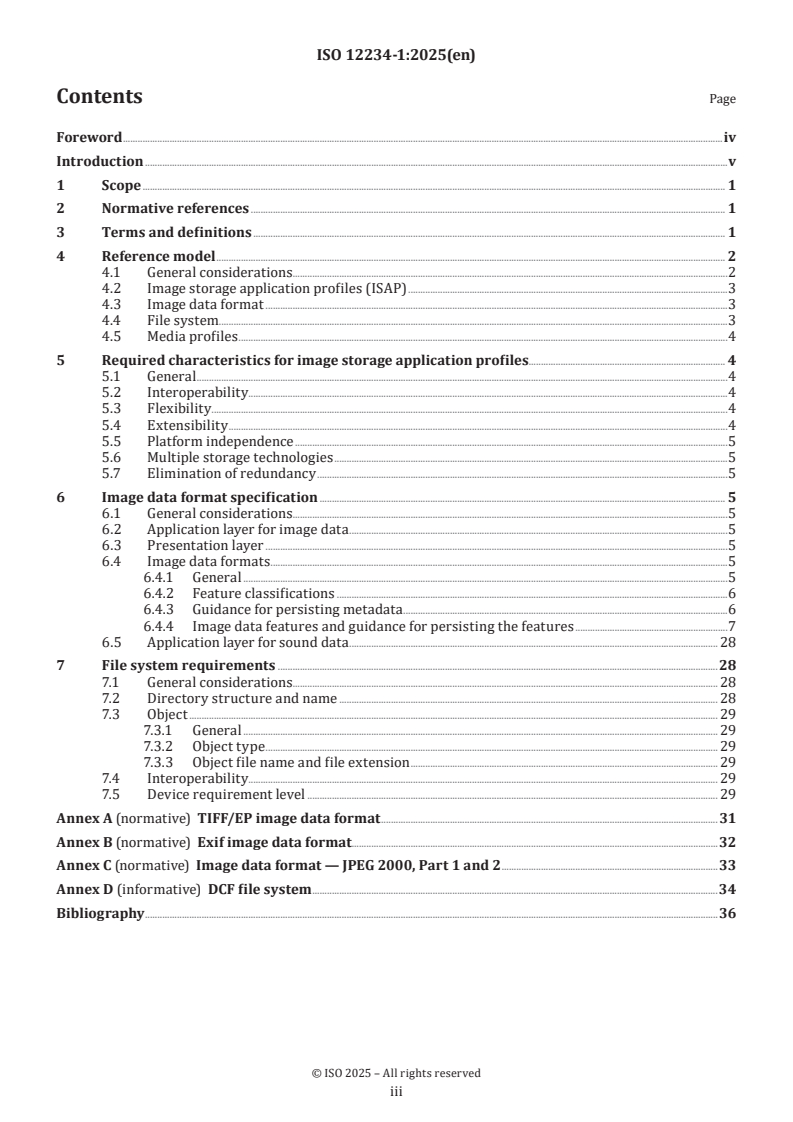
Contents Page
Foreword .iv
Introduction .v
1 Scope . 1
2 Normative references . 1
3 Terms and definitions . 1
4 Reference model . 2
4.1 General considerations.2
4.2 Image storage application profiles (ISAP) .3
4.3 Image data format .3
4.4 File system.3
4.5 Media profiles .4
5 Required characteristics for image storage application profiles. 4
5.1 General .4
5.2 Interoperability.4
5.3 Flexibility.4
5.4 Extensibility .4
5.5 Platform independence .5
5.6 Multiple storage technologies .5
5.7 Elimination of redundancy .5
6 Image data format specification . 5
6.1 General considerations.5
6.2 Application layer for image data .5
6.3 Presentation layer .5
6.4 Image data formats .5
6.4.1 General .5
6.4.2 Feature classifications .6
6.4.3 Guidance for persisting metadata .6
6.4.4 Image data features and guidance for persisting the features .7
6.5 Application layer for sound data . 28
7 File system requirements .28
7.1 General considerations. 28
7.2 Directory structure and name . 28
7.3 Object . 29
7.3.1 General . 29
7.3.2 Object type . 29
7.3.3 Object file name and file extension . 29
7.4 Interoperability. 29
7.5 Device requirement level . 29
Annex A (normative) TIFF/EP image data format .31
Annex B (normative) Exif image data format.32
Annex C (normative) Image data format — JPEG 2000, Part 1 and 2 .33
Annex D (informative) DCF file system .34
Bibliography .36
iii
Foreword
ISO (the International Organization for Standardization) is a worldwide federation of national standards
bodies (ISO member bodies). The work of preparing International Standards is normally carried out through
ISO technical committees. Each member body interested in a subject for which a technical committee
has been established has the right to be represented on that committee. International organizations,
governmental and non-governmental, in liaison with ISO, also take part in the work. ISO collaborates closely
with the International Electrotechnical Commission (IEC) on all matters of electrotechnical standardization.
The procedures used to develop this document and those intended for its further maintenance are described
in the ISO/IEC Directives, Part 1. In particular, the different approval criteria needed for the different types
of ISO document should be noted. This document was drafted in accordance with the editorial rules of the
ISO/IEC Directives, Part 2 (see www.iso.org/directives).
ISO draws attention to the possibility that the implementation of this document may involve the use of (a)
patent(s). ISO takes no position concerning the evidence, validity or applicability of any claimed patent
rights in respect thereof. As of the date of publication of this document, ISO had not received notice of (a)
patent(s) which may be required to implement this document. However, implementers are cautioned that
this may not represent the latest information, which may be obtained from the patent database available at
www.iso.org/patents. ISO shall not be held responsible for identifying any or all such patent rights.
Any trade name used in this document is information given for the convenience of users and does not
constitute an endorsement.
For an explanation of the voluntary nature of standards, the meaning of ISO specific terms and expressions
related to conformity assessment, as well as information about ISO's adherence to the World Trade
Organization (WTO) principles in the Technical Barriers to Trade (TBT), see www.iso.org/iso/foreword.html.
This document was prepared by Technical Committee ISO/TC 42, Photography.
This fourth edition cancels and replaces the third edition (ISO 12234-1:2012), which has been technically
revised.
The main changes are as follows:
— subclauses 6.4.2 and 6.4.3 replace subclause 6.6 in the previous edition;
— Table 2 of the previous edition has been divided into Tables 4, 5 and 6 according to the feature classifications
defined in Table 2 in 6.4.2, and each metadata item is given a post processing rank according to Table 3
in 6.4.3.
A list of all parts in the ISO 12234 series can be found on the ISO website.
Any feedback or questions on this document should be directed to the user’s national standards body. A
complete listing of these bodies can be found at www.iso.org/members.html.
iv
Introduction
This document addresses image storage requirements for digital photography systems, devices, and
components, including digital cameras. A digital photography system typically divides the imaging chain
into discrete components devoted to image acquisition, processing, storage, transmission and display. Since
the components can be made by different manufacturers, there is a need to specify a standard format for
image data interchange among the various components of the digital photography system.
The initial editions of ISO 12234-1 described image data interchange using only removable storage media,
such as removable memory cards, floppy disks, and removable hard drives. The removable storage media
was used to transport the digitized image data to other components in the imaging chain. However, many
current digital cameras, including the digital cameras incorporated into smartphones and tablet computers,
utilize internal non-volatile memory rather than removable memory. Therefore, the title and scope of this
document have been broadened to include devices and systems that utilize non-removable image storage
technologies.
This document specifies the required information content for storing images in digital photography
components, devices and systems. The information content includes both the image data and data items
describing the image. Annexes A, B and C describe various conforming formats. The data features supported
by each of these formats are also described in Clause 6. The information content further includes a
description of the file system which organizes the files containing digitized image data. Annex D describes a
conforming file system. The file system features are described in Clause 7.
An implementation is considered to be in conformity if, at a minimum, all mandatory elements are present.
Recommended features are not required, but will substantially enhance interoperability, performance and/
or robustness.
In developing the earlier editions of ISO 12234, as well as this document, a structured methodology has
been followed. A reference model describes the environment as well as the overall system architecture.
The architecture separates the software layers (termed the “image data format” and the “file system”)
from the hardware technology-dependent layer (termed the “media profile”). An image data format is
media independent and contains the image data, image-related data and a means for structuring these data
elements. A file system defines the data organization on the internal or removable storage media used, but it
is independent of the media.
With the permission of Adobe Systems Incorporated, numerous tag names and values used in this document
[5]
have been copied verbatim from the TIFF 6.0 specification dated June 3, 1992, specification copyright
1986-1988, 1992 Adobe Systems Incorporated.
v
International Standard ISO 12234-1:2025(en)
Digital imaging — Image storage —
Part 1:
Reference model
1 Scope
This document specifies a basic reference model for digital photography systems, including digital
cameras. The reference model includes image file formats for storing image data and metadata, file system
requirements for storing and retrieving the image files using internal or removable memory, and media
profiles which are specific to a given storage technology. The reference model allows the image data and
metadata to be interchanged among the various components of a digital photography system.
2 Normative references
The following documents are referred to in the text in such a way that some or all of their content constitutes
requirements of this document. For dated references, only the edition cited applies. For undated references,
the latest edition of the referenced document (including any amendments) applies.
ISO 12234-2, Electronic still-picture imaging — Removable memory — Part 2: TIFF/EP image data format
ISO/IEC 15444-1, Information technology — JPEG 2000 image coding system — Part 1: Core coding system
ISO/IEC 15444-2, Information technology — JPEG 2000 image coding system — Part 2: Extensions
3 Terms and definitions
For the purposes of this document, the following terms and definitions apply.
ISO and IEC maintain terminology databases for use in standardization at the following addresses:
— ISO Online browsing platform: available at https:// www .iso .org/ obp
— IEC Electropedia: available at https:// www .electropedia .org/
3.1
file system
software structure which specifies how the data is logically organized on a given internal or removable
storage media
3.2
image data format
structure and content which specify image data and the organization of the image related data in a device-
independent manner
3.3
image storage application profile
ISAP
media profile, the file system (3.1) and the image data format (3.2)
Note 1 to entry: The ISAP specifies all the information necessary to completely implement image storage.
3.4
media profile
portion of the memory module specification which is specific to a given memory technology
Note 1 to entry: For removable memory, the media profile includes the form factor, interconnection and access
protocol.
3.5
memory card
specific type of memory module using non-volatile solid-state memory and having a flat physical form factor
3.6
memory module
physical implementation of a removable memory, containing the image data format (3.2) combined with a
specified physical form factor, interconnect definition and access protocol
3.7
removable memory
image storage in a user-removable form factor, which is non-volatile, transportable, and used for the storage
of digital image data in digital cameras
3.8
sound compression
process of altering the sound data coding in order to reduce the size of a sound file
Note 1 to entry: See also sound recording (3.9).
3.9
sound data recording
recording of the sound data relative to an image acquired by the digital camera
Note 1 to entry: The sound data recording can be made before, during or after the time the image is acquired.
Note 2 to entry: A sound data recording attached to a digital still image is considered an annotation of the image, as
distinguished from a sound recording which is attached to and synchronized with a video recording.
4 Reference model
4.1 General considerations
Table 1 summarizes the reference model for this document. The reference model is a layered model. The
implementation of any one layer can be changed without affecting the implementation of any other layer.
The reference model describes the types of elements included in each layer. The physical layer is applicable
only to removable memory.
Table 1 — Reference model
Layer Intent Examples Implementation
Content-image data and pa-
Application Image data
rameters
Image data format
Define structure of image
Presentation data and encoding mecha- Tags
nism
Define data organization File system for image stor-
Session File system
on media age/retrieval
Communication of data
Transport Data transmission protocol
across a channel
Compatibility and interoper-
Network Conformance layer
ability with other systems
Card information structure
Assures reliable data storage
and retrieval
Error correction methods
Data link
Media profile
Storage media-specific re-
Control for insertion/remov-
cording information
al
Form factor, pin alignment,
size
Assure basic compatibili-
Physical ty in physical form factor Electrical interface specifi-
and electrical signals cation
Protocol/command sets
4.2 Image storage application profiles (ISAP)
The ISAP completely specifies all of the information necessary to implement a particular type of removable
storage. The image storage application profile consists of three parts:
— the image data format, which describes the structure and content of the image data;
— the file system, which describes how the image files are stored and retrieved;
— the media profile, which describes the media used to store the image files.
4.3 Image data format
The image data format consists of the application and presentation layers. The application layer defines the
content of the image data. The presentation layer defines the encoding of the image data. This document
specifies image data formats that are consistent across implementations and independent of the media used
for storage.
The content defined in the application layer includes the image and image-related information, called
metadata, such as the date the image was captured. The encoding defined in the presentation layer includes
the structures which define the image and the image-related information as digital values. For example, the
encoding describes whether the image is stored as strips or tiles, and whether the metadata are stored as
numbers or characters. The detailed elements in three allowed image data formats are described in Clause 6.
The image data formats described in this document provide an explicit binding between the content in the
application layer and the encoding method given in the presentation layer.
4.4 File system
The file system definition includes the information required for the session layer. It defines the data
organization on the storage media used.
4.5 Media profiles
Various types of digital storage may be used in digital cameras. These storage technologies include various
internal solid-state memory, removable solid-state memory cards, and magnetic hard drives. Each of these
memory types can be described by an appropriate media profile.
The media profile definition includes the information required for the transport, network, and data link
layers, and for removable memory, the physical layer as well.
The transport layer defines the protocol for how these data are transported between the digital camera and
the memory.
The network layer describes the conformance requirements needed to maintain compatibility and
interoperability with other systems.
The data link layer describes the mechanisms for assuring reliable communications, and the specifications
for reading, writing, erasing images, as well as removing and inserting specific types of media in the case of
removable memory.
The physical layer is applicable only to removable memory and ensures the basic compatibility of the
physical and electrical interface. It defines the physical form factor, connector specifications and electrical
interface specifications.
5 Required characteristics for image storage application profiles
5.1 General
The characteristics required for suitable image data formats and media profiles are specified in 5.2 to 5.7.
These criteria were used in the development of this document and will be used in developing its future
editions.
5.2 Interoperability
This document is intended to foster interoperability between systems manufactured by different vendors.
In the case of removable memory, this interoperability permits
a) storage of image data on a removable medium,
b) removal of that media from a digital camera,
c) insertion of that media into a second system, and
d) transfer of the image data to the second system.
5.3 Flexibility
This reference model permits flexibility across applications requiring different levels of feature sets. Some
image formats allow default values for specific data elements, to simplify the implementation.
5.4 Extensibility
This reference model allows for various extensions to provide the possibility of incorporating new features.
Some image data formats include the capability for private extensions to meet special needs. In future
revisions of this part of this document, new features may be added to the present image data formats. In
addition, new media profiles or image data formats may be included.
5.5 Platform independence
Because it is necessary to exchange data between different hardware platforms running under different
operating systems, this reference model is platform independent. In particular, the data and data structures
presented to the application are platform independent.
5.6 Multiple storage technologies
This reference model supports internal and removable storage media based on various storage technologies,
e.g. different types of solid state EEPROM memory cards as well as rotating magnetic disc storage, are
supported.
5.7 Elimination of redundancy
Information should appear once and only once within the image data format. This prevents conflicts if the
data are entered in two different places and happen to be inconsistent. If the same type of information
appears in multiple places, the data written needs to be consistent, e.g. by assigning equivalent values. This
applies both to explicitly entered data and to data implicitly derived from other fields.
6 Image data format specification
6.1 General considerations
The image data format corresponds to the application and presentation layers of the reference model and is
independent of the storage media used. The image data formats described in Annexes A, B and C are intended
to be used as image interchange formats for photographic images within the scope of the reference model.
It is recognized that images from sources other than digital cameras may use different image data formats.
6.2 Application layer for image data
The application layer defines what image data may be present in the information to be exchanged between
systems. The data defined here determines what information is available to a host system about the image,
the picture-taking conditions, the digital camera which captured the image and any annotations to help
describe the image for the user. Table 2 represents a list of image data features that should be included in an
image data format.
6.3 Presentation layer
The presentation layer defines what data may be present in the information to be exchanged between
systems. The data defined here describe the organization of data in the format, which is media independent.
6.4 Image data formats
6.4.1 General
It is recognized that different applications require different levels of support. Some applications are highly
standardized with many of the data elements assuming default values, while other applications require
more flexibility. To accommodate different applications, three different image formats, TIFF/EP, Exif and
JPEG 2000, are allowed. The image data formats differ in their required elements and degree of flexibility.
When used, the TIFF/EP image data format shall be implemented in accordance with ISO 12234-2 as
indicated in Annex A. When used, the Exif image format shall be implemented as described in Annex B. When
used, the JPEG 2000 image data format shall be implemented as described in Annex C and shall conform to
ISO/IEC 15444-1 and ISO/IEC 15444-2. The DCF file system is described in Annex D. Reference [9] describes
the development and structure of these image formats and this file system.
Following subclauses define image data features for above mentioned image data formats with the
definitions of feature classifications and post processing ranks of the features.
6.4.2 Feature classifications
Table 2 classifies the features into three categories according to the type of metadata they record. The
classification definitions are essentially identical to the definitions in Reference [7] which provides further
details.
Table 2 — Feature classifications
Classification Definition Description
A group of metadata indicating image
structure, such as image size (e.g.
Image structure related features
width, height). This information is
Category I (including image size, colour space
necessary during image display, and
information, and the like)
related metadata need to be updated
when image editing occurs.
A group of metadata that record
camera setting information during
image capture, such as the shutter
Shooting condition related features
Category II speed and lens aperture value. This is
(including image capture settings)
information related to image capture
and should not be updated or deleted
unless special circumstances exist.
A group of metadata other than those
in Category I and II, such as the cam-
Category III Features storing other information era model name, serial number, image
capture date and time, image capture
location, owner name, and copyrights.
6.4.3 Guidance for persisting metadata
The definitions of ranks for persisting the different types of metadata features listed in Tables 4, 5 and 6 are
given in Table 3 and the guideline for persisting each metadata item is also listed in Table 3.
Table 3 defines policy-based ranks for persisting the metadata items during post-processing. The ranks are
divided into
a) update (for features to be updated during image editing), and
b) freeze (for features that do not require updating or deletion).
These ranks are then further subdivided into Update 0 and Update 1 and Freeze 0, Freeze 1, and Freeze 2,
respectively, to accommodate cases in which modification or deletion is possible.
The definitions in Table 3 are essentially identical to the definitions in Reference [7], which provides further
details.
Table 3 — Post processing ranks
Rank Definition Description
Update
Metadata that shall be updated as necessary during
Update 0
Shall be updated when the image structure image post-processing (e.g. editing), such as metada-
is changed due to post-processing ta related to image structure and file structure and
(U0)
metadata related to colour space.
Can optionally be updated regardless of
Update 1
Metadata which can optionally be updated regardless
whether or not the image structure is
of whether or not the image structure is changed.
(U1)
changed
Freeze
Metadata that shall not be deleted or updated under
any circumstance. This includes features not associ-
Freeze 0
Shall not be deleted or updated at any time ated with sensitive information related to individuals,
(F0)
organizations, etc. (e.g. proof of image uniqueness,
etc.)
Special cases here refer to situations where an individ-
ual or organization or a time and location is identified
by metadata which could potentially cause danger or
Freeze 1 damage.
Can be deleted in special cases
(F1) In such cases, the related information can be deleted.
Examples of such cases include ensuring the safety
of combat photographers and protecting personal
privacy.
Metadata that can be corrected, added, or deleted
during post-processing if the original information is
Freeze 2 inaccurate or left blank. Examples include time and
Can be corrected [if wrong], added [if
location.
empty] or deleted [in special cases]
(F2)
Information that can be deleted under special circum-
stances.
6.4.4 Image data features and guidance for persisting the features
Tables 4, 5 and 6 summarize the image data features supported by the TIFF/EP, Exif and JPEG 2000 image data
formats. Each is supported by a specific file system. For each image data format, the support for the feature
can be mandatory, recommended, optional or not used. Further information concerning implementation of
each format is contained in Annexes A, B, and C.
Different requirements are imposed on writing, reading and editing devices by the image data format. The
writing device shall support all mandatory features but need not support features listed as recommended
or optional. The reading device shall support all mandatory features and should support optional or
recommended features at least to the extent of allowing the image to be interpreted without corrupting the
data. Therefore, a reader may ignore recommended or optional features if it is done in a safe manner. If an
editor ignores some features, the ignored features shall be passed along unchanged as part of the data file,
rather than truncating or eliminating them. This permits the previously ignored features to be interpreted
by a subsequent reader.
The features in Tables 4, 5 and 6 are classified into categories I, II and III using the definitions in Table 2
respectively. The post processing ranks defined in Table 3 are listed in Tables 4, 5 and 6 using the codes U0
for Update 0, U1 for Update 1, F0 for Freeze 0, F1 for Freeze 1, and F2 for Freeze 2 as guidance for persisting
metadata.
Table 4 — Category I image data feature descriptions and requirements, with field names and codes
JPEG 2000
a b
Exif TIFF/EP
c
Part 1 and 2
Item
Feature name Description Rank
Tag code, Tag code,
No.
JPEG 2000
d
applicability applicability
element, applicability
Category I
M
M M
Format descrip-
I-1 Format used U0
TIFF header JPEG
tion
TIFF header File Type box
marker
Meaning of first
M M
byte accessed,
I-2 Byte order U0 NU
i.e. whether
TIFF header TIFF header
MSB or LSB
d
NU/O
Control values
DCF -
Control used in relating
File number
I-3 U0 NU NU
parameters files to one
match
another
indicates same
DCF object
Pointer to
I-4 SubIFDs thumbnail U0 NU 330: NU
image
Location of Exif
Exif IFD 34665,
I-5 related meta- U0 NU NU
pointer Exif IFD Pointer
data
O O
GPS Info IFD Pointer to GPS
I-6 U0 NU
pointer information IFD
34853, GPSInfo 34853, GPSInfo
O
/IMAGE_CREATION
O
Location and
/CAMERA_-
O
41492,
Subject loca- area of the main
CAPTURE
I-7 U0
SubjectLocation 37396,
n
tion subject in the
/CAMERA_
37396, Subject- SubjectLocation
image
SETTINGS
Area
/SUBJECT_
POSITION
O
File names
Related of associated
40964,
I-8 U0 NU NU
soundfile image and audio
Related
files
SoundFile
Differentiate
d
O/M
NU
M
image (full
Primary image in
NOTE: JPEG 2000
resolution)
254,
I-9 Thumbnail U0 IFD0
provides a
and thumbnail
NewSubFile
multi-resolution
thumbnail in
image (reduced
Type
image representation
IFD1
resolution) data
Field number
O
I-10 Interlace scan of multi-field U0 NU NU
34857, Interlace
images
e
M M M
Number of pixel
I-11 Image width U0
256, 256, Specified in the
columns
ImageWidth ImageWidth Image Header box
e
M M M
Number of pixel
I-12 Image height U0
257, 257, Specified in the
rows
ImageLength ImageLength Image Header box
TTabablele 4 4 ((ccoonnttiinnueuedd))
JPEG 2000
a b
Exif TIFF/EP
c
Part 1 and 2
Item
Feature name Description Rank
Tag code, Tag code,
No.
JPEG 2000
d
applicability applicability
element, applicability
Category I
O
Ratio of XReso-
Aspect ratio
f f
I-13 lution to YReso- U0 M M
Elements used specified
(pixel)
f
lution
in the Resolution box.
Ratio of XRes-
O
olution/Image
Aspect ratio
Elements used specified
g g
I-14 Width to YRes- U0 M M
(image)
in the Resolution box
olution/Image
and Image Header box.
g
Length
h
M
Valid image
PixelX dimen-
40962,
I-15 width in the U0 NU NU
sion
PixelX
x-direction
Dimension
h
M
Valid image
PixelY dimen-
40963,
I-16 width in the U0 NU NU
sion
PixelY
y-direction
Dimension
Number of pix-
M M O
els per output
I-17 X resolution distance unit in U0
282, 282, Specified in the Resolu-
the ImageWidth
XResolution XResolution tion box
direction
Number of
pixels per
M M O
output distance
I-18 Y resolution U0
283, 283, Specified in the Resolu-
unit in the
YResolution YResolution tion box
ImageLength
direction
M M
Physical units
Resolution
I-19 for output dis- U0 NU
296, 296,
unit
tance data
ResolutionUnit ResolutionUnit
Electro-optical
O
Spatial spatial frequen-
/IMAGE_DATA_
frequency cy response of
I-20 U0 NU NU
CHARACTER
response (of the image, as
/-IMG_SPATIAL_
the image) defined in
FREQ_RESPONSE
[3]
ISO 12233
The relation-
ship between
Opto-
the focal plane
O
electronic
or input scene
conversion
/IMAGE_DATA_
I-21 luminances U0 NU NU
function
CHARACTER
and the digital
(OECF),
/-IMG_OECF
output levels, as
of the image
defined in
[4]
ISO 14524
TTabablele 4 4 ((ccoonnttiinnueuedd))
JPEG 2000
a b
Exif TIFF/EP
c
Part 1 and 2
Item
Feature name Description Rank
Tag code, Tag code,
No.
JPEG 2000
d
applicability applicability
element, applicability
Category I
Orientation
R
of the current
image relative
/IMAGE_CREATION
to the hori-
/CAMERA_
R O
I-22 Orientation zontal rows U0
CAPTURE
274, Orientation 274, Orientation
and vertical
/CAMERA_
columns of the
SETTINGS
originally cap-
/ORIENTATION
tured image
Number of com-
d
M M M
Samples ponents (sam-
I-23 U0
277, 277, Specified in the Image
per pixel ples) stored for
SamplesPerPixel SamplesPerPixel Header box
each pixel
M
Number of bits
Specified in the Image
d
M M
Bits used to store
Header box
I-24 U0
258, 258,
per sample each sample or
or Bits Per Sample box
BitsPerSample BitsPerSample
component
if it's not constant across
all components.
O
/IMAGE_CREATION
Setting of bit
/CAMERA_
Original
rate at the time
CAPTURE
I-25 compressed F1 NU NU
of capture com-
/CAMERA_
bits per pixel
pression
SETTINGS
/COMPRESSED_
BITS_PER_PIXEL
O
h
O
Setting of bit
/IMAGE_DATA_
h
O
Compressed rate at the time
37122, Com- CHARACTE-
I-26 U0
37122, Compressed
bits per pixel of last image
pressed RIZATION/IMG_
BitsPerPixel
compression
BitsPerPixel COMPRESSED_
BITS_PER_PIXEL
Type of image
h
M
compression
Only for thumb-
M
method (none,
i
I-27 Compression U0 Indicated in codestream
nail
JPEG, DPCM,
259, Compression
259,
etc.) applied to
Compression
the image data
h h
M M
JPEG
513, JPEG 513, JPEG
I-28 interchange U0 NU
Interchange Interchange
format
Format Format
h h
M M
JPEG
514, JPEG 514, JPEG
I-29 interchange U0 NU
Interchange Interchange
format length
FormatLength FormatLength
Tables to aid
in decoding
h
M O
JPEG tables
I-30 compressed U0 NU
(DQT, DHT)
JPEG Marker 347, JPEGTables
image data, e.g.
Huffman tables
TTabablele 4 4 ((ccoonnttiinnueuedd))
JPEG 2000
a b
Exif TIFF/EP
c
Part 1 and 2
Item
Feature name Description Rank
Tag code, Tag code,
No.
JPEG 2000
d
applicability applicability
element, applicability
Category I
Storage pattern
of the colour
e
M M
components in
Planar
j
I-31 U0 NU
284, Planar 284, Planar
the image data
configuration
Configuration Configuration
(Interleaving
pattern)
Offsets with
respect to the
e k
M M
j
I-32 Strip offsets beginning of the U0 NU
273, StripOffsets 273, StripOffsets
file to each strip
of image data
e
M
Number of rows
k
M
j
I-33 Rows per strip per strip within U0 NU
278, RowsPer-
278, RowsPerStrip
the image
Strip
Number of bytes
e k
M M
Strip byte in each strip
j
I-34 U0 NU
279, 279,
counts after compres-
StripByteCounts StripByteCounts
sion
Offsets with
respect to the
k
M
j
I-35 Tile offsets beginning of the U0 NU NU
324, TileOffsets
file to each tile
of image data
k
M
Number of
j
I-36 Tile width columns in each U0 NU NU
322,
image tile
TileWidth
Number of rows
k
M
j
I-37 Tile length in each image U0 NU NU
323, TileLength
tile
k
M
Number of bytes
Tile byte
j
I-38 in each image U0 NU NU
325,
counts
tile
TileByteCounts
e
M M
Image colour
Photo-metric
j
I-39 space type: RGB, U0 NU
262, Photometric 262, Photometric
interpretation
YCbCr, etc.
Interpretation Interpretation
M
Order of the 262, Photometric
h
M
image data col- Interpretation
Components
37121, Compo-
j
I-40 our components U0 NU
Note, Photometric
configuration
nents
for each pixel
Interpretation
Configuration
within an image
includes this
information.
Specified within the
codestream: CSsiz pa-
rameter of the SIZ mark-
i i
M M
Subsampling
er segment. The subsam-
YCbCr sub- factors for the
530, 530,
I-41 U0 pling might not be tied
sampling chrominance
YCbCr YCbCr
specifically to YCrCb,
components
SubSampling SubSampling
the use of component
transform is specified in
Ssiz^i parameter in SIZ.
TTabablele 4 4 ((ccoonnttiinnueuedd))
JPEG 2000
a b
Exif TIFF/EP
c
Part 1 and 2
Item
Feature name Description Rank
Tag code, Tag code,
No.
JPEG 2000
d
applicability applicability
element, applicability
Category I
Position of
i i
M M
subsampled Specified within the
YCbCr chrominance codestream: XRsiz^i and
531, 531,
I-42 U0
positioning components YRsiz^i parameters in
YCbCr YCbCr
relative to lumi- the SIZ marker segment
Positioning Positioning
nance samples
Minimum and
M
maximum code
when Photometric-
values used
O Interpretation = 6,
Reference
NU
to specify the
NU
I-43 black white U0
532, Reference-
encoding black
(*8)
(polarity)
BlackWhite otherwise
and white in the
532, Reference
image for each
BlackWhite
component
Exponents for
each colour
component, for
the case where
the transfer
j
Gamma O/M NU
I-44 function can U0 NU
(up to 3) 42240, Gamma (*8)
be represented
using a function
with only an
exponent (VAL-
UES)
Per-component
lookup tables
R
that relate
NU
Transfer func-
I-45 encoded values U0 NU
301, Transfer
tion
(*8)
to intended
Function
output relative
radiance
Encoding
m
O/M
NU
Primary RGB primary
I-46 U0 NU
319, Primary-
chromaticities chromaticities
(*8)
Chromaticities
(VALUES)
m
O/M
NU
White Encoding white
I-47 U0 NU
318, White
chromaticity chromaticity
(*8)
Chromaticity
The standard
M
NU
Colour encod- colour encoding
I-48 U0 NU
40961,
ing used to encode
(*8)
ColorSpace
the image data
M
when Photometric-
j
M
Coefficients of
Interpretation = 6,
NU
YCbCr colour space
529,
NU otherwise
I-49 U0
coefficients conversion from
YCbCr (*8)
529,
RGB to YCbCr
Coefficients
YCbCr
Coefficients
TTabablele 4 4 ((ccoonnttiinnueuedd))
JPEG 2000
a b
Exif TIFF/EP
c
Part 1 and 2
Item
Feature name Description Rank
Tag code, Tag code,
No.
JPEG 2000
d
applicability applicability
element, applicability
Category I
R
NU
34675,
I-50 ICC profile ICC profile U0 NU
InterColor (*8)
Profile
NOTE The status for a particular information field for the image data formats described in Annexes A, B, C and D may
fall into one of the following categories.
Mandatory (M): These features shall be present.
Recommended (R): These features are not required, but their implementation is strongly advised.
Optional (O): These features may be present but are not required. If not present, there are no defaults to be assumed.
Readers are required to respond gracefully to optional information fields. Writers are not required to implement
optional features.
(O/M): These features are optional for an Exif file, unless the Exif file is used with DCF as a DCF basic or optional file,
in which case these features are mandatory. See Annex D for details.
Not used (NU): These features are not applicable and are not present in the given profile.
a
See Annex B.
b
See Annex A.
c
See Ann
...