


ISO 5269-3:2008
(Main)Pulps — Preparation of laboratory sheets for physical testing — Part 3: Conventional and Rapid-Köthen sheet formers using a closed water system
Pulps — Preparation of laboratory sheets for physical testing — Part 3: Conventional and Rapid-Köthen sheet formers using a closed water system
ISO 5269-3:2008 specifies two procedures for preparing a closed water system which is in retention equilibrium, to be used for the preparation of laboratory sheets from pulps with a high fines content. One procedure is applicable to the preparation of laboratory sheets using the conventional sheet former and the other using the Rapid-K'then sheet former. The sheets prepared prior to attaining retention equilibrium are discarded. ISO 5269-3:2008 is especially applicable to mechanical and chemimechanical pulps, as well as to pulps prepared from recycled fibres, i.e. pulps with a high fines content for which retention of fines is poor when using the open water system as described in ISO 5269-1 or ISO 5269-2. ISO 5269-3:2008 is not applicable to some very long-fibred pulps, such as those from unshortened cotton, flax and similar materials. After retention equilibrium is attained, the preparation of laboratory sheets for testing the physical properties follows the procedures described in ISO 5269-1 (conventional sheet former) or ISO 5269-2 (Rapid-K'then sheet former), whichever is relevant. ISO 5269-3:2008 is generally not applicable for the preparation of laboratory sheets from chemical pulps for which ISO 5269-1 or ISO 5269-2 are used. ISO 5269-3:2008 is not applicable for the preparation of laboratory sheets for measuring ISO brightness. These sheets can be prepared in accordance with ISO 3688.
Pâtes — Préparation des feuilles de laboratoire pour essais physiques — Partie 3: Formettes conventionnelle et Rapid-Köthen, à circuit d'eau fermé
L'ISO 5269:2008 spécifie deux modes opératoires pour la préparation d'un circuit d'eau fermé en équilibre de rétention, à utiliser pour la préparation de feuilles de laboratoire à partir de pâtes à haute teneur en fines. L'un des modes opératoires est applicable à la préparation de feuilles de laboratoire à l'aide de la formette conventionnelle tandis que l'autre utilise la formette Rapid-Köthen. Les feuilles préparées avant l'obtention de l'équilibre de rétention sont mises au rebut. L'ISO 5269:2008 s'applique, en particulier, aux pâtes mécaniques et aux pâtes chimicomécaniques, ainsi qu'aux pâtes préparées à partir de fibres recyclées, c'est-à-dire les pâtes à haute teneur en fines pour lesquelles la rétention des fines est faible lorsque l'on utilise le circuit d'eau ouvert décrit dans l'ISO 5269‑1 ou l'ISO 5269‑2. L'ISO 5269:2008 n'est pas applicable à certaines pâtes à fibres très longues telles que celles de coton, lin ou matières similaires, non raccourcies. Après obtention de l'équilibre de rétention, la préparation des feuilles de laboratoire pour le contrôle des propriétés physiques s'effectue conformément aux modes opératoires décrits dans l'ISO 5269‑1 (formette conventionnelle) ou dans l'ISO 5269‑2 (formette Rapid-Köthen), suivant le cas. L'ISO 5269:2008 n'est généralement pas applicable à la préparation de feuilles de laboratoire à partir de pâtes chimiques car celles-ci relèvent de l'ISO 5269‑1 ou de l'ISO 5269‑2. L'ISO 5269:2008 n'est pas applicable à la préparation de feuilles de laboratoire pour le mesurage du degré de blancheur ISO. Ces feuilles peuvent être préparées conformément à l'ISO 3688.
General Information
- Status
- Published
- Publication Date
- 14-May-2008
- Technical Committee
- ISO/TC 6 - Paper, board and pulps
- Drafting Committee
- ISO/TC 6 - Paper, board and pulps
- Current Stage
- 9093 - International Standard confirmed
- Start Date
- 19-Jul-2022
- Completion Date
- 14-Feb-2026
Relations
- Referred By
EN ISO 5270:2012 - Pulps - Laboratory sheets - Determination of physical properties (ISO 5270:2012) - Effective Date
- 09-Feb-2026
Overview
ISO 5269-3:2008, titled Pulps - Preparation of laboratory sheets for physical testing - Part 3: Conventional and Rapid-Köthen sheet formers using a closed water system, is an international standard developed by ISO. It specifies two procedures for preparing laboratory sheets from pulps with a high fines content using a closed water system in retention equilibrium. This standard addresses a critical need for reliable laboratory sheet preparation methods, especially for pulps where retention of fines is poor with open water systems. It applies primarily to mechanical, chemimechanical, and recycled fiber pulps, which contain a high levels of fines. The standard ensures reproducible conditions and improved accuracy for physical testing of such pulps.
Key Topics
Closed Water System Preparation
ISO 5269-3 outlines two separate procedures to establish a closed water circuit with retention equilibrium to prevent the loss of fines during laboratory sheet formation. This closed system minimizes fines loss compared to open water systems described in ISO 5269-1 and ISO 5269-2.Applicable Sheet Formers
The standard provides specific methods for:- Conventional sheet former: Involving a water circulation system beneath and above the forming wire.
- Rapid-Köthen sheet former: Using a reservoir with circulating water pumped above the wire for sheet formation.
Retention Equilibrium
Sheets prepared prior to achieving retention equilibrium are discarded. The process involves producing successive sheets until the dry mass of sheets stabilizes, indicating equilibrium of fines retention has been reached in the closed water system.Pulps Covered
Focus is on pulps with high fines content such as:- Mechanical and chemimechanical pulps
- Pulps from recycled fibers
It is not intended for some very long-fibred pulps (e.g., unshortened cotton, flax) or primarily chemical pulps, which follow ISO 5269-1 or ISO 5269-2.
Preparation Process
After establishing equilibrium, laboratory sheets for physical testing are prepared following the relevant procedures in ISO 5269-1 (conventional) or ISO 5269-2 (Rapid-Köthen).Exclusions
The method is not applicable for preparing laboratory sheets to measure ISO brightness, for which ISO 3688 applies.
Applications
Physical Testing of Pulps
Facilitates consistent preparation of laboratory sheets that accurately reflect the physical properties of pulps with high fines content. This is crucial for evaluating pulp quality, performance, and suitability for paper production.Pulp and Paper Industry Research and Quality Control
Useful for research labs and manufacturing quality control to monitor and optimize pulp characteristics, especially when using recycled fibers or mechanical pulps where fines retention is a concern.Standardized Testing Environments
Supports reproducibility in comparative studies and regulatory compliance by standardizing sheet formation techniques, water circulation, and conditioning prior to physical testing.Analytical Procedures
Ensures that sheets prepared under controlled closed water circulation systems are representative, enhancing reliability of test data (e.g., strength, bonding, porosity).
Related Standards
ISO 5269-1:2005
Methods for preparation of laboratory sheets using the conventional sheet former with an open water system.ISO 5269-2:2004
Methods for preparation of laboratory sheets using the Rapid-Köthen sheet former with an open water system.ISO 5263 Series
Related to wet disintegration of different pulp types prior to sheet preparation:- ISO 5263-1 (chemical pulps)
- ISO 5263-2 and ISO 5263-3 (mechanical pulps)
ISO 3688
Specifies preparation of sheets for measuring ISO brightness, not covered by ISO 5269-3.ISO 187
Conditioning of laboratory sheets prior to physical testing.ISO 5270
Guidelines for physical testing of sheets prepared by these methods.
Practical Benefits
Enhanced Accuracy for High-Fines Pulps
Closed water systems minimize fines loss, providing sheets that better represent actual pulp composition for reliable test results.Adaptability to Different Sheet Formers
Clear procedures for both conventional and Rapid-Köthen equipment maximize utility across various laboratory setups.Improved Quality Control
Enables standardized preparation that supports consistent monitoring of pulp performance, aiding industry decisions on pulp processing and product development.Supports Sustainable Practices
By addressing pulps from recycled fibers, the standard promotes sustainable paper production practices with accurate assessment methods.
ISO 5269-3:2008 remains a key international standard for the pulp and paper industry, guiding laboratory practices to prepare representative sheets that reliably reflect the physical properties of high-fines pulps using closed water systems with conventional and Rapid-Köthen sheet formers.
Buy Documents
ISO 5269-3:2008 - Pulps -- Preparation of laboratory sheets for physical testing
ISO 5269-3:2008 - Pâtes -- Préparation des feuilles de laboratoire pour essais physiques
Get Certified
Connect with accredited certification bodies for this standard

Control Union Certifications
Global certification for agriculture and sustainability.

Gozdarski inštitut Slovenije
Slovenian Forestry Institute. Forest management certification support, timber testing.
Sponsored listings
Frequently Asked Questions
ISO 5269-3:2008 is a standard published by the International Organization for Standardization (ISO). Its full title is "Pulps — Preparation of laboratory sheets for physical testing — Part 3: Conventional and Rapid-Köthen sheet formers using a closed water system". This standard covers: ISO 5269-3:2008 specifies two procedures for preparing a closed water system which is in retention equilibrium, to be used for the preparation of laboratory sheets from pulps with a high fines content. One procedure is applicable to the preparation of laboratory sheets using the conventional sheet former and the other using the Rapid-K'then sheet former. The sheets prepared prior to attaining retention equilibrium are discarded. ISO 5269-3:2008 is especially applicable to mechanical and chemimechanical pulps, as well as to pulps prepared from recycled fibres, i.e. pulps with a high fines content for which retention of fines is poor when using the open water system as described in ISO 5269-1 or ISO 5269-2. ISO 5269-3:2008 is not applicable to some very long-fibred pulps, such as those from unshortened cotton, flax and similar materials. After retention equilibrium is attained, the preparation of laboratory sheets for testing the physical properties follows the procedures described in ISO 5269-1 (conventional sheet former) or ISO 5269-2 (Rapid-K'then sheet former), whichever is relevant. ISO 5269-3:2008 is generally not applicable for the preparation of laboratory sheets from chemical pulps for which ISO 5269-1 or ISO 5269-2 are used. ISO 5269-3:2008 is not applicable for the preparation of laboratory sheets for measuring ISO brightness. These sheets can be prepared in accordance with ISO 3688.
ISO 5269-3:2008 specifies two procedures for preparing a closed water system which is in retention equilibrium, to be used for the preparation of laboratory sheets from pulps with a high fines content. One procedure is applicable to the preparation of laboratory sheets using the conventional sheet former and the other using the Rapid-K'then sheet former. The sheets prepared prior to attaining retention equilibrium are discarded. ISO 5269-3:2008 is especially applicable to mechanical and chemimechanical pulps, as well as to pulps prepared from recycled fibres, i.e. pulps with a high fines content for which retention of fines is poor when using the open water system as described in ISO 5269-1 or ISO 5269-2. ISO 5269-3:2008 is not applicable to some very long-fibred pulps, such as those from unshortened cotton, flax and similar materials. After retention equilibrium is attained, the preparation of laboratory sheets for testing the physical properties follows the procedures described in ISO 5269-1 (conventional sheet former) or ISO 5269-2 (Rapid-K'then sheet former), whichever is relevant. ISO 5269-3:2008 is generally not applicable for the preparation of laboratory sheets from chemical pulps for which ISO 5269-1 or ISO 5269-2 are used. ISO 5269-3:2008 is not applicable for the preparation of laboratory sheets for measuring ISO brightness. These sheets can be prepared in accordance with ISO 3688.
ISO 5269-3:2008 is classified under the following ICS (International Classification for Standards) categories: 85.040 - Pulps. The ICS classification helps identify the subject area and facilitates finding related standards.
ISO 5269-3:2008 has the following relationships with other standards: It is inter standard links to EN ISO 5270:2012. Understanding these relationships helps ensure you are using the most current and applicable version of the standard.
ISO 5269-3:2008 is available in PDF format for immediate download after purchase. The document can be added to your cart and obtained through the secure checkout process. Digital delivery ensures instant access to the complete standard document.
Standards Content (Sample)
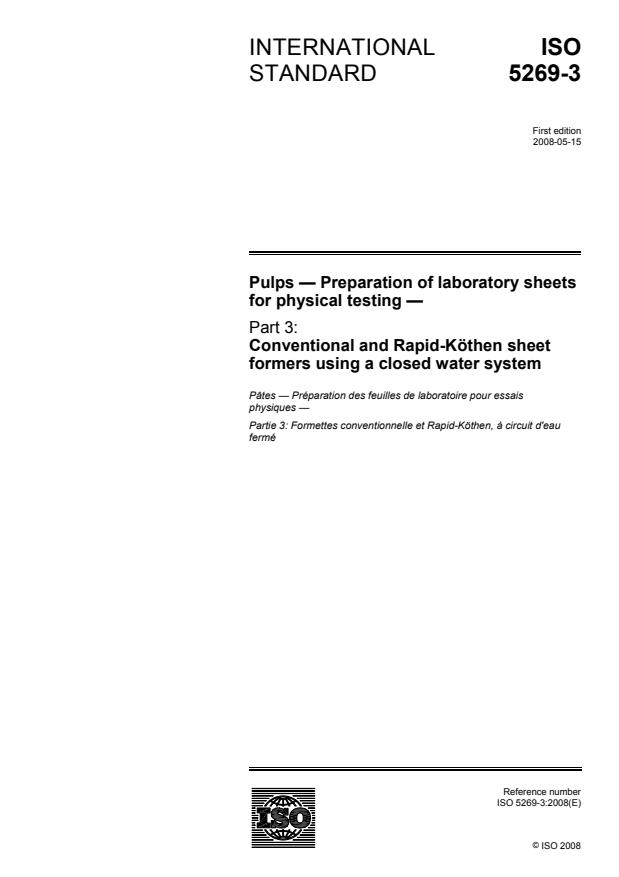
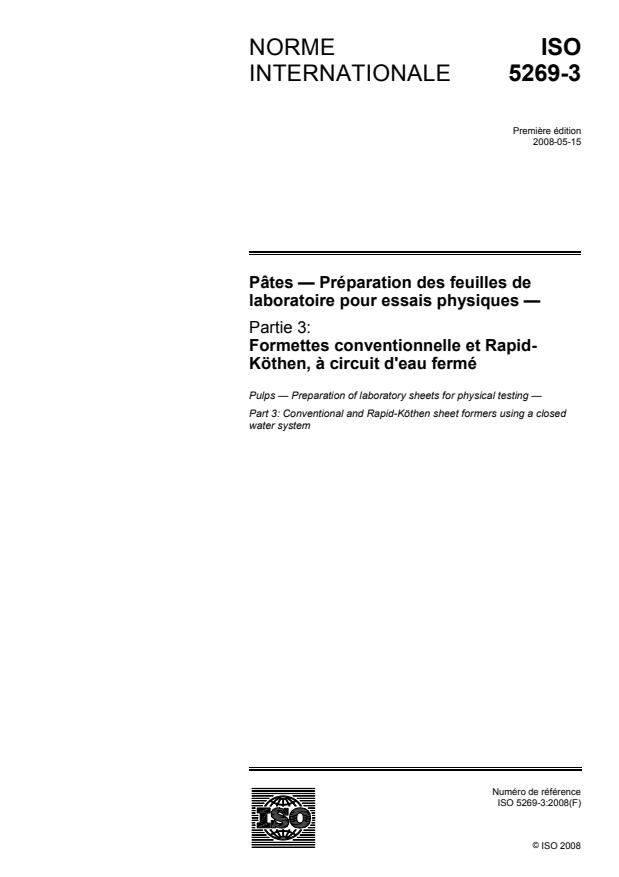
INTERNATIONAL ISO
STANDARD 5269-3
First edition
2008-05-15
Pulps — Preparation of laboratory sheets
for physical testing —
Part 3:
Conventional and Rapid-Köthen sheet
formers using a closed water system
Pâtes — Préparation des feuilles de laboratoire pour essais
physiques —
Partie 3: Formettes conventionnelle et Rapid-Köthen, à circuit d'eau
fermé
Reference number
©
ISO 2008
PDF disclaimer
This PDF file may contain embedded typefaces. In accordance with Adobe's licensing policy, this file may be printed or viewed but
shall not be edited unless the typefaces which are embedded are licensed to and installed on the computer performing the editing. In
downloading this file, parties accept therein the responsibility of not infringing Adobe's licensing policy. The ISO Central Secretariat
accepts no liability in this area.
Adobe is a trademark of Adobe Systems Incorporated.
Details of the software products used to create this PDF file can be found in the General Info relative to the file; the PDF-creation
parameters were optimized for printing. Every care has been taken to ensure that the file is suitable for use by ISO member bodies. In
the unlikely event that a problem relating to it is found, please inform the Central Secretariat at the address given below.
© ISO 2008
All rights reserved. Unless otherwise specified, no part of this publication may be reproduced or utilized in any form or by any means,
electronic or mechanical, including photocopying and microfilm, without permission in writing from either ISO at the address below or
ISO's member body in the country of the requester.
ISO copyright office
Case postale 56 • CH-1211 Geneva 20
Tel. + 41 22 749 01 11
Fax + 41 22 749 09 47
E-mail copyright@iso.org
Web www.iso.org
Published in Switzerland
ii © ISO 2008 – All rights reserved
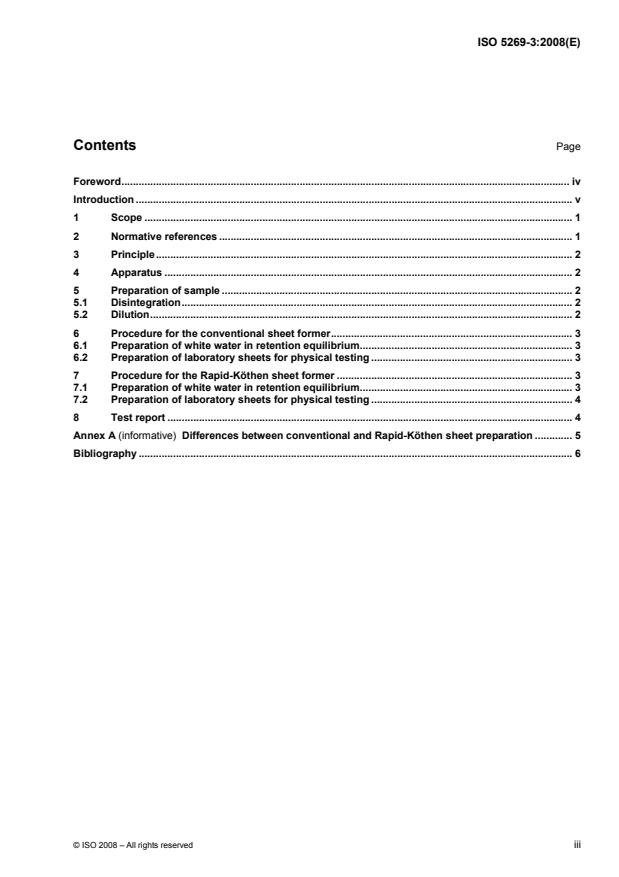
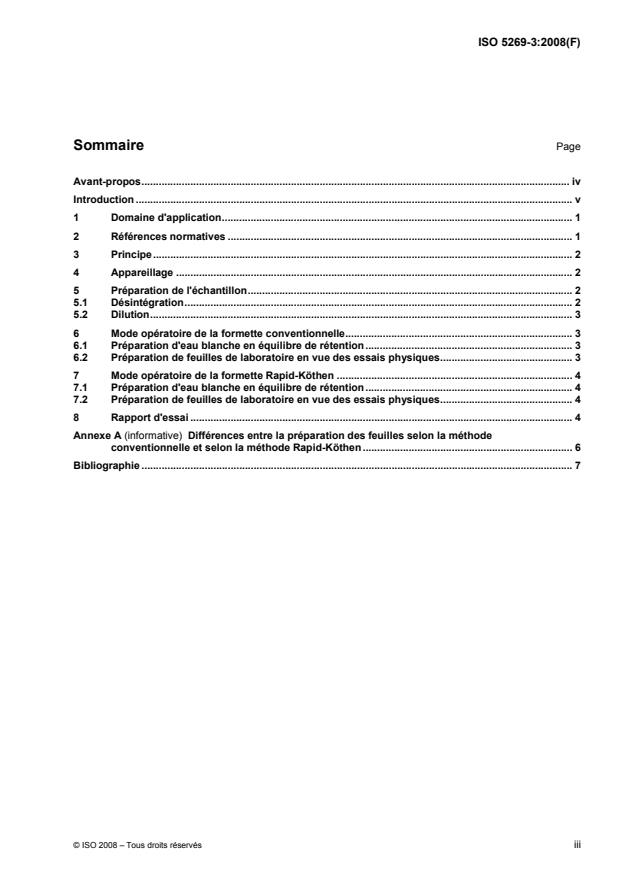
Contents Page
Foreword. iv
Introduction . v
1 Scope. 1
2 Normative references. 1
3 Principle. 2
4 Apparatus. 2
5 Preparation of sample . 2
5.1 Disintegration. 2
5.2 Dilution. 2
6 Procedure for the conventional sheet former. 3
6.1 Preparation of white water in retention equilibrium. 3
6.2 Preparation of laboratory sheets for physical testing . 3
7 Procedure for the Rapid-Köthen sheet former . 3
7.1 Preparation of white water in retention equilibrium. 3
7.2 Preparation of laboratory sheets for physical testing . 4
8 Test report. 4
Annex A (informative) Differences between conventional and Rapid-Köthen sheet preparation . 5
Bibliography . 6
Foreword
ISO (the International Organization for Standardization) is a worldwide federation of national standards bodies
(ISO member bodies). The work of preparing International Standards is normally carried out through ISO
technical committees. Each member body interested in a subject for which a technical committee has been
established has the right to be represented on that committee. International organizations, governmental and
non-governmental, in liaison with ISO, also take part in the work. ISO collaborates closely with the
International Electrotechnical Commission (IEC) on all matters of electrotechnical standardization.
International Standards are drafted in accordance with the rules given in the ISO/IEC Directives, Part 2.
The main task of technical committees is to prepare International Standards. Draft International Standards
adopted by the technical committees are circulated to the member bodies for voting. Publication as an
International Standard requires approval by at least 75 % of the member bodies casting a vote.
Attention is drawn to the possibility that some of the elements of this document may be the subject of patent
rights. ISO shall not be held responsible for identifying any or all such patent rights.
ISO 5269-3 was prepared by Technical Committee ISO/TC 6, Paper, board and pulps, Subcommittee SC 5,
Test methods and quality specifications for pulps.
ISO 5269 consists of the following parts, under the general title Pulps — Preparation of laboratory sheets for
physical testing:
⎯ Part 1: Conventional sheet-former method
⎯ Part 2: Rapid-Köthen method
⎯ Part 3: Conventional and Rapid-Köthen sheet formers using a closed water system
iv © ISO 2008 – All rights reserved
Introduction
This part of ISO 5269 specifies two procedures for the preparation of laboratory sheets using a closed water
system; one based on the conventional sheet former and the other on the Rapid-Köthen sheet former. Since
the two procedures are based on different principles for forming and drying of the sheets, the results from
testing of laboratory sheets prepared using the conventional sheet former and the Rapid-Köthen sheet former
will not give the same results, see Annex A. For this reason, the sheet former used shall be reported.
The purpose of the preparation of laboratory sheets is to carry out subsequent physical tests on these, in
order to assess the relevant properties of the pulp itself.
This part of ISO 5269 is intended for use when preparing laboratory sheets from pulps with a high fines
content, such as mechanical and chemimechanical pulps, as well as for pulps prepared from recycled fibres,
for which ISO 5269-1 and ISO 5269-2, using an open water system, in general cannot be used to prepare
[5]
representative sheets (see in the Bibliography).
INTERNATIONAL STANDARD ISO 5269-3:2008(E)
Pulps — Preparation of laboratory sheets for physical testing —
Part 3:
Conventional and Rapid-Köthen sheet formers using a closed
water system
1 Scope
This part of ISO 5269 specifies two procedures for preparing a closed water system which is in retention
equilibrium, to be used for the preparation of laboratory sheets from pulps with a high fines content. One
procedure is applicable to the preparation of laboratory sheets using the conventional sheet former and the
other using the Rapid-Köthen sheet former. The sheets prepared prior to attaining retention equilibrium are
discarded.
This part of ISO 5269 is especially applicable to mechanical and chemimechanical pulps, as well as to pulps
prepared from recycled fibres, i.e. pulps with a high fines content for which retention of fines is poor when
using the open water system as described in ISO 5269-1 or ISO 5269-2. This part of ISO 5269 is not
applicable to some very long-fibred pulps, such as those from unshortened cotton, flax and similar materials.
After retention equilibrium is attained, the preparation of laboratory sheets for testing the physical properties
follows the procedures described in ISO 5269-1 (conventional sheet former) or ISO 5269-2 (Rapid-Köthen
sheet former), whichever is relevant.
This part of ISO 5269 is generally not applicable for the preparation of laboratory sheets from chemical pulps
for which ISO 5269-1 or ISO 5269-2 are used.
This part of ISO 5269 is not applicable for the preparation of laboratory sheets for measuring ISO brightness.
[3]
These sheets can be prepared in accordance with ISO 3688 .
NOTE The procedures for forming, pressing and drying are different when using the conventional sheet former and
Rapid-Köthen sheet former, see Annex A.
2 Normative references
The following referenced documents are indispensable for the application of this document. For dated
references, only the edition cited applies. For undated references, the latest edition of the referenced
document (including any amendments) applies.
ISO 5263-1, Pulps — Laboratory wet disintegration — Part 1: Disintegration of chemical pulps
ISO 5263-2, Pulps — Laboratory wet disintegration — Part 2: Disintegration of mechanical pulps at 20 °C
ISO 5263-3, Pulps — Laboratory wet disintegration — Part 3: Disintegration of mechanical pulps at W 85 °C
ISO 5269-1:2005, Pulps — Preparation of laboratory sheets for physical testing — Part 1: Conventional sheet-
former method
ISO 5269-2:2004, Pulps — Preparation of laboratory sheets for physical testing — Part 2: Rapid-Köthen
method
3 Principle
White water at retention equilibrium is produced by preparing laboratory sheets of defined grammage using a
closed water system.
This white water is then used to prepare the sheets which will be used for physical testing, in either the
conventional sheet former or the Rapid-Köthen sheet former.
NOTE The physical properties of sheets made in accordance with this International Standard using a closed water
system in retention equilibrium will differ, in general, from the properties of sheets made in accordance with ISO 5269-1 or
ISO 5269-2 using an open water system.
4 Apparatus
Use either a conventional sheet former or a Rapid-Köthen sheet former.
4.1 Conventional sheet former.
All the items described in 4.1 to 4.10 in ISO 5269-1:2005, and the following.
4.1.1 Circulating water system for the conventional sheet former, consisting of a reservoir placed
under the drainage vessel to collect the circulating water and a pumping system which allows the sheet former
to be filled from below the wire and als
...
NORME ISO
INTERNATIONALE 5269-3
Première édition
2008-05-15
Pâtes — Préparation des feuilles de
laboratoire pour essais physiques —
Partie 3:
Formettes conventionnelle et Rapid-
Köthen, à circuit d'eau fermé
Pulps — Preparation of laboratory sheets for physical testing —
Part 3: Conventional and Rapid-Köthen sheet formers using a closed
water system
Numéro de référence
©
ISO 2008
PDF – Exonération de responsabilité
Le présent fichier PDF peut contenir des polices de caractères intégrées. Conformément aux conditions de licence d'Adobe, ce fichier
peut être imprimé ou visualisé, mais ne doit pas être modifié à moins que l'ordinateur employé à cet effet ne bénéficie d'une licence
autorisant l'utilisation de ces polices et que celles-ci y soient installées. Lors du téléchargement de ce fichier, les parties concernées
acceptent de fait la responsabilité de ne pas enfreindre les conditions de licence d'Adobe. Le Secrétariat central de l'ISO décline toute
responsabilité en la matière.
Adobe est une marque déposée d'Adobe Systems Incorporated.
Les détails relatifs aux produits logiciels utilisés pour la création du présent fichier PDF sont disponibles dans la rubrique General Info
du fichier; les paramètres de création PDF ont été optimisés pour l'impression. Toutes les mesures ont été prises pour garantir
l'exploitation de ce fichier par les comités membres de l'ISO. Dans le cas peu probable où surviendrait un problème d'utilisation,
veuillez en informer le Secrétariat central à l'adresse donnée ci-dessous.
DOCUMENT PROTÉGÉ PAR COPYRIGHT
© ISO 2008
Droits de reproduction réservés. Sauf prescription différente, aucune partie de cette publication ne peut être reproduite ni utilisée sous
quelque forme que ce soit et par aucun procédé, électronique ou mécanique, y compris la photocopie et les microfilms, sans l'accord écrit
de l'ISO à l'adresse ci-après ou du comité membre de l'ISO dans le pays du demandeur.
ISO copyright office
Case postale 56 • CH-1211 Geneva 20
Tel. + 41 22 749 01 11
Fax. + 41 22 749 09 47
E-mail copyright@iso.org
Web www.iso.org
Publié en Suisse
ii © ISO 2008 – Tous droits réservés
Sommaire Page
Avant-propos. iv
Introduction . v
1 Domaine d'application. 1
2 Références normatives. 1
3 Principe. 2
4 Appareillage. 2
5 Préparation de l'échantillon. 2
5.1 Désintégration. 2
5.2 Dilution. 3
6 Mode opératoire de la formette conventionnelle. 3
6.1 Préparation d'eau blanche en équilibre de rétention. 3
6.2 Préparation de feuilles de laboratoire en vue des essais physiques. 3
7 Mode opératoire de la formette Rapid-Köthen . 4
7.1 Préparation d'eau blanche en équilibre de rétention. 4
7.2 Préparation de feuilles de laboratoire en vue des essais physiques. 4
8 Rapport d'essai . 4
Annexe A (informative) Différences entre la préparation des feuilles selon la méthode
conventionnelle et selon la méthode Rapid-Köthen. 6
Bibliographie . 7
Avant-propos
L'ISO (Organisation internationale de normalisation) est une fédération mondiale d'organismes nationaux de
normalisation (comités membres de l'ISO). L'élaboration des Normes internationales est en général confiée
aux comités techniques de l'ISO. Chaque comité membre intéressé par une étude a le droit de faire partie du
comité technique créé à cet effet. Les organisations internationales, gouvernementales et non
gouvernementales, en liaison avec l'ISO participent également aux travaux. L'ISO collabore étroitement avec
la Commission électrotechnique internationale (CEI) en ce qui concerne la normalisation électrotechnique.
Les Normes internationales sont rédigées conformément aux règles données dans les Directives ISO/CEI,
Partie 2.
La tâche principale des comités techniques est d'élaborer les Normes internationales. Les projets de Normes
internationales adoptés par les comités techniques sont soumis aux comités membres pour vote. Leur
publication comme Normes internationales requiert l'approbation de 75 % au moins des comités membres
votants.
L'attention est appelée sur le fait que certains des éléments du présent document peuvent faire l'objet de
droits de propriété intellectuelle ou de droits analogues. L'ISO ne saurait être tenue pour responsable de ne
pas avoir identifié de tels droits de propriété et averti de leur existence.
L'ISO 5269-3 a été élaborée par le comité technique ISO/TC 6, Papiers, cartons et pâtes, sous-comité SC 5,
Méthodes d'essai et spécifications de qualité des pâtes.
L'ISO 5269 comprend les parties suivantes, présentées sous le titre général Pâtes — Préparation des feuilles
de laboratoire pour essais physiques:
⎯ Partie 1: Méthode de la formette conventionnelle
⎯ Partie 2: Méthode Rapid-Köthen
⎯ Partie 3: Formettes conventionnelle et Rapid-Köthen, à circuit d'eau fermé
iv © ISO 2008 – Tous droits réservés
Introduction
La présente partie de l'ISO 5269 spécifie deux modes opératoires de préparation de feuilles de laboratoire
utilisant un circuit d'eau fermé, l'une reposant sur la formette conventionnelle et l'autre sur la formette Rapid-
Köthen. Étant donné que ces deux modes opératoires sont fondés sur des principes différents de formation et
de séchage des feuilles, les résultats obtenus lors des essais conduits sur les feuilles de laboratoire
préparées à l'aide de ces deux systèmes ne seront pas identiques, voir l'Annexe A. Par conséquent, il est
nécessaire de consigner le type de formette utilisé.
Des feuilles de laboratoire sont préparées en vue d'être soumises ultérieurement à des essais physiques
dans le but d'évaluer les principales propriétés de la pâte elle-même.
La présente partie de l'ISO 5269 est destinée à être utilisée lors de la préparation de feuilles de laboratoire à
partir de pâtes à haute teneur en fines, comme les pâtes mécaniques et les pâtes chimicomécaniques, ou
ayant été préparées à partir de fibres recyclées pour lesquelles l'ISO 5269-1 et l'ISO 5269-2 qui utilisent un
circuit d'eau ouvert, ne permettent pas en général de préparer des feuilles représentatives (voir la
Référence [5]).
NORME INTERNATIONALE ISO 5269-3:2008(F)
Pâtes — Préparation des feuilles de laboratoire pour essais
physiques —
Partie 3:
Formettes conventionnelle et Rapid-Köthen, à circuit d'eau
fermé
1 Domaine d'application
La présente partie de l'ISO 5269 spécifie deux modes opératoires pour la préparation d'un circuit d'eau fermé
en équilibre de rétention, à utiliser pour la préparation de feuilles de laboratoire à partir de pâtes à haute
teneur en fines. L'un des modes opératoires est applicable à la préparation de feuilles de laboratoire à l'aide
de la formette conventionnelle tandis que l'autre utilise la formette Rapid-Köthen. Les feuilles préparées avant
l'obtention de l'équilibre de rétention sont mises au rebut.
La présente partie de l'ISO 5269 s'applique, en particulier, aux pâtes mécaniques et aux pâtes
chimicomécaniques, ainsi qu'aux pâtes préparées à partir de fibres recyclées, c'est-à-dire les pâtes à haute
teneur en fines pour lesquelles la rétention des fines est faible lorsque l'on utilise le circuit d'eau ouvert décrit
dans l'ISO 5269-1 ou dans l'ISO 5269-2. La présente partie de l'ISO 5269 n'est pas applicable à certaines
pâtes à fibres très longues telles que celles de coton, lin ou matières similaires, non raccourcies.
Après obtention de l'équilibre de rétention, la préparation des feuilles de laboratoire pour le contrôle des
propriétés physiques s'effectue conformément aux modes opératoires décrits dans l'ISO 5269-1 (formette
conventionnelle) ou dans l'ISO 5269-2 (formette Rapid-Köthen), suivant le cas.
La présente partie de l'ISO 5269 n'est généralement pas applicable à la préparation de feuilles de laboratoire
à partir de pâtes chimiques car celles-ci relèvent de l'ISO 5269-1 ou de l'ISO 5269-2.
La présente partie de l'ISO 5269 n'est pas applicable à la préparation de feuilles de laboratoire pour le
[3]
mesurage du degré de blancheur ISO. Ces feuilles peuvent être préparées conformément à l'ISO 3688 .
NOTE Les modes opératoires de formation, pressage et séchage des feuilles diffèrent selon que l'on utilise une
formette conventionnelle ou Rapid-Köthen (voir Annexe A).
2 Références normatives
Les documents de référence suivants sont indispensables pour l'application du présent document. Pour les
références datées, seule l'édition citée s'applique. Pour les références non datées, la dernière édition du
document de référence s'applique (y compris les éventuels amendements).
ISO 5263-1, Pâtes — Désintégration humide en laboratoire — Partie 1: Désintégration des pâtes chimiques
ISO 5263-2, Pâtes — Désintégration humide en laboratoire — Partie 2: Désintégration des pâtes mécaniques
à 20 °C
ISO 5263-3, Pâtes — Désintégration humide en laboratoire — Partie 3: Désintégration des pâtes mécaniques
à une température supérieure ou égale à 85 °C
ISO 5269-1:2005, Pâtes — Préparation des feuilles de laboratoire pour essais physiques — Partie 1: Méthode
de la formette conventionnelle
ISO 5269-2:2004, Pâtes — Préparation des feuilles de laboratoire pour essais physiques — Partie 2: Méthode
Rapid-Köthen
3 Principe
De l'eau blanche en équilibre de rétention est produite en préparant des feuilles de laboratoire de grammage
défini à l'aide d'un circuit d'eau fermé.
Cette eau blanche est ensuite utilisée pour confectionner les feuilles qui seront soumises aux essais
physiques, avec la formette conventionnelle ou avec la formette Rapid-Köthen.
NOTE Les propriétés physiques des feuilles fabriquées conformément à la présente Norme internationale au moyen
d'un circuit d'eau fermé en équilibre de rétention diffèreront, en général, de celles de feuilles fabriquées conformément à
l'ISO 5269-1 ou à l'ISO 5269-2 à l'aide d'un circuit d'eau ouvert.
4 Appareillage
Utiliser soit une formette conventionnelle, soit une formette Rapid-Köthen.
4.1 Formette conventionnelle.
Tous les éléments décrits de 4.1 à 4.10 dans l'ISO 5269-1:2005, et ce qui suit:
4.1.1 Système à circulation d'eau pour la formette conventionnelle, comprenant un réservoir placé
sous le bac d'égouttage pour recueillir l'eau en circulation et un système de pompage qui permet de remplir la
formette par dessous et aussi par dessus la toile. L'eau du circuit fermé doit être en mouvement pour
empêcher le dépôt des fines. Toutes les parties du système qui entrent en contact avec l'eau doivent être
constituées d'un matériau insensible à la corrosion (plastique ou acier inoxydable).
4.2 Formette Rapid-Köthen.
Tous les
...
Questions, Comments and Discussion
Ask us and Technical Secretary will try to provide an answer. You can facilitate discussion about the standard in here.
Loading comments...