

ISO 196:1978
(Main)Wrought copper and copper alloys — Detection of residual stress — Mercury(I) nitrate test
General Information
- Abstract
Specifies an accelerated test for the purpose of detecting the presence of residual (internal) stresses in wrought copper and copper alloy products that might bring about failure of the material in service or storage through stress corrosion cracking. The method is not intended for testing assemblies and partial assemblies. For such use some modifications may be required.
- Status
- Published
- Publication Date
- 31-Mar-1978
- Technical Committee
- ISO/TC 26 - Copper and copper alloys
- Drafting Committee
- ISO/TC 26 - Copper and copper alloys
- Current Stage
- 9093 - International Standard confirmed
- Start Date
- 31-Dec-2024
- Completion Date
- 29-Aug-2026
Buy Documents

ISO 196:1978 - Wrought copper and copper alloys — Detection of residual stress — Mercury(I) nitrate test Released:4/1/1978

ISO 196:1978 - Cuivre et alliages de cuivre corroyés — Détection des contraintes résiduelles — Essai au nitrate de mercure(I) Released:4/1/1978


ISO 196:1978 - Cuivre et alliages de cuivre corroyés — Détection des contraintes résiduelles — Essai au nitrate de mercure(I) Released:4/1/1978
Overview
ISO 196:1978 is an international standard established by the International Organization for Standardization (ISO) that specifies an accelerated chemical test for detecting residual (internal) stresses in wrought copper and copper alloy products. These residual stresses are critical because they can lead to premature material failure through stress corrosion cracking during service or storage. The test method utilizes a Mercury(I) nitrate solution to reveal the presence of these internal stresses effectively.
This standard focuses specifically on wrought copper and copper alloys in the form of rolled products and does not apply directly to assemblies or partial assemblies unless appropriate modifications are made.
Key Topics
- Residual Stress Detection: The presence of residual stresses, caused by plastic deformation during manufacturing processes, can result in cracking or corrosion failures. This test identifies these stresses before the product is deployed.
- Test Solution Preparation: The test uses an aqueous solution consisting of Mercury(I) nitrate and nitric acid. Proper preparation and handling of the solution is essential due to the toxicity of mercury compounds and the potential health hazards.
- Test Procedure:
- Degrease the copper alloy test piece.
- Immerse in a pickling solution (sulfuric acid or nitric acid-water mix) to remove carbonaceous matter and oxides.
- Rinse and immerse in the Mercury(I) nitrate test solution for 30 minutes.
- Examine for cracks immediately after removing excess solution.
- Safety Considerations: Handling of Mercury(I) nitrate must follow strict safety protocols because of its high toxicity. Rubber gloves, proper ventilation, and vapor removal equipment are recommended.
Applications
The Mercury(I) nitrate test as defined by ISO 196:1978 is widely applicable in industries that use wrought copper and copper alloys where internal stress detection is crucial to ensuring material integrity and durability. Common applications include:
- Quality Control in Metal Fabrication: Ensuring copper and copper alloy components such as pipes, tubes, and rolled sheets are free of harmful residual stresses.
- Stress Corrosion Cracking Prevention: Identifying susceptible products prior to service to prevent failure during storage or operational life.
- Research and Development: Evaluating new copper alloy formulations and manufacturing processes for residual stress generation.
- Metallurgical Laboratories: Routine inspection and verification testing of copper alloy products for quality assurance.
This method provides a rapid, reliable means of evaluating internal stresses that can be incorporated into manufacturing quality systems to reduce costly material failures.
Related Standards
ISO 196:1978 is part of a broader set of standards related to copper and copper alloys. Related standards include:
- ISO TC 26: Technical Committee focusing on copper and copper alloys, covering various testing methods, chemical composition specifications, and mechanical properties.
- Stress Corrosion Standards: Other ISO and ASTM standards outlining methods for stress corrosion cracking evaluation in metallic materials.
- Metallic Material Testing Standards: Norms specifying chemical, mechanical, and corrosion testing protocols for non-ferrous metals and alloys.
- Safety Standards for Hazardous Chemicals: Guidelines on handling and disposal of toxic substances such as mercury compounds used in testing processes.
Adhering to ISO 196:1978 along with these related standards ensures comprehensive assessment and compliance concerning residual stress in copper alloy products.
Keywords
Wrought copper, copper alloys, residual stress detection, Mercury(I) nitrate test, stress corrosion cracking, accelerated chemical test, ISO 196, non-ferrous alloys testing, metal quality control, corrosion tests.
Buy Documents
ISO 196:1978 - Wrought copper and copper alloys — Detection of residual stress — Mercury(I) nitrate test Released:4/1/1978
ISO 196:1978 - Cuivre et alliages de cuivre corroyés — Détection des contraintes résiduelles — Essai au nitrate de mercure(I) Released:4/1/1978
ISO 196:1978 - Cuivre et alliages de cuivre corroyés — Détection des contraintes résiduelles — Essai au nitrate de mercure(I) Released:4/1/1978
Get Certified
Connect with accredited certification bodies for this standard

Element Materials Technology
Materials testing and product certification.

Inštitut za kovinske materiale in tehnologije
Institute of Metals and Technology. Materials testing, metallurgical analysis, NDT.
Sponsored listings
Frequently Asked Questions
ISO 196:1978 is a standard published by the International Organization for Standardization (ISO). Its full title is "Wrought copper and copper alloys — Detection of residual stress — Mercury(I) nitrate test". This standard covers: Specifies an accelerated test for the purpose of detecting the presence of residual (internal) stresses in wrought copper and copper alloy products that might bring about failure of the material in service or storage through stress corrosion cracking. The method is not intended for testing assemblies and partial assemblies. For such use some modifications may be required.
Specifies an accelerated test for the purpose of detecting the presence of residual (internal) stresses in wrought copper and copper alloy products that might bring about failure of the material in service or storage through stress corrosion cracking. The method is not intended for testing assemblies and partial assemblies. For such use some modifications may be required.
ISO 196:1978 is classified under the following ICS (International Classification for Standards) categories: 77.040.99 - Other methods of testing of metals. The ICS classification helps identify the subject area and facilitates finding related standards.
ISO 196:1978 is available in PDF format for immediate download after purchase. The document can be added to your cart and obtained through the secure checkout process. Digital delivery ensures instant access to the complete standard document.
Standards Content (Sample)
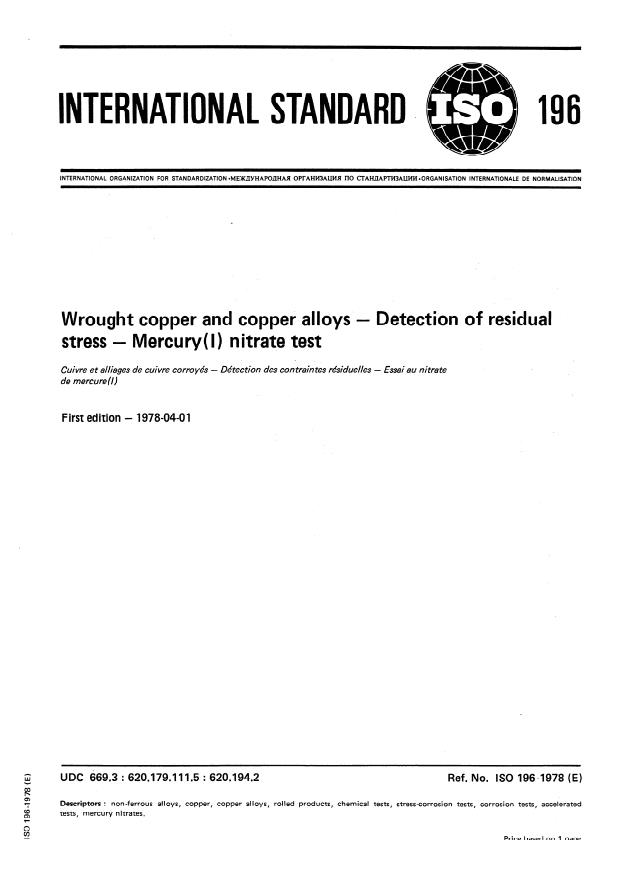
INTERNATIONAL STANDARD.
INTERNATIONAL ORGANIZATION FOR STANDARDIZATION l MEXCAYHAPOP[HASI OPl-AHM3AUUII no CrAHAAPTW3AWiM~ORGANISATION INTERNATIONALE DE NORMALISATION
Wrought copper and copper alloys - Detection of residual
Mercury(I) nitrate test
stress -
De’tection des con train tes rhiduelles - Essai au nitrate 4
Cuivre et alliages de cuivre corroy& -
de mercure (I)
First edition - 1978-04-01
UDC 669.3 : 620.179.111.5 : 620.194.2 Ref. No. IS0 196-1978 (E)
Descriptors : non-ferrous alloys, copper, copper alloys, rolled products, chemical tests, stress-corrosion tests, corrosion tests, accelerated
tests, mercury nitrates.
Price based on 1 page
FOREWORD
IS0 (the International Organization for Standardization) is a worldwide federation
of national standards institutes (IS0 member bodies). The work of developing
International Standards is carried out through IS0 technical committees. Every
member body interested in a subject for which a technical committee has been set
up has the right to be represented on that committee. International organizations,
governmental and non-governmental, in liaison with ISO, also take partin the work.
International Standard IS0 196 was developed by Technical Committee
ISOITC 26, Copper and copper alloys.
It was submitted directly to the IS0 Council, in accordance with clause 6.13.1 of
the Directives for the technical work of ISO. It cancels and replaces IS0 Recommen-
dation R 196-1961, and has been approved by the member bodies of the follow-
ing countries :
Poland
Australia India
Belgium Ireland Romania
Brazil Israel Spain
Canada Italy Sweden
Chile Japan Switzerland
Denmark Mexico Turkey
Finland Netherlands United Kingdom
France New Zealand U.S.A.
Germany Norway
U.S.S.R.
Greece Portugal Yugoslavia
No member body expressed disapproval of the document.
@I International Organization for Standardization, 1978 l
Printed in Switzerland
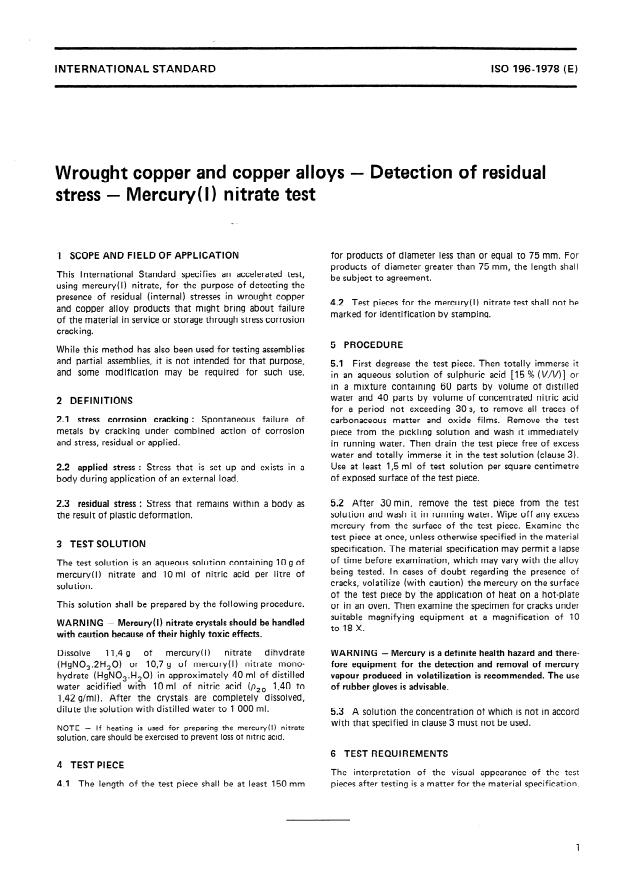
INTERNATIONAL STANDARD IS0 1964978 (E)
Wrought copper and copper alloys - Detection of residual
stress - Mercury(I) nitrate test
for products of diameter less than or equal to 75 mm. For
1 SCOPE AND FIELD OF APPLICATION
products of diameter greater than 75 mm, the length shall
This International Standard specifies an accelerated test,
be subject to agreement.
using mercury(l) nitrate, for the purpose of detecting the
presence of residual (internal) stresses in wrought copper
4.2 Test pieces for the mercury(l) nitrate test shall not be
and copper alloy products that might bring about failure
marked for identification by stamping.
of the material in service or storage through stress corrosion
cracking.
5 PROCEDURE
While this method has also been used for testing assemblies
and partial assemblies, it is not intended for that purpose,
5.1 First degrease the test piece. Then totally immerse it
and some modification may be required for such use.
in an aqueous
...
NORME INTERNATIONALE
INTERNATIONAL ORGANIZATION FOR STANDARDIZATION.MEWYHAPOAHAR OPrAHM3AUMR f-l0 CTAH~APTM3AW’lM.ORGANISATION INTERNATIONALE DE NORMALISATION
Cuivre et alliages de cuivre corroyés - Détection des
Essai au nitrate de mercure(l)
contraintes résiduelles -
Wrough t copper and copper allo ys - Detection of residual stress - Mercury (1) nitrate test
Première Édition - 1978-04-01
iî Réf. no : ISO 196-1978 (F)
CDU 669.3 : 620.179.111.5 : 620.194.2
Y
cuivre, alliage de cuivre, produit laminé, essai chimique, essai de corrosion sous tension, essai de corro-
Descripteurs : produit non ferreux,
sion, essai accéléré, nitrate de mercure.
Prix basé sur 1 page
AVANT-PROPOS
L’ISO (Organisation internationale de normalisation) est une fédération mondiale
d’organismes nationaux de normalisation (comités membres de I’ISO). L’élaboration
des Normes internationales est confiée aux comités techniques de I’ISO. Chaque
comité membre intéressé par une étude a le droit de faire partie du comité technique
correspondant.
Les organisations internationales, gouvernementales et non
gouvernementales, en liaison avec I’ISO, participent également aux travaux.
Les projets de Normes internationales adoptés par les comités techniques sont
soumis aux comités membres pour approbation, avant leur acceptation comme
Normes internationales par le Conseil de I’ISO.
La Norme internationale ISO 196 a été élaborée par le comité technique
ISO/TC 26, Cuivre et alliages de cuivre.
Elle fut soumise directement au Conseil de I’ISO, conformément au paragraphe
6.13.1 des Directives pour les travaux techniques de I’ISO. Elle annule et remplace
la Recommandation ISO/R 1964961, et a été approuvée par les comités membres
des pays suivants :
Al lemagne Pologne
Grèce
Australie Portugal
Inde
Belgique Roumanie
Irlande
Brési I Royaume-Uni
Israël
Canada Suède
Italie
Chili Suisse
Japon
Danemark Mexique Turquie
Espagne Norvège U.R.S.S.
Finlande Nouvelle-Zélande U.S.A.
France Pays-Bas Yougoslavie
Aucun comité membre ne l’a désapprouvée.
0 Organisation internationale de normalisation, 1978 l
Imprimé en Suisse
ISO 1964978 (F)
RME INTERNATKINALE
Cuivre et alliages de cuivre corroyés - Détection des
Essai au nitrate de mercure(l)
contraintes résiduelles -
4 ÉPROUVETTE
1 OBJET ET DOMAINE D’APPLICATION
La présente Norme internationale spécifie un essai rapide 4.1 La longueur de l’éprouvette doit être d’au moins
utilisant le nitrate de mercure(l), applicable aux produits 150 mm pour les produits de diamètre inférieur ou égal
corroyés en cuivre et en alliages de cuivre, destiné à déceler à 75 mm. Pour les produits de diamètre supérieur à 75 mm,
la présence de contraintes résiduelles (internes) susceptibles la longueur doit faire l’objet d’un accord.
d’entraîner, à l’usage ou après stockage, la détérioration du
4.2 Les éprouvettes pour l’essai au nitrate de mercure(l)
produit causée par une corrosion fissurante sous contrainte
ne doivent pas être marquées au poinçon.
qui libère ces contraintes.
Bien que cette méthode puisse servir à des essais sur assem-
blages et sur assemblages partiels, elle n’a pas été élaborée
5 MODE OPÉRATOIRE
dans cette intention, et certaines modifications doivent,
5.1 Dégraisser d’abord l’éprouvette. Puis l’immerger
éventuellement, y être apportées lorsqu’elle est destinée
entièrement
...
NORME INTERNATIONALE
INTERNATIONAL ORGANIZATION FOR STANDARDIZATION.MEWYHAPOAHAR OPrAHM3AUMR f-l0 CTAH~APTM3AW’lM.ORGANISATION INTERNATIONALE DE NORMALISATION
Cuivre et alliages de cuivre corroyés - Détection des
Essai au nitrate de mercure(l)
contraintes résiduelles -
Wrough t copper and copper allo ys - Detection of residual stress - Mercury (1) nitrate test
Première Édition - 1978-04-01
iî Réf. no : ISO 196-1978 (F)
CDU 669.3 : 620.179.111.5 : 620.194.2
Y
cuivre, alliage de cuivre, produit laminé, essai chimique, essai de corrosion sous tension, essai de corro-
Descripteurs : produit non ferreux,
sion, essai accéléré, nitrate de mercure.
Prix basé sur 1 page
AVANT-PROPOS
L’ISO (Organisation internationale de normalisation) est une fédération mondiale
d’organismes nationaux de normalisation (comités membres de I’ISO). L’élaboration
des Normes internationales est confiée aux comités techniques de I’ISO. Chaque
comité membre intéressé par une étude a le droit de faire partie du comité technique
correspondant.
Les organisations internationales, gouvernementales et non
gouvernementales, en liaison avec I’ISO, participent également aux travaux.
Les projets de Normes internationales adoptés par les comités techniques sont
soumis aux comités membres pour approbation, avant leur acceptation comme
Normes internationales par le Conseil de I’ISO.
La Norme internationale ISO 196 a été élaborée par le comité technique
ISO/TC 26, Cuivre et alliages de cuivre.
Elle fut soumise directement au Conseil de I’ISO, conformément au paragraphe
6.13.1 des Directives pour les travaux techniques de I’ISO. Elle annule et remplace
la Recommandation ISO/R 1964961, et a été approuvée par les comités membres
des pays suivants :
Al lemagne Pologne
Grèce
Australie Portugal
Inde
Belgique Roumanie
Irlande
Brési I Royaume-Uni
Israël
Canada Suède
Italie
Chili Suisse
Japon
Danemark Mexique Turquie
Espagne Norvège U.R.S.S.
Finlande Nouvelle-Zélande U.S.A.
France Pays-Bas Yougoslavie
Aucun comité membre ne l’a désapprouvée.
0 Organisation internationale de normalisation, 1978 l
Imprimé en Suisse
ISO 1964978 (F)
RME INTERNATKINALE
Cuivre et alliages de cuivre corroyés - Détection des
Essai au nitrate de mercure(l)
contraintes résiduelles -
4 ÉPROUVETTE
1 OBJET ET DOMAINE D’APPLICATION
La présente Norme internationale spécifie un essai rapide 4.1 La longueur de l’éprouvette doit être d’au moins
utilisant le nitrate de mercure(l), applicable aux produits 150 mm pour les produits de diamètre inférieur ou égal
corroyés en cuivre et en alliages de cuivre, destiné à déceler à 75 mm. Pour les produits de diamètre supérieur à 75 mm,
la présence de contraintes résiduelles (internes) susceptibles la longueur doit faire l’objet d’un accord.
d’entraîner, à l’usage ou après stockage, la détérioration du
4.2 Les éprouvettes pour l’essai au nitrate de mercure(l)
produit causée par une corrosion fissurante sous contrainte
ne doivent pas être marquées au poinçon.
qui libère ces contraintes.
Bien que cette méthode puisse servir à des essais sur assem-
blages et sur assemblages partiels, elle n’a pas été élaborée
5 MODE OPÉRATOIRE
dans cette intention, et certaines modifications doivent,
5.1 Dégraisser d’abord l’éprouvette. Puis l’immerger
éventuellement, y être apportées lorsqu’elle est destinée
entièrement
...