

ISO 2626:1973
(Main)Copper — Hydrogen embrittlement test
General Information
- Abstract
This test is applicable to deoxidized and oxygen-free high-conductivity coppers. ISO 2626 specifies principle, test pieces, and procedure. Embrittlement is revealed by close bending or reverse bending, or by microscopic examination.
- Status
- Published
- Publication Date
- 31-Oct-1973
- Technical Committee
- ISO/TC 26 - Copper and copper alloys
- Drafting Committee
- ISO/TC 26 - Copper and copper alloys
- Current Stage
- 9093 - International Standard confirmed
- Start Date
- 31-Dec-2024
- Completion Date
- 29-Aug-2026
Buy Documents

ISO 2626:1973 - Copper -- Hydrogen embrittlement test
ISO 2626:1973 - Copper — Hydrogen embrittlement test/1/1973

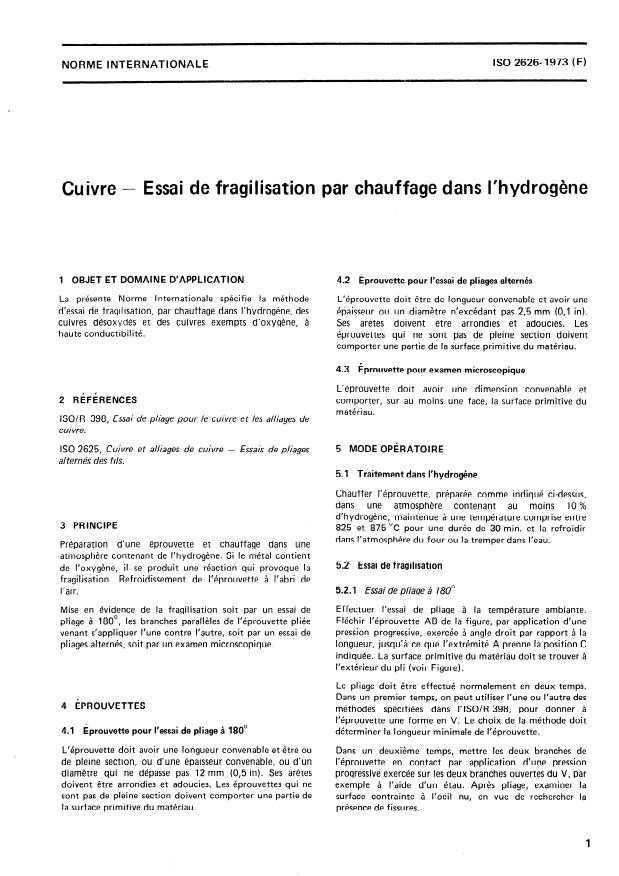

ISO 2626:1973 - Cuivre -- Essai de fragilisation par chauffage dans l'hydrogene


ISO 2626:1973 - Cuivre -- Essai de fragilisation par chauffage dans l'hydrogene
ISO 2626:1973 - Cuivre — Essai de fragilisation par chauffage dans l'hydrogène/1/1973
ISO 2626:1973 - Cuivre — Essai de fragilisation par chauffage dans l'hydrogène/1/1973
Overview
ISO 2626:1973 - "Copper - Hydrogen embrittlement test" specifies a standardized procedure for detecting hydrogen embrittlement in deoxidized and oxygen‑free high‑conductivity coppers. The standard defines the principle, required test pieces, exposure in a hydrogen atmosphere, and post‑exposure examination methods. Embrittlement is revealed by close‑bend or reverse‑bend testing, or by microscopic examination for gassing or open grain structure.
Key topics and requirements
- Scope: Applies to deoxidized and oxygen‑free high‑conductivity copper products.
- Principle: Heat test pieces in a hydrogen‑containing atmosphere; if oxygen in the metal reacts to form hydrogen effects, embrittlement becomes detectable after mechanical or microscopic examination.
- Hydrogen exposure: Heat in a furnace atmosphere containing ≥ 10% hydrogen, at 825–875 °C for 30 minutes. Cool in the furnace atmosphere or quench in water.
- Test piece dimensions:
- Close‑bend pieces: convenient length, full section or thickness/diameter up to 12 mm; original surface must be included and become the outside of the bend.
- Reverse‑bend pieces: convenient length, thickness/diameter not exceeding 2.5 mm; original surface must be present.
- Bend tests:
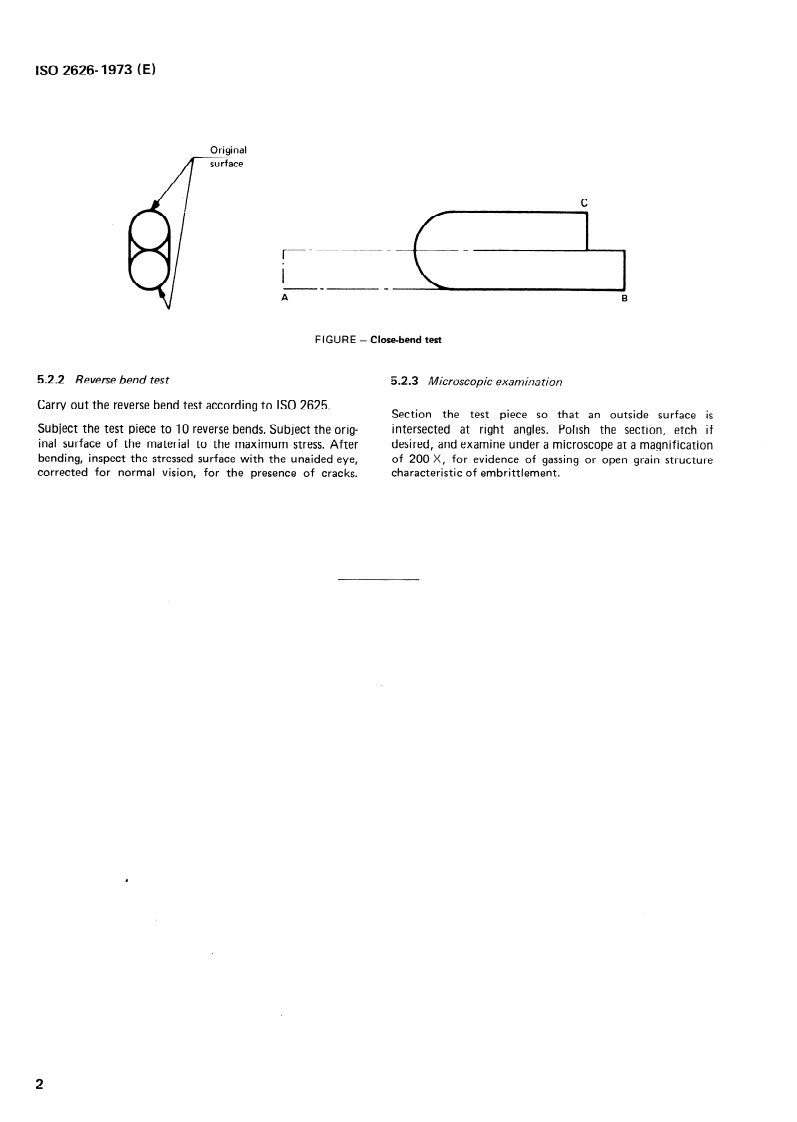
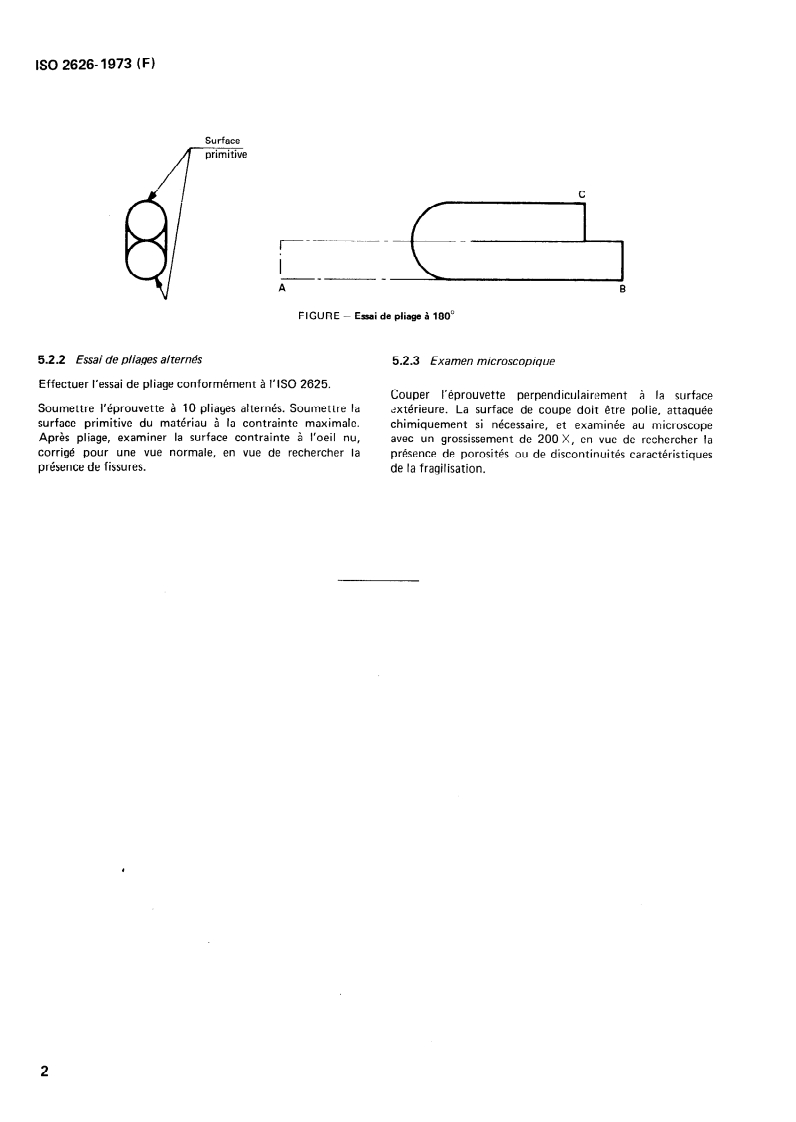
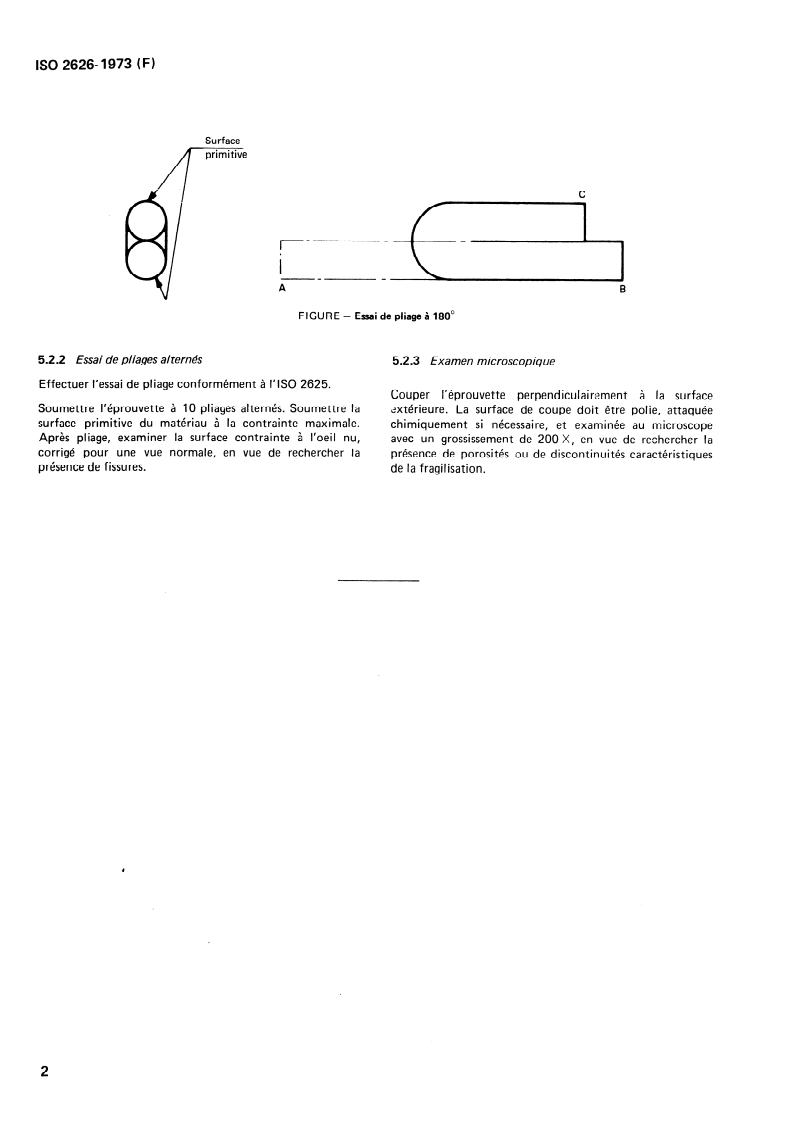
- Close‑bend test: Bend to a V‑shape then bring legs into contact so the original surface is at the outside of the bend; inspect visually for cracks.
- Reverse‑bend test: Performed according to ISO 2625; subject the specimen to 10 reverse bends with the original surface subjected to maximum stress; inspect visually for cracks.
- Microscopic examination: Section to expose an outside surface at right angles, polish (and etch, if desired) and examine at 200× for evidence of gassing or open grain structure.
- Related references: ISO/R 398 (bend test methods) and ISO 2625 (reverse bend testing of wire) are referenced for specific bending procedures.
Applications and users
ISO 2626 is practical for:
- Metallurgical and materials testing laboratories performing hydrogen embrittlement tests on copper.
- Copper producers and quality control departments verifying oxygen‑free high‑conductivity copper integrity.
- Failure‑analysis and R&D groups investigating brittleness or microstructural gas defects.
- Manufacturers of electrical components and conductors where high conductivity copper performance and reliability are critical.
Keywords: ISO 2626:1973, hydrogen embrittlement test, copper, deoxidized copper, oxygen‑free high‑conductivity copper, close‑bend test, reverse‑bend test, microscopic examination.
Related standards
- ISO 2625 - Copper and copper alloys - Reverse bend testing of wire.
- ISO/R 398 - Bend test for copper and copper alloys (methods referenced for close‑bend procedure).
Relations
- Consolidated By
ISO 10939:1998/Cor 1:2000 - Ophthalmic instruments — Slit-lamp microscopes — Technical Corrigendum 1 - Effective Date
- 06-Jun-2022
Buy Documents
ISO 2626:1973 - Copper -- Hydrogen embrittlement test
ISO 2626:1973 - Copper — Hydrogen embrittlement test/1/1973
ISO 2626:1973 - Cuivre -- Essai de fragilisation par chauffage dans l'hydrogene
ISO 2626:1973 - Cuivre -- Essai de fragilisation par chauffage dans l'hydrogene
ISO 2626:1973 - Cuivre — Essai de fragilisation par chauffage dans l'hydrogène/1/1973
ISO 2626:1973 - Cuivre — Essai de fragilisation par chauffage dans l'hydrogène/1/1973
Get Certified
Connect with accredited certification bodies for this standard

Element Materials Technology
Materials testing and product certification.

Inštitut za kovinske materiale in tehnologije
Institute of Metals and Technology. Materials testing, metallurgical analysis, NDT.
Sponsored listings
Frequently Asked Questions
ISO 2626:1973 is a standard published by the International Organization for Standardization (ISO). Its full title is "Copper — Hydrogen embrittlement test". This standard covers: This test is applicable to deoxidized and oxygen-free high-conductivity coppers. ISO 2626 specifies principle, test pieces, and procedure. Embrittlement is revealed by close bending or reverse bending, or by microscopic examination.
This test is applicable to deoxidized and oxygen-free high-conductivity coppers. ISO 2626 specifies principle, test pieces, and procedure. Embrittlement is revealed by close bending or reverse bending, or by microscopic examination.
ISO 2626:1973 is classified under the following ICS (International Classification for Standards) categories: 77.040.99 - Other methods of testing of metals. The ICS classification helps identify the subject area and facilitates finding related standards.
ISO 2626:1973 has the following relationships with other standards: It is inter standard links to ISO 10939:1998/Cor 1:2000. Understanding these relationships helps ensure you are using the most current and applicable version of the standard.
ISO 2626:1973 is available in PDF format for immediate download after purchase. The document can be added to your cart and obtained through the secure checkout process. Digital delivery ensures instant access to the complete standard document.
Standards Content (Sample)
INTERNATIONAL STANDARD
INTERNATIONAL ORGANIZATION FOR STANDARDIZATION l MEXflYHAPOAHA(I OPI-AHW3ALWI l-IO CTAHAAPTW3ALW4.ORGANISATION INTERNATIONALE DE NORMALISATION
Copper - Hydrogen embrittlemerit test
First edition - 1973-I 1-15
Ref. No. IS0 2626-1973 (E)
UDC 669.3 : 539.56
Descriptors : copper, tests, embrittlement, hydrogen embrittlement, bend tests.
Price based on 2 pages
FOREWORD
IS0 (the International Organization for Standardization) is a worldwide federation
of national standards institutes (IS0 Member Bodies). The work of developing
International Standards is carried out through IS0 Technical Committees. Every
Member Body interested in a subject for which a Technical Committee has been set
up has the right to be represented on that Committee. International organizations,
governmental and non-governmental, in liaison with ISO, also take part in the work.
Draft International Standards adopted by the Technical Committees are circulated
to the Member Bodies for approval before their acceptance as International
Standards by the IS0 Council.
International Standard IS0 2626 was drawn up by Technical Committee
lSO/TC 26, Copper and copper alloys, and circulated to the Member Bodies in
November 1971.
It has been approved by the Member Bodies of the following countries :
Austria India Spain
Belgium Japan Sweden
Canada Netherlands Switzerland
Chile New Zealand Thailand
Czechoslovakia
Norway Turkey
Egypt, Arab Rep. of
Portugal United Kingdom
France
Romania U.S.A.
Hungary
South Africa, Rep. of U.S.S.R.
No Member Body expressed disapproval of the document.
0 International Organization for Standardization, 1973 l
Printed in Switzerland
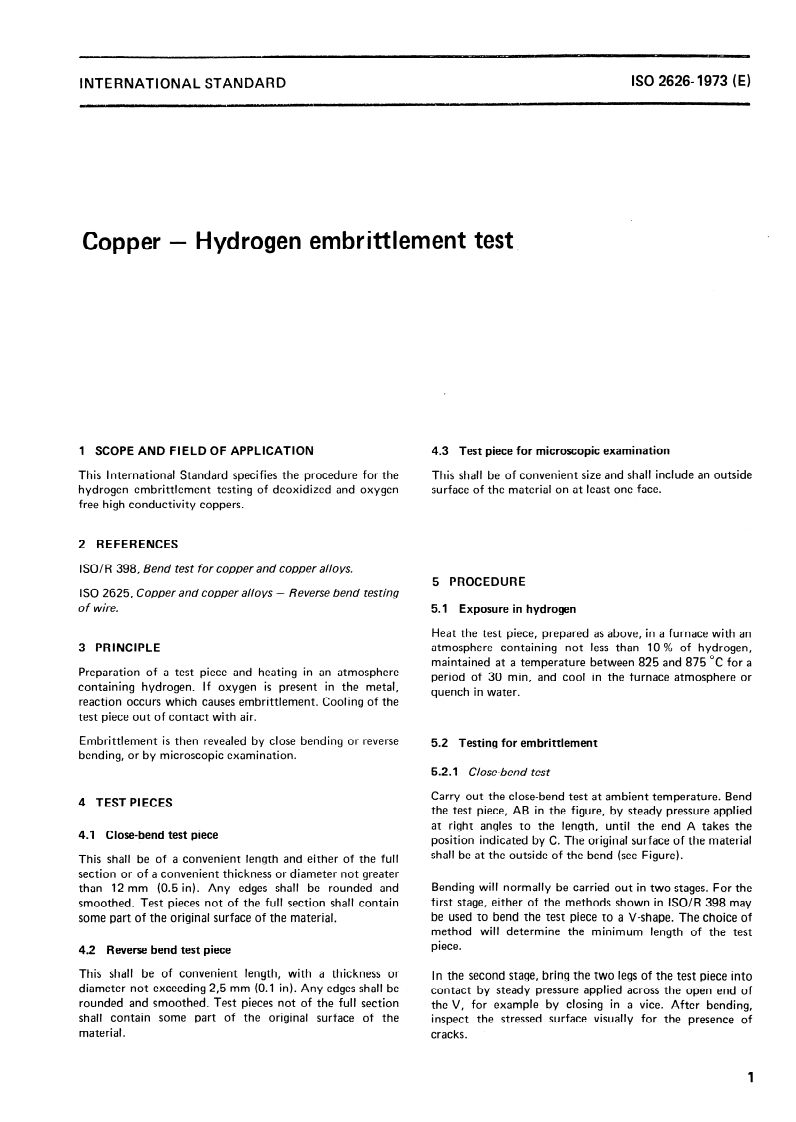
Copper - Hydrogen embrittlement test.
4.3 Test piece for microscopic examination
1 SCOPE AND FIELD OF APPLICATION
This shall be of convenient size and shall include an outside
This International Standard specifies the procedure for the
surface of the material on at least one face.
hydrogen embrittlement testing of deoxidized and oxygen
free high conductivity coppers.
2 REFERENCES
ISOIR 398, Bend test for copper and copper alloys.
5 PROCEDURE
IS0 2625, Copper and copper alloys - Reverse bend testing
of wire.
5.1 Exposure in hydrogen
Heat the test piece, prepared as above, in a furnace with an
atmosphere containing not less than 10 % of hydrogen,
3 PRINCIPLE
maintained at a temperature between 825 and 875 “C for a
Preparation of a test piece and heating in an
...
INTERNATIONAL STANDARD
INTERNATIONAL ORGANIZATION FOR STANDARDIZATION l MEXflYHAPOAHA(I OPI-AHW3ALWI l-IO CTAHAAPTW3ALW4.ORGANISATION INTERNATIONALE DE NORMALISATION
Copper - Hydrogen embrittlemerit test
First edition - 1973-I 1-15
Ref. No. IS0 2626-1973 (E)
UDC 669.3 : 539.56
Descriptors : copper, tests, embrittlement, hydrogen embrittlement, bend tests.
Price based on 2 pages
FOREWORD
IS0 (the International Organization for Standardization) is a worldwide federation
of national standards institutes (IS0 Member Bodies). The work of developing
International Standards is carried out through IS0 Technical Committees. Every
Member Body interested in a subject for which a Technical Committee has been set
up has the right to be represented on that Committee. International organizations,
governmental and non-governmental, in liaison with ISO, also take part in the work.
Draft International Standards adopted by the Technical Committees are circulated
to the Member Bodies for approval before their acceptance as International
Standards by the IS0 Council.
International Standard IS0 2626 was drawn up by Technical Committee
lSO/TC 26, Copper and copper alloys, and circulated to the Member Bodies in
November 1971.
It has been approved by the Member Bodies of the following countries :
Austria India Spain
Belgium Japan Sweden
Canada Netherlands Switzerland
Chile New Zealand Thailand
Czechoslovakia
Norway Turkey
Egypt, Arab Rep. of
Portugal United Kingdom
France
Romania U.S.A.
Hungary
South Africa, Rep. of U.S.S.R.
No Member Body expressed disapproval of the document.
0 International Organization for Standardization, 1973 l
Printed in Switzerland
Copper - Hydrogen embrittlement test.
4.3 Test piece for microscopic examination
1 SCOPE AND FIELD OF APPLICATION
This shall be of convenient size and shall include an outside
This International Standard specifies the procedure for the
surface of the material on at least one face.
hydrogen embrittlement testing of deoxidized and oxygen
free high conductivity coppers.
2 REFERENCES
ISOIR 398, Bend test for copper and copper alloys.
5 PROCEDURE
IS0 2625, Copper and copper alloys - Reverse bend testing
of wire.
5.1 Exposure in hydrogen
Heat the test piece, prepared as above, in a furnace with an
atmosphere containing not less than 10 % of hydrogen,
3 PRINCIPLE
maintained at a temperature between 825 and 875 “C for a
Preparation of a test piece and heating in an
...
NORME INTERNATIONALE
INTERNATIONAL ORGANIZATION FOR STANDARDIZATION l MEXAYHAPOAHA5l OPTAHM3ALJWf l-l0 ~AHAAPTM3AL&iM *ORGANISATION INTERNATIONALE DE NORMALISATION
CU ivre - Essai de fragilisation par chauffage dans l’hydrogène
Première édition - 1973-I l-15
~~
Réf. No : ISO 2626-1973 (F)
CDU 669.3 : 539.56
fragilisation par l’hydrogène, essai de flexion.
Descripteurs : cuivre, essai, fragilisation,
Prix basé sur 2 pages
AVANT-PROPOS
ISO (Organisation Internationale ‘de Normalisation) est une fédération mondiale
d’organismes nationaux de normalisation (Comités Membres ISO). L’élaboration de
Normes Internationales est confiée aux Comités Techniques ISO. Chaque Comité
Membre intéressé par une étude a le droit de faire partie du Comité Technique
correspondant. Les organisations internationales, gouvernementales et non
gouvernementales, en liaison avec I’ISO, participent également aux travaux.
Les Projets de Normes Internationales adoptés par les Comités Techniques sont
soumis aux Comités Membres pour approbation, avant leur acceptation comme
Normes Internationales par le Conseil de I’ISO.
La Norme Internationale ISO 2626 a été établie par le Comité Technique
lSO/TC 26, Cuivre et a/hges de cuivre, et soumise aux Comités Membres en
novembre 197 1.
Elle a été approuvée par les Comités Membres des pays suivants :
Hongrie Royaume-Uni
Afrique du Sud, Rép. d’
Inde Suède
Autriche
Japon Suisse
Belgique
Tchécoslovaquie
Canada Norvège
Thaïlande
Chili Nouvelle-Zélande
Egypte, Rép. arabe d’ Pays-Bas Turquie
Espagne Portugal U.R.S.S.
France Roumanie U.S.A.
Aucun Comité Membre n’a désapprouvé le document.
0 Organisation Internationale de Normalisation, 1973 l
Imprimé en Suisse
ISO 26264973 (FI
NORME INTERNATIONALE
Essai de fragilisation par chauffage dans l’hydrogène
Cuivre -
1 OBJET ET DOMAINE D’APPLICATION 4.2 Éprouvette pour l’essai de pliages alternés
La présente Norme Internationale spécifie la méthode L’éprouvette doit être de longueur convenable et avoir une
d’essai de fragilisation, par chauffage dans l’hydrogène, des
épaisseur ou un diamètre n’excédant pas 2,5 mm (0,l in).
cuivres désoxydés et des cuivres exempts d’oxygène, à
Ses arêtes doivent être arrondies et adoucies. Les
haute conductibilité.
éprouvettes qui ne sont pas de pleine section doivent
comporter une partie de la surface primitive du matériau.
4.3 Éprouvette pour examen microscopique
L’éprouvette doit avoir une dimension convenable et
2 RÉFÉRENCES comporter, sur au moins une face, la surface primitive du
matériau.
I SO/I3 398, Essai de pliage pour le cuivre et les alliages de
cuivre.
ISO 2625, Cuivre et alliages de cuivre - Essais de pliages 5 MODE OPÉRATOIRE
alternés des fils.
5.1 Traitement dans I’hydrogGne
Chauffer l’éprouvette, préparée comme indiqué ci-de
...
NORME INTERNATIONALE
INTERNATIONAL ORGANIZATION FOR STANDARDIZATION l MEXAYHAPOAHA5l OPTAHM3ALJWf l-l0 ~AHAAPTM3AL&iM *ORGANISATION INTERNATIONALE DE NORMALISATION
CU ivre - Essai de fragilisation par chauffage dans l’hydrogène
Première édition - 1973-I l-15
~~
Réf. No : ISO 2626-1973 (F)
CDU 669.3 : 539.56
fragilisation par l’hydrogène, essai de flexion.
Descripteurs : cuivre, essai, fragilisation,
Prix basé sur 2 pages
AVANT-PROPOS
ISO (Organisation Internationale ‘de Normalisation) est une fédération mondiale
d’organismes nationaux de normalisation (Comités Membres ISO). L’élaboration de
Normes Internationales est confiée aux Comités Techniques ISO. Chaque Comité
Membre intéressé par une étude a le droit de faire partie du Comité Technique
correspondant. Les organisations internationales, gouvernementales et non
gouvernementales, en liaison avec I’ISO, participent également aux travaux.
Les Projets de Normes Internationales adoptés par les Comités Techniques sont
soumis aux Comités Membres pour approbation, avant leur acceptation comme
Normes Internationales par le Conseil de I’ISO.
La Norme Internationale ISO 2626 a été établie par le Comité Technique
lSO/TC 26, Cuivre et a/hges de cuivre, et soumise aux Comités Membres en
novembre 197 1.
Elle a été approuvée par les Comités Membres des pays suivants :
Hongrie Royaume-Uni
Afrique du Sud, Rép. d’
Inde Suède
Autriche
Japon Suisse
Belgique
Tchécoslovaquie
Canada Norvège
Thaïlande
Chili Nouvelle-Zélande
Egypte, Rép. arabe d’ Pays-Bas Turquie
Espagne Portugal U.R.S.S.
France Roumanie U.S.A.
Aucun Comité Membre n’a désapprouvé le document.
0 Organisation Internationale de Normalisation, 1973 l
Imprimé en Suisse
ISO 26264973 (FI
NORME INTERNATIONALE
Essai de fragilisation par chauffage dans l’hydrogène
Cuivre -
1 OBJET ET DOMAINE D’APPLICATION 4.2 Éprouvette pour l’essai de pliages alternés
La présente Norme Internationale spécifie la méthode L’éprouvette doit être de longueur convenable et avoir une
d’essai de fragilisation, par chauffage dans l’hydrogène, des
épaisseur ou un diamètre n’excédant pas 2,5 mm (0,l in).
cuivres désoxydés et des cuivres exempts d’oxygène, à
Ses arêtes doivent être arrondies et adoucies. Les
haute conductibilité.
éprouvettes qui ne sont pas de pleine section doivent
comporter une partie de la surface primitive du matériau.
4.3 Éprouvette pour examen microscopique
L’éprouvette doit avoir une dimension convenable et
2 RÉFÉRENCES comporter, sur au moins une face, la surface primitive du
matériau.
I SO/I3 398, Essai de pliage pour le cuivre et les alliages de
cuivre.
ISO 2625, Cuivre et alliages de cuivre - Essais de pliages 5 MODE OPÉRATOIRE
alternés des fils.
5.1 Traitement dans I’hydrogGne
Chauffer l’éprouvette, préparée comme indiqué ci-de
...
NORME INTERNATIONALE
INTERNATIONAL ORGANIZATION FOR STANDARDIZATION l MEXAYHAPOAHA5l OPTAHM3ALJWf l-l0 ~AHAAPTM3AL&iM *ORGANISATION INTERNATIONALE DE NORMALISATION
CU ivre - Essai de fragilisation par chauffage dans l’hydrogène
Première édition - 1973-I l-15
~~
Réf. No : ISO 2626-1973 (F)
CDU 669.3 : 539.56
fragilisation par l’hydrogène, essai de flexion.
Descripteurs : cuivre, essai, fragilisation,
Prix basé sur 2 pages
AVANT-PROPOS
ISO (Organisation Internationale ‘de Normalisation) est une fédération mondiale
d’organismes nationaux de normalisation (Comités Membres ISO). L’élaboration de
Normes Internationales est confiée aux Comités Techniques ISO. Chaque Comité
Membre intéressé par une étude a le droit de faire partie du Comité Technique
correspondant. Les organisations internationales, gouvernementales et non
gouvernementales, en liaison avec I’ISO, participent également aux travaux.
Les Projets de Normes Internationales adoptés par les Comités Techniques sont
soumis aux Comités Membres pour approbation, avant leur acceptation comme
Normes Internationales par le Conseil de I’ISO.
La Norme Internationale ISO 2626 a été établie par le Comité Technique
lSO/TC 26, Cuivre et a/hges de cuivre, et soumise aux Comités Membres en
novembre 197 1.
Elle a été approuvée par les Comités Membres des pays suivants :
Hongrie Royaume-Uni
Afrique du Sud, Rép. d’
Inde Suède
Autriche
Japon Suisse
Belgique
Tchécoslovaquie
Canada Norvège
Thaïlande
Chili Nouvelle-Zélande
Egypte, Rép. arabe d’ Pays-Bas Turquie
Espagne Portugal U.R.S.S.
France Roumanie U.S.A.
Aucun Comité Membre n’a désapprouvé le document.
0 Organisation Internationale de Normalisation, 1973 l
Imprimé en Suisse
ISO 26264973 (FI
NORME INTERNATIONALE
Essai de fragilisation par chauffage dans l’hydrogène
Cuivre -
1 OBJET ET DOMAINE D’APPLICATION 4.2 Éprouvette pour l’essai de pliages alternés
La présente Norme Internationale spécifie la méthode L’éprouvette doit être de longueur convenable et avoir une
d’essai de fragilisation, par chauffage dans l’hydrogène, des
épaisseur ou un diamètre n’excédant pas 2,5 mm (0,l in).
cuivres désoxydés et des cuivres exempts d’oxygène, à
Ses arêtes doivent être arrondies et adoucies. Les
haute conductibilité.
éprouvettes qui ne sont pas de pleine section doivent
comporter une partie de la surface primitive du matériau.
4.3 Éprouvette pour examen microscopique
L’éprouvette doit avoir une dimension convenable et
2 RÉFÉRENCES comporter, sur au moins une face, la surface primitive du
matériau.
I SO/I3 398, Essai de pliage pour le cuivre et les alliages de
cuivre.
ISO 2625, Cuivre et alliages de cuivre - Essais de pliages 5 MODE OPÉRATOIRE
alternés des fils.
5.1 Traitement dans I’hydrogGne
Chauffer l’éprouvette, préparée comme indiqué ci-de
...
NORME INTERNATIONALE
INTERNATIONAL ORGANIZATION FOR STANDARDIZATION l MEXAYHAPOAHA5l OPTAHM3ALJWf l-l0 ~AHAAPTM3AL&iM *ORGANISATION INTERNATIONALE DE NORMALISATION
CU ivre - Essai de fragilisation par chauffage dans l’hydrogène
Première édition - 1973-I l-15
~~
Réf. No : ISO 2626-1973 (F)
CDU 669.3 : 539.56
fragilisation par l’hydrogène, essai de flexion.
Descripteurs : cuivre, essai, fragilisation,
Prix basé sur 2 pages
AVANT-PROPOS
ISO (Organisation Internationale ‘de Normalisation) est une fédération mondiale
d’organismes nationaux de normalisation (Comités Membres ISO). L’élaboration de
Normes Internationales est confiée aux Comités Techniques ISO. Chaque Comité
Membre intéressé par une étude a le droit de faire partie du Comité Technique
correspondant. Les organisations internationales, gouvernementales et non
gouvernementales, en liaison avec I’ISO, participent également aux travaux.
Les Projets de Normes Internationales adoptés par les Comités Techniques sont
soumis aux Comités Membres pour approbation, avant leur acceptation comme
Normes Internationales par le Conseil de I’ISO.
La Norme Internationale ISO 2626 a été établie par le Comité Technique
lSO/TC 26, Cuivre et a/hges de cuivre, et soumise aux Comités Membres en
novembre 197 1.
Elle a été approuvée par les Comités Membres des pays suivants :
Hongrie Royaume-Uni
Afrique du Sud, Rép. d’
Inde Suède
Autriche
Japon Suisse
Belgique
Tchécoslovaquie
Canada Norvège
Thaïlande
Chili Nouvelle-Zélande
Egypte, Rép. arabe d’ Pays-Bas Turquie
Espagne Portugal U.R.S.S.
France Roumanie U.S.A.
Aucun Comité Membre n’a désapprouvé le document.
0 Organisation Internationale de Normalisation, 1973 l
Imprimé en Suisse
ISO 26264973 (FI
NORME INTERNATIONALE
Essai de fragilisation par chauffage dans l’hydrogène
Cuivre -
1 OBJET ET DOMAINE D’APPLICATION 4.2 Éprouvette pour l’essai de pliages alternés
La présente Norme Internationale spécifie la méthode L’éprouvette doit être de longueur convenable et avoir une
d’essai de fragilisation, par chauffage dans l’hydrogène, des
épaisseur ou un diamètre n’excédant pas 2,5 mm (0,l in).
cuivres désoxydés et des cuivres exempts d’oxygène, à
Ses arêtes doivent être arrondies et adoucies. Les
haute conductibilité.
éprouvettes qui ne sont pas de pleine section doivent
comporter une partie de la surface primitive du matériau.
4.3 Éprouvette pour examen microscopique
L’éprouvette doit avoir une dimension convenable et
2 RÉFÉRENCES comporter, sur au moins une face, la surface primitive du
matériau.
I SO/I3 398, Essai de pliage pour le cuivre et les alliages de
cuivre.
ISO 2625, Cuivre et alliages de cuivre - Essais de pliages 5 MODE OPÉRATOIRE
alternés des fils.
5.1 Traitement dans I’hydrogGne
Chauffer l’éprouvette, préparée comme indiqué ci-de
...