

ISO 4746:1977
(Main)Oxygen-free copper — Scale adhesion test
General Information
- Abstract
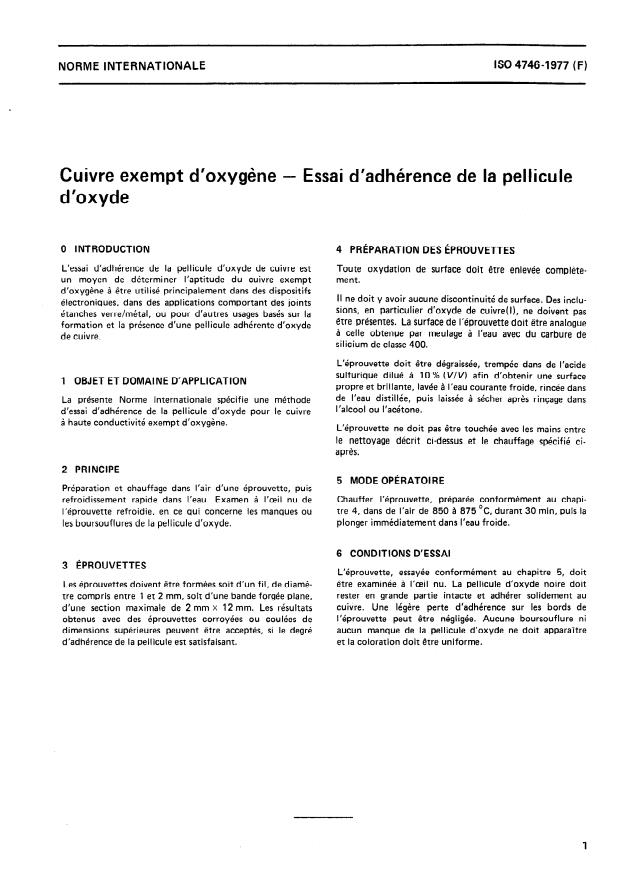
Provides a means of assessing the usability in electronic devices, for applications involving glass-to-metal seals, or other uses relying on the formation and presence of an adherent film of copper oxide. The procedure includes preparation and heating in air of a test piece, followed by rapid cooling in water and visual examination for loss of the oxide film or blistering.
- Status
- Published
- Publication Date
- 31-Jul-1977
- Technical Committee
- ISO/TC 26 - Copper and copper alloys
- Drafting Committee
- ISO/TC 26 - Copper and copper alloys
- Current Stage
- 9093 - International Standard confirmed
- Start Date
- 04-Jul-2025
- Completion Date
- 29-Aug-2026
Buy Documents

ISO 4746:1977 - Oxygen-free copper — Scale adhesion test Released:8/1/1977

ISO 4746:1977 - Cuivre exempt d'oxygene — Essai d'adhérence de la pellicule d'oxyde Released:8/1/1977

ISO 4746:1977 - Cuivre exempt d'oxygene — Essai d'adhérence de la pellicule d'oxyde Released:8/1/1977
Overview
ISO 4746:1977 - Oxygen-free copper - Scale adhesion test establishes an internationally recognized procedure for testing the adhesion of oxide scales on oxygen-free copper. Developed by ISO Technical Committee 26 (Copper and copper alloys), this standard is essential for assessing the suitability of oxygen-free high-conductivity copper, particularly in electronic devices, glass-to-metal seals, and other specialized applications where the presence of a continuous and strongly adherent copper oxide film is critical for product reliability.
Key Topics
- Preparation of Test Pieces: Ensures all surface oxidation, inclusions, and discontinuities are removed from the copper sample. The required surface finish is similar to that achieved by wet grinding with 400-grade silicon carbide, followed by careful cleaning and degreasing.
- Heating Procedure: Test pieces are heated in air at 850°C to 875°C for 30 minutes and then rapidly cooled in cold water. This process forms the oxide scale whose adhesion is subsequently evaluated.
- Visual Assessment: After cooling, the test piece is visually examined. The evaluation focuses on the integrity and adherence of the black oxide film, checking for any blistering or flaking that would indicate a failed test.
- Acceptance Criteria: The oxide film must remain substantially unbroken and firmly attached; slight edge loss is permissible, but the overall film should be even in coloration and free from significant defects.
Applications
- Electronic Devices: Oxygen-free copper is widely used in electronic applications where high electrical conductivity and reliable surface properties are required. The scale adhesion test ensures the copper will maintain a consistent performance over time, especially where oxide film stability is crucial.
- Glass-to-Metal Seals: Many high-reliability electrical and electronic components rely on robust glass-to-metal bonding. The quality of the copper oxide layer directly impacts the performance and longevity of these seals, making rigorous adhesion testing essential.
- Specialty and High-Vacuum Applications: In applications sensitive to contamination or requiring strong, adherent oxide films, such as vacuum equipment or scientific instrumentation, adherence of the oxide layer improves reliability and prevents issues from flaking or film loss.
- Quality Assurance: Manufacturers and suppliers of oxygen-free copper use this standard as part of their quality control systems, verifying that their material will meet the stringent requirements of advanced industrial applications.
Related Standards
- ISO 1811: Methods for testing the mechanical properties of copper.
- ISO 6509: Corrosion of metals and alloys - Determination of dealloying resistance of copper alloys.
- ISO 2626: Copper and copper alloys - Sampling for chemical analysis.
- IEC Materials Standards: Electrical properties testing for copper conductors.
Practical Value
By adhering to ISO 4746:1977, manufacturers, quality assurance teams, and end-users can ensure the consistent performance of oxygen-free copper in advanced technologies. The standardized adhesion test method minimizes the risk of oxide film defects that could compromise product function, reliability, or lifespan, particularly in demanding environments. This standard is a critical reference for any operation specifying, converting, or certifying oxygen-free copper for specialized uses.
Keywords: ISO 4746, oxygen-free copper, scale adhesion test, copper oxide film, electronic devices, glass-to-metal seals, copper quality control, international standards, copper testing.
Relations
- Effective Date
- 25-Aug-2026
- Effective Date
- 25-Aug-2026
- Effective Date
- 25-Aug-2026
- Effective Date
- 25-Aug-2026
Buy Documents
ISO 4746:1977 - Oxygen-free copper — Scale adhesion test Released:8/1/1977
ISO 4746:1977 - Cuivre exempt d'oxygene — Essai d'adhérence de la pellicule d'oxyde Released:8/1/1977
ISO 4746:1977 - Cuivre exempt d'oxygene — Essai d'adhérence de la pellicule d'oxyde Released:8/1/1977
Get Certified
Connect with accredited certification bodies for this standard

Element Materials Technology
Materials testing and product certification.

Inštitut za kovinske materiale in tehnologije
Institute of Metals and Technology. Materials testing, metallurgical analysis, NDT.
Sponsored listings
Frequently Asked Questions
ISO 4746:1977 is a standard published by the International Organization for Standardization (ISO). Its full title is "Oxygen-free copper — Scale adhesion test". This standard covers: Provides a means of assessing the usability in electronic devices, for applications involving glass-to-metal seals, or other uses relying on the formation and presence of an adherent film of copper oxide. The procedure includes preparation and heating in air of a test piece, followed by rapid cooling in water and visual examination for loss of the oxide film or blistering.
Provides a means of assessing the usability in electronic devices, for applications involving glass-to-metal seals, or other uses relying on the formation and presence of an adherent film of copper oxide. The procedure includes preparation and heating in air of a test piece, followed by rapid cooling in water and visual examination for loss of the oxide film or blistering.
ISO 4746:1977 is classified under the following ICS (International Classification for Standards) categories: 77.040.99 - Other methods of testing of metals. The ICS classification helps identify the subject area and facilitates finding related standards.
ISO 4746:1977 has the following relationships with other standards: It is inter standard links to EN 13604:2002, EN 13604:2013, EN 1976:2012, EN 1977:2013. Understanding these relationships helps ensure you are using the most current and applicable version of the standard.
ISO 4746:1977 is available in PDF format for immediate download after purchase. The document can be added to your cart and obtained through the secure checkout process. Digital delivery ensures instant access to the complete standard document.
Standards Content (Sample)
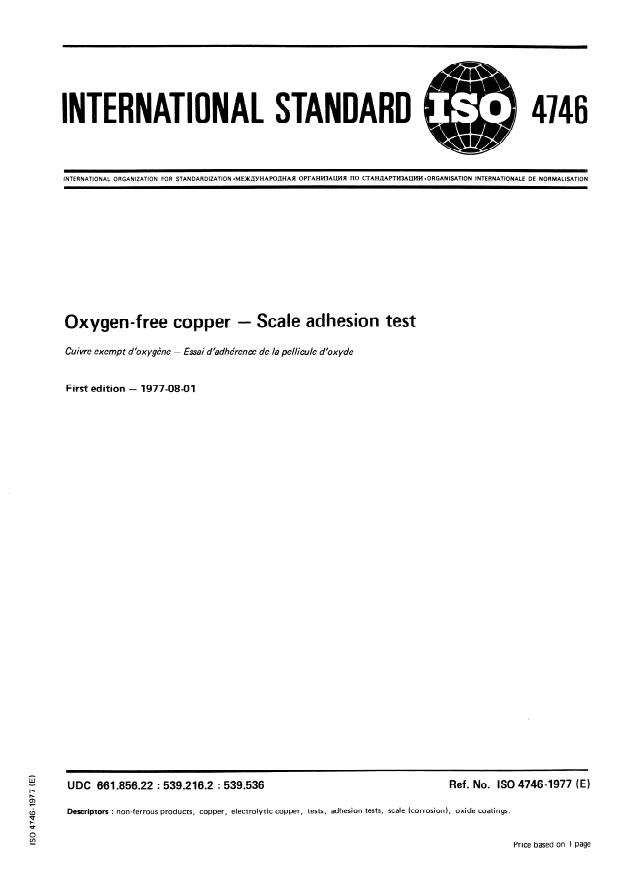
INTERNATIONAL STANDARD.
INTERNATIONAL ORGANIZATION FOR STANDARDIZATION l MEXAYHAPOAHAII OPTAHM3AUWR no CTAHAAPTM3A~WH.ORGANISATION INTERNATIONALE DE NORMALISATION
Oxygen-free topper - Scale adhesion test
Cuivre exemp t d ‘ox ygene
- Essai d ‘adhelrencxl de Ia pelficule d’oxyde
First edition - 1977-08-0 1
w
-
Ref. No. ISO 4746-1977 E)
UDC 661.856.22 : 539.216.2 : 539.536
non-ferrous products, topper, electrolytic topper, tests, adhesion tests, scale korrosion), Oxide coatings.
Descriptors :
d
d
Price based on 1 page
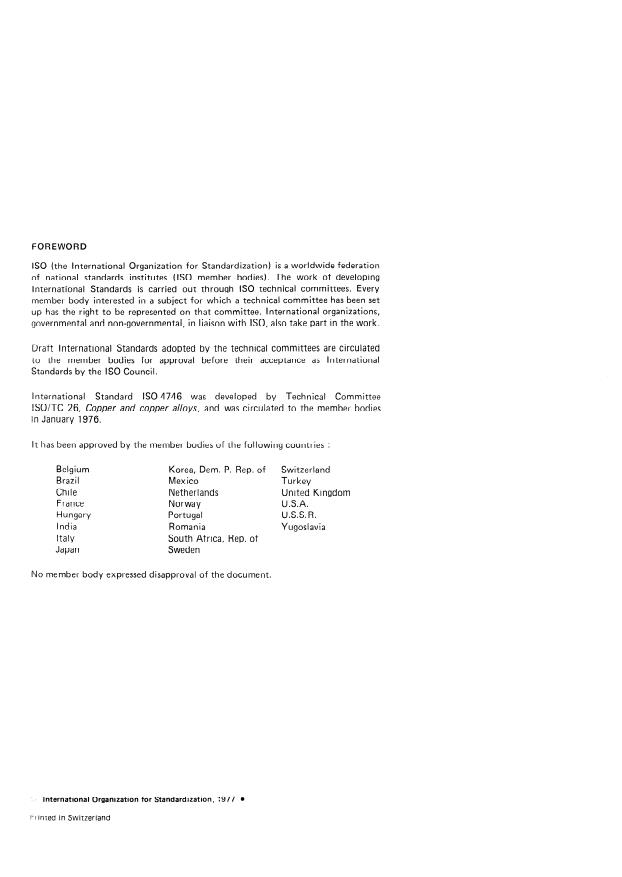
FOREWORD
OS0 (the International Organization for Standardization) is a worldwide federation
of national Standards institutes (ISO member bodies). The work of developing
International Standards is carried out through ISO technical committees. Every
member body interested in a subject for which a technical committee has been set
up has the right to be represented on that committee. International organizations,
governmental and non-governmental, in liaison with ISO, also take part in the work.
Draft International Standards adopted by the technical committees are circulated
to the member bodies for approval before their acceptance as International
Standards by the ISO Council.
International Standard ISO 4746 was developed by Technical Committee
lSO/TC 26, Copper and topper alloys, and was circulated to the member bodies
in January 1976.
lt has been approved by the member bodies of the following countries :
Beigium Korea, Dem. P. Rep. of Switzerland
Brazil Mexico Turkey
Chile Netherlands United Kingdom
USA.
France Norway
U.S.S. R.
Hungary Portugal
lndia Romania Yugoslavia
Italy South Africa, Rep. of
Japan Sweden
No member body expressed disapproval of the document.
International Organization for Standardkation, XI77 l
?rinted in Switzerland
ISO 4746-1977 (E)
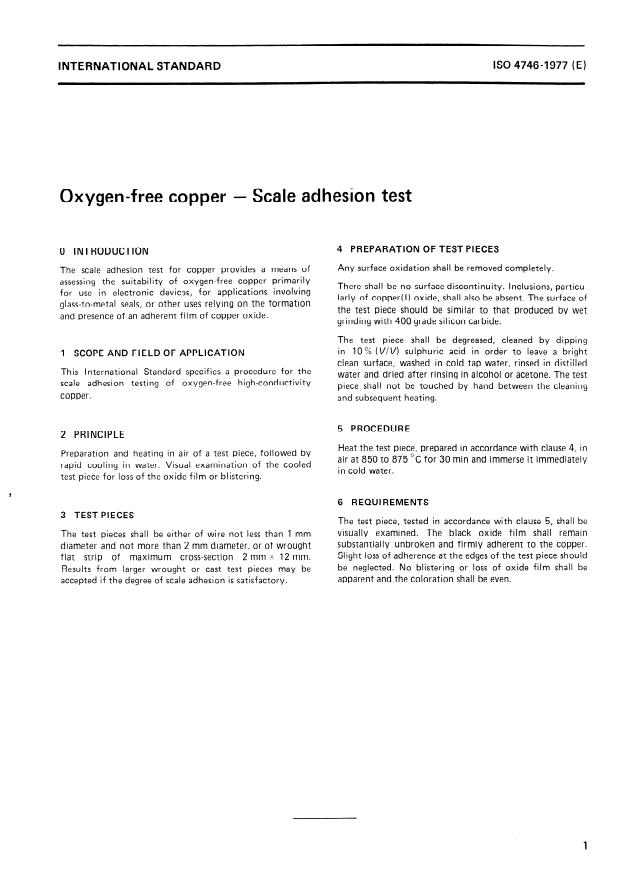
INTERNATIONAL STANDARD
Oxygen-free topper - Scale adhesion test
4 PREPARATION OF TEST PIECES
0 INTRODUCTION
Any surface Oxidation shall be removed completely.
The
...
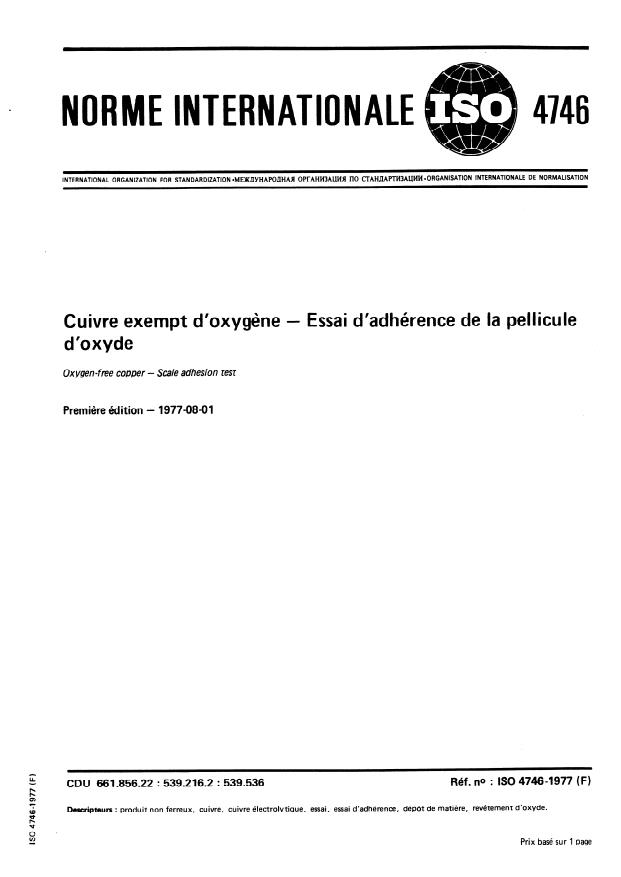
NORME INTERNATIONALE 4746
INTERNATIONAL ORGANIZATION FOR STANDARDIZATION l EXAYHAPOAHAII OPTAHM3ALWI XT0 ~AH~APTW3A~H&ï.ORGANISATION INTERNATIONALE DE NORMALISATION
Cuivre exempt d’oxygène - Essai d’adhérence de la pellicule
d’oxyde
Oxygen-free copper - Scale adhesion test
Première édition - 1977-08-o 1
Réf. no : ISO 4746-1977 (F)
CDU 661.856.22 : 539.216.2 : 539.536
cuivre, cuivre électrolytique, essai, essai d’adhérence, dépôt de matière, revêtement d’oxyde.
Descripteur~ : produit non ferreux,
Prix basé sur 1 page
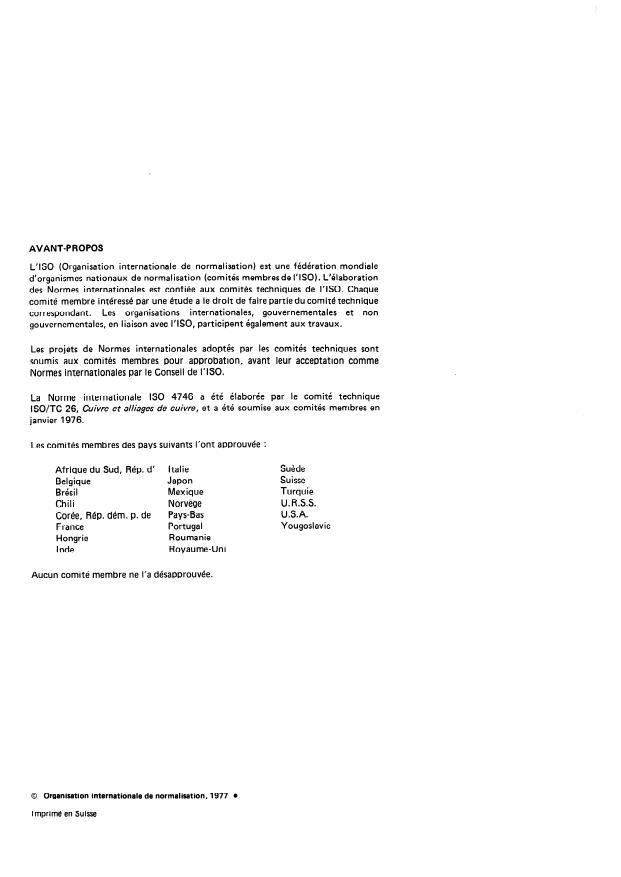
AVANT-PROPOS
L’ISO (Organisation internationale de normalisation) est une fédération mondiale
d’organismes nationaux de normalisation (comités membresde I’ISO). L’élaboration
des Normes internationales est confiée aux comités techniques de I’ISO. Chaque
comité membre intéressé par une étude a le droit de faire partie du comité technique
correspondant. Les organisations internationales, gouvernementales et non
gouvernementales, en liaison avec I’ISO, participent également aux travaux.
Les projets de Normes internationales adoptés par les comités techniques sont
soumis aux comités membres pour approbation, avant leur acceptation comme
Normes internationales par le Conseil de I’ISO.
La Norme internationale ISO 4746 a été élaborée par le comité technique
ISO/TC 26, Cuivre et Mages de cuivre, et a été soumise aux comités membres en
janvier 1976.
Les comités membres des pays suivants l’ont approuvée :
Afrique du Sud, Rép. d’ Italie Suède
Belgique Japon Suisse
Brési I Mexique Turquie
Chili Norvège U.R.S.S.
Corée, Rép. dém. p. de Pays-Bas U.S.A.
France Portugal Yougoslavie
Hongrie Roumanie
Inde Royaume-Uni
Aucun comité membre ne l’a désapprouvée.
0 Organisation internationale de normalisation, 1977 l
Imprimé en Suisse
ISO 4746-1977 (F)
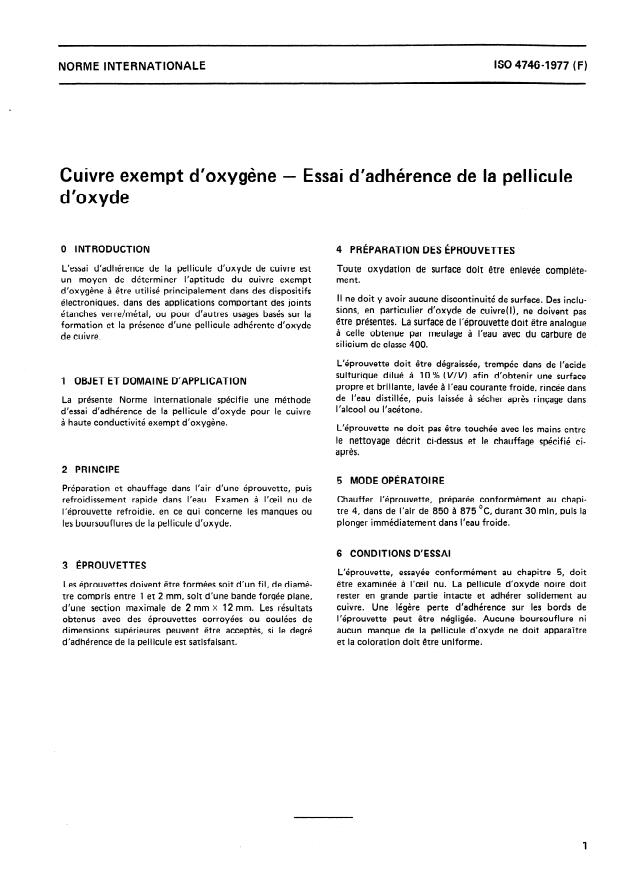
NORME INTERNATIONALE
Cuivre exempt d’oxygène - Essai d’adhérence de la pellicule
d’oxyde
0 INTRODUCTION 4 PRÉPARATION DES ÉPROUVETTES
L’essai d’adhérence de la pellicule d’oxyde de cuivre est Toute oxydation de surface doit être enlevée complète-
un moyen de déterminer l’aptitude du cuivre exempt ment.
d’o’xygène à être utilisé principalement dans des dispositifs
II ne doit y avoir aucun
...
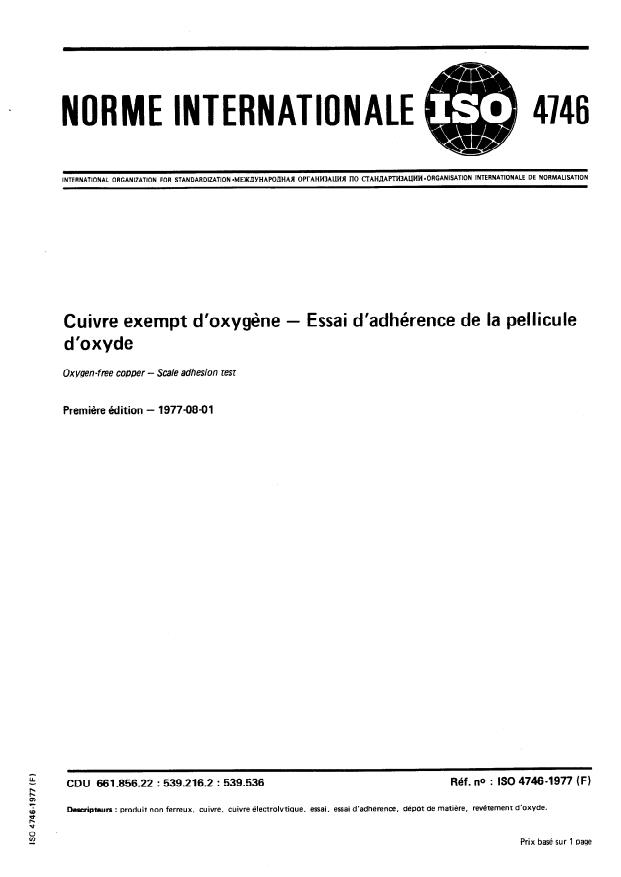
NORME INTERNATIONALE 4746
INTERNATIONAL ORGANIZATION FOR STANDARDIZATION l EXAYHAPOAHAII OPTAHM3ALWI XT0 ~AH~APTW3A~H&ï.ORGANISATION INTERNATIONALE DE NORMALISATION
Cuivre exempt d’oxygène - Essai d’adhérence de la pellicule
d’oxyde
Oxygen-free copper - Scale adhesion test
Première édition - 1977-08-o 1
Réf. no : ISO 4746-1977 (F)
CDU 661.856.22 : 539.216.2 : 539.536
cuivre, cuivre électrolytique, essai, essai d’adhérence, dépôt de matière, revêtement d’oxyde.
Descripteur~ : produit non ferreux,
Prix basé sur 1 page
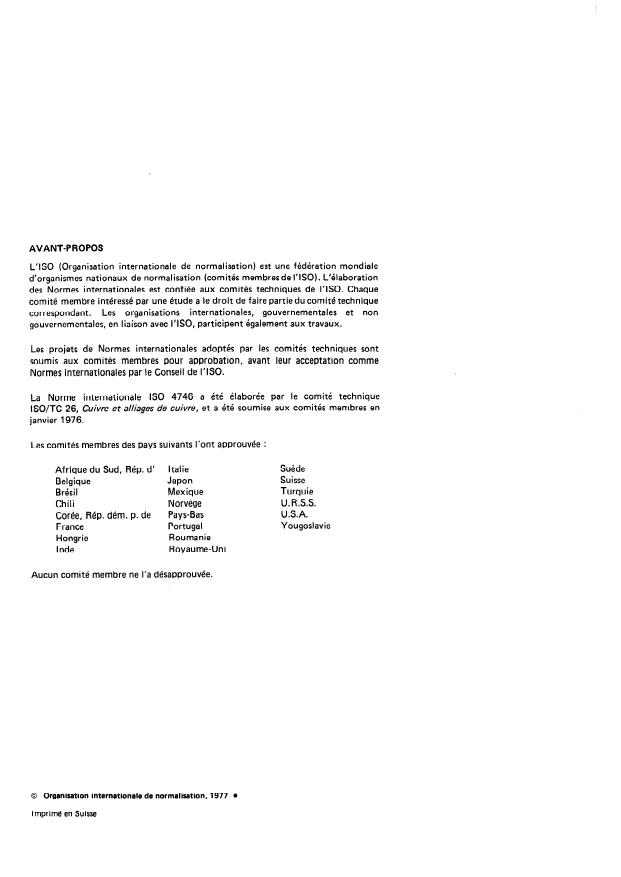
AVANT-PROPOS
L’ISO (Organisation internationale de normalisation) est une fédération mondiale
d’organismes nationaux de normalisation (comités membresde I’ISO). L’élaboration
des Normes internationales est confiée aux comités techniques de I’ISO. Chaque
comité membre intéressé par une étude a le droit de faire partie du comité technique
correspondant. Les organisations internationales, gouvernementales et non
gouvernementales, en liaison avec I’ISO, participent également aux travaux.
Les projets de Normes internationales adoptés par les comités techniques sont
soumis aux comités membres pour approbation, avant leur acceptation comme
Normes internationales par le Conseil de I’ISO.
La Norme internationale ISO 4746 a été élaborée par le comité technique
ISO/TC 26, Cuivre et Mages de cuivre, et a été soumise aux comités membres en
janvier 1976.
Les comités membres des pays suivants l’ont approuvée :
Afrique du Sud, Rép. d’ Italie Suède
Belgique Japon Suisse
Brési I Mexique Turquie
Chili Norvège U.R.S.S.
Corée, Rép. dém. p. de Pays-Bas U.S.A.
France Portugal Yougoslavie
Hongrie Roumanie
Inde Royaume-Uni
Aucun comité membre ne l’a désapprouvée.
0 Organisation internationale de normalisation, 1977 l
Imprimé en Suisse
ISO 4746-1977 (F)
NORME INTERNATIONALE
Cuivre exempt d’oxygène - Essai d’adhérence de la pellicule
d’oxyde
0 INTRODUCTION 4 PRÉPARATION DES ÉPROUVETTES
L’essai d’adhérence de la pellicule d’oxyde de cuivre est Toute oxydation de surface doit être enlevée complète-
un moyen de déterminer l’aptitude du cuivre exempt ment.
d’o’xygène à être utilisé principalement dans des dispositifs
II ne doit y avoir aucun
...