

ISO 17226-3:2011
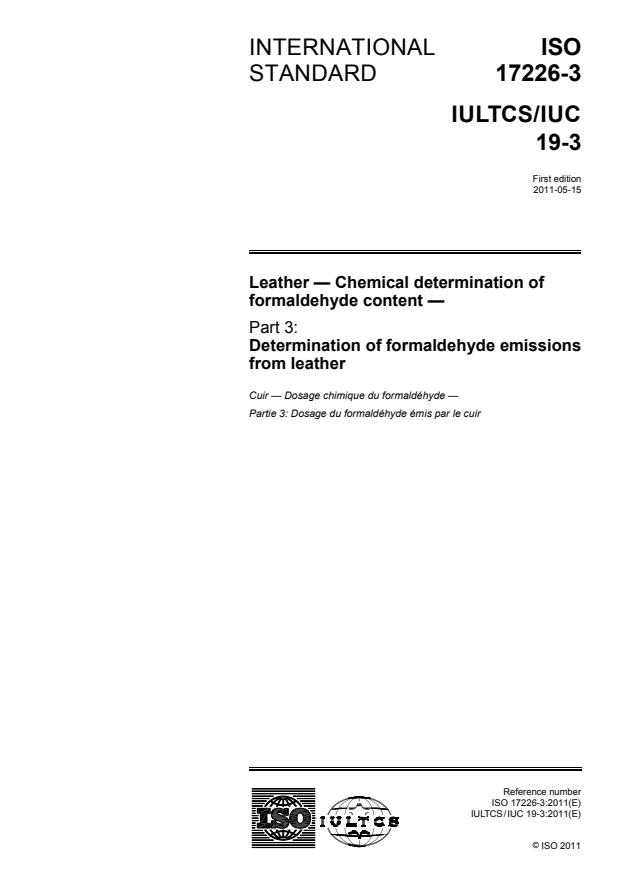
(Main)Leather — Chemical determination of formaldehyde content — Part 3: Determination of formaldehyde emissions from leather
General Information
- Abstract
ISO 17226-3:2011 specifies a method for determining the emission of formaldehyde from leathers. This method is based on high performance liquid chromatography (HPLC). It is selective and also allows the emission of other low molecular aldehydes and ketones to be observed. ISO 17226-3:2011 deals with the release of formaldehyde to the gas phase. Therefore, the obtained results are not comparable with the results of methods described in ISO 17726-1 and ISO 17226-2 which are based on extraction with liquid water.
- Status
- Published
- Publication Date
- 05-May-2011
- Technical Committee
- IULTCS - International Union of Leather Technologists and Chemists Societies
- Current Stage
- 9093 - International Standard confirmed
- Start Date
- 26-Mar-2025
- Completion Date
- 29-Aug-2026
Buy Documents
ISO 17226-3:2011 - Leather — Chemical determination of formaldehyde content — Part 3: Determination of formaldehyde emissions from leather Released:5/6/2011
ISO 17226-3:2011 - Cuir — Dosage chimique du formaldéhyde — Partie 3: Dosage du formaldéhyde émis par le cuir Released:5/6/2011
Overview
ISO 17226-3:2011 is an international standard specifying a precise method for determining formaldehyde emissions from leather. Utilizing high performance liquid chromatography (HPLC), this standard provides a selective analytical approach for measuring formaldehyde released into the gas phase from leather materials. Unique among formaldehyde testing methods, ISO 17226-3 focuses on gaseous emissions rather than extraction into liquid, thereby offering results distinct from ISO 17226-1 and ISO 17226-2. This standard plays a critical role in assessing leather safety and compliance with environmental and health regulations regarding formaldehyde content.
Key Topics
- Formaldehyde Emission Measurement: The standard details a method based on HPLC that quantifies formaldehyde and other low molecular weight aldehydes and ketones emitted from leather.
- Sample Preparation and Handling: Leather samples are cut to specific dimensions, sealed in polyethylene bottles with demineralized water, then conditioned under controlled temperature (60 ± 2°C) to allow formaldehyde release into the gas phase above the water.
- Reagent Use: The method employs analytical-grade reagents, including DNPH (2,4-dinitrophenylhydrazine) which reacts with formaldehyde to form hydrazones detectable via UV at 360 nm.
- Chromatographic Conditions: Reverse-phase C18 columns with an acetonitrile/water mobile phase (60:40) and a flow rate of 1.0 ml/min are recommended for formaldehyde separation and quantification. Calibration curves and recovery rates ensure method reliability.
- Result Expression: Formaldehyde emission is expressed in mg/kg of leather sample, with options to adjust for moisture content to reflect dry substance basis. Multiple samples and blanks enhance result accuracy and reproducibility.
- Safety and Quality Control: Emphasis on controlled storage to prevent contamination or loss of formaldehyde and routine system calibration to maintain analytical precision.
Applications
- Leather Manufacturing Quality Control: Enables manufacturers to monitor and control formaldehyde emissions during production, ensuring products meet safety and environmental standards.
- Regulatory Compliance Testing: Supports compliance with international chemical safety regulations for consumer products, including restrictions on formaldehyde exposure.
- Product Safety Assessment: Helps evaluate potential health risks related to formaldehyde emissions from leather-based goods such as footwear, upholstery, and garments.
- Research and Development: Assists R&D labs in developing low-emission leather treatments and sustainable tanning processes by providing detailed emission profiles.
- Environmental Monitoring: Facilitates environmental health assessments regarding indoor air quality where leather products are used extensively.
Related Standards
- ISO 17226-1:2011: Chemical determination of formaldehyde content in leather using HPLC based on liquid extraction.
- ISO 17226-2:2010: Colorimetric method for determining formaldehyde content in leather by liquid extraction.
- ISO 2418: Sampling location guidelines for chemical, physical, mechanical, and fastness testing of leather.
- ISO 2419: Preparation and conditioning of leather samples for physical and mechanical testing.
- ISO 4684: Determination of volatile matter in leather, important for moisture-adjusted formaldehyde content expression.
By adhering to ISO 17226-3:2011, stakeholders in the leather industry can assure rigorous, reproducible, and internationally comparable measurement of formaldehyde emissions, supporting product safety, regulatory compliance, and environmental stewardship.
Relations
- Effective Date
- 09-Feb-2026
- Effective Date
- 12-Feb-2026
Buy Documents
ISO 17226-3:2011 - Leather — Chemical determination of formaldehyde content — Part 3: Determination of formaldehyde emissions from leather Released:5/6/2011
ISO 17226-3:2011 - Cuir — Dosage chimique du formaldéhyde — Partie 3: Dosage du formaldéhyde émis par le cuir Released:5/6/2011
Get Certified
Connect with accredited certification bodies for this standard

Control Union Certifications
Global certification for agriculture and sustainability.

Hohenstein Institut
Textile testing and certification.

Bureau Veritas Bangladesh
Bureau Veritas certification services in Bangladesh.
Sponsored listings
Frequently Asked Questions
ISO 17226-3:2011 is a standard published by the International Organization for Standardization (ISO). Its full title is "Leather — Chemical determination of formaldehyde content — Part 3: Determination of formaldehyde emissions from leather". This standard covers: ISO 17226-3:2011 specifies a method for determining the emission of formaldehyde from leathers. This method is based on high performance liquid chromatography (HPLC). It is selective and also allows the emission of other low molecular aldehydes and ketones to be observed. ISO 17226-3:2011 deals with the release of formaldehyde to the gas phase. Therefore, the obtained results are not comparable with the results of methods described in ISO 17726-1 and ISO 17226-2 which are based on extraction with liquid water.
ISO 17226-3:2011 specifies a method for determining the emission of formaldehyde from leathers. This method is based on high performance liquid chromatography (HPLC). It is selective and also allows the emission of other low molecular aldehydes and ketones to be observed. ISO 17226-3:2011 deals with the release of formaldehyde to the gas phase. Therefore, the obtained results are not comparable with the results of methods described in ISO 17726-1 and ISO 17226-2 which are based on extraction with liquid water.
ISO 17226-3:2011 is classified under the following ICS (International Classification for Standards) categories: 59.140.30 - Leather and furs. The ICS classification helps identify the subject area and facilitates finding related standards.
ISO 17226-3:2011 has the following relationships with other standards: It is inter standard links to EN ISO 20137:2017, EN ISO 17226-3:2011. Understanding these relationships helps ensure you are using the most current and applicable version of the standard.
ISO 17226-3:2011 is available in PDF format for immediate download after purchase. The document can be added to your cart and obtained through the secure checkout process. Digital delivery ensures instant access to the complete standard document.
Standards Content (Sample)
INTERNATIONAL ISO
STANDARD 17226-3
IULTCS/IUC
19-3
First edition
2011-05-15
Leather — Chemical determination of
formaldehyde content —
Part 3:
Determination of formaldehyde emissions
from leather
Cuir — Dosage chimique du formaldéhyde —
Partie 3: Dosage du formaldéhyde émis par le cuir
Reference number
IULTCS/IUC 19-3:2011(E)
©
ISO 2011
IULTCS/IUC 19-3:2011(E)
© ISO 2011
All rights reserved. Unless otherwise specified, no part of this publication may be reproduced or utilized in any form or by any means,
electronic or mechanical, including photocopying and microfilm, without permission in writing from either ISO at the address below or
ISO's member body in the country of the requester.
ISO copyright office
Case postale 56 • CH-1211 Geneva 20
Tel. + 41 22 749 01 11
Fax + 41 22 749 09 47
E-mail copyright@iso.org
Web www.iso.org
Published in Switzerland
ii © ISO 2011 – All rights reserved
IULTCS/IUC 19-3:2011(E)
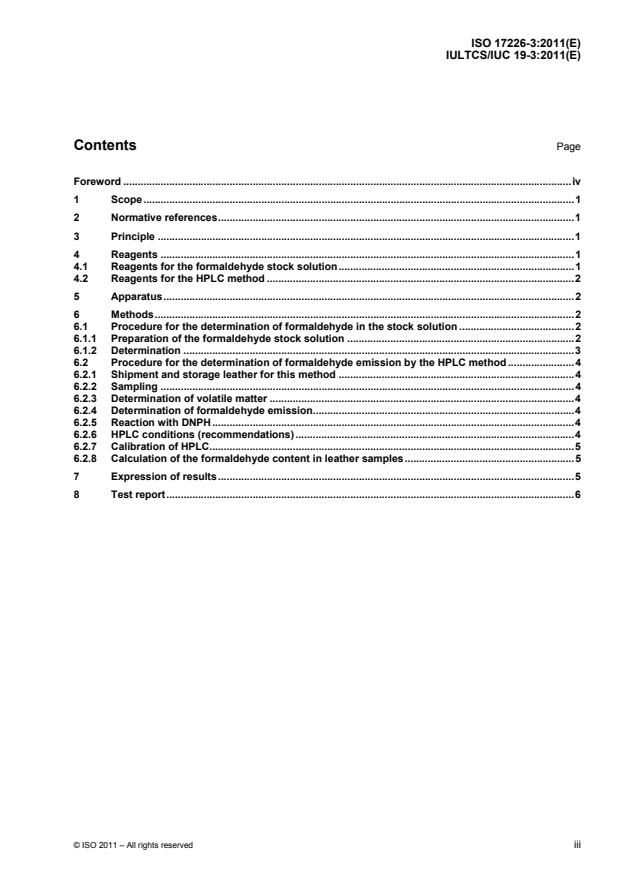
Contents Page
Foreword .iv
1 Scope.1
2 Normative references.1
3 Principle .1
4 Reagents .1
4.1 Reagents for the formaldehyde stock solution.1
4.2 Reagents for the HPLC method .2
5 Apparatus.2
6 Methods.2
6.1 Procedure for the determination of formaldehyde in the stock solution .2
6.1.1 Preparation of the formaldehyde stock solution .2
6.1.2 Determination .3
6.2 Procedure for the determination of formaldehyde emission by the HPLC method .4
6.2.1 Shipment and storage leather for this method .4
6.2.2 Sampling .4
6.2.3 Determination of volatile matter .4
6.2.4 Determination of formaldehyde emission.4
6.2.5 Reaction with DNPH.4
6.2.6 HPLC conditions (recommendations).4
6.2.7 Calibration of HPLC.5
6.2.8 Calculation of the formaldehyde content in leather samples.5
7 Expression of results.5
8 Test report.6
IULTCS/IUC 19-3:2011(E)
Foreword
ISO (the International Organization for Standardization) is a worldwide federation of national standards bodies
(ISO member bodies). The work of preparing International Standards is normally carried out through ISO
technical committees. Each member body interested in a subject for which a technical committee has been
established has the right to be represented on that committee. International organizations, governmental and
non-governmental, in liaison with ISO, also take part in the work. ISO collaborates closely with the
International Electrotechnical Commission (IEC) on all matters of electrotechnical standardization.
International Standards are drafted in accordance with the rules given in the ISO/IEC Directives, Part 2.
The main task of technical committees is to prepare International Standards. Draft International Standards
adopted by the technical committees are circulated to the member bodies for voting. Publication as an
International Standard requires approval by at least 75 % of the member bodies casting a vote.
Attention is drawn to the possibility that some of the elements of this document may be the subject of patent
rights. ISO shall not be held responsible for identifying any or all such patent rights.
ISO 17226-3 was prepared by the European Committee for Standardization (CEN) Technical Committee
CEN/TC 289, Leather, in collaboration with Chemical Test Commission of the International Union of Leather
Technologists and Chemists Societies (IUC Commission, IULTCS), in accordance with the Agreement on
technical cooperation between ISO and CEN (Vienna Agreement).
IULTCS, originally formed in 1897, is a world-wide organization of professional leather societies to further the
advancement of leather science and technology. IULTCS has three Commissions, which are responsible for
establishing international methods for the sampling and testing of leather. ISO recognizes IULTCS as an
international standardizing body for the preparation of test methods for leather.
ISO 17226 consists of the following parts, under the general title Leather — Chemical determination of
formaldehyde content:
⎯ Part 1: Method using high performance liquid chromatography
⎯ Part 2: Method using colorimetric analysis
⎯ Part 3: Determination of formaldehyde emissions from leather
iv © ISO 2011 – All rights reserved
INTERNATIONAL STANDARD
IULTCS/IUC 19-3:2011(E)
Leather — Chemical determination of formaldehyde content —
Part 3:
Determination of formaldehyde emissions from leather
1 Scope
This part of ISO 17226 specifies a method for determining the emission of formaldehyde from leathers. This
method is based on high performance liquid chromatography (HPLC). It is selective and also allows the
emission of other low molecular aldehydes and ketones to be observed.
This part of ISO 17226 deals with the release of formaldehyde to the gas phase. Therefore, the obtained
results are not comparable with the results of methods described in ISO 17726-1 and ISO 17226-2 which are
based on extraction with liquid water.
2 Normative references
The following referenced documents are indispensable for the application of this document. For dated
references, only the edition cited applies. For undated references, the latest edition of the referenced
document (including any amendments) applies.
ISO 2418, Leather — Chemical, physical and mechanical and fastness tests — Sampling location
ISO 2419, Leather — Physical and mechanical tests — Sample preparation and conditioning
ISO 3696:1987, Water for analytical laboratory use — Specification and test methods
ISO 4684, Leather — Chemical tests — Determination of volatile matter
3 Principle
A specimen with defined dimensions is held above demineralized water in a sealed bottle and is heated at
constant temperature for a specific period. Afterwards, the bottle is cooled and the formaldehyde absorbed
into the water is analysed. The water is mixed with 2,4-dinitrophenylhydrazine, whereby aldehydes and
ketones react to give the respective hydrazones. These are separated by means of a reversed-phase HPLC
method, detected at 360 nm and quantified.
4 Reagents
Use only reagents of recognized analytical grade, unless otherwise stated. The water shall be of grade 3 in
accordance with ISO 3696:1987. All solutions are aqueous solutions.
4.1 Reagents for the formaldehyde stock solution
4.1.1 Formaldehyde solution, approximately 37 % (mass fraction).
IULTCS/IUC 19-3:2011(E)
4.1.2 Iodine solution, 0,05 mol/l, i.e. 12,68 g iodine/l.
4.1.3 Sodium hydroxide solution, 2,0 mol/l.
...
NORME ISO
INTERNATIONALE 17226-3
IULTCS/IUC
19-3
Première édition
2011-05-15
Cuir — Dosage chimique du
formaldéhyde —
Partie 3:
Dosage du formaldéhyde émis par le cuir
Leather — Chemical determination of formaldehyde content —
Part 3: Determination of formaldehyde emissions from leather
Numéro de référence
IULTCS/IUC 19-3:2011(F)
©
ISO 2011
IULTCS/IUC 19-3:2011(F)
DOCUMENT PROTÉGÉ PAR COPYRIGHT
© ISO 2011
Droits de reproduction réservés. Sauf prescription différente, aucune partie de cette publication ne peut être reproduite ni utilisée sous
quelque forme que ce soit et par aucun procédé, électronique ou mécanique, y compris la photocopie et les microfilms, sans l'accord écrit
de l'ISO à l'adresse ci-après ou du comité membre de l'ISO dans le pays du demandeur.
ISO copyright office
Case postale 56 • CH-1211 Geneva 20
Tel. + 41 22 749 01 11
Fax + 41 22 749 09 47
E-mail copyright@iso.org
Web www.iso.org
Publié en Suisse
ii © ISO 2011 – Tous droits réservés
IULTCS/IUC 19-3:2011(F)
Sommaire Page
Avant-propos .iv
1 Domaine d'application .1
2 Références normatives.1
3 Principe .1
4 Réactifs.1
4.1 Réactifs pour la solution mère de formaldéhyde.1
4.2 Réactifs pour la méthode par CLHP.2
5 Appareillage .2
6 Méthodes.2
6.1 Mode opératoire pour le dosage du formaldéhyde dans la solution mère .2
6.1.1 Préparation de la solution mère de formaldéhyde.2
6.1.2 Dosage.3
6.2 Mode opératoire pour le dosage du formaldéhyde émis par la méthode par CLHP .4
6.2.1 Transport et stockage du cuir pour cette méthode .4
6.2.2 Échantillonnage.4
6.2.3 Dosage des matières volatiles .4
6.2.4 Dosage du formaldéhyde émis .4
6.2.5 Réaction avec la DNPH .4
6.2.6 Conditions de CLHP (recommandations) .4
6.2.7 Étalonnage de la CLHP .5
6.2.8 Calcul de la teneur en formaldéhyde d'échantillons de cuir .5
7 Expression des résultats.5
8 Rapport d'essai.6
IULTCS/IUC 19-3:2011(F)
Avant-propos
L'ISO (Organisation internationale de normalisation) est une fédération mondiale d'organismes nationaux de
normalisation (comités membres de l'ISO). L'élaboration des Normes internationales est en général confiée
aux comités techniques de l'ISO. Chaque comité membre intéressé par une étude a le droit de faire partie du
comité technique créé à cet effet. Les organisations internationales, gouvernementales et non
gouvernementales, en liaison avec l'ISO participent également aux travaux. L'ISO collabore étroitement avec
la Commission électrotechnique internationale (CEI) en ce qui concerne la normalisation électrotechnique.
Les Normes internationales sont rédigées conformément aux règles données dans les Directives ISO/CEI,
Partie 2.
La tâche principale des comités techniques est d'élaborer les Normes internationales. Les projets de Normes
internationales adoptés par les comités techniques sont soumis aux comités membres pour vote. Leur
publication comme Normes internationales requiert l'approbation de 75 % au moins des comités membres
votants.
L'attention est appelée sur le fait que certains des éléments du présent document peuvent faire l'objet de
droits de propriété intellectuelle ou de droits analogues. L'ISO ne saurait être tenue pour responsable de ne
pas avoir identifié de tels droits de propriété et averti de leur existence.
L'ISO 17226-3 a été élaborée par le comité technique CEN/TC 289, Cuir, du Comité européen de
normalisation (CEN), en collaboration avec la Commission d'essais chimiques de l'Union internationale des
sociétés de techniciens et chimistes du cuir (commission IUC, IULTCS), conformément à l'Accord de
coopération technique entre l'ISO et le CEN (Accord de Vienne).
L'IULTCS est une organisation mondiale de sociétés professionnelles des industries du cuir fondée en 1897
ayant pour mission de favoriser l'avancement des sciences et technologies du cuir. L'IULTCS a trois
commissions, qui sont responsables de l'établissement des méthodes internationales d'échantillonnage et
d'essai des cuirs. L'ISO reconnaît l'IULTCS en tant qu'organisme international à activités normatives pour
l'élaboration de méthodes d'essai relatives au cuir.
L'ISO 17226 comprend les parties suivantes, présentées sous le titre général Cuir — Dosage chimique du
formaldéhyde:
⎯ Partie 1: Méthode par chromatographie en phase liquide à haute performance
⎯ Partie 2: Méthode par analyse colorimétrique
⎯ Partie 3: Dosage du formaldéhyde émis par le cuir
iv © ISO 2011 – Tous droits réservés
NORME INTERNATIONALE
IULTCS/IUC 19-3:2011(F)
Cuir — Dosage chimique du formaldéhyde —
Partie 3:
Dosage du formaldéhyde émis par le cuir
1 Domaine d'application
La présente partie de l'ISO 17226 spécifie une méthode pour doser le formaldéhyde émis par les cuirs. Cette
méthode repose sur la chromatographie en phase liquide à haute performance (CLHP). Elle est sélective et
permet d'observer également les émissions d'autres aldéhydes et cétones de faible poids moléculaire.
La présente partie de l'ISO 17226 concerne le formaldéhyde dégagé en phase gazeuse. Les résultats
obtenus ne sont donc pas comparables avec ceux des méthodes décrites dans l'ISO 17226-1 et
l'ISO 17226-2, qui sont fondées sur une extraction à l'eau liquide.
2 Références normatives
Les documents de référence suivants sont indispensables pour l'application du présent document. Pour les
références datées, seule l'édition citée s'applique. Pour les références non datées, la dernière édition du
document de référence (y compris les éventuels amendements) s'applique.
ISO 2418, Cuir — Essais chimiques, physiques, mécaniques et de solidité — Emplacement de
l'échantillonnage
ISO 2419, Cuir — Essais physiques et mécaniques — Préparation et conditionnement des échantillons
ISO 3696:1987, Eau pour laboratoire à usage analytique — Spécification et méthodes d'essai
ISO 4684, Cuir — Essais chimiques — Détermination des matières volatiles
3 Principe
Une éprouvette de dimensions définies est maintenue au-dessus d'eau déminéralisée dans une bouteille
scellée et est chauffée à température constante pendant une durée spécifique. La bouteille est ensuite
refroidie et le formaldéhyde absorbé dans l'eau est analysé. L'eau est mélangée avec de la
2,4-dinitrophénylhydrazine, de sorte que les aldéhydes et les cétones réagissent pour donner les hydrazones
respectives. Celles-ci sont séparées au moyen d'une méthode par CLHP en phase inverse, sont détectées à
360 nm et quantifiées.
4 Réactifs
Sauf indication contraire, utiliser uniquement des réactifs de qualité analytique reconnue. L'eau doit être de
qualité 3 conformément à l'ISO 3696:1987. Toutes les solutions sont des solutions aqueuses.
4.1 Réactifs pour la solution mère de formaldéhyde
4.1.1 Solution de formaldéhyde, à environ 37 % (fraction massique).
IULTCS/IUC 19-3:2011(F)
4.1.2 Solution iodée, 0,05 mol/l, soit 12,68 g d'iode/l .
4.1.3 Solution d'hydroxyde de sodium, 2,0 mol/l.
4.1.4 Solution d'acide sulfurique, 2,0 mol/l.
4.1.5 Solution de thiosulfate de sodium, 0,1 mol/l.
4.1.6 Solution d'amidon, 1 %, soit 1 g dans 100 ml d'eau.
4.2 Réactifs pour la méthode par CLHP
4.2.1 Solution de dinitrophénylhydrazine (DNPH), composée de 0,3 g de DNPH
(2,4-dinitrophénylhydrazine) dissous dans 100 ml d'acide o-phosphorique concentré (85 % en fraction
massique); (DNPH re
...