


ISO 9379:2005
(Main)Operating forces — Test method — Doors
Operating forces — Test method — Doors
ISO 9379:2005 is for hinged/pivoted and sliding doorsets with latches, for pedestrian use. ISO 9379:2005 defines the test methods to determine the forces to open/close doors and to engage/release and lock/unlock the hardware using a key or handle. ISO 9379:2005 is only applicable to the manual operation doorsets. The tests are applicable to doorsets of any material. ISO 9379:2005 is not applicable to the measurement of forces for doorsets with self closing devices engaged or to doorsets with special hardware e.g. emergency exit devices.
Forces de manoeuvre — Méthodes d'essai — Portes
L'ISO 9379:2005 concerne les blocs-portes battants/pivotants et coulissants équipés de pênes demi-tour et destinés à être utilisés par des piétons. Elle définit les méthodes d'essai permettant de déterminer les forces d'ouverture/fermeture des portes et pour enclencher/libérer et verrouiller/déverrouiller la quincaillerie à l'aide d'une clé ou d'une poignée. L'ISO 9379:2005 n'est applicable qu'à la manoeuvre manuelle de blocs-portes. Les essais sont applicables aux blocs-portes quel que soit leur matériau. L'ISO 9379:2005 n'est pas applicable au mesurage des forces pour les blocs-portes avec des systèmes à fermeture automatique enclenchés. L'ISO 9379:2005 n'est pas applicable également aux blocs-portes équipés d'une quincaillerie spéciales, par exemple les systèmes d'issue de secours.
General Information
- Status
- Published
- Publication Date
- 19-Oct-2005
- Technical Committee
- ISO/TC 162 - Doors, windows and curtain walling
- Drafting Committee
- ISO/TC 162 - Doors, windows and curtain walling
- Current Stage
- 9093 - International Standard confirmed
- Start Date
- 22-May-2025
- Completion Date
- 14-Feb-2026
Relations
- Effective Date
- 15-Apr-2008
Overview
ISO 9379:2005 defines standardized test methods to measure the operating forces for pedestrian doorsets, including hinged, pivoted, and sliding doors equipped with latches. Developed by ISO Technical Committee ISO/TC 162, this standard specifically addresses the forces required to open and close manual doors, as well as to engage, release, lock, and unlock door hardware using keys or handles. Applicable across all door materials, ISO 9379:2005 excludes doors with self-closing devices actively engaged or those fitted with specialized hardware like emergency exit devices.
This international standard ensures reliable and repeatable testing to determine minimum operating forces, facilitating the design, manufacturing, and quality control of doors and hardware systems aimed at ease of use and safety for pedestrian access.
Key Topics
Scope and Applicability:
- Applies to manually operated hinged, pivoted, and sliding pedestrian doorsets with latches.
- Not suitable for self-closing doors or special hardware such as emergency exits.
- Relevant to doorsets made from any material.
Test Principle:
- Measurement of minimum force or torque needed to operate door hardware (locks, latches, handles).
- Includes forces to open, close, lock, unlock, engage, and release doors or safety devices.
Test Apparatus Requirements:
- Use of support frames that do not affect results.
- Application of forces incrementally (up to 1.0 N increments) without shock, via weights and pulleys or torque meters.
- Accurate measurement devices maintaining ±5% accuracy.
Testing Procedures:
- Dynamic closing force: measuring the minimum force to close and engage latches or personal safety devices.
- Hardware operation force: determining forces/torques for locking/unlocking and unlatching.
- Commencing and maintaining motion: measuring forces required to start and sustain door movement.
- Multiple repetitions (minimum three) for each test, averaging results for accuracy.
Environmental Conditions:
- Tests conducted at temperatures between 10°C and 30°C and relative humidity between 25% and 75%.
- Specimens must be fully operable and conditioned to test environment prior to testing.
Reporting:
- Detailed reporting including test conditions, specimen descriptions, test methods used, and measured results in Newtons (N) and Newton metres (Nm).
- Inclusion of drawings, product designations, and observations to support reproducibility and certification.
Applications
ISO 9379:2005 is invaluable for manufacturers, product designers, testing laboratories, and regulatory bodies involved with door safety and usability. Its practical applications include:
- Door Hardware Design: Optimizing door handle, latch, and lock mechanism designs to ensure ease of use and compliance with ergonomic standards.
- Quality Assurance: Verifying force thresholds during production to maintain consistent product performance and user safety.
- Building Compliance: Supporting certification processes and regulatory approvals by providing standardized test evidence of operating forces.
- Accessibility Compliance: Ensuring doors meet accessibility requirements, reducing opening forces to accommodate users with disabilities.
- Material Testing: Evaluating how different materials affect door operation forces, allowing for material selection aligned with performance goals.
Related Standards
- EN 12046-2:2000: The European standard equivalent to ISO 9379:2005 focusing on similar test methods for door operating forces.
- prEN 12519:1996: Establishes terminology for doors and windows, supporting consistency in definitions relevant to this testing.
- ISO 16283 & ISO 21542: Standards related to building hardware and accessibility requirements which may reference operating force considerations.
- ISO/IEC Directives Part 2: Governs the drafting and approval processes for international standards like ISO 9379.
By adopting ISO 9379:2005, stakeholders in the building and construction industry gain a robust methodology that advances product reliability, user safety, and regulatory compliance in door operation testing. This ensures doorsets are functional, user-friendly, and accessible to all pedestrians in various environments.

Get Certified
Connect with accredited certification bodies for this standard

ICC Evaluation Service
Building products evaluation and certification.

QAI Laboratories
Building and construction product testing and certification.

Aboma Certification B.V.
Specialized in construction, metal, and transport sectors.
Sponsored listings
Frequently Asked Questions
ISO 9379:2005 is a standard published by the International Organization for Standardization (ISO). Its full title is "Operating forces — Test method — Doors". This standard covers: ISO 9379:2005 is for hinged/pivoted and sliding doorsets with latches, for pedestrian use. ISO 9379:2005 defines the test methods to determine the forces to open/close doors and to engage/release and lock/unlock the hardware using a key or handle. ISO 9379:2005 is only applicable to the manual operation doorsets. The tests are applicable to doorsets of any material. ISO 9379:2005 is not applicable to the measurement of forces for doorsets with self closing devices engaged or to doorsets with special hardware e.g. emergency exit devices.
ISO 9379:2005 is for hinged/pivoted and sliding doorsets with latches, for pedestrian use. ISO 9379:2005 defines the test methods to determine the forces to open/close doors and to engage/release and lock/unlock the hardware using a key or handle. ISO 9379:2005 is only applicable to the manual operation doorsets. The tests are applicable to doorsets of any material. ISO 9379:2005 is not applicable to the measurement of forces for doorsets with self closing devices engaged or to doorsets with special hardware e.g. emergency exit devices.
ISO 9379:2005 is classified under the following ICS (International Classification for Standards) categories: 91.060.50 - Doors and windows. The ICS classification helps identify the subject area and facilitates finding related standards.
ISO 9379:2005 has the following relationships with other standards: It is inter standard links to ISO 9379:1989. Understanding these relationships helps ensure you are using the most current and applicable version of the standard.
ISO 9379:2005 is available in PDF format for immediate download after purchase. The document can be added to your cart and obtained through the secure checkout process. Digital delivery ensures instant access to the complete standard document.
Standards Content (Sample)
INTERNATIONAL ISO
STANDARD 9379
Second edition
2005-10-15
Operating forces — Test method — Doors
Forces de manœuvre — Méthodes d'essai — Portes
Reference number
©
ISO 2005
PDF disclaimer
This PDF file may contain embedded typefaces. In accordance with Adobe's licensing policy, this file may be printed or viewed but
shall not be edited unless the typefaces which are embedded are licensed to and installed on the computer performing the editing. In
downloading this file, parties accept therein the responsibility of not infringing Adobe's licensing policy. The ISO Central Secretariat
accepts no liability in this area.
Adobe is a trademark of Adobe Systems Incorporated.
Details of the software products used to create this PDF file can be found in the General Info relative to the file; the PDF-creation
parameters were optimized for printing. Every care has been taken to ensure that the file is suitable for use by ISO member bodies. In
the unlikely event that a problem relating to it is found, please inform the Central Secretariat at the address given below.
© ISO 2005
All rights reserved. Unless otherwise specified, no part of this publication may be reproduced or utilized in any form or by any means,
electronic or mechanical, including photocopying and microfilm, without permission in writing from either ISO at the address below or
ISO's member body in the country of the requester.
ISO copyright office
Case postale 56 • CH-1211 Geneva 20
Tel. + 41 22 749 01 11
Fax + 41 22 749 09 47
E-mail copyright@iso.org
Web www.iso.org
Published in Switzerland
ii © ISO 2005 – All rights reserved
Foreword
ISO (the International Organization for Standardization) is a worldwide federation of national standards bodies
(ISO member bodies). The work of preparing International Standards is normally carried out through ISO
technical committees. Each member body interested in a subject for which a technical committee has been
established has the right to be represented on that committee. International organizations, governmental and
non-governmental, in liaison with ISO, also take part in the work. ISO collaborates closely with the
International Electrotechnical Commission (IEC) on all matters of electrotechnical standardization.
International Standards are drafted in accordance with the rules given in the ISO/IEC Directives, Part 2.
The main task of technical committees is to prepare International Standards. Draft International Standards
adopted by the technical committees are circulated to the member bodies for voting. Publication as an
International Standard requires approval by at least 75 % of the member bodies casting a vote.
Attention is drawn to the possibility that some of the elements of this document may be the subject of patent
rights. ISO shall not be held responsible for identifying any or all such patent rights.
ISO 9379 was prepared by Technical Committee CEN/TC 33, Doors, windows, shutters, building hardware
and curtain walling (as EN 12046-2:2000) and was adopted, under a special “fast-track procedure”, by
Technical Committee ISO/TC 162, Doors and windows in parallel with its approval by the ISO member bodies.
This second edition cancels and replaces the first edition (ISO 9379:1989) which has been technically revised.
Throughout the text of this document, read “. this European Standard .” to mean “. this International
Standard .”.
Page 2
EN 12046-2:2000
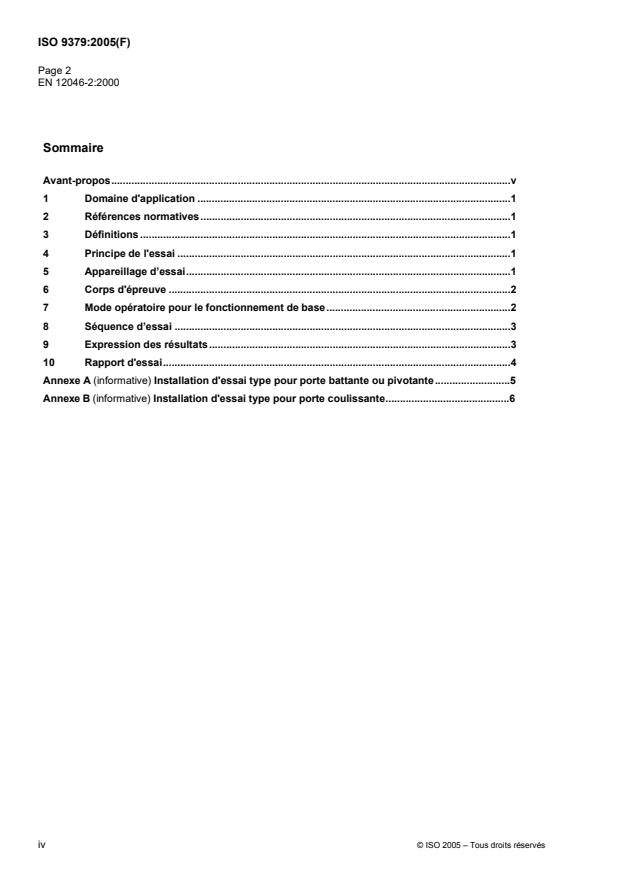
Contents
Foreword .v
1 Scope .1
2 Normative references.1
3 Definitions.1
4 Principle of test .1
5 Test apparatus.1
6 Test specimen .2
7 Procedure for basic operation.2
8 Test sequences.3
9 Expression of results.4
10 Test report.4
Annex A (informative) Typical test set-up for hinged or pivoted door.5
Annex B (informative) Typical test set-up for sliding door .6
iv © ISO 2005 – All rights reserved
Page 3
EN 12046-2:2000
Foreword
This European Standard has been prepared by Technical Committee CEN/TC 33 "Portes,
fenêtres, fermetures, quincaillerie de bâtiment et façades rideaux", the secretariat of which is held
by AFNOR.
This European Standard shall be given the status of a national standard, either by publication of
an identical text or by endorsement, at the latest by August 2000, and conflicting national
standards shall be withdrawn at the latest by August 2000.
According to the CEN/CENELEC Internal Regulations, the national standards organizations of the
following countries are bound to implement this European Standard: Austria, Belgium, Czech
Republic, Denmark, Finland, France, Germany, Greece, Iceland, Ireland, Italy, Luxembourg,
Netherlands, Norway, Portugal, Spain, Sweden, Switzerland and the United Kingdom.
This Standard is one in series of standards for doors.
The Annexes A and B are informative.
Page 4
EN 12046-2:2000
1 Scope
This Standard is for hinged/pivoted and sliding doorsets with latches, for pedestrian use. It defines
the test methods to determine the forces to open/close doors and to engage/release and
lock/unlock the hardware using a key or handle.
It is only applicable to the manual operation doorsets.
The measurement of forces for doorsets with self closing devices engaged is excluded from this
test method. It is also not applicable to doorsets with special hardware e.g. emergency exit
devices.
The tests are applicable to doorsets of any material.
NOTE : The operation of some windows involves latches and may be tested in
accordance with this standard.
2 Normative references
This European Standard incorporates by dated or undated reference, provisions from other
publications. These normative references are cited at the appropriate places in the text and the
publications are listed hereafter. For dated references, subsequent amen
...
NORME ISO
INTERNATIONALE 9379
Deuxième édition
2005-10-15
Forces de manœuvre — Méthodes
d'essai — Portes
Operating forces — Test method — Doors
Numéro de référence
©
ISO 2005
PDF – Exonération de responsabilité
Le présent fichier PDF peut contenir des polices de caractères intégrées. Conformément aux conditions de licence d'Adobe, ce fichier
peut être imprimé ou visualisé, mais ne doit pas être modifié à moins que l'ordinateur employé à cet effet ne bénéficie d'une licence
autorisant l'utilisation de ces polices et que celles-ci y soient installées. Lors du téléchargement de ce fichier, les parties concernées
acceptent de fait la responsabilité de ne pas enfreindre les conditions de licence d'Adobe. Le Secrétariat central de l'ISO décline toute
responsabilité en la matière.
Adobe est une marque déposée d'Adobe Systems Incorporated.
Les détails relatifs aux produits logiciels utilisés pour la création du présent fichier PDF sont disponibles dans la rubrique General Info
du fichier; les paramètres de création PDF ont été optimisés pour l'impression. Toutes les mesures ont été prises pour garantir
l'exploitation de ce fichier par les comités membres de l'ISO. Dans le cas peu probable où surviendrait un problème d'utilisation,
veuillez en informer le Secrétariat central à l'adresse donnée ci-dessous.
© ISO 2005
Droits de reproduction réservés. Sauf prescription différente, aucune partie de cette publication ne peut être reproduite ni utilisée sous
quelque forme que ce soit et par aucun procédé, électronique ou mécanique, y compris la photocopie et les microfilms, sans l'accord écrit
de l'ISO à l'adresse ci-après ou du comité membre de l'ISO dans le pays du demandeur.
ISO copyright office
Case postale 56 • CH-1211 Geneva 20
Tel. + 41 22 749 01 11
Fax. + 41 22 749 09 47
E-mail copyright@iso.org
Web www.iso.org
Publié en Suisse
ii © ISO 2005– Tous droits réservés
Avant-propos
L'ISO (Organisation internationale de normalisation) est une fédération mondiale d'organismes nationaux de
normalisation (comités membres de l'ISO). L'élaboration des Normes internationales est en général confiée
aux comités techniques de l'ISO. Chaque comité membre intéressé par une étude a le droit de faire partie du
comité technique créé à cet effet. Les organisations internationales, gouvernementales et non
gouvernementales, en liaison avec l'ISO participent également aux travaux. L'ISO collabore étroitement avec
la Commission électrotechnique internationale (CEI) en ce qui concerne la normalisation électrotechnique.
Les Normes internationales sont rédigées conformément aux règles données dans les Directives ISO/CEI,
Partie 2.
La tâche principale des comités techniques est d'élaborer les Normes internationales. Les projets de Normes
internationales adoptés par les comités techniques sont soumis aux comités membres pour vote. Leur
publication comme Normes internationales requiert l'approbation de 75 % au moins des comités membres
votants.
L'attention est appelée sur le fait que certains des éléments du présent document peuvent faire l'objet de
droits de propriété intellectuelle ou de droits analogues. L'ISO ne saurait être tenue pour responsable de ne
pas avoir identifié de tels droits de propriété et averti de leur existence.
L’ISO 9379 a été élaborée par le Comité européen de normalisation (en tant que EN 12046-2:2000) et a été
adoptée, selon une procédure spéciale par «voie express», par le comité technique ISO/TC 162, Portes et
fenêtres, parallèlement à son approbation par les comités membres de l'ISO.
Cette deuxième édition annule et remplace la première édition (ISO 9379:1989), qui a fait l'objet d'une
révision technique.
Tout au long du texte du présent document, lire «. cette Norme européenne.» avec le sens de «. la
présente Norme internationale.».
Page 2
EN 12046-2:2000
Sommaire
Avant-propos.v
1 Domaine d'application .1
2 Références normatives.1
3 Définitions .1
4 Principe de l'essai .1
5 Appareillage d’essai.1
6 Corps d'épreuve .2
7 Mode opératoire pour le fonctionnement de base.2
8 Séquence d’essai .3
9 Expression des résultats.3
10 Rapport d'essai.4
Annexe A (informative) Installation d'essai type pour porte battante ou pivotante.5
Annexe B (informative) Installation d'essai type pour porte coulissante.6
iv © ISO 2005 – Tous droits réservés
Page 3
EN 12046-2:2000
Avant-propos
La présente norme européenne a été élaborée par le Comité Technique CEN/TC 33 "Portes, fenêtres, fermetures,
quincaillerie de bâtiment et façades rideaux" dont le secrétariat est tenu par l'AFNOR.
Cette norme européenne devra recevoir le statut de norme nationale, soit par publication d'un texte identique, soit
par entérinement, au plus tard en août 2000, et toutes les normes nationales en contradiction devront être retirées
au plus tard en août 2000.
Selon le Règlement Intérieur du CEN/CENELEC, les instituts de normalisation nationaux des pays suivants sont
tenus de mettre cette norme européenne en application: Allemagne, Autriche, Belgique, Danemark, Espagne,
Finlande, France, Grèce, Irlande, Islande, Italie, Luxembourg, Norvège, Pays-Bas, Portugal, République Tchèque,
Royaume-Uni, Suède et Suisse.
Cette norme fait partie d'une série de normes relatives pour les portes.
Les annexes A et B sont informatives.
Page 4
EN 12046-2:2000
1 Domaine d'application
La présente norme concerne les blocs-portes battants/pivotants et coulissants équipés de pênes demi-tour et
destinés à être utilisés par des piétons. Elle définit les méthodes d'essai permettant de déterminer les forces
d'ouverture/fermeture des portes et pour enclencher/libérer et verrouiller/déverrouiller la quincaillerie à l'aide d'une
clé ou d'une poignée.
Elle n'est applicable qu'à la manœuvre manuelle de blocs-portes.
Le mesurage des forces pour les blocs-portes avec des systèmes à fermeture automatique enclenchés est exclu
de la présente méthode d'essai. Elle n'est pas applicable aux blocs-portes équipés d'une quincaillerie spéciales,
par exemple les systèmes d'issue de secours.
Les essais sont applicables aux blocs-portes quel que soit leur matériau.
NOTE : La manœuvre de certaines fenêtres implique des pênes demi-tour. Il est permis de les essayer
conformément à la présente norme.
2 Références normatives
Cette Norme Européenne comporte par référence datée ou non datée des dispositions d'autres publications. Ces
références normatives sont citées aux endroits appropriés dans le texte et les publications sont énumérées ci-
après. Pour les références datées, les amendements ou révisions ultérieurs de l'une quelconque de ces
publications ne s'appliquent à cette Norme Européenne que s'ils y ont été incorporés par amendement ou révision.
Pour les références non datées
...
Questions, Comments and Discussion
Ask us and Technical Secretary will try to provide an answer. You can facilitate discussion about the standard in here.
Loading comments...