

ISO 8275:2023
(Main)Hinged or pivoted doors — Determination of the resistance to vertical load
General Information
- Abstract
This document specifies the method to be used to determine the permanent deformation caused when a vertical load is applied to an open door leaf fixed in its own door frame as part of a door set. This document applies to all vertically hinged or pivoted doors. The method can also be used with respect to a door leaf submitted for test in a frame, which the manufacturer considers appropriate to and typical for the intended utilization.
- Status
- Published
- Publication Date
- 07-Feb-2023
- Technical Committee
- ISO/TC 162 - Doors, windows and curtain walling
- Drafting Committee
- ISO/TC 162 - Doors, windows and curtain walling
- Current Stage
- 6060 - International Standard published
- Start Date
- 08-Feb-2023
- Due Date
- 26-Nov-2023
- Completion Date
- 08-Feb-2023

Overview
ISO 8275:2023 - Hinged or pivoted doors: Determination of the resistance to vertical load specifies a laboratory method for measuring permanent deformation when a vertical load is applied to an open door leaf fixed in its door frame (or in a typical frame representative of intended use). The standard applies to all vertically hinged or pivoted doors and replaces the 1985 edition with updates for pivoted doors and refined technical content.
Key topics and technical requirements
- Scope: Tests permanent (residual) deformation caused by a vertical load on an open door leaf in its frame.
- Test specimen conditions: Storage and testing in a non‑destructive environment: 15 °C to 30 °C and 25 % to 75 % relative humidity. Glazed doors tested with glazing installed per manufacturer’s instructions.
- Test setup: Door positioned at (90 ± 5)° to the frame; diagonal measurement D taken before and after testing to quantify residual deformation.
- Preload and load application:
- Preload of (200 ± 4) N applied to the top of the lock-side corner (50 ± 5 mm from opening edge) for (60 ± 5) s to take up hinge slack.
- Static test load F applied to the same point for (300 ± 5) s; measure maximum deflection under load and residual deformation after load removal.
- Loads must be applied/removed in increments ≤ 100 N, with load accuracy ±2 % to avoid dynamic effects.
- Apparatus accuracy:
- Loading device accuracy 2 % (weights or calibrated ram).
- Measuring equipment accuracy 0,1 mm.
- Results & reporting: Record deformation under load, residual deformation in vertical plane and change in diagonal D. Test report must reference ISO 8275:2023 and include specimen identification, materials, hardware, frame details, storage conditions, applied load, results, damage observed, deviations, laboratory name and date.
Applications and who uses it
- Door manufacturers - validate product durability and claim conformance when doors are sold as leaves or as complete door sets.
- Test laboratories and certification bodies - carry out standardized testing for type approvals, product certification, and quality assurance.
- Specifiers, architects, building owners - assess suitability of door assemblies for high‑use or safety‑sensitive installations.
- R&D and quality control teams - evaluate hinge design, hardware location, glazing effects and assembly robustness against vertical loads (e.g., child pulling on handle).
Related standards
- ISO 22496 - terminology (vocabulary for windows and pedestrian doors) used by ISO 8275.
- EN 947 - referenced normative source for similar testing; see bibliography of ISO 8275:2023.
Keywords: ISO 8275, hinged doors testing, pivoted doors, resistance to vertical load, door deformation test, door set test procedure, vertical load resistance, door certification.
Relations
- Effective Date
- 06-Jun-2022
Get Certified
Connect with accredited certification bodies for this standard

DIBt (Deutsches Institut für Bautechnik)
German Institute for Building Technology.
DIN CERTCO
DIN Group product certification.

Aboma Certification B.V.
Specialized in construction, metal, and transport sectors.
Sponsored listings
Frequently Asked Questions
ISO 8275:2023 is a standard published by the International Organization for Standardization (ISO). Its full title is "Hinged or pivoted doors — Determination of the resistance to vertical load". This standard covers: This document specifies the method to be used to determine the permanent deformation caused when a vertical load is applied to an open door leaf fixed in its own door frame as part of a door set. This document applies to all vertically hinged or pivoted doors. The method can also be used with respect to a door leaf submitted for test in a frame, which the manufacturer considers appropriate to and typical for the intended utilization.
This document specifies the method to be used to determine the permanent deformation caused when a vertical load is applied to an open door leaf fixed in its own door frame as part of a door set. This document applies to all vertically hinged or pivoted doors. The method can also be used with respect to a door leaf submitted for test in a frame, which the manufacturer considers appropriate to and typical for the intended utilization.
ISO 8275:2023 is classified under the following ICS (International Classification for Standards) categories: 91.060.50 - Doors and windows. The ICS classification helps identify the subject area and facilitates finding related standards.
ISO 8275:2023 has the following relationships with other standards: It is inter standard links to ISO 8275:1985. Understanding these relationships helps ensure you are using the most current and applicable version of the standard.
ISO 8275:2023 is available in PDF format for immediate download after purchase. The document can be added to your cart and obtained through the secure checkout process. Digital delivery ensures instant access to the complete standard document.
Standards Content (Sample)
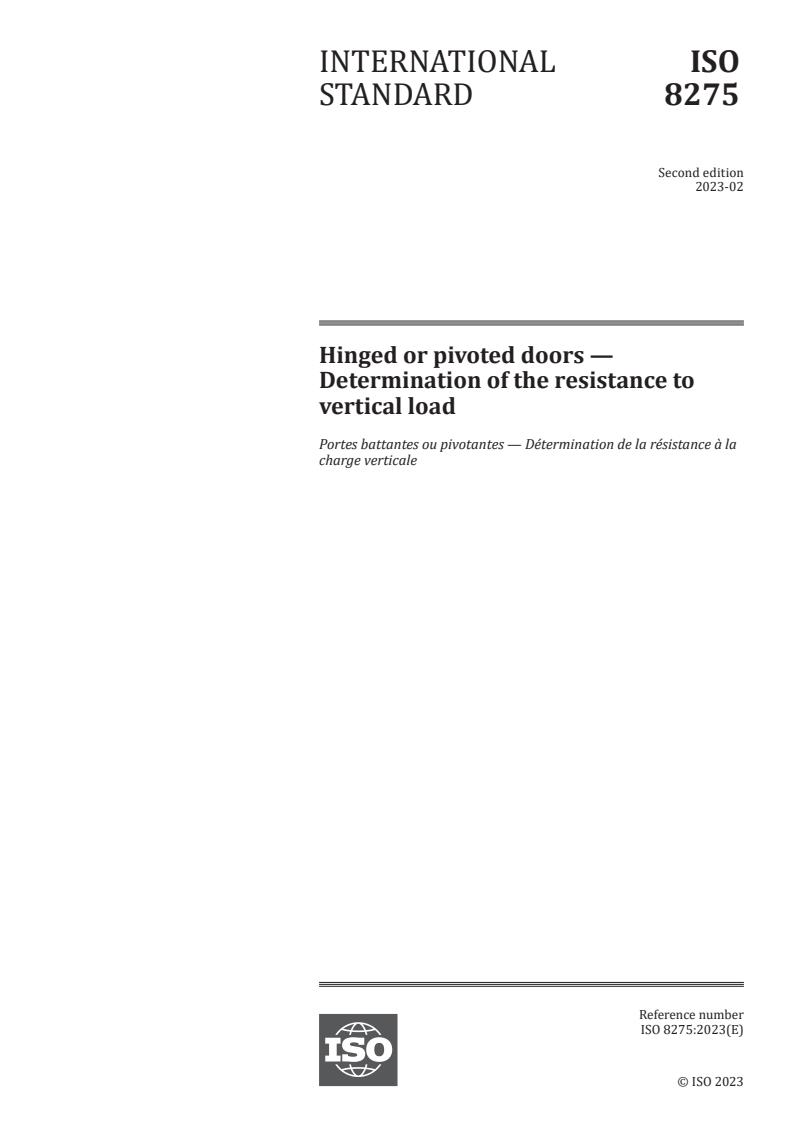
INTERNATIONAL ISO
STANDARD 8275
Second edition
2023-02
Hinged or pivoted doors —
Determination of the resistance to
vertical load
Portes battantes ou pivotantes — Détermination de la résistance à la
charge verticale
Reference number
© ISO 2023
All rights reserved. Unless otherwise specified, or required in the context of its implementation, no part of this publication may
be reproduced or utilized otherwise in any form or by any means, electronic or mechanical, including photocopying, or posting on
the internet or an intranet, without prior written permission. Permission can be requested from either ISO at the address below
or ISO’s member body in the country of the requester.
ISO copyright office
CP 401 • Ch. de Blandonnet 8
CH-1214 Vernier, Geneva
Phone: +41 22 749 01 11
Email: copyright@iso.org
Website: www.iso.org
Published in Switzerland
ii
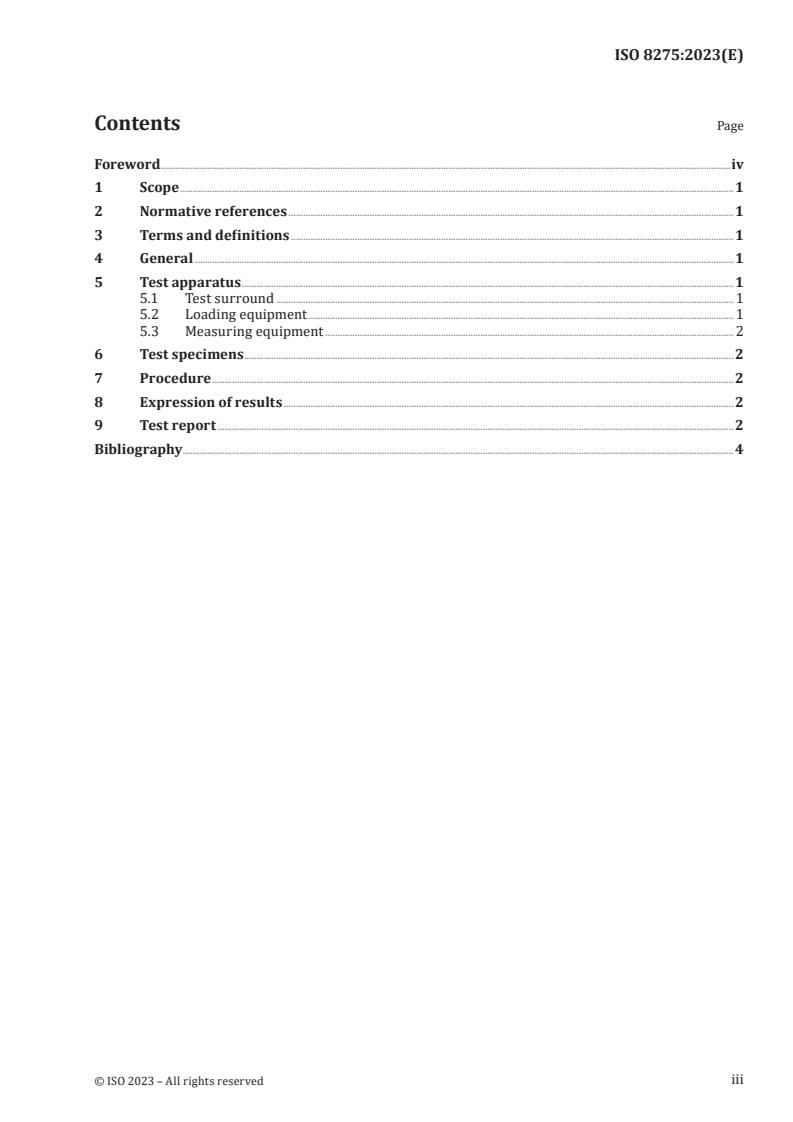
Contents Page
Foreword .iv
1 Scope . 1
2 Normative references . 1
3 Terms and definitions . 1
4 General . 1
5 Test apparatus .1
5.1 Test surround . 1
5.2 Loading equipment . 1
5.3 Measuring equipment . 2
6 Test specimens . 2
7 Procedure .2
8 Expression of results . 2
9 Test report . 2
Bibliography . 4
iii
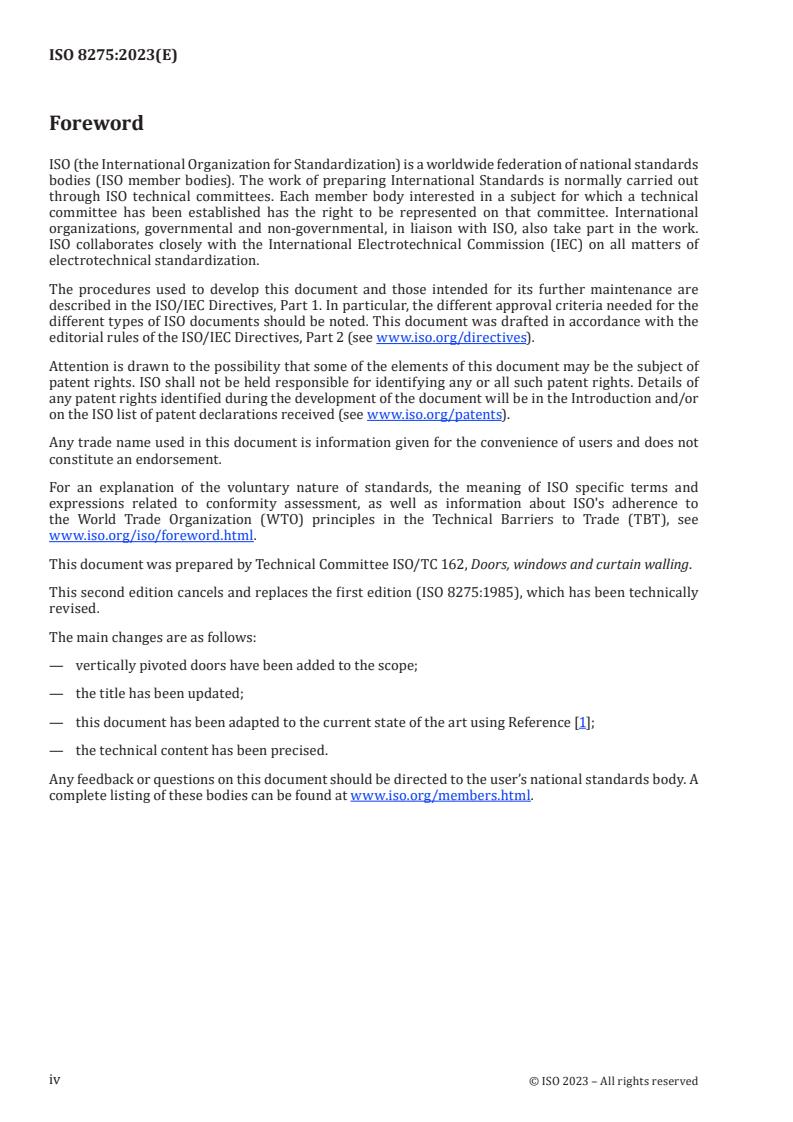
Foreword
ISO (the International Organization for Standardization) is a worldwide federation of national standards
bodies (ISO member bodies). The work of preparing International Standards is normally carried out
through ISO technical committees. Each member body interested in a subject for which a technical
committee has been established has the right to be represented on that committee. International
organizations, governmental and non-governmental, in liaison with ISO, also take part in the work.
ISO collaborates closely with the International Electrotechnical Commission (IEC) on all matters of
electrotechnical standardization.
The procedures used to develop this document and those intended for its further maintenance are
described in the ISO/IEC Directives, Part 1. In particular, the different approval criteria needed for the
different types of ISO documents should be noted. This document was drafted in accordance with the
editorial rules of the ISO/IEC Directives, Part 2 (see www.iso.org/directives).
Attention is drawn to the possibility that some of the elements of this document may be the subject of
patent rights. ISO shall not be held responsible for identifying any or all such patent rights. Details of
any patent rights identified during the development of the document will be in the Introduction and/or
on the ISO list of patent declarations received (see www.iso.org/patents).
Any trade name used in this document is information given for the convenience of users and does not
constitute an endorsement.
For an explanation of the voluntary nature of standards, the meaning of ISO specific terms and
expressions related to conformity assessment, as well as information about ISO's adherence to
the World Trade Organization (WTO) principles in the Technical Barriers to Trade (TBT), see
www.iso.org/iso/foreword.html.
This document was prepared by T
...