


ISO 10303-235:2009
(Main)Industrial automation systems and integration — Product data representation and exchange — Part 235: Application protocol: Engineering properties for product design and verification
Industrial automation systems and integration — Product data representation and exchange — Part 235: Application protocol: Engineering properties for product design and verification
ISO 10303-235:2009 specifies the use of the integrated resources necessary for the scope and information requirements for the representation of engineering property data that are used for product design and product validation. The following are within the scope of ISO 10303-235:2009: descriptions and definitions of the manufactured product, the sample of the product and the testable version of the sample; description of the composition and substance of the product; description of the processes used in the measurement; descriptions of the data values produced by the measurement, with the specification of the conditions in which the data is valid; references to standards and other documents wherein sampling, measurement and other details of testing and measurement processes can be specified or described; descriptions and qualifications of the personnel and or organizations responsible for the measurement; specification of the requirements, conditions and tolerances to be satisfied in the measurement and a description of the outcome; descriptions of the locations of the measurement process and the effectivity of the results; descriptions of the approval that establishes the validity of the measurements and the use of the properties for product design and design validation. The following are outside the scope of ISO 10303-235:2009: data describing rules, guidelines and expert knowledge in the testing of products; names of properties and test methods; data describing why a decision was made to use a particular process; scheduling data for measurement processes; algorithms used for data evaluation and data processing.
Systèmes d'automatisation industrielle et intégration — Représentation et échange de données de produits — Partie 235: Protocole d'application: Propriétés d'ingénierie pour la conception de produits et vérification
General Information
- Status
- Withdrawn
- Publication Date
- 19-Aug-2009
- Withdrawal Date
- 19-Aug-2009
- Technical Committee
- ISO/TC 184/SC 4 - Industrial data
- Drafting Committee
- ISO/TC 184/SC 4/WG 12 - STEP product modelling and resources
- Current Stage
- 9599 - Withdrawal of International Standard
- Start Date
- 27-May-2019
- Completion Date
- 14-Feb-2026
Relations
- Effective Date
- 26-Aug-2017
Buy Documents
ISO 10303-235:2009 - Industrial automation systems and integration -- Product data representation and exchange


ISO 10303-235:2009 - Industrial automation systems and integration -- Product data representation and exchange
Get Certified
Connect with accredited certification bodies for this standard

National Aerospace and Defense Contractors Accreditation Program (NADCAP)
Global cooperative program for special process quality in aerospace.
CARES (UK Certification Authority for Reinforcing Steels)
UK certification for reinforcing steels and construction.
DVS-ZERT GmbH
German welding certification society.
Sponsored listings
Frequently Asked Questions
ISO 10303-235:2009 is a standard published by the International Organization for Standardization (ISO). Its full title is "Industrial automation systems and integration — Product data representation and exchange — Part 235: Application protocol: Engineering properties for product design and verification". This standard covers: ISO 10303-235:2009 specifies the use of the integrated resources necessary for the scope and information requirements for the representation of engineering property data that are used for product design and product validation. The following are within the scope of ISO 10303-235:2009: descriptions and definitions of the manufactured product, the sample of the product and the testable version of the sample; description of the composition and substance of the product; description of the processes used in the measurement; descriptions of the data values produced by the measurement, with the specification of the conditions in which the data is valid; references to standards and other documents wherein sampling, measurement and other details of testing and measurement processes can be specified or described; descriptions and qualifications of the personnel and or organizations responsible for the measurement; specification of the requirements, conditions and tolerances to be satisfied in the measurement and a description of the outcome; descriptions of the locations of the measurement process and the effectivity of the results; descriptions of the approval that establishes the validity of the measurements and the use of the properties for product design and design validation. The following are outside the scope of ISO 10303-235:2009: data describing rules, guidelines and expert knowledge in the testing of products; names of properties and test methods; data describing why a decision was made to use a particular process; scheduling data for measurement processes; algorithms used for data evaluation and data processing.
ISO 10303-235:2009 specifies the use of the integrated resources necessary for the scope and information requirements for the representation of engineering property data that are used for product design and product validation. The following are within the scope of ISO 10303-235:2009: descriptions and definitions of the manufactured product, the sample of the product and the testable version of the sample; description of the composition and substance of the product; description of the processes used in the measurement; descriptions of the data values produced by the measurement, with the specification of the conditions in which the data is valid; references to standards and other documents wherein sampling, measurement and other details of testing and measurement processes can be specified or described; descriptions and qualifications of the personnel and or organizations responsible for the measurement; specification of the requirements, conditions and tolerances to be satisfied in the measurement and a description of the outcome; descriptions of the locations of the measurement process and the effectivity of the results; descriptions of the approval that establishes the validity of the measurements and the use of the properties for product design and design validation. The following are outside the scope of ISO 10303-235:2009: data describing rules, guidelines and expert knowledge in the testing of products; names of properties and test methods; data describing why a decision was made to use a particular process; scheduling data for measurement processes; algorithms used for data evaluation and data processing.
ISO 10303-235:2009 is classified under the following ICS (International Classification for Standards) categories: 25.040.40 - Industrial process measurement and control. The ICS classification helps identify the subject area and facilitates finding related standards.
ISO 10303-235:2009 has the following relationships with other standards: It is inter standard links to ISO 10303-235:2019. Understanding these relationships helps ensure you are using the most current and applicable version of the standard.
ISO 10303-235:2009 is available in PDF format for immediate download after purchase. The document can be added to your cart and obtained through the secure checkout process. Digital delivery ensures instant access to the complete standard document.
Standards Content (Sample)
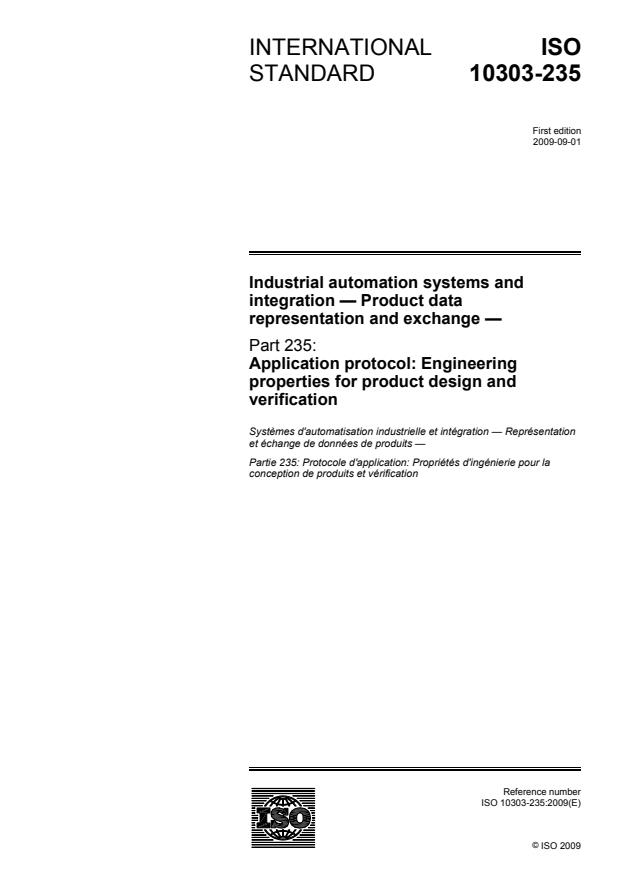
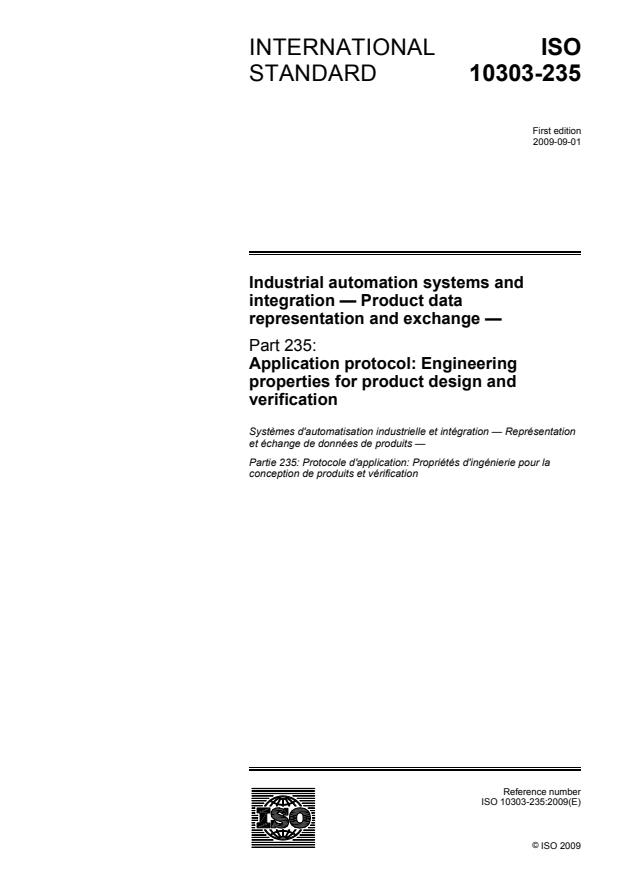
INTERNATIONAL ISO
STANDARD 10303-235
First edition
2009-09-01
Industrial automation systems and
integration — Product data
representation and exchange —
Part 235:
Application protocol: Engineering
properties for product design and
verification
Systèmes d'automatisation industrielle et intégration — Représentation
et échange de données de produits —
Partie 235: Protocole d'application: Propriétés d'ingénierie pour la
conception de produits et vérification
Reference number
©
ISO 2009
PDF disclaimer
This PDF file may contain embedded typefaces. In accordance with Adobe's licensing policy, this file may be printed or viewed but
shall not be edited unless the typefaces which are embedded are licensed to and installed on the computer performing the editing. In
downloading this file, parties accept therein the responsibility of not infringing Adobe's licensing policy. The ISO Central Secretariat
accepts no liability in this area.
Adobe is a trademark of Adobe Systems Incorporated.
Details of the software products used to create this PDF file can be found in the General Info relative to the file; the PDF-creation
parameters were optimized for printing. Every care has been taken to ensure that the file is suitable for use by ISO member bodies. In
the unlikely event that a problem relating to it is found, please inform the Central Secretariat at the address given below.
© ISO 2009
All rights reserved. Unless otherwise specified, no part of this publication may be reproduced or utilized in any form or by any means,
electronic or mechanical, including photocopying and microfilm, without permission in writing from either ISO at the address below or
ISO's member body in the country of the requester.
ISO copyright office
Case postale 56 • CH-1211 Geneva 20
Tel. + 41 22 749 01 11
Fax + 41 22 749 09 47
E-mail copyright@iso.org
Web www.iso.org
Published in Switzerland
ii © ISO 2009 – All rights reserved
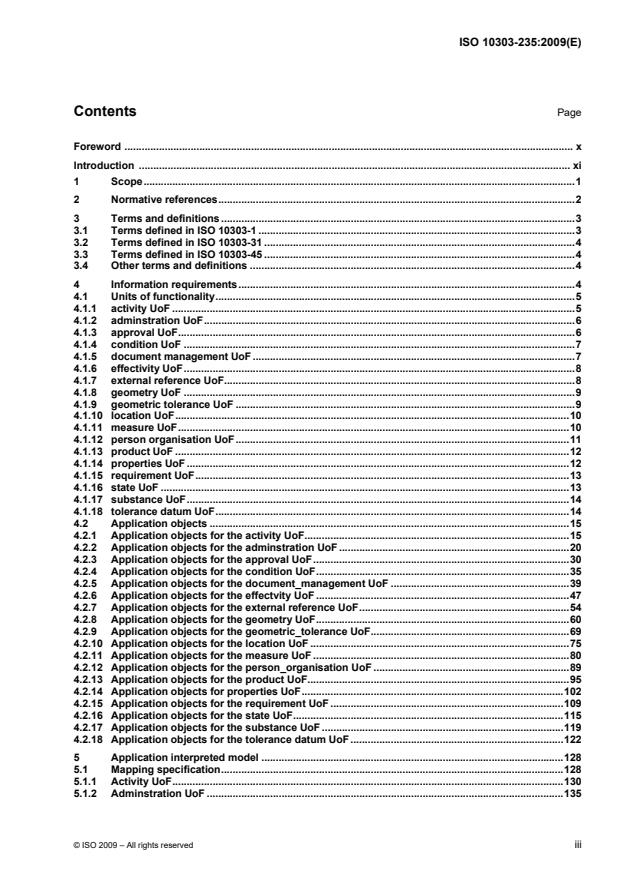
Contents Page
Foreword . x
Introduction . xi
1 Scope.1
2 Normative references.2
3 Terms and definitions .3
3.1 Terms defined in ISO 10303-1 .3
3.2 Terms defined in ISO 10303-31 .4
3.3 Terms defined in ISO 10303-45 .4
3.4 Other terms and definitions .4
4 Information requirements.4
4.1 Units of functionality.5
4.1.1 activity UoF .5
4.1.2 adminstration UoF.6
4.1.3 approval UoF.6
4.1.4 condition UoF .7
4.1.5 document management UoF .7
4.1.6 effectivity UoF.8
4.1.7 external reference UoF.8
4.1.8 geometry UoF .9
4.1.9 geometric tolerance UoF .9
4.1.10 location UoF.10
4.1.11 measure UoF.10
4.1.12 person organisation UoF.11
4.1.13 product UoF .12
4.1.14 properties UoF.12
4.1.15 requirement UoF.13
4.1.16 state UoF .13
4.1.17 substance UoF.14
4.1.18 tolerance datum UoF.14
4.2 Application objects .15
4.2.1 Application objects for the activity UoF.15
4.2.2 Application objects for the adminstration UoF .20
4.2.3 Application objects for the approval UoF.30
4.2.4 Application objects for the condition UoF.35
4.2.5 Application objects for the document_management UoF .39
4.2.6 Application objects for the effectvity UoF .47
4.2.7 Application objects for the external reference UoF.54
4.2.8 Application objects for the geometry UoF.60
4.2.9 Application objects for the geometric_tolerance UoF.69
4.2.10 Application objects for the location UoF .75
4.2.11 Application objects for the measure UoF .80
4.2.12 Application objects for the person_organisation UoF .89
4.2.13 Application objects for the product UoF.95
4.2.14 Application objects for properties UoF.102
4.2.15 Application objects for the requirement UoF .109
4.2.16 Application objects for the state UoF.115
4.2.17 Application objects for the substance UoF .119
4.2.18 Application objects for the tolerance datum UoF .122
5 Application interpreted model .128
5.1 Mapping specification.128
5.1.1 Activity UoF.130
5.1.2 Adminstration UoF .135
5.1.3 Approval UoF . 141
5.1.4 Condition UoF . 146
5.1.5 Document management UoF. 148
5.1.6 Effectivity UoF. 156
5.1.7 External_reference UoF . 162
5.1.8 Geometry UoF . 171
5.1.9 Geometric tolerance UoF . 177
5.1.10 Location UoF. 183
5.1.11 Measure UoF . 187
5.1.12 Person organisation UoF . 193
5.1.13 Product UoF . 199
5.1.14 Properties UoF . 205
5.1.15 Requirements UoF. 211
5.1.16 State UoF . 217
5.1.17 Substance UoF. 220
5.1.18 Tolerance datum UoF . 224
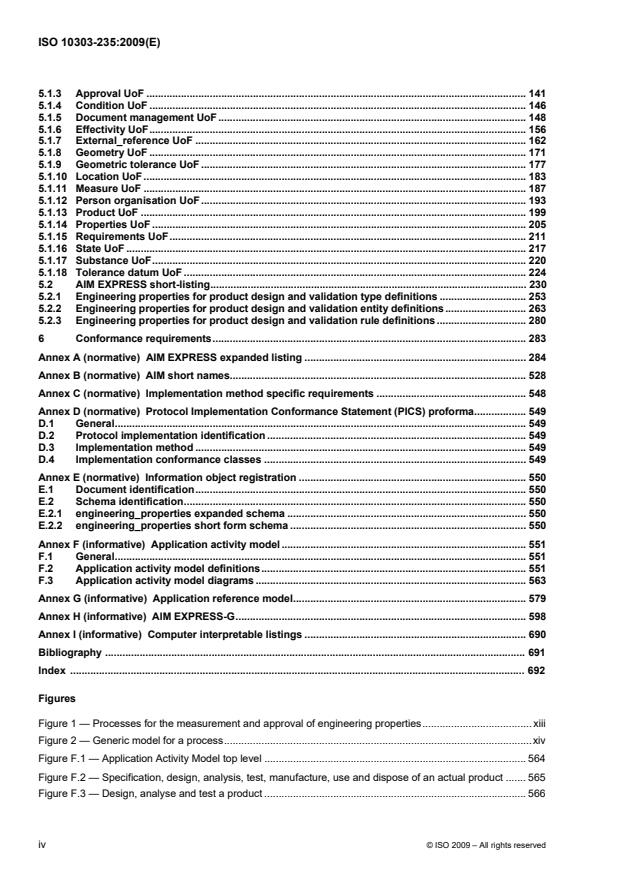
5.2 AIM EXPRESS short-listing. 230
5.2.1 Engineering properties for product design and validation type definitions . 253
5.2.2 Engineering properties for product design and validation entity definitions . 263
5.2.3 Engineering properties for product design and validation rule definitions . 280
6 Conformance requirements. 283
Annex A (normative) AIM EXPRESS expanded listing . 284
Annex B (normative) AIM short names. 528
Annex C (normative) Implementation method specific requirements . 548
Annex D (normative) Protocol Implementation Conformance Statement (PICS) proforma. 549
D.1 General. 549
D.2 Protocol implementation identification . 549
D.3 Implementation method . 549
D.4 Implementation conformance classes . 549
Annex E (normative) Information object registration . 550
E.1 Document identification. 550
E.2 Schema identification. 550
E.2.1 engineering_properties expanded schema . 550
E.2.2 engineering_properties short form schema . 550
Annex F (informative) Application activity model . 551
F.1 General. 551
F.2 Application activity model definitions. 551
F.3 Application activity model diagrams . 563
Annex G (informative) Application reference model. 579
Annex H (informative) AIM EXPRESS-G. 598
Annex I (informative) Computer interpretable listings . 690
Bibliography . 691
Index . 692
Figures
Figure 1 — Processes for the measurement and approval of engineering properties. xiii
Figure 2 — Generic model for a process.xiv
Figure F.1 — Application Activity Model top level . 564
Figure F.2 — Specification, design, analysis, test, manufacture, use and dispose of an actual product . 565
Figure F.3 — Design, analyse and test a product . 566
iv © ISO 2009 – All rights reserved
Figure F.4 — Develop and manage material property information .567
Figure F.5 — Procure and test material object.568
Figure F.6 — Reduce and evaluate data .569
Figure F.7 — Conduct product design, analysis and assessment.570
Figure F.8 — Conduct preliminary whole system and process design .571
Figure F.9 — Conduct component and process design and analysis.572
Figure F.10 — Verify product design.573
Figure F.11 — Conduct detail analysis .574
Figure F.12 — Generate response models.575
Figure F.13 — Generate environment model.576
Figure F.14 — Test product.577
Figure F.15 — Manufacture, use and dispose of an actual product .578
Figure G.1 — ARM EXPRESS-G diagram: activity UoF (1of 18) .580
Figure G.2 — ARM EXPRESS-G diagram: administration UoF (2 of 18).581
Figure G.3 — ARM EXPRESS-G diagram: approval UoF (3 of 18).582
Figure G.4 — ARM EXPRESS-G diagram: condition UoF (4 of 18).583
Figure G.5 — ARM EXPRESS-G diagram: document UoF (5 of 18).584
Figure G.6 — ARM EXPRESS-G diagram: effectivity UoF (6 of 18) .585
Figure G.7 — ARM EXPRESS-G diagram: external_reference UoF (7 of 18) .586
Figure G.8 — ARM EXPRESS-G diagram: geometry UoF (8 of 18) .587
Figure G.9 — ARM EXPRESS-G diagram: geometric_tolerance UoF (9 of 18).588
Figure G.10 — ARM EXPRESS-G diagram: location UoF (10 of 18).589
Figure G.11 — ARM EXPRESS-G diagram: measure UoF (11 of 18) .590
Figure G.12 — ARM EXPRESS-G diagram: person_organisation UoF (12 of 18).591
Figure G.13 — ARM EXPRESS-G diagram: product UoF (13 of 18) .592
Figure G.14 — ARM EXPRESS-G diagram: properties UoF (14 of 18) .593
Figure G.15 — ARM EXPRESS-G diagram: requirements UoF (15 of 18) .594
Figure G.16 — ARM EXPRESS-G diagram: state UoF (16 of 18).595
Figure G.17 — ARM EXPRESS-G diagram: substance UoF (17 of 18).596
Figure G.18 — ARM EXPRESS-G diagram: tolerance_datum (18 of 18) .597
Figure H.1 — AIM EXPRESS-G diagram: common resources (1 of 91). 599
Figure H.2 — AIM EXPRESS-G diagram: date_time types (2 of 91). 600
Figure H.3 — AIM EXPRESS-G diagram: integer numbers (3 of 91) . 601
Figure H.4 — AIM EXPRESS-G diagram: object_role (4 of 91). 602
Figure H.5 — AIM EXPRESS-G diagram: id_attribute (5 of 91) . 603
Figure H.6 — AIM EXPRESS-G diagram: description_attribute (6 of 91). 604
Figure H.7 — AIM EXPRESS-G diagram: name_attribute (7 of 91) . 605
Figure H.8 — AIM EXPRESS-G diagram: action (8 of 91). 606
Figure H.9 — AIM EXPRESS-G diagram: action_method (9 of 91). 607
Figure H.10 — AIM EXPRESS-G diagram: action_property and action_resource (10 of 91). 608
Figure H.11 — AIM EXPRESS-G diagram: action_request (11 of 91). 609
Figure H.12 — AIM EXPRESS-G diagram: application_context (12 of 91) . 610
Figure H.13 — AIM EXPRESS-G diagram: approval (13 of 91). 611
Figure H.14 — AIM EXPRESS-G diagram: math_types (14 of 91). 612
Figure H.15 — AIM EXPRESS-G diagram: generic_expression (15 of 91). 613
Figure H.16 — AIM EXPRESS-G diagram: simple_generic_expression (16 of 91). 614
Figure H.17 — AIM EXPRESS-G diagram: unary_generic_expression (17 of 91). 615
Figure H.18 — AIM EXPRESS-G diagram: binary_generic_expression (18 of 91) . 616
Figure H.19 — AIM EXPRESS-G diagram: multiple_arity_generic_expression (19 of 91). 617
Figure H.20 — AIM EXPRESS-G diagram: generic_literal_expression (20 of 91) . 618
Figure H.21 — AIM EXPRESS-G diagram: generic_variable (21 of 91). 619
Figure H.22 — AIM EXPRESS-G diagram: expression (22 of 91). 620
Figure H.23 — AIM EXPRESS-G diagram: numeric_expression (23 of 91). 621
Figure H.24 — AIM EXPRESS-G diagram: boolean_expression (24 of 91). 622
Figure H.25 — AIM EXPRESS-G diagram: string_expression (25 of 91) . 623
Figure H.26 — AIM EXPRESS-G diagram: document (26 of 91). 624
Figure H.27 — AIM EXPRESS-G diagram: defined_function (27 of 91). 625
Figure H.28 — AIM EXPRESS-G diagram: numeric_expressions (28 of 91) . 626
Figure H.29 — AIM EXPRESS-G diagram: boolean_expressions (29 of 91) . 627
Figure H.30 — AIM EXPRESS-G diagram: comparison_expression. 628
vi © ISO 2009 – All rights reserved
Figure H.31 — AIM EXPRESS-G diagram: maths_variable (31 of 91).629
Figure H.32 — AIM EXPRESS-G diagram: maths_literal (32 of 91).630
Figure H.33 — AIM EXPRESS-G diagram: maths_space (33 of 91).631
Figure H.34 — AIM EXPRESS-G diagram: maths_spaces (34 of 91).632
Figure H.35 — AIM EXPRESS-G diagram: maths_function (35 of 91).633
Figure H.36 — AIM EXPRESS-G diagram: explicit_table_function (36 of 91) .634
Figure H.37 — AIM EXPRESS-G diagram: maths_functions_1 (37 of 91).635
Figure H.38 — AIM EXPRESS-G diagram: maths_functions_2 (38 of 91).636
Figure H.39 — AIM EXPRESS-G diagram: external_item (39 of 91) .637
Figure H.40 — AIM EXPRESS-G diagram: imported_function (40 of 91) .638
Figure H.41 — AIM EXPRESS-G diagram: geometric_representation_item (41 of 91) .639
Figure H.42 — AIM EXPRESS-G diagram: placement (42 of 91) .640
Figure H.43 — AIM EXPRESS-G diagram: point (43 of 91) .641
Figure H.44 — AIM EXPRESS-G diagram: curve (44 of 91) .642
Figure H.45 — AIM EXPRESS-G diagram: surface (45 of 91) .643
Figure H.46 — AIM EXPRESS-G diagram: volume (46 of 91) .644
Figure H.47 — AIM EXPRESS-G diagram: certification (47 of 91).645
Figure H.48 — AIM EXPRESS-G diagram: contract (48 of 91) .646
Figure H.49 — AIM EXPRESS-G diagram: date_and_time_entities (49 of 91).647
Figure H.50 — AIM EXPRESS-G diagram: time_interval (50 of 91).648
Figure H.51 — AIM EXPRESS-G diagram: event_occurrence (51 of 91) .649
Figure H.52 — AIM EXPRESS-G diagram: event_occurrence (51 of 91) .650
Figure H.53 — AIM EXPRESS-G diagram: group (53 of 91).651
Figure H.54 — AIM EXPRESS-G diagram: language _assignment (54 of 91).652
Figure H.55 — AIM EXPRESS-G diagram: attribute_language_assignment (55 of 91).653
Figure H.56 — AIM EXPRESS-G diagram: location (56 of 91).654
Figure H.57 — AIM EXPRESS-G diagram: material_property (57 of 91).655
Figure H.58 — AIM EXPRESS-G diagram: material_property_representation (58 of 91).656
Figure H.59 — AIM EXPRESS-G diagram: SI_unit and derived _unit (59 of 91).657
Figure H.60 — AIM EXPRESS-G diagram: measure_with_unit (60 of 91).658
Figure H.61 — AIM EXPRESS-G diagram: measure_value (61 of 91). 659
Figure H.62 — AIM EXPRESS-G diagram: named_unit. 660
Figure H.63 — AIM EXPRESS-G diagram:address (63 of 91). 661
Figure H.64 — AIM EXPRESS-G diagram: organization (64 of 91). 662
Figure H.65 — AIM EXPRESS-G diagram: organizational_project (65 of 91). 663
Figure H.66 — AIM EXPRESS-G diagram: person (66 of 91) . 664
Figure H.67 — AIM EXPRESS-G diagram: qualification_type (67 of 91) . 665
Figure H.68 — AIM EXPRESS-G diagram: property_process (68 of 91) . 666
Figure H.69 — AIM EXPRESS-G diagram: resource_property (69 of 91) . 667
Figure H.70 — AIM EXPRESS-G diagram: product (70 of 91) . 668
Figure H.71 — AIM EXPRESS-G diagram: product_category and configuration_design (71 of 91). 669
Figure H.72 — AIM EXPRESS-G diagram: product_definition (72 of 91). 670
Figure H.73 — AIM EXPRESS-G diagram: property_definition and shape_aspect (73 of 91). 671
Figure H.74 — AIM EXPRESS-G diagram: characterized_object (74 of 91). 672
Figure H.75 — AIM EXPRESS-G diagram: general_property (75 of 91). 673
Figure H.76 — AIM EXPRESS-G diagram: property_definition_representation (76 of 91) . 674
Figure H.77 — AIM EXPRESS-G diagram: shape_representation and item_identified_representation_usage
(77 of 91) . 675
Figure H.78 — AIM EXPRESS-G diagram: measure_qualification (78 of 91) . 676
Figure H.79 — AIM EXPRESS-G diagram: representation (79 of 91) . 677
Figure H.80 — AIM EXPRESS-G diagram: representation_item (80 of 91) . 678
Figure H.81 — AIM EXPRESS-G diagram: representation_context (81 of 91). 679
Figure H.82 — AIM EXPRESS-G diagram: security_classification (82 of 91) . 680
Figure H.83 — AIM EXPRESS-G diagram: tolerance_datum (83 of 91) . 681
Figure H.84 — AIM EXPRESS-G diagram: geometric_tolerance_with_datum (84 of 91) . 682
Figure H.85 — AIM EXPRESS-G diagram: geometric_tolerance (85 of 91). 683
Figure H.86 — AIM EXPRESS-G diagram: tolerance_zone_definition (86 of 91) . 684
Figure H.87 — AIM EXPRESS-G diagram: tolerance_value (87 of 91). 685
Figure H.88 — AIM EXPRESS-G diagram: dimensional_location and dimensional_size (88 of 91). 686
Figure H.89 — AIM EXPRESS-G diagram: state_type (89 of 91). 687
viii © ISO 2009 – All rights reserved
Figure H.90 — AIM EXPRESS-G diagram: state_observed (90 of 91) .688
Figure H.91 — AIM EXPRESS-G diagram: multi_language_attribute_item (91 of 91).689
Tables
Table B.1 — Short names of entities specified in the AIM of this part of ISO 10303.528
Foreword
ISO (the International Organization for Standardization) is a worldwide federation of national standards bodies
(ISO member bodies). The work of preparing International Standards is normally carried out through ISO
technical committees. Each member body interested in a subject for which a technical committee has been
established has the right to be represented on that committee. International organizations, governmental and
non-governmental, in liaison with ISO, also take part in the work. ISO collaborates closely with the
International Electrotechnical Commission (IEC) on all matters of electrotechnical standardization.
International Standards are drafted in accordance with the rules given in the ISO/IEC Directives, Part 2.
The main task of technical committees is to prepare International Standards. Draft International Standards
adopted by the technical committees are circulated to the member bodies for voting. Publication as an
International Standard requires approval by at least 75 % of the member bodies casting a vote.
Attention is drawn to the possibility that some of the elements of this document may be the subject of patent
rights. ISO shall not be held responsible for identifying any or all such patent rights.
ISO 10303-235 was prepared by Technical Committee ISO/TC 184, Automation systems and integration,
Subcommittee SC 4, Industrial data.
ISO 10303 is organized as a series of parts, each published separately. The structure of ISO 10303 is described
in ISO 10303-1.
Each part of ISO 10303 is a member of one of the following series: descriptive methods, implementation
methods, conformance testing methodology and framework, integrated generic resources, integrated
application resources, application protocols, abstract test suites, application interpreted constructs and
application modules. This part of ISO 10303 is a member of the application protocols series.
A complete list of the parts of ISO 10303 is available from the Internet:
http://www.tc184-sc4.org/titles/STEP_titles.htm .
x © ISO 2009 – All rights reserved
Introduction
ISO 10303 is an International Standard for the computer-interpretable representation of product information
and for the exchange of product data. The objective is to provide a neutral mechanism capable of describing
products throughout their life cycle. This mechanism is suitable not only for neutral file exchange, but also as a
basis for implementing and sharing product databases, and as a basis for archiving.
This part of ISO 10303 is a member of the application protocol series. This part of ISO 10303 specifies an
application protocol (AP) for those properties of products that can be used for product design and design
validation.
This application protocol defines the context, scope, and information requirements for properties of products
that can be used for product design and design validation, the testing, measurement and approval processes
used to determine those properties and specifies the integrated resources necessary to satisfy these
requirements.
Application protocols provide the basis for developing implementations of ISO 10303 and abstract test suites
for the conformance testing of AP implementations.
Clause 1 defines the scope of this part of ISO 10303 and summarizes the functionality and data covered by this
part of ISO 10303. Clause 3 lists the words defined in this part of ISO 10303 and gives pointers to words
defined elsewhere. An application activity model that is the basis for the definition of the scope is provided in
Annex F. The information requirements for the application are specified in Clause 4, using terminology
appropriate to the application. A graphical representation of the information requirements, referred to as the
application reference model, is given in Annex G.
Resource constructs are interpreted to meet the information requirements of this application and produce the
application interpreted model (AIM). This interpretation, given in 5.1, shows the correspondence between the
information requirements and the AIM. The short-listing of the AIM specifies the interface to the integrated
resources and is given in 5.2. Note that the definitions and EXPRESS provided in the integrated resources for
constructs used in the AIM can include items in select lists and subtypes that are not imported into the AIM.
The expanded listing given in Annex A contains the complete EXPRESS for the AIM without annotation. A
graphical representation of the AIM is given in Annex H. Additional requirements for specific implementation
methods are given in Annex C.
Engineering properties, which include materials properties, are not fundamental constants derived from
physical or chemical laws. The value of an engineering property of a product is dependent on the process
used to measure the property value and on the conditions used in that process.
If properties that are based on fundamental physical or chemical behaviour, such as latent heat or melting
temperature, are measured by different methods, then the results obtained are usually sufficiently similar to be
regarded as a single value. A method used for measuring an engineering property attempts to simulate the
behaviour of a product in an engineering situation in the real world. Each aspect of behaviour, for example the
hardness of a product, can be simulated by several different methods. The methods are usually designed to
be convenient to use and to provide a consistent result from repeated measurements. However, the difference
between physical or chemical properties of a substance and the engineering properties of a product is that if
different methods are used to measure an engineering property, then different results are obtained. For
example, the measurement of the elongation property attempts to provide a numerical value to represent the
engineering concept of plastic ductility by stretching a specially shaped sample of a product by applying a
uniaxial tensile load. The value of the elongation property is determined as a percentage of the original length
of a portion of a sample piece of the product. Comparisons between values of the elongation property for
different products are therefore only possible if the fixed length was the same for each case. It is therefore
necessary to state this length explicitly for all values of the elongation property.
An engineering property is therefore the result from operating a specific test method in a specific manner and
it is necessary to associate the value of an engineering property with the conditions in which it is valid, in order
for the meaning of the value to be explicitly determined. This additional information is called the data
environment in ISO 10303-45. An alternative term that is often used is metadata, i.e. data about data.
In most communications of engineering data, the relationship of a property value to its data environment or
metadata is often an implicit assumption and it might not be explicitly associated with the value. The purpose
of this part of ISO 10303 is to provide the means to associate a property value explicitly to the conditions in
which it was measured, and thus provide an audit trail to the origins of data values that can be used in product
design.
In order to measure the properties of a product, it is sometimes, but not always, possible to test the whole
product. Accordingly, a sample of a product can be taken to represent the bulk of the product and the
procedure for taking this sample can be specified in some regulatory document, such as a quality manual, or
in a standard. The operation of the testing apparatus and the measurement procedure can require that the
item that is tested has a specific shape and dimensions, and it will be necessary to create this from the
product sample by some manufacturing process. The result of this process can be called a test piece. The
specific shape and dimensions of test pieces can also be defined in standards or other regulatory documents.
The measurement of the engineering property is then carried out on the test piece by means of some
measuring apparatus or testing machine, whose operation might have to be controlled to be within specified
limits. Manufactured products can be assemblies or single products, but they are rarely homogenous or
isotropic in their properties, and so it is necessary to know the relationships between the test piece, the
sample and the original product if the results of the measurement are to be related to the original product.
Data produced by a testing or measurement process is rarely used in its original form. It is necessary to first
evaluate data values by some process in order to determine if the conditions prescribed for a particular test
method have been met. For many properties, such as fracture toughness as an example, the validity of a test
result can only be determined by an evaluation process after all the measurements have been completed and
the process is specified in the standard that describes how to make the measurement. Data values are rarely
used as single values, but can be combined or processed in some way to provide a collective result that is
indicative of the results of a series of measurements. It is necessary to identify the central value of the
collection and to provide the uncertainty associated with this value.
The validity of a test result can be established by an approval procedure which results in the issue of a
certificate. The certificate affirms that the original product from which the sample was taken conforms to a
particular requirement or specification, and that the tests used to determine this were carried out in an
approved manner. The data obtained from a valid test can also be subject to a further approval procedure that
confirms the suitability of property values for the design of a functional product. This procedure will use criteria
for the approval based on the requirements that the product has to satisfy. The approval process and the
criteria can be established and administered by an independent regulatory body or authority.
Test data values are not used for design because they often represent a condition of failure of the test piece.
Design values are derived from the test data to represent a condition in which it is safe to use the product, and
it is also advisable to record explicitly the procedures by which a design value is derived. Further testing can
be required to measure the design values.
The number of different engineering properties and test methods is too large for every property and test
method to be included in this part of ISO 10303. There are also differences in test methods, and therefore
differences in the engineering meaning of the properties, between different national engineering systems.
Provision has therefore been made for the names of test methods and their assocation with particular
properties to be defined in computer-processable dictionaries conforming to ISO 13584 Parts Libraries, or
defined in a referenced document. An entry in such a dictionary can be referenced from the information model
in this part of ISO 10303, in order to make use of a particular property name associated with a particular
measurement method.
The benefit of this approach is that, with appropriate
...
INTERNATIONAL ISO
STANDARD 10303-235
First edition
2009-09-01
Industrial automation systems and
integration — Product data
representation and exchange —
Part 235:
Application protocol: Engineering
properties for product design and
verification
Systèmes d'automatisation industrielle et intégration — Représentation
et échange de données de produits —
Partie 235: Protocole d'application: Propriétés d'ingénierie pour la
conception de produits et vérification
Reference number
©
ISO 2009
PDF disclaimer
PDF files may contain embedded typefaces. In accordance with Adobe's licensing policy, such files may be printed or viewed but shall
not be edited unless the typefaces which are embedded are licensed to and installed on the computer performing the editing. In
downloading a PDF file, parties accept therein the responsibility of not infringing Adobe's licensing policy. The ISO Central Secretariat
accepts no liability in this area.
Adobe is a trademark of Adobe Systems Incorporated.
Details of the software products used to create the PDF file(s) constituting this document can be found in the General Info relative to
the file(s); the PDF-creation parameters were optimized for printing. Every care has been taken to ensure that the files are suitable for
use by ISO member bodies. In the unlikely event that a problem relating to them is found, please inform the Central Secretariat at the
address given below.
This CD-ROM contains the publication ISO 10303-235:2009 in portable document format (PDF), which can
be viewed using Adobe® Acrobat® Reader.
Adobe and Acrobat are trademarks of Adobe Systems Incorporated.
© ISO 2009
All rights reserved. Unless required for installation or otherwise specified, no part of this CD-ROM may be reproduced, stored in a retrieval
system or transmitted in any form or by any means without prior permission from ISO. Requests for permission to reproduce this product
should b
...
Questions, Comments and Discussion
Ask us and Technical Secretary will try to provide an answer. You can facilitate discussion about the standard in here.
Loading comments...