

ISO 10303-235:2019
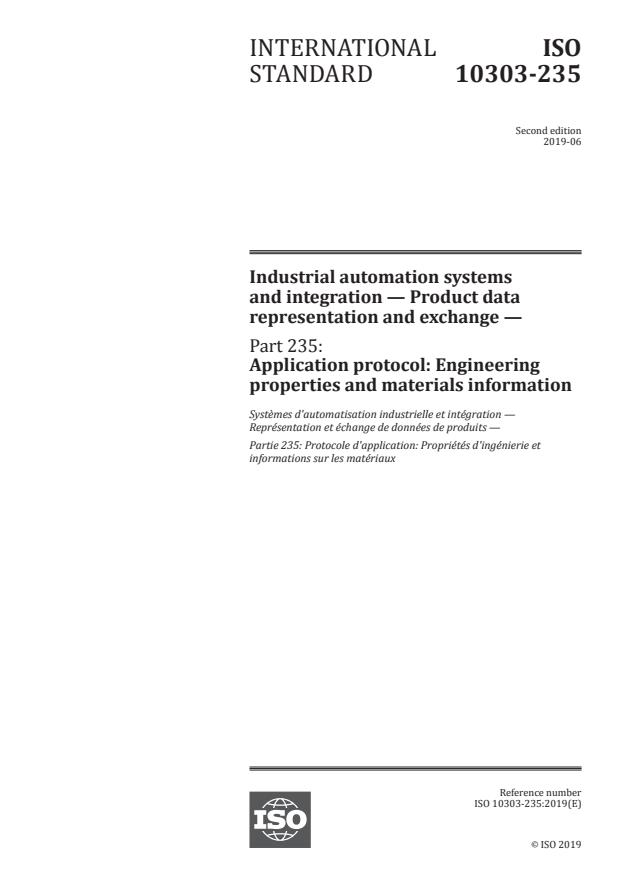
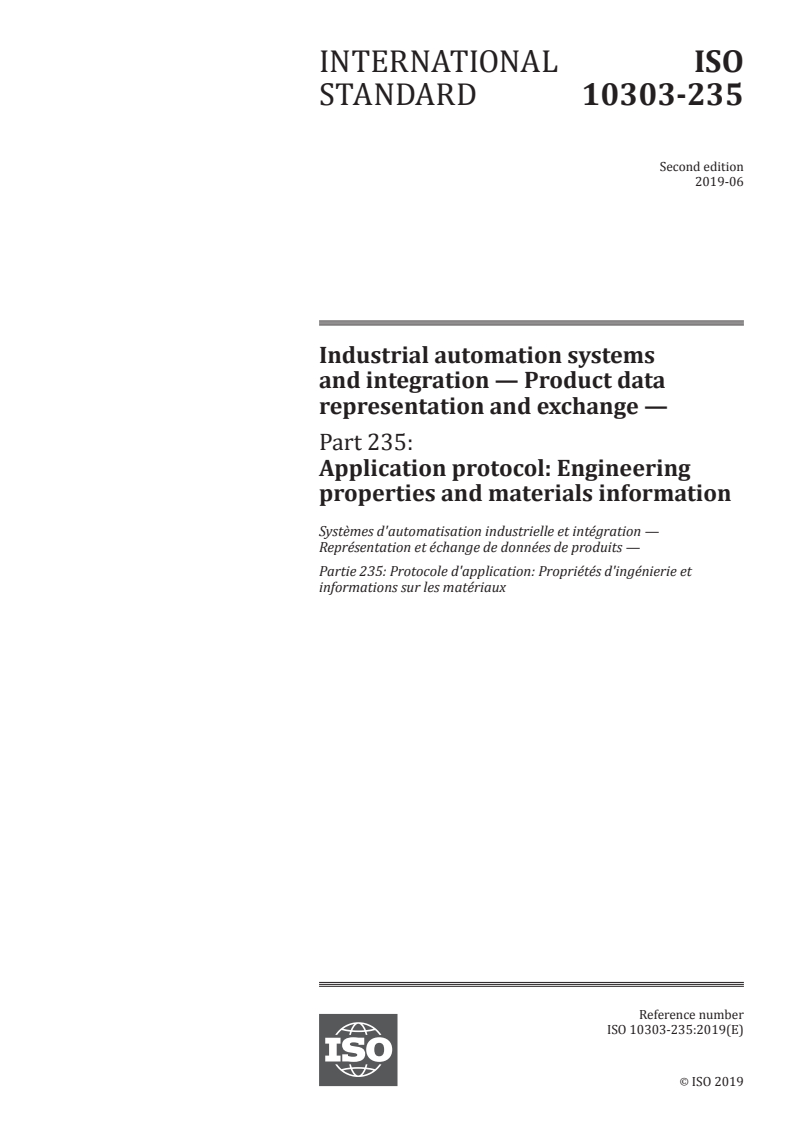
(Main)Industrial automation systems and integration — Product data representation and exchange — Part 235: Application protocol: Engineering properties and materials information
General Information
- Abstract
This document specifies the use of the integrated resources necessary for the scope and information requirements for the representation of engineering property data that are used for product design, product validation and other purposes. NOTE 1 The application activity model in Annex F provides a graphical representation of the processes and information flows that are the basis for the definition of the scope of this document. The following are within the scope of this document: — descriptions and definitions of the manufactured product, the sample of the product and the testable version of the sample; — description of the composition and substance of the product; — description of the processes used in the measurement; — descriptions of the data values produced by the measurement, with the specification of the conditions in which the data is valid; — references to standards and other documents wherein sampling, measurement and other details of testing and measurement processes can be specified or described; — descriptions and qualifications of the personnel and or organizations responsible for the measurement; — specification of the requirements, conditions and tolerances to be satisfied in the measurement and a description of the outcome; — descriptions of the locations of the measurement process and the effectivity of the results; — descriptions of the approval that establishes the validity of the measurements and the use of the properties for product design, design validation and other product characteristics such as structural integrity. NOTE 2 Data representations sometimes need to be archived to meet legal and regulatory requirements and to meet quality objectives. The following are outside the scope of this document: — data describing rules, guidelines and expert knowledge in the testing of products; — names of properties and test methods; — data describing why a decision was made to use a particular process; — scheduling data for measurement processes; — algorithms used for data evaluation and data processing. NOTE 3 The names and definitions of properties and test methods are assumed to be provided in computer processable dictionaries, conforming to ISO 13584 Parts Libraries, which could classify measurement methods and their associated property types.
- Status
- Published
- Publication Date
- 26-May-2019
- Technical Committee
- ISO/TC 184/SC 4 - Industrial data
- Drafting Committee
- ISO/TC 184/SC 4/WG 12 - STEP product modelling and resources
- Current Stage
- 9093 - International Standard confirmed
- Start Date
- 08-May-2025
- Completion Date
- 29-Aug-2026
Buy Documents
ISO 10303-235:2019 - Industrial automation systems and integration -- Product data representation and exchange
ISO 10303-235:2019 - Industrial automation systems and integration — Product data representation and exchange — Part 235: Application protocol: Engineering properties and materials information/27/2019
Overview
ISO 10303-235:2019 - part of the ISO 10303 (STEP) family - defines an application protocol for engineering properties and materials information. It specifies the information requirements, integrated resources and the Application Interpreted Model (AIM) needed to represent engineering property data used in product design, validation and related workflows. The standard supports neutral, computer-interpretable product data representation and exchange for measurement results, material composition, test conditions and approvals.
Key topics and technical requirements
- Scope of representation
- Descriptions of the manufactured product, sampled specimen and testable sample version
- Composition and substance information for materials
- Test and measurement processes and the produced data values, together with the conditions of validity for those values
- References to external standards and documents that specify sampling and measurement methods
- Qualifications of personnel or organizations performing measurements
- Measurement requirements, conditions, tolerances and the recorded outcomes
- Measurement locations, effectivity/validity intervals and approvals that establish data validity
- Models and deliverables
- Application Reference Model (ARM) describing information flows (Annex G / Annex F)
- Application Interpreted Model (AIM) and AIM EXPRESS listings for implementation (Clause 5, Annex A/H)
- Mapping specifications, conformance requirements and Protocol Implementation Conformance Statement (PICS) proforma
- Archiving & traceability
- Support for archiving engineering-property data to meet legal, regulatory and quality objectives
- Explicit exclusions
- Rules, guidelines or expert knowledge for testing; names of properties and test methods (assumed supplied via external dictionaries such as ISO 13584 Parts Libraries); decision rationale, scheduling data, and evaluation algorithms are out of scope
Practical applications
- Exchange of validated material and property data between CAD, CAE and PLM systems
- Recording test results, measurement conditions and approvals for design validation and structural integrity assessments
- Building interoperable materials databases and product test archives for regulatory compliance and quality assurance
- Enabling supplier-to-manufacturer data exchanges that include traceable measurement provenance and effectivity
Who uses ISO 10303-235
- Materials, mechanical and structural engineers capturing material properties for design and simulation
- Test laboratories and QA organizations that need machine-readable, provable measurement records
- PLM/CAD/CAE software vendors and system integrators implementing STEP/AP235 support
- Regulatory, compliance and records-management teams requiring long-term archiving of measurement data
Related standards and implementation notes
- Part of the ISO 10303 (STEP) suite for neutral product data exchange
- Names and definitions of properties/test methods are expected to come from ISO 13584 (Parts Libraries) or other computer-processable dictionaries
- Implementation artifacts include AIM EXPRESS schemas, conformance rules and PICS proformas provided in the standard
Keywords: ISO 10303-235, engineering properties, materials information, product data exchange, STEP, AIM, ARM, measurement traceability, PLM, CAD, test results, materials database.
Relations
- Effective Date
- 26-Aug-2017
Buy Documents
ISO 10303-235:2019 - Industrial automation systems and integration -- Product data representation and exchange
ISO 10303-235:2019 - Industrial automation systems and integration — Product data representation and exchange — Part 235: Application protocol: Engineering properties and materials information/27/2019
Get Certified
Connect with accredited certification bodies for this standard

DVS-ZERT GmbH
German welding certification society.
CARES (UK Certification Authority for Reinforcing Steels)
UK certification for reinforcing steels and construction.
EWF/IIW (European/International Welding Federation)
International welding personnel certification.
Sponsored listings
Frequently Asked Questions
ISO 10303-235:2019 is a standard published by the International Organization for Standardization (ISO). Its full title is "Industrial automation systems and integration — Product data representation and exchange — Part 235: Application protocol: Engineering properties and materials information". This standard covers: This document specifies the use of the integrated resources necessary for the scope and information requirements for the representation of engineering property data that are used for product design, product validation and other purposes. NOTE 1 The application activity model in Annex F provides a graphical representation of the processes and information flows that are the basis for the definition of the scope of this document. The following are within the scope of this document: — descriptions and definitions of the manufactured product, the sample of the product and the testable version of the sample; — description of the composition and substance of the product; — description of the processes used in the measurement; — descriptions of the data values produced by the measurement, with the specification of the conditions in which the data is valid; — references to standards and other documents wherein sampling, measurement and other details of testing and measurement processes can be specified or described; — descriptions and qualifications of the personnel and or organizations responsible for the measurement; — specification of the requirements, conditions and tolerances to be satisfied in the measurement and a description of the outcome; — descriptions of the locations of the measurement process and the effectivity of the results; — descriptions of the approval that establishes the validity of the measurements and the use of the properties for product design, design validation and other product characteristics such as structural integrity. NOTE 2 Data representations sometimes need to be archived to meet legal and regulatory requirements and to meet quality objectives. The following are outside the scope of this document: — data describing rules, guidelines and expert knowledge in the testing of products; — names of properties and test methods; — data describing why a decision was made to use a particular process; — scheduling data for measurement processes; — algorithms used for data evaluation and data processing. NOTE 3 The names and definitions of properties and test methods are assumed to be provided in computer processable dictionaries, conforming to ISO 13584 Parts Libraries, which could classify measurement methods and their associated property types.
This document specifies the use of the integrated resources necessary for the scope and information requirements for the representation of engineering property data that are used for product design, product validation and other purposes. NOTE 1 The application activity model in Annex F provides a graphical representation of the processes and information flows that are the basis for the definition of the scope of this document. The following are within the scope of this document: — descriptions and definitions of the manufactured product, the sample of the product and the testable version of the sample; — description of the composition and substance of the product; — description of the processes used in the measurement; — descriptions of the data values produced by the measurement, with the specification of the conditions in which the data is valid; — references to standards and other documents wherein sampling, measurement and other details of testing and measurement processes can be specified or described; — descriptions and qualifications of the personnel and or organizations responsible for the measurement; — specification of the requirements, conditions and tolerances to be satisfied in the measurement and a description of the outcome; — descriptions of the locations of the measurement process and the effectivity of the results; — descriptions of the approval that establishes the validity of the measurements and the use of the properties for product design, design validation and other product characteristics such as structural integrity. NOTE 2 Data representations sometimes need to be archived to meet legal and regulatory requirements and to meet quality objectives. The following are outside the scope of this document: — data describing rules, guidelines and expert knowledge in the testing of products; — names of properties and test methods; — data describing why a decision was made to use a particular process; — scheduling data for measurement processes; — algorithms used for data evaluation and data processing. NOTE 3 The names and definitions of properties and test methods are assumed to be provided in computer processable dictionaries, conforming to ISO 13584 Parts Libraries, which could classify measurement methods and their associated property types.
ISO 10303-235:2019 is classified under the following ICS (International Classification for Standards) categories: 25.040.40 - Industrial process measurement and control. The ICS classification helps identify the subject area and facilitates finding related standards.
ISO 10303-235:2019 has the following relationships with other standards: It is inter standard links to ISO 10303-235:2009. Understanding these relationships helps ensure you are using the most current and applicable version of the standard.
ISO 10303-235:2019 is available in PDF format for immediate download after purchase. The document can be added to your cart and obtained through the secure checkout process. Digital delivery ensures instant access to the complete standard document.
Standards Content (Sample)
INTERNATIONAL ISO
STANDARD 10303-235
Second edition
2019-06
Industrial automation systems
and integration — Product data
representation and exchange —
Part 235:
Application protocol: Engineering
properties and materials information
Systèmes d'automatisation industrielle et intégration —
Représentation et échange de données de produits —
Partie 235: Protocole d'application: Propriétés d'ingénierie et
informations sur les matériaux
Reference number
©
ISO 2019
© ISO 2019
All rights reserved. Unless otherwise specified, or required in the context of its implementation, no part of this publication may
be reproduced or utilized otherwise in any form or by any means, electronic or mechanical, including photocopying, or posting
on the internet or an intranet, without prior written permission. Permission can be requested from either ISO at the address
below or ISO’s member body in the country of the requester.
ISO copyright office
CP 401 • Ch. de Blandonnet 8
CH-1214 Vernier, Geneva
Phone: +41 22 749 01 11
Fax: +41 22 749 09 47
Email: copyright@iso.org
Website: www.iso.org
Published in Switzerland
ii © ISO 2019 – All rights reserved
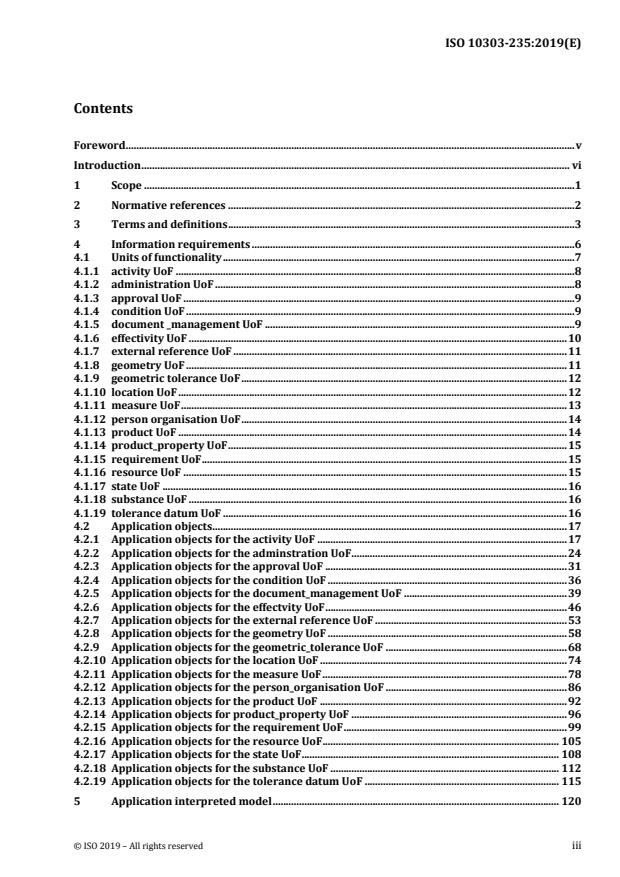
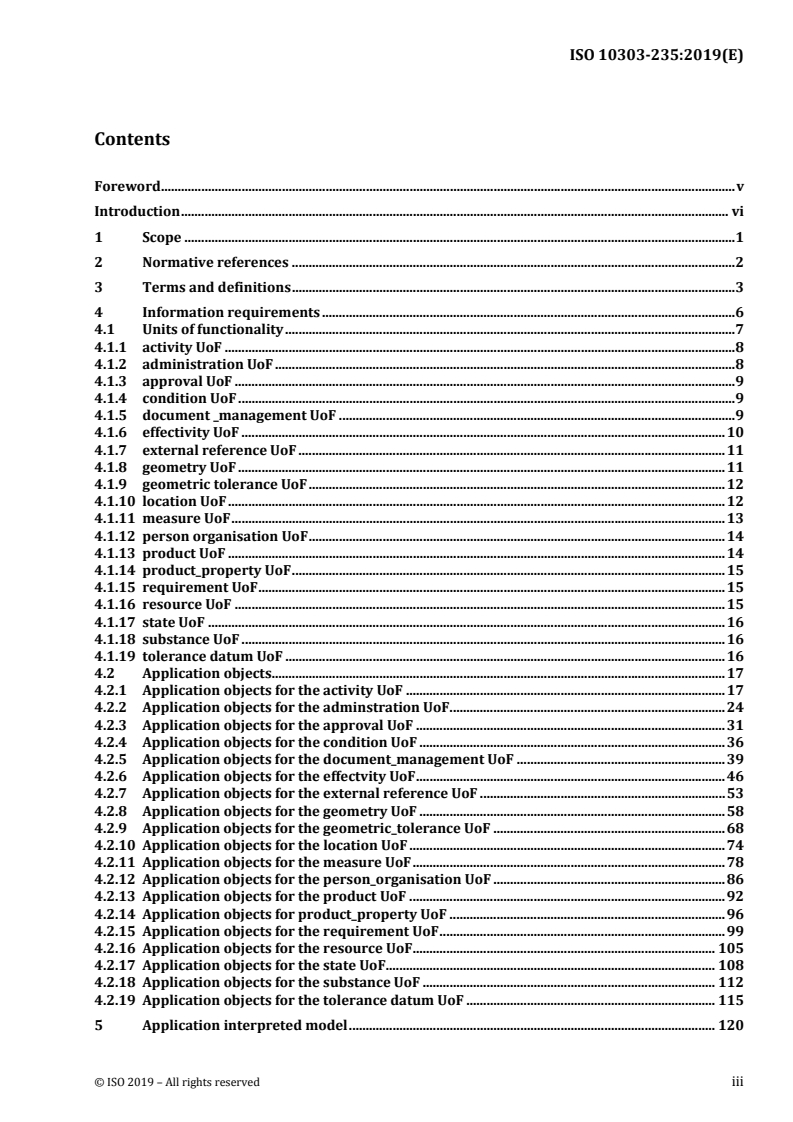
Contents
Foreword . v
Introduction . vi
1 Scope . 1
2 Normative references . 2
3 Terms and definitions . 3
4 Information requirements . 6
4.1 Units of functionality . 7
4.1.1 activity UoF . 8
4.1.2 administration UoF . 8
4.1.3 approval UoF . 9
4.1.4 condition UoF . 9
4.1.5 document _management UoF . 9
4.1.6 effectivity UoF . 10
4.1.7 external reference UoF . 11
4.1.8 geometry UoF . 11
4.1.9 geometric tolerance UoF . 12
4.1.10 location UoF . 12
4.1.11 measure UoF . 13
4.1.12 person organisation UoF . 14
4.1.13 product UoF . 14
4.1.14 product_property UoF . 15
4.1.15 requirement UoF . 15
4.1.16 resource UoF . 15
4.1.17 state UoF . 16
4.1.18 substance UoF . 16
4.1.19 tolerance datum UoF . 16
4.2 Application objects. 17
4.2.1 Application objects for the activity UoF . 17
4.2.2 Application objects for the adminstration UoF. 24
4.2.3 Application objects for the approval UoF . 31
4.2.4 Application objects for the condition UoF . 36
4.2.5 Application objects for the document_management UoF . 39
4.2.6 Application objects for the effectvity UoF . 46
4.2.7 Application objects for the external reference UoF . 53
lication objects for the geometry UoF . 58
4.2.8 App
4.2.9 Application objects for the geometric_tolerance UoF . 68
4.2.10 Application objects for the location UoF . 74
4.2.11 Application objects for the measure UoF . 78
4.2.12 Application objects for the person_organisation UoF . 86
4.2.13 Application objects for the product UoF . 92
4.2.14 Application objects for product_property UoF . 96
4.2.15 Application objects for the requirement UoF . 99
4.2.16 Application objects for the resource UoF . 105
4.2.17 Application objects for the state UoF . 108
4.2.18 Application objects for the substance UoF . 112
4.2.19 Application objects for the tolerance datum UoF . 115
5 Application interpreted model . 120
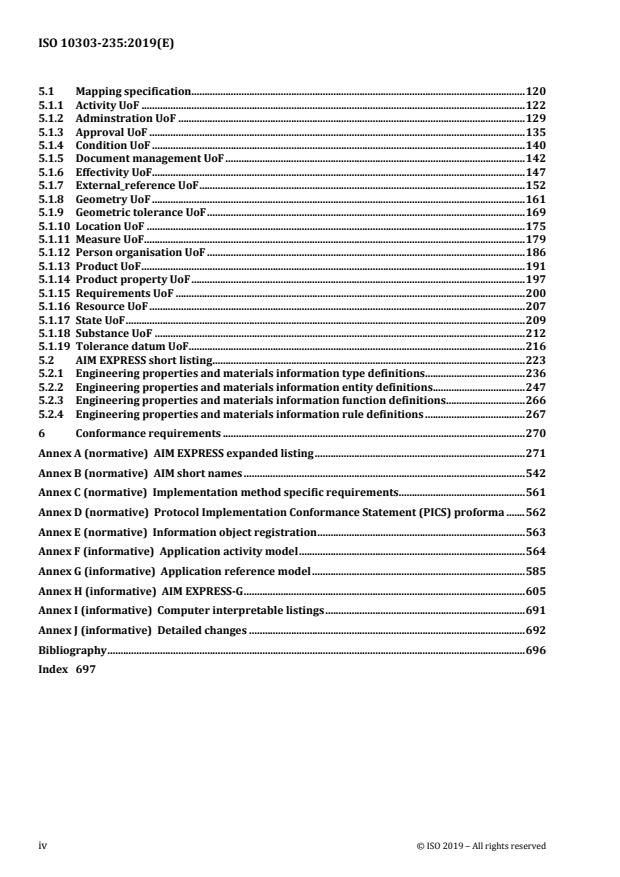
© ISO 2019 – All rights reserved iii
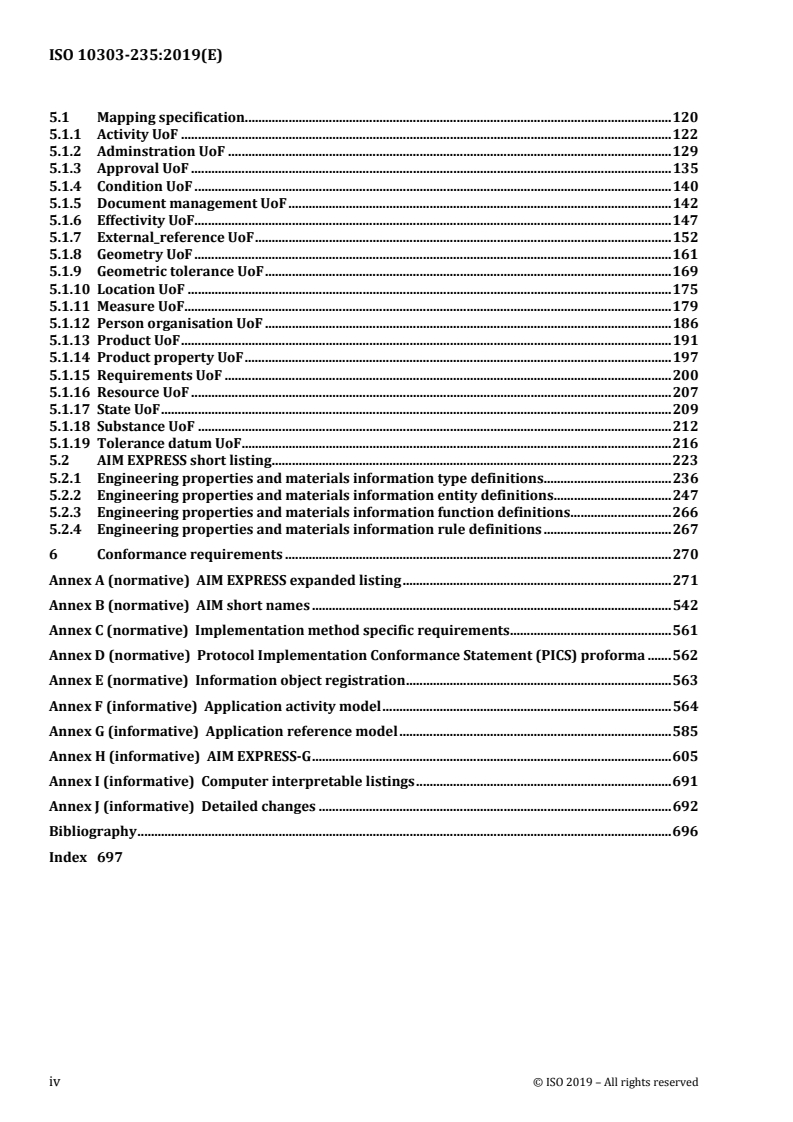
5.1 Mapping specification. 120
5.1.1 Activity UoF . 122
5.1.2 Adminstration UoF . 129
5.1.3 Approval UoF . 135
5.1.4 Condition UoF . 140
5.1.5 Document management UoF . 142
5.1.6 Effectivity UoF. 147
5.1.7 External_reference UoF . 152
5.1.8 Geometry UoF . 161
5.1.9 Geometric tolerance UoF . 169
5.1.10 Location UoF . 175
5.1.11 Measure UoF. 179
5.1.12 Person organisation UoF . 186
5.1.13 Product UoF . 191
5.1.14 Product property UoF . 197
5.1.15 Requirements UoF . 200
5.1.16 Resource UoF . 207
5.1.17 State UoF . 209
5.1.18 Substance UoF . 212
5.1.19 Tolerance datum UoF. 216
5.2 AIM EXPRESS short list ing . 223
5.2.1 Engineering properties and materials information type definitions. 236
5.2.2 Engineering properties and materials information entity definitions. 247
5.2.3 Engineering properties and materials information function defini tion s . 266
5.2.4 Engineering properties and materials information rule definitions . 267
6 Conformance requirements . 270
Annex A (normative) AIM EXPRESS expanded listing . 271
Annex B (normative) AIM short names . 542
Annex C (normative) Implementation method specific requirements . 561
Annex D (normative) Protocol Implementation Conformance Statement (PICS) proforma . 562
Annex E (normative) Information object registration . 563
Annex F (informative) Application activity model . 564
Annex G (informative) Application reference model . 585
Annex H (informative) AIM EXPRESS-G . 605
Annex I (informative) Computer interpretable listings . 691
Annex J (informative) Detailed changes . 692
Bibliography . 696
Index 697
iv © ISO 2019 – All rights reserved
Foreword
ISO (the International Organization for Standardization) is a worldwide federation of national
standards bodies (ISO member bodies). The work of preparing International Standards is normally
carried out through ISO technical committees. Each member body interested in a subject for which a
technical committee has been established has the right to be represented on that committee.
International organizations, governmental and non‐governmental, in liaison with ISO, also take part in
the work. ISO collaborates closely with the International Electrotechnical Commission (IEC) on all
matters of electrotechnical standardization.
The procedures used to develop this document and those intended for its further maintenance are
described in the ISO/IEC Directives, Part 1. In particular, the different approval criteria needed for the
different types of ISO documents should be noted. This document was drafted in accordance with the
editorial rules of the ISO/IEC Directives, Part 2 (see www.iso.org/directives).
Attention is drawn to the possibility that some of the elements of this document may be the subject of
patent rights. ISO shall not be held responsible for identifying any or all such patent rights. Details of
any patent rights identified during the development of the document will be in the Introduction and/or
on the ISO list of patent declarations received (see www.iso.org/patents).
Any trade name used in this document is information given for the convenience of users and does not
constitute an endorsement.
For an explanation on the voluntary nature of standards, the meaning of ISO specific terms and
expressions related to conformity assessment, as well as information about ISO's adherence to the
World Trade Organization (WTO) principles in the Technical Barriers to Trade (TBT) see the following
URL: www.iso.org/iso/foreword.html.
This document was prepared by Technical Committee ISO/TC 184, Automation systems and integration,
Subcommittee SC 4, Industrial data.
This second edition cancels and replaces the first edition (ISO 10303‐235:2009), which has been
technically revised. It also incorporates the Technical Corrigendum ISO 10303‐235:2009/Cor 1:2011.
The changes made in this edition are documented in Annex J.
ISO 10303 is organized as a series parts, each published separately. Each part of ISO 10303 is a
member of one of the following series: descriptive methods, implementation methods, conformance
testing methodology and framework, integrated generic resources, integrated application resources,
application protocols, abstract test suites, application interpreted constructs and application modules.
This document is a member of the application protocols series.
A list of the parts of ISO 10303 is located at: https://standards.iso.org/iso/10303/tech/step_titles.htm.
Any feedback or questions on this document should be directed to the user’s national standards body. A
complete listing of these bodies can be found at www.iso.org/members.html.
© ISO 2019 – All rights reserved v
Introduction
ISO 10303 is an International Standard for the computer‐interpretable representation and exchange of
product data. The objective is to provide a neutral mechanism capable of describing product data
throughout the life cycle of a product and independent from any particular system. The nature of this
description makes it suitable not only for neutral file exchange, but also as a basis for implementing and
sharing product databases and archiving.
This document defines the context, scope and information requirements for properties of products that
can be used for product design and design validation and other purposes, the testing, measurement and
approval processes used to determine those properties and specifies the integrated resources
necessary to satisfy these requirements.
Clause 1 defines the scope and summarises the functionality and data covered by this document. Clause
3 lists the words defined in this document and gives pointers to words defined elsewhere. An
application activity model that is the basis for the definition of the scope is provided in Annex F. The
information requirements for the application are specified in Clause 4, using terminology appropriate to
the application. A graphical representation of the information requirements, referred to as the
application reference model (ARM), is given in Annex G.
Resource constructs from the Integrated Generic Resource Model are interpreted to meet the
information requirements of this application and produce the application interpreted model (AIM). This
interpretation, given in 5.1, shows the correspondence between the information requirements and the
AIM. The short listing of the AIM specifies the interface to the integrated resources and is given in 5.2.
Note that the definitions and EXPRESS provided in the integrated resources for constructs used in the
AIM can include items in select lists and subtypes that are not imported into the AIM. The expanded
listing given in Annex A contains the complete EXPRESS schema for the AIM without annotation. A
graphical representation of the AIM is given in Annex H. Additional requirements for specific
implementation methods are given in Annex C.
Engineering properties, which include materials properties, are not fundamental constants derived
from physical or chemical laws. The understanding of an engineering property of a product is
dependent on the process used to measure the property value and the value is dependent on the
conditions used in that process.
If properties that are based on fundamental physical or chemical behaviour, such as latent heat or
melting temperature, are measured by different methods, then the results obtained are usually
sufficiently similar to be regarded as a single value. A method used for measuring an engineering
property attempts to simulate the behaviour of a product in an engineering situation in the real world.
Each aspect of behaviour, for example the hardness of a product, can be simulated by several different
methods. The methods are usually designed to be convenient to use and to provide a consistent result
from repeated measurements. However, the difference between physical or chemical properties of a
substance and the engineering properties of a product is that if different methods are used to measure
an engineering property, then different results are obtained. For example, the measurement of the
elongation property attempts to provide a numerical value to represent the engineering concept of
plastic ductility by stretching a specially shaped sample of a product by applying a uniaxial tensile load.
The value of the elongation property is determined as a percentage of the original length of a portion of
a sample piece of the product. Comparisons between values of the elongation property for different
products are therefore only possible if the fixed length was the same for each case. It is therefore
necessary to state this length explicitly for all values of the elongation property.
An engineering property is therefore the result from operating a specific test method in a specific
manner and it is necessary to associate the value of an engineering property with the conditions in
which it is valid, in order for the meaning of the value to be explicitly determined. This additional
vi © ISO 2019 – All rights reserved
information is called the data environment in ISO 10303‐45. An alternative term that is often used is
metadata ‐ i.e. data about data.
In most communications of engineering data, the relationship of a property value to its data
environment or metadata is often an implicit assumption and it might not be explicitly associated with
the value. The purpose of this document is to provide the means to associate a property value explicitly
to the conditions in which it was measured, and thus provide an audit trail to the origins of data values
that can be used in product design.
In order to measure the properties of a product, it is sometimes possible to test the whole product but
usually this is not possible and a sample of a product has be taken to represent the bulk of the product.
The procedure for taking this sample can be specified in a regulatory document, such as a quality
manual, or in a standard. The operation of the testing apparatus and the measurement procedure can
require that the item that is tested has a specific shape and dimensions, and it will be necessary to
create this from the product sample by some manufacturing process. The result of this process can be
called a test piece. The specific shape and dimensions of test pieces can also be defined in standards or
other regulatory documents. The measurement of the engineering property is then carried out on the
test piece by means of some measuring apparatus or testing machine, whose operation might need to be
controlled to be within specified limits. Manufactured products can be assemblies or single products,
but they are rarely homogeneous or isotropic in their properties, so it is necessary to know the
relationships between the test piece, the sample and the original product if the results of the
measurement need to be related to the original product.
Data produced by a testing or measurement process is rarely used in its original form. It is necessary to
first evaluate data values by some process in order to determine if the conditions prescribed for a
particular test method have been met. For many properties, such as fracture toughness as an example,
the validity of a test result can only be determined by an evaluation process after all the measurements
have been completed and that process is specified in the standard that describes how to make the
measurement. Individual results are rarely used as single values, but can be combined or processed in
some way to provide a collective result that is indicative of the results of a series of measurements. It is
necessary to identify the most likely value of the collection and to provide the uncertainty associated
with this value.
The validity of a test result can be established by an approval procedure which results in the issue of a
certificate. The certificate affirms that the original product from which the sample was taken conforms
to a particular requirement or specification, and that the tests used to determine this were carried out
in an approved manner. The data obtained from a valid test can also be subject to a further approval
procedure that confirms the suitability of property values for the design of a functional product. This
procedure will use criteria for the approval based on the requirements that the product needs to satisfy.
The approval process and the criteria can be established and administered by an independent
regulatory body or authority.
Test data values are not used for design because they often represent a condition of failure of the test
piece. Design values are derived from the test data to represent a condition in which it is safe to use the
product, and it is also advisable to record explicitly the procedures by which a design value is derived.
Further testing can be required to measure the design values.
The number of different engineering properties and test methods is too large for every property and
test method to be included in this document. There are also differences in test methods, and therefore
differences in the engineering meaning of the properties, between different national engineering
systems. Provision has therefore been made for the names of test methods and their association with
particular properties to be defined in computer‐processable dictionaries conforming to ISO 13584 Parts
Libraries, or defined in a referenced document. An entry in such a dictionary can be referenced from the
information model in this document in order to make use of a particular property name associated with
a particular measurement method.
© ISO 2019 – All rights reserved vii
The benefit of this approach is that, with appropriate dictionaries to define test methods and their
relevant property names, this document can be used for the representation of any engineering property
measured by any method, provided that those methods and properties are defined in a computer
processable dictionary. The application of this document therefore extends to other engineering
domains and is not restricted to materials. Other applications could include the results of
measurements of environmental data, for example.
Figure 1 shows a high level view of the concept of this document. Figure 2 shows the high‐level view of
a process. Further information on the application of product data technology to materials information,
as examples of engineering properties can be found in Reference [1] in the Bibliography.
Functional_
P roduct_ for_ designs
Functional_
product_design_
testing
product
process
used_in
sam pled_by used_in
sam ple
Sam pling_
process
Analysis_ Analysis_
properties allowables
processed_by
Sam pled_product
properties allowables
sam ple_for_test
M anufacture_
process
Define_criteria
test_by
Apply_design_
tested_sam ple
Testable_sample
allowables_
process
defined_criteria
test_result
Testing_process
test_requirem ents
Specify_design_
characterization_
evaluated_by
test_specifications
tests
Test_values
requirements
certificated_data
Evaluation_criteria
Test_evaluation_
process evaluated_data
cert_value
T est_certificate_
value
reduced_data
Data_reduction_
process
T est_ certificate_
design_characterization_data
process
Test_and_data_
approval_process
supplier_approved_data
produces
certifies
T est_certificate
Figure 1 — Processes for the measurement and approval of engineering properties
viii © ISO 2019 – All rights reserved
Figure 2 — Generic model for a process
© ISO 2019 – All rights reserved ix
INTERNATIONAL STANDARD ISO 10303-235:2019(E)
Industrial automation systems and integration — Product data
representation and exchange
Part 235:
Application protocol: Engineering properties and materials
information
1 Scope
This document specifies the use of the integrated resources necessary for the scope and information
requirements for the representation of engineering property data that are used for product
design, product validation and other purposes.
NOTE 1 The application activity model in Annex F provides a graphical representation of the processes and
information flows that are the basis for the definition of the scope of this document.
The following are within the scope of this document:
descriptions and definitions of the manufactured product, the sample of the product and the
testable version of the sample;
description of the composition and substance of the product;
description of the processes used in the measurement;
descriptions of the data values produced by the measurement, with the specification of the
conditions in which the data is valid;
references to standards and other documents wherein sampling, measurement and other details of
testing and measurement processes can be specified or described;
descriptions and qualifications of the personnel and or organizations responsible for the
measurement;
specification of the requirements, conditions and tolerances to be satisfied in the measurement and
a description of the outcome;
descriptions of the locations of the measurement process and the effectivity of the results;
descriptions of the approval that establishes the validity of the measurements and the use of the
properties for product design, design validation and other product characteristics such as
structural integrity.
NOTE 2 Data representations sometimes need to be archived to meet legal and regulatory requirements and to
meet quality objectives.
© ISO 2019 – All rights reserved 1
The following are outside the scope of this document:
data describing rules, guidelines and expert knowledge in the testing of products;
names of properties and test methods;
data describing why a decision was made to use a particular process;
scheduling data for measurement processes;
algorithms used for data evaluation and data processing.
NOTE 3 The names and definitions of properties and test methods are assumed to be provided in computer
processable dictionaries, conforming to ISO 13584 Parts Libraries, which could classify measurement methods
and their associated property types.
2 Normative references
The following documents are referred to in the text in such a way that some or all of their content
constitutes requirements of this document. For dated references, only the edition cited applies. For
undated references, the latest edition of the referenced document (including any amendments) applies.
ISO/IEC 8824‐1, Information technology — Abstract Syntax Notation One (ASN.1) — Part 1: Specification
of basic notation
ISO 10303‐1, Industrial automation systems and integration — Product data representation and
exchange — Part 1: Overview and fundamental principles
ISO 10303‐11, Industrial automation systems and integration — Product data representation and
exchange — Part 11: Description methods: The EXPRESS language reference manual
ISO 10303‐21, Industrial automation systems and integration — Product data representation and
exchange — Part 21: Implementation methods: Clear text encoding of the exchange structure
ISO 10303‐31, Industrial automation systems and integration — Product data representation and
exchange —Part 31: Conformance testing methodology and framework: General concepts
ISO 10303‐41, Industrial automation systems and integration — Product data representation and
exchange —Part 41: Integrated generic resource: Fundamentals of product description and support
ISO 10303‐42, Industrial automation systems and integration — Product data representation and
exchange — Part 42: Integrated generic resource: Geometric and topological representation
ISO 10303‐43, Industrial automation systems and integration — Product data representation and
exchange — Part 43: Integrated generic resource: Representation structures
ISO 10303‐45, Industrial automation systems and integration — Product data representation and
exchange — Part 45: Integrated generic resource: Material and other engineering properties
ISO 10303‐47, Industrial automation systems and integration — Product data representation and
exchange —Part 47: Integrated generic resource: Shape variation tolerances
2 © ISO 2019 – All rights reserved
ISO 10303‐49, Industrial automation systems and integration — Product data representation and
exchange — Part 49: Integrated generic resources: Process structure and properties
ISO 10303‐50, Industrial automation systems and integration — Product data representation and
exchange — Part 50: Integrated generic resource: Mathematical constructs
ISO 10303‐56, Industrial automation systems and integration — Product data representation and
exchange — Part 56: Integrated generic resource: State
ISO 10303‐519, Industrial automation systems and integration — Product data representation and
exchange — Part 519: Application interpreted construct: Geometric tolerances
ISO 13584‐20, Industrial automation systems and integration — Parts library — Part 20: Logical
resource: Logical model of expressions
ISO 13584‐26, Industrial automation systems and integration — Parts library — Part 26: Logical
resource: Information supplier identification
ISO 13584‐42, Industrial automation systems and integration — Parts library — Part 42: Description
methodology: Methodology for structuring parts families
3 Terms and definitions
For the purposes of this document, the terms and definitions given in ISO 10303‐1 and the following
apply.
ISO and IEC maintain terminological databases for use in standardization at the following addresses:
— ISO Online browsing platform: available at https://www.iso.org/obp
— IEC Electropedia: available at http://www.electropedia.org/
3.1
application
group of one or more processes using product data
3.2
application model
model that describes an application in terms of its processes and information flows
3.3
application construct
collection of EXPRESS language entities, types, functions, rules and references that are based on
resource constructs and that specialize those resource constructs as necessary in order to define a valid
description of an aspect of product data for specific application areas
3.4
application context
subset of an application activity model
3.5
application interpreted construct
AIC
© ISO 2019 – All rights reserved 3
logical grouping of interpreted constructs that supports a specific function for the usage of product data
across multiple application contexts
3.6
application interpreted model
AIM
information model that includes the application constructs necessary to satisfy the requirements of an
application reference model
3.7
application object
atomic element of an application reference model that defines a unique concept of the application and
contains attributes specifying the data elements of the object
3.8
application protocol
AP
part of ISO 10303 that specifies an application interpreted model satisfying the scope and information
requirements for a specific application
3.9
application reference model
ARM
information model that describes the information requirements and constraints of an application
within an application protocol
3.10
unit of functionality
UoF
collection of application objects and their relationships that defines one or more concepts within the
application context such that removal of any component would render the concepts incomplete or
ambiguous
3.11
conformance class
subset of an application protocol for which compliance can be claimed
3.12
conformance requirement
precise, text definition of a characteristic required to be present in an implementation for achieving
compliance
3.13
data
representation of information in a formal manner suitable for communication, interpretation, or
processing by human beings or computers
3.14
data exchange
storing, accessing, transferring and archiving of data
3.15
exchange structure
computer‐interpretable format used for storing, accessing, transferring and archiving data
4 © ISO 2019 – All rights reserved
3.16
implementation method
part of ISO 10303 that specifies a technique used by computer systems to exchange product data that is
described using the EXPRESS data specification language
3.17
information
facts, concepts, or instructions
3.18
information model
formal model of a bounded set of facts, concepts or instructions to meet a specific requirement
3.19
resource construct
collection of EXPRESS language entities, types, functions, rules and references that together define a
valid description of product data
3.20
integrated resource
IR
part of ISO 10303 that defines a group of resource constructs used as the basis for product data
3.21
generic resource
integrated resource whose contexts are context‐independent
3.22
interpretation
process of adapting a resource construct to satisfy an application‐specific requirement of an application
protocol
Note 1 entry: This can involve the additions of restrictions on attribute, the addition of constraints and the
addition of assignments.
3.23
product
thing or substance produced by a natural or artificial process
3.24
product data
representation of information about a product in a formal manner suitable for communication,
interpretation, or processing by human beings or by computers
3.25
product information
facts, concepts, or instructions about a product
3.26
product information model
information model that provides an abstract description of facts, concepts and instructions about a
product
© ISO 2019 – All rights reserved 5
3.27
presentation
recognizable visual representation of product data
3.28
structure
set of interrelated parts of any complex thing, and the relationships between them
3.29
data environment
set of application objects that allows the conditions related to the validity of one or more property
values to be grouped together
3.30
material product
physical object that is manufactured to a specification and from which other objects can be
manufactured
3.31
sample
portion of a material product that is selected by a specified procedure to ensure that the portion is
representative of the whole material product
3.32
test method
test
procedure designed to measure the characteristics of a material product in specified conditions
3.33
test specimen
physical object that is manufactured from a sample in order to be used in a test
Note 1 to entry: The manufacture, shape and dimensions of a test specimen can be specified for the test method.
3.34
tested specimen
test specimen after it has been used in a test
Note 1 to entry: A tested specimen can be used in further tests.
4 Information requirements
This clause specifies the information required for the representation and exchange of engineering
properties and the processes and conditions in which the values were measured.
The information requirements are specified as a set of units of functionality (UoF) and application
objects. A unit of functionality specifies the collection of application objects that are needed to satisfy a
general information requirement. The information requirements are defined using the terminology of
the subject area of this document. The information objects in this clause, and all subsequent clauses
that include computer–processable code, shall be presented in the EXPRESS language that is defined in
ISO 10303‐11.
NOTE 1 A graphical representation of the information requirements is given in Annex G.
6 © ISO 2019 – All rights reserved
NOTE 2 The information requirements correspond to those of the activities identified in Annex F as being
within the scope of this document.
NOTE 3 The mapping specification specified in 5.1 shows how the integrated resources and application
interpreted constructs are used to meet the information requirements.
4.1 Units of functionality
This subclause specifies the units of functionality for Engineering properties and materials information.
The following units of functionality are specified:
activity;
administration;
approval;
condition;
document management;
effectivity;
external reference;
geometry;
geometric tolerance;
location;
measure;
person organisation;
product;
properties;
requirement;
resource;
state;
substance;
tolerance datum.
The units of functionality and a description that each UoF supports are given below. The application
objects included in the UoFs are defined in 4.2.
© ISO 2019 – All rights reserved 7
4.1.1 activity UoF
The activity UoF enables the description of the operations and the properties for a process. The activity
UoF uses the following application objects:
Activity_as_planned;
Activity_as_realised;
Activity_property;
Activity_property_defined_in_external_reference;
Activity_property_relationship;
Activity_property_representation;
Activity_relationship;
Activity_type;
Activity_type_defined_in_external_reference;
Activity_type_relationship;
Activity_type_specified;
Individual_activity;
Individual_activity_assignment.
4.1.2 administration UoF
The administration UoF enables the description of the administration of the testing and measurement
processes. The administration UoF uses the following application objects:
Calendar_date;
Contract;
Contract_assignment;
Date_time;
Event;
Event_relationship;
Local_time;
Project;
Specification;
8 © ISO 2019 – All rights reserved
Specification_relationship;
Specification _type;
Time_offset.
4.1.3 approval UoF
The approval UoF enables the description of the approval and certification of the data used and
generated in the testing and measurement processes. The approval UoF uses the following application
objects:
AP_qualification_type;
Approval;
Approval_assignment;
Approval_relationship;
Approval_status;
Approving_person_organisation;
Certificate;
Certificate_assignment;
Security_classification.
4.1.4 condition UoF
The condition UoF enables the description of the conditions that shall be satisfied in a testing and
measurement process. The condition UoF uses the following application objects:
Condition;
Condition_assignment;
Condition_evaluation;
Condition_evaluation_assignment;
Condition_relationship.
4.1.5 document _management UoF
The document_management UoF enables the description of documents used to support the testing and
measurement process and store the results. The document_management UoF uses the following
application objects:
Digital_document_definition;
Digital_file;
© ISO 2019 – All rights reserved 9
Digital_record;
Document;
Document_assignment;
D
...
INTERNATIONAL ISO
STANDARD 10303-235
Second edition
2019-06
Industrial automation systems
and integration — Product data
representation and exchange —
Part 235:
Application protocol: Engineering
properties and materials information
Systèmes d'automatisation industrielle et intégration —
Représentation et échange de données de produits —
Partie 235: Protocole d'application: Propriétés d'ingénierie et
informations sur les matériaux
Reference number
©
ISO 2019
© ISO 2019
All rights reserved. Unless otherwise specified, or required in the context of its implementation, no part of this publication may
be reproduced or utilized otherwise in any form or by any means, electronic or mechanical, including photocopying, or posting
on the internet or an intranet, without prior written permission. Permission can be requested from either ISO at the address
below or ISO’s member body in the country of the requester.
ISO copyright office
CP 401 • Ch. de Blandonnet 8
CH-1214 Vernier, Geneva
Phone: +41 22 749 01 11
Fax: +41 22 749 09 47
Email: copyright@iso.org
Website: www.iso.org
Published in Switzerland
ii © ISO 2019 – All rights reserved
Contents
Foreword . v
Introduction . vi
1 Scope . 1
2 Normative references . 2
3 Terms and definitions . 3
4 Information requirements . 6
4.1 Units of functionality . 7
4.1.1 activity UoF . 8
4.1.2 administration UoF . 8
4.1.3 approval UoF . 9
4.1.4 condition UoF . 9
4.1.5 document _management UoF . 9
4.1.6 effectivity UoF . 10
4.1.7 external reference UoF . 11
4.1.8 geometry UoF . 11
4.1.9 geometric tolerance UoF . 12
4.1.10 location UoF . 12
4.1.11 measure UoF . 13
4.1.12 person organisation UoF . 14
4.1.13 product UoF . 14
4.1.14 product_property UoF . 15
4.1.15 requirement UoF . 15
4.1.16 resource UoF . 15
4.1.17 state UoF . 16
4.1.18 substance UoF . 16
4.1.19 tolerance datum UoF . 16
4.2 Application objects. 17
4.2.1 Application objects for the activity UoF . 17
4.2.2 Application objects for the adminstration UoF. 24
4.2.3 Application objects for the approval UoF . 31
4.2.4 Application objects for the condition UoF . 36
4.2.5 Application objects for the document_management UoF . 39
4.2.6 Application objects for the effectvity UoF . 46
4.2.7 Application objects for the external reference UoF . 53
lication objects for the geometry UoF . 58
4.2.8 App
4.2.9 Application objects for the geometric_tolerance UoF . 68
4.2.10 Application objects for the location UoF . 74
4.2.11 Application objects for the measure UoF . 78
4.2.12 Application objects for the person_organisation UoF . 86
4.2.13 Application objects for the product UoF . 92
4.2.14 Application objects for product_property UoF . 96
4.2.15 Application objects for the requirement UoF . 99
4.2.16 Application objects for the resource UoF . 105
4.2.17 Application objects for the state UoF . 108
4.2.18 Application objects for the substance UoF . 112
4.2.19 Application objects for the tolerance datum UoF . 115
5 Application interpreted model . 120
© ISO 2019 – All rights reserved iii
5.1 Mapping specification. 120
5.1.1 Activity UoF . 122
5.1.2 Adminstration UoF . 129
5.1.3 Approval UoF . 135
5.1.4 Condition UoF . 140
5.1.5 Document management UoF . 142
5.1.6 Effectivity UoF. 147
5.1.7 External_reference UoF . 152
5.1.8 Geometry UoF . 161
5.1.9 Geometric tolerance UoF . 169
5.1.10 Location UoF . 175
5.1.11 Measure UoF. 179
5.1.12 Person organisation UoF . 186
5.1.13 Product UoF . 191
5.1.14 Product property UoF . 197
5.1.15 Requirements UoF . 200
5.1.16 Resource UoF . 207
5.1.17 State UoF . 209
5.1.18 Substance UoF . 212
5.1.19 Tolerance datum UoF. 216
5.2 AIM EXPRESS short list ing . 223
5.2.1 Engineering properties and materials information type definitions. 236
5.2.2 Engineering properties and materials information entity definitions. 247
5.2.3 Engineering properties and materials information function defini tion s . 266
5.2.4 Engineering properties and materials information rule definitions . 267
6 Conformance requirements . 270
Annex A (normative) AIM EXPRESS expanded listing . 271
Annex B (normative) AIM short names . 542
Annex C (normative) Implementation method specific requirements . 561
Annex D (normative) Protocol Implementation Conformance Statement (PICS) proforma . 562
Annex E (normative) Information object registration . 563
Annex F (informative) Application activity model . 564
Annex G (informative) Application reference model . 585
Annex H (informative) AIM EXPRESS-G . 605
Annex I (informative) Computer interpretable listings . 691
Annex J (informative) Detailed changes . 692
Bibliography . 696
Index 697
iv © ISO 2019 – All rights reserved
Foreword
ISO (the International Organization for Standardization) is a worldwide federation of national
standards bodies (ISO member bodies). The work of preparing International Standards is normally
carried out through ISO technical committees. Each member body interested in a subject for which a
technical committee has been established has the right to be represented on that committee.
International organizations, governmental and non‐governmental, in liaison with ISO, also take part in
the work. ISO collaborates closely with the International Electrotechnical Commission (IEC) on all
matters of electrotechnical standardization.
The procedures used to develop this document and those intended for its further maintenance are
described in the ISO/IEC Directives, Part 1. In particular, the different approval criteria needed for the
different types of ISO documents should be noted. This document was drafted in accordance with the
editorial rules of the ISO/IEC Directives, Part 2 (see www.iso.org/directives).
Attention is drawn to the possibility that some of the elements of this document may be the subject of
patent rights. ISO shall not be held responsible for identifying any or all such patent rights. Details of
any patent rights identified during the development of the document will be in the Introduction and/or
on the ISO list of patent declarations received (see www.iso.org/patents).
Any trade name used in this document is information given for the convenience of users and does not
constitute an endorsement.
For an explanation on the voluntary nature of standards, the meaning of ISO specific terms and
expressions related to conformity assessment, as well as information about ISO's adherence to the
World Trade Organization (WTO) principles in the Technical Barriers to Trade (TBT) see the following
URL: www.iso.org/iso/foreword.html.
This document was prepared by Technical Committee ISO/TC 184, Automation systems and integration,
Subcommittee SC 4, Industrial data.
This second edition cancels and replaces the first edition (ISO 10303‐235:2009), which has been
technically revised. It also incorporates the Technical Corrigendum ISO 10303‐235:2009/Cor 1:2011.
The changes made in this edition are documented in Annex J.
ISO 10303 is organized as a series parts, each published separately. Each part of ISO 10303 is a
member of one of the following series: descriptive methods, implementation methods, conformance
testing methodology and framework, integrated generic resources, integrated application resources,
application protocols, abstract test suites, application interpreted constructs and application modules.
This document is a member of the application protocols series.
A list of the parts of ISO 10303 is located at: https://standards.iso.org/iso/10303/tech/step_titles.htm.
Any feedback or questions on this document should be directed to the user’s national standards body. A
complete listing of these bodies can be found at www.iso.org/members.html.
© ISO 2019 – All rights reserved v
Introduction
ISO 10303 is an International Standard for the computer‐interpretable representation and exchange of
product data. The objective is to provide a neutral mechanism capable of describing product data
throughout the life cycle of a product and independent from any particular system. The nature of this
description makes it suitable not only for neutral file exchange, but also as a basis for implementing and
sharing product databases and archiving.
This document defines the context, scope and information requirements for properties of products that
can be used for product design and design validation and other purposes, the testing, measurement and
approval processes used to determine those properties and specifies the integrated resources
necessary to satisfy these requirements.
Clause 1 defines the scope and summarises the functionality and data covered by this document. Clause
3 lists the words defined in this document and gives pointers to words defined elsewhere. An
application activity model that is the basis for the definition of the scope is provided in Annex F. The
information requirements for the application are specified in Clause 4, using terminology appropriate to
the application. A graphical representation of the information requirements, referred to as the
application reference model (ARM), is given in Annex G.
Resource constructs from the Integrated Generic Resource Model are interpreted to meet the
information requirements of this application and produce the application interpreted model (AIM). This
interpretation, given in 5.1, shows the correspondence between the information requirements and the
AIM. The short listing of the AIM specifies the interface to the integrated resources and is given in 5.2.
Note that the definitions and EXPRESS provided in the integrated resources for constructs used in the
AIM can include items in select lists and subtypes that are not imported into the AIM. The expanded
listing given in Annex A contains the complete EXPRESS schema for the AIM without annotation. A
graphical representation of the AIM is given in Annex H. Additional requirements for specific
implementation methods are given in Annex C.
Engineering properties, which include materials properties, are not fundamental constants derived
from physical or chemical laws. The understanding of an engineering property of a product is
dependent on the process used to measure the property value and the value is dependent on the
conditions used in that process.
If properties that are based on fundamental physical or chemical behaviour, such as latent heat or
melting temperature, are measured by different methods, then the results obtained are usually
sufficiently similar to be regarded as a single value. A method used for measuring an engineering
property attempts to simulate the behaviour of a product in an engineering situation in the real world.
Each aspect of behaviour, for example the hardness of a product, can be simulated by several different
methods. The methods are usually designed to be convenient to use and to provide a consistent result
from repeated measurements. However, the difference between physical or chemical properties of a
substance and the engineering properties of a product is that if different methods are used to measure
an engineering property, then different results are obtained. For example, the measurement of the
elongation property attempts to provide a numerical value to represent the engineering concept of
plastic ductility by stretching a specially shaped sample of a product by applying a uniaxial tensile load.
The value of the elongation property is determined as a percentage of the original length of a portion of
a sample piece of the product. Comparisons between values of the elongation property for different
products are therefore only possible if the fixed length was the same for each case. It is therefore
necessary to state this length explicitly for all values of the elongation property.
An engineering property is therefore the result from operating a specific test method in a specific
manner and it is necessary to associate the value of an engineering property with the conditions in
which it is valid, in order for the meaning of the value to be explicitly determined. This additional
vi © ISO 2019 – All rights reserved
information is called the data environment in ISO 10303‐45. An alternative term that is often used is
metadata ‐ i.e. data about data.
In most communications of engineering data, the relationship of a property value to its data
environment or metadata is often an implicit assumption and it might not be explicitly associated with
the value. The purpose of this document is to provide the means to associate a property value explicitly
to the conditions in which it was measured, and thus provide an audit trail to the origins of data values
that can be used in product design.
In order to measure the properties of a product, it is sometimes possible to test the whole product but
usually this is not possible and a sample of a product has be taken to represent the bulk of the product.
The procedure for taking this sample can be specified in a regulatory document, such as a quality
manual, or in a standard. The operation of the testing apparatus and the measurement procedure can
require that the item that is tested has a specific shape and dimensions, and it will be necessary to
create this from the product sample by some manufacturing process. The result of this process can be
called a test piece. The specific shape and dimensions of test pieces can also be defined in standards or
other regulatory documents. The measurement of the engineering property is then carried out on the
test piece by means of some measuring apparatus or testing machine, whose operation might need to be
controlled to be within specified limits. Manufactured products can be assemblies or single products,
but they are rarely homogeneous or isotropic in their properties, so it is necessary to know the
relationships between the test piece, the sample and the original product if the results of the
measurement need to be related to the original product.
Data produced by a testing or measurement process is rarely used in its original form. It is necessary to
first evaluate data values by some process in order to determine if the conditions prescribed for a
particular test method have been met. For many properties, such as fracture toughness as an example,
the validity of a test result can only be determined by an evaluation process after all the measurements
have been completed and that process is specified in the standard that describes how to make the
measurement. Individual results are rarely used as single values, but can be combined or processed in
some way to provide a collective result that is indicative of the results of a series of measurements. It is
necessary to identify the most likely value of the collection and to provide the uncertainty associated
with this value.
The validity of a test result can be established by an approval procedure which results in the issue of a
certificate. The certificate affirms that the original product from which the sample was taken conforms
to a particular requirement or specification, and that the tests used to determine this were carried out
in an approved manner. The data obtained from a valid test can also be subject to a further approval
procedure that confirms the suitability of property values for the design of a functional product. This
procedure will use criteria for the approval based on the requirements that the product needs to satisfy.
The approval process and the criteria can be established and administered by an independent
regulatory body or authority.
Test data values are not used for design because they often represent a condition of failure of the test
piece. Design values are derived from the test data to represent a condition in which it is safe to use the
product, and it is also advisable to record explicitly the procedures by which a design value is derived.
Further testing can be required to measure the design values.
The number of different engineering properties and test methods is too large for every property and
test method to be included in this document. There are also differences in test methods, and therefore
differences in the engineering meaning of the properties, between different national engineering
systems. Provision has therefore been made for the names of test methods and their association with
particular properties to be defined in computer‐processable dictionaries conforming to ISO 13584 Parts
Libraries, or defined in a referenced document. An entry in such a dictionary can be referenced from the
information model in this document in order to make use of a particular property name associated with
a particular measurement method.
© ISO 2019 – All rights reserved vii
The benefit of this approach is that, with appropriate dictionaries to define test methods and their
relevant property names, this document can be used for the representation of any engineering property
measured by any method, provided that those methods and properties are defined in a computer
processable dictionary. The application of this document therefore extends to other engineering
domains and is not restricted to materials. Other applications could include the results of
measurements of environmental data, for example.
Figure 1 shows a high level view of the concept of this document. Figure 2 shows the high‐level view of
a process. Further information on the application of product data technology to materials information,
as examples of engineering properties can be found in Reference [1] in the Bibliography.
Functional_
P roduct_ for_ designs
Functional_
product_design_
testing
product
process
used_in
sam pled_by used_in
sam ple
Sam pling_
process
Analysis_ Analysis_
properties allowables
processed_by
Sam pled_product
properties allowables
sam ple_for_test
M anufacture_
process
Define_criteria
test_by
Apply_design_
tested_sam ple
Testable_sample
allowables_
process
defined_criteria
test_result
Testing_process
test_requirem ents
Specify_design_
characterization_
evaluated_by
test_specifications
tests
Test_values
requirements
certificated_data
Evaluation_criteria
Test_evaluation_
process evaluated_data
cert_value
T est_certificate_
value
reduced_data
Data_reduction_
process
T est_ certificate_
design_characterization_data
process
Test_and_data_
approval_process
supplier_approved_data
produces
certifies
T est_certificate
Figure 1 — Processes for the measurement and approval of engineering properties
viii © ISO 2019 – All rights reserved
Figure 2 — Generic model for a process
© ISO 2019 – All rights reserved ix
INTERNATIONAL STANDARD ISO 10303-235:2019(E)
Industrial automation systems and integration — Product data
representation and exchange
Part 235:
Application protocol: Engineering properties and materials
information
1 Scope
This document specifies the use of the integrated resources necessary for the scope and information
requirements for the representation of engineering property data that are used for product
design, product validation and other purposes.
NOTE 1 The application activity model in Annex F provides a graphical representation of the processes and
information flows that are the basis for the definition of the scope of this document.
The following are within the scope of this document:
descriptions and definitions of the manufactured product, the sample of the product and the
testable version of the sample;
description of the composition and substance of the product;
description of the processes used in the measurement;
descriptions of the data values produced by the measurement, with the specification of the
conditions in which the data is valid;
references to standards and other documents wherein sampling, measurement and other details of
testing and measurement processes can be specified or described;
descriptions and qualifications of the personnel and or organizations responsible for the
measurement;
specification of the requirements, conditions and tolerances to be satisfied in the measurement and
a description of the outcome;
descriptions of the locations of the measurement process and the effectivity of the results;
descriptions of the approval that establishes the validity of the measurements and the use of the
properties for product design, design validation and other product characteristics such as
structural integrity.
NOTE 2 Data representations sometimes need to be archived to meet legal and regulatory requirements and to
meet quality objectives.
© ISO 2019 – All rights reserved 1
The following are outside the scope of this document:
data describing rules, guidelines and expert knowledge in the testing of products;
names of properties and test methods;
data describing why a decision was made to use a particular process;
scheduling data for measurement processes;
algorithms used for data evaluation and data processing.
NOTE 3 The names and definitions of properties and test methods are assumed to be provided in computer
processable dictionaries, conforming to ISO 13584 Parts Libraries, which could classify measurement methods
and their associated property types.
2 Normative references
The following documents are referred to in the text in such a way that some or all of their content
constitutes requirements of this document. For dated references, only the edition cited applies. For
undated references, the latest edition of the referenced document (including any amendments) applies.
ISO/IEC 8824‐1, Information technology — Abstract Syntax Notation One (ASN.1) — Part 1: Specification
of basic notation
ISO 10303‐1, Industrial automation systems and integration — Product data representation and
exchange — Part 1: Overview and fundamental principles
ISO 10303‐11, Industrial automation systems and integration — Product data representation and
exchange — Part 11: Description methods: The EXPRESS language reference manual
ISO 10303‐21, Industrial automation systems and integration — Product data representation and
exchange — Part 21: Implementation methods: Clear text encoding of the exchange structure
ISO 10303‐31, Industrial automation systems and integration — Product data representation and
exchange —Part 31: Conformance testing methodology and framework: General concepts
ISO 10303‐41, Industrial automation systems and integration — Product data representation and
exchange —Part 41: Integrated generic resource: Fundamentals of product description and support
ISO 10303‐42, Industrial automation systems and integration — Product data representation and
exchange — Part 42: Integrated generic resource: Geometric and topological representation
ISO 10303‐43, Industrial automation systems and integration — Product data representation and
exchange — Part 43: Integrated generic resource: Representation structures
ISO 10303‐45, Industrial automation systems and integration — Product data representation and
exchange — Part 45: Integrated generic resource: Material and other engineering properties
ISO 10303‐47, Industrial automation systems and integration — Product data representation and
exchange —Part 47: Integrated generic resource: Shape variation tolerances
2 © ISO 2019 – All rights reserved
ISO 10303‐49, Industrial automation systems and integration — Product data representation and
exchange — Part 49: Integrated generic resources: Process structure and properties
ISO 10303‐50, Industrial automation systems and integration — Product data representation and
exchange — Part 50: Integrated generic resource: Mathematical constructs
ISO 10303‐56, Industrial automation systems and integration — Product data representation and
exchange — Part 56: Integrated generic resource: State
ISO 10303‐519, Industrial automation systems and integration — Product data representation and
exchange — Part 519: Application interpreted construct: Geometric tolerances
ISO 13584‐20, Industrial automation systems and integration — Parts library — Part 20: Logical
resource: Logical model of expressions
ISO 13584‐26, Industrial automation systems and integration — Parts library — Part 26: Logical
resource: Information supplier identification
ISO 13584‐42, Industrial automation systems and integration — Parts library — Part 42: Description
methodology: Methodology for structuring parts families
3 Terms and definitions
For the purposes of this document, the terms and definitions given in ISO 10303‐1 and the following
apply.
ISO and IEC maintain terminological databases for use in standardization at the following addresses:
— ISO Online browsing platform: available at https://www.iso.org/obp
— IEC Electropedia: available at http://www.electropedia.org/
3.1
application
group of one or more processes using product data
3.2
application model
model that describes an application in terms of its processes and information flows
3.3
application construct
collection of EXPRESS language entities, types, functions, rules and references that are based on
resource constructs and that specialize those resource constructs as necessary in order to define a valid
description of an aspect of product data for specific application areas
3.4
application context
subset of an application activity model
3.5
application interpreted construct
AIC
© ISO 2019 – All rights reserved 3
logical grouping of interpreted constructs that supports a specific function for the usage of product data
across multiple application contexts
3.6
application interpreted model
AIM
information model that includes the application constructs necessary to satisfy the requirements of an
application reference model
3.7
application object
atomic element of an application reference model that defines a unique concept of the application and
contains attributes specifying the data elements of the object
3.8
application protocol
AP
part of ISO 10303 that specifies an application interpreted model satisfying the scope and information
requirements for a specific application
3.9
application reference model
ARM
information model that describes the information requirements and constraints of an application
within an application protocol
3.10
unit of functionality
UoF
collection of application objects and their relationships that defines one or more concepts within the
application context such that removal of any component would render the concepts incomplete or
ambiguous
3.11
conformance class
subset of an application protocol for which compliance can be claimed
3.12
conformance requirement
precise, text definition of a characteristic required to be present in an implementation for achieving
compliance
3.13
data
representation of information in a formal manner suitable for communication, interpretation, or
processing by human beings or computers
3.14
data exchange
storing, accessing, transferring and archiving of data
3.15
exchange structure
computer‐interpretable format used for storing, accessing, transferring and archiving data
4 © ISO 2019 – All rights reserved
3.16
implementation method
part of ISO 10303 that specifies a technique used by computer systems to exchange product data that is
described using the EXPRESS data specification language
3.17
information
facts, concepts, or instructions
3.18
information model
formal model of a bounded set of facts, concepts or instructions to meet a specific requirement
3.19
resource construct
collection of EXPRESS language entities, types, functions, rules and references that together define a
valid description of product data
3.20
integrated resource
IR
part of ISO 10303 that defines a group of resource constructs used as the basis for product data
3.21
generic resource
integrated resource whose contexts are context‐independent
3.22
interpretation
process of adapting a resource construct to satisfy an application‐specific requirement of an application
protocol
Note 1 entry: This can involve the additions of restrictions on attribute, the addition of constraints and the
addition of assignments.
3.23
product
thing or substance produced by a natural or artificial process
3.24
product data
representation of information about a product in a formal manner suitable for communication,
interpretation, or processing by human beings or by computers
3.25
product information
facts, concepts, or instructions about a product
3.26
product information model
information model that provides an abstract description of facts, concepts and instructions about a
product
© ISO 2019 – All rights reserved 5
3.27
presentation
recognizable visual representation of product data
3.28
structure
set of interrelated parts of any complex thing, and the relationships between them
3.29
data environment
set of application objects that allows the conditions related to the validity of one or more property
values to be grouped together
3.30
material product
physical object that is manufactured to a specification and from which other objects can be
manufactured
3.31
sample
portion of a material product that is selected by a specified procedure to ensure that the portion is
representative of the whole material product
3.32
test method
test
procedure designed to measure the characteristics of a material product in specified conditions
3.33
test specimen
physical object that is manufactured from a sample in order to be used in a test
Note 1 to entry: The manufacture, shape and dimensions of a test specimen can be specified for the test method.
3.34
tested specimen
test specimen after it has been used in a test
Note 1 to entry: A tested specimen can be used in further tests.
4 Information requirements
This clause specifies the information required for the representation and exchange of engineering
properties and the processes and conditions in which the values were measured.
The information requirements are specified as a set of units of functionality (UoF) and application
objects. A unit of functionality specifies the collection of application objects that are needed to satisfy a
general information requirement. The information requirements are defined using the terminology of
the subject area of this document. The information objects in this clause, and all subsequent clauses
that include computer–processable code, shall be presented in the EXPRESS language that is defined in
ISO 10303‐11.
NOTE 1 A graphical representation of the information requirements is given in Annex G.
6 © ISO 2019 – All rights reserved
NOTE 2 The information requirements correspond to those of the activities identified in Annex F as being
within the scope of this document.
NOTE 3 The mapping specification specified in 5.1 shows how the integrated resources and application
interpreted constructs are used to meet the information requirements.
4.1 Units of functionality
This subclause specifies the units of functionality for Engineering properties and materials information.
The following units of functionality are specified:
activity;
administration;
approval;
condition;
document management;
effectivity;
external reference;
geometry;
geometric tolerance;
location;
measure;
person organisation;
product;
properties;
requirement;
resource;
state;
substance;
tolerance datum.
The units of functionality and a description that each UoF supports are given below. The application
objects included in the UoFs are defined in 4.2.
© ISO 2019 – All rights reserved 7
4.1.1 activity UoF
The activity UoF enables the description of the operations and the properties for a process. The activity
UoF uses the following application objects:
Activity_as_planned;
Activity_as_realised;
Activity_property;
Activity_property_defined_in_external_reference;
Activity_property_relationship;
Activity_property_representation;
Activity_relationship;
Activity_type;
Activity_type_defined_in_external_reference;
Activity_type_relationship;
Activity_type_specified;
Individual_activity;
Individual_activity_assignment.
4.1.2 administration UoF
The administration UoF enables the description of the administration of the testing and measurement
processes. The administration UoF uses the following application objects:
Calendar_date;
Contract;
Contract_assignment;
Date_time;
Event;
Event_relationship;
Local_time;
Project;
Specification;
8 © ISO 2019 – All rights reserved
Specification_relationship;
Specification _type;
Time_offset.
4.1.3 approval UoF
The approval UoF enables the description of the approval and certification of the data used and
generated in the testing and measurement processes. The approval UoF uses the following application
objects:
AP_qualification_type;
Approval;
Approval_assignment;
Approval_relationship;
Approval_status;
Approving_person_organisation;
Certificate;
Certificate_assignment;
Security_classification.
4.1.4 condition UoF
The condition UoF enables the description of the conditions that shall be satisfied in a testing and
measurement process. The condition UoF uses the following application objects:
Condition;
Condition_assignment;
Condition_evaluation;
Condition_evaluation_assignment;
Condition_relationship.
4.1.5 document _management UoF
The document_management UoF enables the description of documents used to support the testing and
measurement process and store the results. The document_management UoF uses the following
application objects:
Digital_document_definition;
Digital_file;
© ISO 2019 – All rights reserved 9
Digital_record;
Document;
Document_assignment;
D
...