

ISO 5149-1:2014/Amd 1:2015
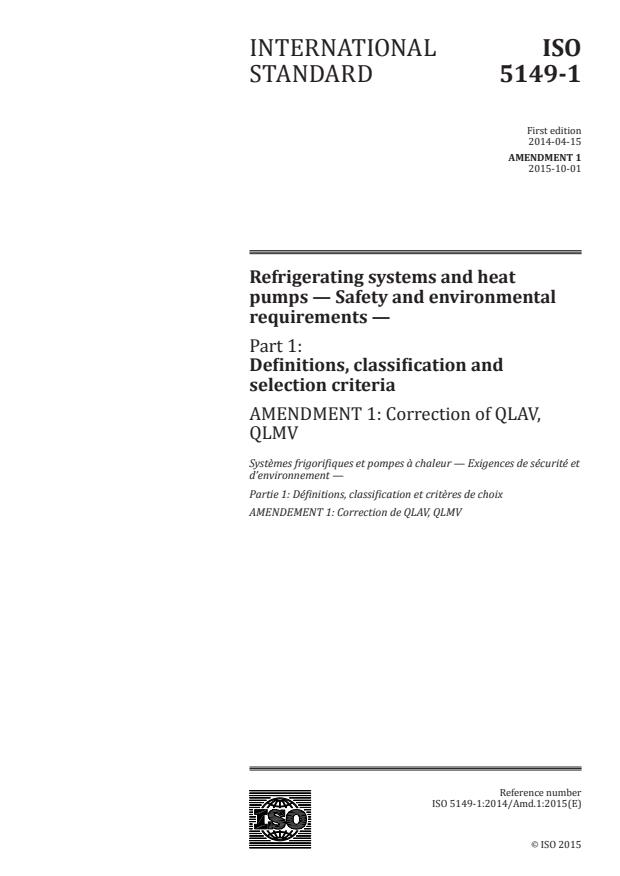
(Amendment)Refrigerating systems and heat pumps — Safety and environmental requirements — Part 1: Definitions, classification and selection criteria — Amendment 1: Correction of QLAV, QLMV
General Information
- Abstract
- Status
- Published
- Publication Date
- 05-Oct-2015
- Current Stage
- 6060 - International Standard published
- Start Date
- 06-Oct-2015
- Due Date
- 07-Jan-2017
- Completion Date
- 07-Jan-2017
Buy Documents

ISO 5149-1:2014/Amd 1:2015 - Refrigerating systems and heat pumps — Safety and environmental requirements — Part 1: Definitions, classification and selection criteria — Amendment 1: Correction of QLAV, QLMV Released:10/6/2015

ISO 5149-1:2014/Amd 1:2015 - Systemes frigorifiques et pompes a chaleur — Exigences de sécurité et d'environnement — Partie 1: Définitions, classification et criteres de choix — Amendement 1: Correction de QLAV, QLMV Released:10/6/2015
Overview
ISO 5149-1:2014/Amd 1:2015 is an important amendment to the international standard covering refrigerating systems and heat pumps, specifically focusing on safety and environmental requirements. This amendment corrects key definitions relating to the charge density limits of refrigerants used in occupied spaces, improving safety criteria for system design and operation. The standard is issued by ISO and serves as a critical reference for engineers, designers, and safety professionals working with refrigeration and heat pump systems.
Key Topics
Definitions Correction
The amendment updates the definitions of Quantity Limit with Additional Ventilation (QLAV) and Quantity Limit with Minimum Ventilation (QLMV). These terms define safe refrigerant charge densities in rooms based on ventilation conditions, essential for risk management in occupied spaces:- QLAV denotes the maximum refrigerant charge density permissible when additional ventilation can sufficiently disperse leaked refrigerant within 15 minutes.
- QLMV represents the charge density limit in environments with minimal ventilation where the refrigerant dispersal is slower.
Safety and Environmental Requirements
The amendment refines criteria for evaluating refrigerant charge densities relative to room volume and ventilation, addressing scenarios such as below-ground spaces and larger rooms exceeding 250 m². It mandates appropriate protective measures like mechanical ventilation, gas detection, safety shut-off valves, and alarms to mitigate hazards from refrigerant leaks.Refrigerant Charge Density Tables and Formulas
The standard provides detailed tables specifying QLAV and QLMV values for common refrigerants such as R22, R134a, R407C, R410A, R744, R32, and newer low GWP refrigerants like R1234yf and R1234ze.
It also introduces calculation methods to determine charge limits for refrigerants not explicitly listed, using parameters such as molar mass, leak rates, and ventilation openings.Risk Management in Occupied Spaces
The standard emphasizes the importance of managing refrigerant risks in spaces where people are present, particularly addressing the dispersal and concentration thresholds that might lead to dangerous conditions such as asphyxiation or toxicity.
Applications
Design and Installation of Refrigeration Systems
Engineers can use this amendment to accurately calculate safe refrigerant charge limits based on room size and ventilation conditions. Compliance ensures safer environments and minimizes the risk of leak-related incidents.Safety Auditing and Risk Assessment
Facility managers and safety inspectors can apply the updated definitions and charge limits to evaluate existing refrigeration and heat pump installations, implementing necessary safety measures where charge densities exceed QLMV or QLAV.Environmental Compliance
The amendment supports environmental safety objectives by setting limits on refrigerant quantities, reducing the potential impact of leaks on indoor air quality and the atmosphere.Training and Standards Development
The clarified definitions serve as a foundational reference for training programs targeting refrigeration professionals, and for the development of related safety and environmental standards in HVAC and refrigeration sectors.
Related Standards
ISO 5149 Series
Part 3 of ISO 5149 details safety measures, including alarms and gas detection systems, complementing the charge limit requirements set forth in Part 1.ISO 817: Refrigerants - Designation and Safety Classification
Provides standardized classification and safety information for refrigerants referenced in ISO 5149-1.ISO/IEC Directives
These directives guide the development and maintenance of ISO standards and ensure consistency in terminology and conformity assessment procedures.International Electrotechnical Commission (IEC) Standards
Relevant for integrating electrical safety aspects with refrigeration and heat pump systems.
Keywords
ISO 5149 amendment, refrigerating systems safety, heat pumps safety, refrigerant charge limits, QLAV, QLMV, refrigeration standards, environmental requirements, refrigerant classification, HVAC safety, refrigerant leak risk management, ventilation requirements, refrigerant concentration limits, refrigeration system design, ISO refrigeration safety.
Relations
- Effective Date
- 25-Aug-2026
- Effective Date
- 14-Oct-2020
- Effective Date
- 19-Nov-2022
Buy Documents
ISO 5149-1:2014/Amd 1:2015 - Refrigerating systems and heat pumps — Safety and environmental requirements — Part 1: Definitions, classification and selection criteria — Amendment 1: Correction of QLAV, QLMV Released:10/6/2015
ISO 5149-1:2014/Amd 1:2015 - Systemes frigorifiques et pompes a chaleur — Exigences de sécurité et d'environnement — Partie 1: Définitions, classification et criteres de choix — Amendement 1: Correction de QLAV, QLMV Released:10/6/2015
Get Certified
Connect with accredited certification bodies for this standard

DNV
DNV is an independent assurance and risk management provider.

Lloyd's Register
Lloyd's Register is a global professional services organisation specialising in engineering and technology.
DNV Energy Systems
Energy and renewable energy certification.
Sponsored listings
Frequently Asked Questions
ISO 5149-1:2014/Amd 1:2015 is a standard published by the International Organization for Standardization (ISO). Its full title is "Refrigerating systems and heat pumps — Safety and environmental requirements — Part 1: Definitions, classification and selection criteria — Amendment 1: Correction of QLAV, QLMV". This standard covers: Refrigerating systems and heat pumps — Safety and environmental requirements — Part 1: Definitions, classification and selection criteria — Amendment 1: Correction of QLAV, QLMV
Refrigerating systems and heat pumps — Safety and environmental requirements — Part 1: Definitions, classification and selection criteria — Amendment 1: Correction of QLAV, QLMV
ISO 5149-1:2014/Amd 1:2015 is classified under the following ICS (International Classification for Standards) categories: 27.080 - Heat pumps; 27.200 - Refrigerating technology. The ICS classification helps identify the subject area and facilitates finding related standards.
ISO 5149-1:2014/Amd 1:2015 has the following relationships with other standards: It is inter standard links to EN ISO 12643-2:2023, ISO 5149-1:2014, ISO 5149-1. Understanding these relationships helps ensure you are using the most current and applicable version of the standard.
ISO 5149-1:2014/Amd 1:2015 is available in PDF format for immediate download after purchase. The document can be added to your cart and obtained through the secure checkout process. Digital delivery ensures instant access to the complete standard document.
Standards Content (Sample)
INTERNATIONAL ISO
STANDARD 5149-1
First edition
2014-04-15
AMENDMENT 1
2015-10-01
Refrigerating systems and heat
pumps — Safety and environmental
requirements —
Part 1:
Definitions, classification and
selection criteria
AMENDMENT 1: Correction of QLAV,
QLMV
Systèmes frigorifiques et pompes à chaleur — Exigences de sécurité et
d’environnement —
Partie 1: Définitions, classification et critères de choix
AMENDEMENT 1: Correction de QLAV, QLMV
Reference number
ISO 5149-1:2014/Amd.1:2015(E)
©
ISO 2015
ISO 5149-1:2014/Amd.1:2015(E)
© ISO 2015, Published in Switzerland
All rights reserved. Unless otherwise specified, no part of this publication may be reproduced or utilized otherwise in any form
or by any means, electronic or mechanical, including photocopying, or posting on the internet or an intranet, without prior
written permission. Permission can be requested from either ISO at the address below or ISO’s member body in the country of
the requester.
ISO copyright office
Ch. de Blandonnet 8 • CP 401
CH-1214 Vernier, Geneva, Switzerland
Tel. +41 22 749 01 11
Fax +41 22 749 09 47
copyright@iso.org
www.iso.org
ii © ISO 2015 – All rights reserved
ISO 5149-1:2014/Amd.1:2015(E)
Foreword
ISO (the International Organization for Standardization) is a worldwide federation of national standards
bodies (ISO member bodies). The work of preparing International Standards is normally carried out
through ISO technical committees. Each member body interested in a subject for which a technical
committee has been established has the right to be represented on that committee. International
organizations, governmental and non-governmental, in liaison with ISO, also take part in the work.
ISO collaborates closely with the International Electrotechnical Commission (IEC) on all matters of
electrotechnical standardization.
The procedures used to develop this document and those intended for its further maintenance are
described in the ISO/IEC Directives, Part 1. In particular the different approval criteria needed for the
different types of ISO documents should be noted. This document was drafted in accordance with the
editorial rules of the ISO/IEC Directives, Part 2 (see www.iso.org/directives).
Attention is drawn to the possibility that some of the elements of this document may be the subject of
patent rights. ISO shall not be held responsible for identifying any or all such patent rights. Details of
any patent rights identified during the development of the document will be in the Introduction and/or
on the ISO list of patent declarations received (see www.iso.org/patents).
Any trade name used in this document is information given for the convenience of users and does not
constitute an endorsement.
For an explanation on the meaning of ISO specific terms and expressions related to conformity
assessment, as well as information about ISO’s adherence to the WTO principles in the Technical
Barriers to Trade (TBT) see the following URL: Foreword - Supplementary information
The committee responsible for this document is ISO/TC 86, Refrigeration and air-conditioning,
Subcommittee SC 1, Safety and environmental requirements for refrigerating systems.
ISO 5149-1:2014/Amd.1:2015(E)
Refrigerating systems and heat pumps — Safety and
environmental requirements —
Part 1:
Definitions, classification and selection criteria
AMENDMENT 1: Correction of QLAV, QLMV
Page 11, 3.10.3 and 3.10.4
Replace definitions 3.10.3 and 3.10.4 with the following:
3.10.3
quantity limit with additional ventilation
charge density of refrigerant that when exceeded creates an instantaneous dangerous situation, if the
total charge leaked within the occupied space
Note 1 to entry See A.5 for the use of Quantity Limit with Additional Ventilation (QLAV) to manage risk for systems
in occupied spaces where the level of ventilation is sufficient to disperse the leaked refrigerant within 15 min.
3.10.4
quantity limit with minimum ventilation
charge density of refrigerant that results in a concentration equal to the RCL in a room of non-airtight
construction with a moderately sever
...
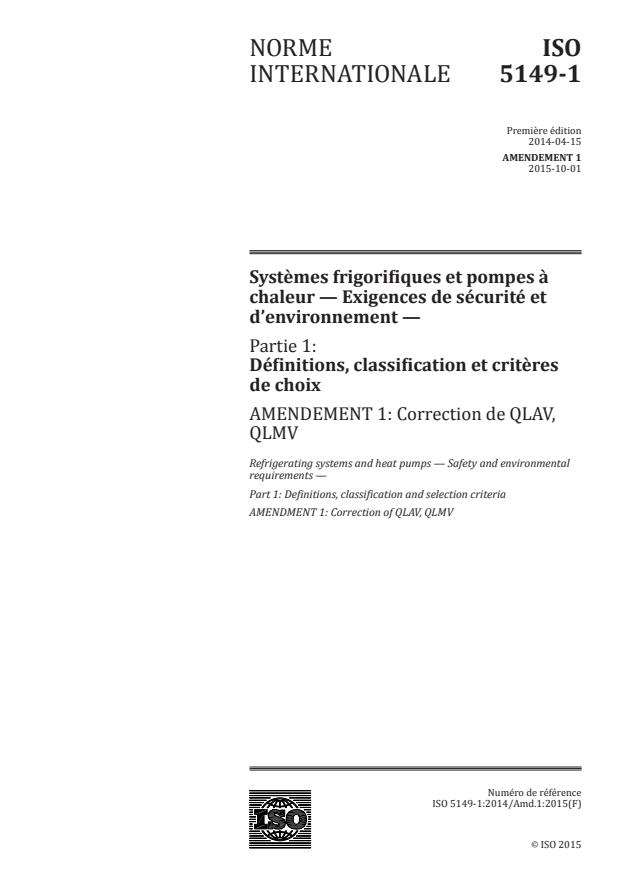
NORME ISO
INTERNATIONALE 5149-1
Première édition
2014-04-15
AMENDEMENT 1
2015-10-01
Systèmes frigorifiques et pompes à
chaleur — Exigences de sécurité et
d’environnement —
Partie 1:
Définitions, classification et critères
de choix
AMENDEMENT 1: Correction de QLAV,
QLMV
Refrigerating systems and heat pumps — Safety and environmental
requirements —
Part 1: Definitions, classification and selection criteria
AMENDMENT 1: Correction of QLAV, QLMV
Numéro de référence
ISO 5149-1:2014/Amd.1:2015(F)
©
ISO 2015
ISO 5149-1:2014/Amd.1:2015(F)
DOCUMENT PROTÉGÉ PAR COPYRIGHT
© ISO 2015, Publié en Suisse
Droits de reproduction réservés. Sauf indication contraire, aucune partie de cette publication ne peut être reproduite ni utilisée
sous quelque forme que ce soit et par aucun procédé, électronique ou mécanique, y compris la photocopie, l’affichage sur
l’internet ou sur un Intranet, sans autorisation écrite préalable. Les demandes d’autorisation peuvent être adressées à l’ISO à
l’adresse ci-après ou au comité membre de l’ISO dans le pays du demandeur.
ISO copyright office
Ch. de Blandonnet 8 • CP 401
CH-1214 Vernier, Geneva, Switzerland
Tel. +41 22 749 01 11
Fax +41 22 749 09 47
copyright@iso.org
www.iso.org
ii © ISO 2015 – Tous droits réservés
ISO 5149-1:2014/Amd.1:2015(F)
Avant-propos
L’ISO (Organisation internationale de normalisation) est une fédération mondiale d’organismes
nationaux de normalisation (comités membres de l’ISO). L’élaboration des Normes internationales est
en général confiée aux comités techniques de l’ISO. Chaque comité membre intéressé par une étude
a le droit de faire partie du comité technique créé à cet effet. Les organisations internationales,
gouvernementales et non gouvernementales, en liaison avec l’ISO participent également aux travaux.
L’ISO collabore étroitement avec la Commission électrotechnique internationale (IEC) en ce qui
concerne la normalisation électrotechnique.
Les procédures utilisées pour élaborer le présent document et celles destinées à sa mise à jour sont
décrites dans les Directives ISO/IEC, Partie 1. Il convient, en particulier de prendre note des différents
critères d’approbation requis pour les différents types de documents ISO. Le présent document a été
rédigé conformément aux règles de rédaction données dans les Directives ISO/IEC, Partie 2 (voir www.
iso.org/directives).
L’attention est appelée sur le fait que certains des éléments du présent document peuvent faire l’objet de
droits de propriété intellectuelle ou de droits analogues. L’ISO ne saurait être tenue pour responsable
de ne pas avoir identifié de tels droits de propriété et averti de leur existence. Les détails concernant
les références aux droits de propriété intellectuelle ou autres droits analogues identifiés lors de
l’élaboration du document sont indiqués dans l’Introduction et/ou dans la liste des déclarations de
brevets reçues par l’ISO (voir www.iso.org/brevets).
Les appellations commerciales éventuellement mentionnées dans le présent document sont données
pour information, par souci de commodité, à l’intention des utilisateurs et ne sauraient constituer
un engagement.
Pour une explication de la signification des termes et expressions spécifiques de l’ISO liés à
l’évaluation de la conformité, ou pour toute information au sujet de l’adhésion de l’ISO aux principes
de l’OMC concernant les obstacles techniques au commerce (OTC), voir le lien suivant: Avant-propos —
Informations supplémentaires.
Le comité responsable de l’élaboration du présent document est l’ISO/TC 86, Froid et climatisation, sous-
comité SC 1, Exigences de sécurité et d’environnement relatives aux systèmes frigorifiques.
ISO 5149-1:2014/Amd.1:2015(F)
Systèmes frigorifiques et pompes à chaleur — Exigences de
sécurité et d’environnement —
Partie 1:
Définitions, classification et critères de choix
AMENDEMENT 1: Correction de QLAV, QLMV
Page 11, 3.10.3 et 3.10.4
Remplacer les définitions 3.10.3 et 3.10.4 par ce qui suit:
3.10.3
quantité limite avec ventilation additionnelle
concentration de fluide frigorigène qui, lorsqu’elle est dépassée, conduit à une situation dangereuse
instantanée, si la charge totale s’échappe dans l’espace occupé
Note 1 à l’article Voir A.5 pour l’utilisation de limite de quantité avec une ventilation additionnelle (QLAV) pour
gérer les risques associés aux systèmes dans les espaces occupés où le niveau de ventilation est suffisant pour
disperser les fuites de fluide frigorigène en 15 min.
3.10.4
quantité limite avec ventilation minimale
concentration de fluide frigorigène qui aboutit à une concentration égale à la limite de concentration
en fluide frigorigène (RCL) dans une salle non étanche à l’air en cas de fuite modérément sévè
...