

ISO 5149-3:2014/Amd 1:2021
(Amendment)Refrigerating systems and heat pumps — Safety and environmental requirements — Part 3: Installation site — Amendment 1: Update of the requirements for machinery rooms and emergency mechanical ventilation
General Information
- Abstract
- Status
- Published
- Publication Date
- 15-Mar-2021
- Current Stage
- 6060 - International Standard published
- Start Date
- 16-Mar-2021
- Due Date
- 18-Jan-2021
- Completion Date
- 16-Mar-2021
Buy Documents



ISO 5149-3:2014/Amd 1:2021 - Refrigerating systems and heat pumps — Safety and environmental requirements — Part 3: Installation site — Amendment 1: Update of the requirements for machinery rooms and emergency mechanical ventilation Released:3/16/2021


ISO 5149-3:2014/Amd 1:2021 - Systemes frigorifiques et pompes a chaleur — Exigences de sécurité et d'environnement — Partie 3: Site d'installation — Amendement 1: Mise a jour des exigences relatives aux salles des machines et a la ventilation mécanique d'urgence Released:3/16/2021
Overview
ISO 5149-3:2014/Amd 1:2021 is an important international standard issued by ISO that updates safety and environmental requirements concerning the installation site of refrigerating systems and heat pumps. This amendment focuses specifically on the requirements for machinery rooms and emergency mechanical ventilation. It provides critical guidelines to ensure the safe and environmentally responsible installation of refrigeration equipment, helping to prevent hazards related to refrigerant leaks, ventilation failures, and explosion risks.
This updated document serves as a key reference for manufacturers, installers, safety engineers, and facility managers involved in the design, installation, and maintenance of refrigerating and heat pump systems.
Key Topics
Machinery Room Safety
- Proper location and protection of refrigerating equipment
- Compliance with hazardous zone requirements for rooms containing flammable refrigerants
- Prevention of refrigerant leaks threatening building occupants
Ventilation Design and Requirements
- Sufficient ventilation for temperature control under normal and emergency conditions
- Emergency mechanical ventilation activated by gas detectors to mitigate refrigerant accumulation
- Minimum ventilation rates specified for emergency scenarios (at least 15 air changes per hour)
- Design of air intake and exhaust openings to avoid recirculation and ensure effective contaminant removal
Flammable Refrigerants
- Additional safety measures for refrigerants classified under flammability classes 2L, 2, and 3
- Requirements for explosion risk mitigation, including protective walls or frangible roofs
- Restrictions on combustion equipment in rooms containing certain refrigerant types
- Surface temperature limits to prevent ignition risks
Special Provisions for Ammonia (R-717)
- Drainage systems to prevent environmental contamination
- Emergency wash stations and showers for personnel safety in case of exposure
- Restrictions on the use of water-based fire extinguishing systems due to chemical reactivity
Detection and Alarm Systems
- Installation of refrigerant-specific gas detectors with alarm activation thresholds below 25% Lower Flammable Limit (LFL)
- Automatic triggering of ventilation and system shutdown upon detection of hazardous refrigerant levels
Applications
The updated ISO 5149-3 standard is crucial for:
Facility and Plant Design
Ensuring refrigeration machinery rooms are designed and located to minimize risks to personnel and property.Safety Compliance and Risk Management
Providing practical measures to detect and respond to refrigerant leaks, preventing fires, explosions, and toxic exposures.Maintenance and Operation of Refrigeration Systems
Guiding organizations on proper ventilation maintenance, gas detection, and emergency response systems to uphold continuous safety.Environmental Protection
Minimizing refrigerant emissions through proper system installation and ventilation control.Industrial and Commercial Refrigeration
Catering to a wide range of systems from commercial supermarkets to large industrial refrigeration plants that use various refrigerant types including flammable and toxic gases.
Related Standards
ISO 5149 Series – Covers safety and environmental requirements for refrigerating systems and heat pumps in multiple parts, providing a comprehensive framework for refrigeration safety.
IEC 60079-10-1 – Explosive atmospheres - Part 10-1: Classification of hazardous locations, relevant for defining zones in machinery rooms with flammable refrigerants.
ISO 5149-1:2014 – Provides definitions and general requirements essential for understanding terminology and scope for refrigeration systems.
ISO 5149-2:2014 – Contains specific requirements applicable to the construction and components of refrigeration systems, complementing installation site safety.
ISO/IEC Directives – Guidelines on the development and update of standards, ensuring consistency and quality.
This amendment to ISO 5149-3 supports enhanced safety protocols and environmental stewardship in refrigeration installations, making it an indispensable resource aligned with the latest best practices in the HVAC and refrigeration industries. Adhering to these requirements reduces risks associated with refrigerant leaks, fire hazards, and mechanical failures while maintaining operational efficiency.
Relations
- Effective Date
- 13-Oct-2020
- Effective Date
- 19-Nov-2022
Buy Documents
ISO 5149-3:2014/Amd 1:2021 - Refrigerating systems and heat pumps — Safety and environmental requirements — Part 3: Installation site — Amendment 1: Update of the requirements for machinery rooms and emergency mechanical ventilation Released:3/16/2021
ISO 5149-3:2014/Amd 1:2021 - Systemes frigorifiques et pompes a chaleur — Exigences de sécurité et d'environnement — Partie 3: Site d'installation — Amendement 1: Mise a jour des exigences relatives aux salles des machines et a la ventilation mécanique d'urgence Released:3/16/2021
Get Certified
Connect with accredited certification bodies for this standard

DNV
DNV is an independent assurance and risk management provider.

Lloyd's Register
Lloyd's Register is a global professional services organisation specialising in engineering and technology.
DNV Energy Systems
Energy and renewable energy certification.
Sponsored listings
Frequently Asked Questions
ISO 5149-3:2014/Amd 1:2021 is a standard published by the International Organization for Standardization (ISO). Its full title is "Refrigerating systems and heat pumps — Safety and environmental requirements — Part 3: Installation site — Amendment 1: Update of the requirements for machinery rooms and emergency mechanical ventilation". This standard covers: Refrigerating systems and heat pumps — Safety and environmental requirements — Part 3: Installation site — Amendment 1: Update of the requirements for machinery rooms and emergency mechanical ventilation
Refrigerating systems and heat pumps — Safety and environmental requirements — Part 3: Installation site — Amendment 1: Update of the requirements for machinery rooms and emergency mechanical ventilation
ISO 5149-3:2014/Amd 1:2021 is classified under the following ICS (International Classification for Standards) categories: 27.080 - Heat pumps; 27.200 - Refrigerating technology. The ICS classification helps identify the subject area and facilitates finding related standards.
ISO 5149-3:2014/Amd 1:2021 has the following relationships with other standards: It is inter standard links to ISO 5149-3:2014, ISO 5149-3. Understanding these relationships helps ensure you are using the most current and applicable version of the standard.
ISO 5149-3:2014/Amd 1:2021 is available in PDF format for immediate download after purchase. The document can be added to your cart and obtained through the secure checkout process. Digital delivery ensures instant access to the complete standard document.
Standards Content (Sample)
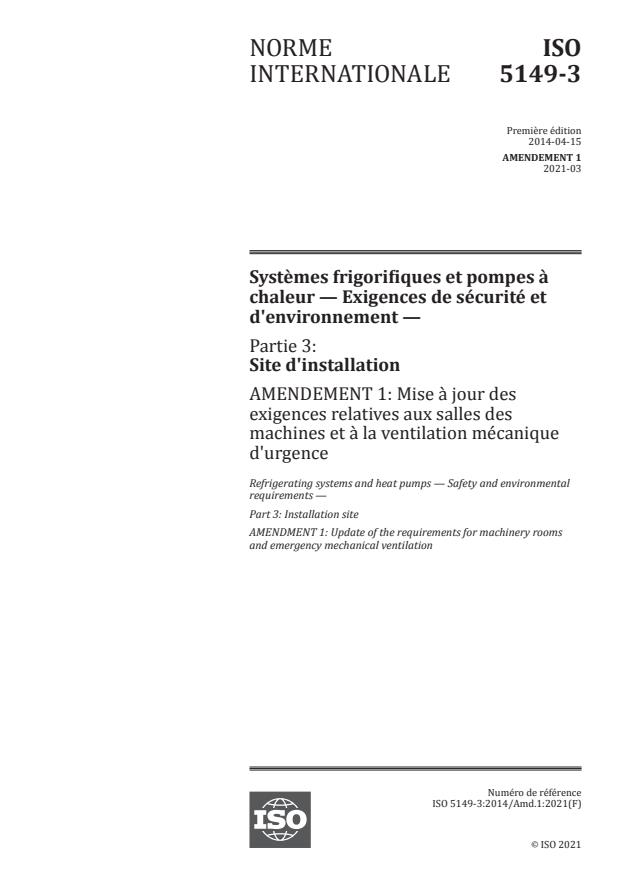
INTERNATIONAL ISO
STANDARD 5149-3
First edition
2014-04-15
AMENDMENT 1
2021-03
Refrigerating systems and heat
pumps — Safety and environmental
requirements —
Part 3:
Installation site
AMENDMENT 1: Update of the
requirements for machinery rooms and
emergency mechanical ventilation
Systèmes frigorifiques et pompes à chaleur — Exigences de sécurité et
d'environnement —
Partie 3: Site d'installation
AMENDEMENT 1: Mise à jour des exigences relatives aux salles des
machines et à la ventilation mécanique d'urgence
Reference number
ISO 5149-3:2014/Amd.1:2021(E)
©
ISO 2021
ISO 5149-3:2014/Amd.1:2021(E)
© ISO 2021
All rights reserved. Unless otherwise specified, or required in the context of its implementation, no part of this publication may
be reproduced or utilized otherwise in any form or by any means, electronic or mechanical, including photocopying, or posting
on the internet or an intranet, without prior written permission. Permission can be requested from either ISO at the address
below or ISO’s member body in the country of the requester.
ISO copyright office
CP 401 • Ch. de Blandonnet 8
CH-1214 Vernier, Geneva
Phone: +41 22 749 01 11
Email: copyright@iso.org
Website: www.iso.org
Published in Switzerland
ii © ISO 2021 – All rights reserved
ISO 5149-3:2014/Amd.1:2021(E)
Foreword
ISO (the International Organization for Standardization) is a worldwide federation of national standards
bodies (ISO member bodies). The work of preparing International Standards is normally carried out
through ISO technical committees. Each member body interested in a subject for which a technical
committee has been established has the right to be represented on that committee. International
organizations, governmental and non-governmental, in liaison with ISO, also take part in the work.
ISO collaborates closely with the International Electrotechnical Commission (IEC) on all matters of
electrotechnical standardization.
The procedures used to develop this document and those intended for its further maintenance are
described in the ISO/IEC Directives, Part 1. In particular the different approval criteria needed for the
different types of ISO documents should be noted. This document was drafted in accordance with the
editorial rules of the ISO/IEC Directives, Part 2 (see www .iso .org/ directives).
Attention is drawn to the possibility that some of the elements of this document may be the subject of
patent rights. ISO shall not be held responsible for identifying any or all such patent rights. Details of
any patent rights identified during the development of the document will be in the Introduction and/or
on the ISO list of patent declarations received (see www .iso .org/ patents).
Any trade name used in this document is information given for the convenience of users and does not
constitute an endorsement.
For an explanation of the voluntary nature of standards, the meaning of ISO specific terms and
expressions related to conformity assessment, as well as information about ISO's adherence to the
World Trade Organization (WTO) principles in the Technical Barriers to Trade (TBT), see www .iso .org/
iso/ foreword .html.
This document was prepared by Technical Committee ISO/TC 86, Refrigeration and air-conditioning,
Subcommittee SC 1, Safety and environmental requirements for refrigerating systems.
A list of all parts in the ISO 5149 series can be found on the ISO website.
Any feedback or questions on this document should be directed to the user’s national standards body. A
complete listing of these bodies can be found at www .iso .org/ members .html.
ISO 5149-3:2014/Amd.1:2021(E)
Refrigerating systems and heat pumps — Safety and
environmental requirements —
Part 3:
Installation site
AMENDMENT 1: Update of the requirements for machinery
rooms and emergency mechanical ventilation
Clause 3
Replace the introductory paragraph with the following:
For the purposes of this document, the terms and definitions given in ISO 5149-1 and the following apply.
ISO and IEC maintain terminological databases for use in standardization at the following addresses:
— ISO Online browsing platform: available at https:// www .iso .org/ obp
— IEC Electropedia: available at http:// www .electropedia .org/
4.2, first paragraph
Replace the paragraph with the following:
Refrigerating systems sited in the open air shall be positioned to avoid refrigerant flowing from the
system into the building or otherwise endangering people.
NOTE Possible methods to achieve this include one or more of the following:
— location of the refrigerant containing part of the refrigeration system (except piping) at least 6 m away from
any opening to the building,
— use of barriers of at least 1 m height between the system location and the inlet ventilation opening to block
the flow of leaked or vented refrigerant,
— location of the inlet ventilation opening at least 1 m above the level at which the system is installed.
The discharge opening from safety relief devices shall be positioned 6 m away from and oriented to
direct vented refrigerant away from inlet ventilation openings.
4.6, last sentence
In the last sentence, replace the reference to "ISO 5149-1:2014, 5.2.17" with "ISO 5149-1:2014, Annex A".
5.13
Replace 5.13 with the following:
ISO 5149-3:2014/Amd.1:2021(E)
5.13 Ventilation
5.13.1 General
The ventilation of machinery rooms shall be sufficient for background ventilation (if required),
temperature control under normal operating conditions, occupancy and emergencies.
NOTE Details of background ventilation are given in 5.14.1.3.
Air from machinery rooms shall be vented outdoors using mechanical ventilation in the event of a release
of refrigerant due to leaks or rupture of components. This ventilation system shall be independent of
any other ventilation system on the site.
Provision shall be made for a sufficient supply of outside replacement air and a good distribution of that
air over the machinery room avoiding dead zones.
Openings for exhaust from the machinery room to the outside shall be positioned to avoid re-circulation
into the room.
5.13.2 Ventilation for temperature control under normal operating conditions
Ventilation shall be designed to limit the temperature rise of air to 10 K above outdoor ambient
temperature when the equipment is operating at maximum capacity. If the heat emission from the
system is not known, it shall be taken to be 10 % of the connected compressor motor power.
NOTE The figure of 10 % allows for heat gain from air-cooled electric motors and heat radiation from hot
surfaces. If the motors are water-cooled or cooled by the refrigerant flow, or if the hot surfaces are insulated then
it may be appropriate to reduce this allowance.
5.13.3 Ventilation when machinery room is occupied
For ventilation purposes, there shall be a minimum of four air changes
...
NORME ISO
INTERNATIONALE 5149-3
Première édition
2014-04-15
AMENDEMENT 1
2021-03
Systèmes frigorifiques et pompes à
chaleur — Exigences de sécurité et
d'environnement —
Partie 3:
Site d'installation
AMENDEMENT 1: Mise à jour des
exigences relatives aux salles des
machines et à la ventilation mécanique
d'urgence
Refrigerating systems and heat pumps — Safety and environmental
requirements —
Part 3: Installation site
AMENDMENT 1: Update of the requirements for machinery rooms
and emergency mechanical ventilation
Numéro de référence
ISO 5149-3:2014/Amd.1:2021(F)
©
ISO 2021
ISO 5149-3:2014/Amd.1:2021(F)
DOCUMENT PROTÉGÉ PAR COPYRIGHT
© ISO 2021
Tous droits réservés. Sauf prescription différente ou nécessité dans le contexte de sa mise en œuvre, aucune partie de cette
publication ne peut être reproduite ni utilisée sous quelque forme que ce soit et par aucun procédé, électronique ou mécanique,
y compris la photocopie, ou la diffusion sur l’internet ou sur un intranet, sans autorisation écrite préalable. Une autorisation peut
être demandée à l’ISO à l’adresse ci-après ou au comité membre de l’ISO dans le pays du demandeur.
ISO copyright office
Case postale 401 • Ch. de Blandonnet 8
CH-1214 Vernier, Genève
Tél.: +41 22 749 01 11
E-mail: copyright@iso.org
Web: www.iso.org
Publié en Suisse
ii © ISO 2021 – Tous droits réservés
ISO 5149-3:2014/Amd.1:2021(F)
Avant-propos
L'ISO (Organisation internationale de normalisation) est une fédération mondiale d'organismes
nationaux de normalisation (comités membres de l'ISO). L'élaboration des Normes internationales est
en général confiée aux comités techniques de l'ISO. Chaque comité membre intéressé par une étude
a le droit de faire partie du comité technique créé à cet effet. Les organisations internationales,
gouvernementales et non gouvernementales, en liaison avec l'ISO participent également aux travaux.
L'ISO collabore étroitement avec la Commission électrotechnique internationale (IEC) en ce qui
concerne la normalisation électrotechnique.
Les procédures utilisées pour élaborer le présent document et celles destinées à sa mise à jour sont
décrites dans les Directives ISO/IEC, Partie 1. Il convient, en particulier de prendre note des différents
critères d'approbation requis pour les différents types de documents ISO. Le présent document a été
rédigé conformément aux règles de rédaction données dans les Directives ISO/IEC, Partie 2 (voir www
.iso .org/ directives).
L'attention est attirée sur le fait que certains des éléments du présent document peuvent faire l'objet de
droits de propriété intellectuelle ou de droits analogues. L'ISO ne saurait être tenue pour responsable
de ne pas avoir identifié de tels droits de propriété et averti de leur existence. Les détails concernant
les références aux droits de propriété intellectuelle ou autres droits analogues identifiés lors de
l'élaboration du document sont indiqués dans l'Introduction et/ou dans la liste des déclarations de
brevets reçues par l'ISO (voir www .iso .org/ brevets).
Les appellations commerciales éventuellement mentionnées dans le présent document sont données
pour information, par souci de commodité, à l’intention des utilisateurs et ne sauraient constituer un
engagement.
Pour une explication de la nature volontaire des normes, la signification des termes et expressions
spécifiques de l'ISO liés à l'évaluation de la conformité, ou pour toute information au sujet de l'adhésion
de l'ISO aux principes de l’Organisation mondiale du commerce (OMC) concernant les obstacles
techniques au commerce (OTC), voir www .iso .org/ avant -propos.
Le présent document a été élaboré par le comité technique ISO/TC 86, Froid et climatisation, sous-comité
SC 1, Exigences de sécurité et d'environnement relatives aux systèmes frigorifiques.
Une liste de toutes les parties de la série ISO 5149 se trouve sur le site web de l’ISO.
Il convient que l’utilisateur adresse tout retour d’information ou toute question concernant le présent
document à l’organisme national de normalisation de son pays. Une liste exhaustive desdits organismes
se trouve à l’adresse www .iso .org/ fr/ members .html.
ISO 5149-3:2014/Amd.1:2021(F)
Systèmes frigorifiques et pompes à chaleur — Exigences de
sécurité et d'environnement —
Partie 3:
Site d'installation
AMENDEMENT 1: Mise à jour des exigences relatives aux salles
des machines et à la ventilation mécanique d'urgence
Article 3
Remplacer l'alinéa d’introduction comme suit:
Pour les besoins du présent document, les termes et définitions donnés dans l’ISO 5149-1, ainsi que les
suivants, s'appliquent.
L’ISO et l’IEC tiennent à jour des bases de données terminologiques destinées à être utilisées en
normalisation, consultables aux adresses suivantes:
— ISO Online browsing platform: disponible à l’adresse https:// www .iso .org/ obp
— IEC Electropedia: disponible à l’adresse http:// www .electropedia .org/
4.2, premier alinéa
Remplacer l'alinéa comme suit:
Les systèmes de réfrigération installés à l'air libre doivent être placés de manière à éviter que le fluide
frigorigène ne s'écoule du système vers le bâtiment ou ne mette les personnes en danger.
NOTE Les méthodes possibles pour y parvenir comprennent un ou plusieurs des points suivants:
— la partie du système de réfrigération contenant du fluide frigorigène (sauf la tuyauterie) est située à au moins
6 m de toute ouverture vers le bâtiment,
— utilisation de barrières d'au moins 1 m de hauteur entre l'emplacement du système et l'ouverture de la prise
d'air de la ventilation pour bloquer l'écoulement du fluide frigorigène qui fuit ou qui fait l'objet d'une purge,
— l'emplacement de l'ouverture de la prise d'air de la ventilation est situé à au moins 1 m au-dessus du niveau
auquel le système est installé.
L'ouverture d'évacuation des dispositifs de décharge de sécurité doit être placée à une distance de 6 m
des ouvertures prises d'air de ventilation et orientée de manière à diriger le fluide frigorigène évacué
loin de celles-ci.
4.6, dernière phrase
Dans la dernière phrase, remplacer la référence «ISO 5149-2:2014, 5.2.17» par «ISO 5149-1:2014,
Annexe A».
ISO 5149-3:2014/Amd.1:2021(F)
5.13
Remplacer le 5.13 comme suit:
5.13 Ventilation
5.13.1 Généralités
La ventilation des salles des machines doit être suffisante pour assurer la ventilation: de fond (si
nécessaire), pour le contrôle de la température dans des conditions normales de fonctionnement, lors
de l'occupation et dans les situations d'urgence.
NOTE Des détails sur la ventilation de fond sont donnés en 5.14.1.3.
L'air provenant des salles des machines doit être évacué vers l'extérieur en utilisant un système de
ventilation mécanique en cas de décharge de fluide frigorigène due à des fuites ou à une rupture des
composants. Ce système de ventilation doit être indépendant de tout autre système de ventilation sur
le site.
Des dispositions doivent être prises pour une alimentation suffisante en air de remplacement extérieur
et une bonne distribution de cet air dans la salle des machines en évitant les zones mortes.
Les ouvertures pour le refoulement de la salle des machines vers l'extérieur doivent être placées de
manière à éviter la recirculation dans la salle.
5.13.2 Ventilation pour le contrôle de la température dans des conditions normales de
fonctionnement
La ventilation doit être conçue pour limiter l'élévation de température de l'air à 10 K au-dessus de la
température ambiante extérieure lorsque l'équipement fonctionne à sa capacité maximale. Si l'émission
de chaleur du système n'est pas connue, elle doit être considérée comme égale à 10 % de la puissance du
moteur du compresseur raccordé.
NOTE Le chiffre de 10 % tient compte des gains de chaleur provenant des moteurs électriques refroidis par
air et du rayonnement thermique provenant des surfaces chaudes. Si les moteurs sont refroidis par l'eau ou par le
flux de fluide frigorigène, ou si les surfaces chaudes sont isolées, il peut être approprié de réduire cette tolérance.
5.13.3 Ventilation lorsque la salle des machines est occupée
Pour les besoins de ventilation, il doit y avoir au minimum quatre renouvellements d'air par heure
lorsque la salle des machines est occupée.
5.13.4 Ventilation mécanique d'urgence
Si un sys
...