


ISO 8402:1994
(Main)Quality management and quality assurance — Vocabulary
Quality management and quality assurance — Vocabulary
Management de la qualité et assurance de la qualité — Vocabulaire
Vodenje kakovosti in zagotavljanje kakovosti - Slovar
General Information
- Status
- Withdrawn
- Publication Date
- 23-Mar-1994
- Withdrawal Date
- 23-Mar-1994
- Technical Committee
- ISO/TC 176/SC 1 - Concepts and terminology
- Drafting Committee
- ISO/TC 176/SC 1/WG 1 - Development of ISO 9000
- Current Stage
- 9599 - Withdrawal of International Standard
- Start Date
- 08-Dec-2000
- Completion Date
- 14-Feb-2026
Relations
- Effective Date
- 12-May-2008
- Effective Date
- 15-Apr-2008
- Effective Date
- 15-Apr-2008
Get Certified
Connect with accredited certification bodies for this standard

BSI Group
BSI (British Standards Institution) is the business standards company that helps organizations make excellence a habit.

Bureau Veritas
Bureau Veritas is a world leader in laboratory testing, inspection and certification services.

DNV
DNV is an independent assurance and risk management provider.
Sponsored listings
Frequently Asked Questions
ISO 8402:1994 is a standard published by the International Organization for Standardization (ISO). Its full title is "Quality management and quality assurance — Vocabulary". This standard covers: Quality management and quality assurance — Vocabulary
Quality management and quality assurance — Vocabulary
ISO 8402:1994 is classified under the following ICS (International Classification for Standards) categories: 01.040.03 - Services. Company organization, management and quality. Administration. Transport. Sociology. (Vocabularies); 03.100.70 - Management systems; 03.120.10 - Quality management and quality assurance. The ICS classification helps identify the subject area and facilitates finding related standards.
ISO 8402:1994 has the following relationships with other standards: It is inter standard links to SIST ISO 8402:1996, ISO 8402:1986, ISO 9000:2000. Understanding these relationships helps ensure you are using the most current and applicable version of the standard.
ISO 8402:1994 is available in PDF format for immediate download after purchase. The document can be added to your cart and obtained through the secure checkout process. Digital delivery ensures instant access to the complete standard document.
Standards Content (Sample)
INTERNATIONAL
STANDARD
Second edition
NORME
Deuxieme bdition
B~opoe i43aatiMe
1994-04-01
INTERNATIONALE
MEmYHAPOnHblti
CTAHJJAPT
Quality management and quality assurance -
Vocabulary
Management de la qualit et assurance
de la qualit - Vocabulaire
YnpaBnetiue KavecTBonn M obecneqetwe
KaYecTBa -
CJlOBapb
Reference number
Numbro de rbfbrence
fiOMep CCbUlKM
IS0 84023 994( E/F/R)
IS0 8402:1994(E/F/R)
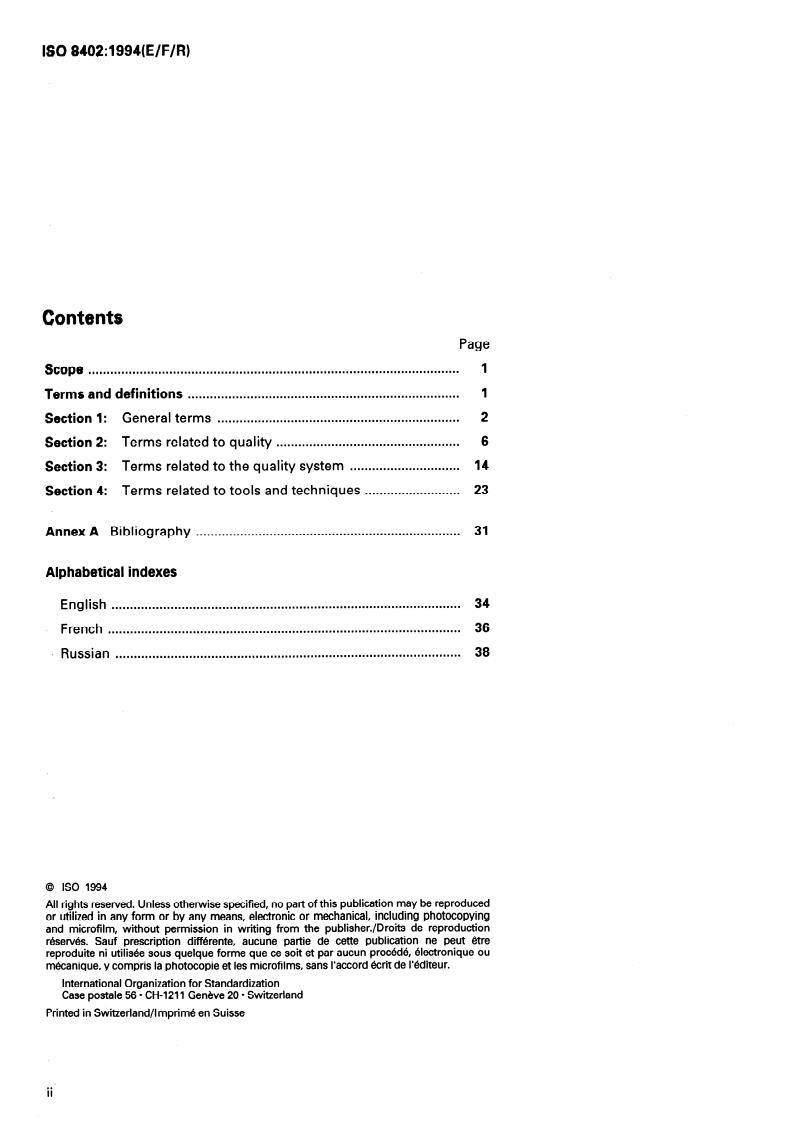
Contents
Page
.....................................................................................................
Scope
..........................................................................
Terms and definitions
General terms .
Section 1:
..................................................
Section 2: Terms related to quality
..............................
Section 3: Terms related to the quality system
..........................
Section 4: Terms related to tools and techniques
Annex A Bibliography . . . . . . . . . . . . . . . . . . . . . . . . . . . . . . . . . . . . . . . . . . . . . . . . . . . . . . . . . . . . . . . . . . . . . . . .
Alphabetical indexes
...............................................................................................
English
French .
. Russian .
0 IS0 1994
All rights reserved. Unless otherwise specified, no part of this publication may be reproduced
or utilized in any form or by any means, electronic or mechanical, including photocopying
and microfilm, without permission in writing from the publisher./Droits de reproduction
reserves. Sauf prescription differente, aucune partie de cette publication ne peut etre
reproduite ni utilisee sous quelque forme que ce soit et par aucun procede, Blectronique ou
mecanique, y compris la photocopie et les microfilms, sans I’accord Wit de I’editeur.
International Organization for Standardization
Case postale 56 l CH-1211 Geneve 20 l Switzerland
Printed in Switzerland/l mprime en Suisse
ii
IS0 8402:1994(E/F/R)
@ IS0
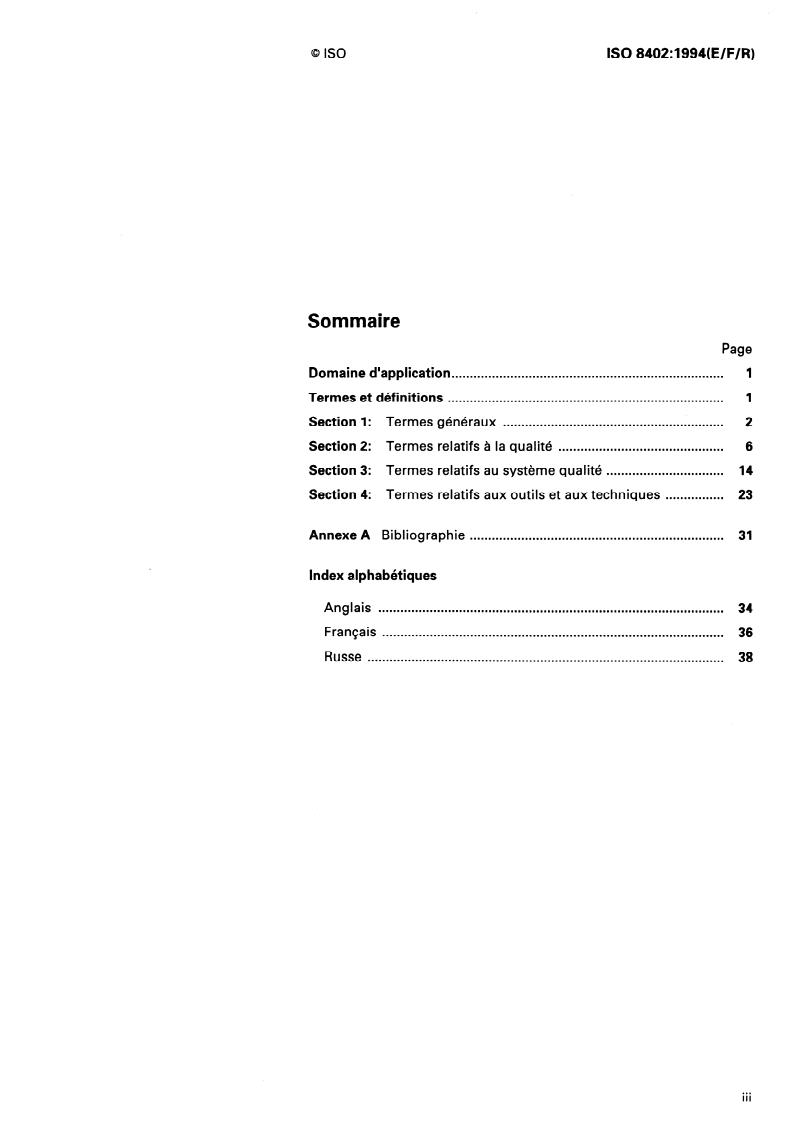
Sommaire
Page
Domaine d’application . . . . . . . . . . . . . . . . . . . . . . . . . . . . . . . . . . . . . . . . . . . . . . . . . . . . . . . . . . . . . . . . . . . . . . . . . .
Termes et dhfinitions .*. 1
Section 1: Termes g&Graux . . . . . . . . . . . . . . . . . . . . . . . . . . . . . . . . . . . . . . . . . . . . . . . . . . . . . . . . . . . . 2
Section 2: Termes relatifs 5 la qualit . . . . . . . . . . . . . . . . . . . . . . . . . . . . . . . . . . . . . . . . . . . . . 6
Termes relatifs au systkme qualit . . . . . . . . . . . . . . . . . . . . . . . . . . . . . . . . 14
Section 3:
Termes relatifs aux outils et aux techniques . . . . . . . . . . . . . . . . 23
Section 4:
. . . . . . . . . . . . . . . . . . . . . . . . . . . . . . . . . . . . . . . . . . . . . . . . . . . . . . . . . . . . . .*. 31
Annexe A Bibliographie
Index alphab&iques
Anglais . 34
FranGais . 36
Russe . 38
. . .
III
0 IS0
IS0 8402:1994(E/F/R)
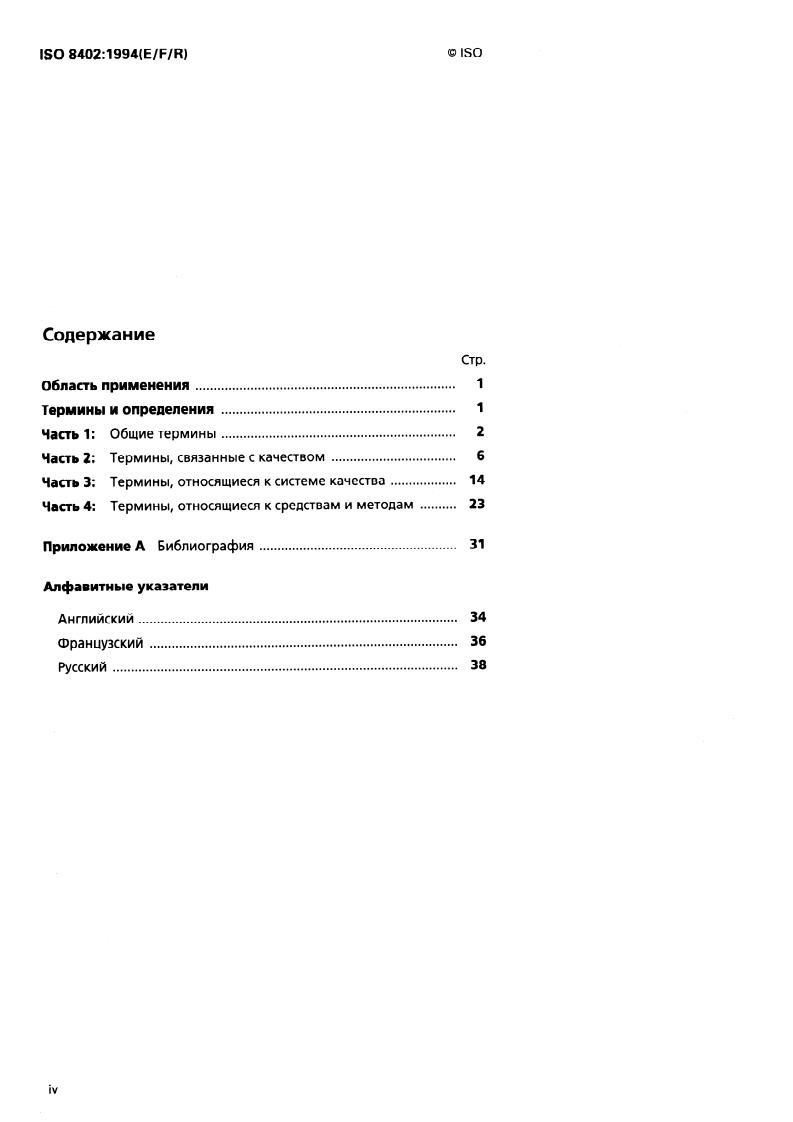
Caflepxakwe
.
CTP
. . . . . . . . . . . . . . . . . . . . . . . . . . . . . . . . . . . . . . . . . . . . . . . . . . . . . . . . . . . . . . . . . . . . . . .
Odnacn npuweHeww
. . . . . . . . . . . . . . . . . . . . . . . . . . . . . . . . . . . . . . . . . . . . . . . . . . . . . . . . . . . . . . . .
TepMwHbl u 0npeAeneww
. . . . . . . . . . . . . . . . . . . . . . . . . . . . . . . . . . . . . . . . . . . . . . .~.
Yacrb 1: 06we TepMMHbl
..................................
Yacrb 2: TepMkIHbl, CBfI3aHHble C KaWCTBOM
.................. 14
TepMMHbl, OTHOCFl~MeCFI K CMCTeMe KalfeCTBa
Yacrb 3:
.......... 23
TepMMHbl, OTHOCFlU(MeC5I K CpeflCTBaM M MeTOnaM
%CTb 4:
. . . . . . . . . . . . . . . . . . . . . . . . . . . . . . . . . . . . . . . . . . . . . . . . . . . . . .
npwmoxeHwe A 6vr6morpac#wm
h@aBMTHble yKa3aTeJWl
hirflMkKMti .
Q)PaH~Y3CKMli .
PYCCKMI? .
iv
@ IS0 IS0 8402: 1994( E/F/R)
Foreword
IS0 (the International Organization for Standardization) is a worldwide
federation of national standards bodies (IS0 member bodies). The work of
preparing International Standards is normally carried out through IS0
technical committees. Each member body interested in a subject for which a
technical committee has been established has the right to be represented on
that committee. International organizations, governmental and non-
governmental, in liaison with ISO, also take part in the work. IS0 collaborates
closely with the International Electrotechnical Commission (IEC) on all matters
of electrotechnical standardization.
Draft International Standards adopted by the technical committees are
circulated to the member bodies for voting. Publication as an International
Standard requires approval by at least 75 % of the member bodies casting a
vote.
International Standard IS0 8402 was prepared by Technical Committee
lSO/rC 176, Quality management and quality assurance, Subcommittee
SC 1, Concepts and terminology.
This second edition cancels and replaces the first edition (IS0 8402:1986),
which has been revised and substantially extended.
Annex A of this International Standard is for information only.
@ IS0
IS0 8402:1994(E/F/R)
Avant-propos
L’ISO (Organisation internationale de normalisation) est une federation
mondiale d’organismes nationaux de normalisation (comites membres de
I’ISO). L’elaboration des Normes internationales est en general confide
aux comites techniques de I’ISO. Chaque comite membre inter-es& par
une etude a le droit de faire partie du comite technique tree a cet effet.
Les organisations internationales, gouvernementales et non gouverne-
mentales, en liaison avec I’ISO participent egalement aux travaux. L’ISO
collabore etroitement avec la Commission electrotechnique internationale
(CEI) en ce qui concerne la normalisation electrotechnique.
Les projets de Normes internationales adopt& par les comites techniques
sont soumis aux comites membres pour vote. Leur publication comme
Normes internationales requiert I’approbation de 75 % au moins des
comites membres votants.
La Norme internationale IS0 8402 a ete elaboree par le comite technique
lSO/rC 176, Management de la qua/it& et assurance de la qua/it& sous-
comite SC 1, Concepts et terminologie.
Cette deuxieme edition annule et remplace la premiere edition
(IS0 8402:1986), qui a fait I’objet d’une revision et d’une importante
extension.
L’annexe A de la presente est donnee un iquement a
N orme internationale
titre d’information.
Q IS0
VICO (MewyHaponHafl OpraHM3auwI no CTaHnapTmawM) RBmeTm
BceMMpHoii aenepaweii HauMoHanbHblx opraHu3awGi no craHnapTu3awM
(KOMlrlTeTOB-YneHOB vlco). Pa3pa6oTKa MemLl)cHapOflHblX CTaHJJapTOB
OCy~eCTBnfleTCJI TeXHWeCKL’lMM KOML’lTeTaMM MCO. Kamblii KOMMTeT-YneH,
3aL’lHTepeCOBaHHblli B fleFlTenbHOCTl/l, JJJlFl KOTOpOli 6bln CO3flaH TeXHMYeCKMii
KOMMTeT, PIMeeT npaB0 6blTb npenCTdBneHHblM B 3TOM KOMMTeTe.
MemyHapOflHble rlpaBVlTenbCTBeHHble M HenpaBVlTenbCTBeHHble OpraHM3aLWlW,
MMeiouide CBA~M c MCO, TaKxe npMHuMa0-r yqacrr/le B pa6oTax. L1~0 KacaeTm
craHnapTl/r3aum B obnacm meKTpoTexHMKM, IACO pa60TaeT B TecHoM
coTpynHwecTBe c MemyHaponHoii 3neKTpoTexHwecKoii KoMvmMei? (M3K).
npOeKTbl MeIq/HapOflHblX CTaHnapTOB, npMHFlTble TeXHbWeCKMML’l KOMM-
TeTaMM, PaCCblnatOTCFI KOMMTeTaM-YneHaM Ha rOnOCOBaHVle. t’!X onybnn-
KOBaHMe B KalleCTBe MemnyHapOnHblX CTaHnapTOB Tpe6yeT ono6peHm I-IO
MeHbUJeii Mepe 75 % KOMMTeTOB-YneHOB, npMHVlMalO~MX yraCTMe B rOnO-
COBaHLWl.
Me~yHapOnHbli CTaHnapT IKO 8402 6bln pa3pa6oTaH TexHwecKtdM
KorvweToM VlCO/TK 176, Ynpasnewe mvecmoM M o6ecneueme muema,
llOnKOMMTeT f-l K 1, ~ep/wwonorm.
HacroRuee BTopoe id3naHvle aHHympyeT M 3aMeHneT nepeoe I/r3naHMe
(VlCO 8402:1986), KoTopoe 6blno nepecMoTpeHo III 3HawTenbHo pacuupeHo.
IlpmnomeHMe A Hacaom4ero MemnyHaponHoro CTaHnapTa naH0 TonbKo mfl MH-
~0pMaumvl.
vii
Introduction
Many ordinary words, in everyday use, are used in the quality field in
a specific or restricted manner compared with the full range of
dictionary definitions, due to such reasons as:
- the adoption of quality terminology by different sectors of
business and industry to suit their specific perceived needs,
- the introduction of a multiplicity of terms by quality professionals
in different industrial and economic sectors.
The intent of this International Standard is to clarify and standardize
the quality terms as they apply to the field of quality management.
These terms and definitions are discussed and grouped together in
the text according to logical topics. They are also regrouped in an
alphabetical index at the end for convenience.
The word quality (2.1) in popular usage often means different things
to different people. In this International Standard quality is defined as
the totality of characteristics of an entity that bear on its ability to
satisfy stated and implied needs.
There are many different usages of the word quality. These different
usages create considerable confusion and misunderstanding. Two
such usages are “conformance to requirements” and “degree of
excellence”. “Conformance to requirements” leads people to argue
that “quality costs less”, which in some cases it does. Conversely,
“degree of excellence” implies that “quality costs more”, which in
some cases it does. In order to resolve some of the confusion in the
usage of the word quality, another term grade (2.2) can be used to
describe the degree of excellence. The term grade is used, when
needed, to describe the sense of technical excellence. Grade reflects a
planned or recognized difference in the requirements for quality.
Although the different categories of grade do not necessarily stand in
rank order relationship to each other, grade indicators can readily be
used in a rank order sense to describe the sense of technical
excellence. An example of this usage is that it costs more to provide
and run a five-star hotel than a boarding house.
The term product (1.4) is used throughout this International Standard.
It is the result of activities or processes and can be tangible or
intangible, or a combination thereof. In current IS0 quality
management standardization, products are classified in four generic
product categories:
- hardware (e.g. parts, components, assemblies),
- software (e.g. computer programs, procedures, information, data,
records),
- processed materials (e.g. raw materials, liquids, solids, gases,
sheets, wires),
- services (e.g. insurance, banking, transport).
It is recognized that products generally involve combinations of these
generic product categories. The terms and concepts presented in this
International Standard are intended to be applicable to any product.
. . .
VIII
@ IS0
IS0 8402: 1994( E/F/R)
In this International Standard, the term entity (I .I) includes the term
product, but extends further to cover, for example, activity, process
(1.2), organization (1.7) or person.
Confusion has arisen in understanding the terms quality control (3.4),
quality assurance (3.5), quality management (3.2) and total quality
management (3.7). This International Standard is intended to clarify
these concepts.
In simplified terms, quality control concerns the operational means to
while quality assurance aims at
fulfil the quality requirements,
providing confidence in this fulfilment, both within the organization
and externally to customers (1.9) and authorities. Within International
and “assure” are used in the
Standards, the English terms “ensure”
following sense: “ensure” means to make sure or certain, “assure”
means to give confidence to oneself or to others.
Quality management includes both quality control and quality as-
surance, as well as the additional concepts of quality policy (3.1),
quality planning (3.3) and quality improvement (3.8). Quality
management operates throughout the quality system (3.6). These
concepts can be extended to all parts of an organization.
Total quality management brings to these concepts a long-term
global management strategy and the participation of all members of
the organization for the benefit of the organization itself, its members,
its customers and society as a whole.
All concepts addressed in this International Standard have both
economic and time implications. This should be recognized in the
interpretation of all definitions in this International Standard even
though it has not been explicitly stated in each definition.
The distinction made in this International Standard between the terms
defect (2.11) and nonconformity (2.10) is crucial as it has legal conno-
tations, particularly those associated with product liability (2.12)
issues. Consequently, the term defect should be used with extreme
care.
The terms defined in this International Standard have direct
application to the International Standards on quality given in annex A.
Other pertinent standards are listed in annex A. Special attention
should be paid to vocabulary standards in the statistics field: parts 1
to 3 of IS0 3534.
@ IS0
IS0 8402:1994(E/F/R)
Introduction
Dans le domaine de la qualite, beaucoup de termes d’usage courant
s’emploient dans un sens specifique ou plus restrictif que celui donne
par I’ensemble des definitions du dictionnaire. Ceci resulte notam-
ment
- de I’adoption par differents secteurs commerciaux et industriels
d’une terminologie de la qualite satisfaisant leurs besoins specifiques
p-w,
- de I’introduction d’une multiplicite de termes par les profession-
nels de la qualite dans differents secteurs industriels et economiques.
La presente Norme internationale a pour objet de clarifier et de
normaliser les termes relatifs a la qualite tels qu’ils s’appliquent au
domaine du management de la qualite. Ces termes et definitions sont
trait& et regroup& dans le texte selon un ordre logique des sujets. II
sont egalement regroup& dans un index alphabetique a la fin du
document par souci d’ordre pratique.
Dans le langage courant, le terme qualit (2.1) n’a pas le meme sens
pour tout le monde. Dans la presente Norme internationale, le terme
qualit est defini comme etant I’ensemble des caracthristiques d’une
entitQ qui lui confhent I’aptitude h satisfaire des besoins exprimds et
implicites.
II y a de nombreuses acceptions differentes du mot qualite. Ces dif-
ferentes acceptions creent de nombreuses confusions et malenten-
dus. Deux de ces acceptions sont ((Ia conformite aux exigencew et ((le
degre d’excellencew La conformite aux exigences amene a argumen-
ter que la ((qualite coute moinw, ce qui est vrai dans certains cas.
Inversement, ((le degre d’excellencej) implique que ((Ia qualite coute
plus ce qui est vrai dans certains cas. Afin d’eviter une certaine
“I
confusion dans I’acception du terme qualite, un autre terme, classe
(2.2), peut etre utilise pour decrire le degre d’excellence. Le terme
classe est, le cas echeant, utilise au sens descriptif de I’excellence
technique. La classe reflete une difference planifiee ou reconnue dans
les exigences pour la qualite. Bien que les categories definies par dif-
ferentes categories de classe ne soient pas necessairement rangees
les unes par rapport aux autres dans un certain ordre, des indicateurs
peuvent etre facilement utilises au sens d’un ordre decrivant celui de
I’excellence technique. Un exemple de cet usage est illustre par le fait
qu’il est plus couteux de diriger un hotel cinq etoiles qu’une pension.
Le terme produit (1.4) est utilise tout au long de la presente Norme
internationale. C’est le rksultat d’activith ou de processus et il peut
etre materiel ou immateriel ou bien une combinaison des deux. Dans
la normalisation actuelle IS0 du management de la qualite, les pro-
duits sont classes en quatre categories generiques de produits:
- materiels (par exemple pieces, composants, montages),
- logiciels exemple programmes d’ordinateur, procedures,
(par
informations, donnees, enregistrements),
- produits issus de processus a caractere continu (par exemple
matieres premieres, liquides, solides, gaz, tales, fils),
- services (par exemple assurances, banques, transports).
X
0 IS0
IS0 8402:1994(E/F/R)
II est reconnu que les produits sont generalement une combinaison
de ces categories generiques de produits. Les termes et concepts
present& dans la presente Norme internationale sont destines a etre
appliques a tout produit.
Dans la presente Norme internationale, le terme entith (1 .l) com-
prend le terme produit, mais englobe egalement un concept plus
large, tel qu’une activite, un processus (1.2), un organisme (1.7) ou
une personne.
II y a eu une certaine confusion concernant la comprehension des
termes maitrise de la qualit (3.4), assurance de la qualit (3.5),
management de la qualit (3.2) et management total de la qualitk
(3.7). L’objectif de la presente Norme internationale est de clarifier ces
concepts.
En termes simplifies, la maitrise de la qualit concerne les moyens
operationnels utilises pour satisfaire aux exigences pour la qualit&
tandis que l’assurance de la qualit vise a donner confiance en cette
satisfaction, a la fois au sein de I’organisme et a l’exterieur vis-a-vis
des clients (1.9) et des autorites. Dans les Normes internationales, les
termes anglais ((ensure)) et ((assure)) sont employ& dans le sens
suivant : ((ensure)) signifie rendre sur ou certain, ((assure)) signifie se
donner confiance ou donner confiance aux autres.
Le management de la qualitQ comprend 5 la fois la maitrise de la
qualit et /‘assurance de la qualit& ainsi que les concepts sup-
plementaires de politique qualit (3.1), planification de la qualitk
(3.3.) et amklioration de la qualit (3.8). Le management de la qualit
opere tout au long du systbme qualit (3.6). Ces concepts peuvent
s’etendre a toutes les parties d’un organisme.
Le management total de la qualith apporte a ces concepts une
strategie de management global a long terme ainsi que la partici-
pation de tous les membres de I’organisme dans I’interet de I’or-
ganisme lui-meme, de ses membres, de ses clients et de la societe
consideree dans son ensemble.
Tous les concepts trait& dans la presente Norme internationale ont a
la fois des implications economiques et de temps. II faut l’admettre
lors de I’interpretation de toutes les definitions de la presente Norme
internationale, meme si chaque definition ne le mentionne pas
explicitement .
La distinction faite dans la presente Norme internationale entre les
termes dbfaut (2.11) et non-conformitk (2.10) est essentielle car elle
comporte des connotations juridiques, tout patticulierement lorsque
la responsabilitb du fait du produit (2.12) est mise en cause. Par
consequent, le terme dhfaut doit etre utilise avec une extreme
precaution.
Les termes definis dans la presente Norme internationale s’appliquent
directement aux Normes internationales relatives a la qualite dont la
liste figure dans I’annexe A.
D’autres normes appropriees figurent dans I’annexe A. II est bon
d’apporter une attention particuliere aux normes de vocabulaire dans
le domaine des statistiques: IS0 3534, Parties 1 a 3.
@ IS0
IS0 8402:1994(E/F/R)
BBefleHule
MHorMe 06blYHble CnOBa, MCnonb3yeMble nOBCenHeBH0, llpMMeHfUOTCR
B o6nacw KaYeCTBa B ClleLJl/lC@NeCKOM MJlM OrpaHMreHHOM 3HaYeHMM
n0 CpaBHeHlNO C flOnHblM QMalla3OHOM OnpeneneHVlii, rlpMBOflMMblM B
cnosapflx. 3To 06yCnOBneHo cnenylowMi4 npwwHaMw
- llpMHFITMeM pa3nWiHblMM OT MblllJneHHOCTPl
pacn flMM 6ti3tieca M n
PO
B OTBe11aeT MX
TepMvlHonorMM o6nacm Kall WTB KOTOpafl
a,
KOHKpeTHblM nOTpe6tiOCTRM,
- BBeneHMeM MHOIKeCTBa TepMLlHOB Clle~PlanVlCTaML’l l-l0 KacleCTBy B
pa3nMrHblX OTpaCnRX rlpOMblWneHHocTM M 3KOHOMMKM.
uenb HacTom4ero MeJK~yHapOflHOrO CTaHflapTa - nomHtdTb M cTaH-
KaK OHM rlpVlMeHSUOTC5I B
flapTM3MpOBaTb TepMMHbl l-l0 KaqeCTBy,
o6nacTm ynpaBneHMR KaYeCTBOM. 3TM llOH5ITLlFl MCTOnKOBaHbl M Crpyn-
WlpOBaHbl BMeCTe B TeKCTe B COOTBeTCTBVlM C nOrM~eCKMMM TeMaML’l.
OHM Tame neperpynnt4poBaHbl B an*aBMTHoM yKa3aTene B KoHue craH-
napTa nnfl yno6crBa.
Cnoso KaYecTBo (2.1) B 06qenOayntiOM ynoTpe6neHIm 03HaclaeT pa3-
Hble llOHflTMFi flJl5l pa3nWHblX JllOneik B HaCTOFlqeM MemnyHapOnHOM
CTaHnapTe KavecTBo onpeneneH0 KaK coBoKynHocTb xapaKTepvlc-
THK o6beKTa, OTHOCSl~WlXCFi K er0 CnOCObHOCTH yflOBOlleTBOpSlTb
yCTaHOBJleHHb!e H npe~nOnaraeMbIe noTpe6Hocm
CyqeCTByeT MHOrO flpyrVlX pa3JlWHblX nOHFiTMii, CBFl3aHHblX CO CllOCO-
60M npl4MeHeHWI TepMMHa KaC1eCTBO. 3T0 BeneT K 3HaWTenbHOii ny-ra-
HML(e M HeJJOpa3yMeHMtO. flBa M3 3TMX llOHFlTMii - 3T0 ,,COOTBeTCTBMe
Tpe6OBaHWIM” M ,,CTeneHb npeBOCXO~CTBa”. COOTBeTCTBVle Tpe6ofm
HMRM 3aCTaBJlAeT apryMeHTVlpOBaHH0 flOKa3blBaTb, YTO ,,KaYeCTBO
CTOVlT MeHbWe”. llonpa3yMesaeTc54, 11~0 ynoBoneTBopeHMe Hym ,,c
nepeoro pa3a ” flOnIKH0 OnpaBnblBaTb 3aTpaTbl. C npyrOi CTOpOHbl,
ynoTpe6neHMe ,,cTeneHM npeBocxoncTBa” npennonoraeT npoTMBono-
nOIKHblih CMblCn - ,,KaCleCTBO CTOL/IT 6onbue”, YTO BepHO B HeKOTOpblX
CnyqaAX. DJlR pa3peUJeHWl nyTaHMubl, Bbl3BaHHOii npOTVlBOnOnO>KHblM
npMMeHeHMeM 3HaqeHm cnosa KaqecTBo, aKueHT nenaeTcfl Ha npyroi
TepMMH -
rpap(aum (Knacc, copr) (2.2). Teprwvi rpaflaqwi (Knacc,
CM blCn TeXHMYecKoro
ucnon b3yeTm, wo6bl OnldcaTb
COPT)
npeBOCXOnCTBa. 3TOT TepMMH ABnSIeTCfi OTpameHMeM nnaHMpOBaHHOti
MnL’l npVl3HaHHOii pa3HMUbl B Tpe6oMWMX K KaqeCTBy. tieCMOTpfi Ha
To, YTo KaTeropm, 0npeneneHHble pa3HblMM CTeneHfiMM rpanauvw He
06A3aTenbHo pacnonoxeHbl B 0npeneneHHoM nopflnKe, B03MomHo
wnonb30BaTb MHmKaTopbl rpanaum nnfl 0nmaHm cMblcna cTeneHi4
npeBocxoncTBa. npMMepOM TaKor0 npMMeHeHwi - nopome CTOMT
npenocTaBneHi4e M
nonb30BaHMe mTM3Be3nHoii rocTMHweii, YeM
llaHCL4OHOM.
TepMwi npo~yK~ulSi (1.4) MCnonb3yeTcR Ha BCeM npoTmKeHMM HacTow
zero MemnyHaponHoro CTaHnapTa. OH 03HaqaeT pesynbrar AefiTenb-
HOCTH HJlH npOlJeCCOB. 3T0 MOmeT 6blTb HeC1TO MaTepManbHOe MnM
HeMaTepkdanbHoe, Mm4 KOM6wia~MR M3 HVlX. B COBpeMeHHOli
cTaHnapm3aww ynpasnewm KaYecTBoM, nposonvmoi MCO, nponyk
uwl Knaccmc#mwpyeTcfl no ‘leTblpeM o6qm KaTeropMRM nponyKwu:
- 06opynoBaHue (Hanp. 3anacHble YacTM, neTam, y3nbl),
xii
@ IS0 IS0 8402: 1994( E/F/R)
- nporpa MMHOe o6ecneqeHMe (Hanp. KOMll bl0Tep Hble nporpa MMbl,
MeTOflMKM, MHC#IOpMaWlR, naHHbl e, 3anM
CM),
- nepepa6aTblBaeMble MaTepManbl (Hanp. cblpbe, wmKocTM, ra3bl,
nMcTbl, npoBonoKa),
- yCnyrL4 (Hanp. CTpaXOBaHVIe, 6aHKoBCKVIe OrlepaW’Wl, TpaHCnOpT).
llpM3Haem, YTO BlilJJbl llpO~yKL&lVl, KaK llpaBWl0, ~BnJIl0TC~ COlre-
TaHL’lfIMM WTblpex o6qMx KaTerOpUi npOflyKWIM. TepMMHbl M I1OHfITMfi,
npencTaBneHHble B HacTomueM MemyHaponHoM CTaHnapTe, npen-
Ha3HaclaK)TcH am npl/rMeHeHm K mo6oti nponyKum.
B HaCTOFlqeM Me2q/tiapOflHOM CTaHnapTe TepMMH ,,odbem” (1 .l)
BKnwiaeT B ce6R TepMMH nponyKum, ~0 pacnpocTpaHfleTm nanbue,
OXBaTblBafl, HallpMMep, cJeflTenbHOCTb, I’IpO~ecC (1.2), opraHH3a4HK)
(1.7) km4 nvuo.
Bo3wwa llyTaHMLla B llOHMMaHVlL’l TepMMHOB YVlpaBneHHe KaYeBOM
(3.4), o6ecnereme KaYecrBa (3.5), o6qee PYKOBOACTBO Kar1e-
CTBOM (3.2) M Bceo6qee PYKOBOACTBO KarlecTBoM (3.7). t=iacTo~q~fi
MemnyHapOnHbli? CTaHnapT npVl3BaH npOFlCHMTb 3TM nOHfITl+‘l~.
KarleCTBOM KacaeTm CpencTB
rOBOpFl ynpoqeHH0, ynpasnewe
onepaTi4BHoro xapaKTepa am BblnonHeHm rpe6oBaHuIh K Kar(ecrBy,
B TO BpeMn KaK o6ecneqewe icaqecwa HanpaBneHo Ha nocTweHue
yBepeHHOCTM B 3TOM BblilOnHeHW’l KaK BHyTpM OpraHH3a4HH, TaK M
BHe ee - y norpe6menek (1.9) M llOnHOMO~HblX OpraHOB.
B Me>KnyHapOnHblX CTaHnapTax Mcnonb3ytoTcfl TepMVlHbl ,,o6ecnew-
BaTb” id ,,y6exnaTb” B cnenytoqeM cMblcne: ,,obecnewsa-rb” 03HaYaeT
rapaHTMpOBaTb MnM flenaTb nOCTOBepHblM; ,,y6eWmb” 03Ha11aeT y6e-
flMTbCA CaMOMy i’OnM y6enMTb npyrMX.
06qee pyK0~0~cr~0 Karlecmomd wuwo~aeT KaK ynpasnewme Karle-
CTB~M, TaK id o6ecnereHwe Kar(ecrBa, a Tame KaK nononHvlTenbHble
llOHFlTMFl - nonwrwcy B odnacm KaYecrBa (3.1), nnatwposanwe
KaYecma (3.3) M ynywueHlne Kar(ecma (3.8). 06qee PYKOBO~(CTBO
KarleCTBOM OCyqeCTBnFIeTGI c nOMOUlblO CHCTeMbl Ka’leCTBa (3.6).
3TM flOHFiTMFi MOryT 6blTb paCnpOCTpaHeHbl Ha BCe I7Onpa3neneHWi
opraHM3awM.
Bceo6qee PYK~B~~CTB~ icaYecTBoM BHOCMT B naHHble noHflTm
nonroBpeMeHHyD cTpaTerw0 rno6anbHoro pyKoBoncTBa M ycracTue
Bcex weHoB opraHid3aum B MHTepecax caMoGi opra3awm4, ee weHoB,
ee noTpe6MTeneii M 06qeCTBa B UenoM.
Bee ynoMvlHaeMble B HaCTOFlqeM MemnyHaponHoM CTaHflapTe
llOHFlTM5I lAMetOT KaK 3KOHOMMYeCKMe, TaK M 3aBMCF1qMe OT BpeMeHM
3HaLleHMFl. 3T0 ClOnIKHO IlOHL’lMaTbCR B TOnKOBaHLWl BCeX OnpefleneHUlii
B Hac-romueM MemnytiapontioM CTaHnapTe, name ecm F~BHO M He
0roBapuBaeTcfi B KamoM 0npeneneHvw.
Pa3nwwe, cnenawoe B HacTomueM MemyHaponHoM CTaHcJapTe
Memny TepMMHaMM Ae@eKT (2.11) M HeCOOTBeTCTBYle (2.10) 5IBnfleTCR
peluamwhn, TaK KaK MMeeT nonTeKcT i0pMnwiecKoro xapaKTepa, oco-
6eHIiO CBR3aHHblfi C OTBeTCTBeHHOCTbI0 3a KaYeCTBO BblnyCKaeMOii
nponyKuw4 CnenoBaTenbHo, TepMuH ae*eKT Han0 Mcnonb3oBaTb
rpe3BblraiiHO OCTOpOIKHO.
. . .
XIII
IS0 8402:1994(E/F/R) @ IS0
TepMMHbl, OflpenefleHHble 6 HaCTOFlqeM MemJJytiapOnHOM CTatiapTe,
HerlOCpeJJCTBeHHO llpPlMeHRtOTCFl B MexJJyHapOflHblX CTaHnapTaX IlO
KareCTBy.
ApyrMe OTHOCf4~VleCFl ctwa CTaHnapTbl nepewcneHbi B npmoeHm A.
Oco6oe BHMMaHMe ClOJDKHO 6blTb yneneH0 TepMMOnOrMcleCKMM CTaH-
napTaM B o6nacTM CTaTMCTMKM: CfacTui 1-3 MC0 3534.
xiv
-_
INTERNATIONAL STANDARD
NORME INTERNATIONALE 0 IS0 IS0 8402:1994(E/F/R)
MEXnYHAPOflHblih CTAHDAPT
Quality management Management de la Ynpasnekiue KaYeCTBOM
and quality qualit et assurance IA o6ecnereHMe
assurance - de la qualit - KaYecrBa - CJlOBapb
Vocabulary Vocabulaire
scope Domaine d’application 06nacTb flpVlMeHeHUl~
This International Standard de- La presente Norme internationale HacroHulvlCi hhKQ/HapOnHblii CTaH-
fines the fundamental terms definit les termes fondamentaux napr 0npeflenfleT 0cHoBHbie Tep-
MMHbl, OTHOCFlUWleCA K nOHfiTMflM
relating to quality concepts, as relatifs aux concepts de la qualite,
they apply to all areas, for applicables a tous les domaines KaYeCTBa B WCTM MX npMMeHeHMFl
the preparation and use of en vue de I’elaboration et l’utilisa- KO BCeM o6nacTFIM, nnfi pa3pa-
quality-related standards and for tion des normes relatives a la 6oTw M MCnOnb30BaHMA CTaH-
mutual understanding in inter- qualite et pour une comprehen- napToB no KarecTBy, a Tame ycTa-
national communications. sion mutuelle dans les com- HOBJleHL’lfI B3WlMOllOHb’lMaHb’l~ B
munications internationales. Me~yHaPOflHblX CBFl3FlX.
Termes et dbfinitions
Terms and definitions TepMmHbl M 0npeAeneHm
In the following definitions, the Dans les definitions suivantes, les B npr4f3oflr4Mbix riMme onpenene-
terms appearing in the alpha- termes appartenant a I’index al- HMRX TePMMHbl, BKJltOYeHHble B an-
betical index are in semi-bold phabetique figurent en caracteres C#IaBMTHblti yKa3aTenb, BblneneHbl
type. Within each definition, ref- demi-gras. Dans chaque defini- nOnyXVlpHblM TeKCTOM. n0 KaX-
erence is made to the number tion, il est fait reference au nume-
noMy 0npeneneHurto cnenakia ccbin-
ro ou ils sont definis.
where they are defined. Ka Ha nyHKT, me naHbl ~TM on-
peneneHMx
Les termes et definitions nume-
The numbered terms and defi-
rot& sont classes dans les ru-
nitions are classified under the npOHyMepOBaHHble TepMMHbl M
following main headings: briques principales indiquees ci- onpefleneHr4fl pacnpeneneHbi no
apres: cnenytouvlhn rnaBHblM rpynnaM:
- general terms;
- termes generaux; - o6we TepMMHbl;
- terms related to quality;
termes relatifs 5 la qualite;
- TepMVlHbl, CBfi3aHHble C KaLle-
- terms related to the quality -
CTBOM;
- termes relatifs au systeme
system;
qualite;
- TepMMHb0, OTHOCSI~MeCFil K CM-
- terms related to tools and
CTeMe KaqecTBa;
- termes relatifs aux outils et
techniques.
aux techniques.
- TepMMHbl, OTHOCFl~MeC57 K Cpefl-
CTBaM M MeTOnaM.
IS0 8402: 1994( E/F/R) 0 IS0
Section 1: Section 1: %CTb 1:
General terms Termes ghbraux 06u(Me TePMMHbl
1.1
11 1.1
ektity entitQ odbem
item
that which can be individually ce qui peut etre decrit et consi- TO C1TO MO)KeT 6blTb MHJJMBMn)/aJlb-
described and considered d&e individuellement HO OnMCaHO M PaCCMOTpeHO
An entity may be, for ex- NOTE - Une entitb peut etre, par IlPVlME~AHVlE- OdbeKTOM Moxe-r
NOTE -
6blTb, HanpLNVRp:
ample: exemple
- LWiTWlbHOCTb MflM npOlJeCC (1.2),
- an activity or a process (1.2), - une activite ou un processus (1.2),
- npO~yl<~Wl (1.4),
- a product (1.4), - un produit (1.4),
- an organization (1.7), a system - un organisme (1.7), un systeme - opraHw3auwi CMCTeMa L/lnVl
(13,
or a person, or ou une personne, ou OTAWlbHOe JlVlLlO, VlJlM
- any combination thereof. - une corn binaison de I’e nsemble - nro6an KoM6vrHaLImR ~3 HMX.
ci-dessus.
12 1.2 12
pioceto processus nbouecc
pro&d6
set of inter-related resources and ensemble de moyens et d’acti- COBOKynHOCTb B3NlMOCBFl3aHHblX
activities which transform inputs vites lies qui transforment des pecypcos ~/1 nefl-ren bHocTM, K0~0-
elements entrants en elements paFi npeo6pa3yei sxonflqMe 3ne-
into outputs
sortants MeHTbl B BblXOflRllWle
Ces moyens peuvent in- I-lPVlME~AHVlE -
NOTE - Resources may include NOTE - K pecypcaM MOQIT
clure le personnel, les finances, les
personnel, finance, facilities, equip- OTHOCMTbCA: nepCOHan, CpeKTBa 06-
ment, techniques and methods. installations, les equipements, les CJl)0KPlBaHWl, 060pynOBaHMe, TeXHOnO-
techniques et les methodes. rHfi H MeTolqonorMfl.
13 1.3 13
piocedure procedure M’eToClulKa
specified way to perform an ac- maniere specifiee d’accomplir yCTaHOBJleHHblih cnocod ocyqe-
tivity une activite CTBJleHWI JJeSITeJlbHOCTL’l
NOTES NOTES FlPVlME‘lAHL’lfl
1 Dans de nombreux cas, les pro&
1 In many cases, procedures are 1 Bo MHOWlX cnyraflx MeTO~HKH
documented [e.g. quality system dures sont exprimees par des docu- KyMeHTVrpytoTCR [Han
(3.6) procedures]. ments [par exemple, procedures d’un KM citmeMbi Karlem3a
systhme qualit (3.6)].
2 When a procedure is docu- 2 Lorsqu’une procedure est expri-
2 Korea KaKaR-nvrdo MeTOJqMKa
mented, the term “written proce- mee par un document, le terme
fiOKyMeHTPlpyeTC& nylcure yno-rpe-
dure” or “documented procedure” is ccproc6dure &rite)) est souvent uti-
6mTb TepMMH ,,nHCbMeHHafl MeTO-
frequently used.
lise. jquKa” HnH ,,~OKyMeHTaJlbHa~ MeTO-
nHKa “.
IS0 8402:1994( E/F/R)
@ IS0
3 A written or documented pro- 3 Une procedure &rite comporte 3 i%lCbMeHHaSl MnM flOKyMeHTanbHaA
cedure usually contains the pur- generalement I’objet et le domaine MeTonHKa 06blYHO E?KnK)~aeT: UenM M
d’application d’une activite; ce qui o6nacTb LleIITenbHOCTM; rlT0 nOn>KHO
poses and scope of an activity; what
6blTb aenaH0 IA KeM; KOrAa, rfle M KaK
shall be done and by whom; when, doit etre fait et qui doit le faire;
where and how it shall be done; quand, ou et comment cela doit etre 3T0 flOn>KHO 6blTb CJJenaHO; KaKMe
what materials, equipment and fait; quels materiels, equipements et MaTepUanbl, LIOKyMeHTbl M KaKOe 060-
documents shall be used; and how documents doivent etre utilises; et pyaoBaHMe AOJlJKHbl 6blTb MCnOnb-
it shall be controlled and recorded. comment cela doit etre maitrise et 30BaHbl; IA KaKMM o6pa3oM 3T0 non-
enregistre. >KHO 6blTb npOKOHTpOnMpOBaH0 M 3a-
permcrpmposaH0.
1.4 1.4 1.4
product produit
nPOP(yW~fl
result of activities or processes resultat d’activit& ou de proces- pe3yJlbTaT JJWTWl bHOCTM MJlM llpO-
sus (1.2) IJeccoB (1.2)
(1 .a
NOTES NOTES
1 Le terme produit peut inclure les 1 flPO#JyK~HFI MOJKeT BKJlWiaTb yCJly-
1 A product may include service
(1.5), hardware, processed ma- services (1.5), les materiels, les rlr( (1.5), 06opynosaHMe, nepepadaTbi-
terials, software or a combination produits issus de processus a Baervrbie MaTepManbi, nporpaMMrioe
thereof. caractere continu, les logiciels, ou o6ecnereHMe MnM KOM6lAHaLwIL4 1413
une combinaison des deux. HlAX.
2 Un produit peut etre materiel (par 2 nPO~)/KlJHFI MOIKeT 6blTb MaTe-
2 A product can be tangible (e.g.
exemple, assemblages ou produits pulanbHoti (HanpMMep, y3nbl ww ne-
assemblies or processed materials)
issus de processus a caractere conti- pepa6aTblBaeMble MaTepManbl) vw
or intangible (e.g. knowledge or
nu) ou immateriel (par exemple, HeMaTepManbHofi (tianpMMep, ~~Ct)op-
concepts), or a combination thereof.
connaissances ou concepts), ou une rvmI&W MnM nOHRTWl), MnM K~M~M-
combinaison des deux. Haur4eiii ~3 HM~.
3 A product can be either intended 3 Un produit peut etre soit inten- 3 nPOJJyl<~lrlfl MOmeT 6blTb HaMepeH-
tionnel [par exemple, une offre aux HOE (HanpMMep, npennomeHMe noTpe-
[e.g. offering to customers (1.9)] or
clients (1.9)], soit non intentionnel 6menm (1.9) MnM HeHaMepeHHOiil
unintended (e.g. pollutant or un-
(par exemple, un polluant ou des (HanpMMep, 3arpR3HMTenb ww Hexe-
wanted effects).
effets indesirables).
naTenbHble nocnencrsvw).
1.5 1.5 15
service service yialyra
result generated by activities at ksultat g&&k par des activites 5 MTOI-M HellOCpe~CTBeHHOrO B3a-
l’interface entre le fournisseur MMO&iCTBMR rlOClaB~HKa (1.10) M
the interface between the sup-
(1 .I 0) et le client (1.9), et par des noTpe6wenn (1.9) 1/1 BHyTpeHHei;l
plier (1 .lO) and the customer
activitbs internes au fournisseur jJWlTWl bHOCTM
(1.9) and by supplier internal ac- rlocTaB~HKa no
pour repondre aux besoins du
tivities to meet the customer y~OBJleTBOpeHW0 noTpe6HocTeii
needs client noTpe6mnfl
NOTES NOTES I-lPL’lMEYAHWl
1 Le fournisseur ou le client peut
1 The supplier or the customer 1 nOCTaBlJ#lK Mnl/l nOTpe6IdTenb MO-
may be represented at the interface etre represente a I’interface par des Q/T 6blTb npencraBneHbl npH B3aMMO-
personnes ou par des equipements. neticrsMM nepcoHanorvr MnM odopyno-
by personnel or equipment.
BaHVleM.
2 Les activites du client a I’interface
2 Customer activities at the inter- 2 HenocpencrseHHoe f33ar4rvroneCi-
avec le fournisseur peuvent etre es-
face with the supplier may be es- CTBMe flOTpe6HTenfl c nOCTaB~b’lKOM
sentielles pour la prestation de ser-
sential to the service delivery (I .6). MOIKeT 6blTb CyllleCTBeHHblM QJ’lS7 tlpe-
flocrasneww ycnyw (1.6).
vice (1.6).
IS0 8402:1994( E/F/R) @ IS0
3 Delivery or use of tangible prod- 3 La livraison ou I’utilisation de 3 IlocTaBKa MnM Mcnonb30BaHMe Ma-
ucts (1.4) may form part of the ser- produits (1.4) materiels peut faire TepManbHblX BMJJOB npO~yK~H# (1.4)
vice delivery. par-tie de la prestation de service. MOXeT 6blTb YaCTblO npeAOCTaBJleHHA
ycnym.
4 A service may be linked with the 4 Un service peut etre lie a la fabri- 4 YCJlyra MOXeT 6blTb CBF13aHa C I7pO-
manufacture and supply of tangible cation et a la fourniture d’un produit l/r3r3oncrsorvr in nocraBKoi;l MaTepManb-
HOIi nPO~yK4Hlrl.
product. materiel.
1.6 1.6 1.6
service delivery prestation de service npeaoc=rameHwe ycnyrw
those supplier (1 .I 0) activities celles des activites du fournisseur JJeFlTenbHOCTb nO&TaB~idKa (1 .lo),
necessary to provide the service (1.10) qui sont necessaires a la Heo6xonwvm flnfi o6ecneqeHm
fourniture du service (I .5) ycnyrw (1.5)
(1.5)
1.7 1.7 1.7
organization organisme opraw3a~wi
KOMnaHMB, KOpnOpal.iMfl, aMpMa,
company, corporation, firm, en- compagnie, societe, firme, entre-
MnM yrpexneriMe,
terprise or institution, or part prise ou institution, ou par-tie de npennpMflTMe
MnM MX noflpasneneHMn, o6benw
thereof, whether incorporated or celles-ci, a responsabilite limitee
not, public or private, that has its ou d’un autre statut, de droit pu- HeHHble w-w HeT, o6qecTBeti-
BblllOnHFllO-
own functions and admini- blic ou prive, qui a sa propre Hble vm4 YaCTHble,
stration structure fonctionnelle et admi- U/Me CaMOCTOFITenbHble C@S/HKUMU M
nistrative MrdetoqIrle anML/1riMcTpaqMro
NOTE - The above definition is NOTE - La definition ci-dessus I-lPVlMEYAHVlE - HacToRutee onpene-
valid for the purposes of quality s’applique aux normes qualite. Le neHMe llpVlMeHVlM0 K CTaHJilapTaM Ha
terme ((organisme)) est defini diffe- KaqecTf30. TepMIAH ,,oprarim3aWW” on-
standards. The term “organization”
remment dans le Guide lSO/CEI 2. peneneH B PyKoBoncrBe MCO/M~K 2.
is defined differently in lSO/IEC
Guide 2.
1.8 1.8 3.8
organizational structure organisation opraHm3a~MoHHasl CTpyKTypa
responsibilities, authorities and responsabilites, liaisons hierar- 06fl3aTenbCTBa, nonHoMorMFl M
relationships, arranged in a chiques et relations agencees se- B3aidMooTHoweHm, npenc-rasnekr-
Ion une structure permettant a un Hble B Bi4ne CXeMbl, no ~0~0p0ii
pattern, through which an
organisme (1.7) d’accomplir ses OpraHM3a~MFI (1.7) BblnOnHFleT CBOM
organization (1.7) performs its
functions fonctions Ct)yHKWM
1.9 1.9 1.9
customer client noTpe6menb
recipient of a product destinataire d’un produit (1.4 nonyraTenb npo~yKww (1.4), npe-
(1.4) pro-
vided by the supplier (1 .lO)
fourni par le fournisseur (I .lO) nOCTaBnAMOi? nOCTaB~L’lKOM (1 .lo)
NOTES NOTES IlPVlMEIrAHVlfl
1 In a contractual situation, the
1 Dans une situation contractuelle, 1 B KOHTpaKTHOii CllTyaLWl nOTpe-
customer (1.9) is called the “pur-
le client (1.9) est denomme
chaser” ( 1.11). teur)) (1.11). KynaTeneM (1 .ll).
2 The customer may be, for ex- 2 Le client peut etre, par exemple, le 2 nOTpe6ldTeJleM MOXeT 6blTb, Ha-
ample, the ultimate consumer, user, consommateur final, I’utilisateur, le KOHeYHblii noTpedvlTenb,
npmMep,
beneficiary or purchaser. beneficiaire ou I’acheteur. nonb30BaTenb, nbroTH0 o6cnymBae-
Mbli? noTpe6MTenb w-w noKynaTenb.
ient peut etre interne ou
3 The customer can be either ex- 3 Le cl 3 noTpee HTeJlb MOXeT 6bn ‘b vm
ternal or internal to the organ- exte lrne 5 I’organisme. BHeUJHL’lM, MJlM BHyTpeHHVl M.
ization.
62 IS0 IS0 8402:1994(E/F/R)
1.10 1.10 1.10
supplier fournisseur nOCTaBwHK
organization (1.7) that provides organisme (1.7) qui fournit un opratiw3aum (1.7), npeAocTaB-
a product (1.4) to the customer produit (1.4) au client (1.9) nmoua~ npO~yK~HK) (1.4) noTpe-
6memo (1.9)
(1.9)
IlPVlMEYAHWI
NOTES NOTES
1 Dans une situation contractuelle, 1 B KOHTpaKTHblX CUlTyauWlX nOCTaB-
1 In a contractual situation, the
le fournisseur peut etre denomme MHK MOXeT 6blTb Ha3BaH nO#JpAfl-
supplier may be called the ‘con-
YHKOM (1.12).
tractor” (1.12). cctitulaire du contrat)) (1.12).
2 nOCTaB~PlKOM MOXeT 6blTb, Ha-
2 The supplier may be, for ex- 2 Le fournisseur peut etre, par
ample, the producer, distributor, exemple, le producteur, le distribu- llpOl43BOWlTeJlb, OnTOBMK,
npmMep,
importer, assembler or service or- teur, I’importateur, I’ensemblier ou MMflOpTep, MOHTaXHMK WlM CepBVlC-
ganization. I’organisme de service. Hafi opraHM3auw
3 nOCTaB~HK MOXeT 6blTb WlM BH@-
3 The supplier can be either exte r- 3 Le fourn isseur peut etre externe
UJHMM, MJlM BHyTpeHHVlM.
n al or i nternal to the organization. ou interne a I’orga nisme.
1.11 1.11 1.11
purchaser acheteur IloKynaTenb
customer (1.9) in a contractual client (1.9) dans une situation noTpe6wenb (1.9) B KOHTpaKTHOti
situation contractuelle cmyauw4
NOTE - Dans la pratique des affai- IlPVlMErAHME - IloKynaTenb worna
NOTE - The purchaser is some-
res, I’acheteur est parfois appele paCCMaTpMBaeTC5I KaK BTOpaA CTOpOHa
times referred to as the ‘business
((seconde partie)). B KOMMepcleCKOii JJeATeJlbHOCT~.
second party”.
1.12 1.12 1.12
contractor titulaire du contrat flO~pSI~‘WlK
fournisseur (1.10) dans une si- nOCTaB~MK (1 .lo) B KOHTpaKTHOtl
supplier (1.10) in a contractual
situation tuation contractueile cmyaum
NOTES IlPVlMEclAHL’lFl
NOTES
1 Dans la pratique des affaires, le 1 no~pfl~w~ morna
1 The contractor is sometimes re- pacchna-rpvl-
titulaire du contrat est parfois appele BaeTcfl KaK nepeafl cropoHa B KIM-
ferred to as the “business first
(1 premiere pat-tie)).
party”. MepcrecKoGi ~e5lTenbHoCTM.
2 In French, the “titulaire du con- 2 En francais, le titulaire du contrat 2 90 C@paHuy3CKOM R3blKe ,,titUlaire
trat” is sometimes called “contrac- est parfois appel6 le ((contractant)). du COntrat’ MOXeT TaKXe Ha3blBaTbCFl
,,contractant”.
tant”.
1.13 1.13 1.13
sous-contractant
subcontractor cy6nonpaawK
organization (1.7) that provides organisme (1.7) qui fournit un opratiw3auwi rl penoc-ra B-
(13,
a product (1.4) to the supplier produit (1.4) au fournisseur (1 .lO) nmo~afl nponyKuw0 (1.4) nocTaB-
(1.10) UMKy (1 .lo)
NOTES NOTES I-lPL’lMElrAHL’lFl
1 In En glish, the subcontractor 1 En anglais, le ((subcontractor)) 1 B aHrnMiiCKoM AsbiKe ,,subcon-
may also be cal led “subsupplier”. peut egalement etre appele ((sub- tractor’ (cydnonp~nq~~) MoxeT TaKXe
supplier)). Ha3blBaTbCFI ,,subsupplier”
(cy6no-
CTaBUWlKOM).
2 En francais, le sous-contractant peut 2 90 C#IpaHUy3CKOM F13blKe ,,SOUS-COn-
2 In French, the “souscontractant”
egalement etre appele, selon lie cas, ti-actant” MOXeT TaKXe Ha3blBaTbU ,,SOuS-
may also be called, as appropriate,
((sous-traitant)) ou ((sous-commandiew traitant” vw ,,sous-commandier”.
“sous-traitant” or “souscommandier”.
@ IS0
IS0 8402:1994(E/F/R)
YacTb 2:
Section 2: Section 2:
Termes relatifs 6 la TepMWibl, CBF13aHHble
Terms related to
C KaWCTBOM
quality qualit
2.1 21
qualit KkCTBO
qiality
totality of characteristics of an ensemble des caract&istiques COBOKynHOCrb XapaKTepMCTMK o6a-
entity (1.1) that bear on its abil- d’une entitb (1.1) qui lui confkrent eKTa (1.1), OTHOC~~lrlXC5l K ef0 CnO-
I’aptitude 5 satisfaire des besoins CO6HOCTM )/~OBJleTBOpVlTb YCTaHOB-
ity to satisfy stated and implied
exprimks et implicites neHHble M npeflnonaraeMble no-
needs
-rpe6HocrM
I-iPVlMEYAHL’lFl
NOTES NOTES
1 In a contractual environment, or 1 Dans une situation contractuelle, 1 flpVl 3aKJllOLleHlAVl KOHTpaKTa WlM B
ou dans un environnement regle- pernaMeHTPlpoBaHHol2 oKpyxalouei2
in a regulated environment, such as
mente, tel que le domaine de la se- cpene, Hanp. B o6nacTl/r 6esonactiocm
the nuclear safety (2.8) field, needs
curit (2.8) nucleaire, les besoins sont (2.8) AnepHblx ycTaHOBOK, noTpe6-
are specified, whereas in other en-
specifies, tandis que dans d’autres, il HOCTM qeTK0 yCTaHaBJWlBalOTCR, TOrna
vironments, implied needs should
convient d’identifier et de definir les KaK B npyri4x ycnoswix npenno-
be identified and defined.
naraeMble noTpe6Hocrv! nonxt-ibi 6blTb
besoins implicites.
BblnBneHbl M 0npeneneHbl.
2 In many instances, needs can 2 Dans de nombreux cas, les be- 2 90 MHOrMX CJIyclaRX noTpe6HocTM
change with time; this implies a soins peuvent evoluer avec le temps; MOQ/T MeHfITbCR CO BpeMeHeM; 3T0
periodic review of requirements for ceci implique la revue periodique des npennonaraeT npoBeneHvle nepr/lonw
exigences pour la qualit (2.3). YecKoro aHanM3a Tpe6osawIih K Ka-
quality (2.3).
qecrsy (2.3).
3 06blqHO noTpe6Hocru nepeBOAF1TCA B
3 Needs are usually translate
...
Questions, Comments and Discussion
Ask us and Technical Secretary will try to provide an answer. You can facilitate discussion about the standard in here.
Loading comments...