

ISO 13111-2:2022
(Main)Intelligent transport systems (ITS) — The use of personal ITS stations to support ITS service provision for travellers — Part 2: General requirements for data exchange between ITS stations
General Information
- Abstract
This document defines the data exchange protocol used to implement use cases for applications based on the personal ITS station defined in ISO 13111-1, which provides and maintains ITS services to travellers, including drivers, passengers and pedestrians. The ITS applications supported by this document include multimodal transportation information services and multimodal navigation services that are based on personal ITS stations in various application scenarios defined in ISO 13111-1. The use case implementations described in this document refer to the architecture defined in ISO 21217 and ISO 13184.
- Status
- Published
- Publication Date
- 21-Jul-2022
- Technical Committee
- ISO/TC 204 - Intelligent transport systems
- Drafting Committee
- ISO/TC 204/WG 17 - Nomadic Devices in ITS Systems
- Current Stage
- 6060 - International Standard published
- Start Date
- 22-Jul-2022
- Due Date
- 11-Nov-2022
- Completion Date
- 22-Jul-2022
Buy Documents



ISO 13111-2:2022 - Intelligent transport systems (ITS) — The use of personal ITS stations to support ITS service provision for travellers — Part 2: General requirements for data exchange between ITS stations Released:22. 07. 2022
Overview
ISO 13111-2:2022 specifies the data exchange protocol and general requirements for communications between personal ITS stations (P-ITS-S) and other ITS stations to support traveller-facing services. Part 2 builds on the personal ITS station concept in ISO 13111-1 and the ITS architecture in ISO 21217 / ISO 13184, defining message structures, use-case implementations and interaction interfaces for multimodal transportation and navigation services for drivers, passengers and pedestrians.
Key Topics
- Data exchange protocol: General requirements for exchanging service requests and responses between P-ITS-S and other ITS stations.
- Use case clusters: Detailed implementations for common traveller services, including:
- Positioning and roadside access (P-ITS-S ↔ R-ITS-S)
- Multimodal and slow-transport information
- Safety evacuation and emergency services
- Parking and parking-lot navigation
- Integrated transportation hub transfer services
- Traffic and public transport information via P2C/P2R interfaces
- Trip planning and multimodal navigation
- Vehicle services (P2V), location sharing and team travel
- Message set definitions: Named message elements and payloads (for example: get_positioning, local_transportnetwork, planning_route, request_vehicle_status, surrounding_parking_info) that enable consistent implementation of ITS applications.
- Interaction interfaces: Standardized interaction models such as P2V, P2C, P2R and P-ITS-S/R-ITS-S to support interoperability across devices and infrastructure.
- Architecture alignment: Conformance with the ITS reference architecture (ISO 21217) and personal station definitions (ISO 13111-1).
Applications
ISO 13111-2 is intended for organizations implementing traveller-centric ITS services and multimodal navigation:
- ITS solution developers building apps that rely on personal ITS stations for route planning, real-time transport information and pedestrian navigation.
- Transport agencies and mobility service providers integrating roadside infrastructure, hubs and parking systems with traveller devices.
- Automotive and device manufacturers implementing P2V interactions for vehicle status, remote control and location services.
- Smart city and infrastructure vendors ensuring interoperable data exchange between roadside units, transit systems and traveller devices. Practical benefits include interoperable multimodal trip planning, improved accessibility and consistent emergency/evacuation messaging.
Related Standards
- ISO 13111-1 (personal ITS station - concepts and requirements)
- ISO 21217 (ITS station architecture)
- ISO 13184 (related ITS architecture elements)
By following ISO 13111-2:2022, implementers ensure consistent, interoperable intelligent transport systems messaging for traveller services, enabling reliable multimodal navigation, parking and safety applications across devices and infrastructure.
Buy Documents
ISO 13111-2:2022 - Intelligent transport systems (ITS) — The use of personal ITS stations to support ITS service provision for travellers — Part 2: General requirements for data exchange between ITS stations Released:22. 07. 2022
Get Certified
Connect with accredited certification bodies for this standard

BSI Group
BSI (British Standards Institution) is the business standards company that helps organizations make excellence a habit.

Great Wall Tianjin Quality Assurance Center
Established 1993, first batch to receive national accreditation with IAF recognition.
Hong Kong Quality Assurance Agency (HKQAA)
Hong Kong's leading certification body.
Sponsored listings
Frequently Asked Questions
ISO 13111-2:2022 is a standard published by the International Organization for Standardization (ISO). Its full title is "Intelligent transport systems (ITS) — The use of personal ITS stations to support ITS service provision for travellers — Part 2: General requirements for data exchange between ITS stations". This standard covers: This document defines the data exchange protocol used to implement use cases for applications based on the personal ITS station defined in ISO 13111-1, which provides and maintains ITS services to travellers, including drivers, passengers and pedestrians. The ITS applications supported by this document include multimodal transportation information services and multimodal navigation services that are based on personal ITS stations in various application scenarios defined in ISO 13111-1. The use case implementations described in this document refer to the architecture defined in ISO 21217 and ISO 13184.
This document defines the data exchange protocol used to implement use cases for applications based on the personal ITS station defined in ISO 13111-1, which provides and maintains ITS services to travellers, including drivers, passengers and pedestrians. The ITS applications supported by this document include multimodal transportation information services and multimodal navigation services that are based on personal ITS stations in various application scenarios defined in ISO 13111-1. The use case implementations described in this document refer to the architecture defined in ISO 21217 and ISO 13184.
ISO 13111-2:2022 is classified under the following ICS (International Classification for Standards) categories: 03.220.20 - Road transport; 35.240.60 - IT applications in transport. The ICS classification helps identify the subject area and facilitates finding related standards.
ISO 13111-2:2022 is available in PDF format for immediate download after purchase. The document can be added to your cart and obtained through the secure checkout process. Digital delivery ensures instant access to the complete standard document.
Standards Content (Sample)
INTERNATIONAL ISO
STANDARD 13111-2
First edition
2022-07
Intelligent transport systems (ITS) —
The use of personal ITS stations to
support ITS service provision for
travellers —
Part 2:
General requirements for data
exchange between ITS stations
Systèmes de transport intelligents (ITS) — Utilisation d'une station
ITS personnelle pour la fourniture de services ITS aux voyageurs —
Partie 2: Exigences générales pour l'échange de données entre station
ITS personnelle et autres stations ITS
Reference number
© ISO 2022
All rights reserved. Unless otherwise specified, or required in the context of its implementation, no part of this publication may
be reproduced or utilized otherwise in any form or by any means, electronic or mechanical, including photocopying, or posting on
the internet or an intranet, without prior written permission. Permission can be requested from either ISO at the address below
or ISO’s member body in the country of the requester.
ISO copyright office
CP 401 • Ch. de Blandonnet 8
CH-1214 Vernier, Geneva
Phone: +41 22 749 01 11
Email: copyright@iso.org
Website: www.iso.org
Published in Switzerland
ii
Contents Page
Foreword . vi
Introduction .vii
1 Scope . 1
2 Normative references . 1
3 Terms, definitions and abbreviated terms . 1
3.1 Terms and definitions . 1
3.2 Abbreviated terms . 2
4 General requirements . 3
5 Use case implementations .3
5.1 Use case clusters overview . 3
5.2 Use case implementations . 5
5.2.1 Get positioning information by accessing a roadside station through the
P-ITS-S and R-ITS-S interaction interface . 5
5.2.2 Requesting slow transport and local transport information service . 7
5.2.3 Requesting the safety evacuation passageway or emergency service. 9
5.2.4 Transfer information service in the parking lot . 10
5.2.5 Requesting the transfer information service in an integrated
transportation hub .12
5.2.6 Traffic and public transport information service via P2C or P2R interaction
interface . 14
5.2.7 Trip planning for travellers with a personal ITS station .15
5.2.8 Vehicle service through the P2V interaction interface . 17
5.2.9 Share location through the interaction interface between the personal
stations. 19
5.2.10 Team travel . 21
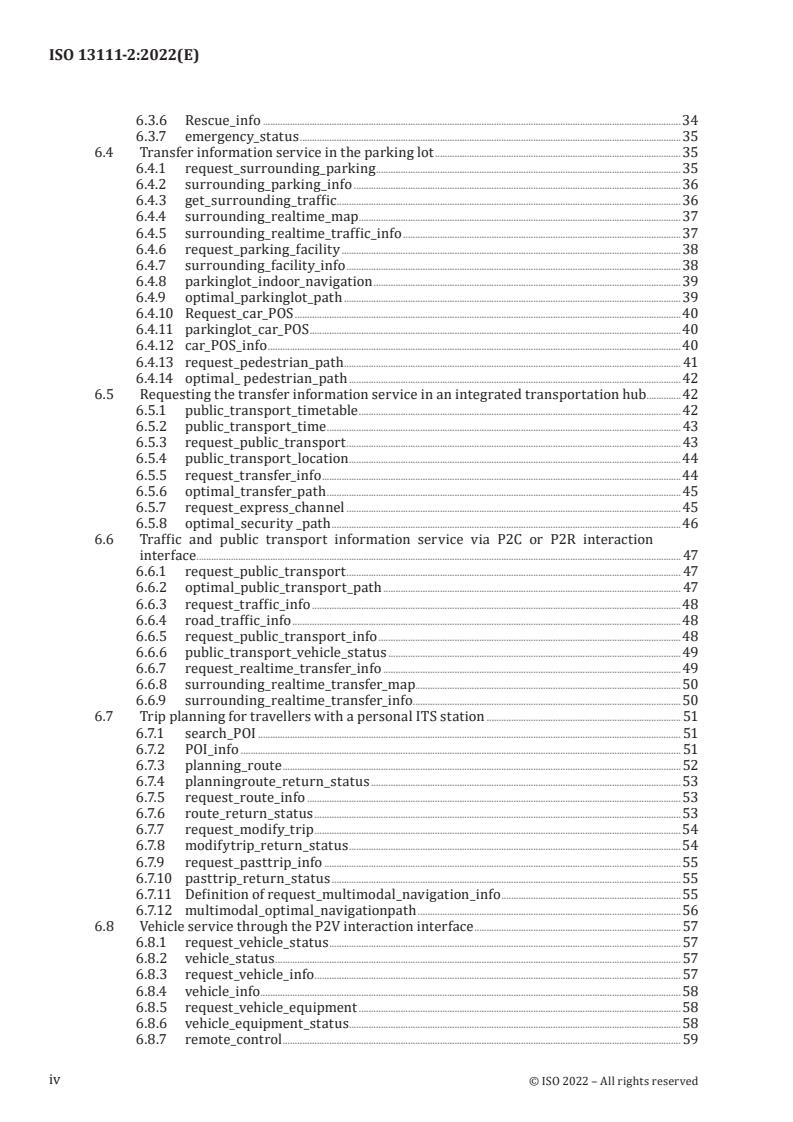
6 Message set .22
6.1 Get positioning information by accessing a roadside station through the P-ITS-S
and R-ITS-S interaction interface . 22
6.1.1 available_positioning_service . 22
6.1.2 position_service_list .23
6.1.3 selected_position_service . 23
6.1.4 position_info_collection . 24
6.1.5 position_service_CITS . 24
6.1.6 current_position_info . 25
6.1.7 return_status . .25
6.1.8 roadside_request . 26
6.1.9 roadside_info_list . .26
6.2 Requesting to download and update local transport network data . 27
6.2.1 local_transportnetwork . 27
6.2.2 get_datapackage . 27
6.2.3 slowtransport_navi .29
6.2.4 optimal_slowtransport_navi_path .29
6.2.5 search_surrounding_facilities.30
6.2.6 surrounding_facilities .30
6.2.7 search_surrounding_commercial . 31
6.2.8 surrounding_commercial_info . 31
6.3 Requesting the safety evacuation passageway or emergency service . 32
6.3.1 safety_evacuation_passageway . 32
6.3.2 optimal_navigation_path . 32
6.3.3 emergency_info .33
6.3.4 sending_status .34
6.3.5 request_rescue_info .34
iii
6.3.6 Rescue_info .34
6.3.7 emergency_status . 35
6.4 Transfer information service in the parking lot . 35
6.4.1 request_surrounding_parking . 35
6.4.2 surrounding_parking_info . 36
6.4.3 get_surrounding_traffic . .36
6.4.4 surrounding_realtime_map . 37
6.4.5 surrounding_realtime_traffic_info . 37
6.4.6 request_parking_facility .38
6.4.7 surrounding_facility_info .38
6.4.8 parkinglot_indoor_navigation .39
6.4.9 optimal_parkinglot_path . 39
6.4.10 Request_car_POS .40
6.4.11 parkinglot_car_POS .40
6.4.12 car_POS_info .40
6.4.13 request_pedestrian_path . 41
6.4.14 optimal_ pedestrian_path . 42
6.5 Requesting the transfer information service in an integrated transportation hub . 42
6.5.1 public_transport_timetable . 42
6.5.2 public_transport_time . 43
6.5.3 request_public_transport . 43
6.5.4 public_transport_location .44
6.5.5 request_transfer_info .44
6.5.6 optimal_transfer_path . 45
6.5.7 request_express_channel . 45
6.5.8 optimal_security _path .46
6.6 Traffic and public transport information service via P2C or P2R interaction
interface . 47
6.6.1 request_public_transport . 47
6.6.2 optimal_public_transport_path . 47
6.6.3 request_traffic_info .48
6.6.4 road_traffic_info .48
6.6.5 request_public_transport_info .48
6.6.6 public_transport_vehicle_status .49
6.6.7 request_realtime_transfer_info .49
6.6.8 surrounding_realtime_transfer_map.50
6.6.9 surrounding_realtime_transfer_info .50
6.7 Trip planning for travellers with a personal ITS station . 51
6.7.1 search_POI . 51
6.7.2 POI_info . 51
6.7.3 planning_route . 52
6.7.4 planningroute_return_status . 53
6.7.5 request_route_info . 53
6.7.6 route_return_status .53
6.7.7 request_modify_trip .54
6.7.8 modifytrip_return_status .54
6.7.9 request_pasttrip_info .55
6.7.10 pasttrip_return_status .55
6.7.11 Definition of request_multimodal_navigation_info .55
6.7.12 multimodal_optimal_navigationpath .56
6.8 Vehicle service through the P2V interaction interface . 57
6.8.1 request_vehicle_status . 57
6.8.2 vehicle_status . 57
6.8.3 request_vehicle_info . 57
6.8.4 vehicle_info .58
6.8.5 request_vehicle_equipment .58
6.8.6 vehicle_equipment_status .58
6.8.7 remote_control . 59
iv
6.8.8 sending_status . 59
6.8.9 execution_status . .60
6.8.10 mirror_link.60
6.9 Share location through the interaction interface between the personal stations .60
6.9.1 request_open_POS.60
6.9.2 request_participate_activity . 61
6.9.3 request_info_sharing . 61
6.9.4 shared_info . 62
6.9.5 request_help . 62
6.9.6 help_info . 62
6.9.7 remove_linkage .63
6.10 Team travel .63
6.10.1 join_team .63
6.10.2 request_team_info .63
6.10.3 team_info .64
6.10.4 request_leading_vehicle .64
6.10.5 leading_vehicle_trajectory .64
6.10.6 member_location .65
6.10.7 request_close_tracking .65
Annex A (normative) ASN.1 module .67
Bibliography .69
v
Foreword
ISO (the International Organization for Standardization) is a worldwide federation of national standards
bodies (ISO member bodies). The work of preparing International Standards is normally carried out
through ISO technical committees. Each member body interested in a subject for which a technical
committee has been established has the right to be represented on that committee. International
organizations, governmental and non-governmental, in liaison with ISO, also take part in the work.
ISO collaborates closely with the International Electrotechnical Commission (IEC) on all matters of
electrotechnical standardization.
The procedures used to develop this document and those intended for its further maintenance are
described in the ISO/IEC Directives, Part 1. In particular, the different approval criteria needed for the
different types of ISO documents should be noted. This document was drafted in accordance with the
editorial rules of the ISO/IEC Directives, Part 2 (see www.iso.org/directives).
Attention is drawn to the possibility that some of the elements of this document may be the subject of
patent rights. ISO shall not be held responsible for identifying any or all such patent rights. Details of
any patent rights identified during the development of the document will be in the Introduction and/or
on the ISO list of patent declarations received (see www.iso.org/patents).
Any trade name used in this document is information given for the convenience of users and does not
constitute an endorsement.
For an explanation of the voluntary nature of standards, the meaning of ISO specific terms and
expressions related to conformity assessment, as well as information about ISO's adherence to the
World Trade Organization (WTO) principles in the Technical Barriers to Trade (TBT), see www.iso.org/
iso/foreword.html.
This document was prepared by Technical Committee ISO/TC 204, Intelligent transport systems.
A list of all parts in the ISO 13111 series can be found on the ISO website.
Any feedback or questions on this document should be directed to the user’s national standards body. A
complete listing of these bodies can be found at www.iso.org/members.html.
vi
Introduction
This document defines the data exchange protocol between personal ITS stations and other ITS stations
which are used to implement the use case defined in ISO 13111-1.
This document defines protocol based on the data exchange message (DXM) at application level
between personal ITS stations and other ITS stations, such as vehicle ITS stations, central ITS stations,
roadside ITS stations, etc.
Applications supporting ITS service provisions and multimedia use via personal ITS stations need to
harmonize with existing or developing documents in the relevant areas. These applications can be
implemented using vehicle information, driver advisory systems, warning systems, entertainment
systems, traffic information, public transport information, slow transportation system (non-motorized
travel) information and multimodal navigation services based on the communication architecture and
protocol defined in ISO/TR 13185-1 and other related documents listed below:
— the ISO 13185 series, defining the vehicle interface for provisioning and support of ITS services;
— ISO 19132, ISO 19133 and ISO 19134, defining the conceptual schema of location-based services,
tracking and navigation services, and multimodal navigation services;
— the ISO 15031 series, defining emissions-related diagnostic data supported by vehicles in all
countries requiring on-board diagnostics (OBD) compliance;
— ISO 22900-2, defining the modular vehicle communication interface (MVCI) diagnostic protocol
data unit (D-PDU API) to separate the protocol data unit (PDU) from vehicle-specific protocols;
1)
— the ISO 22902 series, defining provisions for multimedia and telematics based on automotive
multimedia interface collaboration (AMI-C) specifications and reference documents for the
automotive industry. The important logical element of the architecture is a vehicle interface;
— ISO 22837, defining the reference architecture for probe vehicle systems and a basic data framework
for probe data;
— the ISO 27145 series, defining diagnostic data (emissions-related systems, future safety-related
systems, etc.) to be supported by vehicles in all countries implementing the GTR (Global Technical
Regulation) into their local legislation;
— ISO/TS 29284, defining the standardization of information, communication and control systems in
the field of urban and rural surface transport, including intermodal and multimodal aspects thereof,
traveller information, traffic management, public transport, commercial transport, emergency
services and commercial services in the ITS field;
— SAE J2735, defining the support of interoperability among dedicated short-range communication
(DSRC) applications through the use of standardized message sets, data frames and data elements.
1) Withdrawn.
vii
INTERNATIONAL STANDARD ISO 13111-2:2022(E)
Intelligent transport systems (ITS) — The use of
personal ITS stations to support ITS service provision for
travellers —
Part 2:
General requirements for data exchange between ITS
stations
1 Scope
This document defines the data exchange protocol used to implement use cases for applications based
on the personal ITS station defined in ISO 13111-1, which provides and maintains ITS services to
travellers, including drivers, passengers and pedestrians.
The ITS applications supported by this document include multimodal transportation information
services and multimodal navigation services that are based on personal ITS stations in various
application scenarios defined in ISO 13111-1.
The use case implementations described in this document refer to the architecture defined in ISO 21217
and ISO 13184.
2 Normative references
The following documents are referred to in the text in such a way that some or all of their content
constitutes requirements of this document. For dated references, only the edition cited applies. For
undated references, the latest edition of the referenced document (including any amendments) applies.
ISO 15031-2, Road vehicles — Communication between vehicle and external equipment for emissions-
related diagnostics — Part 2: Guidance on terms, definitions, abbreviations and acronyms
3 Terms, definitions and abbreviated terms
3.1 Terms and definitions
For the purposes of this document, the terms and definitions given in ISO 15031-2 and the following
apply.
ISO and IEC maintain terminology databases for use in standardization at the following addresses:
— ISO Online browsing platform: available at https:// www .iso .org/ obp
— IEC Electropedia: available at https:// www .electropedia .org/
3.1.1
central ITS station
C-ITS-S
implementation of an ITS station in a central ITS subsystem
3.1.2
ITS service
service provided by a set of ITS station applications
3.1.3
ITS station
ITS-S
entity in a communication network, comprised of application, facilities, networking and access layer
components as specified in ISO 21217, that operate within a bounded secure management domain
3.1.4
ITS-S application
functionality in an ITS station that uses ITS station services to connect to one or more other ITS station
applications.
3.1.5
ITS-S service
communication functionality offered by an ITS station to an ITS station application
3.1.6
nomadic device
ND
device that provides communications connectivity via equipment such as cellular telephones,
mobile wireless broadband (WIMAX, HC-SDMA, etc.), WiFi, etc. and includes short range links, such
as Bluetooth, Zigbee, etc. to connect nomadic devices to the motor vehicle communications system
network
3.1.7
personal ITS station
P-ITS-S
implementation of an ITS station with a personal ITS subsystem
Note 1 to entry: P-ITS-S is used to send the information of each user (drivers, passengers and pedestrians) to the
other ITS station, and receives messages from other ITS stations which will be processed and presented on the
user’s terminal device according to the ITS station services and/or applications being executed.
3.1.8
roadside ITS station
R-ITS-S
system that receives and processes vehicular and pedestrian information within a certain zone and
determines the situation, in order to provide safety warning and parking guide services to vehicles and
pedestrians
Note 1 to entry: The system is installed at the roadside.
3.1.9
slow transportation system
non-motorized travel
transport system via pedestrians and bicycles
3.1.10
vehicle ITS station
V-ITS-S
implementation of an ITS station with a vehicle ITS subsystem
3.2 Abbreviated terms
AMI-C automotive multimedia interface collaboration
ASN.1 abstract syntax notation one
D-PDU diagnostic protocol data unit
DSRC dedicated short-range communication
DXM data exchange message
GTR Global Technical Regulation
ITS intelligent transport systems
ITS-S intelligent transport system-station
MVCI modular vehicle communication interface
OBD on-board diagnostics
P2C product to consumer
P2R product to retail
PDU protocol data unit
POI point of interest
POS position
UC use case
V-ITS-S vehicle ITS station
V-ITS-SG vehicle ITS station gateway
4 General requirements
The service consists of a request and response message. The data transmitted in request and response
message are structured in ASN.1 in accordance with Annex A.
5 Use case implementations
5.1 Use case clusters overview
Table 1 provides an overview of use cases (UCs).
Table 1 — Use case clusters
No. Title of use case cluster Brief description
1 Slow transport informa- The use cases shall describe the data exchange between the P-ITS-S and
tion service: R-ITS-S.
Get positioning infor- UC 1.1—Requesting available positioning service
mation by accessing a
UC 1.2—Requesting positioning information
roadside station through
the P-ITS-S and R-ITS-S UC 1.3—Requesting positioning service from C-ITS-S
interaction interface
UC 1.4—Requesting to turn ON/OFF the positioning service
UC 1.5—Requesting/receiving roadside information
Table 1 (continued)
No. Title of use case cluster Brief description
2 Slow transport informa- The use cases shall describe the slow transport information service and
tion service: local transport service.
Requesting slow trans- UC 2.1—Requesting to download and update local transport network data
port and local transport
UC 2.2—Requesting slow transport navigation information [pedestrian,
information service
bicycles, and information to support those with disabilities such as de-
creased personal mobility or decreased vison (amblyopia)]
UC 2.3—Requesting to search surrounding facilities
UC 2.4—Requesting/receiving surrounding commercial information
3 Slow transport informa- The use cases shall describe the evacuation information and emergency
tion service: service for a P-ITS-S user.
Requesting the safety UC 3.1—Requesting the safety evacuation passageway
evacuation passageway or
UC 3.2—Requesting emergency service
emergency service
UC 3.3—Sending the rescue information
UC 3.4—Receiving the rescue information
UC 3.5—Closing the state of emergency
4 Transfer information The use cases shall describe the transfer information service in the parking
service: lot via P2C or P2R interaction interface.
Transfer information ser- UC 4.1—Requesting/receiving the surrounding parking information
vice in the parking lot
UC 4.2—Requesting/receiving the surrounding real-time traffic informa-
tion
UC 4.3—Requesting the parking facility information
UC 4.4—Requesting indoor navigation in a parking lot
UC 4.5—Requesting the car location in the parking lot
UC 4.6—Requesting pedestrian routing to the car location
5 Transfer information The use cases shall describe the transfer information service in an inte-
service: grated transportation hub for specific flight, train and/or bus lines.
Requesting the transfer UC 5.1—Requesting/receiving the arrival and departure time
information service in an
UC 5.2—Requesting the station or platform for specific flight, train and/or
integrated transportation
bus lines
hub
UC 5.3—Requesting the transfer route
UC 5.4—Requesting the express security channel
6 Multimodal traffic infor- The use cases shall describe the public transport service via P2C or P2R
mation service: interaction interface.
Traffic and public trans- UC 6.1—Requesting public transport information
port information service
UC 6.2—Requesting road traffic information
via P2C or P2R interaction
interface
UC 6.3—Requesting/Receiving real-time public transport information
UC 6.4—Requesting/Receiving real-time transfer information
Table 1 (continued)
No. Title of use case cluster Brief description
7 Multimodal navigation The use cases shall describe the trip planning for travellers with a personal
service: ITS station.
Trip planning for travel- UC 7.1—Requesting to search point of interest (POI)
lers with a personal ITS
UC 7.2—Requesting trip and/or route planning
station
UC 7.3—Request route information (routing, traffic information, waypoint,
destination and eco-driving)
UC 7.4—Requesting to modify the trip or re-routing
UC 7.5—Requesting past trip information (route, arrival time)
UC 7.6—Requesting multimodal navigation information
8 Multimodal navigation The use cases shall describe the interface of the vehicle information service
service: when a P-ITS-S connects to a V-ITS-S through the V-ITS-SG defined in the
ISO 13185 series.
Vehicle service through
the P2V interaction inter- UC 8.1—Requesting vehicle status
face
UC 8.2—Requesting vehicle basic information
UC 8.3—Requesting vehicle equipment status
UC 8.4—Requesting remote control
UC 8.5—Requesting mirror link
9 Communities activities: The use cases shall describe the interaction interface between the personal
ITS stations.
Share location through
the interaction interface UC 9.1—Requesting to open the location information
between the personal
UC 9.2—Requesting to participate in a location-based activity
stations
UC 9.3—Requesting data or information sharing
UC 9.4—Requesting help
UC 9.5—Removing the linkage/cancelling the session
10 Communities activities: The use cases shall describe team travel when a group of vehicles (or bicy-
cles) follows the lead vehicle on the way to the same destination.
Team travel
UC 10.1—Requesting team information
UC 10.2—Requesting to join a team
UC 10.3—Requesting to track the lead vehicle
UC 10.4—Close the tracking or quit the team
5.2 Use case implementations
5.2.1 Get positioning information by accessing a roadside station through the P-ITS-S and
R-ITS-S interaction interface
5.2.1.1 UC 1.1 — Requesting available positioning service
Table 2 provides a definition of UC 1.1 — Requesting available positioning service.
Table 2 — Definition of UC 1.1 — Requesting available positioning service
Use case Type of service Slow transport information service ND in a given environment can get the
local available positioning service.
Cluster 1) Get positioning information by
accessing a roadside station through
the P-ITS-S and R-ITS-S interaction
interface
Name UC 1.1 Requesting available positioning
service
Actor P-ITS-S, R-ITS-S
Message Subclause Name Description
available_position_service
6.1.1 requesting position service
position_service_list
6.1.2 show position service list
5.2.1.2 UC 1.2 — RequestingPositioning information
Table 3 provides a definition of UC 1.2 — Requesting positioning information.
Table 3 — Definition of UC 1.2 — Requesting positioning information
Use case Type of service Slow transport information service ND in a given environment can get the
surrounding positioning information.
Cluster 1) Get positioning information by
accessing a roadside station through
the P-ITS-S and R-ITS-S interaction
interface
Name UC 1.2 Requesting positioning informa-
tion
Actor P-ITS-S, R-ITS-S
Message Subclause Name Description
available_position_service
6.1.1 search available position service
through R-ITS-S
selected_position_service
6.1.3 position service has selected
position_info_collection
6.1.4 collect position information
5.2.1.3 UC 1.3 — Requesting positioning service from C-ITS-S
Table 4 provides a definition of UC 1.3 — Requesting position service from C-ITS-S.
Table 4 — Definition of UC 1.3 — Requesting positioning service from C-ITS-S
Use case Type of service Slow transport information service ND in a given environment can get the sur-
rounding positioning information. P-ITS-S
Cluster 1) Get positioning information by
sends the request to C-ITS-S or R-ITS-S.
accessing a roadside station through
Then C-ITS-S or R-ITS-S returns the cur-
the P-ITS-S and R-ITS-S interaction
rent location information to the P-ITS-S.
interface
Name UC 1.3 Requesting positioning ser-
vice from C-ITS-S
Actor P-ITS-S, R-ITS-S, C-ITS-S
Message Subclause Name Description
position_service_CITS
6.1.5 send user ID and position service to
C-ITS-S
current_position_info
6.1.6 get current position information
5.2.1.4 UC 1.4 — Requesting to turn ON/OFF positioning service
Table 5 provides a definition of UC 1.4 — Requesting to turn ON/OFF positioning service.
Table 5 — Definition of UC 1.4 — Requesting to turn ON/OFF positioning service
Use case Type of service Slow transport information service When the ND does not want to use location
information, P-ITS-S may close(open)posi-
Cluster 1) Get positioning information by
tioning service.
accessing a roadside station through
the P-ITS-S and R-ITS-S interaction
interface
Name UC 1.4 Requesting to turn ON/OFF
positioning service
Actor P-ITS-S
Message Subclause Name Description
return_status
6.1.7 return the status before requesting
5.2.1.5 UC 1.5 — Requesting/receiving roadside information
Table 6 provides a definition of UC 1.5 — Requesting/receiving roadside information.
Table 6 — Definition of UC 1.5 — Requesting/receiving roadside information
Use case Type of service Slow transport information service Individual users request to search the
roadside information from P-ITS-S. Then,
Cluster 1) Get positioning information by
P-ITS-S sends the request to R-ITS-S which
accessing a roadside station through
returns the roadside information and
the P-ITS-S and R-ITS-S interaction
P-ITS-S receives the roadside information.
interface
Name UC 1.5 Requesting/receiving road-
side information
Actor P-ITS-S, R-ITS-S
Message Subclause Name Description
roadside_request
6.1.8 request the roadside information
roadside_info_list
6.1.9 show roadside information list
5.2.2 Requesting slow transport and local transport information service
5.2.2.1 UC 2.1 — Requesting to download and update local transport network data
Table 7 provides a definition of UC 2.1 — Requesting to download and update local transport network
data.
Table 7 — Definition of UC 2.1 — Requesting to download and update local transport network
data
Use case Type of service Slow transport information service Individual users in the slow transport
services area request to download and
Cluster 2) Requesting slow transport and
update local transport network data from
local transport information service
the P-ITS-S. The P-ITS-S sends the request
Name UC 2.1 Requesting to download and
to the central intelligent transport sys-
update local transport network data
tems; then it returns the data information
about the current position.
Actor P-ITS-S, R-ITS-S
Message Subclause Name Description
local_transportnetwork
6.2.1 show the local transport network
get_datapackage
6.2.2 download data package
5.2.2.2 UC 2.2 — Requesting slow transport navigation information
Table 8 provides a definition of UC 2.2 — Requesting slow transport navigation information.
Table 8 — Definition of UC 2.2 — Requesting slow transport navigation information
Use case Type of ser- Slow transport information service Individual users in the slow
...