

ISO 24394:2023
(Main)Welding for aerospace applications — Qualification test for welders and welding operators — Fusion welding of metallic components
General Information
- Abstract
This document specifies requirements for the qualification of welders and welding operators for fusion welding of metallic materials for aerospace applications. NOTE Success in the test is an essential precondition for the qualification of welders and welding operators in new production and repair work in aerospace. However, welding equipment operators do not need to be qualified according to this document.
- Status
- Published
- Publication Date
- 13-Sep-2023
- Technical Committee
- ISO/TC 44/SC 14 - Welding and brazing in aerospace
- Drafting Committee
- ISO/TC 44/SC 14 - Welding and brazing in aerospace
- Current Stage
- 6060 - International Standard published
- Start Date
- 14-Sep-2023
- Due Date
- 18-Apr-2023
- Completion Date
- 14-Sep-2023
Buy Documents


ISO 24394:2023 - Welding for aerospace applications — Qualification test for welders and welding operators — Fusion welding of metallic components Released:14. 09. 2023
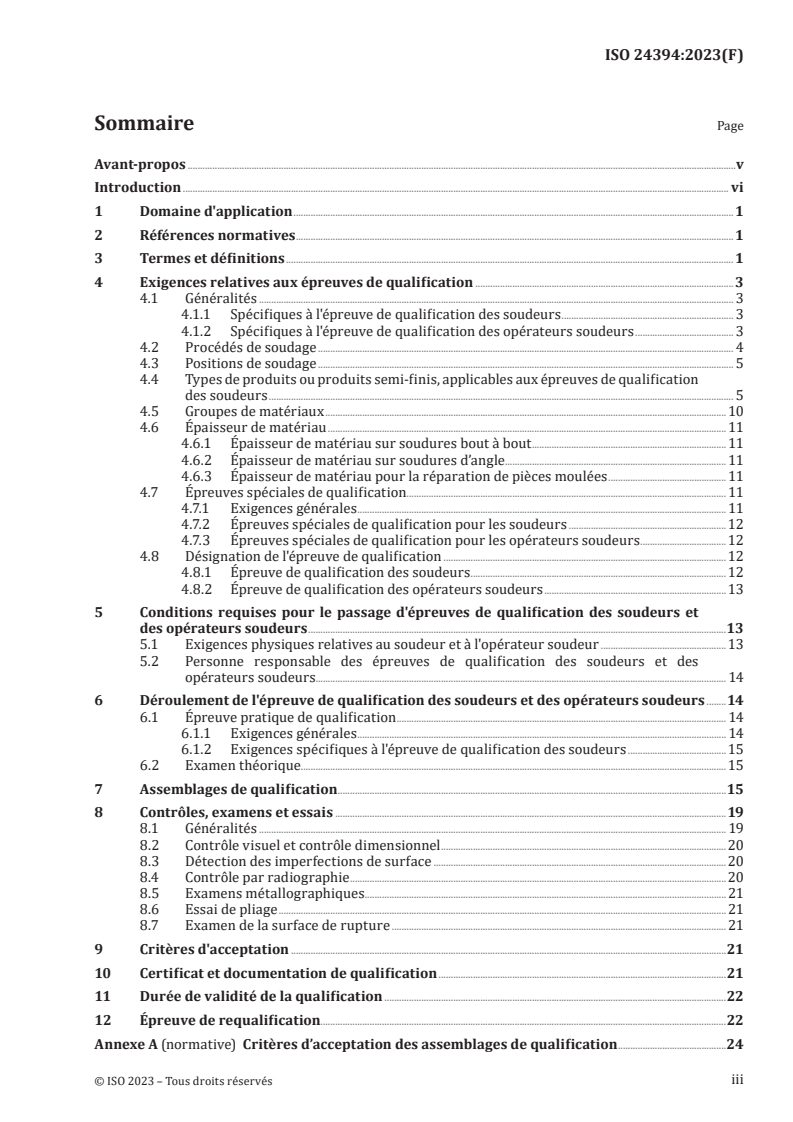
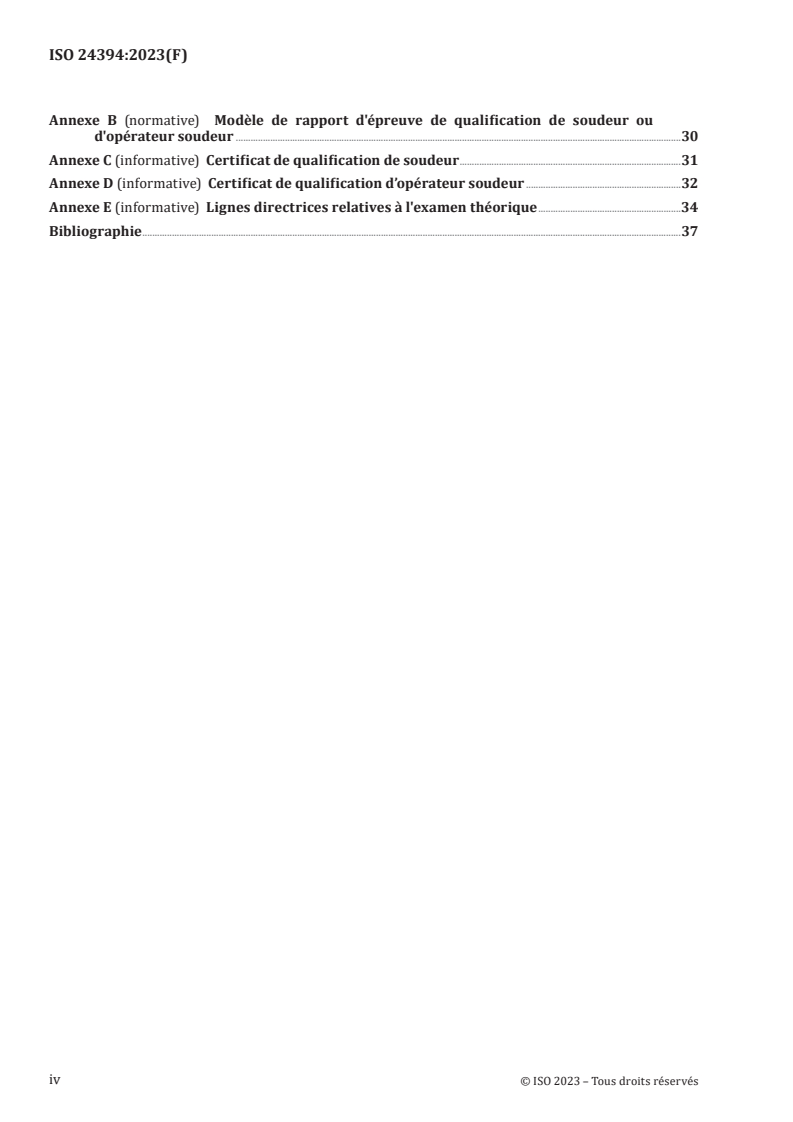
ISO 24394:2023 - Soudage pour applications aérospatiales — Épreuve de qualification pour soudeurs et opérateurs soudeurs — Soudage par fusion des composants métalliques/17/2024
Overview
ISO 24394:2023 - Welding for aerospace applications - Qualification test for welders and welding operators - Fusion welding of metallic components - defines minimum requirements for qualifying personnel who perform fusion welding on metallic aerospace hardware. The third edition (2023) is a prescriptive test standard used to demonstrate that a welder or welding operator has the necessary practical skill and theoretical knowledge for new production and repair work in aerospace. Note: welding equipment operators who only run automatic equipment and have no direct influence on joint quality are not required to be qualified under this document.
Key topics and technical requirements
- Scope of qualification: Covers welder and welding operator tests for fusion welding of metallic materials used in aerospace.
- Test structure:
- Practical (hands-on) qualification tests and a theory exam.
- Test piece selection based on parent material form, joint type (butt/groove, fillet), welding process, material group, thickness ranges and welding positions.
- Welding coordinator/fabricator selects appropriate test piece(s); special test pieces and complementary tests are included.
- Welding operator classification: Based on welding process and machine type (e.g., longitudinal, orbital, circumferential, robotic) - additional machine-type qualifications may be required.
- Examinations and NDT: Visual inspection, dimensional checks, surface imperfection detection, radiographic examination, metallographic tests, bend tests and fracture-surface examinations.
- Documentation and compliance: Test record, acceptance criteria, qualification certificate, period of validity and requalification requirements are specified. Annexes provide templates and guidance (test-piece acceptance criteria, test records, certificate examples, theory-test guidelines).
- Related control documents: Uses terms such as WPS (welding procedure specification) and pWPS; aligns with welding coordination and NDT competency standards.
Practical applications and users
Who uses ISO 24394:2023:
- Aerospace manufacturers, maintenance, repair and overhaul (MRO) organizations.
- Welding coordinators, quality managers, and production engineers responsible for personnel qualification.
- Training bodies and examining bodies that administer welder/welding-operator tests. Practical benefits:
- Ensures consistently qualified welding personnel for critical aerospace structures.
- Standardizes qualification across production and repair environments, improving traceability and airworthiness compliance.
- Provides objective acceptance criteria and documentation for audits and regulatory review.
Related standards (for implementation)
- ISO 6520-1 (geometric imperfections classification)
- ISO 6947 (welding positions)
- ISO 9606-2 (welder qualification - aluminium)
- ISO 14731 (welding coordination)
- ISO 18490 (vision acuity for NDT personnel)
- EN 4179 (NDT personnel qualification in aerospace)
Keywords: ISO 24394:2023, welding for aerospace applications, welder qualification, welding operator qualification, fusion welding, metallic components, aerospace welding standard, WPS, NDT, welder certification.
Relations
- Effective Date
- 06-Jun-2022
Buy Documents
ISO 24394:2023 - Welding for aerospace applications — Qualification test for welders and welding operators — Fusion welding of metallic components Released:14. 09. 2023
ISO 24394:2023 - Soudage pour applications aérospatiales — Épreuve de qualification pour soudeurs et opérateurs soudeurs — Soudage par fusion des composants métalliques/17/2024
Get Certified
Connect with accredited certification bodies for this standard

DVS-ZERT GmbH
German welding certification society.
CARES (UK Certification Authority for Reinforcing Steels)
UK certification for reinforcing steels and construction.
EWF/IIW (European/International Welding Federation)
International welding personnel certification.
Sponsored listings
Frequently Asked Questions
ISO 24394:2023 is a standard published by the International Organization for Standardization (ISO). Its full title is "Welding for aerospace applications — Qualification test for welders and welding operators — Fusion welding of metallic components". This standard covers: This document specifies requirements for the qualification of welders and welding operators for fusion welding of metallic materials for aerospace applications. NOTE Success in the test is an essential precondition for the qualification of welders and welding operators in new production and repair work in aerospace. However, welding equipment operators do not need to be qualified according to this document.
This document specifies requirements for the qualification of welders and welding operators for fusion welding of metallic materials for aerospace applications. NOTE Success in the test is an essential precondition for the qualification of welders and welding operators in new production and repair work in aerospace. However, welding equipment operators do not need to be qualified according to this document.
ISO 24394:2023 is classified under the following ICS (International Classification for Standards) categories: 25.160.01 - Welding, brazing and soldering in general. The ICS classification helps identify the subject area and facilitates finding related standards.
ISO 24394:2023 has the following relationships with other standards: It is inter standard links to ISO 24394:2018. Understanding these relationships helps ensure you are using the most current and applicable version of the standard.
ISO 24394:2023 is available in PDF format for immediate download after purchase. The document can be added to your cart and obtained through the secure checkout process. Digital delivery ensures instant access to the complete standard document.
Standards Content (Sample)
SLOVENSKI STANDARD
01-marec-2024
Nadomešča:
SIST ISO 24394:2020
Varjenje v aeronavtiki - Preskušanje usposobljenosti varilcev in operaterjev
varjenja - Talilno varjenje kovinskih sestavnih delov
Welding for aerospace applications — Qualification test for welders and welding
operators — Fusion welding of metallic components
Soudage pour applications aérospatiales — Épreuve de qualification pour soudeurs et
opérateurs soudeurs — Soudage par fusion des composants métalliques
Ta slovenski standard je istoveten z: ISO 24394:2023
ICS:
03.100.30 Vodenje ljudi Management of human
resources
25.160.01 Varjenje, trdo in mehko Welding, brazing and
spajkanje na splošno soldering in general
49.020 Letala in vesoljska vozila na Aircraft and space vehicles in
splošno general
2003-01.Slovenski inštitut za standardizacijo. Razmnoževanje celote ali delov tega standarda ni dovoljeno.
INTERNATIONAL ISO
STANDARD 24394
Third edition
2023-09
Welding for aerospace applications —
Qualification test for welders and
welding operators — Fusion welding
of metallic components
Soudage pour applications aérospatiales — Épreuve de qualification
pour soudeurs et opérateurs soudeurs — Soudage par fusion des
composants métalliques
Reference number
© ISO 2023
All rights reserved. Unless otherwise specified, or required in the context of its implementation, no part of this publication may
be reproduced or utilized otherwise in any form or by any means, electronic or mechanical, including photocopying, or posting on
the internet or an intranet, without prior written permission. Permission can be requested from either ISO at the address below
or ISO’s member body in the country of the requester.
ISO copyright office
CP 401 • Ch. de Blandonnet 8
CH-1214 Vernier, Geneva
Phone: +41 22 749 01 11
Email: copyright@iso.org
Website: www.iso.org
Published in Switzerland
ii
Contents Page
Foreword .v
Introduction . vi
1 Scope . 1
2 Normative references . 1
3 Terms and definitions . 1
4 Qualification test requirements . 3
4.1 General . 3
4.1.1 Specific to the welder qualification test . 3
4.1.2 Specific to the welding operator qualification test. 3
4.2 Welding processes . 4
4.3 Welding positions . 5
4.4 Product types or semi-finished products applicable to welder qualification tests . 5
4.5 Material groups . 9
4.6 Material thickness . 10
4.6.1 Butt weld material thickness . 10
4.6.2 Fillet weld material thickness . 10
4.6.3 Casting repair material thickness. 10
4.7 Special qualification tests . . 10
4.7.1 General requirements . 10
4.7.2 Special qualification tests for welders . 10
4.7.3 Special qualification tests for welding operators . 11
4.8 Designation for qualification test . 11
4.8.1 Welder qualification test . 11
4.8.2 Welding operator qualification test .12
5 Conditions required for welder and welding operator qualification tests .12
5.1 Physical requirements for welder and welding operator .12
5.2 Person responsible for welder and welding operator qualification tests .13
6 Performing the welder and welding operator qualification test .13
6.1 Practical qualification test .13
6.1.1 General requirements .13
6.1.2 Specific requirements for the welder qualification test.13
6.2 Theory test . 14
7 Test pieces .14
8 Examination and testing .18
8.1 General . 18
8.2 Visual inspection and dimensional examination . 19
8.3 Surface imperfection detection . 19
8.4 Radiographic examination . 19
8.5 Metallographic examinations. 19
8.6 Bend test . 20
8.7 Fracture surface examination .20
9 Acceptance criteria .20
10 Qualification test certificate and documentation .20
11 Period of validity of the qualification .21
12 Requalification test .21
Annex A (normative) Test piece acceptance criteria .22
Annex B (normative) Welder or welding operator qualification test record .27
Annex C (informative) Welder qualification test certificate .28
iii
Annex D (informative) Welding operator qualification test certificate .29
Annex E (informative) Guidelines for the theory test .31
Bibliography .34
iv
Foreword
ISO (the International Organization for Standardization) is a worldwide federation of national standards
bodies (ISO member bodies). The work of preparing International Standards is normally carried out
through ISO technical committees. Each member body interested in a subject for which a technical
committee has been established has the right to be represented on that committee. International
organizations, governmental and non-governmental, in liaison with ISO, also take part in the work.
ISO collaborates closely with the International Electrotechnical Commission (IEC) on all matters of
electrotechnical standardization.
The procedures used to develop this document and those intended for its further maintenance are
described in the ISO/IEC Directives, Part 1. In particular, the different approval criteria needed for the
different types of ISO document should be noted. This document was drafted in accordance with the
editorial rules of the ISO/IEC Directives, Part 2 (see www.iso.org/directives).
ISO draws attention to the possibility that the implementation of this document may involve the use
of (a) patent(s). ISO takes no position concerning the evidence, validity or applicability of any claimed
patent rights in respect thereof. As of the date of publication of this document, ISO had not received
notice of (a) patent(s) which may be required to implement this document. However, implementers are
cautioned that this may not represent the latest information, which may be obtained from the patent
database available at www.iso.org/patents. ISO shall not be held responsible for identifying any or all
such patent rights.
Any trade name used in this document is information given for the convenience of users and does not
constitute an endorsement.
For an explanation of the voluntary nature of standards, the meaning of ISO specific terms and
expressions related to conformity assessment, as well as information about ISO's adherence to
the World Trade Organization (WTO) principles in the Technical Barriers to Trade (TBT), see
www.iso.org/iso/foreword.html.
This document was prepared by Technical Committee ISO/TC 44, Welding and allied processes,
Subcommittee SC 14, Welding and brazing in aerospace.
This third edition cancels and replaces the second edition (ISO 24394:2018), which has been technically
revised.
The main changes are as follows:
— 3.8: note to entry added;
— Table 4 revised;
— editorial revisions.
Any feedback or questions on this document should be directed to the user’s national standards
body. A complete listing of these bodies can be found at www.iso.org/members.html. Official
interpretations of ISO/TC 44 documents, where they exist, are available from this page:
https://committee.iso.org/sites/tc44/home/interpretation.html.
v
Introduction
A welder or welding operator qualification test properly passed in accordance with this document
demonstrates that the welder or welding operator concerned has been proven to possess the minimum
degree of skill and knowledge required for the fusion welding of aerospace hardware.
vi
INTERNATIONAL STANDARD ISO 24394:2023(E)
Welding for aerospace applications — Qualification test
for welders and welding operators — Fusion welding of
metallic components
1 Scope
This document specifies requirements for the qualification of welders and welding operators for fusion
welding of metallic materials for aerospace applications.
NOTE Success in the test is an essential precondition for the qualification of welders and welding operators
in new production and repair work in aerospace. However, welding equipment operators do not need to be
qualified according to this document.
2 Normative references
The following documents are referred to in the text in such a way that some or all of their content
constitutes requirements of this document. For dated references, only the edition cited applies. For
undated references, the latest edition of the referenced document (including any amendments) applies.
ISO 6520-1, Welding and allied processes — Classification of geometric imperfections in metallic materials
— Part 1: Fusion welding
ISO 6947, Welding and allied processes — Welding positions
ISO 9606-2, Qualification test of welders — Fusion welding — Part 2: Aluminium and aluminium alloys
ISO 14731, Welding coordination — Tasks and responsibilities
ISO 18490, Non-destructive testing — Evaluation of vision acuity of NDT personnel
EN 4179, Aerospace series — Qualification and approval of personnel for non-destructive testing
3 Terms and definitions
For the purposes of this document, the terms and definitions given in ISO 6520-1, ISO 9606-2 and
ISO 14731 and the following apply.
ISO and IEC maintain terminology databases for use in standardization at the following addresses:
— ISO Online browsing platform: available at https:// www .iso .org/ obp
— IEC Electropedia: available at https:// www .electropedia .org/
3.1
parent material form
type of the semi-finished product
Note 1 to entry: Semi-finished products are sheets or plates, tubes and castings.
3.2
welder
person who holds and manipulates the electrode holder, welding torch or blowpipe by hand
Note 1 to entry: In this document, a blowpipe is considered to be a gas welding torch.
[SOURCE: ISO/TR 25901-1:2016, 2.5.24, modified — Definition revised and note 1 to entry added.]
3.3
welding operator
person who prepares the joint and sets up mechanized or
automated welding equipment and thereby has direct influence on the welded joint quality
3.4
welding equipment operator
person who only operates automatic welding equipment and has
no direct influence on the welded joint quality
3.5
examiner
person who has been appointed to verify conformity to the applicable standard
Note 1 to entry: In certain cases, an external independent examiner can be required.
[SOURCE: ISO/TR 25901-1:2016, 2.5.29, modified — Definition revised.]
3.6
examining body
organization that has been appointed to verify conformity to the applicable standard
Note 1 to entry: In certain cases, an external independent examining body can be required.
[SOURCE: ISO/TR 25901-1:2016, 2.5.30, modified – Definition revised.]
3.7
rework
corrective action made to a weldment in the as-welded condition
3.8
design/engineering authority
organization that has the responsibility for the structural integrity or maintenance of airworthiness of
the hardware and compliance with all relevant documents
EXAMPLE Drawings, 3D models, specifications for manufacturing.
Note 1 to entry: In the case of a welded product, the engineering authority is usually the organization that has
responsibility for the engineering definition of the product.
Note 2 to entry: In civil aviation, the design authority is normally the type certificate holder, a legal entity related
to the airworthiness authorities.
3.9
backing
material placed at the reverse side of a joint preparation for the purpose of supporting molten weld
metal
3.10
welding procedure specification
WPS
document that has been qualified and provides the required variables of the welding procedure to
ensure repeatability during production welding
[SOURCE: ISO/TR 25901-1:2016, 2.5.4]
3.11
preliminary welding procedure specification
pWPS
document containing the required variables of the welding procedure which is to be qualified
[SOURCE: ISO/TR 25901-1:2016, 2.5.6, modified — Definition revised.]
3.12
automatic welding
welding in which all operations are performed without welding operator intervention during the
process
Note 1 to entry: Manual adjustment of welding variables by the welding operator during welding is not possible.
[SOURCE: ISO 14732:2013, 3.1]
4 Qualification test requirements
4.1 General
4.1.1 Specific to the welder qualification test
The welder qualification tests are classified according to:
a) parent material form;
b) types of weld joint (butt/groove or fillet);
c) welding processes;
d) material groups;
e) thickness ranges;
f) welding positions.
The welding coordinator of the plant or the fabricator shall select from Figure 1 to Figure 6 the test
piece as required for the production work on which the welder is to be employed. Two complementary
specific test pieces (TP5 and TP6) may also be chosen as defined in 4.4 and 4.7.1.
4.1.2 Specific to the welding operator qualification test
The welding operator qualification tests are classified according to welding process and welding
machine type.
NOTE Machine type within the scope of this document stands for longitudinal, orbital, circumferential and
robotic welding machines.
For multiple welding machine types, additional qualification shall be at the discretion of the responsible
welding coordinator.
The welding operator has to show theoretical knowledge of the welding process.
In the practical part of the qualification test, the welding operator shall demonstrate competency in
operating the welding machine according to an established WPS.
A test weld of any type of weld with a process on a given welding machine type shall qualify for all
product types or semi-finished products and all types of welds with this process and this machine type.
The test weld can be performed on dedicated test pieces or production parts.
When substituting test pieces with actual production parts, testing shall be carried out according to
Table 6.
4.2 Welding processes
This document covers qualification testing for the following welding processes with their reference
1)
numbers in accordance with ISO 4063:1998:
2)
— 111 manual metal arc welding (metal arc welding with covered electrode);
2)
— 12 submerged arc welding;
— 13 gas-shielded metal arc welding;
— 141 TIG welding/gas tungsten arc welding;
— 15 plasma arc welding;
— 31 oxy-fuel gas welding;
— 51 electron beam welding;
— 52 laser beam welding.
NOTE 1 Other fusion welding processes not specified in ISO 4063:1998 can be covered.
NOTE 2 Attention is drawn to the fact that ISO 4063:1998 and ISO 4063:2023 sometimes have different
processes for the same process number. The main differences are as follows (see Table 1):
a) process designation was changed or modified for processes 121, 131, 135, 136 and 141;
b) process 137 was split into processes 132 and 133;
c) process 136 was split into processes 136 and 138.
Table 1 — Equivalent process numbers and designations between ISO 4063:1998 and
ISO 4063:2023
Process
Process designation in ISO 4063:1998 Process designation in ISO 4063:2023
number
Submerged arc welding with solid wire elec-
121 Submerged arc welding with one wire electrode
trode
131 Metal inert gas welding; MIG welding MIG welding with solid wire electrode
132 — MIG welding with flux cored electrode
133 — MIG welding with metal cored electrode
135 Metal active gas welding; MAG welding MAG welding with solid wire electrode
Tubular cored metal arc welding with active gas
136 MAG welding with flux cored electrode
shield
Tubular cored metal arc welding with inert gas
137 —
shield
138 — MAG welding with metal cored electrode
TIG welding with solid filler material (wire or
141 Tungsten inert gas welding; TIG welding
rod)
1) Cancelled and replaced by ISO 4063:2023.
2) This process can require a special qualification test as defined in 4.7.
4.3 Welding positions
Depending on welding positions in actual production, the welding position of the test piece shall be
chosen in accordance with Table 2, Table 3, Table 4 and/or Table 5.
A test piece welded in the fixed position also qualifies for welding parts when not in the fixed position,
for example rotational turntable for tubes.
TP6 shall be welded in PA or PB, which qualifies for all welding positions for in-process welding of
castings in casting facilities.
4.4 Product types or semi-finished products applicable to welder qualification tests
Depending on the types of products in actual production, a distinction is made between welder
qualification tests for sheet or plate (S), tube (T) and castings (C).
Test pieces with tube (TP3, TP4 and TP5) do not qualify for sheet or plate.
NOTE 1 Tube welding has overlapping start and stop points. This is not the case for sheet or plate welding.
Therefore, test pieces with tube (TP3, TP4 and TP5) do not qualify for sheet or plate.
The range of qualification for each welding position is given in Table 2, Table 3, Table 4 and Table 5.
The welding positions are specified in ISO 6947. The test pieces shall be welded in accordance with the
nominal angles of the welding positions given in ISO 6947.
Test piece TP5 (see Figure 5) is mandatory for structural tube frameworks of outside diameter
D < 26 mm. It is optional for structural tube frameworks of D ≥ 26 mm.
Test piece TP 6 is required for in-process welding of castings in casting facilities.
NOTE 2 Within the scope of this document, in-process welding is welding on castings to correct casting
defects.
Excluding in-process welding in casting facilities, a welder who is qualified to weld sheet or plate or
tube is also qualified to weld on castings within his or her range of qualification regarding the welding
position and geometric shape of the work piece (planar or tubular).
NOTE 3 Casting facilities are excluded because casting methods and in-process welding of castings are subject
to specific engineering requirements.
In instances of structural welding of castings requiring specific welding techniques, for example Nickel
Alloy 718, the welder qualification test pieces (TP1 to TP4) shall be of the same casting alloy.
As an alternative, qualifications according to SAE AMS 2694C are acceptable for in-process welding of
castings, but the period of validity according to Clause 11 applies.
Table 2 — Range of qualification for welding positions, joint type and base metal form for TP1
Qualified welding position
Test weld
Butt weld on sheet or
Butt weld on tube
plate
Form or Test piece welding posi-
PA PC PE PF PA PC PE PF H-L 045
joint type tion (ISO 6947)
PA
Sheet or
a,b
plate butt X X
weld
PC
a,b a,b,c
X X X X
PE
Sheet or
a,b a,b
X X X X
plate butt
weld
PF
a,b a,b
X X X X
NOTE 1 X indicates what the welder is qualified for.
NOTE 2 The arrows in PA, PC and PE show the welding position.
NOTE 3 The arrow in PF shows the weld progression or direction.
a
Applicable for longitudinal weld on a tube.
b
Applicable for circumferential weld on a rotating tube if tube diameter is D > 26 mm.
c
Applicable for circumferential weld on a tube in a fixed position if tube diameter is D > 26 mm.
Table 3 — Range of qualification for welding positions, joint type and base metal form for TP2
Qualified welding position
Test weld
Fillet weld on sheet or plate
Form or joint Test piece welding position (ISO
PA PB PC PD PF
type 6947)
PA
X
Sheet or plate
PB
fillet weld
X X
NOTE 1 X indicates for which the welder is qualified.
NOTE 2 The arrows in PA, PB, PC and PD show the welding position
NOTE 3 The arrow in PF shows the weld progression or direction.
TTabablele 3 3 ((ccoonnttiinnueuedd))
Qualified welding position
Test weld
Fillet weld on sheet or plate
Form or joint Test piece welding position (ISO
PA PB PC PD PF
type 6947)
PC
X X X
PD
X X X
Sheet or plate
fillet weld
PF
X X X
NOTE 1 X indicates for which the welder is qualified.
NOTE 2 The arrows in PA, PB, PC and PD show the welding position
NOTE 3 The arrow in PF shows the weld progression or direction.
Table 4 — Range of qualification for welding positions, joint type and base metal form for TP3
Test weld Qualified welding position
Butt weld on Butt weld on
Form or b
tube sheet or plate
Test piece welding position (ISO 6947)
joint type
PA PC PH PA PC PF
a
PA
X
Tube butt
c
PC
weld
a
X X
NOTE 1 The qualification is valid for any tube of outer diameter equal to or larger than the outer diameter of the test piece.
NOTE 2 The arrows in PA and PC show the welding position
NOTE 3 The arrows in PH and H-L045 show the weld progression or direction.
a
Only applicable for a rotated tube with the torch in welding position PA.
b
Qualification is only valid for sheet or plate if run-on and run-off tabs are used in production.
c
Pipe is not rotating during welding. Only one welding direction is required.
TTabablele 4 4 ((ccoonnttiinnueuedd))
Test weld Qualified welding position
Butt weld on Butt weld on
Form or b
tube sheet or plate
Test piece welding position (ISO 6947)
joint type
PA PC PH PA PC PF
PH
a
X X
Tube butt
H-L045
weld
a
X X X
NOTE 1 The qualification is valid for any tube of outer diameter equal to or larger than the outer diameter of the test piece.
NOTE 2 The arrows in PA and PC show the welding position
NOTE 3 The arrows in PH and H-L045 show the weld progression or direction.
a
Only applicable for a rotated tube with the torch in welding position PA.
b
Qualification is only valid for sheet or plate if run-on and run-off tabs are used in production.
c
Pipe is not rotating during welding. Only one welding direction is required.
Table 5 — Range of qualification for welding positions, joint type and base metal form for TP4
Test weld Qualified welding position
Tube to sheet or plate fillet weld
Form or joint
Test piece welding position (ISO 6947)
type
PA PB PD PH PJ
PA
a
X
Tube to sheet
or plate fillet
PB
weld
a
X X
NOTE 1 The qualification is valid for any tube of outer diameter equal to or larger than the outer diameter of the test piece.
NOTE 2 The arrows in PA, PB and PD show the welding position
NOTE 3 The arrows in PH and PJ show the weld progression or direction.
a
Only applicable for a rotating tube to sheet or plate assembly with the torch in welding position PA.
TTabablele 5 5 ((ccoonnttiinnueuedd))
Test weld Qualified welding position
Tube to sheet or plate fillet weld
Form or joint
Test piece welding position (ISO 6947)
type
PA PB PD PH PJ
PD
a
X X X
PH
Tube to sheet
a
X X X
or plate fillet
weld
PJ
a
X X X
NOTE 1 The qualification is valid for any tube of outer diameter equal to or larger than the outer diameter of the test piece.
NOTE 2 The arrows in PA, PB and PD show the welding position
NOTE 3 The arrows in PH and PJ show the weld progression or direction.
a
Only applicable for a rotating tube to sheet or plate assembly with the torch in welding position PA.
4.5 Material groups
The welder qualification tests are subdivided into the following material groups:
— material group A: unalloyed steel, low-alloyed steels, high-alloyed ferritic steels;
— material group B: austenitic, martensitic and precipitation hardening steels;
— material group C: titanium and titanium alloys, niobium, zirconium and other reactive metals;
— material group D: aluminium and magnesium alloys;
— material group E: materials that do not conform to other material groups (e.g. molybdenum,
tungsten, copper alloys);
— material group F: nickel alloys, cobalt alloys.
A test piece made in material groups A, B, C, D and E only qualifies for welding in the same material
group.
A test piece made in material group F qualifies for welding in material group F and also for welding in
austenitic materials of group B but not vice versa.
4.6 Material thickness
4.6.1 Butt weld material thickness
A test piece of thickness t shall qualify a welder to weld a thickness range of 0,67t to 4t, except that
when t ≥ 25 mm, the qualification range is 0,67t to unlimited.
Two independent test pieces of different material thicknesses t shall qualify butt welding of all
intermediate thicknesses.
4.6.2 Fillet weld material thickness
A test piece of thickness t shall qualify a welder to weld a thickness range of 0,67t to 4t of the thinner
1 1 1
material, except that when t ≥ 25 mm, the qualification range is 0,67t to unlimited.
1 1
Two independent test pieces of different material thicknesses t shall qualify fillet welding of all
intermediate thicknesses of the thinner members.
4.6.3 Casting repair material thickness
Welding of test piece TP 6 qualifies for all material thicknesses for in-process welding of castings in
casting facilities.
4.7 Special qualification tests
4.7.1 General requirements
Any changes to the requirements defined in this document are classified as special qualification tests.
As required by actual production, the welding coordinator shall specify the geometry of the test pieces,
welding process, material and material thickness range. A special qualification test only qualifies for
welding under the specific conditions represented by the special qualification test.
If test methods are not in accordance with this document, they shall be defined by the welding
coordinator. The welding coordinator shall define additional test methods and also increase the quality
requirements as defined by the design or engineering authority.
A special qualification test shall be marked with an “X” in the designation.
4.7.2 Special qualification tests for welders
Examples include:
a) qualification for surfacing or cladding welds;
b) qualification for welds with special condition for welding position and/or accessibility;
c) qualification for restriction to weld only tack welds;
d) qualification for welding test where start and end of weld seam is on additional material, to be cut
off;
e) qualification for butt welds without filler material;
f) qualification for welds on dissimilar material groups;
g) qualification for welds with backing;
h) qualification for welding positions that are not covered by Table 2 to Table 5.
A welder qualified for welding with backing may only weld using backing in production.
A welder qualified without using backing may weld with or without using backing in production.
4.7.3 Special qualification tests for welding operators
Examples include:
a) qualification for surfacing or cladding welds;
b) qualification for welds on dissimilar material groups.
4.8 Designation for qualification test
4.8.1 Welder qualification test
The designation for a welder qualification test comprises the following:
— “welder qualification test”;
— reference to this document (i.e. ISO 24394);
— welding processes code number in accordance with ISO 4063:1998;
— symbol of product type or semi-finished product (see 4.4);
— welding position and test piece number (see Table 2 to Table 5);
— material group (see 4.5);
— test piece material thickness(es) (see 4.6); in case of different thicknesses on fillet welds, the thinner
value shall be indicated;
— test piece outside diameter(s), if applicable;
— possibly X for a special qualification test (see 4.7).
For test pieces TP5 and TP6, welding positions do not need to be indicated.
EXAMPLE 1 Welder qualification test ISO 24394-31-S-PA1-A-t1
where
ISO 24394 is the number of this document;
31 is the welding process (oxyfuel gas welding; oxy-fuel gas welding);
S is the product type (sheet or plate);
PA1 is the welding position and number of the test piece (see Table 2 or Table 3);
A is the material group (see 4.5);
t1 is the test piece material thickness 1 mm (see 4.6).
EXAMPLE 2 Welder qualification test ISO 24394-141-T-PF3-D-t1-d10-X
where
ISO 24394 is the number of this document;
141 is the welding process (tungsten inert gas welding; TIG welding);
T is the product type (tube);
PF3 is the welding position PF and test piece 3 (see Table 4);
D is the material group (aluminium and magnesium alloys);
t1 is the test piece material thickness 1 mm;
d10 is the outside tube diameter 10 mm;
X is the special qualification test (e.g. with backing).
4.8.2 Welding operator qualification test
The designation for a welding operator qualification test comprises the following:
— “welding operator qualification test”;
— reference to this document (i.e. ISO 24394);
— welding processes code number in accordance with ISO 4063:1998;
— possibly X for a special qualification test (see 4.7).
EXAMPLE Welding operator qualification test ISO 24394-15-robotic
where
ISO 24394 is the number of this document;
15 is the welding process (plasma arc welding);
robotic is the robotic welding machine.
5 Conditions required for welder and welding operator qualification tests
5.1 Physical requirements for welder and welding operator
The candidate shall provide documented evidence of satisfactory vision in accordance with the
following requirements. Any limitations (e.g. visual aids when required to pass an eye test) shall be
documented on the welder or welding operator test certificate. Any limitations in colour perception
shall be evaluated by the welding coordinator prior to certification and shall be approved in writing.
Eyesight requirements shall be achieved by using one eye or both eyes. The candidate shall successfully
achieve the near vision acuity and colour perception specified herein.
Eye tests shall be administered by competent personnel.
The method for testing near vision acuity shall be chosen from one of the following:
a) Jaeger No. 2 eye chart at approximately 400 mm;
b) Visus 0,8 at approximately 400 mm;
c) eyesight requirements of EN 4179 or ISO 18490.
NOTE The results of the three near-vision testing methods are not fully comparable.
Colour perception shall be examined by a suitable method, e.g. the Ishihara test.
Near vision shall be tested to these requirements at least every 2 years. Colour perception shall be
tested to these requirements at least every 5 years.
5.2 Person responsible for welder and welding operator qualification tests
The welding coordinator (see ISO 14731) shall be designated, in writing, as responsible for welder
and welding operator qualification tests, requalification tests and disqualification (see Clause 11).
The welding coordinator shall have knowledge and experience relevant to the welding process and be
acceptable to the responsible design authority or recognized examining body. The welding coordinator
may authorize another person to administer the welder or welding operator qualification test.
NOTE The person responsible for welder and welding operator qualification tests can differ from the person
responsible for implementing 4.1.1.
6 Performing the welder and welding operator qualification test
6.1 Practical qualification test
6.1.1 General requirements
The following provisions, which are also applicable to any special qualification tests, shall be satisfied:
a) all required parameter settings of the welding equipment shall be made by the welder or welding
operator on his or her own in accordance with the welding procedure specification (WPS) or
preliminary welding procedure specification (pWPS);
b) welding may be performed with or without fixtures according to the WPS or pWPS;
c) any rework performed on a test piece shall be performed using the WPS or pWPS valid for
qualification testing – rework shall only be performed with the agreement of the person authorized
to conduct the welder or welding operator qualification test;
d) rework by welding on the root side of butt welds is not permitted;
e) each test piece shall be clearly identified and traceable to the welder or welding operator;
f) the welding wire, if required, shall be mentioned in the WPS or pWPS;
g) when welding the test pieces, these shall be in a fixed position.
The welded test pieces shall be assessed by the person authorized to conduct the welder or welding
operator qualification test and shall be clearly identified in the welder or welding operator qualification
test record.
Annex B specifies minimum requirements for the content of the welder or welding operator qualification
test record and recommends a format.
6.1.2 Specific requirements for the welder qualification test
The welding coordinator should choose the material that is most difficult to weld from the material
group used by the welder in actual production. In the practical part of the welder qualification test, the
welder shall weld the test pieces (see Figure 1 to Figure 6) of the related test, or according to special
qualification tests defined by the welding coordinator, see 4.7.1, in line with specified conditions and
under the surveillance of the person authorized to conduct the welder qualification test.
6.2 Theory test
A theory test is required. The content of the theory test and the grading shall be at the discretion of the
welding coordinator and shall be documented. See Annex E for guidelines.
7 Test pieces
Test pieces (see Figure 1 to Figure 6) shall be applied according to the required welder qualification
test, see 4.1.1.
Dimensions in millimetres
a
Welding sequence. For materials susceptible to cracking, the welding sequence may be altered.
Figure 1 — Test piece no. TP1
Dimensions in millimetres
Key
t thinner sheet or plate
t thicker sheet or plate
t ≥ 1,5 t
2 1
The weld direction is optional but shall be maintained in one direction only. Stop and restart after approximately
50 mm weld length.
NOTE This weld stop and restart is intended to simulate a weld wire change.
Figure 2 — Test piece no. TP2
Dimensions in millimetres
Figure 3 — Test piece no. TP3
Dimensions in millimetres
Key
t ≥ 1,5 t
2 1
Figure 4 — Test piece no. TP4
Dimensions in millimetres
Key
diameter ratios: d > 1,2d ; d ≤ d
1 2 3 2
tube axis: d : horizontal; d : vertical
1 2
Tube wall thickness and diameters occurring in production.
a
All welds indicated by rippling shall be performed.
Figure 5 — Test piece no. TP5
Dimensions in millimetres
a)
Dimensions and delivery conditions
b)
a
All welds indicated by rippling shall be performed.
Figure 6 — Test piece No. TP6
8 Examination and testing
8.1 General
The test piece(s) shall be tested and examined in accordance with Table 6. Additional testing may be
applied at the discretion of the welding coordinator. The test results shall be documented in the welder
or welding operator qualification test record in accordance with Annex B.
Table 6 — Test pieces and appropriate test methods
Test piece no.
and designa- Illustration Test method
tion
Visual inspection (see 8.2)
Dimensional examination (see 8.2
and Annex A)
TP1
Surface imperfection detection
Butt weld on (see 8.3)
sheet or plate
Radiographic examination (see 8.4)
or, as an alternative, fracture test
(see 8.7) or bend test (see 8.6) for
test pieces in unalloyed steel
Visual inspection (see 8.2)
Dimensional examination (see 8.2
and Annex A)
TP2
Surface imperfection detection
Fillet weld on
(see 8.3)
sheet or plate
Examination of two macro-sections
of fillet weld – one section shall be
taken through the stop/start point
Visual inspection (see 8.2)
Dimensional examination (see 8.2
and Annex A)
TP3
Surface imperfection detection
Butt weld on (see 8.3)
tube
Radiographic examination (see 8.4)
...
INTERNATIONAL ISO
STANDARD 24394
Third edition
2023-09
Welding for aerospace applications —
Qualification test for welders and
welding operators — Fusion welding
of metallic components
Soudage pour applications aérospatiales — Épreuve de qualification
pour soudeurs et opérateurs soudeurs — Soudage par fusion des
composants métalliques
Reference number
© ISO 2023
All rights reserved. Unless otherwise specified, or required in the context of its implementation, no part of this publication may
be reproduced or utilized otherwise in any form or by any means, electronic or mechanical, including photocopying, or posting on
the internet or an intranet, without prior written permission. Permission can be requested from either ISO at the address below
or ISO’s member body in the country of the requester.
ISO copyright office
CP 401 • Ch. de Blandonnet 8
CH-1214 Vernier, Geneva
Phone: +41 22 749 01 11
Email: copyright@iso.org
Website: www.iso.org
Published in Switzerland
ii
Contents Page
Foreword .v
Introduction . vi
1 Scope . 1
2 Normative references . 1
3 Terms and definitions . 1
4 Qualification test requirements . 3
4.1 General . 3
4.1.1 Specific to the welder qualification test . 3
4.1.2 Specific to the welding operator qualification test. 3
4.2 Welding processes . 4
4.3 Welding positions . 5
4.4 Product types or semi-finished products applicable to welder qualification tests . 5
4.5 Material groups . 9
4.6 Material thickness . 10
4.6.1 Butt weld material thickness . 10
4.6.2 Fillet weld material thickness . 10
4.6.3 Casting repair material thickness. 10
4.7 Special qualification tests . . 10
4.7.1 General requirements . 10
4.7.2 Special qualification tests for welders . 10
4.7.3 Special qualification tests for welding operators . 11
4.8 Designation for qualification test . 11
4.8.1 Welder qualification test . 11
4.8.2 Welding operator qualification test .12
5 Conditions required for welder and welding operator qualification tests .12
5.1 Physical requirements for welder and welding operator .12
5.2 Person responsible for welder and welding operator qualification tests .13
6 Performing the welder and welding operator qualification test .13
6.1 Practical qualification test .13
6.1.1 General requirements .13
6.1.2 Specific requirements for the welder qualification test.13
6.2 Theory test . 14
7 Test pieces .14
8 Examination and testing .18
8.1 General . 18
8.2 Visual inspection and dimensional examination . 19
8.3 Surface imperfection detection . 19
8.4 Radiographic examination . 19
8.5 Metallographic examinations. 19
8.6 Bend test . 20
8.7 Fracture surface examination .20
9 Acceptance criteria .20
10 Qualification test certificate and documentation .20
11 Period of validity of the qualification .21
12 Requalification test .21
Annex A (normative) Test piece acceptance criteria .22
Annex B (normative) Welder or welding operator qualification test record .27
Annex C (informative) Welder qualification test certificate .28
iii
Annex D (informative) Welding operator qualification test certificate .29
Annex E (informative) Guidelines for the theory test .31
Bibliography .34
iv
Foreword
ISO (the International Organization for Standardization) is a worldwide federation of national standards
bodies (ISO member bodies). The work of preparing International Standards is normally carried out
through ISO technical committees. Each member body interested in a subject for which a technical
committee has been established has the right to be represented on that committee. International
organizations, governmental and non-governmental, in liaison with ISO, also take part in the work.
ISO collaborates closely with the International Electrotechnical Commission (IEC) on all matters of
electrotechnical standardization.
The procedures used to develop this document and those intended for its further maintenance are
described in the ISO/IEC Directives, Part 1. In particular, the different approval criteria needed for the
different types of ISO document should be noted. This document was drafted in accordance with the
editorial rules of the ISO/IEC Directives, Part 2 (see www.iso.org/directives).
ISO draws attention to the possibility that the implementation of this document may involve the use
of (a) patent(s). ISO takes no position concerning the evidence, validity or applicability of any claimed
patent rights in respect thereof. As of the date of publication of this document, ISO had not received
notice of (a) patent(s) which may be required to implement this document. However, implementers are
cautioned that this may not represent the latest information, which may be obtained from the patent
database available at www.iso.org/patents. ISO shall not be held responsible for identifying any or all
such patent rights.
Any trade name used in this document is information given for the convenience of users and does not
constitute an endorsement.
For an explanation of the voluntary nature of standards, the meaning of ISO specific terms and
expressions related to conformity assessment, as well as information about ISO's adherence to
the World Trade Organization (WTO) principles in the Technical Barriers to Trade (TBT), see
www.iso.org/iso/foreword.html.
This document was prepared by Technical Committee ISO/TC 44, Welding and allied processes,
Subcommittee SC 14, Welding and brazing in aerospace.
This third edition cancels and replaces the second edition (ISO 24394:2018), which has been technically
revised.
The main changes are as follows:
— 3.8: note to entry added;
— Table 4 revised;
— editorial revisions.
Any feedback or questions on this document should be directed to the user’s national standards
body. A complete listing of these bodies can be found at www.iso.org/members.html. Official
interpretations of ISO/TC 44 documents, where they exist, are available from this page:
https://committee.iso.org/sites/tc44/home/interpretation.html.
v
Introduction
A welder or welding operator qualification test properly passed in accordance with this document
demonstrates that the welder or welding operator concerned has been proven to possess the minimum
degree of skill and knowledge required for the fusion welding of aerospace hardware.
vi
INTERNATIONAL STANDARD ISO 24394:2023(E)
Welding for aerospace applications — Qualification test
for welders and welding operators — Fusion welding of
metallic components
1 Scope
This document specifies requirements for the qualification of welders and welding operators for fusion
welding of metallic materials for aerospace applications.
NOTE Success in the test is an essential precondition for the qualification of welders and welding operators
in new production and repair work in aerospace. However, welding equipment operators do not need to be
qualified according to this document.
2 Normative references
The following documents are referred to in the text in such a way that some or all of their content
constitutes requirements of this document. For dated references, only the edition cited applies. For
undated references, the latest edition of the referenced document (including any amendments) applies.
ISO 6520-1, Welding and allied processes — Classification of geometric imperfections in metallic materials
— Part 1: Fusion welding
ISO 6947, Welding and allied processes — Welding positions
ISO 9606-2, Qualification test of welders — Fusion welding — Part 2: Aluminium and aluminium alloys
ISO 14731, Welding coordination — Tasks and responsibilities
ISO 18490, Non-destructive testing — Evaluation of vision acuity of NDT personnel
EN 4179, Aerospace series — Qualification and approval of personnel for non-destructive testing
3 Terms and definitions
For the purposes of this document, the terms and definitions given in ISO 6520-1, ISO 9606-2 and
ISO 14731 and the following apply.
ISO and IEC maintain terminology databases for use in standardization at the following addresses:
— ISO Online browsing platform: available at https:// www .iso .org/ obp
— IEC Electropedia: available at https:// www .electropedia .org/
3.1
parent material form
type of the semi-finished product
Note 1 to entry: Semi-finished products are sheets or plates, tubes and castings.
3.2
welder
person who holds and manipulates the electrode holder, welding torch or blowpipe by hand
Note 1 to entry: In this document, a blowpipe is considered to be a gas welding torch.
[SOURCE: ISO/TR 25901-1:2016, 2.5.24, modified — Definition revised and note 1 to entry added.]
3.3
welding operator
person who prepares the joint and sets up mechanized or
automated welding equipment and thereby has direct influence on the welded joint quality
3.4
welding equipment operator
person who only operates automatic welding equipment and has
no direct influence on the welded joint quality
3.5
examiner
person who has been appointed to verify conformity to the applicable standard
Note 1 to entry: In certain cases, an external independent examiner can be required.
[SOURCE: ISO/TR 25901-1:2016, 2.5.29, modified — Definition revised.]
3.6
examining body
organization that has been appointed to verify conformity to the applicable standard
Note 1 to entry: In certain cases, an external independent examining body can be required.
[SOURCE: ISO/TR 25901-1:2016, 2.5.30, modified – Definition revised.]
3.7
rework
corrective action made to a weldment in the as-welded condition
3.8
design/engineering authority
organization that has the responsibility for the structural integrity or maintenance of airworthiness of
the hardware and compliance with all relevant documents
EXAMPLE Drawings, 3D models, specifications for manufacturing.
Note 1 to entry: In the case of a welded product, the engineering authority is usually the organization that has
responsibility for the engineering definition of the product.
Note 2 to entry: In civil aviation, the design authority is normally the type certificate holder, a legal entity related
to the airworthiness authorities.
3.9
backing
material placed at the reverse side of a joint preparation for the purpose of supporting molten weld
metal
3.10
welding procedure specification
WPS
document that has been qualified and provides the required variables of the welding procedure to
ensure repeatability during production welding
[SOURCE: ISO/TR 25901-1:2016, 2.5.4]
3.11
preliminary welding procedure specification
pWPS
document containing the required variables of the welding procedure which is to be qualified
[SOURCE: ISO/TR 25901-1:2016, 2.5.6, modified — Definition revised.]
3.12
automatic welding
welding in which all operations are performed without welding operator intervention during the
process
Note 1 to entry: Manual adjustment of welding variables by the welding operator during welding is not possible.
[SOURCE: ISO 14732:2013, 3.1]
4 Qualification test requirements
4.1 General
4.1.1 Specific to the welder qualification test
The welder qualification tests are classified according to:
a) parent material form;
b) types of weld joint (butt/groove or fillet);
c) welding processes;
d) material groups;
e) thickness ranges;
f) welding positions.
The welding coordinator of the plant or the fabricator shall select from Figure 1 to Figure 6 the test
piece as required for the production work on which the welder is to be employed. Two complementary
specific test pieces (TP5 and TP6) may also be chosen as defined in 4.4 and 4.7.1.
4.1.2 Specific to the welding operator qualification test
The welding operator qualification tests are classified according to welding process and welding
machine type.
NOTE Machine type within the scope of this document stands for longitudinal, orbital, circumferential and
robotic welding machines.
For multiple welding machine types, additional qualification shall be at the discretion of the responsible
welding coordinator.
The welding operator has to show theoretical knowledge of the welding process.
In the practical part of the qualification test, the welding operator shall demonstrate competency in
operating the welding machine according to an established WPS.
A test weld of any type of weld with a process on a given welding machine type shall qualify for all
product types or semi-finished products and all types of welds with this process and this machine type.
The test weld can be performed on dedicated test pieces or production parts.
When substituting test pieces with actual production parts, testing shall be carried out according to
Table 6.
4.2 Welding processes
This document covers qualification testing for the following welding processes with their reference
1)
numbers in accordance with ISO 4063:1998:
2)
— 111 manual metal arc welding (metal arc welding with covered electrode);
2)
— 12 submerged arc welding;
— 13 gas-shielded metal arc welding;
— 141 TIG welding/gas tungsten arc welding;
— 15 plasma arc welding;
— 31 oxy-fuel gas welding;
— 51 electron beam welding;
— 52 laser beam welding.
NOTE 1 Other fusion welding processes not specified in ISO 4063:1998 can be covered.
NOTE 2 Attention is drawn to the fact that ISO 4063:1998 and ISO 4063:2023 sometimes have different
processes for the same process number. The main differences are as follows (see Table 1):
a) process designation was changed or modified for processes 121, 131, 135, 136 and 141;
b) process 137 was split into processes 132 and 133;
c) process 136 was split into processes 136 and 138.
Table 1 — Equivalent process numbers and designations between ISO 4063:1998 and
ISO 4063:2023
Process
Process designation in ISO 4063:1998 Process designation in ISO 4063:2023
number
Submerged arc welding with solid wire elec-
121 Submerged arc welding with one wire electrode
trode
131 Metal inert gas welding; MIG welding MIG welding with solid wire electrode
132 — MIG welding with flux cored electrode
133 — MIG welding with metal cored electrode
135 Metal active gas welding; MAG welding MAG welding with solid wire electrode
Tubular cored metal arc welding with active gas
136 MAG welding with flux cored electrode
shield
Tubular cored metal arc welding with inert gas
137 —
shield
138 — MAG welding with metal cored electrode
TIG welding with solid filler material (wire or
141 Tungsten inert gas welding; TIG welding
rod)
1) Cancelled and replaced by ISO 4063:2023.
2) This process can require a special qualification test as defined in 4.7.
4.3 Welding positions
Depending on welding positions in actual production, the welding position of the test piece shall be
chosen in accordance with Table 2, Table 3, Table 4 and/or Table 5.
A test piece welded in the fixed position also qualifies for welding parts when not in the fixed position,
for example rotational turntable for tubes.
TP6 shall be welded in PA or PB, which qualifies for all welding positions for in-process welding of
castings in casting facilities.
4.4 Product types or semi-finished products applicable to welder qualification tests
Depending on the types of products in actual production, a distinction is made between welder
qualification tests for sheet or plate (S), tube (T) and castings (C).
Test pieces with tube (TP3, TP4 and TP5) do not qualify for sheet or plate.
NOTE 1 Tube welding has overlapping start and stop points. This is not the case for sheet or plate welding.
Therefore, test pieces with tube (TP3, TP4 and TP5) do not qualify for sheet or plate.
The range of qualification for each welding position is given in Table 2, Table 3, Table 4 and Table 5.
The welding positions are specified in ISO 6947. The test pieces shall be welded in accordance with the
nominal angles of the welding positions given in ISO 6947.
Test piece TP5 (see Figure 5) is mandatory for structural tube frameworks of outside diameter
D < 26 mm. It is optional for structural tube frameworks of D ≥ 26 mm.
Test piece TP 6 is required for in-process welding of castings in casting facilities.
NOTE 2 Within the scope of this document, in-process welding is welding on castings to correct casting
defects.
Excluding in-process welding in casting facilities, a welder who is qualified to weld sheet or plate or
tube is also qualified to weld on castings within his or her range of qualification regarding the welding
position and geometric shape of the work piece (planar or tubular).
NOTE 3 Casting facilities are excluded because casting methods and in-process welding of castings are subject
to specific engineering requirements.
In instances of structural welding of castings requiring specific welding techniques, for example Nickel
Alloy 718, the welder qualification test pieces (TP1 to TP4) shall be of the same casting alloy.
As an alternative, qualifications according to SAE AMS 2694C are acceptable for in-process welding of
castings, but the period of validity according to Clause 11 applies.
Table 2 — Range of qualification for welding positions, joint type and base metal form for TP1
Qualified welding position
Test weld
Butt weld on sheet or
Butt weld on tube
plate
Form or Test piece welding posi-
PA PC PE PF PA PC PE PF H-L 045
joint type tion (ISO 6947)
PA
Sheet or
a,b
plate butt X X
weld
PC
a,b a,b,c
X X X X
PE
Sheet or
a,b a,b
X X X X
plate butt
weld
PF
a,b a,b
X X X X
NOTE 1 X indicates what the welder is qualified for.
NOTE 2 The arrows in PA, PC and PE show the welding position.
NOTE 3 The arrow in PF shows the weld progression or direction.
a
Applicable for longitudinal weld on a tube.
b
Applicable for circumferential weld on a rotating tube if tube diameter is D > 26 mm.
c
Applicable for circumferential weld on a tube in a fixed position if tube diameter is D > 26 mm.
Table 3 — Range of qualification for welding positions, joint type and base metal form for TP2
Qualified welding position
Test weld
Fillet weld on sheet or plate
Form or joint Test piece welding position (ISO
PA PB PC PD PF
type 6947)
PA
X
Sheet or plate
PB
fillet weld
X X
NOTE 1 X indicates for which the welder is qualified.
NOTE 2 The arrows in PA, PB, PC and PD show the welding position
NOTE 3 The arrow in PF shows the weld progression or direction.
TTabablele 3 3 ((ccoonnttiinnueuedd))
Qualified welding position
Test weld
Fillet weld on sheet or plate
Form or joint Test piece welding position (ISO
PA PB PC PD PF
type 6947)
PC
X X X
PD
X X X
Sheet or plate
fillet weld
PF
X X X
NOTE 1 X indicates for which the welder is qualified.
NOTE 2 The arrows in PA, PB, PC and PD show the welding position
NOTE 3 The arrow in PF shows the weld progression or direction.
Table 4 — Range of qualification for welding positions, joint type and base metal form for TP3
Test weld Qualified welding position
Butt weld on Butt weld on
Form or b
tube sheet or plate
Test piece welding position (ISO 6947)
joint type
PA PC PH PA PC PF
a
PA
X
Tube butt
c
PC
weld
a
X X
NOTE 1 The qualification is valid for any tube of outer diameter equal to or larger than the outer diameter of the test piece.
NOTE 2 The arrows in PA and PC show the welding position
NOTE 3 The arrows in PH and H-L045 show the weld progression or direction.
a
Only applicable for a rotated tube with the torch in welding position PA.
b
Qualification is only valid for sheet or plate if run-on and run-off tabs are used in production.
c
Pipe is not rotating during welding. Only one welding direction is required.
TTabablele 4 4 ((ccoonnttiinnueuedd))
Test weld Qualified welding position
Butt weld on Butt weld on
Form or b
tube sheet or plate
Test piece welding position (ISO 6947)
joint type
PA PC PH PA PC PF
PH
a
X X
Tube butt
H-L045
weld
a
X X X
NOTE 1 The qualification is valid for any tube of outer diameter equal to or larger than the outer diameter of the test piece.
NOTE 2 The arrows in PA and PC show the welding position
NOTE 3 The arrows in PH and H-L045 show the weld progression or direction.
a
Only applicable for a rotated tube with the torch in welding position PA.
b
Qualification is only valid for sheet or plate if run-on and run-off tabs are used in production.
c
Pipe is not rotating during welding. Only one welding direction is required.
Table 5 — Range of qualification for welding positions, joint type and base metal form for TP4
Test weld Qualified welding position
Tube to sheet or plate fillet weld
Form or joint
Test piece welding position (ISO 6947)
type
PA PB PD PH PJ
PA
a
X
Tube to sheet
or plate fillet
PB
weld
a
X X
NOTE 1 The qualification is valid for any tube of outer diameter equal to or larger than the outer diameter of the test piece.
NOTE 2 The arrows in PA, PB and PD show the welding position
NOTE 3 The arrows in PH and PJ show the weld progression or direction.
a
Only applicable for a rotating tube to sheet or plate assembly with the torch in welding position PA.
TTabablele 5 5 ((ccoonnttiinnueuedd))
Test weld Qualified welding position
Tube to sheet or plate fillet weld
Form or joint
Test piece welding position (ISO 6947)
type
PA PB PD PH PJ
PD
a
X X X
PH
Tube to sheet
a
X X X
or plate fillet
weld
PJ
a
X X X
NOTE 1 The qualification is valid for any tube of outer diameter equal to or larger than the outer diameter of the test piece.
NOTE 2 The arrows in PA, PB and PD show the welding position
NOTE 3 The arrows in PH and PJ show the weld progression or direction.
a
Only applicable for a rotating tube to sheet or plate assembly with the torch in welding position PA.
4.5 Material groups
The welder qualification tests are subdivided into the following material groups:
— material group A: unalloyed steel, low-alloyed steels, high-alloyed ferritic steels;
— material group B: austenitic, martensitic and precipitation hardening steels;
— material group C: titanium and titanium alloys, niobium, zirconium and other reactive metals;
— material group D: aluminium and magnesium alloys;
— material group E: materials that do not conform to other material groups (e.g. molybdenum,
tungsten, copper alloys);
— material group F: nickel alloys, cobalt alloys.
A test piece made in material groups A, B, C, D and E only qualifies for welding in the same material
group.
A test piece made in material group F qualifies for welding in material group F and also for welding in
austenitic materials of group B but not vice versa.
4.6 Material thickness
4.6.1 Butt weld material thickness
A test piece of thickness t shall qualify a welder to weld a thickness range of 0,67t to 4t, except that
when t ≥ 25 mm, the qualification range is 0,67t to unlimited.
Two independent test pieces of different material thicknesses t shall qualify butt welding of all
intermediate thicknesses.
4.6.2 Fillet weld material thickness
A test piece of thickness t shall qualify a welder to weld a thickness range of 0,67t to 4t of the thinner
1 1 1
material, except that when t ≥ 25 mm, the qualification range is 0,67t to unlimited.
1 1
Two independent test pieces of different material thicknesses t shall qualify fillet welding of all
intermediate thicknesses of the thinner members.
4.6.3 Casting repair material thickness
Welding of test piece TP 6 qualifies for all material thicknesses for in-process welding of castings in
casting facilities.
4.7 Special qualification tests
4.7.1 General requirements
Any changes to the requirements defined in this document are classified as special qualification tests.
As required by actual production, the welding coordinator shall specify the geometry of the test pieces,
welding process, material and material thickness range. A special qualification test only qualifies for
welding under the specific conditions represented by the special qualification test.
If test methods are not in accordance with this document, they shall be defined by the welding
coordinator. The welding coordinator shall define additional test methods and also increase the quality
requirements as defined by the design or engineering authority.
A special qualification test shall be marked with an “X” in the designation.
4.7.2 Special qualification tests for welders
Examples include:
a) qualification for surfacing or cladding welds;
b) qualification for welds with special condition for welding position and/or accessibility;
c) qualification for restriction to weld only tack welds;
d) qualification for welding test where start and end of weld seam is on additional material, to be cut
off;
e) qualification for butt welds without filler material;
f) qualification for welds on dissimilar material groups;
g) qualification for welds with backing;
h) qualification for welding positions that are not covered by Table 2 to Table 5.
A welder qualified for welding with backing may only weld using backing in production.
A welder qualified without using backing may weld with or without using backing in production.
4.7.3 Special qualification tests for welding operators
Examples include:
a) qualification for surfacing or cladding welds;
b) qualification for welds on dissimilar material groups.
4.8 Designation for qualification test
4.8.1 Welder qualification test
The designation for a welder qualification test comprises the following:
— “welder qualification test”;
— reference to this document (i.e. ISO 24394);
— welding processes code number in accordance with ISO 4063:1998;
— symbol of product type or semi-finished product (see 4.4);
— welding position and test piece number (see Table 2 to Table 5);
— material group (see 4.5);
— test piece material thickness(es) (see 4.6); in case of different thicknesses on fillet welds, the thinner
value shall be indicated;
— test piece outside diameter(s), if applicable;
— possibly X for a special qualification test (see 4.7).
For test pieces TP5 and TP6, welding positions do not need to be indicated.
EXAMPLE 1 Welder qualification test ISO 24394-31-S-PA1-A-t1
where
ISO 24394 is the number of this document;
31 is the welding process (oxyfuel gas welding; oxy-fuel gas welding);
S is the product type (sheet or plate);
PA1 is the welding position and number of the test piece (see Table 2 or Table 3);
A is the material group (see 4.5);
t1 is the test piece material thickness 1 mm (see 4.6).
EXAMPLE 2 Welder qualification test ISO 24394-141-T-PF3-D-t1-d10-X
where
ISO 24394 is the number of this document;
141 is the welding process (tungsten inert gas welding; TIG welding);
T is the product type (tube);
PF3 is the welding position PF and test piece 3 (see Table 4);
D is the material group (aluminium and magnesium alloys);
t1 is the test piece material thickness 1 mm;
d10 is the outside tube diameter 10 mm;
X is the special qualification test (e.g. with backing).
4.8.2 Welding operator qualification test
The designation for a welding operator qualification test comprises the following:
— “welding operator qualification test”;
— reference to this document (i.e. ISO 24394);
— welding processes code number in accordance with ISO 4063:1998;
— possibly X for a special qualification test (see 4.7).
EXAMPLE Welding operator qualification test ISO 24394-15-robotic
where
ISO 24394 is the number of this document;
15 is the welding process (plasma arc welding);
robotic is the robotic welding machine.
5 Conditions required for welder and welding operator qualification tests
5.1 Physical requirements for welder and welding operator
The candidate shall provide documented evidence of satisfactory vision in accordance with the
following requirements. Any limitations (e.g. visual aids when required to pass an eye test) shall be
documented on the welder or welding operator test certificate. Any limitations in colour perception
shall be evaluated by the welding coordinator prior to certification and shall be approved in writing.
Eyesight requirements shall be achieved by using one eye or both eyes. The candidate shall successfully
achieve the near vision acuity and colour perception specified herein.
Eye tests shall be administered by competent personnel.
The method for testing near vision acuity shall be chosen from one of the following:
a) Jaeger No. 2 eye chart at approximately 400 mm;
b) Visus 0,8 at approximately 400 mm;
c) eyesight requirements of EN 4179 or ISO 18490.
NOTE The results of the three near-vision testing methods are not fully comparable.
Colour perception shall be examined by a suitable method, e.g. the Ishihara test.
Near vision shall be tested to these requirements at least every 2 years. Colour perception shall be
tested to these requirements at least every 5 years.
5.2 Person responsible for welder and welding operator qualification tests
The welding coordinator (see ISO 14731) shall be designated, in writing, as responsible for welder
and welding operator qualification tests, requalification tests and disqualification (see Clause 11).
The welding coordinator shall have knowledge and experience relevant to the welding process and be
acceptable to the responsible design authority or recognized examining body. The welding coordinator
may authorize another person to administer the welder or welding operator qualification test.
NOTE The person responsible for welder and welding operator qualification tests can differ from the person
responsible for implementing 4.1.1.
6 Performing the welder and welding operator qualification test
6.1 Practical qualification test
6.1.1 General requirements
The following provisions, which are also applicable to any special qualification tests, shall be satisfied:
a) all required parameter settings of the welding equipment shall be made by the welder or welding
operator on his or her own in accordance with the welding procedure specification (WPS) or
preliminary welding procedure specification (pWPS);
b) welding may be performed with or without fixtures according to the WPS or pWPS;
c) any rework performed on a test piece shall be performed using the WPS or pWPS valid for
qualification testing – rework shall only be performed with the agreement of the person authorized
to conduct the welder or welding operator qualification test;
d) rework by welding on the root side of butt welds is not permitted;
e) each test piece shall be clearly identified and traceable to the welder or welding operator;
f) the welding wire, if required, shall be mentioned in the WPS or pWPS;
g) when welding the test pieces, these shall be in a fixed position.
The welded test pieces shall be assessed by the person authorized to conduct the welder or welding
operator qualification test and shall be clearly identified in the welder or welding operator qualification
test record.
Annex B specifies minimum requirements for the content of the welder or welding operator qualification
test record and recommends a format.
6.1.2 Specific requirements for the welder qualification test
The welding coordinator should choose the material that is most difficult to weld from the material
group used by the welder in actual production. In the practical part of the welder qualification test, the
welder shall weld the test pieces (see Figure 1 to Figure 6) of the related test, or according to special
qualification tests defined by the welding coordinator, see 4.7.1, in line with specified conditions and
under the surveillance of the person authorized to conduct the welder qualification test.
6.2 Theory test
A theory test is required. The content of the theory test and the grading shall be at the discretion of the
welding coordinator and shall be documented. See Annex E for guidelines.
7 Test pieces
Test pieces (see Figure 1 to Figure 6) shall be applied according to the required welder qualification
test, see 4.1.1.
Dimensions in millimetres
a
Welding sequence. For materials susceptible to cracking, the welding sequence may be altered.
Figure 1 — Test piece no. TP1
Dimensions in millimetres
Key
t thinner sheet or plate
t thicker sheet or plate
t ≥ 1,5 t
2 1
The weld direction is optional but shall be maintained in one direction only. Stop and restart after approximately
50 mm weld length.
NOTE This weld stop and restart is intended to simulate a weld wire change.
Figure 2 — Test piece no. TP2
Dimensions in millimetres
Figure 3 — Test piece no. TP3
Dimensions in millimetres
Key
t ≥ 1,5 t
2 1
Figure 4 — Test piece no. TP4
Dimensions in millimetres
Key
diameter ratios: d > 1,2d ; d ≤ d
1 2 3 2
tube axis: d : horizontal; d : vertical
1 2
Tube wall thickness and diameters occurring in production.
a
All welds indicated by rippling shall be performed.
Figure 5 — Test piece no. TP5
Dimensions in millimetres
a)
Dimensions and delivery conditions
b)
a
All welds indicated by rippling shall be performed.
Figure 6 — Test piece No. TP6
8 Examination and testing
8.1 General
The test piece(s) shall be tested and examined in accordance with Table 6. Additional testing may be
applied at the discretion of the welding coordinator. The test results shall be documented in the welder
or welding operator qualification test record in accordance with Annex B.
Table 6 — Test pieces and appropriate test methods
Test piece no.
and designa- Illustration Test method
tion
Visual inspection (see 8.2)
Dimensional examination (see 8.2
and Annex A)
TP1
Surface imperfection detection
Butt weld on (see 8.3)
sheet or plate
Radiographic examination (see 8.4)
or, as an alternative, fracture test
(see 8.7) or bend test (see 8.6) for
test pieces in unalloyed steel
Visual inspection (see 8.2)
Dimensional examination (see 8.2
and Annex A)
TP2
Surface imperfection detection
Fillet weld on
(see 8.3)
sheet or plate
Examination of two macro-sections
of fillet weld – one section shall be
taken through the stop/start point
Visual inspection (see 8.2)
Dimensional examination (see 8.2
and Annex A)
TP3
Surface imperfection detection
Butt weld on (see 8.3)
tube
Radiographic examination (see 8.4)
or, as an alternative, fracture test
(see 8.7) or bend test (see 8.6) for
test pieces in unalloyed steel
Visual inspection (see 8.2)
Dimensional examination (see 8.2
and Annex A)
Surface imperfection detection
(see 8.3)
TP4
Examination of two macro-sec-
Tube to sheet
tions – one section shall be taken
or plate
through the stop point
One section shall be taken at a
location that represents the welding
position to be tested (e.g. PH or PJ
position)
TTabablele 6 6 ((ccoonnttiinnueuedd))
Test piece no.
and designa- Illustration Test method
tion
Visual inspection (see 8.2)
Dimensional examination (see 8.2
TP5 and Annex A)
Structural Surface imperfection detection
tube frame- (see 8.3)
work
Examination of macro-sections of
fillet welds in the parting faces of
the symmetrically cut tube junction
Visual inspection (see 8.2)
Surface imperfection detection
(see 8.3)
Radiographic examination (see
TP6
8.4): the unwelded casting blanks
Fill weld on
shall be radiographically examined
casting
in accordance with the applicable
standards for castings in aerospace
(e.g. the ISO 17636 series); the radi-
ographic images shall be supplied
with the casting
8.2 Visual inspection and dimensional examination
Visual inspection shall be carried out with the test piece in the as-welded condition. Visual examination
for external weld imperfections or features shall be performed at up to 10 times magnification an
...
NORME ISO
INTERNATIONALE 24394
Troisième édition
2023-09
Soudage pour applications
aérospatiales — Épreuve de
qualification pour soudeurs et
opérateurs soudeurs — Soudage par
fusion des composants métalliques
Welding for aerospace applications — Qualification test for welders
and welding operators — Fusion welding of metallic components
Numéro de référence
DOCUMENT PROTÉGÉ PAR COPYRIGHT
© ISO 2023
Tous droits réservés. Sauf prescription différente ou nécessité dans le contexte de sa mise en œuvre, aucune partie de cette
publication ne peut être reproduite ni utilisée sous quelque forme que ce soit et par aucun procédé, électronique ou mécanique,
y compris la photocopie, ou la diffusion sur l’internet ou sur un intranet, sans autorisation écrite préalable. Une autorisation peut
être demandée à l’ISO à l’adresse ci-après ou au comité membre de l’ISO dans le pays du demandeur.
ISO copyright office
Case postale 401 • Ch. de Blandonnet 8
CH-1214 Vernier, Genève
Tél.: +41 22 749 01 11
E-mail: copyright@iso.org
Web: www.iso.org
Publié en Suisse
ii
Sommaire Page
Avant-propos .v
Introduction . vi
1 Domaine d'application .1
2 Références normatives .1
3 Termes et définitions . 1
4 Exigences relatives aux épreuves de qualification . 3
4.1 Généralités . 3
4.1.1 Spécifiques à l'épreuve de qualification des soudeurs . 3
4.1.2 Spécifiques à l'épreuve de qualification des opérateurs soudeurs . 3
4.2 Procédés de soudage . 4
4.3 Positions de soudage . 5
4.4 Types de produits ou produits semi-finis, applicables aux épreuves de qualification
des soudeurs . 5
4.5 Groupes de matériaux . 10
4.6 Épaisseur de matériau . 11
4.6.1 Épaisseur de matériau sur soudures bout à bout . 11
4.6.2 Épaisseur de matériau sur soudures d’angle. 11
4.6.3 Épaisseur de matériau pour la réparation de pièces moulées . 11
4.7 Épreuves spéciales de qualification . 11
4.7.1 Exigences générales . 11
4.7.2 Épreuves spéciales de qualification pour les soudeurs .12
4.7.3 Épreuves spéciales de qualification pour les opérateurs soudeurs .12
4.8 Désignation de l'épreuve de qualification .12
4.8.1 Épreuve de qualification des soudeurs .12
4.8.2 Épreuve de qualification des opérateurs soudeurs .13
5 Conditions requises pour le passage d'épreuves de qualification des soudeurs et
des opérateurs soudeurs .13
5.1 Exigences physiques relatives au soudeur et à l'opérateur soudeur .13
5.2 Personne responsable des épreuves de qualification des soudeurs et des
opérateurs soudeurs. 14
6 Déroulement de l'épreuve de qualification des soudeurs et des opérateurs soudeurs .14
6.1 Épreuve pratique de qualification . 14
6.1.1 Exigences générales . 14
6.1.2 Exigences spécifiques à l'épreuve de qualification des soudeurs .15
6.2 Examen théorique . . . 15
7 Assemblages de qualification . .15
8 Contrôles, examens et essais .19
8.1 Généralités . 19
8.2 Contrôle visuel et contrôle dimensionnel . 20
8.3 Détection des imperfections de surface . 20
8.4 Contrôle par radiographie .20
8.5 Examens métallographiques . . 21
8.6 Essai de pliage . 21
8.7 Examen de la surface de rupture . 21
9 Critères d'acceptation .21
10 Certificat et documentation de qualification .21
11 Durée de validité de la qualification .22
12 Épreuve de requalification.22
Annexe A (normative) Critères d’acceptation des assemblages de qualification .24
iii
Annexe B (normative) Modèle de rapport d'épreuve de qualification de soudeur ou
d'opérateur soudeur .30
Annexe C (informative) Certificat de qualification de soudeur .31
Annexe D (informative) Certificat de qualification d’opérateur soudeur .32
Annexe E (informative) Lignes directrices relatives à l'examen théorique .34
Bibliographie .37
iv
Avant-propos
L'ISO (Organisation internationale de normalisation) est une fédération mondiale d'organismes
nationaux de normalisation (comités membres de l'ISO). L'élaboration des Normes internationales est
en général confiée aux comités techniques de l'ISO. Chaque comité membre intéressé par une étude
a le droit de faire partie du comité technique créé à cet effet. Les organisations internationales,
gouvernementales et non gouvernementales, en liaison avec l'ISO, participent également aux travaux.
L'ISO collabore étroitement avec la Commission électrotechnique internationale (IEC) en ce qui
concerne la normalisation électrotechnique.
Les procédures utilisées pour élaborer le présent document et celles destinées à sa mise à jour sont
décrites dans les Directives ISO/IEC, Partie 1. Il convient, en particulier, de prendre note des différents
critères d’approbation requis pour les différents types de documents ISO. Le présent document a été
rédigé conformément aux règles de rédaction données dans les Directives ISO/IEC, Partie 2 (voir
www.iso.org/directives).
L’ISO attire l’attention sur le fait que la mise en application du présent document peut entraîner
l’utilisation d’un ou de plusieurs brevets. L’ISO ne prend pas position quant à la preuve, à la validité
et à l’applicabilité de tout droit de brevet revendiqué à cet égard. À la date de publication du présent
document, l’ISO n’avait pas reçu notification qu’un ou plusieurs brevets pouvaient être nécessaires à sa
mise en application. Toutefois, il y a lieu d’avertir les responsables de la mise en application du présent
document que des informations plus récentes sont susceptibles de figurer dans la base de données de
brevets, disponible à l’adresse www.iso.org/brevets. L’ISO ne saurait être tenue pour responsable de ne
pas avoir identifié de tels droits de propriété et averti de leur existence.
Les appellations commerciales éventuellement mentionnées dans le présent document sont données
pour information, par souci de commodité, à l’intention des utilisateurs et ne sauraient constituer un
engagement.
Pour une explication de la nature volontaire des normes, la signification des termes et expressions
spécifiques de l'ISO liés à l'évaluation de la conformité, ou pour toute information au sujet de l'adhésion
de l'ISO aux principes de l’Organisation mondiale du commerce (OMC) concernant les obstacles
techniques au commerce (OTC), voir www.iso.org/iso/avant-propos.
Le présent document a été élaboré par le comité technique ISO/TC 44, Soudage et techniques connexes,
sous-comité SC 14, Soudage et brasage dans l'aéronautique et l'espace.
Cette troisième édition annule et remplace la deuxième édition (ISO 24394:2018), qui a fait l’objet d’une
révision technique.
Les principales modifications sont les suivantes:
— 3.8: note à l’article ajoutée;
— Tableau 4 révisé;
— révisions rédactionnelles.
Il convient que l’utilisateur adresse tout retour d’information ou toute question concernant le
présent document à l’organisme national de normalisation de son pays. Une liste exhaustive
desdits organismes se trouve à l'adresse www.iso.org/fr/members.html. Les interprétations
officielles des documents ISO/TC 44, lorsqu'elles existent sont disponibles depuis la page:
https://committee.iso.org/sites/tc44/home/interpretation.html.
v
Introduction
La réussite d'un soudeur ou d'un opérateur soudeur à l'épreuve de qualification, conformément au
présent document, est la garantie que le soudeur ou l'opérateur soudeur concerné a démontré qu'il
possédait le niveau minimal de compétences et de connaissances requis pour le soudage par fusion de
matériel pour l'industrie aérospatiale.
vi
NORME INTERNATIONALE ISO 24394:2023(F)
Soudage pour applications aérospatiales — Épreuve de
qualification pour soudeurs et opérateurs soudeurs —
Soudage par fusion des composants métalliques
1 Domaine d'application
Le présent document spécifie les exigences relatives à la qualification des soudeurs et des opérateurs
soudeurs pour le soudage par fusion de composants métalliques destinés à des applications
aérospatiales.
NOTE La réussite à l'épreuve est une condition préalable indispensable à la qualification des soudeurs et des
opérateurs soudeurs intervenant dans la production et la réparation dans l'industrie aérospatiale. En revanche,
les opérateurs sur machine de soudage n'ont pas besoin d'être qualifiés conformément au présent document.
2 Références normatives
Les documents suivants cités dans le texte constituent, pour tout ou partie de leur contenu, des
exigences du présent document. Pour les références datées, seule l'édition citée s'applique. Pour les
références non datées, la dernière édition du document de référence s'applique (y compris les éventuels
amendements).
ISO 6520-1, Soudage et techniques connexes — Classification des défauts géométriques dans les soudures
des matériaux métalliques — Partie 1: Soudage par fusion
ISO 6947, Soudage et techniques connexes — Positions de soudage
ISO 9606-2, Épreuve de qualification des soudeurs — Soudage par fusion — Partie 2: Aluminium et alliages
d'aluminium
ISO 14731, Coordination en soudage — Tâches et responsabilités
ISO 18490, Essais non destructifs — Évaluation de l'acuité visuelle du personnel END
EN 4179, Série aérospatiale — Qualification et agrément du personnel pour les essais non destructifs
3 Termes et définitions
Pour les besoins du présent document, les termes et définitions donnés dans l’ISO 6520-1, l’ISO 9606-2
et l’ISO 14731 ainsi que les suivants s'appliquent.
L’ISO et l’IEC tiennent à jour des bases de données terminologiques destinées à être utilisées en
normalisation, consultables aux adresses suivantes:
— ISO Online browsing platform: disponible à l'adresse https:// www .iso .org/ obp
— IEC Electropedia: disponible à l'adresse https:// www .electropedia .org/
3.1
forme de matériau de base
type de produit semi-fini
Note 1 à l'article: Les produits semi-finis sont les tôles ou plaques, les tubes et les pièces moulées.
3.2
soudeur
personne qui tient et guide manuellement le porte-électrode, la torche de soudage ou le chalumeau
Note 1 à l'article: Dans le présent document, un chalumeau est considéré comme étant un bec à l'acétylène.
[SOURCE: ISO/TR 25901-1:2016, 2.5.24, modifié — définition révisée et note 1 à l'article ajoutée]
3.3
opérateur soudeur
personne qui prépare les bords à souder et configure le
matériel de soudage mécanisé ou automatique, et a de ce fait une influence directe sur la qualité du joint
soudé
3.4
opérateur sur machine de soudage
personne qui manipule uniquement le matériel de soudage
automatique et qui n'a donc pas d'influence directe sur la qualité du joint soudé
3.5
examinateur
personne qui a été désignée pour vérifier la conformité à la norme applicable
Note 1 à l'article: Dans certains cas, un examinateur externe indépendant peut être exigé.
[SOURCE: ISO/TR 25901-1:2016, 2.5.29, modifié — définition révisée]
3.6
organisme d’examen
organisme qui a été désigné pour vérifier la conformité à la norme applicable
Note 1 à l'article: Dans certains cas, un organisme d'examen externe indépendant peut être exigé.
[SOURCE: ISO/TR 25901-1:2016, 2.5.30, modifié — définition révisée]
3.7
reprise
action corrective effectuée sur un assemblage soudé à l'état brut de soudage
3.8
responsable de la conception ou des études techniques
organisme qui a la responsabilité de l'intégrité structurale ou du maintien de la navigabilité du matériel
et de la conformité à tous les documents applicables
EXEMPLE Dessins, modèles 3D, spécifications de fabrication.
Note 1 à l'article: Dans le cas d’un produit soudé, le responsable des études techniques est généralement
l’organisme qui a la responsabilité de la définition technique du produit.
Note 2 à l'article: Dans l'aviation civile, le responsable de la conception est normalement le titulaire du certificat
de type, une entité juridique liée aux autorités chargées de la navigabilité.
3.9
support envers
matériau situé à l'envers de la préparation des bords à souder afin de supporter le métal d’apport en
fusion
3.10
descriptif de mode opératoire de soudage
DMOS
document ayant été qualifié et fournissant les variables exigées d'un mode opératoire de soudage afin
d'en assurer la répétabilité au cours du soudage de production
[SOURCE: ISO/TR 25901-1:2016, 2.5.4]
3.11
descriptif de mode opératoire de soudage préliminaire
DMOS-P
document comportant les variables exigées d'un mode opératoire de soudage à qualifier
[SOURCE: ISO/TR 25901-1:2016, 2.5.6, modifié — définition révisée]
3.12
soudage automatique
soudage dans lequel toutes les opérations sont effectuées sans intervention de l’opérateur soudeur
pendant le processus de soudage
Note 1 à l'article: Le réglage manuel des paramètres de soudage par l’opérateur soudeur n'est pas possible
pendant le soudage.
[SOURCE: ISO 14732:2013, 3.1]
4 Exigences relatives aux épreuves de qualification
4.1 Généralités
4.1.1 Spécifiques à l'épreuve de qualification des soudeurs
Les épreuves de qualification des soudeurs sont classées en fonction:
a) de la forme du matériau de base;
b) des types de joints de soudure (bout à bout/sur chanfrein ou d’angle);
c) des procédés de soudage;
d) des groupes de matériaux;
e) des plages d'épaisseur;
f) des positions de soudage.
Le coordinateur en soudage du site ou du fabricant doit sélectionner dans les Figure 1 à
Figure 6 l'assemblage de qualification requis pour les travaux de fabrication qui seront confiés au
soudeur. Deux assemblages de qualification spécifiques supplémentaires (TP5 et TP6) peuvent
également être choisis tels que définis en 4.4 et 4.7.1.
4.1.2 Spécifiques à l'épreuve de qualification des opérateurs soudeurs
Les épreuves de qualification des opérateurs soudeurs sont classées en fonction du procédé de soudage
et du type de machine de soudage.
NOTE Les types de machines couverts par le domaine d'application du présent document sont les suivants:
machines de soudage longitudinal, orbital, circonférentiel et robotique.
Pour les machines à types de soudage multiples, une qualification supplémentaire doit être laissée à
l'appréciation du coordinateur en soudage responsable.
L'opérateur soudeur doit faire preuve de connaissances théoriques du procédé de soudage.
Au cours de la partie pratique de l'épreuve de qualification, l'opérateur soudeur doit démontrer des
compétences dans l'utilisation de la machine de soudage conformément à un DMOS établi.
Une soudure d'essai de n'importe quel type selon un procédé sur un type de machine de soudage donné
doit être qualifiante pour tous les types de produits ou produits semi-finis et tous les types de soudures
réalisés selon ce procédé et ce type de machine.
La soudure d'essai peut être réalisée sur des assemblages de qualification dédiés ou des pièces de
fabrication.
Lorsque des assemblages de qualification sont remplacés par des pièces de fabrication réelle, les essais
doivent être réalisés conformément au Tableau 6.
4.2 Procédés de soudage
Le présent document couvre les épreuves de qualification relatives aux procédés de soudage suivants,
1)
associés à leur numéro de référence conformément à l'ISO 4063:1998:
2)
— 111 soudage manuel à l'arc avec électrode enrobée;
2)
— 12 soudage à l'arc sous flux (en poudre); soudage à l'arc submergé;
— 13 soudage à l'arc avec électrode fusible sous protection gazeuse;
— 141 soudage TIG (soudage à l'arc sous protection de gaz inerte avec électrode de tungstène);
— 15 soudage plasma;
— 31 soudage oxygaz;
— 51 soudage par faisceau d'électrons;
— 52 soudage laser.
NOTE 1 D'autres procédés de soudage par fusion non spécifiés dans l'ISO 4063:1998 peuvent être couverts.
NOTE 2 L’attention est attirée sur le fait que l'ISO 4063:1998 et l’ISO 4063:2023 comportent parfois des
procédés différents pour le même numéro de procédé. Les principales différences sont les suivantes (voir
Tableau 1):
a) la désignation des procédés 121, 131, 135, 136 et 141 a été modifiée;
b) le procédé 137 a été divisé en deux procédés: 132 et 133;
c) le procédé 136 a été divisé en deux procédés: 136 et 138.
1) Annulée et remplacée par l’ISO 4063:2023.
2) Ce procédé peut nécessiter des épreuves spéciales de qualification telles que définies en 4.7.
Tableau 1 — Équivalences des numéros et désignations de procédés entre l'ISO 4063:1998 et
l’ISO 4063:2023
Numéro de Désignation du procédé dans Désignation du procédé dans
procédé l'ISO 4063:1998 l'ISO 4063:2023
Soudage à l'arc sous flux (en poudre) avec un Soudage à l'arc sous flux (en poudre) avec un
121 seul fil; soudage à l'arc submergé avec un seul seul fil; soudage à l'arc submergé avec un seul
fil-électrode /B/ fil-électrode
Soudage MIG avec fil-électrode fusible (soudage
Soudage MIG (soudage à l'arc sous protection de
131 à l'arc sous protection de gaz inerte avec fil-élec-
gaz inerte avec fil-électrode fusible)
trode fusible)
Soudage MIG avec fil fourré de flux (soudage à
132 — l'arc sous protection de gaz inerte avec fil-élec-
trode fourré)
Soudage MIG avec fil fourré de poudre métal-
133 — lique (soudage à l'arc sous protection de gaz
inerte avec fil fourré de poudre métallique)
Soudage MAG avec fil-électrode fusible (soudage
Soudage MAG (soudage à l'arc sous protection
135 à l'arc sous protection de gaz actif avec fil-élec-
de gaz actif avec fil-électrode fusible)
trode fusible)
Soudage MAG avec fil fourré (soudage à l'arc Soudage MAG avec fil fourré de flux (soudage à
136 sous protection de gaz actif avec fil-électrode l'arc sous protection de gaz actif avec fil fourré
fourré) de flux)
Soudage MIG avec fil fourré (soudage à l'arc
137 sous protection de gaz inerte avec fil-électrode —
fourré)
Soudage MAG avec fil fourré de poudre métal-
lique (soudage à l'arc sous protection de gaz
138 —
actif avec fil-électrode fourré de poudre métal-
lique)
Soudage TIG avec fil d'apport (soudage à l'arc
Soudage TIG (soudage à l'arc sous protection de
141 sous protection de gaz inerte avec électrode de
gaz inerte avec électrode de tungstène)
tungstène et fil d'apport)
4.3 Positions de soudage
Selon les positions de soudage en fabrication réelle, la position de soudage de l'assemblage de
qualification doit être choisie conformément aux Tableau 2, Tableau 3, Tableau 4 et/ou Tableau5.
Un assemblage de qualification soudé en position fixe qualifie également pour le soudage de pièces en
position mobile, par exemple en présence d'un plateau rotatif pour les tubes.
Le TP6 doit être soudé en PA ou PB, ce qui qualifie pour toutes les positions de soudage en fabrication de
pièces moulées dans les fonderies.
4.4 Types de produits ou produits semi-finis, applicables aux épreuves de qualification
des soudeurs
Selon les types de produits réellement fabriqués, une distinction est faite entre les épreuves de
qualification des soudeurs sur tôle ou plaque (S), sur tube (T) et sur pièces moulées (C).
Les assemblages de qualification sur tubes (TP3, TP4 et TP5) ne qualifient pas pour les tôles ou plaques.
NOTE 1 Les zones de reprise et d'arrêt se superposent pour le soudage sur tube. Ce n'est pas le cas pour le
soudage sur tôle ou plaque. Par conséquent, les assemblages de qualification sur tubes (TP3, TP4 et TP5) ne
qualifient pas pour les tôles ou plaques.
Le domaine de validité pour chaque position de soudage est donné dans les Tableau 2, Tableau 3,
Tableau 4 et Tableau 5. Les positions de soudage sont spécifiées dans l'ISO 6947. Les assemblages de
qualification doivent être soudés en respectant les angles nominaux pour les positions de soudage
données dans l'ISO 6947.
L'assemblage de qualification TP5 (voir Figure 5) est obligatoire pour les structures tubulaires de
diamètre extérieur D < 26 mm. Il est facultatif pour les structures tubulaires lorsque D ≥ 26 mm.
L'assemblage de qualification TP 6 est requis pour le soudage en fabrication de pièces moulées dans les
fonderies.
NOTE 2 Dans les limites du présent document, le soudage en fabrication est le soudage sur des pièces moulées
destiné à corriger les défauts de coulée.
À l'exception du soudage en fabrication de pièces moulées dans les fonderies, un soudeur qualifié sur
tôle ou plaque ou sur tube est aussi qualifié pour souder des pièces moulées, dans son domaine de
validité respectant la position de soudage et la forme géométrique de la pièce à travailler (planaire ou
tubulaire).
NOTE 3 Les fonderies sont exclues parce que les méthodes de coulée et le soudage en fabrication des pièces
moulées sont soumis à des exigences techniques spécifiques.
Dans les cas de soudage structurel de pièces moulées faisant appel à des techniques de soudage
spécifiques, par exemple l'alliage de nickel 718, les assemblages de qualification du soudeur (TP1 à TP4)
doivent être composés du même alliage de moulage.
Comme alternative, les qualifications conformes à la SAE AMS2694C sont acceptables pour le soudage
en fabrication de pièces moulées, mais la période de validité selon l’Article 11 s'applique.
Tableau 2 — Domaine de validité selon les positions de soudage, le type de joint et la forme
du métal de base du TP1
Position de soudage qualifiée
Soudure d'essai
Soudure bout à bout Soudure bout à bout
sur tôle ou plaque sur tube
Position de soudage
Type de
de l'assemblage
forme ou PA PC PE PF PA PC PE PF H-L 045
de qualification
joint
(ISO 6947)
PA
a,b
X X
PC
a,b a,b,c
X X X X
Soudure
bout à bout
PE
sur tôle ou
a,b a,b
plaque
X X X X
PF
a,b a,b
X X X X
NOTE 1 X indique les éléments pour lesquels le soudeur est qualifié.
NOTE 2 Les flèches en PA, PC et PE indiquent la position de soudage.
NOTE 3 La flèche en PF indique la progression ou le sens de la soudure.
a
Applicable à une soudure longitudinale sur un tube.
b
Applicable à une soudure circonférentielle sur un tube en rotation, si le diamètre du tube est D > 26 mm.
c
Applicable à une soudure circonférentielle sur un tube en position fixe, si le diamètre du tube est D > 26 mm.
Tableau 3 — Domaine de validité selon les positions de soudage, le type de joint et la forme
du métal de base du TP2
Position de soudage qualifiée
Soudure d'essai
Soudure d’angle sur tôle ou plaque
Type de Position de soudage de
forme ou l'assemblage de qualification PA PB PC PD PF
joint (ISO 6947)
PA
X
PB
X X
PC
Soudure
X X X
d’angle sur
tôle ou
plaque
PD
X X X
PF
X X X
NOTE 1 X indique les éléments pour lesquels le soudeur est qualifié.
NOTE 2 Les flèches en PA, PB, PC et PD indiquent la position de soudage.
NOTE 3 La flèche en PF indique la progression ou le sens de la soudure.
Tableau 4 — Domaine de validité selon les positions de soudage, le type de joint et la forme
du métal de base du TP3
Soudure d'essai Position de soudage qualifiée
Soudure bout à
Soudure bout à
Type de
bout sur tôle ou
Position de soudage de l'assemblage de qualification
bout sur tube
forme ou
b
plaque
(ISO 6947)
joint
PA PC PH PA PC PF
a
PA
X
c
PC
a
X X
Soudure bout
à bout sur
PH
tube
a
X X
H-L045
a
X X X
NOTE 1 La qualification est valide pour tout tube de diamètre extérieur supérieur ou égal au diamètre extérieur de
l'assemblage de qualification.
NOTE 2 Les flèches en PA et PC indiquent la position de soudage.
NOTE 3 Les flèches en PH et H-L045 indiquent la progression ou le sens de la soudure.
a
Applicable uniquement au soudage sur un tube qui tourne avec la torche dans la position de soudage PA.
b
La qualification est valide uniquement pour les tôles ou plaques, si des appendices de départ et de fin de soudure sont
utilisés en production.
c
Le tube ne tourne pas pendant le soudage. Un seul sens de soudure est requis.
Tableau 5 — Domaine de validité selon les positions de soudage, le type de joint et la forme
du métal de base du TP4
Soudure d'essai Position de soudage qualifiée
Soudure d'angle entre tube et tôle ou plaque
Type de forme Position de soudage de l'assemblage
ou joint de qualification (ISO 6947)
PA PB PD PH PJ
PA
a
X
PB
a
X X
PD
Soudure
a
X X X
d'angle entre
tube et tôle ou
plaque
PH
a
X X X
PJ
a
X X X
NOTE 1 La qualification est valide pour tout tube de diamètre extérieur supérieur ou égal au diamètre extérieur de
l'assemblage de qualification.
NOTE 2 Les flèches en PA, PB et PD indiquent la position de soudage.
NOTE 3 Les flèches en PH et PJ indiquent la progression ou le sens de la soudure.
a
Applicable uniquement au soudage d'un ensemble tube et tôle ou plaque en rotation avec la torche dans la position de
soudage PA.
4.5 Groupes de matériaux
Les épreuves de qualification des soudeurs sont subdivisées en groupes de matériaux suivants:
— groupe de matériaux A: acier non allié, aciers faiblement alliés, aciers ferritiques fortement alliés;
— groupe de matériaux B: aciers austénitiques, martensitiques et à durcissement par précipitation;
— groupe de matériaux C: titane et alliages de titane, niobium, zirconium et autres métaux réactifs;
— groupe de matériaux D: alliages d'aluminium et de magnésium;
— groupe de matériaux E: matériaux non cités dans d’autres groupes de matériaux (par exemple
molybdène, tungstène, alliages de cuivre);
— groupe de matériaux F: alliages de nickel, alliages de cobalt.
Un assemblage de qualification composé de matériaux des groupes A, B, C, D et E qualifie uniquement
au soudage du même groupe de matériaux.
Un assemblage de qualification composé de matériaux du groupe F qualifie au soudage du groupe de
matériaux F ainsi qu'au soudage à base des matériaux austénitiques du groupe B, mais pas l'inverse.
4.6 Épaisseur de matériau
4.6.1 Épaisseur de matériau sur soudures bout à bout
Un assemblage de qualification ayant une épaisseur t doit qualifier le soudeur pour les soudures
d'épaisseur comprise entre 0,67t et 4t, excepté que, lorsque t ≥ 25 mm, le domaine de validité est
compris entre 0,67t et l'infini.
Deux assemblages de qualification indépendants, ayant des épaisseurs de matériau t différentes,
doivent qualifier le soudage bout à bout de toutes les épaisseurs intermédiaires.
4.6.2 Épaisseur de matériau sur soudures d’angle
Un assemblage de qualification ayant une épaisseur t doit qualifier le soudeur pour les soudures
d'épaisseur comprise entre 0,67t et 4t du matériau le plus mince, excepté que, lorsque t ≥ 25 mm, le
1 1 1
domaine de validité est compris entre 0,67t et l'infini.
Deux assemblages de qualification indépendants, ayant des épaisseurs de matériau t différentes,
doivent qualifier le soudage d’angle de toutes les épaisseurs intermédiaires des membres les plus fins.
4.6.3 Épaisseur de matériau pour la réparation de pièces moulées
Le soudage d'un assemblage de qualification TP 6 qualifie pour toutes les épaisseurs de matériau d'un
soudage en fabrication de pièces moulées dans les fonderies.
4.7 Épreuves spéciales de qualification
4.7.1 Exigences générales
Toutes les modifications apportées aux exigences définies dans le présent document sont classées en
tant qu'épreuves spéciales de qualification.
En fonction des exigences de fabrication réelle, le coordinateur en soudage doit spécifier la géométrie
des assemblages de qualification, le procédé de soudage, le matériau et la plage d'épaisseurs de matériau.
Une épreuve spéciale de qualification ne qualifie que pour le soudage effectué dans les conditions
spécifiques représentées par l'épreuve spéciale de qualification.
Si les méthodes d'essai ne sont pas conformes au présent document, elles doivent être définies par le
coordinateur en soudage. Le coordinateur en soudage doit définir les méthodes d'essai supplémentaires,
mais également élever les exigences de qualité telles que définies par le responsable de la conception ou
des études techniques.
Une épreuve spéciale de qualification doit être repérée par «X» dans la désignation.
4.7.2 Épreuves spéciales de qualification pour les soudeurs
Voici des exemples:
a) qualification pour soudures de rechargement ou de surfaçage;
b) qualification pour soudures réalisées dans des conditions particulières en matière de position de
soudage et/ou d'accessibilité;
c) qualification pour soudage limité à des soudures de pointage uniquement;
d) qualification pour épreuve de soudage dans laquelle le début et la fin du cordon de soudure se
situent sur un matériau supplémentaire devant être coupé;
e) qualification pour soudures bout à bout sans matériau d'apport;
f) qualification pour soudures réalisées sur des groupes de matériaux dissemblables;
g) qualification pour soudures d’angle avec support envers;
h) qualification pour des positions de soudage qui ne sont pas couvertes par les Tableau 2 à Tableau 5.
Un soudeur qualifié pour le soudage avec support ne peut souder qu'avec support en production.
Un soudeur qualifié sans utiliser de support peut souder avec ou sans utiliser de support en production.
4.7.3 Épreuves spéciales de qualification pour les opérateurs soudeurs
Voici des exemples:
a) qualification pour soudures de rechargement ou de surfaçage;
b) qualification pour soudures réalisées sur des groupes de matériaux dissemblables.
4.8 Désignation de l'épreuve de qualification
4.8.1 Épreuve de qualification des soudeurs
La désignation d'une épreuve de qualification des soudeurs est composée de la manière suivante:
— mention «Épreuve de qualification des soudeurs»;
— référence au présent document (c’est-à-dire l'ISO 24394);
— numéro de code des procédés de soudage selon l'ISO 4063:1998;
— symbole du type de produit ou produit semi-fini (voir 4.4);
— position de soudage et numéro de l'assemblage de qualification (voir Tableau 2 à Tableau 5);
— groupe de matériaux (voir 4.5);
— épaisseur(s) de matériau de l'assemblage de qualification (voir 4.6); en cas d’épaisseurs différentes
sur les soudures d'angle, la valeur la plus fine doit être indiquée;
— diamètre(s) extérieur(s) de l'assemblage de qualification, si applicable;
— éventuellement «X» pour une épreuve spéciale de qualification (voir 4.7).
Pour les assemblages de qualification TP5 et TP6, les positions de soudage n’ont pas besoin d’être
indiquées.
EXEMPLE 1 Épreuve de qualification des soudeurs ISO 24394-31-S-PA1-A-t1
où
ISO 24394 est le numéro du présent document;
31 est le procédé de soudage (soudage oxygaz);
S est le type de produit (tôle ou plaque);
PA1 est la position de soudage et le numéro de l'assemblage de qualification (voir Tableau 2 ou
Tableau 3);
A est le groupe de matériaux (voir 4.5);
t1 est l’épaisseur de matériau de l'assemblage de qualification: 1 mm (voir 4.6).
EXEMPLE 2 Épreuve de qualification des soudeurs ISO 24394-141-T-PF3-D-t1-d10-X
où
ISO 24394 est le numéro du présent document;
141 est le procédé de soudage (soudage à l'arc sous protection de gaz inerte avec électrode de
tungstène; soudage TIG);
T est le type de produit (tube);
PF3 est la position de soudage et le numéro de l'assemblage de qualification (voir Tableau 4);
D est le groupe de matériaux (alliages d'aluminium et de magnésium);
t1 est l’épaisseur de matériau de l'assemblage de qualification: 1 mm;
d10 est le diamètre extérieur du tube: 10 mm;
X correspond à l’épreuve spéciale de qualification (par exemple, avec support envers).
4.8.2 Épreuve de qualification des opérateurs soudeurs
La désignation d'une épreuve de qualification des opérateurs soudeurs est composée de la manière
suivante:
— mention «Épreuve de qualification des opérateurs soudeurs»;
— référence au présent document (c’est-à-dire l'ISO 24394);
— numéro de code des procédés de soudage selon l'ISO 4063:1998;
— éventuellement «X» pour une épreuve spéciale de qualification (voir 4.7).
EXEMPLE Épreuve de qualification des opérateurs soudeurs ISO 24394-15-robotique
où
ISO 24394 est le numéro du présent document;
15 est le procédé de soudage (soudage plasma);
robotique correspond à la machine de soudage robotique.
5 Conditions requises pour le passage d'épreuves de qualification des soudeurs
et des opérateurs soudeurs
5.1 Exigences physiques relatives au soudeur et à l'opérateur soudeur
Le candidat doit fournir la preuve documentée que sa vue est satisfaisante au regard des exigences ci-
dessous. Toutes contraintes (par exemple, aides visuelles le cas échéant pour réussir un test de vue),
doivent être mentionnées sur le certificat de qualification de soudeur ou d’opérateur soudeur. Toute
restriction en termes de perception des couleurs doit être évaluée par le coordinateur en soudage
préalablement à la certification et doit être approuvée par écrit.
Les exigences liées à la vision oculaire doivent être satisfaites en utilisant un œil ou les deux yeux.
Le candidat doit répondre avec succès aux conditions d'acuité visuelle de près et de perception des
couleurs spécifiées ci-après.
Les tests de vue doivent être encadrés par du personnel compétent.
La méthode de mesure de l'acuité visuelle de près doit être choisie parmi les suivantes:
o
a) échelle d'acuité visuelle Jaeger N 2 à une distance d'environ 400 mm;
b) visus de 8/10 à une distance d'environ 400 mm;
c) exigences en matière de vision oculaire de l’EN 4179 ou de l’ISO 18490.
NOTE Les résultats des trois méthodes d'évaluation de la vision de près ne sont pas complètement
comparables.
La perception des couleurs doit être contrôlée par une méthode adéquate, par exemple le test d'Ishihara.
La conformité de la vision de près à ces exigences doit être vérifiée au moins tous les deux ans. La
conformité de la perception des couleurs à ces exigences doit être vérifiée au moins tous les cinq ans.
5.2 Personne responsable des épreuves de qualification des soudeurs et des
opérateurs soudeurs
Le coordinateur en soudage (voir l'ISO 14731) doit être désigné, par écrit, comme responsable des
épreuves de qualification des soudeurs et des opérateurs soudeurs, des épreuves de requalification et
de la disqualification (voir Article 11). Le coordinateur en soudage doit posséder les connaissances et
l'expérience nécessaires concernant le procédé de soudage, et être qualifié par l'autorité responsable de
la conception ou par un organisme d'examen reconnu. Le coordinateur en soudage peut autoriser une
autre personne à encadrer l'épreuve de qualification des soudeurs ou des opérateurs soudeurs.
NOTE La personne responsable de l'épreuve de qualification des soudeurs et des opérateurs soudeurs peut
être différente de celle intervenant en 4.1.1.
6 Déroulement de l'épreuve de qualification des soudeurs et des opérateurs
soudeurs
6.1 Épreuve pratique de qualification
6.1.1 Exigences générales
Les dispositions suivantes, qui sont également applicables à toutes les épreuves spéciales de
qualification, doivent être satisfaites:
a) tous les paramétrages requis du matériel de soudage doivent être effectués par le soudeur ou
l'opérateur soudeur lui-même, conformément au descriptif du mode opératoire de soudage (DMOS)
ou au descriptif du mode opératoire de soudage préliminaire (DMOS-P);
b) le soudage peut être effectué avec ou sans outillage de fixation conformément au DMOS ou
au DMOS-P;
c) toute reprise effectuée sur un assemblage de qualification doit être réalisée en utilisant le DMOS
ou le DMOS-P valable pour les épreuves de qualification; la reprise ne doit être effectuée qu'avec
l'accord de la personne autorisée à conduire l'épreuve de qualification des soudeurs ou des
opérateurs soudeurs;
d) une reprise par soudage sur la face envers des soudures bout à bout n'est pas autorisée;
e) chaque assemblage de qualification doit être clairement identifié et traçable jusqu'au soudeur ou
jusqu'à l'opérateur soudeur;
f) le fil-électrode doit, si nécessaire, être mentionné dans le DMOS ou dans le DMOS-P;
g) lors du soudage des assemblages de qualification, ceux-ci doivent être en position fixe.
Les assemblages de qualification soudés doivent être évalués par la personne autorisée à conduire
l'épreuve de qualification des soudeurs ou des opérateurs soudeurs et doivent être clairement identifiés
dans le rapport d'épreuve de qualification de soudeur ou d'opérateur soudeur.
L'Annexe B spécifie les exigences minimales relatives au contenu du rapport d'épreuve de qualification
de soudeur ou d'opérateur soudeur et recommande un format.
6.1.2 Exigences spécifiques à l'épreuve de qualification des soudeurs
Il convient que le coordinateur en soudage choisisse le matériau le plus difficile à souder dans le groupe
de matériaux utilisé par le soudeu
...