

ISO 21939-2:2023
(Main)Method to calculate and express energy consumption of industrial wastewater treatment for the purpose of water reuse — Part 2: Accounting for energy recovery
General Information
- Abstract
This document sets out the general principles for, and provides guidance on, the quantitative characterization of energy recovery from wastewater and sludge treatment, and how to account for this in the total energy consumption calculation. The scope of this document includes: — a definition of the main energy recovery processes applicable to industrial wastewater treatment and sludge treatment for reuse, such as anaerobic digestion yielding biogas; — an introduction to the possible forms of energy generated by energy recovery processes and systems, such as electricity, steam or heat, and how to account for intentional wasting or commercial utilization of biogas; — guidance on the value to be taken into account as quantification of the energy generated, including the power actually generated on average; — a limit level for contaminated components in biogas allowed before any utilization; — principles to integrate the energy recovery results with the energy consumption in accordance with ISO 21939-1. Energy production which is not recovered from wastewater or sludge treatment processes is not within the scope of this document and is not included in the calculations and results expressed in it.
- Status
- Published
- Publication Date
- 19-Dec-2023
- Technical Committee
- ISO/TC 282/SC 4 - Industrial water reuse
- Current Stage
- 6060 - International Standard published
- Start Date
- 20-Dec-2023
- Due Date
- 27-Feb-2024
- Completion Date
- 20-Dec-2023
Overview
ISO 21939-2:2023 - Method to calculate and express energy consumption of industrial wastewater treatment for the purpose of water reuse - Part 2: Accounting for energy recovery. This ISO document provides principles and guidance to quantitatively characterize energy recovered from industrial wastewater and sludge treatment (primarily from anaerobic digestion) and to integrate that recovery into total energy consumption calculations. Energy production not recovered from wastewater or sludge processes is outside the scope.
Key topics and technical requirements
- Energy recovery processes: Definitions and descriptions of main recovery routes such as anaerobic digestion (AD) producing biogas, and downstream uses (electricity, steam, heat, CHP).
- Forms of recovered energy: Guidance on accounting for electricity generation, steam production, heat recovery and combined heat and power (CHP), including practical considerations for prime movers (gas engines, turbines, fuel cells).
- Biogas characteristics: Notes on typical biogas composition (methane ~50–70%) and process temperature ranges (mesophilic 25–45 °C, thermophilic 50–65 °C) affecting yield.
- Data handling and quantification: Methods to quantify energy generated, recommended values to use (average power generated), data required for biogas yield calculations, and accounting for variable operating conditions.
- Gas quality and limits: Guidance on limit levels for contaminants and trace substances in biogas before utilization, gas cleaning system considerations and restrictions for flaring emissions.
- Integration with energy accounting: Principles to integrate recovered energy with the energy consumption calculation described in ISO 21939-1 to report net energy consumption for reuse applications.
- Supporting material: Informative annexes with main energy uses in treatment plants and worked examples of calculations.
Applications and who should use it
This standard is practical for:
- Wastewater treatment plant designers and process engineers optimizing energy balance and reuse systems.
- Energy managers and sustainability teams calculating net energy consumption and reporting for water reuse projects.
- Industrial operators (food, beverage, pulp & paper, chemical) implementing anaerobic treatment and biogas utilization.
- Consultants, auditors and regulators assessing energy performance, emissions from flaring, and compliance with water reuse energy benchmarks.
Practical uses include designing CHP systems, selecting gas treatment trains, calculating net plant energy for lifecycle or cost analyses, and comparing treatment options by energy performance.
Related standards
- ISO 21939-1 (energy consumption calculation framework)
- ISO 20670 (water reuse - vocabulary)
- ISO 19388 (biogas handling guidance)
- ISO 22580 (flaring systems)
Keywords: ISO 21939-2:2023, energy recovery, industrial wastewater treatment, anaerobic digestion, biogas, CHP, energy accounting, water reuse.
Relations
- Effective Date
- 11-Nov-2023
Get Certified
Connect with accredited certification bodies for this standard

CIS Institut d.o.o.
Personal Protective Equipment (PPE) certification body. Notified Body NB-2890 for EU Regulation 2016/425 PPE.

Kiwa BDA Testing
Building and construction product certification.
Kmetijski inštitut Slovenije
Agricultural Institute of Slovenia. Soil testing, plant health, agricultural product analysis.
Sponsored listings
Frequently Asked Questions
ISO 21939-2:2023 is a standard published by the International Organization for Standardization (ISO). Its full title is "Method to calculate and express energy consumption of industrial wastewater treatment for the purpose of water reuse — Part 2: Accounting for energy recovery". This standard covers: This document sets out the general principles for, and provides guidance on, the quantitative characterization of energy recovery from wastewater and sludge treatment, and how to account for this in the total energy consumption calculation. The scope of this document includes: — a definition of the main energy recovery processes applicable to industrial wastewater treatment and sludge treatment for reuse, such as anaerobic digestion yielding biogas; — an introduction to the possible forms of energy generated by energy recovery processes and systems, such as electricity, steam or heat, and how to account for intentional wasting or commercial utilization of biogas; — guidance on the value to be taken into account as quantification of the energy generated, including the power actually generated on average; — a limit level for contaminated components in biogas allowed before any utilization; — principles to integrate the energy recovery results with the energy consumption in accordance with ISO 21939-1. Energy production which is not recovered from wastewater or sludge treatment processes is not within the scope of this document and is not included in the calculations and results expressed in it.
This document sets out the general principles for, and provides guidance on, the quantitative characterization of energy recovery from wastewater and sludge treatment, and how to account for this in the total energy consumption calculation. The scope of this document includes: — a definition of the main energy recovery processes applicable to industrial wastewater treatment and sludge treatment for reuse, such as anaerobic digestion yielding biogas; — an introduction to the possible forms of energy generated by energy recovery processes and systems, such as electricity, steam or heat, and how to account for intentional wasting or commercial utilization of biogas; — guidance on the value to be taken into account as quantification of the energy generated, including the power actually generated on average; — a limit level for contaminated components in biogas allowed before any utilization; — principles to integrate the energy recovery results with the energy consumption in accordance with ISO 21939-1. Energy production which is not recovered from wastewater or sludge treatment processes is not within the scope of this document and is not included in the calculations and results expressed in it.
ISO 21939-2:2023 is classified under the following ICS (International Classification for Standards) categories: 13.060.01 - Water quality in general; 13.060.30 - Sewage water. The ICS classification helps identify the subject area and facilitates finding related standards.
ISO 21939-2:2023 has the following relationships with other standards: It is inter standard links to ISO/IEEE 11073-10421:2024. Understanding these relationships helps ensure you are using the most current and applicable version of the standard.
ISO 21939-2:2023 is available in PDF format for immediate download after purchase. The document can be added to your cart and obtained through the secure checkout process. Digital delivery ensures instant access to the complete standard document.
Standards Content (Sample)
International
Standard
ISO 21939-2
First edition
Method to calculate and express
2023-12
energy consumption of industrial
wastewater treatment for the
purpose of water reuse —
Part 2:
Accounting for energy recovery
Reference number
© ISO 2023
All rights reserved. Unless otherwise specified, or required in the context of its implementation, no part of this publication may
be reproduced or utilized otherwise in any form or by any means, electronic or mechanical, including photocopying, or posting on
the internet or an intranet, without prior written permission. Permission can be requested from either ISO at the address below
or ISO’s member body in the country of the requester.
ISO copyright office
CP 401 • Ch. de Blandonnet 8
CH-1214 Vernier, Geneva
Phone: +41 22 749 01 11
Email: copyright@iso.org
Website: www.iso.org
Published in Switzerland
ii
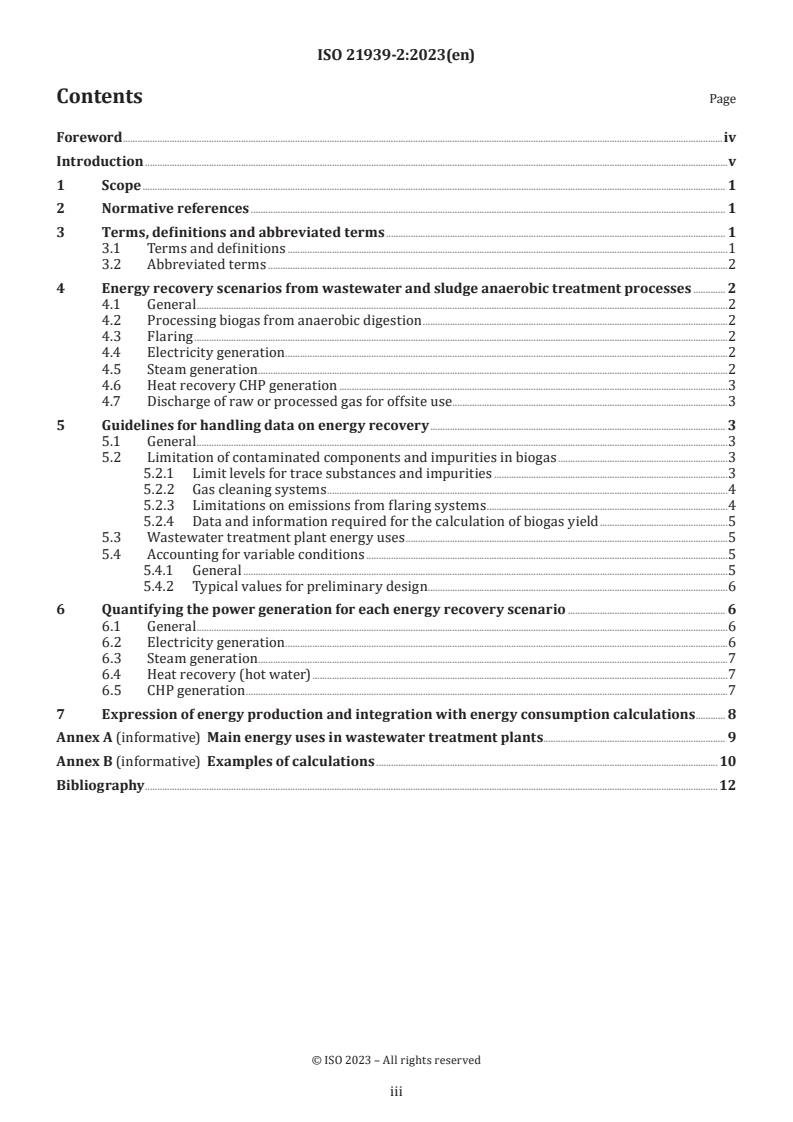
Contents Page
Foreword .iv
Introduction .v
1 Scope . 1
2 Normative references . 1
3 Terms, definitions and abbreviated terms . 1
3.1 Terms and definitions .1
3.2 Abbreviated terms .2
4 Energy recovery scenarios from wastewater and sludge anaerobic treatment processes . 2
4.1 General .2
4.2 Processing biogas from anaerobic digestion .2
4.3 Flaring .2
4.4 Electricity generation .2
4.5 Steam generation .2
4.6 Heat recovery CHP generation .3
4.7 Discharge of raw or processed gas for offsite use .3
5 Guidelines for handling data on energy recovery . 3
5.1 General .3
5.2 Limitation of contaminated components and impurities in biogas .3
5.2.1 Limit levels for trace substances and impurities .3
5.2.2 Gas cleaning systems .4
5.2.3 Limitations on emissions from flaring systems .4
5.2.4 Data and information required for the calculation of biogas yield .5
5.3 Wastewater treatment plant energy uses .5
5.4 Accounting for variable conditions .5
5.4.1 General .5
5.4.2 Typical values for preliminary design . .6
6 Quantifying the power generation for each energy recovery scenario . 6
6.1 General .6
6.2 Electricity generation .6
6.3 Steam generation .7
6.4 Heat recovery (hot water) .7
6.5 CHP generation .7
7 Expression of energy production and integration with energy consumption calculations . 8
Annex A (informative) Main energy uses in wastewater treatment plants. 9
Annex B (informative) Examples of calculations . 10
Bibliography .12
iii
Foreword
ISO (the International Organization for Standardization) is a worldwide federation of national standards
bodies (ISO member bodies). The work of preparing International Standards is normally carried out through
ISO technical committees. Each member body interested in a subject for which a technical committee
has been established has the right to be represented on that committee. International organizations,
governmental and non-governmental, in liaison with ISO, also take part in the work. ISO collaborates closely
with the International Electrotechnical Commission (IEC) on all matters of electrotechnical standardization.
The procedures used to develop this document and those intended for its further maintenance are described
in the ISO/IEC Directives, Part 1. In particular, the different approval criteria needed for the different types
of ISO document should be noted. This document was drafted in accordance with the editorial rules of the
ISO/IEC Directives, Part 2 (see www.iso.org/directives).
ISO draws attention to the possibility that the implementation of this document may involve the use of (a)
patent(s). ISO takes no position concerning the evidence, validity or applicability of any claimed patent
rights in respect thereof. As of the date of publication of this document, ISO had not received notice of (a)
patent(s) which may be required to implement this document. However, implementers are cautioned that
this may not represent the latest information, which may be obtained from the patent database available at
www.iso.org/patents. ISO shall not be held responsible for identifying any or all such patent rights.
Any trade name used in this document is information given for the convenience of users and does not
constitute an endorsement.
For an explanation of the voluntary nature of standards, the meaning of ISO specific terms and expressions
related to conformity assessment, as well as information about ISO's adherence to the World Trade
Organization (WTO) principles in the Technical Barriers to Trade (TBT), see www.iso.org/iso/foreword.html.
This document was prepared by Technical Committee ISO/TC 282, Water reuse, Subcommittee SC 4,
Industrial water reuse.
A list of all parts in the ISO 21939 series can be found on the ISO website.
Any feedback or questions on this document should be directed to the user’s national standards body. A
complete listing of these bodies can be found at www.iso.org/members.html.
iv
Introduction
Anaerobic treatment is a common part of industrial wastewater treatment, for example in the food industry.
It is also commonly used in municipal wastewater systems as sludge stabilization, for example anaerobic
digester (AD). Anaerobic digestion is a sequence of processes by which microorganisms break down
biodegradable material in the absence of oxygen.
Anaerobic digestion is widely used as a source of renewable energy. The anaerobic digestion process has
two main products: digested sludge and biogas, consisting of methane, carbon dioxide and traces of other
contaminant gases.
The anaerobic treatment can be analysed for its energy consumption, like any other treatment process,
[1]
using ISO 21939-1. The energy consumption in AD is mainly used for mixing and heating systems.
However, anaerobic treatment also produces a potential energy resource, namely biogas, that can offset
some or all of its energy consumption and in some cases end up energy positive. The excess energy can be
[1]
utilized to produce electricity for other systems in the treatment plant, as indicated in ISO 21939-1, such
as aeration in aerobic processes, which can be the greatest consumers of energy in the plant.
In biological wastewater treatment, such as activated sludge treatment, a lot of energy is consumed for
aeration systems such as blowers and aerators, which are needed to supply oxygen and mixing for the
aerobic process.
[1]
To expand ISO 21939-1, it is beneficial to account for the energy recovered and the net energy consumption
as a basis for evaluation and comparison of biological treatment processes for reuse. It is also important to
design and operate efficiency processes to produce and recover the highest amount of energy in order to use
it as a source for the anaerobic digestion process and other uses, on site or outside the wastewater plant.
This document relies on the following concepts:
— Energy recovery is an operation encouraged in industrial wastewater treatment for reuse, mainly due
to its net energy efficiency, which becomes significant and relevant with high concentrations of organic
matter.
— One of the common ways to recover energy from industrial wastewater treatment is by using anaerobic
digestion.
— The anaerobic digestion wastewater treatment is characterized by low energy consumption, as well as
generation of biogas with a high calorific value.
— The biogas is often used as an energy source for generation of heat or electricity or a combination of both
(combined heat and power generation).
— In addition, treated wastewater at high temperature is sometimes used for heating.
[1]
This document complements ISO 21939-1, in which the energy consumption for the wastewater treatment
process is quantified. Its purposes are:
— to account for energy production, where applicable, in order to obtain a net high energy value;
— to review different conditions and their influence on the biogas and methane yield;
— to outline possible uses of the biogas which have different actual energy production values;
— to define general principles for quantification and accounting for energy recovered and provide guidance
[1]
on how to integrate these values with the energy consumption of ISO 21939-1;
— to provide general guideline for efficient reuse of biogas for the consumption of relevant systems in
[1]
industrial wastewater treatment plants, as discussed in ISO 21939-1.
v
International Standard ISO 21939-2:2023(en)
Method to calculate and express energy consumption of
industrial wastewater treatment for the purpose of water
reuse —
Part 2:
Accounting for energy recovery
1 Scope
This document sets out the general principles for, and provides guidance on, the quantitative characterization
of energy recovery from wastewater and sludge treatment, and how to account for this in the total energy
consumption calculation.
The scope of this document includes:
— a definition of the main energy recovery processes applicable to industrial wastewater treatment and
sludge treatment for reuse, such as anaerobic digestion yielding biogas;
— an introduction to the possible forms of energy generated by energy recovery processes and systems,
such as electricity, steam or heat, and how to account for intentional wasting or commercial utilization
of biogas;
— guidance on the value to be taken into account as quantification of the energy generated, including the
power actually generated on average;
— a limit level for contaminated components in biogas allowed before any utilization;
— principles to integrate the energy recovery results with the energy consumption in accordance with
[1]
ISO 21939-1.
Energy production which is not recovered from wastewater or sludge treatment processes is not within the
scope of this document and is not included in the calculations and results expressed in it.
2 Normative references
The following documents are referred to in the text in such a way that some or all of their content constitutes
requirements of this document. For dated references, only the edition cited applies. For undated references,
the latest edition of the referenced document (including any amendments) applies.
ISO 20670, Water reuse — Vocabulary
3 Terms, definitions and abbreviated terms
3.1 Terms and definitions
For the purposes of this document, the terms and definitions given in ISO 20670 apply.
ISO and IEC maintain terminology databases f
...