


ISO 12815:2013
(Main)Fibre-reinforced plastic composites — Determination of plain-pin bearing strength
Fibre-reinforced plastic composites — Determination of plain-pin bearing strength
This International Standard specifies a procedure for determining the plain-pin bearing strength of fibre-reinforced plastic composites. The method described in this International Standard is applicable to fibre-reinforced plastic composites with either thermoset or thermoplastic matrices.
Composites plastiques renforcés de fibres — Détermination de la résistance au matage au moyen d'une goupille ordinaire
General Information
- Status
- Published
- Publication Date
- 24-Feb-2013
- Technical Committee
- ISO/TC 61/SC 13 - Composites and reinforcement fibres
- Drafting Committee
- ISO/TC 61/SC 13/WG 2 - Laminates and moulding compounds
- Current Stage
- 9599 - Withdrawal of International Standard
- Start Date
- 26-Feb-2025
- Completion Date
- 14-Feb-2026
Relations
- Effective Date
- 13-Jan-2024
Overview
ISO 12815:2013 defines a standardized test method for determining the plain-pin bearing strength of fibre-reinforced plastic composites (FRP). The procedure applies to composites with either thermoset or thermoplastic matrices and produces a reproducible material bearing strength for a given laminate lay-up. The test uses a metallic plain-pin in a clearance fit to load a rectangular specimen in tension and defines bearing strength from the maximum (failure) load divided by the projected pin contact area.
Key topics and technical requirements
- Test principle: Tension loading of a rectangular coupon with a centrally placed plain hole using a double-shear loading plate and plain-pin; maximum load is used to calculate bearing strength.
- Specimen geometry:
- Preferred width: 36 mm ± 0.5 mm; length: 100–180 mm (180 mm in disputes).
- Hole diameter: 6 mm (tolerance per the standard); recommended specimen thickness minimum 4 mm unless otherwise specified.
- End distance e = 36 mm (6 × hole diameter), reducible to 18 mm if acceptable.
- Apparatus:
- Plain-pin and hardened plates; pin typically hardened steel, clearance fit with at least 0.5 mm clearance in loading jig.
- Test machine conforming to ISO 5893 with load indicator accuracy within ±1% full scale.
- Precision measuring tools: micrometer capable of 0.01 mm (or better).
- Test procedure:
- Measure specimen width to 0.1 mm and thickness to 0.02 mm; verify hole and pin dimensions and roundness.
- Default testing speed: 1 mm/min unless otherwise specified for the material.
- Record load continuously; failure load = maximum load; discontinue when load falls >50% after peak.
- Statistical and reporting:
- Minimum five specimens per test series.
- Conditioning per ISO 291 where applicable.
- Calculation and expression of results, precision and reporting requirements are specified in the standard.
Applications and users
ISO 12815:2013 is used by:
- Materials and mechanical engineers assessing bearing performance of FRP laminates.
- Composite test laboratories and QA/QC teams validating laminate strength for aerospace, automotive, marine and industrial applications.
- R&D teams optimizing laminate lay-up for bolted/fastened joint designs (as a material property input). Note: plain-pin bearing tests characterize material response under controlled conditions; additional bolted-joint tests (torqued bolt, washers, environmental conditioning) are recommended for full joint performance assessment.
Related standards
- ISO 291 (conditioning)
- ISO 527‑4 (tensile test guidance for composites)
- ISO 1268 (test plate production)
- ISO 2818 (machining specimens)
- ISO 5893 (test machine specification)
- ISO 2602 (statistical interpretation)
- ASTM D5961 (guidance on bolted joint tests)
Keywords: ISO 12815:2013, plain-pin bearing strength, fibre-reinforced plastic composites, FRP bearing test, composite testing, pin-bearing test.
Get Certified
Connect with accredited certification bodies for this standard

Smithers Quality Assessments
US management systems and product certification.

DIN CERTCO
DIN Group product certification.
Sponsored listings
Frequently Asked Questions
ISO 12815:2013 is a standard published by the International Organization for Standardization (ISO). Its full title is "Fibre-reinforced plastic composites — Determination of plain-pin bearing strength". This standard covers: This International Standard specifies a procedure for determining the plain-pin bearing strength of fibre-reinforced plastic composites. The method described in this International Standard is applicable to fibre-reinforced plastic composites with either thermoset or thermoplastic matrices.
This International Standard specifies a procedure for determining the plain-pin bearing strength of fibre-reinforced plastic composites. The method described in this International Standard is applicable to fibre-reinforced plastic composites with either thermoset or thermoplastic matrices.
ISO 12815:2013 is classified under the following ICS (International Classification for Standards) categories: 83.120 - Reinforced plastics. The ICS classification helps identify the subject area and facilitates finding related standards.
ISO 12815:2013 has the following relationships with other standards: It is inter standard links to ISO 12815:2025. Understanding these relationships helps ensure you are using the most current and applicable version of the standard.
ISO 12815:2013 is available in PDF format for immediate download after purchase. The document can be added to your cart and obtained through the secure checkout process. Digital delivery ensures instant access to the complete standard document.
Standards Content (Sample)
INTERNATIONAL ISO
STANDARD 12815
First edition
2013-03-01
Fibre-reinforced plastic
composites — Determination of
plain-pin bearing strength
Composites plastiques renforcés de fibres — Détermination de la
résistance au matage au moyen d’une goupille ordinaire
Reference number
©
ISO 2013
© ISO 2013
All rights reserved. Unless otherwise specified, no part of this publication may be reproduced or utilized otherwise in any form
or by any means, electronic or mechanical, including photocopying, or posting on the internet or an intranet, without prior
written permission. Permission can be requested from either ISO at the address below or ISO’s member body in the country of
the requester.
ISO copyright office
Case postale 56 • CH-1211 Geneva 20
Tel. + 41 22 749 01 11
Fax + 41 22 749 09 47
E-mail copyright@iso.org
Web www.iso.org
Published in Switzerland
ii © ISO 2013 – All rights reserved
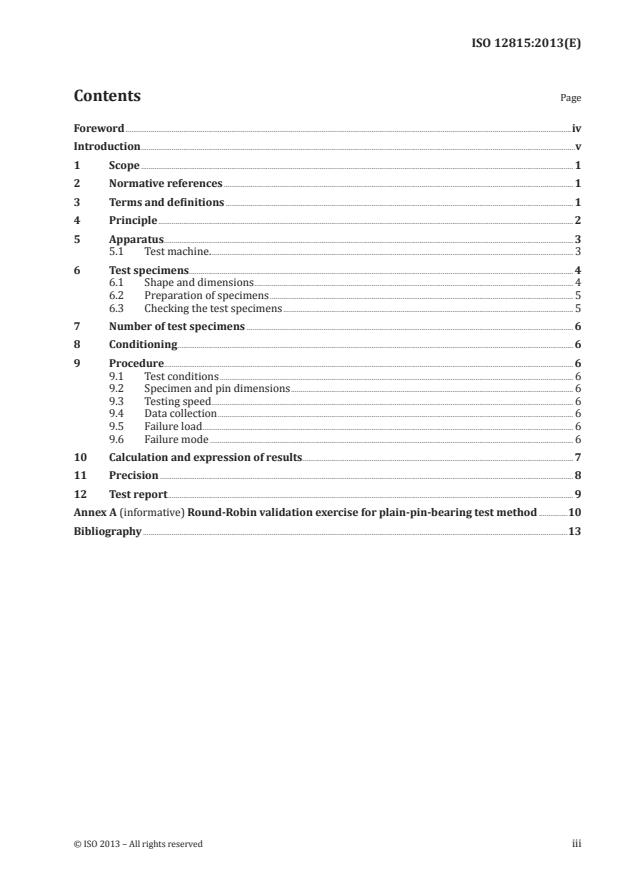
Contents Page
Foreword .iv
Introduction .v
1 Scope . 1
2 Normative references . 1
3 Terms and definitions . 1
4 Principle . 2
5 Apparatus . 3
5.1 Test machine. . 3
6 Test specimens. 4
6.1 Shape and dimensions . 4
6.2 Preparation of specimens . 5
6.3 Checking the test specimens . 5
7 Number of test specimens . 6
8 Conditioning . 6
9 Procedure. 6
9.1 Test conditions . 6
9.2 Specimen and pin dimensions . 6
9.3 Testing speed . 6
9.4 Data collection . 6
9.5 Failure load . 6
9.6 Failure mode . 6
10 Calculation and expression of results . 7
11 Precision . 8
12 Test report . 9
Annex A (informative) Round-Robin validation exercise for plain-pin-bearing test method .10
Bibliography .13
Foreword
ISO (the International Organization for Standardization) is a worldwide federation of national standards
bodies (ISO member bodies). The work of preparing International Standards is normally carried out
through ISO technical committees. Each member body interested in a subject for which a technical
committee has been established has the right to be represented on that committee. International
organizations, governmental and non-governmental, in liaison with ISO, also take part in the work.
ISO collaborates closely with the International Electrotechnical Commission (IEC) on all matters of
electrotechnical standardization.
International Standards are drafted in accordance with the rules given in the ISO/IEC Directives, Part 2.
The main task of technical committees is to prepare International Standards. Draft International
Standards adopted by the technical committees are circulated to the member bodies for voting.
Publication as an International Standard requires approval by at least 75 % of the member bodies
casting a vote.
Attention is drawn to the possibility that some of the elements of this document may be the subject of
patent rights. ISO shall not be held responsible for identifying any or all such patent rights.
ISO 12815 was prepared by Technical Committee ISO/TC 61, Plastics, Subcommittee SC 13, Composites
and reinforcement fibres.
iv © ISO 2013 – All rights reserved
Introduction
In preparing this harmonized version, reference was made to similar methods, such as prEN 6037 and
ASTM D 5961, harmonization with open-hole tests has been achieved where relevant (e.g. specimen
and hole size). The method is applicable to all current and future fibre-reinforced plastic composites
meeting the requirements of this International Standard.
The method described in this International Standard uses the maximum load to define the plain-pin
laminate bearing strength. This point is well-defined and has been shown to be at a similar level to the
less easily defined, initial failure in the similar “torqued bolt” test(s) (see below). In the torqued bolt
test, the load can increase after the bearing failure (up to x 2), as the failed material is jammed against
the bolt, washers and loading jigs. The property determined applies only to the laminate lay-up tested.
The strength properties of “bolted” joints are dependent on the actual conditions involved for the
joint being assessed. This includes initial bolt torque (including any load lost in bolt threads), effect
of relaxation due to visco-elastic effects, effect of hot/wet conditioning, washer size/over-size, bolt
material/rivet details and chamfer depth/plate thickness. It is recommended that additional tests
to the plain-pin test be conducted for the actual joint conditions of interest in the applications, as no
standardized configuration can represent all these variations. ASTM D 5961, Standard test method for
bearing response of polymer matrix composite laminates, can be used as guidance on bolted joint tests.
INTERNATIONAL STANDARD ISO 12815:2013(E)
Fibre-reinforced plastic composites — Determination of
plain-pin bearing strength
1 Scope
This International Standard specifies a procedure for determining the plain-pin bearing strength of
fibre-reinforced plastic composites.
The method described in this International Standard is applicable to fibre-reinforced plastic composites
with either thermoset or thermoplastic matrices.
2 Normative references
The following referenced documents are indispensable for the application of this document. For dated
references, only the edition cited applies. For undated references, the latest edition of the referenced
document (including any amendments) applies.
ISO 291, Plastics — Standard atmospheres for conditioning and testing
ISO 527-4, Plastics — Determination of tensile properties — Part 4: Test conditions for isotropic and
orthotropic fibre-reinforced plastic composites
ISO 472, Plastics — Vocabulary
ISO 1268 (all parts), Fibre-reinforced plastics — Methods of producing test plates
ISO 2602, Statistical interpretation of test results — Estimation of the mean — Confidence interval
ISO 2818, Plastics — Preparation of test specimens by machining
ISO 5893, Rubber and plastics test equipment — Tensile, flexural and compression types (constant rate of
traverse) — Specification
3 Terms and definitions
For the purposes of this document, the terms and definitions given in ISO 472 and the following apply.
3.1
plain-pin bearing strength
σ
p
stress obtained by dividing the maximum load by the projected cross-sectional area of the pin contact
area with the specimen (i.e. d x t)
Note 1 to entry: The result is expressed in megapascals, MPa.
3.2
specimen coordinate axes
coordinate axes for the material under test, the direction parallel to the plate longitudinal axis
being defined as the “1” direction, the direction perpendicular to them as the “2” direction
and, the direction “3” being perpendicular to the plate (i.e. the through-thickness direction)
[SOURCE: ISO 527-4:1997, Clause 4.8]
Key
t thickness
w specimen width
L specimen length
e distance from end of specimen
h length of tabbing (if used)
d pin/hole diameter
Figure 1 — Test specimen for determination of plain-pin bearing strength
4 Principle
A test specimen consisting of a strip of rectangular cross-section with a plain hole, centrally positioned
with respect to the width, is loaded in tension by a clearance fit metallic plain-pin. The maximum load
sustained by the specimen is used to determine the plain-pin bearing strength, based on the projected
area of the pin in contact with the specimen. The test measures a material plain-pin bearing strength
under these loading conditions, rather than a load to fail a bolted joint, for the laminate lay-up tested.
2 © ISO 2013 – All rights reserved
5 Apparatus
5.1 Test machine.
5.1.1 General, test machine conforming to ISO 5893 as appropriate to the requirements given in
5.1.2 to 5.1.3.
5.1.2 Speed of testing, v, shall be kept constant according to ISO 5893.
5.1.3 Indicator for load, such that the error in the indicated force is less than ±1 % of the full scale
(see ISO 5893).
5.2 Micrometer, or equivalent, capable of reading to 0,01 mm, or less, and suitable for measuring the
thickness, t and width, w of the test specimen; and the pin/hole diameter, d and position. The micrometer
shall have faces appropriate to the surface being measured (i.e. flat faces for flat, polished surfaces and
hemispherical faces for irregular surfaces).
5.3 Loading jig and pin, the plain-pin is loaded by a double-shear metal plate assembly, as shown in
Figure 2. The loading jig shall include clearance, c, of at least 0.5 mm on both sides of the specimen and
shall not distort under the applied load. The pin should be manufactured in a hardened steel. The loading
pin shall similarly not distort during the test and should be an clearance fit in the hole in the specimen,
unless specified otherwise. The loading pin shall have a diameter of 6 mm (tolerance 0 to −0.05 mm).
NOTE Hardened plates are acceptable as an alternative to the use of the hardened bushes shown in Figure 1.
Key
1 grip plate
2 side plate
3 hardened bushes
4 hardened loading pin
5 specimen
6, 7 machine grips
c clearance = 0.5 mm (minimum)
Figure 2 — Loading plates and test arrangement
6 Test specimens
6.1 Shape and dimensions
6.1.1 Preferred specimen size
The specimen shall have a width, w, of 36 mm ± 0,5 mm and a length, L of 100 to 180 mm. In cases of
dispute the specimen length shall be 180 mm. For specimen thickness reference shall be made to the
international standard for the material or the appropriate part of ISO 1268 for test panel manufacture,
otherwise a minimum of 4 mm shall be used for the pin hole size given in 6.1.2. The width of individual
specimens shall be parallel to within 0,2 mm. The configuration of the specimen is shown in Figure 1.
4 © ISO 2013 – All rights reserved
A hole, 6 mm (tolerance 0 to + 0,05 mm), in diameter is machined within 0,1 mm of the specimen centre
line and a distance, e, of 36 mm (i.e. 6 × the hole diameter) from the end of the coupon. Providing that an
acceptable bearing failure (c.f. shear-out) is still obtained, the end distance, e, can be reduced to 18 mm.
6.1.2 Alternative specimen size
Alternative specimens shall maintain a specimen width/hole diameter and an end distance/hole
diameter ratio of 6; and a plain-pin diameter/specimen thickness of 1,5.
NOTE For existing applications, a 6,35 mm (0,25”) hole at 38,1 mm (1,5”) from the end of a 38,1 mm (1
...
Questions, Comments and Discussion
Ask us and Technical Secretary will try to provide an answer. You can facilitate discussion about the standard in here.
Loading comments...