

ISO 8116-5:2008
(Main)Textile machinery and accessories — Beams for winding — Part 5: Sectional beams for warp knitting machines
General Information
- Abstract
ISO 8116-5:2008 specifies the main dimensions, mechanical strength, designation and permissible values of tolerances of form and position for the main elements of sectional beams for warp knitting machines.
- Status
- Published
- Publication Date
- 30-Nov-2008
- Current Stage
- 9093 - International Standard confirmed
- Start Date
- 09-Sep-2024
- Completion Date
- 29-Aug-2026

Overview
ISO 8116-5:2008 - part of the ISO 8116 series on beams for winding - defines the essential dimensional, mechanical and tolerance requirements for sectional beams used on warp knitting machines. The standard specifies main dimensions, mechanical strength classification, permissible form and position tolerances, run‑out limits and designation rules to ensure interchangeability, safe operation and consistent winding quality for warp knitting applications.
Key topics and technical requirements
- Main dimensions: Specifies flange diameters, barrel and overall lengths and related keyway dimensions for sectional beams (main dimensions given in the standard).
- Mechanical strength: Classification of strength by quality classes (Q1–Q4) and verification by test methods referenced to ISO 8116-4.
- Flange circular axial run‑out (Ta): Permissible values are provided by flange diameter (examples in the standard include 335, 532, 762 and 1 000 mm with corresponding Ta limits).
- Barrel total run‑out (Tr): Calculated from overall length l using the formula Tr = 0.25 × l / 1000 (measured per ISO 8116-8).
- Residual imbalance: Guidance recommends a balance quality grade G 6.3 per ISO 1940-1 unless other grades are specified.
- Taper reception: For flange diameters ≥ 762 mm, a taper reception option is defined to improve centring on a mandrel.
- Specification details to provide: Material of barrel and flanges, material to be wound, flange fabrication (casting/forging), surface quality/treatment, number of boss grooves, and taper reception if applicable.
- Designation format: e.g., “Sectional beam ISO 8116-5 - 535 × 1 065‑Q4” (flange diameter × overall length × quality class).
Applications and users
- Practical use: Ensures sectional beam parts meet dimensional and balance tolerances for reliable winding and consistent warp yarn supply on warp knitting machines.
- Who uses it:
- Textile machinery manufacturers and OEMs (design and production of sectional beams)
- Machine builders and integrators (specifying compatible beams)
- Textile mills and warp knitting operations (procurement and acceptance testing)
- Quality and maintenance engineers (inspection, balancing and replacement)
- Suppliers of flanges, barrels and mandrels (manufacturing to agreed tolerances)
Related standards
- ISO 8116 series (Parts 1–9) for beams and related terminology, tests and tolerances
- ISO 8116-4 (test methods and quality classification of flanges)
- ISO 8116-8 (definitions of run‑out tolerances and measurement methods)
- ISO 1940-1 (balance quality requirements for rotors)
- ISO 286-2 (system of limits and fits - tolerance grades)
ISO 8116-5:2008 is essential when specifying or validating sectional beams for warp knitting machines to ensure dimensional compatibility, mechanical integrity and winding performance.
Relations
- Effective Date
- 06-Jun-2022
- Effective Date
- 15-Apr-2008
Get Certified
Connect with accredited certification bodies for this standard

Control Union Certifications
Global certification for agriculture and sustainability.

Hohenstein Institut
Textile testing and certification.

Bureau Veritas Bangladesh
Bureau Veritas certification services in Bangladesh.
Sponsored listings
Frequently Asked Questions
ISO 8116-5:2008 is a standard published by the International Organization for Standardization (ISO). Its full title is "Textile machinery and accessories — Beams for winding — Part 5: Sectional beams for warp knitting machines". This standard covers: ISO 8116-5:2008 specifies the main dimensions, mechanical strength, designation and permissible values of tolerances of form and position for the main elements of sectional beams for warp knitting machines.
ISO 8116-5:2008 specifies the main dimensions, mechanical strength, designation and permissible values of tolerances of form and position for the main elements of sectional beams for warp knitting machines.
ISO 8116-5:2008 is classified under the following ICS (International Classification for Standards) categories: 59.120.20 - Winding machines and equipment. The ICS classification helps identify the subject area and facilitates finding related standards.
ISO 8116-5:2008 has the following relationships with other standards: It is inter standard links to ISO 2286-3:2016, ISO 8116-5:1995. Understanding these relationships helps ensure you are using the most current and applicable version of the standard.
ISO 8116-5:2008 is available in PDF format for immediate download after purchase. The document can be added to your cart and obtained through the secure checkout process. Digital delivery ensures instant access to the complete standard document.
Standards Content (Sample)
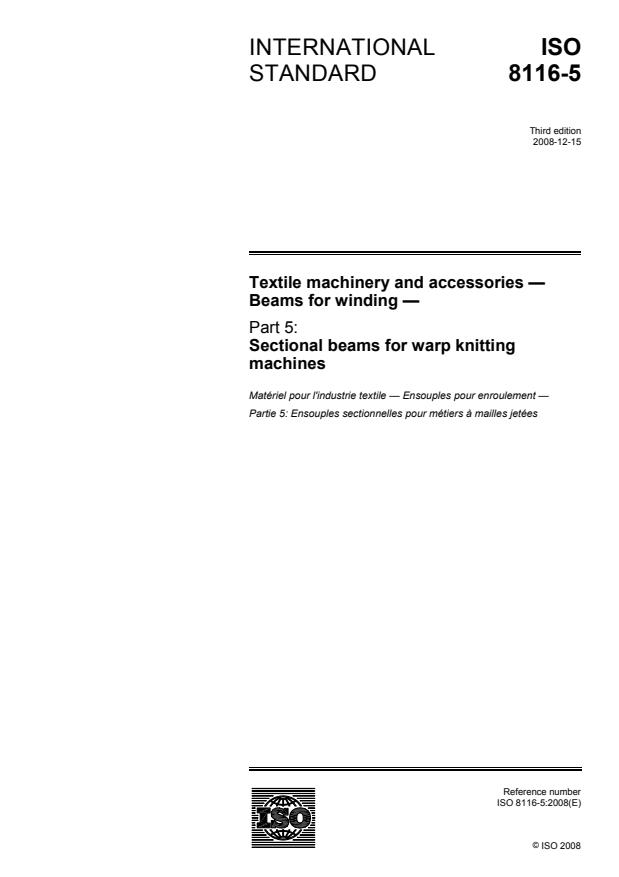
INTERNATIONAL ISO
STANDARD 8116-5
Third edition
2008-12-15
Textile machinery and accessories —
Beams for winding —
Part 5:
Sectional beams for warp knitting
machines
Matériel pour l'industrie textile — Ensouples pour enroulement —
Partie 5: Ensouples sectionnelles pour métiers à mailles jetées
Reference number
©
ISO 2008
PDF disclaimer
This PDF file may contain embedded typefaces. In accordance with Adobe’s licensing policy, this file may be printed or viewed but
shall not be edited unless the typefaces which are embedded are licensed to and installed on the computer performing the editing. In
downloading this file, parties accept therein the responsibility of not infringing Adobe’s licensing policy. The ISO Central Secretariat
accepts no liability in this area.
Adobe is a trademark of Adobe Systems Incorporated.
Details of the software products used to create this PDF file can be found in the General Info relative to the file; the PDF-creation
parameters were optimized for printing. Every care has been taken to ensure that the file is suitable for use by ISO member bodies. In
the unlikely event that a problem relating to it is found, please inform the Central Secretariat at the address given below.
© ISO 2008
All rights reserved. Unless otherwise specified, no part of this publication may be reproduced or utilized in any form or by any means,
electronic or mechanical, including photocopying and microfilm, without permission in writing from either ISO at the address below or
ISO’s member body in the country of the requester.
ISO copyright office
Case postale 56 • CH-1211 Geneva 20
Tel. + 41 22 749 01 11
Fax + 41 22 749 09 47
E-mail copyright@iso.org
Web www.iso.org
Published in Switzerland
ii © ISO 2008 – All rights reserved
Foreword
ISO (the International Organization for Standardization) is a worldwide federation of national standards bodies
(ISO member bodies). The work of preparing International Standards is normally carried out through ISO
technical committees. Each member body interested in a subject for which a technical committee has been
established has the right to be represented on that committee. International organizations, governmental and
non-governmental, in liaison with ISO, also take part in the work. ISO collaborates closely with the
International Electrotechnical Commission (IEC) on all matters of electrotechnical standardization.
International Standards are drafted in accordance with the rules given in the ISO/IEC Directives, Part 2.
The main task of technical committees is to prepare International Standards. Draft International Standards
adopted by the technical committees are circulated to the member bodies for voting. Publication as an
International Standard requires approval by at least 75 % of the member bodies casting a vote.
Attention is drawn to the possibility that some of the elements of this document may be the subject of patent
rights. ISO shall not be held responsible for identifying any or all such patent rights.
ISO 8116-5 was prepared by Technical Committee ISO/TC 72, Textile machinery and accessories,
Subcommittee SC 3, Machinery for fabric manufacturing including preparatory machinery and accessories.
This third edition cancels and replaces the second edition (ISO 8116-5:1995), which has been technically
revised.
ISO 8116 consists of the following parts, under the general title Textile machinery and accessories — Beams
for winding:
⎯ Part 1: General vocabulary
⎯ Part 2: Warper’s beams
⎯ Part 3: Weaver’s beams
⎯ Part 4: Test methods and quality classification of flanges for weaver’s beams, warper’s beams and
sectional beams
⎯ Part 5: Sectional beams for warp knitting machines
⎯ Part 6: Beams for ribbon weaving and ribbon knitting
⎯ Part 7: Beams for dyeing slivers, rovings and yarns
⎯ Part 8: Definitions of run-out tolerances and methods of measurement
⎯ Part 9: Dyeing beams for textile fabrics
INTERNATIONAL STANDARD ISO 8116-5:2008(E)
Textile machinery and accessories — Beams for winding —
Part 5:
Sectional beams for warp knitting machines
1 Scope
This part of ISO 8116 specifies the main dimensions, mechanical strength, designation and permissible values
of tolerances of form and position for the main elements of sectional beams for warp knitting machines. For
cases where a limit must be fixed for the residual imbalance, a recommendation is made for the choice of
quality grade.
2 Normative references
The following referenced documents
...