

ISO/TR 11064-10:2020
(Main)Ergonomic design of control centres — Part 10: Introduction to the control room design series of standards
General Information
- Abstract
This document describes the different parts of the ISO 11064 series. The overall content of each of the parts is presented, the most likely users of that part and the relevance of each part to different stages in the control room design process.
- Status
- Published
- Publication Date
- 17-Sep-2020
- Technical Committee
- ISO/TC 159/SC 4 - Ergonomics of human-system interaction
- Drafting Committee
- ISO/TC 159/SC 4/WG 8 - Ergonomic design of control centres
- Current Stage
- 6060 - International Standard published
- Start Date
- 18-Sep-2020
- Completion Date
- 18-Sep-2020
Buy Documents
ISO/TR 11064-10:2020 - Ergonomic design of control centres — Part 10: Introduction to the control room design series of standards Released:9/18/2020
ISO/TR 11064-10:2020 - Ergonomic design of control centres — Part 10: Introduction to the control room design series of standards/18/2020
Overview
ISO/TR 11064-10:2020 - Ergonomic design of control centres: Part 10 is an introductory technical report that describes the structure and purpose of the ISO 11064 series. Rather than giving new design rules, this document helps users identify which part(s) of the ISO 11064 family they should apply at different stages of a control room design, refurbishment or evaluation project. It explains scope, intended users and how each part relates to typical control room design activities.
Key Topics
- Series overview and selection guidance - guidance on selecting the appropriate ISO 11064 part(s) for a given project or stakeholder role.
- Summaries of core parts - concise descriptions of what each part covers, including:
- ISO 11064-1: principles and an 11‑phase user-centred design framework for planning control centres.
- ISO 11064-2: control suite arrangement and spatial/functional relationships.
- ISO 11064-3: control room layout, workstation grouping and siting of displays.
- ISO 11064-4: workstation layout and dimensions for visual-display‑based operator stations.
- ISO 11064-5: displays, controls, dialogue design and alarm systems.
- ISO 11064-6: environmental requirements (lighting, acoustics, thermal) - summarized.
- ISO 11064-7: principles for evaluation of control centres.
- Stakeholder mapping - which professionals (architects, ergonomists, HVAC engineers, project managers, usability specialists, procurers, certification bodies, control-room staff) are most likely to use each part.
- Human-centred design linkages - relationship to broader usability/ergonomics guidance such as ISO 9241-210 and other parts of the ISO 9241 series.
Applications
ISO/TR 11064-10 is primarily a navigational and planning aid to:
- Help project teams determine which ISO 11064 documents to apply for new builds, refurbishments or upgrades.
- Guide multidisciplinary teams (architects, human factors specialists, furniture designers, systems integrators) on responsibilities and timing of ergonomic requirements.
- Reduce design iterations by pointing teams to the correct part for specific issues (workstation dimensions, alarm design, environmental limits, layout).
- Inform procurement, certification and evaluation planning by clarifying relevant requirements and evaluation points.
Relevant use cases include process-industry control rooms, transportation control centres, security/command centres and other non‑mobile control centres (many principles are also transferable to mobile contexts such as ships or aircraft).
Related standards
- ISO 11064 series (Parts 1–7) - detailed ergonomic requirements and guidance for planning, layout, workstations, displays, environment and evaluation.
- ISO 9241-210 / ISO 9241 series - human-centred design for interactive systems; referenced for user-centred process alignment.
Keywords: ISO/TR 11064-10:2020, ISO 11064 series, ergonomic design, control room design, control centres, workstation layout, displays and controls, human-centred design, control suite arrangement, control room standards.
Buy Documents
ISO/TR 11064-10:2020 - Ergonomic design of control centres — Part 10: Introduction to the control room design series of standards Released:9/18/2020
ISO/TR 11064-10:2020 - Ergonomic design of control centres — Part 10: Introduction to the control room design series of standards/18/2020
Get Certified
Connect with accredited certification bodies for this standard

CIS Institut d.o.o.
Personal Protective Equipment (PPE) certification body. Notified Body NB-2890 for EU Regulation 2016/425 PPE.

Kiwa BDA Testing
Building and construction product certification.
Kmetijski inštitut Slovenije
Agricultural Institute of Slovenia. Soil testing, plant health, agricultural product analysis.
Sponsored listings
Frequently Asked Questions
ISO/TR 11064-10:2020 is a technical report published by the International Organization for Standardization (ISO). Its full title is "Ergonomic design of control centres — Part 10: Introduction to the control room design series of standards". This standard covers: This document describes the different parts of the ISO 11064 series. The overall content of each of the parts is presented, the most likely users of that part and the relevance of each part to different stages in the control room design process.
This document describes the different parts of the ISO 11064 series. The overall content of each of the parts is presented, the most likely users of that part and the relevance of each part to different stages in the control room design process.
ISO/TR 11064-10:2020 is classified under the following ICS (International Classification for Standards) categories: 13.180 - Ergonomics. The ICS classification helps identify the subject area and facilitates finding related standards.
ISO/TR 11064-10:2020 is available in PDF format for immediate download after purchase. The document can be added to your cart and obtained through the secure checkout process. Digital delivery ensures instant access to the complete standard document.
Standards Content (Sample)
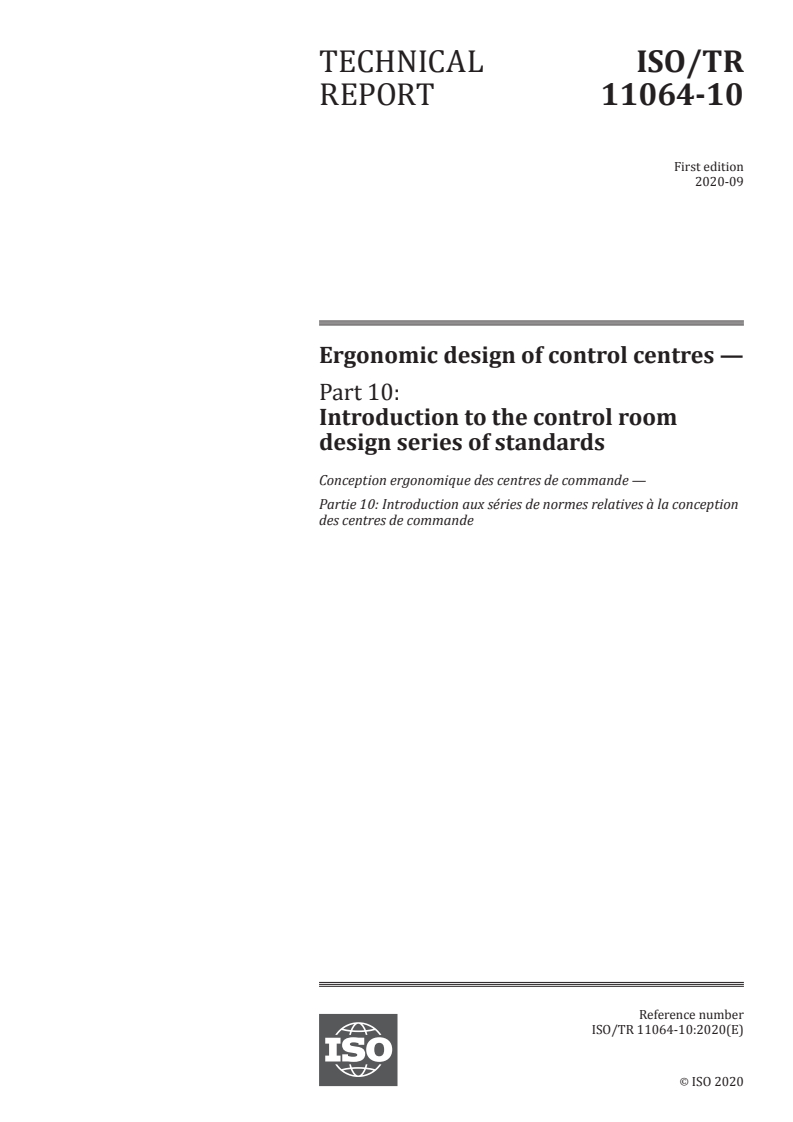
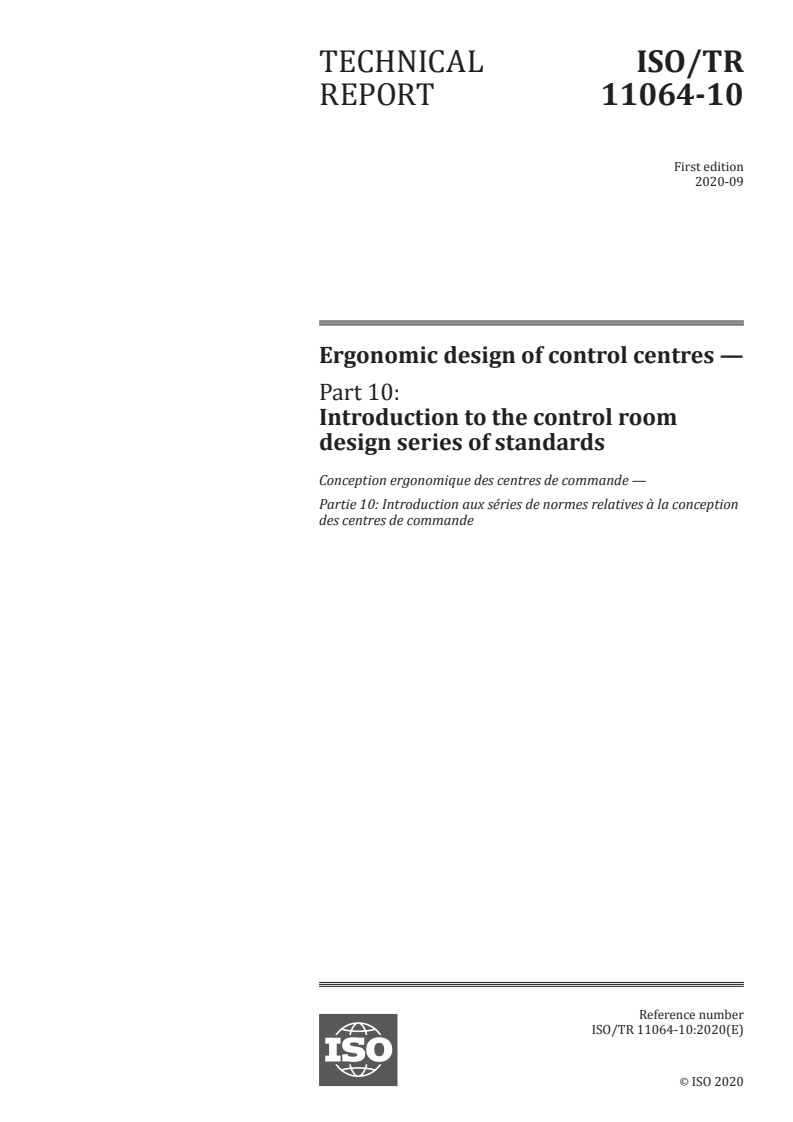
TECHNICAL ISO/TR
REPORT 11064-10
First edition
2020-09
Ergonomic design of control centres —
Part 10:
Introduction to the control room
design series of standards
Conception ergonomique des centres de commande —
Partie 10: Introduction aux séries de normes relatives à la conception
des centres de commande
Reference number
©
ISO 2020
© ISO 2020
All rights reserved. Unless otherwise specified, or required in the context of its implementation, no part of this publication may
be reproduced or utilized otherwise in any form or by any means, electronic or mechanical, including photocopying, or posting
on the internet or an intranet, without prior written permission. Permission can be requested from either ISO at the address
below or ISO’s member body in the country of the requester.
ISO copyright office
CP 401 • Ch. de Blandonnet 8
CH-1214 Vernier, Geneva
Phone: +41 22 749 01 11
Email: copyright@iso.org
Website: www.iso.org
Published in Switzerland
ii © ISO 2020 – All rights reserved
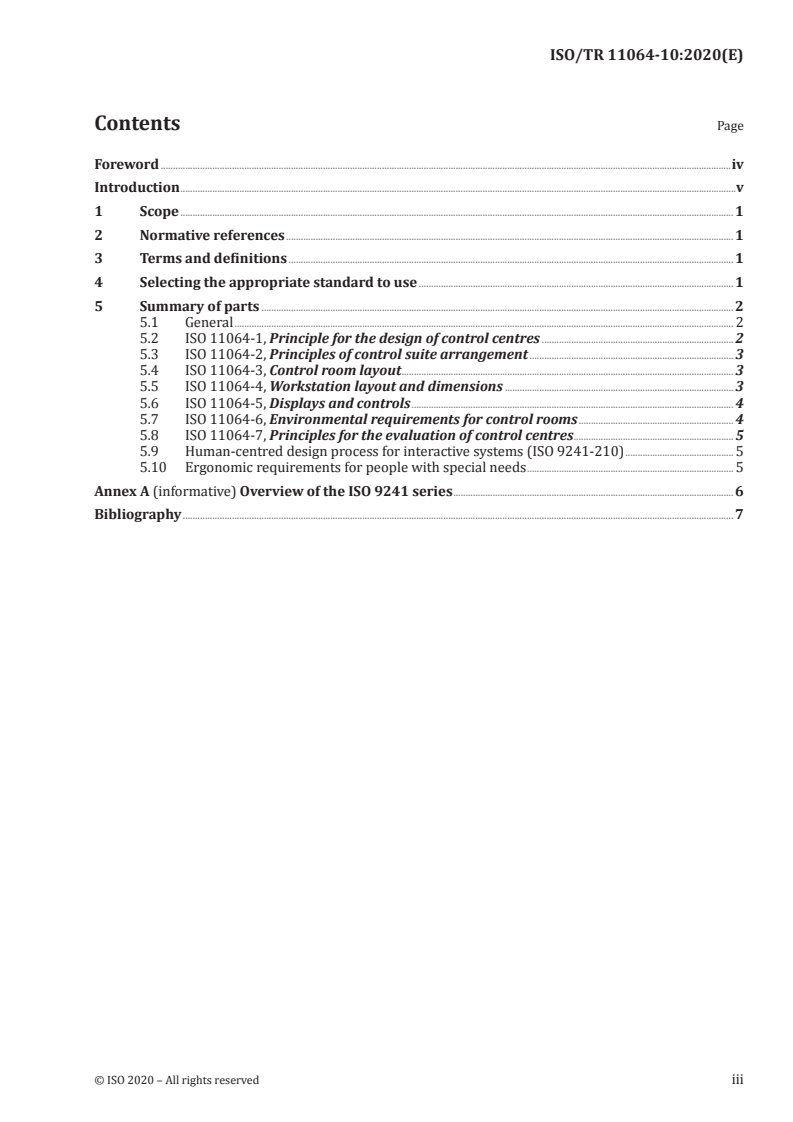
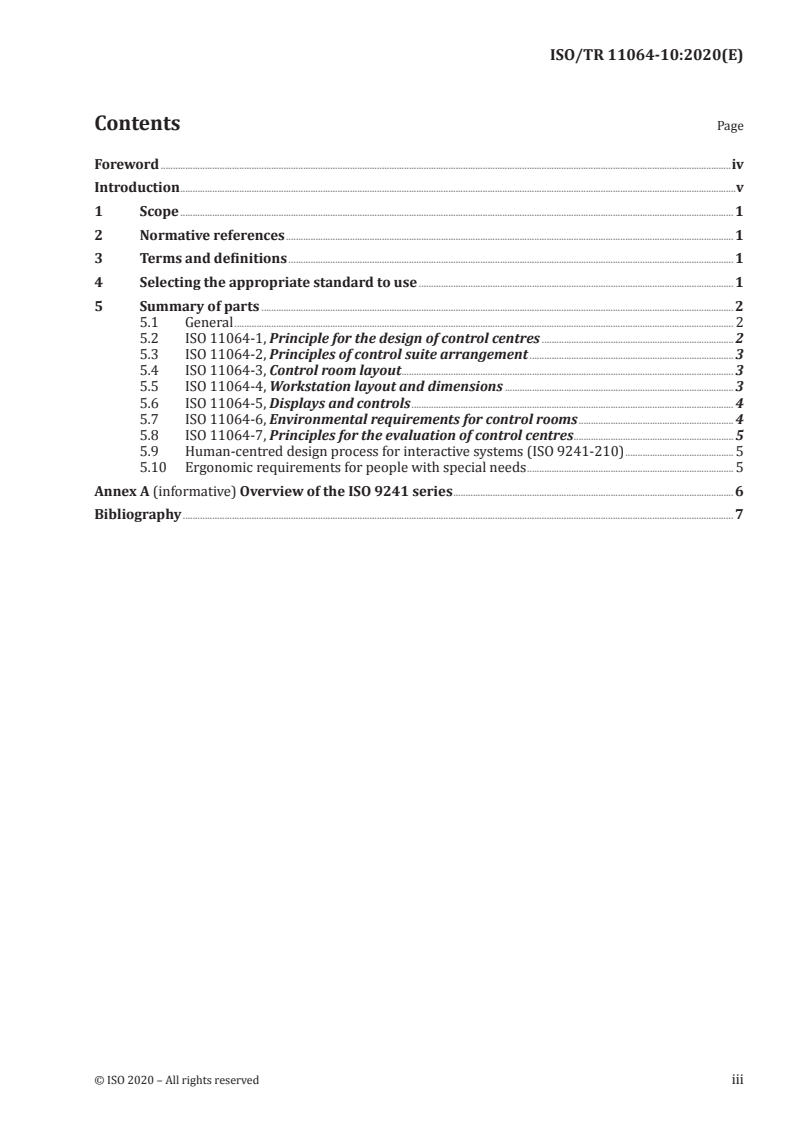
Contents Page
Foreword .iv
Introduction .v
1 Scope . 1
2 Normative references . 1
3 Terms and definitions . 1
4 Selecting the appropriate standard to use . 1
5 Summary of parts . 2
5.1 General . 2
5.2 ISO 11064-1, Principle for the design of control centres . 2
5.3 ISO 11064-2, Principles of control suite arrangement . 3
5.4 ISO 11064-3, Control room layout . 3
5.5 ISO 11064-4, Workstation layout and dimensions . 3
5.6 ISO 11064-5, Displays and controls . 4
5.7 ISO 11064-6, Environmental requirements for control rooms . 4
5.8 ISO 11064-7, Principles for the evaluation of control centres . 5
5.9 Human-centred design process for interactive systems (ISO 9241-210) . 5
5.10 Ergonomic requirements for people with special needs . 5
Annex A (informative) Overview of the ISO 9241 series . 6
Bibliography . 7
Foreword
ISO (the International Organization for Standardization) is a worldwide federation of national standards
bodies (ISO member bodies). The work of preparing International Standards is normally carried out
through ISO technical committees. Each member body interested in a subject for which a technical
committee has been established has the right to be represented on that committee. International
organizations, governmental and non-governmental, in liaison with ISO, also take part in the work.
ISO collaborates closely with the International Electrotechnical Commission (IEC) on all matters of
electrotechnical standardization.
The procedures used to develop this document and those intended for its further maintenance are
described in the ISO/IEC Directives, Part 1. In particular, the different approval criteria needed for the
different types of ISO documents should be noted. This document was drafted in accordance with the
editorial rules of the ISO/IEC Directives, Part 2 (see www .iso .org/ directives).
Attention is drawn to the possibility that some of the elements of this document may be the subject of
patent rights. ISO shall not be held responsible for identifying any or all such patent rights. Details of
any patent rights identified during the development of the document will be in the Introduction and/or
on the ISO list of patent declarations received (see www .iso .org/ patents).
Any trade name used in this document is information given for the convenience of users and does not
constitute an endorsement.
For an explanation of the voluntary nature of standards, the meaning of ISO specific terms and
expressions related to conformity assessment, as well as information about ISO's adherence to the
World Trade Organization (WTO) principles in the Technical Barriers to Trade (TBT), see www .iso .org/
iso/ foreword .html.
This document was prepared by Technical Committee ISO/TC 159, Ergonomics, Subcommittee SC 4,
Ergonomics of human-system interaction.
A list of all parts in the ISO 11064 series can be found on the ISO website.
Any feedback or questions on this document should be directed to the user’s national standards body. A
complete listing of these bodies can be found at www .iso .org/ members .html.
iv © ISO 2020 – All rights reserved
Introduction
Ergonomics is the scientific discipline and systematic study concerned with the understanding of the
interactions among human and other elements of a system. The term also describes the profession
that applies theory, principles, data and methods to design in order to optimize human well-being and
overall system performance.
The ISO 11064 series provides general guidance, principles and recommendations. The requirements
focus on the interaction between human and system and also the processes and methods required to
achieve usable and accessible interactive systems.
The ISO 11064 series covers a wide range of topics including architectural requirements, computer
interface design and furniture design. This document provides guidance on the overall structure of the
series and offers advice on where specific requirements are discussed. This document is designed to
help the potential users identify which of these is relevant to their needs.
The principles, recommendations and requirements given in the ISO 11064 series can help users with:
— user consultation;
— matching functional design with purpose;
— avoiding abortive design and unnecessary iterations;
— contributing to multi-disciplinary team coordination;
— minimizing the mistiming of critical inputs from stakeholders.
The ISO 11064 series enables users to:
— apply a systematic process to the design of control rooms;
— lay out the group of rooms closely associated with the control room;
— arrange furniture and major displays in a control room;
— design and specify ergonomic layouts of workstations;
— specify the design of the user interfaces including computer systems, communications equipment
and CCTV systems;
— identify and specify the environmental requirements for lighting, acoustics and thermal
environments;
— evaluate existing control rooms.
The ISO 11064 series covers all types of control centres typically employed in the process industries,
transportation and command, communications and control. Although the ISO 11064 series is primarily
intended for non-mobile control centres, many of the principles specified in this document can be
applicable to mobile control centres, such as those found on ships and aircraft.
The ISO 11064 series provides information which is relevant to the following stakeholder groups:
— ergonomists;
— usability professionals;
— control room designers;
— architects;
— interior designers;
— heating and ventilation engineers;
— project managers;
— control room staff;
— certification bodies;
— procurers.
The terms "human factors" and "ergonomics" are used interchangeably in this document and are
considered as synonyms.
vi © ISO 2020 – All rights reserved
TECHNICAL REPORT ISO/TR 11064-10:2020(E)
Ergonomic design of control centres —
Part 10:
Introduction to the control room design series of standards
1 Scope
This document describes the different parts of the ISO 11064 series. The overall content of each of the
parts is presented, the most likely users of that part and the relevance of each part to different stages in
the control room design process.
2 Normative references
There are no normative references in this document.
3 Terms and definitions
No terms and definitions are listed in this document.
ISO and IEC maintain terminological databases for use in standardization at the following addresses:
— ISO Online browsing platform: available at https:// www .iso .org/ obp
— IEC Electropedia: available at http:// www .electropedia .org/
4 Selecting the appropriate standard to use
The control room requirements presented in the ISO 11064 series are likely to be addressed by a
range of professions. Certain parts of the ISO 11064 series can be of particular relevance to specific
individuals in the design team (for example, those requirements relating to control suite layout are
likely to be of particular concern to architects). Figure 1 shows how various members of the control
room design team can use the different parts of the ISO 11064 series. The figure is illustrative, not
prescriptive, and in practice which professions require to address which parts can depend on the
composition of the team and the nature of the project. Familiarity with all parts of the ISO 11064 series,
and the requirements and recommendations they contain, can be helpful to the human factors engineer.
The model is not based on any specific industry and draws together some commonality to be found in
many control room projects.
Figure 1 — Control room standard series and primary stakeholder interest
The actual involvement of each stakeholder can vary depending on the nature of the control room
project. The relevance of the ISO 11064 series on control suite design, for example, can be less relevant
for a control room upgrade than for a "greenfield" design. Similarly, the relevance of guidance on early
planning, as presented in ISO 11064- 1, can be irrelevant where furniture is being replaced.
5 Summary of parts
5.1 General
The design of control centres is covered in seven separate parts. General requirements for the planning,
design and evaluation of control centres are covered in ISO 11064-1 and ISO 11064-7 supported by
specific requirements on working environments, human system interfaces and workstation design.
Subclauses 5.2 to 5.10 present a summary of each part and those stakeholders who can have a particular
interest in the requirements presented.
5.2 ISO 11064-1, Principle for the design of control centres
ISO 11064-1 includes requirements and recommendations concerning the control room design process.
It can be applied to both the elements of a control room project, such as workstations and overview
displays, as well as to the overall planning and design of entire projects. Other parts of the ISO 11064
series deal with more detailed requirements associated with specific elements of a control centre. A
core consideration is ensuring that the design process has a user-centred focus.
ISO 11064
...
TECHNICAL ISO/TR
REPORT 11064-10
First edition
2020-09
Ergonomic design of control centres —
Part 10:
Introduction to the control room
design series of standards
Conception ergonomique des centres de commande —
Partie 10: Introduction aux séries de normes relatives à la conception
des centres de commande
Reference number
©
ISO 2020
© ISO 2020
All rights reserved. Unless otherwise specified, or required in the context of its implementation, no part of this publication may
be reproduced or utilized otherwise in any form or by any means, electronic or mechanical, including photocopying, or posting
on the internet or an intranet, without prior written permission. Permission can be requested from either ISO at the address
below or ISO’s member body in the country of the requester.
ISO copyright office
CP 401 • Ch. de Blandonnet 8
CH-1214 Vernier, Geneva
Phone: +41 22 749 01 11
Email: copyright@iso.org
Website: www.iso.org
Published in Switzerland
ii © ISO 2020 – All rights reserved
Contents Page
Foreword .iv
Introduction .v
1 Scope . 1
2 Normative references . 1
3 Terms and definitions . 1
4 Selecting the appropriate standard to use . 1
5 Summary of parts . 2
5.1 General . 2
5.2 ISO 11064-1, Principle for the design of control centres . 2
5.3 ISO 11064-2, Principles of control suite arrangement . 3
5.4 ISO 11064-3, Control room layout . 3
5.5 ISO 11064-4, Workstation layout and dimensions . 3
5.6 ISO 11064-5, Displays and controls . 4
5.7 ISO 11064-6, Environmental requirements for control rooms . 4
5.8 ISO 11064-7, Principles for the evaluation of control centres . 5
5.9 Human-centred design process for interactive systems (ISO 9241-210) . 5
5.10 Ergonomic requirements for people with special needs . 5
Annex A (informative) Overview of the ISO 9241 series . 6
Bibliography . 7
Foreword
ISO (the International Organization for Standardization) is a worldwide federation of national standards
bodies (ISO member bodies). The work of preparing International Standards is normally carried out
through ISO technical committees. Each member body interested in a subject for which a technical
committee has been established has the right to be represented on that committee. International
organizations, governmental and non-governmental, in liaison with ISO, also take part in the work.
ISO collaborates closely with the International Electrotechnical Commission (IEC) on all matters of
electrotechnical standardization.
The procedures used to develop this document and those intended for its further maintenance are
described in the ISO/IEC Directives, Part 1. In particular, the different approval criteria needed for the
different types of ISO documents should be noted. This document was drafted in accordance with the
editorial rules of the ISO/IEC Directives, Part 2 (see www .iso .org/ directives).
Attention is drawn to the possibility that some of the elements of this document may be the subject of
patent rights. ISO shall not be held responsible for identifying any or all such patent rights. Details of
any patent rights identified during the development of the document will be in the Introduction and/or
on the ISO list of patent declarations received (see www .iso .org/ patents).
Any trade name used in this document is information given for the convenience of users and does not
constitute an endorsement.
For an explanation of the voluntary nature of standards, the meaning of ISO specific terms and
expressions related to conformity assessment, as well as information about ISO's adherence to the
World Trade Organization (WTO) principles in the Technical Barriers to Trade (TBT), see www .iso .org/
iso/ foreword .html.
This document was prepared by Technical Committee ISO/TC 159, Ergonomics, Subcommittee SC 4,
Ergonomics of human-system interaction.
A list of all parts in the ISO 11064 series can be found on the ISO website.
Any feedback or questions on this document should be directed to the user’s national standards body. A
complete listing of these bodies can be found at www .iso .org/ members .html.
iv © ISO 2020 – All rights reserved
Introduction
Ergonomics is the scientific discipline and systematic study concerned with the understanding of the
interactions among human and other elements of a system. The term also describes the profession
that applies theory, principles, data and methods to design in order to optimize human well-being and
overall system performance.
The ISO 11064 series provides general guidance, principles and recommendations. The requirements
focus on the interaction between human and system and also the processes and methods required to
achieve usable and accessible interactive systems.
The ISO 11064 series covers a wide range of topics including architectural requirements, computer
interface design and furniture design. This document provides guidance on the overall structure of the
series and offers advice on where specific requirements are discussed. This document is designed to
help the potential users identify which of these is relevant to their needs.
The principles, recommendations and requirements given in the ISO 11064 series can help users with:
— user consultation;
— matching functional design with purpose;
— avoiding abortive design and unnecessary iterations;
— contributing to multi-disciplinary team coordination;
— minimizing the mistiming of critical inputs from stakeholders.
The ISO 11064 series enables users to:
— apply a systematic process to the design of control rooms;
— lay out the group of rooms closely associated with the control room;
— arrange furniture and major displays in a control room;
— design and specify ergonomic layouts of workstations;
— specify the design of the user interfaces including computer systems, communications equipment
and CCTV systems;
— identify and specify the environmental requirements for lighting, acoustics and thermal
environments;
— evaluate existing control rooms.
The ISO 11064 series covers all types of control centres typically employed in the process industries,
transportation and command, communications and control. Although the ISO 11064 series is primarily
intended for non-mobile control centres, many of the principles specified in this document can be
applicable to mobile control centres, such as those found on ships and aircraft.
The ISO 11064 series provides information which is relevant to the following stakeholder groups:
— ergonomists;
— usability professionals;
— control room designers;
— architects;
— interior designers;
— heating and ventilation engineers;
— project managers;
— control room staff;
— certification bodies;
— procurers.
The terms "human factors" and "ergonomics" are used interchangeably in this document and are
considered as synonyms.
vi © ISO 2020 – All rights reserved
TECHNICAL REPORT ISO/TR 11064-10:2020(E)
Ergonomic design of control centres —
Part 10:
Introduction to the control room design series of standards
1 Scope
This document describes the different parts of the ISO 11064 series. The overall content of each of the
parts is presented, the most likely users of that part and the relevance of each part to different stages in
the control room design process.
2 Normative references
There are no normative references in this document.
3 Terms and definitions
No terms and definitions are listed in this document.
ISO and IEC maintain terminological databases for use in standardization at the following addresses:
— ISO Online browsing platform: available at https:// www .iso .org/ obp
— IEC Electropedia: available at http:// www .electropedia .org/
4 Selecting the appropriate standard to use
The control room requirements presented in the ISO 11064 series are likely to be addressed by a
range of professions. Certain parts of the ISO 11064 series can be of particular relevance to specific
individuals in the design team (for example, those requirements relating to control suite layout are
likely to be of particular concern to architects). Figure 1 shows how various members of the control
room design team can use the different parts of the ISO 11064 series. The figure is illustrative, not
prescriptive, and in practice which professions require to address which parts can depend on the
composition of the team and the nature of the project. Familiarity with all parts of the ISO 11064 series,
and the requirements and recommendations they contain, can be helpful to the human factors engineer.
The model is not based on any specific industry and draws together some commonality to be found in
many control room projects.
Figure 1 — Control room standard series and primary stakeholder interest
The actual involvement of each stakeholder can vary depending on the nature of the control room
project. The relevance of the ISO 11064 series on control suite design, for example, can be less relevant
for a control room upgrade than for a "greenfield" design. Similarly, the relevance of guidance on early
planning, as presented in ISO 11064- 1, can be irrelevant where furniture is being replaced.
5 Summary of parts
5.1 General
The design of control centres is covered in seven separate parts. General requirements for the planning,
design and evaluation of control centres are covered in ISO 11064-1 and ISO 11064-7 supported by
specific requirements on working environments, human system interfaces and workstation design.
Subclauses 5.2 to 5.10 present a summary of each part and those stakeholders who can have a particular
interest in the requirements presented.
5.2 ISO 11064-1, Principle for the design of control centres
ISO 11064-1 includes requirements and recommendations concerning the control room design process.
It can be applied to both the elements of a control room project, such as workstations and overview
displays, as well as to the overall planning and design of entire projects. Other parts of the ISO 11064
series deal with more detailed requirements associated with specific elements of a control centre. A
core consideration is ensuring that the design process has a user-centred focus.
ISO 11064
...