


ISO 27025:2010
(Main)Space systems — Programme management — Quality assurance requirements
Space systems — Programme management — Quality assurance requirements
ISO 27025:2010 defines the quality assurance (QA) requirements for the establishment and implementation of QA programmes for projects covering mission definition, design, development, production and operations of space systems, including disposal. It is applicable to the customer-supplier relationship for space products to the extent agreed by both parties. The requirements of this International Standard and its associated referenced standards are tailored to the needs and classes of specific projects. When viewed from the perspective of a specific project context, the requirements defined in ISO 27025:2010 are tailored to match the genuine requirements of a particular profile and circumstances of a project.
Systèmes spatiaux — Management de programme — Exigences pour assurance qualité
General Information
- Status
- Withdrawn
- Publication Date
- 21-Feb-2010
- Technical Committee
- ISO/TC 20/SC 14 - Space systems and operations
- Drafting Committee
- ISO/TC 20/SC 14 - Space systems and operations
- Current Stage
- 9599 - Withdrawal of International Standard
- Start Date
- 13-Oct-2023
- Completion Date
- 14-Feb-2026
Relations
- Revised
ISO 27025:2023 - Space systems — Programme management — Product quality assurance requirements - Effective Date
- 27-Aug-2022
Get Certified
Connect with accredited certification bodies for this standard

DEKRA North America
DEKRA certification services in North America.

Eagle Registrations Inc.
American certification body for aerospace and defense.

Element Materials Technology
Materials testing and product certification.
Sponsored listings
Frequently Asked Questions
ISO 27025:2010 is a standard published by the International Organization for Standardization (ISO). Its full title is "Space systems — Programme management — Quality assurance requirements". This standard covers: ISO 27025:2010 defines the quality assurance (QA) requirements for the establishment and implementation of QA programmes for projects covering mission definition, design, development, production and operations of space systems, including disposal. It is applicable to the customer-supplier relationship for space products to the extent agreed by both parties. The requirements of this International Standard and its associated referenced standards are tailored to the needs and classes of specific projects. When viewed from the perspective of a specific project context, the requirements defined in ISO 27025:2010 are tailored to match the genuine requirements of a particular profile and circumstances of a project.
ISO 27025:2010 defines the quality assurance (QA) requirements for the establishment and implementation of QA programmes for projects covering mission definition, design, development, production and operations of space systems, including disposal. It is applicable to the customer-supplier relationship for space products to the extent agreed by both parties. The requirements of this International Standard and its associated referenced standards are tailored to the needs and classes of specific projects. When viewed from the perspective of a specific project context, the requirements defined in ISO 27025:2010 are tailored to match the genuine requirements of a particular profile and circumstances of a project.
ISO 27025:2010 is classified under the following ICS (International Classification for Standards) categories: 49.140 - Space systems and operations. The ICS classification helps identify the subject area and facilitates finding related standards.
ISO 27025:2010 has the following relationships with other standards: It is inter standard links to ISO 27025:2023. Understanding these relationships helps ensure you are using the most current and applicable version of the standard.
ISO 27025:2010 is available in PDF format for immediate download after purchase. The document can be added to your cart and obtained through the secure checkout process. Digital delivery ensures instant access to the complete standard document.
Standards Content (Sample)
INTERNATIONAL ISO
STANDARD 27025
First edition
2010-03-01
Space systems — Programme
management — Quality assurance
requirements
Systèmes spatiaux — Management de programme — Exigences pour
assurance qualité
Reference number
©
ISO 2010
PDF disclaimer
This PDF file may contain embedded typefaces. In accordance with Adobe's licensing policy, this file may be printed or viewed but
shall not be edited unless the typefaces which are embedded are licensed to and installed on the computer performing the editing. In
downloading this file, parties accept therein the responsibility of not infringing Adobe's licensing policy. The ISO Central Secretariat
accepts no liability in this area.
Adobe is a trademark of Adobe Systems Incorporated.
Details of the software products used to create this PDF file can be found in the General Info relative to the file; the PDF-creation
parameters were optimized for printing. Every care has been taken to ensure that the file is suitable for use by ISO member bodies. In
the unlikely event that a problem relating to it is found, please inform the Central Secretariat at the address given below.
© ISO 2010
All rights reserved. Unless otherwise specified, no part of this publication may be reproduced or utilized in any form or by any means,
electronic or mechanical, including photocopying and microfilm, without permission in writing from either ISO at the address below or
ISO's member body in the country of the requester.
ISO copyright office
Case postale 56 • CH-1211 Geneva 20
Tel. + 41 22 749 01 11
Fax + 41 22 749 09 47
E-mail copyright@iso.org
Web www.iso.org
Published in Switzerland
ii © ISO 2010 – All rights reserved
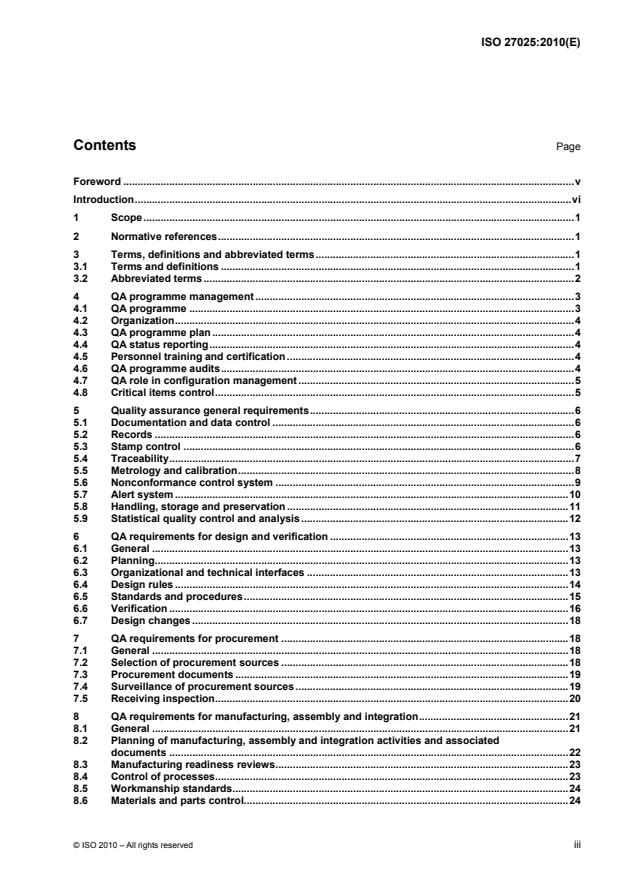
Contents Page
Foreword .v
Introduction.vi
1 Scope.1
2 Normative references.1
3 Terms, definitions and abbreviated terms.1
3.1 Terms and definitions .1
3.2 Abbreviated terms .2
4 QA programme management .3
4.1 QA programme .3
4.2 Organization.4
4.3 QA programme plan .4
4.4 QA status reporting.4
4.5 Personnel training and certification .4
4.6 QA programme audits.4
4.7 QA role in configuration management .5
4.8 Critical items control.5
5 Quality assurance general requirements.6
5.1 Documentation and data control .6
5.2 Records .6
5.3 Stamp control .6
5.4 Traceability.7
5.5 Metrology and calibration.8
5.6 Nonconformance control system .9
5.7 Alert system .10
5.8 Handling, storage and preservation .11
5.9 Statistical quality control and analysis.12
6 QA requirements for design and verification .13
6.1 General .13
6.2 Planning.13
6.3 Organizational and technical interfaces .13
6.4 Design rules .14
6.5 Standards and procedures.15
6.6 Verification .16
6.7 Design changes .18
7 QA requirements for procurement .18
7.1 General .18
7.2 Selection of procurement sources .18
7.3 Procurement documents .19
7.4 Surveillance of procurement sources .19
7.5 Receiving inspection.20
8 QA requirements for manufacturing, assembly and integration.21
8.1 General .21
8.2 Planning of manufacturing, assembly and integration activities and associated
documents .22
8.3 Manufacturing readiness reviews.23
8.4 Control of processes.23
8.5 Workmanship standards.24
8.6 Materials and parts control.24
8.7 Equipment control .24
8.8 Cleanliness and contamination control .25
8.9 Inspection .26
8.10 Specific requirements for assembly and integration.27
8.11 Manufacturing, assembly and integration records .28
9 Testing .28
9.1 General.28
9.2 Test facilities .28
9.3 Test equipment .28
9.4 Test documentation.28
9.5 Test performance monitoring.29
9.6 Test reviews .30
10 QA requirements for acceptance and delivery.30
10.1 General.30
10.2 End item data package.30
10.3 Delivery review board (DRB) .30
10.4 Preparation for delivery .31
10.5 Delivery .32
11 Operations .32
11.1 General.32
11.2 Basic quality concepts for operations .32
11.3 Validation of the system .33
11.4 QA requirements.33
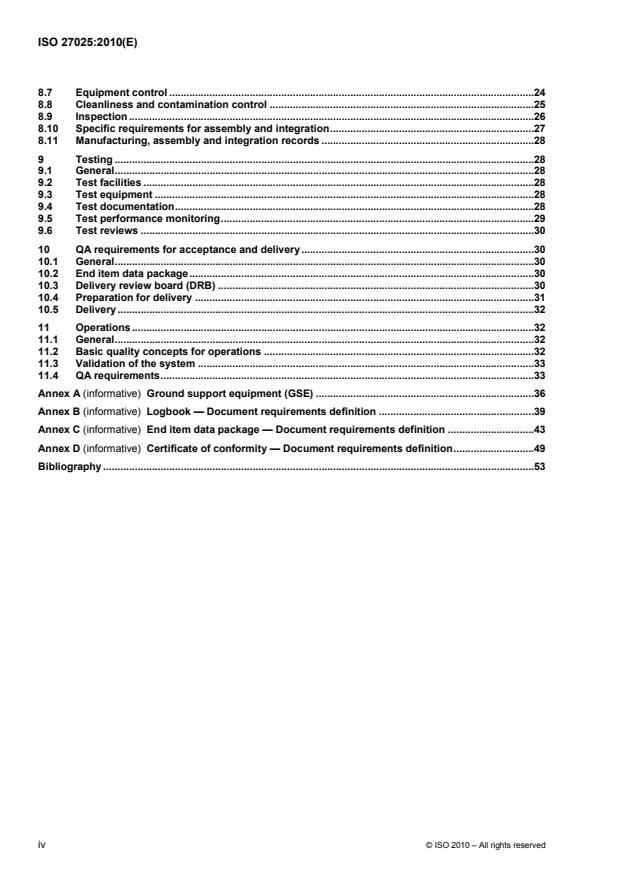
Annex A (informative) Ground support equipment (GSE) .36
Annex B (informative) Logbook — Document requirements definition .39
Annex C (informative) End item data package — Document requirements definition .43
Annex D (informative) Certificate of conformity — Document requirements definition.49
Bibliography .53
iv © ISO 2010 – All rights reserved
Foreword
ISO (the International Organization for Standardization) is a worldwide federation of national standards bodies
(ISO member bodies). The work of preparing International Standards is normally carried out through ISO
technical committees. Each member body interested in a subject for which a technical committee has been
established has the right to be represented on that committee. International organizations, governmental and
non-governmental, in liaison with ISO, also take part in the work. ISO collaborates closely with the
International Electrotechnical Commission (IEC) on all matters of electrotechnical standardization.
International Standards are drafted in accordance with the rules given in the ISO/IEC Directives, Part 2.
The main task of technical committees is to prepare International Standards. Draft International Standards
adopted by the technical committees are circulated to the member bodies for voting. Publication as an
International Standard requires approval by at least 75 % of the member bodies casting a vote.
Attention is drawn to the possibility that some of the elements of this document may be the subject of patent
rights. ISO shall not be held responsible for identifying any or all such patent rights.
ISO 27025 was prepared by Technical Committee ISO/TC 20, Aircraft and space vehicles, Subcommittee
SC 14, Space systems and operations.
Introduction
This International Standard is intended to be applied for the management of quality assurance in space
programmes and applications.
The formulation of this International Standard takes into account the existing International Standards prepared
by ISO/TC 176 (notably ISO 9000, ISO 9001 and ISO 9004) and the content of ISO 14300-1 and ISO 14300-2.
For programme management, and as required in ISO 14300-2, the following concepts apply.
⎯ The objective of quality assurance is to provide adequate confidence to the customer that the end product
or service satisfies the requirements.
⎯ The quality assurance policy is to ensure, in conjunction with other integrated project and product
assurance functions, that required quality is specified, designed-in and will be incorporated, verified and
maintained in the relevant hardware, software and associated documentation throughout all project
phases, by applying a programme where
⎯ assurance is provided that all requirements are adequately specified,
⎯ design rules and methods are consistent with the project requirements,
⎯ each applicable requirement is verified through a verification programme which includes one or more
of the following methods: analysis, inspection, test, review of design, audits,
⎯ design and performance requirements including the specified margin are demonstrated through a
qualification process,
⎯ assurance is provided that the design is producible and repeatable, and that the specification of the
resulting product can be verified and operated within the required operating limits,
⎯ adequate controls are established for the procurement of components, materials, software and
hardware items, services,
⎯ fabrication, integration, test and maintenance are conducted in a controlled manner such that the end
item conforms to the applicable baseline,
⎯ a non-conformance control system is established and maintained in order to track non conformances
systematically and to prevent reoccurrence,
⎯ records are maintained and analysed to report and detect trends in due time for preventive/corrective
actions,
⎯ inspection, measuring and test equipment and tools in use on the contract are controlled to be
accurate for their application,
⎯ procedures and instructions are established which provide for the identification, segregation,
handling, packaging, preservation, storage and transportation of all items, and
⎯ assurance that the operations including post-flight and disposal are carried out in a controlled way
and in accordance with the relevant requirements.
Requirements in this International Standard are defined in terms of what shall be accomplished, rather than in
terms of how to organize and perform the necessary work. This allows existing organizational structures and
methods to be applied, where they are effective, and for the structures and methods to evolve as necessary.
vi © ISO 2010 – All rights reserved
INTERNATIONAL STANDARD ISO 27025:2010(E)
Space systems — Programme management — Quality
assurance requirements
1 Scope
This International Standard defines the quality assurance (QA) requirements for the establishment and
implementation of QA programmes for projects covering mission definition, design, development, production
and operations of space systems, including disposal.
It is applicable to the customer-supplier relationship for space products to the extent agreed by both parties.
The requirements of this International Standard and its associated referenced standards are tailored to the
needs and classes of specific projects.
When viewed from the perspective of a specific project context, the requirements defined in this International
Standard are tailored to match the genuine requirements of a particular profile and circumstances of a project.
2 Normative references
The following referenced documents are indispensable for the application of this document. For dated
references, only the edition cited applies. For undated references, the latest edition of the referenced
document (including any amendments) applies.
ISO 9000, Quality management systems — Fundamentals and vocabulary
ISO 14300-2, Space systems — Programme management — Part 2: Product assurance
ISO 14620-1, Space systems — Safety requirements — Part 1: System safety
ISO 14621-1, Space systems — Electrical, electronic and electromagnetical (EEE) parts — Part 1: Parts
management
ISO 14621-2:2003, Space systems — Electrical, electronic and electromagnetical (EEE) parts — Part 2:
Control programme requirements
ISO 23460, Space projects — Programme management — Dependability assurance requirements
ISO 23461, Space systems — Programme management — Non conformance control system
3 Terms, definitions and abbreviated terms
3.1 Terms and definitions
For the purposes of this document, the terms and definitions given in ISO 9000 and the following apply.
3.1.1
business agreement
agreement between two or more parties for the supply of goods or services
3.1.2
ground support equipment
GSE
optical, mechanical, fluidic, electrical and software support equipment or systems used, for example, for
calibration, measurements, testing, simulation, transportation and handling of space segments or of space
segment elements
3.1.3
tailoring
process by which individual requirements of specifications, standards and related documents are evaluated
and made applicable to a specific project by selection, and in some exceptional cases, modification of existing
or addition of new requirements
3.2 Abbreviated terms
3.2.1 General
AIV assembly, integration, verification
DRB delivery review board
EEE electrical, electronic, electromechanical
EIDP end item data package
GSE ground support equipment
MIP mandatory inspection point
NRB nonconformance review board
QA quality assurance
PA product assurance
3.2.2 Abbreviated terms relating to document requirement definition
NOTE For document requirement definition for
⎯ logbook see Annex B,
⎯ EIDP see Annex C, and
⎯ certificate of conformity see Annex D.
BB breadboard
CI configuration item
DRB delivery review board
DRD document requirements definition
DWI deviation work item
EGSE electrical ground support equipment
FGSE fluidic ground support equipment
2 © ISO 2010 – All rights reserved
FM flight model
KIP key inspection point
ICD interface control document
MGSE mechanical ground support equipment
OGSE optical ground support equipment
PM project manager
PTR post test review
PVS procedure variation sheet
QM qualification model
RFD request for deviation
RFW request for waiver
SOW statement of work
TRB test review board
TRR test readiness review
WI work item
4 QA programme management
4.1 QA programme
The supplier shall implement a QA programme whereby assurance is given that:
a) all requirements are specified through definition and implementation of adequate methods and
procedures;
b) a set of design rules and methods has been set up and is consistent with the project techniques and
technologies;
c) methods, procedures and tools have been defined and are implemented in order to prove that each
applicable requirement is verified through one or more of the following methods: analysis, inspection, test,
review of design, audits;
d) for each configuration item there is a defined and implemented qualification approach that makes it
possible to demonstrate that the item is so designed that it performs satisfactorily in the intended
environment;
e) the approach adopted guarantees that the design is producible and repeatable and that the resulting
product can be verified and operated within the required operating limits;
f) adequate controls are established for the procurement of components, materials, software and hardware
items, services;
g) fabrication, integration, test and maintenance are conducted in a controlled manner so that the end item
conforms to the applicable baseline;
h) a nonconformance control system is established and maintained in order to systematically track and
prevent recurrence;
i) records are maintained and analysed so that trends can be detected and reported in time to enable
preventive or corrective actions to be taken;
j) equipment and tools used for inspecting, measuring and testing project items are regularly calibrated to
ensure their accuracy;
k) procedures and instructions are established which provide for the identification, segregation, handling,
packaging, preservation, storage and transportation of all items;
l) assurance is provided that the operations including post-flight and disposal are carried out in a controlled
way and in accordance with the relevant requirements.
4.2 Organization
General requirements for organization and responsibilities are defined in ISO 14300-2.
The supplier shall identify the personnel responsible for implementing and performing QA functions.
4.3 QA programme plan
The supplier shall prepare, maintain and implement a plan of the QA activities, in accordance with the general
requirements in ISO 14300-2.
The plan may be part of the overall project product assurance plan.
4.4 QA status reporting
The supplier shall periodically prepare and submit to the customer reports on the status and progress of the
QA programme, as part of the overall PA reporting.
4.5 Personnel training and certification
4.5.1 The supplier shall establish a documented training programme for QA personnel and all other
personnel whose performance determines or affects product quality.
4.5.2 Operators performing critical processes shall be trained and certified by internal or external training
programmes, or can demonstrate a regular and satisfactory use of the related skills.
4.5.3 Those inspecting or controlling critical processes, or performing non-destructive testing and evaluation,
shall be trained and certified according to national or international training programmes and standards, or can
demonstrate a regular and satisfactory use of the related skills.
4.6 QA programme audits
4.6.1 The supplier shall perform systematic audits on its own performance to verify the implementation and
effectiveness of the provisions defined in the QA programme plan.
4.6.2 The supplier shall establish and maintain an audit plan for procurement activities on the project,
designating the lower-tier suppliers to be audited, the current status and the schedule for auditing.
4 © ISO 2010 – All rights reserved
4.6.3 In addition to the planned audits, extra audits shall be performed when necessary to overcome failure,
consistent poor quality, or other problems.
4.6.4 The customer shall have the right to be represented in the planned external audits. For this purpose,
the external audit schedule shall be supplied to the customer and updated regularly.
4.6.5 The customer shall also have the right to audit any lower-tier supplier at any time; such audits shall be
arranged by the supplier and the next or higher-level customers of the audited supplier as relevant.
4.7 QA role in configuration management
4.7.1 The supplier shall ensure that configuration and data management rules are provided for, conform to
those specified and are applied both by its own personnel and by its suppliers' personnel.
4.7.2 A supplier product assurance representative shall attend all boards established to review the
suitability for release of drawings, plans, specifications, procedures and changes thereto.
4.7.3 During the configuration verification process the “as-built” configuration of hardware and software
shall be certified against the latest approved manufacturing documentation.
4.7.4 The supplier's QA function shall ensure that:
a) the “as-designed” status is defined prior to manufacturing,
b) the as-built documentation is properly defined, identified and maintained in order to reflect approved
modifications, and
c) items to be delivered conform to the as-built documentation.
4.8 Critical items control
The QA function shall contribute to the overall risk management activities by:
a) supporting the identification and risk evaluation of critical items for which major difficulties or uncertainties
are expected in
⎯ demonstration of design performances,
⎯ development and qualification of new products, processes and technologies,
⎯ procurement, manufacturing, assembly, inspection, test, handling, storage and transportation, which
can lead to major degradation in the quality of the product, and
⎯ product utilization or service implementation;
b) contributing to the risk management activity by identifying the QA activities accompanying the individual
risk reduction measures;
c) monitoring and documenting the achievement of the specified risk reduction implementation and the
corresponding verification measures throughout all project phases.
5 Quality assurance general requirements
5.1 Documentation and data control
5.1.1 The QA function shall ensure that:
a) the pertinent issues of appropriate documents and data are available at all locations where operations
essential to the effective functioning of the quality system are performed;
b) invalid or obsolete documents and data are promptly removed from all points of issue or use, or otherwise
assured against unintended use;
c) any obsolete documents and data retained for legal or knowledge preservation purposes are suitably
identified and kept separately from the valid documentation;
d) proper data and documentation exchange procedures and formats are set up throughout the project
organization;
e) the documents required by the business agreement are verified and signed by the designated people
before release;
f) documents are identified and verified for adequacy, currency and incorporation of product assurance
requirements;
g) the need for document approval by product assurance is identified;
h) changes to documents and data are reviewed and approved by the same functions or organizations that
performed the original review and approval unless specifically designated otherwise;
i) a master list or equivalent document control procedure identifying the current revision of documents and
data support is established and is readily available to preclude the use of invalid or obsolete documents
and data.
5.1.2 The supplier shall establish and maintain current product assurance data as defined by the business
agreement.
5.2 Records
5.2.1 The supplier shall maintain quality records to provide objective evidence of complete and effective
performance of QA tasks and to demonstrate achievement of the required quality.
5.2.2 Quality records shall be stored in safe conditions, which prevent alterations, loss or deterioration.
5.2.3 Quality records shall be retained for the period specified in the business agreement, unless release
before that time is given by contractual authorization.
5.2.4 The supplier shall ensure that quality records are readily accessible and retrievable whenever they
are needed.
5.2.5 Quality records shall be accessible to the customer upon request.
5.3 Stamp control
5.3.1 The supplier shall establish and maintain a documented stamp control system to ensure the correct
and legitimate use of all fabrication and inspection stamps.
6 © ISO 2010 – All rights reserved
5.3.2 Stamps shall be used to
a) signify the completion of operations and processes, and
b) indicate inspection performance at source and incoming inspection, in process inspection and tests, final
inspection, end point testing, storage and shipment.
5.3.3 The use of stamps shall be restricted to authorized personnel.
5.3.4 Stamps shall be traceable to individuals responsible for their use.
The use of signatures in place of stamps is acceptable provided that similar traceability and responsibility
records are maintained and available.
5.3.5 Stamps shall be applied directly to articles and materials, when requested by engineering drawings
and specifications, and associated documents, records, labels. Stamping materials and methods shall be
documentary determined and compatible with the articles and their use.
5.4 Traceability
5.4.1 General
a) The supplier shall implement a traceability system, which shall be maintained throughout all phases of
business agreement performance and during the planned operational life of deliverable items.
b) The traceability system shall make it possible to:
1) establish bidirectional and unequivocal relationships between parts, materials or products and
associated documentation or records;
2) trace data, personnel and equipment related to procurement, fabrication, inspection, test, assembly,
integration and operations activities;
3) trace backwards the locations of materials, parts, sub-assemblies;
4) trace forwards the locations of materials from raw stock and also for some critical items, as defined in
the business agreement;
5) monitor information such as input data, calculation codes, models and standards used.
c) The level of traceability to be applied to an item shall be specified in technical specifications and drawings.
5.4.2 Identification
a) Each part, material or product shall be identified by a unique and permanent part or type number.
b) In addition, parts, materials and products shall be identified as individual entities or groups by means of
one or more of the following methods:
1) date codes indicating date of manufacture, to identify items made by a continuous process or subject
to degradation with age;
2) lot or batch numbers, to identify items produced in homogeneous groups and under uniform
conditions; this identification applies when the items need not be individually distinguishable;
3) serial numbers, to identify individual items for which unique data shall be maintained.
c) Controls shall be established to ensure that:
1) identification numbers are assigned in a systematic and consecutive manner,
2) identification numbers of scrapped or destroyed items are not used again,
3) identification numbers, once allocated, are not changed, unless the change is authorized by the
customer.
d) Identification numbers shall be marked on documentation and, where possible, on respective items and
parts.
e) Method of marking on items shall be defined on engineering drawings and specifications.
f) Method of marking shall be compatible with the nature of the item and its use and to provide safety of
marking during the operational life.
5.4.3 Data retrieval system
a) Documents and records shall be identified and linked to the respective items by means of their unique
identification numbers.
b) The data retrieval system shall allow traceability starting from any point of the interconnected network
existing between records, documents and marking on parts.
c) The supplier shall ensure that identification numbers or methods and retrieval methodology used in
different activities, such as design, configuration control, purchase, manufacturing and quality control, are
consistent and interrelated.
d) The supplier shall assure that documents and the registration data are kept during the operational life.
5.5 Metrology and calibration
5.5.1 The supplier shall control, calibrate and maintain inspection, measuring and test equipment, whether
owned by the supplier, on loan, or provided by the customer to demonstrate the conformance of product to the
specified requirements.
5.5.2 Equipment shall be used in a manner which ensures that measurement uncertainty is known and is
consistent with the required measurement capability.
5.5.3 All measurements shall take into account the total error in the measurement process attributable to
the cumulative error from the calibration chain, measuring equipment and, as appropriate, those contributed
by personnel, procedures and the environment. The basis for the calculation of the cumulative error shall be
recorded.
5.5.4 Corrective action shall be taken when the total error is such as to compromise significantly the ability
to make measurements within the required accuracy and precision.
5.5.5 The supplier shall:
a) identify the measurements to be made and the accuracy required and shall select the appropriate
inspection, measuring and test equipment;
b) identify, calibrate and adjust all inspection, measuring and test equipment and devices that can affect
product quality at prescribed intervals, or prior to use, against certified equipment having a known valid
relationship to nationally recognized standards, where no such standards exist, the bases used for
calibration shall be documented;
8 © ISO 2010 – All rights reserved
c) establish, document and maintain calibration procedures, including details of equipment type,
identification number, location, frequency of checks, check method, acceptance criteria and the action to
be taken when results are unsatisfactory;
d) ensure that the inspection, measuring and test equipment is capable of the accuracy and precision
necessary;
e) identify inspection, measuring and test equipment with a suitable indicator or approved identification
record to show the calibration status;
f) maintain calibration records for inspection, measuring and test equipment (see 5.2);
g) assess and document the validity of previous inspection and test results when inspection, measuring or
test equipment is found to be out of calibration;
h) ensure that the environmental conditions are suitable for the calibrations, inspections, measurements and
tests being carried out;
i) ensure that the handling, preservation and storage of inspection, measuring and test equipment is such
that the accuracy and fitness for use is maintained;
j) safeguard inspection, measuring and test facilities, including both test hardware and test software, from
adjustments that can invalidate the calibration setting.
5.5.6 Where test hardware (e.g. jigs, fixtures, templates and patterns) or test software is used as suitable
forms of inspection, it shall be checked to prove that it is capable of verifying the acceptability of the product
prior to release for use during production and installation, and rechecked at prescribed intervals. The supplier
shall establish the extent and frequency of such checks and shall maintain records as evidence of control.
5.5.7 Test aids, such as test leads, break-out boxes, mains leads and similar items are not subject to the
entire set of requirements defined in 5.5, but shall be validated in a way appropriate to their usage.
5.5.8 Measurement design data shall be made available, when required by the customer or its
representative, for verification that it is functionally adequate.
5.6 Nonconformance control system
5.6.1 The supplier shall establish and maintain a non-conformance control system in accordance with the
requirements of 5.6.2 to 5.6.13 and the detailed requirements in ISO 23461 specified below.
5.6.2 The system shall provide for a disciplined approach to the identification and segregation of
nonconforming items, the recording, reporting, review, disposition and analysis of non-conformances, and the
definition and implementation of corrective actions.
5.6.3 Non-conformances shall be classified as major or minor, on the basis of the severity of their
consequences as specified in ISO 23461.
5.6.4 Major non-conformances shall be formally notified to the next customer, up to the level of the
customer which specified the affected requirements.
5.6.5 Non-conformances shall be reviewed and dispositioned by a formal non-conformance review board
(NRB), established at all contractual levels.
5.6.6 The disposition for a nonconforming item shall be one of the following:
⎯ use as-is;
⎯ return to supplier;
⎯ rework;
⎯ repair;
⎯ scrap;
⎯ as specified in ISO 23461.
5.6.7 The supplier shall ensure that:
a) responsibilities and authorities for the disposition of nonconformances are properly defined;
b) the NRB includes at least representatives from the PA and engineering organizations;
c) the board to review nonconformances is chaired by the product assurance management function;
d) all relevant product assurance experts are involved in the review, investigation and disposition of
nonconformances;
e) all knowledge acquired from nonconformances results in preventive actions in all relevant engineering,
manufacturing and product assurance fields and all preventive actions are realized in full.
5.6.8 The supplier shall provide a precise definition of the authority and responsibilities assigned to its
suppliers for non-conformance processing.
5.6.9 The proposed use of items that do not conform to requirements specified by the customer or
approved baseline shall be handled in accordance with the waiver processing procedure as specified in
ISO 23461.
5.6.10 Non-conformances shall be reviewed to identify the root causes and implement corrective actions to
prevent recurrence.
5.6.11 The supplier shall maintain records of all non-conformances.
5.6.12 The supplier shall review periodically the non-conformance records to evaluate the effectiveness of
the system and identify trends.
5.6.13 The supplier shall enter to the accompanying documentation the full information on all major
nonconformances of products to specifications.
5.7 Alert system
5.7.1 Supplier participation
The supplier shall participate in the alert system established when the final customer has established the
system for the prompt interchange of information on failures or problems which can affect more than one user,
or can recur in other projects or circumstances, if no preventive actions are taken.
5.7.2 PA experts involvement
The supplier shall ensure that all relevant product assurance experts are involved in
⎯ the assessment of any failure to be reported to the customer as a potential for raising an alert by the
customer,
⎯ the investigation, until disposition of the items subject of the potential alert,
10 © ISO 2010 – All rights reserved
⎯ the assessment of incoming alerts for the definition, implementation and follow-up of necessary actions,
and
⎯ the development of preventive actions.
5.7.3 Generation of alerts within the project
a) The system shall provide for:
1) notification of preliminary information, by the originator through the contractual chain to the final
customer, on failures or problems that can result in an alert, detected at any contractual level with
granting concrete actions on prevention of failures;
2) investigation of the failure or problem by the customer in cooperation with the originator and the
supplier, to define the immediate measures to be taken, to establish the causes and to recommend
corrective actions for similar items;
3) release of formal alerts by the customer, to warn all participants in the alert system.
b) An alert shall be issued only when all of the following criteria are met:
1) the item with the observed failure or problem has multiple applications, which can have implications
for more than one project, or more than one utilization within the project, thus requiring prompt
action;
2) the failure or problem has occurred in the application of an item within the specified design and
usage limitations. However, failures or problems due to usage within reasonably expected limits of
performance, but where these limits were not specified precisely, should also cause the issuing of an
alert;
3) a preliminary investigation has provided sufficient evidence of the root cause of the failure or
problem;
4) the failures or problems are documentary confirmed not to be of a random nature.
5.7.4 Processing of alerts from other sources
The supplier shall process alerts distributed by the customer through
1) distribution of incoming relevant alerts to all possible affected users within the project organization,
and
2) assessment of incoming alerts to project work, and definition, implementation and follow-up of
necessary corrective actions at any contractual level.
5.8 Handling, storage and preservation
5.8.1 Handling
The supplier shall prevent handling damage during all phases of manufacturing, assembly, integration, testing,
storage, transportation and operation, by adequate
a) protection of items during handling,
b) handling devices, and
c) procedures and instructions.
5.8.2 Storage
a) The supplier shall have secure storage areas available for
1) incoming materials,
2) intermediate items needing temporary storage, and
3) end items before shipping.
b) Limited-life materials, suspended limited-life materials, nonconforming items awaiting NRB disposition,
scrap items and all other items which are designated to be stored separately for health or safety reasons,
shall be placed in segregated areas within the storage area.
c) Each segregated area within the stores shall be clearly identified and labelled.
d) Co
...
Questions, Comments and Discussion
Ask us and Technical Secretary will try to provide an answer. You can facilitate discussion about the standard in here.
Loading comments...