

ISO 27025:2023
(Main)Space systems — Programme management — Product quality assurance requirements
General Information
- Abstract
This document defines the quality assurance (QA) requirements for the establishment and implementation of product QA programmes for projects covering mission definition, design, development, production and operations of space systems, including disposal. It is applicable to the customer-supplier relationship for space products to the extent agreed by both parties.
- Status
- Published
- Publication Date
- 12-Oct-2023
- Technical Committee
- ISO/TC 20/SC 14 - Space systems and operations
- Drafting Committee
- ISO/TC 20/SC 14 - Space systems and operations
- Current Stage
- 6060 - International Standard published
- Start Date
- 13-Oct-2023
- Due Date
- 23-Aug-2024
- Completion Date
- 13-Oct-2023
Overview - ISO 27025:2023 (Space systems product QA)
ISO 27025:2023, "Space systems - Programme management - Product quality assurance requirements," defines product quality assurance (QA) requirements for space projects across the full lifecycle - from mission definition, design, development and production through operations and disposal. The standard is the second edition (2023) and is applicable to customer–supplier relationships for space products as agreed by both parties. It provides a programme-level framework for establishing and implementing QA programmes tailored to space systems.
Key topics and technical requirements
ISO 27025 organizes QA requirements by programme and technical areas. Major topics include:
- QA programme management: establishment of QA programmes, organisational roles, QA programme plans, status reporting, training/certification, audits and QA involvement in configuration management and critical items control.
- General QA requirements: document/data control, records, stamp control, traceability (identification and data retrieval), metrology and calibration, nonconformity control systems and an alert system for reporting and processing issues.
- Design and verification: design planning, interfaces, design rules (producibility, repeatability, inspectability/testability, operability), standards/procedures, verification methods, design reviews, qualification and design change control.
- Procurement QA: supplier/source selection and records, procurement documentation and review, supplier surveillance (including lower-tier suppliers), receiving inspection and control of customer-furnished items.
- Manufacturing, assembly and integration: planning and readiness reviews, control of processes (including critical processes and statistical process control), workmanship standards, materials/parts control (sensitive items, marking), equipment and tooling control, cleanliness and contamination control.
These topics reflect the standard’s emphasis on traceability, rigorous verification, supplier oversight, and lifecycle QA controls that are essential for space system reliability and safety.
Practical applications
ISO 27025 is used to:
- Develop and implement product QA programmes for satellites, launch vehicles, payloads and ground-segment hardware.
- Define contractual QA expectations between prime contractors, subsystem suppliers and customers.
- Guide procurement, incoming inspection, manufacturing control, integration and pre-launch verification activities.
- Support configuration management, anomaly reporting (alerts) and nonconformity remediation across mission phases.
Who should use this standard
- Space agency programme managers and product assurance (PA) engineers
- Prime contractors, subsystem integrators and tiered suppliers
- Quality managers, procurement officers and manufacturing engineers
- Systems engineers responsible for design verification and configuration control
Related standards
ISO 27025 complements other quality-management and space-industry standards and best practices used for product assurance, supplier management and metrology in aerospace and space-system programmes.
Relations
- Effective Date
- 27-Aug-2022
Get Certified
Connect with accredited certification bodies for this standard

BUREAU VERITAS Certification Germany
Bureau Veritas certification in Germany.

Element Materials Technology
Materials testing and product certification.

AQMS Ltd.
AQMS provides ISO certification to SMEs across the UK.
Sponsored listings
Frequently Asked Questions
ISO 27025:2023 is a standard published by the International Organization for Standardization (ISO). Its full title is "Space systems — Programme management — Product quality assurance requirements". This standard covers: This document defines the quality assurance (QA) requirements for the establishment and implementation of product QA programmes for projects covering mission definition, design, development, production and operations of space systems, including disposal. It is applicable to the customer-supplier relationship for space products to the extent agreed by both parties.
This document defines the quality assurance (QA) requirements for the establishment and implementation of product QA programmes for projects covering mission definition, design, development, production and operations of space systems, including disposal. It is applicable to the customer-supplier relationship for space products to the extent agreed by both parties.
ISO 27025:2023 is classified under the following ICS (International Classification for Standards) categories: 49.140 - Space systems and operations. The ICS classification helps identify the subject area and facilitates finding related standards.
ISO 27025:2023 has the following relationships with other standards: It is inter standard links to ISO 27025:2010. Understanding these relationships helps ensure you are using the most current and applicable version of the standard.
ISO 27025:2023 is available in PDF format for immediate download after purchase. The document can be added to your cart and obtained through the secure checkout process. Digital delivery ensures instant access to the complete standard document.
Standards Content (Sample)
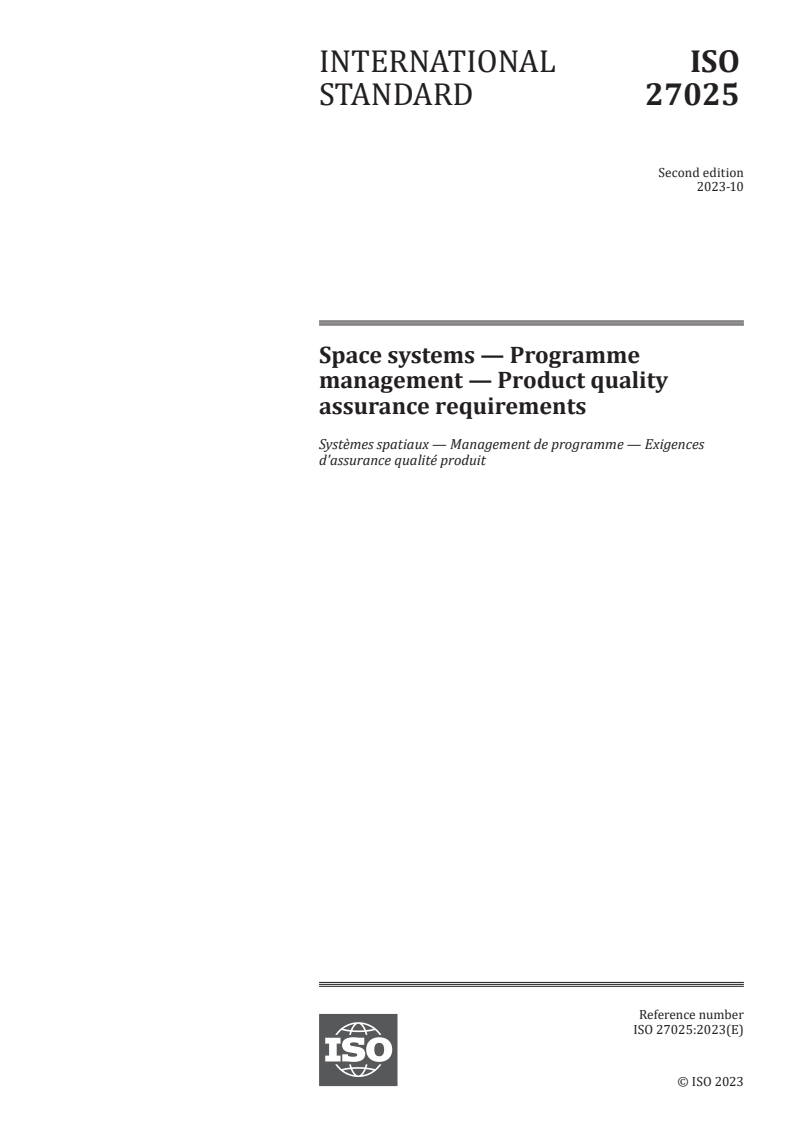
INTERNATIONAL ISO
STANDARD 27025
Second edition
2023-10
Space systems — Programme
management — Product quality
assurance requirements
Systèmes spatiaux — Management de programme — Exigences
d'assurance qualité produit
Reference number
© ISO 2023
All rights reserved. Unless otherwise specified, or required in the context of its implementation, no part of this publication may
be reproduced or utilized otherwise in any form or by any means, electronic or mechanical, including photocopying, or posting on
the internet or an intranet, without prior written permission. Permission can be requested from either ISO at the address below
or ISO’s member body in the country of the requester.
ISO copyright office
CP 401 • Ch. de Blandonnet 8
CH-1214 Vernier, Geneva
Phone: +41 22 749 01 11
Email: copyright@iso.org
Website: www.iso.org
Published in Switzerland
ii
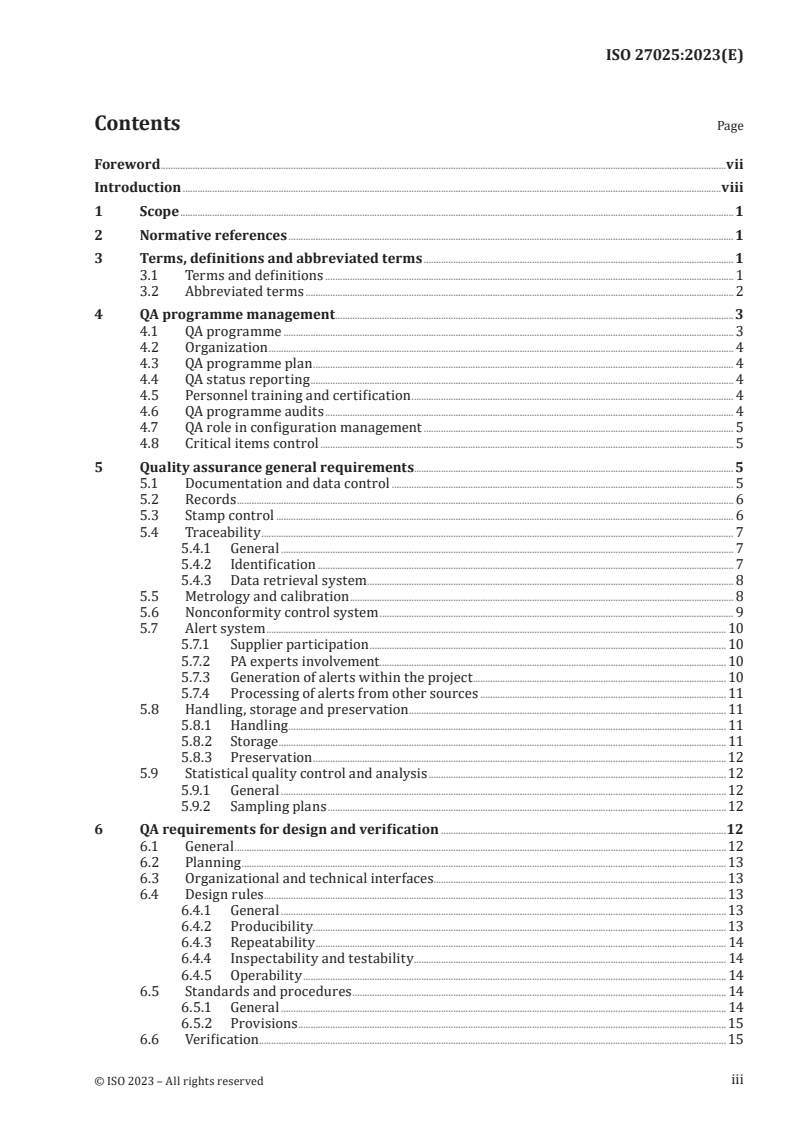
Contents Page
Foreword .vii
Introduction .viii
1 Scope . 1
2 Normative references . 1
3 Terms, definitions and abbreviated terms . 1
3.1 Terms and definitions . 1
3.2 Abbreviated terms . 2
4 QA programme management .3
4.1 QA programme . 3
4.2 Organization . 4
4.3 QA programme plan . 4
4.4 QA status reporting . 4
4.5 Personnel training and certification . 4
4.6 QA programme audits . 4
4.7 QA role in configuration management . 5
4.8 Critical items control . 5
5 Quality assurance general requirements. 5
5.1 Documentation and data control . 5
5.2 Records . 6
5.3 Stamp control . 6
5.4 Traceability . 7
5.4.1 General . 7
5.4.2 Identification . 7
5.4.3 Data retrieval system . 8
5.5 Metrology and calibration . 8
5.6 Nonconformity control system . 9
5.7 Alert system . 10
5.7.1 Supplier participation . 10
5.7.2 PA experts involvement . . 10
5.7.3 Generation of alerts within the project . 10
5.7.4 Processing of alerts from other sources . 11
5.8 Handling, storage and preservation . 11
5.8.1 Handling . 11
5.8.2 Storage . 11
5.8.3 Preservation .12
5.9 Statistical quality control and analysis .12
5.9.1 General .12
5.9.2 Sampling plans .12
6 QA requirements for design and verification .12
6.1 General .12
6.2 Planning . 13
6.3 Organizational and technical interfaces. 13
6.4 Design rules . 13
6.4.1 General .13
6.4.2 Producibility . . 13
6.4.3 Repeatability . 14
6.4.4 Inspectability and testability . 14
6.4.5 Operability . 14
6.5 Standards and procedures . 14
6.5.1 General . 14
6.5.2 Provisions .15
6.6 Verification . 15
iii
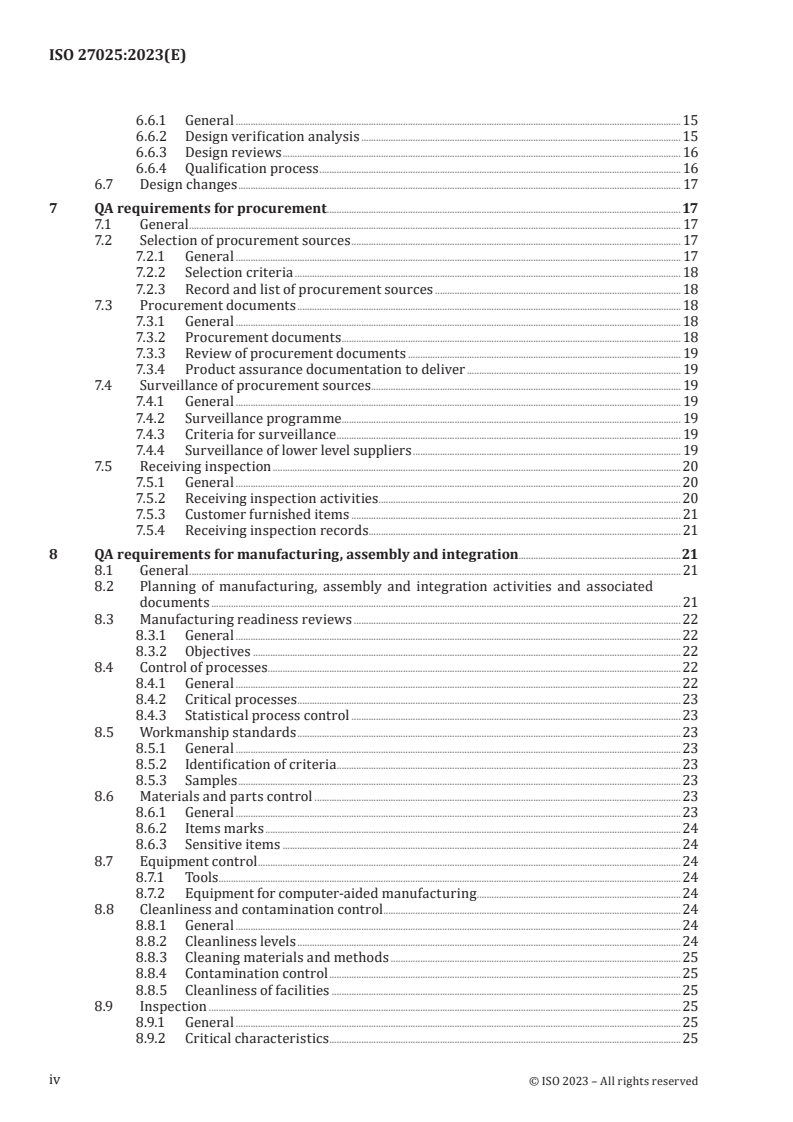
6.6.1 General .15
6.6.2 Design verification analysis . 15
6.6.3 Design reviews . 16
6.6.4 Qualification process . 16
6.7 Design changes . 17
7 QA requirements for procurement .17
7.1 General . 17
7.2 Selection of procurement sources . 17
7.2.1 General . 17
7.2.2 Selection criteria . 18
7.2.3 Record and list of procurement sources . 18
7.3 Procurement documents . 18
7.3.1 General . 18
7.3.2 Procurement documents . 18
7.3.3 Review of procurement documents . 19
7.3.4 Product assurance documentation to deliver . 19
7.4 Surveillance of procurement sources . 19
7.4.1 General . 19
7.4.2 Surveillance programme . 19
7.4.3 Criteria for surveillance . 19
7.4.4 Surveillance of lower level suppliers . 19
7.5 Receiving inspection .20
7.5.1 General .20
7.5.2 Receiving inspection activities . . 20
7.5.3 Customer furnished items . 21
7.5.4 Receiving inspection records . . 21
8 QA requirements for manufacturing, assembly and integration.21
8.1 General . 21
8.2 Planning of manufacturing, assembly and integration activities and associated
documents . 21
8.3 Manufacturing readiness reviews . 22
8.3.1 General .22
8.3.2 Objectives .22
8.4 Control of processes . .22
8.4.1 General .22
8.4.2 Critical processes . 23
8.4.3 Statistical process control . 23
8.5 Workmanship standards .23
8.5.1 General .23
8.5.2 Identification of criteria .23
8.5.3 Samples .23
8.6 Materials and parts control . 23
8.6.1 General .23
8.6.2 Items marks . 24
8.6.3 Sensitive items . 24
8.7 Equipment control . 24
8.7.1 Tools . . 24
8.7.2 Equipment for computer-aided manufacturing . 24
8.8 Cleanliness and contamination control . 24
8.8.1 General . 24
8.8.2 Cleanliness levels . 24
8.8.3 Cleaning materials and methods . 25
8.8.4 Contamination control .25
8.8.5 Cleanliness of facilities . 25
8.9 Inspection . 25
8.9.1 General . 25
8.9.2 Critical characteristics . .25
iv
8.9.3 Self-inspection .25
8.9.4 Mandatory inspection points (MIPs) . 25
8.9.5 MIPs agreement . 25
8.9.6 MIPs selection . 25
8.9.7 MIPs invitation .26
8.9.8 Inspection and tests status identification . 26
8.10 Specific requirements for assembly and integration . 26
8.10.1 Control of temporary installations and removals . 26
8.10.2 Logbooks . 27
8.11 Manufacturing, assembly and integration records . 27
9 Testing.27
9.1 General . 27
9.2 Test facilities . 27
9.3 Test equipment . 27
9.3.1 General . 27
9.3.2 Verification of test equipment . 27
9.4 Test documentation . . 27
9.4.1 Test procedures . 27
9.4.2 Test reports .28
9.5 Test performance monitoring .28
9.5.1 General .28
9.5.2 Test witnessing .28
9.5.3 Test of critical characteristics .28
9.5.4 Self-certification for test activities .28
9.5.5 Testing activities subject to QA certification .28
9.5.6 Testing of hazardous operations .29
9.5.7 QA authority .29
9.6 Test reviews .29
9.6.1 General .29
9.6.2 QA function representation .29
10 QA requirements for acceptance and delivery .29
10.1 General .29
10.1.1 Acceptance process .29
10.1.2 Preparation of items for delivery .29
10.2 End item data package .29
10.2.1 General .29
10.2.2 Basis for formal acceptance . .29
10.2.3 EIDP objectives .29
10.2.4 EIDP content . 29
10.3 Delivery review board (DRB) .30
10.3.1 General .30
10.3.2 DRB functions .30
10.3.3 DRB composition . 30
10.3.4 Customer participation .30
10.3.5 DRB responsibilities .30
10.3.6 Delivery authorization .30
10.4 Preparation for delivery . . 31
10.4.1 Packaging . 31
10.4.2 Marking and labelling . 31
10.5 Delivery . 31
10.5.1 Shipping control . 31
10.5.2 Transportation . 31
11 Operations .31
11.1 General . 31
11.2 Basic quality concepts for operations . 31
11.2.1 Mission quality . 31
11.2.2 Quality of mission products and services . 32
v
11.3 Validation of the system . 32
11.4 QA requirements . 32
11.4.1 QA plan for operations . 32
11.4.2 Operations planning . . 32
11.4.3 Operational demonstration . 33
11.4.4 Training and operator certification . . 33
11.4.5 Operations anomalies and feedback corrective loop . 33
11.4.6 Alerts .34
11.4.7 Procedural deviations .34
11.4.8 General requirements .34
Annex A (informative) Ground support equipment (GSE) .35
Annex B (informative) Logbook — Document requirements definition .38
Annex C (informative) End item data package — Document requirements definition .42
Annex D (informative) Declaration of conformity — Document requirements definition.47
Bibliography .50
vi
Foreword
ISO (the International Organization for Standardization) is a worldwide federation of national standards
bodies (ISO member bodies). The work of preparing International Standards is normally carried out
through ISO technical committees. Each member body interested in a subject for which a technical
committee has been established has the right to be represented on that committee. International
organizations, governmental and non-governmental, in liaison with ISO, also take part in the work.
ISO collaborates closely with the International Electrotechnical Commission (IEC) on all matters of
electrotechnical standardization.
The procedures used to develop this document and those intended for its further maintenance are
described in the ISO/IEC Directives, Part 1. In particular, the different approval criteria needed for the
different types of ISO document should be noted. This document was drafted in accordance with the
editorial rules of the ISO/IEC Directives, Part 2 (see www.iso.org/directives).
ISO draws attention to the possibility that the implementation of this document may involve the use
of (a) patent(s). ISO takes no position concerning the evidence, validity or applicability of any claimed
patent rights in respect thereof. As of the date of publication of this document, ISO had not received
notice of (a) patent(s) which may be required to implement this document. However, implementers are
cautioned that this may not represent the latest information, which may be obtained from the patent
database available at www.iso.org/patents. ISO shall not be held responsible for identifying any or all
such patent rights.
Any trade name used in this document is information given for the convenience of users and does not
constitute an endorsement.
For an explanation of the voluntary nature of standards, the meaning of ISO specific terms and
expressions related to conformity assessment, as well as information about ISO's adherence to
the World Trade Organization (WTO) principles in the Technical Barriers to Trade (TBT), see
www.iso.org/iso/foreword.html.
This document was prepared by Technical Committee ISO/TC 20, Aircraft and space vehicles,
Subcommittee SC 14, Space systems and operations.
This second edition cancels and replaces the first edition (ISO 27025:2010), which has been technically
revised.
The main changes are as follows:
— updated the normative references in Clause 2;
— updated the terms and definitions references in Clause 3.
Any feedback or questions on this document should be directed to the user’s national standards body. A
complete listing of these bodies can be found at www.iso.org/members.html.
vii
Introduction
This document is intended to be applied for the management of product quality assurance in space
programmes and applications.
The formulation of this document takes into account the existing International Standards prepared by
ISO/TC 176 (notably ISO 9000 and ISO 10006) and the content of ISO 14300-1 and ISO 14300-2.
The requirements of this document and its associated referenced standards are tailored to the needs
and classes of specific projects.
When viewed from the perspective of a specific project context, the requirements defined in this
document are tailored to match the genuine requirements of a particular profile and circumstances of
a project.
For programme management, and as required in ISO 14300-2, the following concepts apply.
— The objective of quality assurance is to provide adequate confidence to the customer that the end
product or service satisfies the requirements.
— The quality assurance policy is to ensure, in conjunction with other integrated project and product
assurance functions, that required quality is specified, designed-in and will be incorporated, verified
and maintained in the relevant hardware, software and associated documentation throughout all
project phases, by applying a programme where:
— assurance is provided that all requirements are adequately specified;
— design rules and methods are consistent with the project requirements;
— each applicable requirement is verified through a verification programme which includes one
or more of the following methods: analysis, inspection, test, review of design, audits;
— design and performance requirements including the specified margin are demonstrated
through a qualification process;
— assurance is provided that the design is producible and repeatable, and that the specification of
the resulting product can be verified and operated within the required operating limits;
— adequate controls are established for the procurement of components, materials, software and
hardware items, services;
— fabrication, integration, test and maintenance are conducted in a controlled manner such that
the end item conforms to the applicable baseline;
— a nonconformity control system is established and maintained in order to track nonconformities
systematically and to prevent reoccurrence;
— records are maintained and analysed to report and detect trends in due time for preventive/
corrective actions;
— inspection, measuring and test equipment and tools in use on the contract are controlled to be
accurate for their application;
— procedures and instructions are established which provide for the identification, segregation,
handling, packaging, preservation, storage and transportation of all items;
— assurance that the operations including post-flight and disposal are carried out in a controlled
way and in accordance with the relevant requirements.
Requirements in this document are defined in terms of what shall be accomplished, rather than in terms
of how to organize and perform the necessary work. This allows existing organizational structures
viii
and methods to be applied, where they are effective, and for the structures and methods to evolve as
necessary.
ix
INTERNATIONAL STANDARD ISO 27025:2023(E)
Space systems — Programme management — Product
quality assurance requirements
1 Scope
This document defines the quality assurance (QA) requirements for the establishment and
implementation of product QA programmes for projects covering mission definition, design,
development, production and operations of space systems, including disposal.
It is applicable to the customer-supplier relationship for space products to the extent agreed by both
parties.
2 Normative references
The following documents are referred to in the text in such a way that some or all of their content
constitutes requirements of this document. For dated references, only the edition cited applies. For
undated references, the latest edition of the referenced document (including any amendments) applies.
ISO 9000, Quality management systems — Fundamentals and vocabulary
ISO 10795, Space systems — Programme management and quality — Vocabulary
ISO 14300-1, Space systems — Programme management — Part 1: Structuring a project
ISO 14300-2, Space systems — Programme management — Part 2: Product assurance
ISO 14620-1, Space systems — Safety requirements — Part 1: System safety
ISO 14621-1, Space systems — Electrical, electronic and electromechanical (EEE) parts — Part 1: Parts
management
ISO 14621-2:2019, Space systems — Electrical, electronic and electromechanical (EEE) parts — Part 2:
Control programme requirements
ISO 21886, Space systems — Configuration management
ISO 23460, Space projects — Programme management — Dependability assurance requirements
ISO 23461, Space systems — Programme management — Non-conformance control system
3 Terms, definitions and abbreviated terms
3.1 Terms and definitions
For the purposes of this document, the terms and definitions given in ISO 9000, ISO 10795 and the
following apply.
ISO and IEC maintain terminology databases for use in standardization at the following addresses:
— ISO Online browsing platform: available at https:// www .iso .org/ obp
— IEC Electropedia: available at https:// www .electropedia .org/
3.1.1
business agreement
legally binding agreement, for the supply of goods or services, between two or more actors in the
customer-supplier chain
Note 1 to entry: Business agreements are recorded in a variety of forms, such as:
— contracts;
— memoranda of understanding;
— inter-governmental agreements;
— inter-agency agreements;
— partnerships;
— bartering agreements;
— purchase orders.
3.2 Abbreviated terms
AIV assembly, integration, verification
BB breadboard
CI configuration item
DRB delivery review board
DRD document requirements definition
DWI deviation work item
EEE electrical, electronic, electromechanical
EGSE electrical ground support equipment
EIDP end item data package
FGSE fluidic ground support equipment
FM flight model
GSE ground support equipment
KIP key inspection point
ICD interface control document
MGSE mechanical ground support equipment
MIP mandatory inspection point
NRB nonconformity review board
OGSE optical ground support equipment
QA quality assurance
PA product assurance
PM project manager
PTR post-test review
PVS procedure variation sheet
QM qualification model
RFD request for deviation
RFW request for waiver
SOW statement of work
TRB test review board
TRR test readiness review
WI work item
4 QA programme management
4.1 QA programme
The supplier shall implement a QA programme for products whereby assurance is given that:
a) all requirements are specified through definition and implementation of adequate methods and
procedures;
b) a set of design rules and methods has been set up a
...