

ISO 10786:2025
(Main)Space systems — Structural components and assemblies
General Information
- Abstract
This document establishes requirements for the design, material selection and characterization, fabrication, testing and inspection of all structural items in space systems, including expendable and reusable launch vehicles, satellites and their payloads. This document applies to all structural items, including fracture-critical hardware used in space systems during all phases of the mission, with the following exceptions: adaptive structures, propulsion systems, nuclear systems, and thermal protection systems.
- Status
- Published
- Publication Date
- 31-Aug-2025
- Technical Committee
- ISO/TC 20/SC 14 - Space systems and operations
- Drafting Committee
- ISO/TC 20/SC 14 - Space systems and operations
- Current Stage
- 6060 - International Standard published
- Start Date
- 01-Sep-2025
- Due Date
- 24-Aug-2025
- Completion Date
- 01-Sep-2025
Overview - ISO 10786:2025 (Space systems - Structural components and assemblies)
ISO 10786:2025 defines requirements for the design, material selection, fabrication, testing and inspection of structural components and assemblies used in space systems. It applies to structural items in expendable and reusable launch vehicles, satellites and payloads, including fracture‑critical hardware, across all mission phases. Exceptions explicitly excluded are adaptive structures, propulsion systems, nuclear systems and thermal protection systems. The standard covers lifecycle topics from tailoring and manufacturing to in‑service inspection, maintenance, repair and traceability.
Key technical topics and requirements
ISO 10786:2025 organizes requirements and verification across these principal areas:
Design requirements
- Static strength, buckling strength and margin of safety (MS)
- Static stiffness, dynamic behaviour and fatigue life
- Dimensional stability, tolerances, alignments and interface requirements
- Thermal effects, thermal distortion and outgassing
- Electromagnetic compatibility (EMC) and lightning protection
- Mass and inertia properties, impact damage and fracture control
- Meteoroid and orbital debris protection
Material requirements
- Mechanical property characterization for metallic, glass/ceramic, composite, polymeric and adhesive materials used in bonded joints
Manufacturing, quality and inspection
- Production engineering to ensure quality, reliability and reproducibility
- Manufacturing process controls, integration procedures, non‑destructive inspection (NDI), acceptance and proof tests
- Traceability, deliverables, packing/handling/storage
Verification and qualification
- Verification methods for static strength, buckling, stiffness, dynamic response, thermal distortion, fatigue, fracture control and more
- Acceptance tests (NDI, proof load/pressure, vibration and shock)
- Qualification programmes and associated inspections/tests
In‑service, maintenance and repair
- Ground and in‑orbit inspection, damage evaluation, preventive/corrective maintenance, and repair/refurbishment controls
Practical applications and intended users
ISO 10786:2025 is intended for organizations involved in space structure development and supply chains:
- Spacecraft and launch vehicle structural designers and stress analysts
- Materials engineers and composite specialists
- Manufacturing engineers, production and assembly teams
- Test laboratories performing qualification, vibration, shock and NDI
- Quality assurance, procurement and program managers managing traceability and deliverables
- Maintenance and mission operations teams responsible for in‑service inspection and repair
Using ISO 10786 helps ensure consistent structural integrity, reliability and regulatory compliance across satellite and launch vehicle programs.
Related standards and references
See section 2 (Normative references) of ISO 10786:2025 for specific referenced standards. In practice this ISO standard is used together with material, test and aerospace sector standards to implement detailed test methods, material specifications and certification processes.
Relations
- Effective Date
- 27-Aug-2022
Get Certified
Connect with accredited certification bodies for this standard

BUREAU VERITAS Certification Germany
Bureau Veritas certification in Germany.

Element Materials Technology
Materials testing and product certification.

AQMS Ltd.
AQMS provides ISO certification to SMEs across the UK.
Sponsored listings
Frequently Asked Questions
ISO 10786:2025 is a standard published by the International Organization for Standardization (ISO). Its full title is "Space systems — Structural components and assemblies". This standard covers: This document establishes requirements for the design, material selection and characterization, fabrication, testing and inspection of all structural items in space systems, including expendable and reusable launch vehicles, satellites and their payloads. This document applies to all structural items, including fracture-critical hardware used in space systems during all phases of the mission, with the following exceptions: adaptive structures, propulsion systems, nuclear systems, and thermal protection systems.
This document establishes requirements for the design, material selection and characterization, fabrication, testing and inspection of all structural items in space systems, including expendable and reusable launch vehicles, satellites and their payloads. This document applies to all structural items, including fracture-critical hardware used in space systems during all phases of the mission, with the following exceptions: adaptive structures, propulsion systems, nuclear systems, and thermal protection systems.
ISO 10786:2025 is classified under the following ICS (International Classification for Standards) categories: 49.140 - Space systems and operations. The ICS classification helps identify the subject area and facilitates finding related standards.
ISO 10786:2025 has the following relationships with other standards: It is inter standard links to ISO 10786:2011. Understanding these relationships helps ensure you are using the most current and applicable version of the standard.
ISO 10786:2025 is available in PDF format for immediate download after purchase. The document can be added to your cart and obtained through the secure checkout process. Digital delivery ensures instant access to the complete standard document.
Standards Content (Sample)
International
Standard
ISO 10786
Second edition
Space systems — Structural
2025-09
components and assemblies
Systèmes spatiaux — Composants et assemblages de structure
Reference number
© ISO 2025
All rights reserved. Unless otherwise specified, or required in the context of its implementation, no part of this publication may
be reproduced or utilized otherwise in any form or by any means, electronic or mechanical, including photocopying, or posting on
the internet or an intranet, without prior written permission. Permission can be requested from either ISO at the address below
or ISO’s member body in the country of the requester.
ISO copyright office
CP 401 • Ch. de Blandonnet 8
CH-1214 Vernier, Geneva
Phone: +41 22 749 01 11
Email: copyright@iso.org
Website: www.iso.org
Published in Switzerland
ii
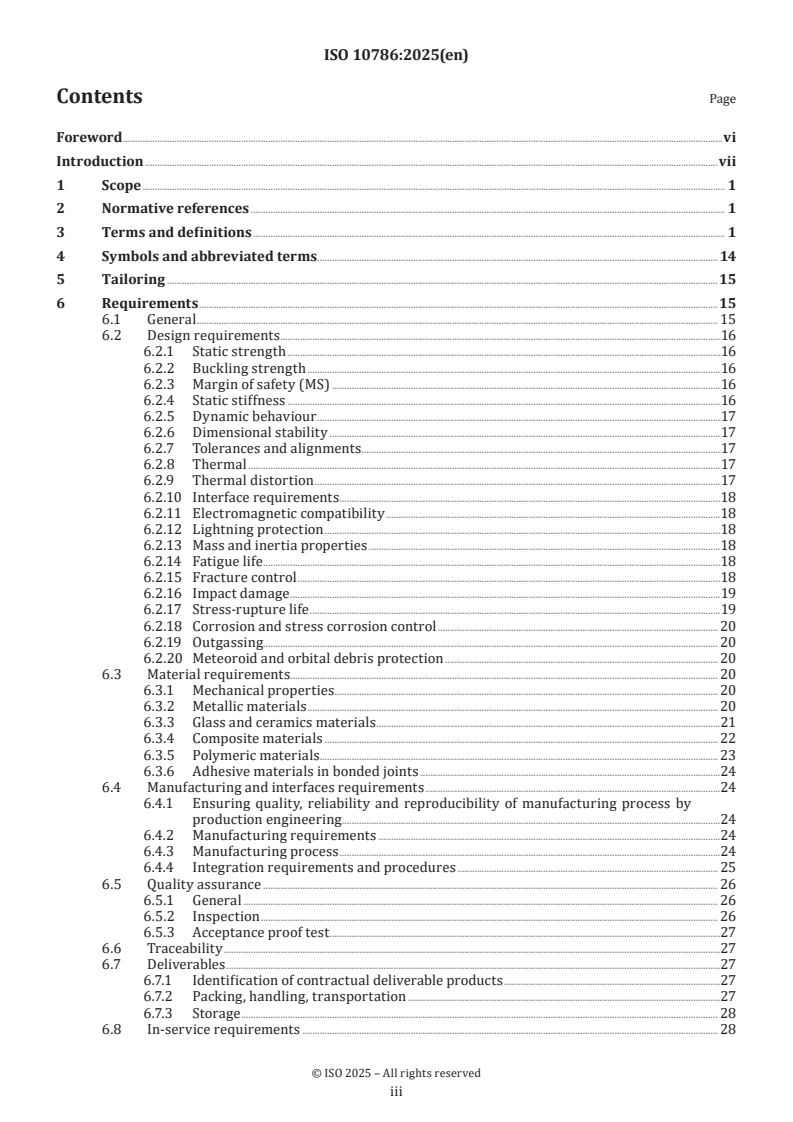
Contents Page
Foreword .vi
Introduction .vii
1 Scope . 1
2 Normative references . 1
3 Terms and definitions . 1
4 Symbols and abbreviated terms. 14
5 Tailoring .15
6 Requirements .15
6.1 General . 15
6.2 Design requirements .16
6.2.1 Static strength .16
6.2.2 Buckling strength .16
6.2.3 Margin of safety (MS) .16
6.2.4 Static stiffness .16
6.2.5 Dynamic behaviour .17
6.2.6 Dimensional stability .17
6.2.7 Tolerances and alignments . . .17
6.2.8 Thermal .17
6.2.9 Thermal distortion .17
6.2.10 Interface requirements . . .18
6.2.11 Electromagnetic compatibility .18
6.2.12 Lightning protection .18
6.2.13 Mass and inertia properties .18
6.2.14 Fatigue life .18
6.2.15 Fracture control .18
6.2.16 Impact damage .19
6.2.17 Stress-rupture life .19
6.2.18 Corrosion and stress corrosion control . 20
6.2.19 Outgassing. 20
6.2.20 Meteoroid and orbital debris protection . 20
6.3 Material requirements. 20
6.3.1 Mechanical properties . 20
6.3.2 Metallic materials . 20
6.3.3 Glass and ceramics materials .21
6.3.4 Composite materials . 22
6.3.5 Polymeric materials. 23
6.3.6 Adhesive materials in bonded joints .24
6.4 Manufacturing and interfaces requirements .24
6.4.1 Ensuring quality, reliability and reproducibility of manufacturing process by
production engineering.24
6.4.2 Manufacturing requirements .24
6.4.3 Manufacturing process .24
6.4.4 Integration requirements and procedures . 25
6.5 Quality assurance . 26
6.5.1 General . 26
6.5.2 Inspection . 26
6.5.3 Acceptance proof test . .27
6.6 Traceability .27
6.7 Deliverables .27
6.7.1 Identification of contractual deliverable products .27
6.7.2 Packing, handling, transportation .27
6.7.3 Storage . 28
6.8 In-service requirements . 28
iii
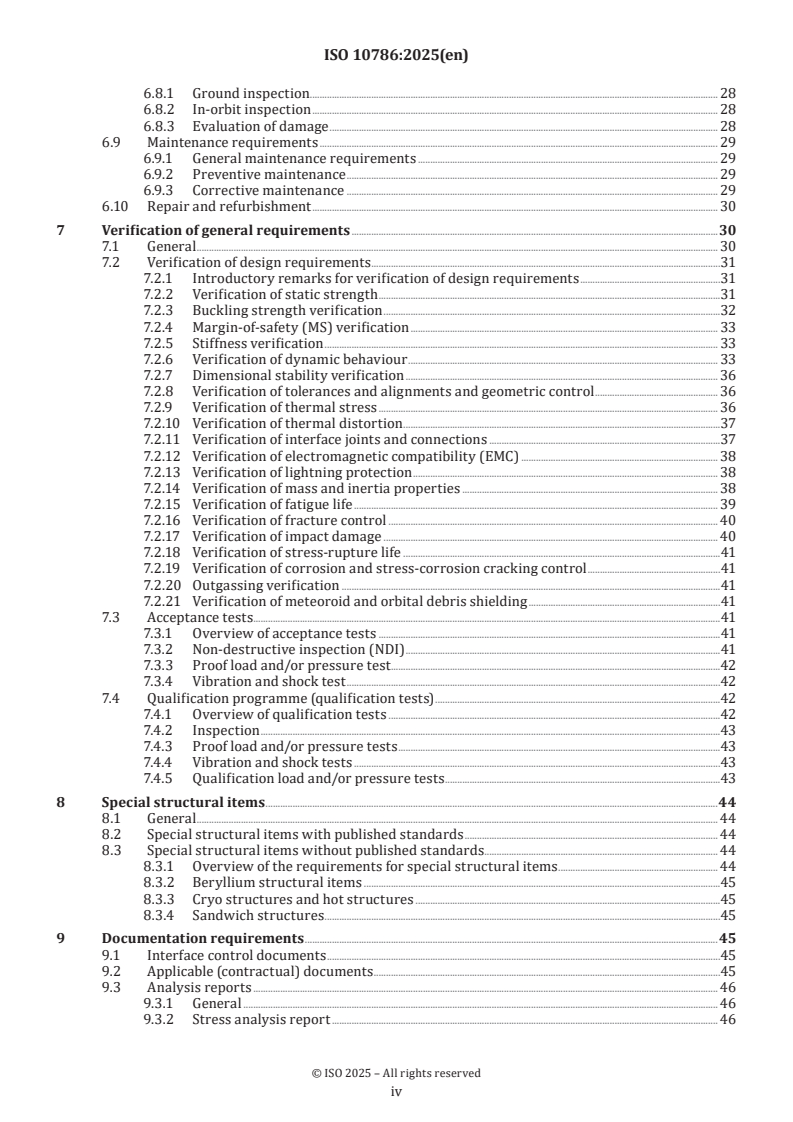
6.8.1 Ground inspection . . 28
6.8.2 In-orbit inspection . 28
6.8.3 Evaluation of damage . 28
6.9 Maintenance requirements . 29
6.9.1 General maintenance requirements . 29
6.9.2 Preventive maintenance . 29
6.9.3 Corrective maintenance . 29
6.10 Repair and refurbishment . 30
7 Verification of general requirements .30
7.1 General . 30
7.2 Verification of design requirements . .31
7.2.1 Introductory remarks for verification of design requirements .31
7.2.2 Verification of static strength .31
7.2.3 Buckling strength verification .32
7.2.4 Margin-of-safety (MS) verification . 33
7.2.5 Stiffness verification . 33
7.2.6 Verification of dynamic behaviour . 33
7.2.7 Dimensional stability verification . 36
7.2.8 Verification of tolerances and alignments and geometric control . 36
7.2.9 Verification of thermal stress . 36
7.2.10 Verification of thermal distortion .37
7.2.11 Verification of interface joints and connections .37
7.2.12 Verification of electromagnetic compatibility (EMC) . 38
7.2.13 Verification of lightning protection . 38
7.2.14 Verification of mass and inertia properties . 38
7.2.15 Verification of fatigue life . 39
7.2.16 Verification of fracture control . 40
7.2.17 Verification of impact damage . 40
7.2.18 Verification of stress-rupture life .41
7.2.19 Verification of corrosion and stress-corrosion cracking control .41
7.2.20 Outgassing verification .41
7.2.21 Verification of meteoroid and orbital debris shielding .41
7.3 Acceptance tests.41
7.3.1 Overview of acceptance tests .41
7.3.2 Non-destructive inspection (NDI) .41
7.3.3 Proof load and/or pressure test .42
7.3.4 Vibration and shock test .42
7.4 Qualification programme (qualification tests) .42
7.4.1 Overview of qualification tests .42
7.4.2 Inspection .43
7.4.3 Proof load and/or pressure tests .43
7.4.4 Vibration and shock tests .43
7.4.5 Qualification load and/or pressure tests .43
8 Special structural items .44
8.1 General . 44
8.2 Special structural items with published standards . 44
8.3 Special structural items without published standards. 44
8.3.1 Overview of the requirements for special structural items . 44
8.3.2 Beryllium structural items .45
8.3.3 Cryo structures and hot structures .45
8.3.4 Sandwich structures .45
9 Documentation requirements .45
9.1 Interface control documents .45
9.2 Applicable (contractual) documents .45
9.3 Analysis reports . 46
9.3.1 General . 46
9.3.2 Stress analysis report . 46
iv
9.3.3 Fatigue or damage tolerance life analysis reports . 46
9.3.4 Fracture/impact damage control plan/report .47
9.3.5 Inspection reports .47
9.3.6 Dynamic analysis .47
10 Data exchange . 47
10.1 Data set requirements .47
10.2 System configuration data . 48
10.3 Data exchange between design and structural analysis . 48
10.4 Data exchange between structural design and manufacturing . 48
10.5 Data exchange with other subsystems . 48
10.6 Tests and structural analysis . 48
10.7 Structural mathematical models. 48
Annex A (informative) Recommended best practices for structural design .50
Annex B (informative) Design requirements verification methods .60
Annex C (informative) Minimum design safety factors .63
Annex D (informative) Margin of safety for combined loads . 67
Bibliography .69
v
Foreword
ISO (the International Organization for Standardization) is a worldwide federation of national standards
bodies (ISO member bodies). The work of preparing International Standards is normally carried out through
ISO technical committees. Each member body interested in a subject for which a technical committee
has been established has the right to be represented on that committee. International organizations,
governmental and non-governmental, in liaison with ISO, also take part in the work. ISO collaborates closely
with the International Electrotechnical Commission (IEC) on all matters of electrotechnical standardization.
The procedures used to develop this document and those intended for its further maintenance are described
in the ISO/IEC Directives, Part 1. In particular, the different approval criteria needed for the different types
of ISO document should be noted. This document was drafted in accordance with the editorial rules of the
ISO/IEC Directives, Part 2 (see www.iso.org/directives).
ISO draws attention to the possibility that the implementation of this document may involve the use of (a)
patent(s). ISO takes no position concerning the evidence, validity or applicability of any claimed patent
rights in respect thereof. As of the date of publication of this document, ISO had not received notice of (a)
patent(s) which may be required to implement this document. However, implementers are cautioned that
this may not represent the latest information, which may be obtained from the patent database available at
www.iso.org/patents. ISO shall not be held responsible for identifying any or all such patent rights.
Any trade name used in this document is information given for the convenience of users and does not
constitute an endorsement.
For an explanation of the voluntary nature of standards, the meaning of ISO specific terms and expressions
related to conformity assessment, as well as information about ISO's adherence to the World Trade
Organization (WTO) principles in the Technical Barriers to Trade (TBT), see www.iso.org/iso/foreword.html.
This document was prepared by Technical Committee ISO/TC 20, Aircraft and space vehicles, Subcommittee
SC 14, Space systems and operations.
This second edition cancels and replaces the first edition (ISO 10786:2011), which has been technically
revised.
The main changes are as follows:
— clarification of the Scope;
— updates of the normative references and their citations in the text;
— updates of the terms and definitions to harmonize with the other ISO structural related standards.
Any feedback or questions on this document should be directed to the user’s national standards body. A
complete listing of these bodies can be found at www.iso.org/members.html.
vi
Introduction
Structures are the backbones of all spaceflight systems. A structural failure can cause the loss of human
lives for crewed space systems or can jeopardize the intended mission for uncrewed space systems.
The purpose of this document is to establish general requirements for structures in all space flight systems.
It provides the uniform requirements necessary to minimize the duplication of effort and the differences
between approaches taken by the participating nations and their commercial space communities in
developing structures. In addition, the use of agreed-upon standards can facilitate cooperation and
communication among space programmes.
This document, when implemented for a particular space system, ensures high confidence in achieving safe
and reliable operation in all phases of its planned mission.
vii
International Standard ISO 10786:2025(en)
Space systems — Structural components and assemblies
1 Scope
This document establishes requirements for the design, material selection and characterization, fabrication,
testing and inspection of all structural items in space systems, including expendable and reusable launch
vehicles, satellites and their payloads.
This document applies to all structural items, including fracture-critical hardware used in space systems
during all phases of the mission, with the following exceptions: adaptive structures, propulsion systems,
nuclear systems, and thermal protection systems.
2 Normative references
The following documents are referred to in the text in such a way that some or all of their content constitutes
requirements of this document. For dated references, only the edition cited applies. For undated references,
the latest edition of the referenced document (including any amendments) applies.
ISO 14623, Space systems - Pressure vessels and pressurized structures — Design and operation
ISO 15864, Space systems — General test methods for spacecraft, subsystems and units
ISO 16126, Space systems — Survivability of unmanned spacecraft against space debris and meteoroid impacts
for the purpose of space debris mitigation
ISO 16454, Space systems — Structural design — Stress analysis requirements
ISO 21347, Space systems — Fracture and damage control
ISO 21648, Space systems — Flywheel module design and testing
ISO 24113, Space systems — Space debris mitigation requirements
ISO 24638, Space systems — Pressure components and pressure system integration
ISO 24917, Space systems — General test requirements for launch vehicles
3 Terms and definitions
For the purposes of this document, the following terms and definitions apply.
ISO and IEC maintain terminology databases for use in standardization at the following addresses:
— ISO Online browsing platform: available at https:// www .iso .org/ obp
— IEC Electropedia: available at https:// www .electropedia .org/
3.1
A-basis allowable
A-basis design allowable
A-value
mechanical strength value above which at least 99 % of the population of values is expected to fall, with a
confidence level (3.13) of 95 %
[SOURCE: ISO 14623:2003, 2.1, modified — The admitted terms "A-basis design allowable" and "A-value"
have been added.]
3.2
acceptance test
required formal test (3.77) conducted on flight hardware to ascertain that the materials (3.39), manufacturing
processes (3.36), and workmanship meet specifications and that the hardware is acceptable for intended usage
[SOURCE: ISO 14623:2003, 2.2, modified — The term and definition have been changed from plural to
singular forms.]
3.3
adaptive structure
autonomous structural system which incorporates sensors, processors, and actuators to enable adaptation
to changing environmental conditions, thereby enhancing safety, stability, vibration damping, acoustic noise
suppression, aerodynamic performance and optimization, pointing accuracy, load redistribution, damage
response, structural integrity, etc.
3.4
allowable load
maximum load that can be accommodated by a material (3.39)/structure (3.75) or a component of a
structural assembly (3.5) without potential rupture, collapse (3.9), or detrimental deformation (3.19) in a
given environment
Note 1 to entry: Commonly, “allowable load” is the load which correspond to the statistically based ultimate strength
(3.80), buckling (3.7) strength, and yield strength (3.86), or strength defined by maximum strain (for ductile materials).
Note 2 to entry: "Allowable stress", or "allowable strain" are similar definition of "allowable load”, which are defined
for potential rupture, collapse, or detrimental deformation, by using other physical properties such as "stress" or
"strain" respectively, instead of "load".
3.5
assembly
combination of parts, components and units that form a functional entity
[SOURCE: ISO 10795:2019, 3.23]
3.6
B-basis allowable
B-basis design allowable
B-value
mechanical strength value above which at least 90 % of the population of values is expected to fall, with a
confidence level (3.13) of 95 %
Note 1 to entry: See also A-basis allowable (3.1).
[SOURCE: ISO 21648:2008, 2.1.4, modified — The admitted terms "B-basis design allowable" and "B-value"
have been added.]
3.7
buckling
failure mode (3.22) in which an infinitesimal increase in the load can lead to sudden collapse (3.9) or
detrimental deformation (3.19) of a structure (3.75)
EXAMPLE Snapping of slender beams, columns, struts and thin-wall shells.
3.8
catastrophic failure
failure which results in the loss of human life, mission or a major ground facility, or long-term detrimental
environmental effects
3.9
collapse
failure mode (3.22) induced by quasi-static loads (3.58) (compression, shear or combined stress) accompanied
by irreversible loss of load-carrying capability
3.10
composite material
combination of materials (3.39) different in composition or form on a macro scale
Note 1 to entry: The constituents retain their identities in the composite.
Note 2 to entry: The constituents can normally be physically identified; and there is an interface between them.
Note 3 to entry: Composites include:
— fibrous (composed of fibres, usually in a matrix),
— laminar (layers of materials), and
— hybrid (combination of fibrous and laminar).
[SOURCE: ISO 16454:2024, 3.6, modified— Note 3 to entry has been added.]
3.11
composite overwrapped pressure vessel
COPV
pressure vessel (3.46) with a fibre-based composite system fully or partially encapsulating a liner
Note 1 to entry: The liner serves as a liquid or gas permeation barrier and may or may not carry substantial pressure
loads. The composite overwraps generally carry pressure and environmental loads.
3.12
composite structure
structural components (3.71) that are made of composite materials (3.10)
3.13
confidence level
value (1 − α) of the probability associated with a confidence interval or a statistical coverage interval
Note 1 to entry: The confidence level, i.e. (1 − α), is often expressed as a percentage.
Note 2 to entry: In some cases, the confidence level is dictated by the needs of the situation. In all other instances, use
of (1 − α) = 0,95 is recommended.
3.14
damage tolerance
ability of a structure (3.75) or a component of a structural assembly (3.5) to resist failure due to the presence
of flaws (3.25) for a specified period of unrepaired usage
[SOURCE: ISO 24638:2021, 3.5, modified — The wording “a material/structure” has been replaced by “a
structure or a component of a structural assembly”.]
3.15
damage tolerance life
safe life
design criterion under which failure due to the presence of flaws (3.25) does not occur in
the expected environment during the service life (3.65)
Note 1 to entry: In this design criterion, a flaw is assumed consistent with the inspection (3.31) process specified and
it is shown that the largest undetected flaw that can exist in the structure (3.75) will not grow to failure in durations
multiplying life factors (3.32) to service lifetimes when subjected to the cyclic and sustained loads in the environments
encountered.
3.16
damage tolerance life
safe life