

ISO 10303-109:2004/Cor 2:2014
(Corrigendum)Industrial automation systems and integration — Product data representation and exchange — Part 109: Integrated application resource: Kinematic and geometric constraints for assembly models — Technical Corrigendum 2
General Information
- Abstract
- Status
- Published
- Publication Date
- 01-Dec-2014
- Technical Committee
- ISO/TC 184/SC 4 - Industrial data
- Drafting Committee
- ISO/TC 184/SC 4/WG 12 - STEP product modelling and resources
- Current Stage
- 6060 - International Standard published
- Start Date
- 02-Dec-2014
- Due Date
- 04-Oct-2016
- Completion Date
- 04-Oct-2016
Buy Documents
ISO 10303-109:2004/Cor 2:2014 - Industrial automation systems and integration — Product data representation and exchange — Part 109: Integrated application resource: Kinematic and geometric constraints for assembly models — Technical Corrigendum 2 Released:12/2/2014
Overview
ISO 10303-109:2004/Cor 2:2014 is a Technical Corrigendum to the international standard ISO 10303-109:2004 developed by the International Organization for Standardization (ISO). This update targets Industrial Automation Systems and Integration, specifically in Product Data Representation and Exchange. It focuses on Part 109, which covers the integrated application resource for kinematic and geometric constraints within assembly models. The corrigendum primarily addresses editorial improvements and updates to the EXPRESS data modeling language specifications to enhance clarity, consistency, and schema referencing across related product data standards.
Key Topics
- Kinematic and Geometric Constraints: The standard deals with specifying constraints for assembly models in product data representation, enabling precise control of component movement and spatial relationships during assembly.
- EXPRESS Specifications: Several EXPRESS language entities and functions are revised, including those for assembly feature relationships, kinematic motion representations, constrained motions, and shape aspect relationships to ensure data integrity and semantic completeness.
- Schema References: A comprehensive set of interrelated ISO 10303 parts-such as 41 (product definition), 42 (geometry), 43 (representation), 44 (product structure), 59 (shape data quality), 105 (kinematic structures), and 109 (assembly constraints)-are referenced to maintain integration and interoperability within product data frameworks.
- Functions and Rules: New and updated EXPRESS functions such as assembly_root, find_assembly_root, and shape representation retrieval mechanisms standardize component hierarchy navigation and shape association processes within assemblies.
- Editorial Corrections: Removal and replacement of outdated EXPRESS schemas and notes, renumbering of clauses, and updates to normative references contribute to improved document accuracy and usability.
Applications
- Industrial Automation: Facilitates transparent information exchange about mechanical assemblies where accurate kinematic and geometric constraint definitions are crucial for automated manufacturing and robotics systems.
- Product Lifecycle Management (PLM): Supports consistent representation of assembly structures and motion constraints in digital product models across different software and enterprise systems, ensuring interoperability.
- CAD/CAM Systems: Enhances the ability of computer-aided design and manufacturing applications to model assemblies with precise motion constraints, improving simulation and virtual prototyping.
- Quality Inspection and Control: Incorporates data quality schemas (ISO 10303-59) to assure that shape representation meets required standards, vital for inspection and verification processes.
- Systems Integration: Assists integration of multidisciplinary product data from geometry, kinematics, properties, and product definitions for comprehensive digital twins and smart manufacturing implementations.
Related Standards
- ISO 10303-41: Product Definition Schema – foundational for product definitions shared in the application resource.
- ISO 10303-42: Geometry Schema – defines geometric constructs referenced for spatial constraints.
- ISO 10303-43: Representation Schema – covers abstract representation structures referenced across the assembly constraints.
- ISO 10303-44: Product Structure Schema – manages the hierarchical relationships within product assemblies.
- ISO 10303-59: Shape Data Quality Schema – addresses quality assurance of geometric and shape data.
- ISO 10303-105: Kinematic Motion and Structure Schemas – details motion representation and kinematic pairs critical to the standard's assembly model constraints.
By adhering to ISO 10303-109:2004/Cor 2:2014, organizations can achieve more reliable and interoperable assembly modeling within industrial automation, enabling better product data integration, accurate motion constraints, and refined product shape representation across global manufacturing and engineering ecosystems.
Relations
- Effective Date
- 24-Jul-2021
Buy Documents
ISO 10303-109:2004/Cor 2:2014 - Industrial automation systems and integration — Product data representation and exchange — Part 109: Integrated application resource: Kinematic and geometric constraints for assembly models — Technical Corrigendum 2 Released:12/2/2014
Get Certified
Connect with accredited certification bodies for this standard

DVS-ZERT GmbH
German welding certification society.
CARES (UK Certification Authority for Reinforcing Steels)
UK certification for reinforcing steels and construction.
EWF/IIW (European/International Welding Federation)
International welding personnel certification.
Sponsored listings
Frequently Asked Questions
ISO 10303-109:2004/Cor 2:2014 is a standard published by the International Organization for Standardization (ISO). Its full title is "Industrial automation systems and integration — Product data representation and exchange — Part 109: Integrated application resource: Kinematic and geometric constraints for assembly models — Technical Corrigendum 2". This standard covers: Industrial automation systems and integration — Product data representation and exchange — Part 109: Integrated application resource: Kinematic and geometric constraints for assembly models — Technical Corrigendum 2
Industrial automation systems and integration — Product data representation and exchange — Part 109: Integrated application resource: Kinematic and geometric constraints for assembly models — Technical Corrigendum 2
ISO 10303-109:2004/Cor 2:2014 is classified under the following ICS (International Classification for Standards) categories: 25.040.40 - Industrial process measurement and control. The ICS classification helps identify the subject area and facilitates finding related standards.
ISO 10303-109:2004/Cor 2:2014 has the following relationships with other standards: It is inter standard links to ISO 10303-109:2004. Understanding these relationships helps ensure you are using the most current and applicable version of the standard.
ISO 10303-109:2004/Cor 2:2014 is available in PDF format for immediate download after purchase. The document can be added to your cart and obtained through the secure checkout process. Digital delivery ensures instant access to the complete standard document.
Standards Content (Sample)
INTERNATIONAL STANDARD ISO 10303-109:2004
TECHNICAL CORRIGENDUM 2
Published 2014-07-01
INTERNATIONAL ORGANIZATION FOR STANDARDIZATION • МЕЖДУНАРОДНАЯ ОРГАНИЗАЦИЯ ПО СТАНДАРТИЗАЦИИ • ORGANISATION INTERNATIONALE DE NORMALISATION
Industrial automation systems and integration —
Product data representation and exchange —
Part 109:
Integrated generic resource:
Kinematic and geometric constraints for assembly
models
TECHNICAL CORRIGENDUM 2
Systèmes d’ automatisation industrielle et intégration – Représentation et échange de données de produits -
Partie 109: Ressources génériques intégrées: Contraintes cinématiques et géométriques pour les modèles
d'assemblage RECTIFICATIF TECHNIQUE 2
Technical Corrigendum 2 to International Standard ISO 10303-109:2004 was prepared by Technical Committee ISO/TC
184, Automation systems and integration, Subcommittee SC 4, Industrial data.
The purpose of the modification is to the text of ISO 10303-109:2004 is to correct editorial issues.
ICS 25.040.40 Ref. No. ISO 10303-109:2004/Cor.2:2014(E)
© ISO 2014 – All rights reserved
Published in Switzerland
ISO 10303-109:2004/Cor.1:2010(E) (Only Reference)
Modifications to the text of ISO 10303-109:2004
Page 2, Clause 2, Normative references
Add the following to the list of normative references:
ISO 10303-59, Industrial automation systems and integration — Product data representation and
exchange — Part 59: Integrated generic resource — Quality of product shape data
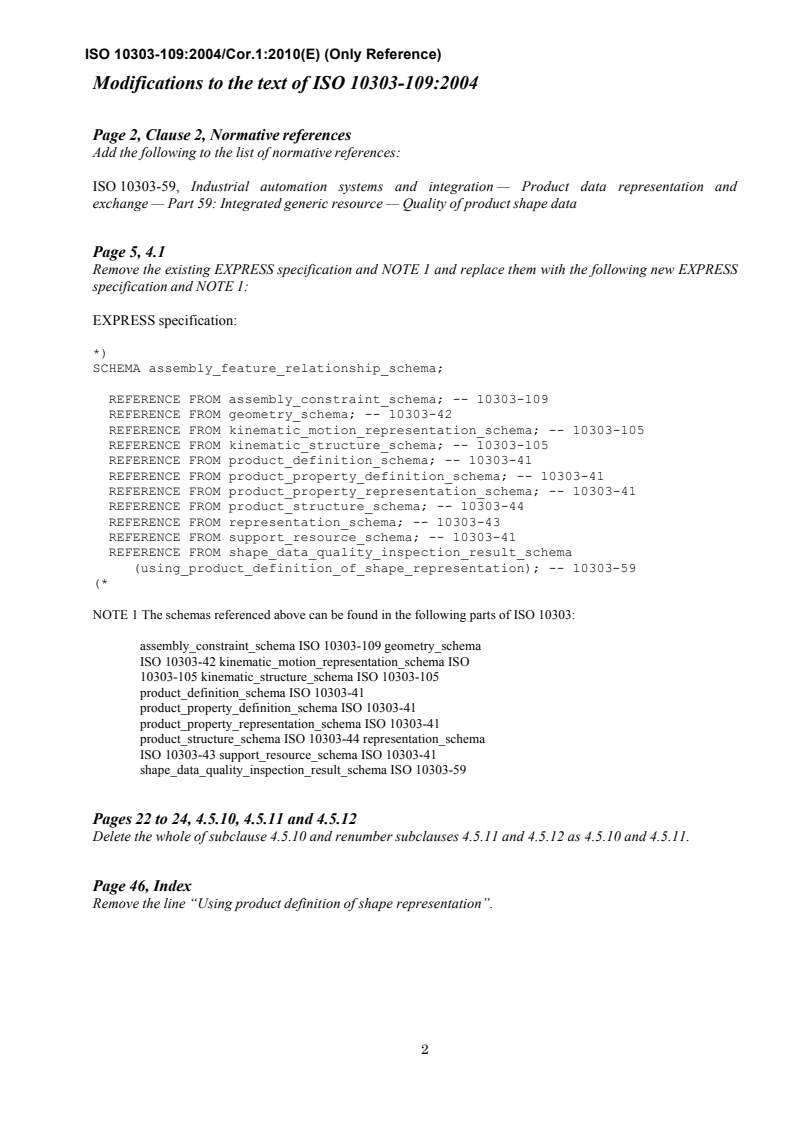
Page 5, 4.1
Remove the existing EXPRESS specification and NOTE 1 and replace them with the following new EXPRESS
specification and NOTE 1:
EXPRESS specification:
*)
SCHEMA assembly_feature_relationship_schema;
REFERENCE FROM assembly_constraint_schema; -- 10303-109
REFERENCE FROM geometry_schema; -- 10303-42
REFERENCE FROM kinematic_motion_representation_schema; -- 10303-105
REFERENCE FROM kinematic_structure_schema; -- 10303-105
REFERENCE FROM product_definition_schema; -- 10303-41
REFERENCE FROM product_property_definition_schema; -- 10303-41
REFERENCE FROM product_property_representation_schema; -- 10303-41
REFERENCE FROM product_structure_schema; -- 10303-44
REFERENCE FROM representation_schema; -- 10303-43
REFERENCE FROM support_resource_schema; -- 10303-41
REFERENCE FROM shape_data_quality_inspection_result_schema
(using_product_definition_of_shape_representation); -- 10303-59
(*
NOTE 1 The schemas referenced above can be found in the following parts of ISO 10303:
assembly_constraint_schema ISO 10303-109 geometry_schema
ISO 10303-42 kinematic_motion_representation_schema ISO
10303-105 kinematic_structure_schema ISO 10303-105
product_definition_schema ISO 10303-41
product_property_definition_schema ISO 10303-41
product_property_representation_schema ISO 10303-41
product_structure_schema ISO 10303-44 representation_schema
ISO 10303-43 support_resource_schema ISO 10303-41
shape_data_quality_inspection_result_schema ISO 10303-59
Pages 22 to 24, 4.5.10, 4.5.11 and 4.5.12
Delete the whole of subclause 4.5.10 and renumber subclauses 4.5.11 and 4.5.12 as 4.5.10 and 4.5.11.
Page 46, Index
Remove the line “Using product definition of shape representation”.
Modifications to the text of ISO 10303-109:2004
Page iii, Contents
Removal of the line regarding Using product definition of shape representation
Page vii, Introduction
Addition of the following two lines at the end of the page
shape_data_quality_inspection_result_schema ISO 10303-59
support_resource_schema ISO 10303-41
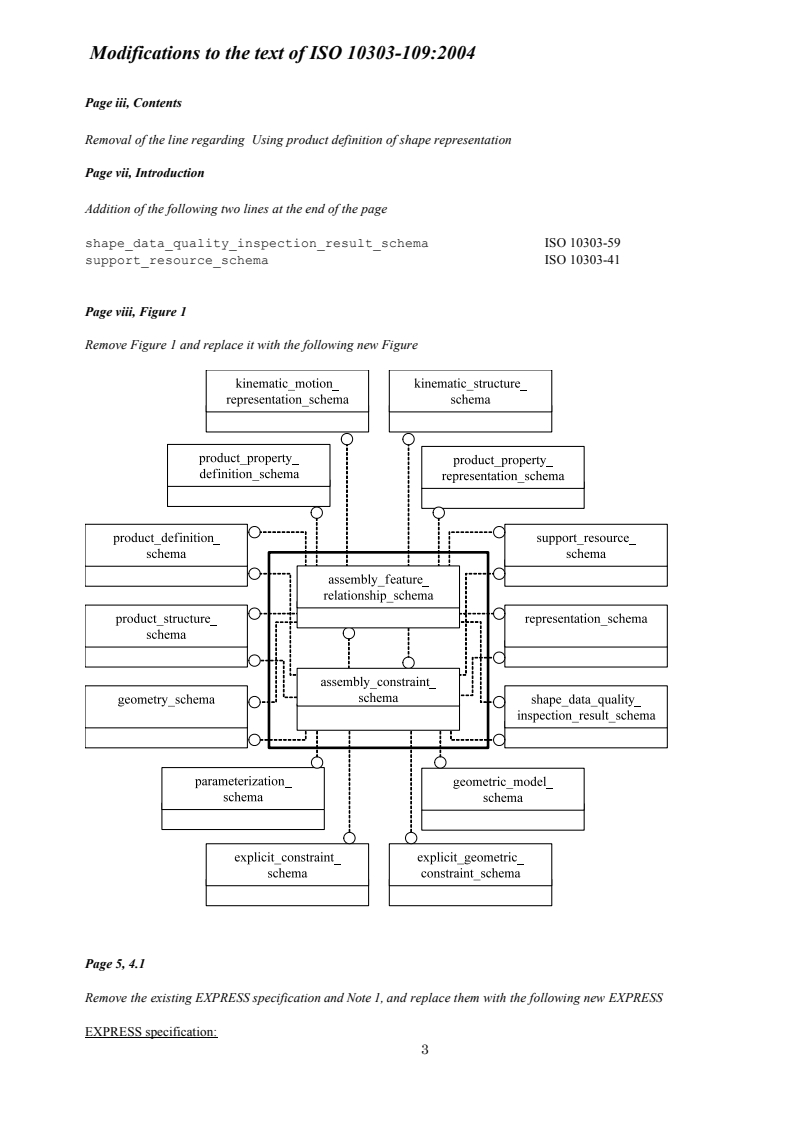
Page viii, Figure 1
Remove Figure 1 and replace it with the following new Figure
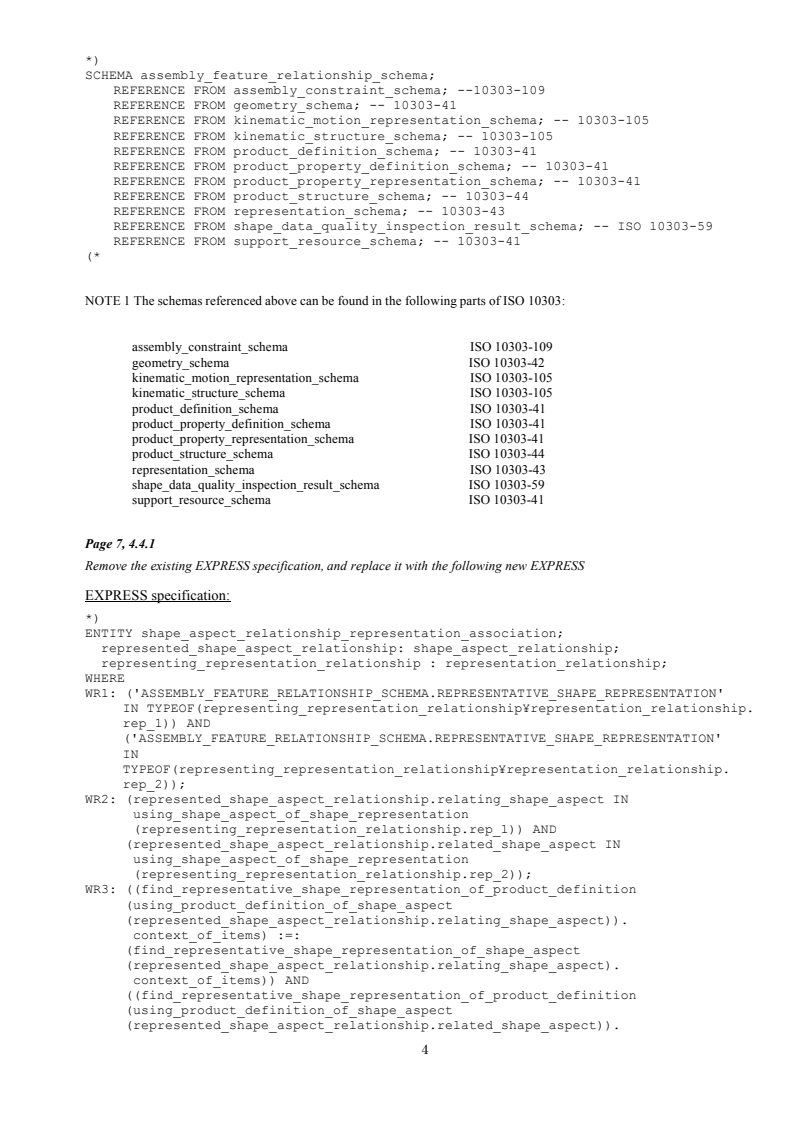
Page 5, 4.1
Remove the existing EXPRESS specification and Note 1, and replace them with the following new EXPRESS
EXPRESS specification:
*)
SCHEMA assembly_feature_relationship_schema;
REFERENCE FROM assembly_constraint_schema; --10303-109
REFERENCE FROM geometry_schema; -- 10303-41
REFERENCE FROM kinematic_motion_representation_schema; -- 10303-105
REFERENCE FROM kinematic_structure_schema; -- 10303-105
REFERENCE FROM product_definition_schema; -- 10303-41
REFERENCE FROM product_property_definition_schema; -- 10303-41
REFERENCE FROM product_property_representation_schema; -- 10303-41
REFERENCE FROM product_structure_schema; -- 10303-44
REFERENCE FROM representation_schema; -- 10303-43
REFERENCE FROM shape_data_quality_inspection_result_schema; -- ISO 10303-59
REFERENCE FROM support_resource_schema; -- 10303-41
(*
NOTE 1 The schemas referenced above can be found in the following parts of ISO 10303:
assembly_constraint_schema ISO 10303-109
geometry_schema ISO 10303-42
kinematic_motion_representation_schema ISO 10303-105
kinematic_structure_schema ISO 10303-105
product_definition_schema ISO 10303-41
product_property_definition_schema ISO 10303-41
product_property_representation_schema ISO 10303-41
product_structure_schema ISO 10303-44
representation_schema ISO 10303-43
shape_data_quality_inspection_result_schema ISO 10303-59
support_resource_schema ISO 10303-41
Page 7, 4.4.1
Remove the existing EXPRESS specification, and replace it with the following new EXPRESS
EXPRESS specification:
*)
ENTITY shape_aspect_relationship_representation_association;
represented_shape_aspect_relationship: shape_aspect_relationship;
representing_representation_relationship : representation_relationship;
WHERE
WR1: ('ASSEMBLY_FEATURE_RELATIONSHIP_SCHEMA.REPRESENTATIVE_SHAPE_REPRESENTATION'
IN TYPEOF(representing_representation_relationship¥representation_relationship.
rep_1)) AND
('ASSEMBLY_FEATURE_RELATIONSHIP_SCHEMA.REPRESENTATIVE_SHAPE_REPRESENTATION'
IN
TYPEOF(representing_representation_relationship¥representation_relationship.
rep_2));
WR2: (represented_shape_aspect_relationship.relating_shape_aspect IN
using_shape_aspect_of_shape_representation
(representing_representation_relationship.rep_1)) AND
(represented_shape_aspect_relationship.related_shape_aspect IN
using_shape_aspect_of_shape_representation
(representing_representation_relationship.rep_2));
WR3: ((find_representative_shape_representation_of_product_definition
(using_product_definition_of_shape_aspect
(represented_shape_aspect_relationship.relating_shape_aspect)).
context_of_items) :=:
(find_representative_shape_representation_of_shape_aspect
(represented_shape_aspect_relationship.relating_shape_aspect).
context_of_items)) AND
((find_representative_shape_representation_of_product_definition
(using_product_definition_of_shape_aspect
(represented_shape_aspect_relationship.related_shape_aspect)).
context_of_items) :=:
(find_representative_shape_representation_of_shape_aspect
(represented_shape_aspect_relationship.related_shape_aspect).
context_of_items));
WR4: using_product_definition_of_shape_aspect
(represented_shape_aspect_relationship.relating_shape_aspect) :<>:
using_product_definition_of_shape_aspect
(represented_shape_aspect_relationship.related_shape_aspect);
WR5: find_assembly_root ([using_product_definition_of_shape_aspect
(represented_shape_aspect_relationship.relating_shape_aspect)]) :=:
find_assembly_root ([using_product_definition_of_shape_aspect
(represented_shape_aspect_relationship.related_shape_aspect)]);
END_ENTITY; -- shape_aspect_relationship_representation_association
(*
Page 10, 4.4.3
Remove the existing EXPRESS specification, and replace it with the following new EXPRESS
EXPRESS specification:
*)
ENTITY free_kinematic_motion_representation
SUBTYPE OF (representation_relationship_with_transformation);
SELF¥representation_relationship.rep_1:
representative_shape_representation;
SELF¥representation_relationship.rep_2:
representative_shape_representation;
motion : kinematic_path;
WHERE
WR1: 'REPRESENTATION_SCHEMA.ITEM_DEFINED_TRANSFORMATION' IN TYPEOF
(SELF¥representation_relationship_with_transformation.
transformation_operator);
WR2: ('GEOMETRY_SCHEMA.GEOMETRIC_REPRESENTATION_ITEM' IN TYPEOF
(SELF¥representation_relationship_with_transformation.
transformation_operator¥item_defined_transformation.transform_item_1)) AND
('GEOMETRY_SCHEMA.GEOMETRIC_REPRESENTATION_ITEM' IN TYPEOF
(SELF¥representation_relationship_with_transformation.
transformation_operator¥item_defined_transformation.
transform_item_2));
WR3: ((dimension_of
(SELF¥representation_relationship_with_transformation.
transformation_operator¥item_defined_transformation.
transform_item_1) = 3 ) AND
(dimension_of
(SELF¥representation_relationship_with_transformation.
transformation_operator¥item_defined_transformation.
transform_item_2) = 3 ));
WR4:(SELF¥representation_relationship.rep_1 IN
(using_representations
(SELF¥representation_relationship_with_transformation.
transformation_operator¥item_defined_transformation.transform_item_1) +
using_representation_with_mapping
(SELF¥representation_relationship_with_transformation.
transformation_operator¥item_defined_transformation.transform_item_1)))
AND
(SELF¥representation_relationship.rep_2 IN
(using_representations
(SELF¥representation_relationship_with_transformation.
transformation_operator¥item_defined_transformation.transform_item_2) +
using_representation_with_mapping
(SELF¥representation_relationship_with_transformation.
transformation_operator¥item_defined_transformation.transform_item_2)));
END_ENTITY; -- free_kinematic_motion_representation
(*
Page 12, 4.4.4
Remove the existing EXPRESS specification, and replace it with the following new EXPRESS
EXPRESS specification:
*)
ENTITY constrained_kinematic_motion_representation
SUBTYPE OF (representation_relationship_with_transformation);
SELF¥representation_relationship.rep_1:
representative_shape_representation;
SELF¥representation_relationship.rep_2:
representative_shape_representation;
WHERE
WR1: ('GEOMETRY_SCHEMA.AXIS2_PLACEMENT_3D' IN TYPEOF
(SELF¥representation_relationship_with_transformation.
transformation_operator¥item_defined_transformation.transform_item_1)) AND
('GEOMETRY_SCHEMA.AXIS2_PLACEMENT_3D' IN TYPEOF
(SELF¥representation_relationship_with_transformation.
transformation_operator¥item_defined_transformation.transform_item_2));
WR2: ((dimension_of
(SELF¥representation_relationship_with_transformation.
transformation_operator¥item_defined_transformation.
transform_item_1) = 3 ) AND
(dimension_of
(SELF¥representation_relationship_with_transformation.
transformation_operator¥item_defined_transformation.
transform_item_2) = 3 ));
WR3:(SELF¥representation_relationship.rep_1 IN
(using_representations
(SELF¥representation_relationship_with_transformation.
transformation_operator¥item_defined_transformation.transform_item_1) +
using_representation_with_mapping
(SELF¥representation_relationship_with_transformation.
transformation_operator¥item_defined_transformation.transform_item_1))) AND
(SELF¥representation_relationship.rep_2 IN
(using_representations
(SELF¥representation_relationship_with_transformation.
transformation_operator¥item_defined_transformation.transform_item_2) +
using_representation_with_mapping
(SELF¥representation_relationship_with_transformation.
transformation_operator¥item_defined_transformation.transform_item_2)));
WR4: 'KINEMATIC_STRUCTURE_SCHEMA.KINEMATIC_PAIR' IN TYPEOF
(SELF¥representation_relationship_with_transformation.
transformation_operator);
END_ENTITY; -- constrained_kinematic_motion_representation
(*
Page 13, 4.5.1
Remove the existing EXPRESS specification, and replace it with the following new EXPRESS
EXPRESS specification:
*)
FUNCTION assembly_root
(item: product_definition) : BOOLEAN;
-- extraction of related assembly_component_relationships --
IF (SIZEOF(QUERY(pdr <* USEDIN (item,
'PRODUCT_DEFINITION_SCHEMA.PRODUCT_DEFINITION_RELATIONSHIP.' +
'RELATED_PRODUCT_DEFINITION') |
'PRODUCT_STRUCTURE_SCHEMA.ASSEMBLY_COMPONENT_USAGE' IN
TYPEOF(pdr)))
= 0) THEN RETURN(TRUE);
ELSE RETURN (FALSE);
END_IF;
END_FUNCTION;
(*
Page 14, 4.5.2
Remove the existing EXPRESS specification, and replace it with the following new EXPRESS
EXPRESS specification:
*)
FUNCTION find_assembly_root
(constituent: SET OF product_definition) : SET OF product_definition;
LOCAL
local_relation: SET OF assembly_component_usage := [];
local_relation2: BAG OF assembly_component_usage := [];
local_parent: SET OF product_definition := [];
root : SET OF product_definition;
i : INTEGER := 0;
j : INTEGER := 0;
END_LOCAL;
-- Is constituent root ? --
IF ((SIZEOF (constituent) = 1) AND assembly_root (constituent[1]))
THEN RETURN ([constituent [1]]);
-- ERROR constituent is vacant --
ELSE IF (SIZEOF (constituent) = 0
...