

ISO/PAS 8329:2024
(Main)Extended master connection file (χMCF) — Description of mechanical connections and joints in structural systems
General Information
- Abstract
This document specifies XML definitions that are used to describe data and information related to connections or joints in mechanical systems or structures. The following is within the scope of this document: — description and explanation of XML definitions for logical or process related data or other properties of a connection. The following aspects are outside the scope of this document: — geometry of fasteners or other parts, — handling of χMCF data in — product data management (PDM) systems, — subscriber data management (SDM) systems, and — other data management systems.
- Status
- Published
- Publication Date
- 29-Aug-2024
- Technical Committee
- ISO/TC 184/SC 4 - Industrial data
- Drafting Committee
- ISO/TC 184/SC 4 - Industrial data
- Current Stage
- 6060 - International Standard published
- Start Date
- 30-Aug-2024
- Due Date
- 13-Aug-2024
- Completion Date
- 30-Aug-2024

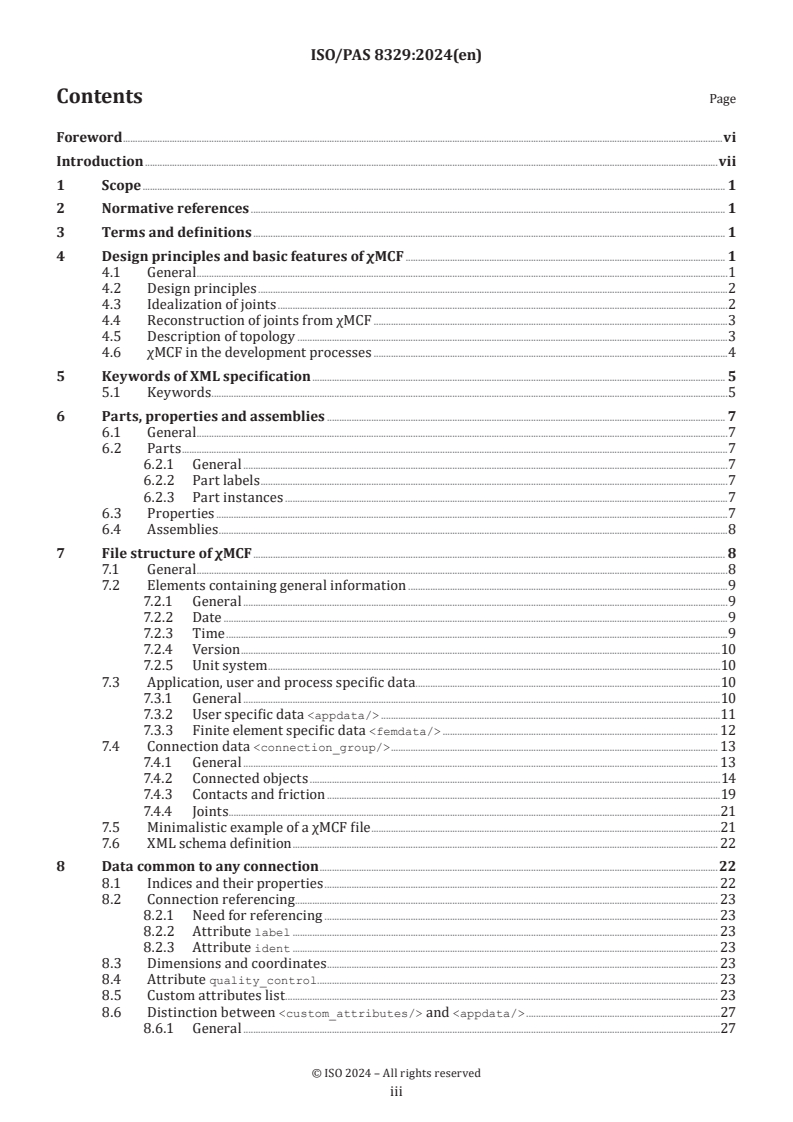
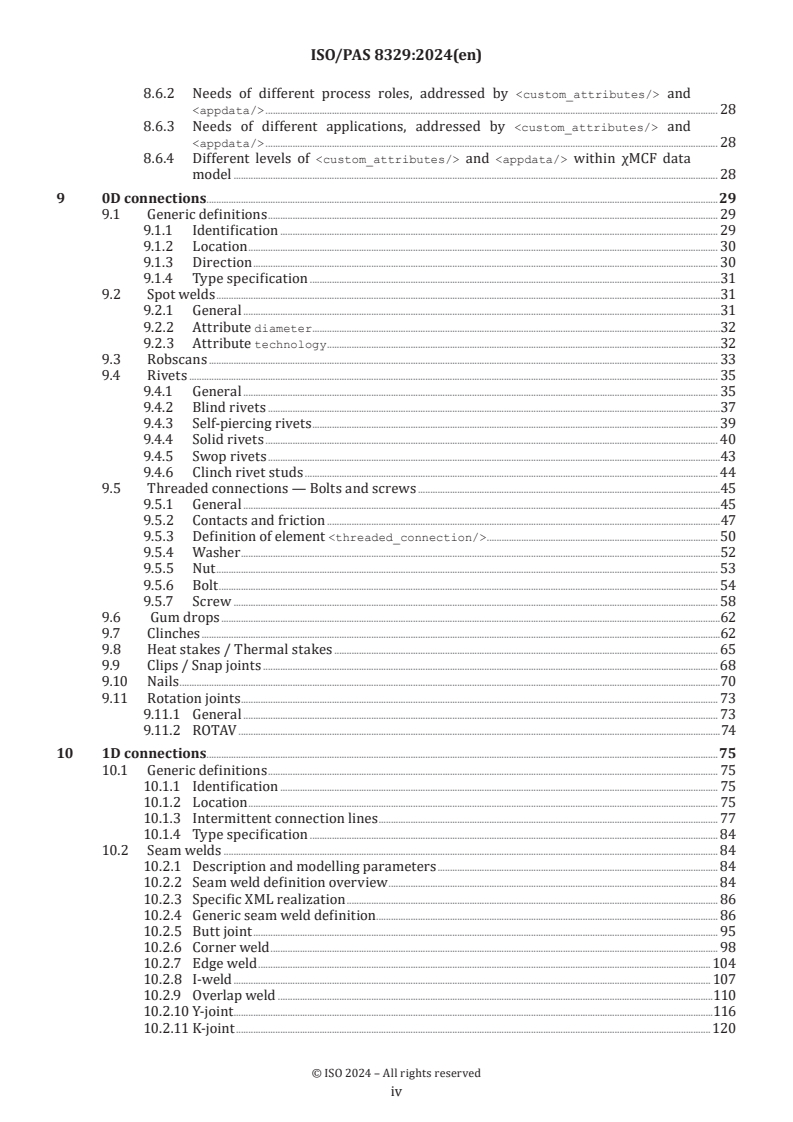
Overview - ISO/PAS 8329:2024 (χMCF)
ISO/PAS 8329:2024 - Extended master connection file (χMCF) specifies an XML-based data model for describing mechanical connections and joints in structural systems. The specification defines XML elements, keywords and a file structure to represent logical, process-related and property data for connections and joints. χMCF focuses on information exchange and semantic description rather than the detailed geometry of fasteners or storage/management inside PDM/SDM systems.
Key scope points:
- Defines XML definitions and schema for connection data (parts, properties, assemblies, topology).
- Includes file metadata (date, time, version, unit system), application-specific data (, ), and connection groups (<connection_group/>).
- Excludes geometric modeling of fasteners and handling within specific data-management systems.
Key Topics and Requirements
- XML schema & file structure: Standardizes elements, namespaces, and minimal example files to ensure consistent χMCF documents.
- Parts, properties, assemblies: Definitions for part labels, instances and property sets to describe connection participants.
- Topology and reconstruction: Rules for idealising joints and reconstructing joint topology from χMCF data.
- Connection data elements: Formalized elements for connected objects, contacts, friction, and joint types (0D/1D connections).
- Common attributes & referencing: Indices, attribute label/ident, dimensions, coordinates and quality_control attributes for interoperability.
- Application-specific extensions: , , and <custom_attributes/> provide structured extension points without breaking interoperability.
- Component coverage examples: The document addresses spot welds, rivets, threaded_connection (bolts/screws), washers, nuts, and other joint types in its content index.
Practical Applications & Who Uses It
- Structural and mechanical engineers: Exchange standardized connection descriptions for analysis, simulation and verification.
- CAD/CAE/FEM software vendors: Implement χMCF import/export to enable interoperable workflows between design and simulation tools.
- Simulation engineers: Use χMCF to feed consistent connection/topology data into finite-element models ().
- OEMs, suppliers and integrators: Share connection specifications across supply chains without embedding geometry or PDM implementation details.
- Data architects & standards teams: Map internal connection schemas to χMCF for consistent product lifecycle data exchange.
Practical benefits include improved data interoperability, repeatable joint reconstruction in simulations, and clearer exchange of connection metadata (friction, contact definitions, attribute quality).
Related Standards (if applicable)
- Other ISO data-exchange standards (for example, STEP / ISO 10303) and CAD/PLM interoperability specifications may complement χMCF when combining geometry and product-data management workflows.
Get Certified
Connect with accredited certification bodies for this standard

DVS-ZERT GmbH
German welding certification society.
CARES (UK Certification Authority for Reinforcing Steels)
UK certification for reinforcing steels and construction.
EWF/IIW (European/International Welding Federation)
International welding personnel certification.
Sponsored listings
Frequently Asked Questions
ISO/PAS 8329:2024 is a technical specification published by the International Organization for Standardization (ISO). Its full title is "Extended master connection file (χMCF) — Description of mechanical connections and joints in structural systems". This standard covers: This document specifies XML definitions that are used to describe data and information related to connections or joints in mechanical systems or structures. The following is within the scope of this document: — description and explanation of XML definitions for logical or process related data or other properties of a connection. The following aspects are outside the scope of this document: — geometry of fasteners or other parts, — handling of χMCF data in — product data management (PDM) systems, — subscriber data management (SDM) systems, and — other data management systems.
This document specifies XML definitions that are used to describe data and information related to connections or joints in mechanical systems or structures. The following is within the scope of this document: — description and explanation of XML definitions for logical or process related data or other properties of a connection. The following aspects are outside the scope of this document: — geometry of fasteners or other parts, — handling of χMCF data in — product data management (PDM) systems, — subscriber data management (SDM) systems, and — other data management systems.
ISO/PAS 8329:2024 is classified under the following ICS (International Classification for Standards) categories: 25.040.40 - Industrial process measurement and control. The ICS classification helps identify the subject area and facilitates finding related standards.
ISO/PAS 8329:2024 is available in PDF format for immediate download after purchase. The document can be added to your cart and obtained through the secure checkout process. Digital delivery ensures instant access to the complete standard document.
Standards Content (Sample)
Publicly
Available
Specification
ISO/PAS 8329
First edition
Extended master connection
2024-08
file (χMCF) — Description of
mechanical connections and joints
in structural systems
Reference number
© ISO 2024
All rights reserved. Unless otherwise specified, or required in the context of its implementation, no part of this publication may
be reproduced or utilized otherwise in any form or by any means, electronic or mechanical, including photocopying, or posting on
the internet or an intranet, without prior written permission. Permission can be requested from either ISO at the address below
or ISO’s member body in the country of the requester.
ISO copyright office
CP 401 • Ch. de Blandonnet 8
CH-1214 Vernier, Geneva
Phone: +41 22 749 01 11
Email: copyright@iso.org
Website: www.iso.org
Published in Switzerland
ii
Contents Page
Foreword .vi
Introduction .vii
1 Scope . 1
2 Normative references . 1
3 Terms and definitions . 1
4 Design principles and basic features of χMCF . 1
4.1 General .1
4.2 Design principles .2
4.3 Idealization of joints .2
4.4 Reconstruction of joints from χMCF .3
4.5 Description of topology .3
4.6 χMCF in the development processes .4
5 Keywords of XML specification . 5
5.1 Keywords.5
6 Parts, properties and assemblies . 7
6.1 General .7
6.2 Parts .7
6.2.1 General .7
6.2.2 Part labels .7
6.2.3 Part instances .7
6.3 Properties .7
6.4 Assemblies .8
7 File structure of χMCF . 8
7.1 General .8
7.2 Elements containing general information .9
7.2.1 General .9
7.2.2 Date .9
7.2.3 Time .9
7.2.4 Version .10
7.2.5 Unit system .10
7.3 Application, user and process specific data.10
7.3.1 General .10
7.3.2 User specific data .11
7.3.3 Finite element specific data . 12
7.4 Connection data . 13
7.4.1 General . 13
7.4.2 Connected objects .14
7.4.3 Contacts and friction .19
7.4.4 Joints . .21
7.5 Minimalistic example of a χMCF file .21
7.6 XML schema definition . 22
8 Data common to any connection .22
8.1 Indices and their properties . 22
8.2 Connection referencing . 23
8.2.1 Need for referencing . 23
8.2.2 Attribute label . 23
8.2.3 Attribute ident . 23
8.3 Dimensions and coordinates . 23
8.4 Attribute quality_control . . 23
8.5 Custom attributes list . 23
8.6 Distinction between and .27
8.6.1 General .27
iii
8.6.2 Needs of different process roles, addressed by and
. 28
8.6.3 Needs of different applications, addressed by and
. 28
8.6.4 Different levels of and within χMCF data
model . 28
9 0D connections . .29
9.1 Generic definitions . 29
9.1.1 Identification . 29
9.1.2 Location . 30
9.1.3 Direction . 30
9.1.4 Type specification .31
9.2 Spot welds .31
9.2.1 General .31
9.2.2 Attribute diameter . .32
9.2.3 Attribute technology .32
9.3 Robscans . 33
9.4 Rivets . 35
9.4.1 General . 35
9.4.2 Blind rivets .37
9.4.3 Self-piercing rivets . 39
9.4.4 Solid rivets . 40
9.4.5 Swop rivets .43
9.4.6 Clinch rivet studs . 44
9.5 Threaded connections — Bolts and screws .45
9.5.1 General .45
9.5.2 Contacts and friction .47
9.5.3 Definition of element . 50
9.5.4 Washer .52
9.5.5 Nut . 53
9.5.6 Bolt . 54
9.5.7 Screw . 58
9.6 Gum drops .62
9.7 Clinches .62
9.8 Heat stakes / Thermal stakes . 65
9.9 Clips / Snap joints . 68
9.10 Nails .70
9.11 Rotation joints . 73
9.11.1 General . 73
9.11.2 ROTAV .74
10 1D connections . .75
10.1 Generic definitions . 75
10.1.1 Identification . 75
10.1.2 Location . 75
10.1.3 Intermittent connection lines . 77
10.1.4 Type specification . 84
10.2 Seam welds . 84
10.2.1 Description and modelling parameters . 84
10.2.2 Seam weld definition overview . 84
10.2.3 Specific XML realization . 86
10.2.4 Generic seam weld definition . 86
10.2.5 Butt joint . 95
10.2.6 Corner weld . 98
10.2.7 Edge weld . 104
10.2.8 I-weld . 107
10.2.9 Overlap weld .110
10.2.10 Y-joint .116
10.2.11 K-joint . 120
iv
10.2.12 Cruciform joint . 124
10.2.13 Flared joint . 129
10.3 Adhesive lines . 131
10.3.1 Element . 131
10.3.2 Element . 132
10.3.3 Element . 132
10.3.4 Element . 132
10.4 Hemming flanges . 132
10.4.1 General . 132
10.4.2 Element is placed within .134
10.4.3 Element . 135
10.4.4 Element . 135
10.4.5 Element . 135
10.4.6 Element . 135
10.5 Sequence connections . 137
11 2D Connections .139
11.1 Generic definitions . 139
11.1.1 Identification . 139
11.1.2 Connection face . 140
11.1.3 Type specification .141
11.2 Adhesive faces .141
12 Future extensions .143
12.1 General .143
12.2 Additional parameters for spot and seam welds .143
12.3 Other relevant and new joint types .143
Annex A (informative) Derivation of formulae used for regular intermittent welds .144
Annex B (informative) Federative use of χMCF with ISO 10303-242 .146
Annex C (informative) Background and context to this document .149
Bibliography .150
v
Foreword
ISO (the International Organization for Standardization) is a worldwide federation of national standards
bodies (ISO member bodies). The work of preparing International Standards is normally carried out through
ISO technical committees. Each member body interested in a subject for which a technical committee
has been established has the right to be represented on that committee. International organizations,
governmental and non-governmental, in liaison with ISO, also take part in the work. ISO collaborates closely
with the International Electrotechnical Commission (IEC) on all matters of electrotechnical standardization.
The procedures used to develop this document and those intended for its further maintenance are described
in the ISO/IEC Directives, Part 1. In particular, the different approval criteria needed for the different types
of ISO document should be noted. This document was drafted in accordance with the editorial rules of the
ISO/IEC Directives, Part 2 (see www.iso.org/directives).
ISO draws attention to the possibility that the implementation of this document may involve the use of (a)
patent(s). ISO takes no position concerning the evidence, validity or applicability of any claimed patent
rights in respect thereof. As of the date of publication of this document, ISO had not received notice of (a)
patent(s) which may be required to implement this document. However, implementers are cautioned that
this may not represent the latest information, which may be obtained from the patent database available at
www.iso.org/patents. ISO shall not be held responsible for identifying any or all such patent rights.
Any trade name used in this document is information given for the convenience of users and does not
constitute an endorsement.
For an explanation of the voluntary nature of standards, the meaning of ISO specific terms and expressions
related to conformity assessment, as well as information about ISO's adherence to the World Trade
Organization (WTO) principles in the Technical Barriers to Trade (TBT), see www.iso.org/iso/foreword.html.
This document was prepared by Technical Committee ISO/TC 184, Automation systems and integration,
Subcommittee SC 4, Industrial data.
Any feedback or questions on this document should be directed to the user’s national standards body. A
complete listing of these bodies can be found at www.iso.org/members.html.
vi
Introduction
This document aims at describing mechanical connections or joints related to mechanical systems or
structures. The demand for such a standard has grown from the observation that modern product lifestyle
management (PLM) systems, while working well with part information (e.g. geometry, material, weight),
are lacking a consistent handling of logical and process related connection information (e.g. parts being
connected, orientation of point connections, assembly process parameter).
PLM workstreams need to include connection data to automate development processes and enable seamless
data flows between engineering functions. χMCF is intended to be the “language” that is understood and
used by the various tools to exchange connection data along the development chain.
The initial motivation to develop this document came from the automotive industry (see Annex C for
background and context on this document). However, there is no element in this document that limits it
to this industry. It is clearly targeted to support virtual development processes for mechanical systems or
structures in any industrial area.
One design goal of χMCF is to support the widest possible range of development and manufacturing
[1]
processes. This makes it very likely that xMCF and STEP (ISO 10303-242), will be used together. Annex B
investigates how this can be done in a way that benefits both standards.
Regardless of the respective industrial domain, complex technical systems (e.g. vehicles, planes, ships)
typically consist of thousands of individual parts which are assembled by joints. Depending on the involved
materials and the manufacturing processes, a wide range of joining types are used within an individual
technical structure or system. Typical connection types are welds, bolt connections, adhesives, rivets, clips,
etc. Efficient and reliable data management of such connection data is not only required for the actual design
and verification process [computer-aided design (CAD) and computer-aided engineering (CAE)], but also for
manufacturing planning and even cost estimation. Various design, material and manufacturing parameters
are required to be managed for each connection.
Details for connections or joints grow and mature along the development process. At different development
stages (e.g. concept phase, detailed design, verification, manufacturing planning) and engineering functions
(e.g. CAD, CAE, manufacturing), data will be added and consumed. Therefore, a database for connection data
is required. But also, the software tools adding or extracting data need to understand the data structure and
use a common description language. χMCF, defined in this document, serves as this language.
The advantages are evident. Integrating dedicated connection data into the PLM structure and using a
common language (χMCF) for data exchange avoids data conversions or re-generations and, therefore,
decreases inconsistencies and flaws during system development.
vii
Publicly Available Specification ISO/PAS 8329:2024(en)
Extended master connection file (χMCF) — Description of
mechanical connections and joints in structural systems
1 Scope
This document specifies XML definitions that are used to describe data and information related to
connections or joints in mechanical systems or structures.
The following is within the scope of this document:
— description and explanation of XML definitions for logical or process related data or other properties of
a connection.
The following aspects are outside the scope of this document:
— geometry of fasteners or other parts,
— handling of χMCF data in
— product data management (PDM) systems,
— subscriber data management (SDM) systems, and
— other data management systems.
2 Normative references
There are no normative references in this document.
3 Terms and definitions
No terms and definitions are listed in this document.
ISO and IEC maintain terminology databases for use in standardization at the following addresses:
— ISO Online browsing platform: available at https:// www .iso .org/ obp,
— IEC Electropedia: available at https:// www .electropedia .org/ .
4 Design principles and basic features of χMCF
4.1 General
The Extended Master Connection File (χMCF) is a container for connection information of complex
structures. A complex structure consists of individual parts which are joined together. Connections establish
a topology between the parts. Therefore, a database or container designed to gather connection information
should be equipped with data structures which reflect this topology between the parts.
χMCF is intended to define an industry standard for the exchange of connection data between different CAx
tools (e.g. CAD, CAE, CAM, CAT) along development process steps. Design principles for χMCF are required
to keep the standard as lean as possible on one hand, but also enable use case dependent extensions.
Subclause 4.2 explains the design principles and basic features of χMCF.
4.2 Design principles
The design of χMCF is guided by the following principles:
a) χMCF should be able to completely and unambiguously describe all relevant connections/joints that
are in use in the automotive or other industries. Amongst others, this includes spot welds, seam welds,
rivets, adhesives.
b) χMCF should be able to address all kinds of CAx processes.
c) χMCF contains only information relevant for connections. Hierarchical product structures, assembly
sequences, part variants etc. are not the subject of χMCF. Such kind of information needs different
methods for propagation. However, χMCF may refer to such “external” information, for example part
codes. This principle provides the flexibility to use χMCF in any development process variant established
at different companies.
d) χMCF has to be flexible and easy to extend to any future joint types and applications.
[2]
e) χMCF is based on the industry standard extensible markup language (XML).
f) Connection data in χMCF must be unique.
g) The content of χMCF data may be incomplete to a certain extent. This addresses the fact that new data is
created continuously and needs to be stored throughout the course of CAx processes, without changing
its vessel.
h) χMCF follows the max-min principle. It contains information as much as necessary and, at the same time,
as little as possible.
i) χMCF shall enable the reconstruction of connections at any certain stage of the involved processes
without loss of data or risk of ambiguities.
j) Data in χMCF format shall be kept compact. Elements shall be reused, whenever possible.
k) χMCF offers containers which can be assigned to any certain connector, to a collection of connectors or
even to the complete file. This allows incorporation of software or usage specific data before or without
standardization.
l) χMCF forms a good candidate for long-term archival of connection data due to its simplicity and
extendibility.
XML has been selected as a foundation since it is by itself an industry standard and human readable. XML
facilitates efficient data structures which describe the connection topology of such complex structures like
automobiles or planes.
4.3 Idealization of joints
Different types of joints have different characteristics. They can differ from each other by their geometrical
shapes, mechanical properties like strengths for different loadings, manufacturing processes etc.
To allow for efficient description of joints, some simplifications and idealizations are necessary. The approach
chosen by χMCF is to classify joints by their most basic and mandatory attribute, namely its geometrical
dimensions. Thus, there are 0-, 1- and 2-dimensional joints in χMCF.
Figure 1 — Seam weld as 1-dimensional joint
A spot weld is treated as a 0-dimensional joint in χMCF. In this way, a (an idealized) spot weld is geometrically
described by its coordinate vector x and its diameter d as an additional attribute. Besides spot welds, there
are more joints which can be treated as 0-dimensional.
A seam weld is a typical representative of 1-dimensional joints, see Figure 1 above. It is characterized by a
curve describing its spatial course and additional parameters (attributes) determining the sectional shape
perpendicular to the curve.
Similarly, adhesive joints can be modelled as 2-dimensional surfaces.
4.4 Reconstruction of joints from χMCF
The reconstruction of joints from χMCF is an important use case. It is crucial that it is possible to reconstruct
any joint in its idealized form uniquely by means of the introduced parameters and attributes. In case of
a spot weld, a unique reconstruction is possible by the coordinate vector x and the diameter d, plus the
sheet thicknesses which by themselves are not a constituent of χMCF (recall χMCF contains only information
relevant to joints), but of the corresponding CAD or CAE model.
4.5 Description of topology
As mentioned before, a complex structure arises by connection of parts and sub-structures (assemblies). The
connections introduce a topology between the individual components. The following example (see Figure 2)
demonstrates the way how χMCF facilitates description of such topology:
— Part (or Assembly) A is joined to Part B by the seam weld 1 along the curve l and the spot welds at
positions x , and
i
— Part (or Assembly) A is connected to Part C by the adhesive AD in the area A, etc.
Key
A, B, C parts
I seam weld 1
x spot welds
i
AD adhesive
Figure 2 — Topological relations between parts and assemblies
This kind of topology is represented in χMCF by the element . A
comprises all joints which connect the same parts (or assemblies).
Frequently, more than two parts are joined. A spot weld can, for instance, join three sheets, a screw even
more. Such situations are covered, too.
According to design principle c), overall product structure cannot be reproduced from χMCF. For example,
any of the product structures shown in Figure 3 would equally fit to Figure 2:
Figure 3 — Product structures fitting to previous figure
NOTE This list of four product structures shown in Figure 3 is not exhaustive.
4.6 χMCF in the development processes
A typical development process is a long chain involving many (maybe overlapping) single steps, e.g. design,
construction, prototyping, simulation, testing, production planning (see Figure 4). Depending on the
manufacturer considered, information of connections and joints arises at different stages of the process and
comes from different parties (see Figure 5). An efficient handling and management of this information can
only be guaranteed by a (common) database/container which contains the information uniquely. This shall
be guaranteed by using χMCF.
Figure 4 — Development process
Key
1 design, construction
2 engineering
3 production planning
a
χMCF.
Figure 5 — χMCF as a platform for connection data in the complete development process
A careful look at Figure 5 provides understanding on how the work with χMCF in a real process can be
organized: χMCF is a structured set which can be divided into several overlapping subsets. Each subset
contains a part of connection information which is of interest for a certain party, for instance simulation or
planning. The intersection of all subsets contains information which is of interest for all the parties involved,
e.g. coordinates and flange partners.
As mentioned before, the information contained in χMCF is not necessarily complete, at least not at
an early stage of the development process. Rather its content grows while the process is advancing.
Defining the individual joint and filling up the container thus builds up a continuous process. As shown in
Figure 5, connection information can be created by any of the involved parties (e.g. design, construction,
engineering, planning). The common situation is that each party contributes part of the information (e.g.
geometrical, technological) defining a specific joint. Merging of the partial information leads to the complete
characterization of the joint. Therefore, χMCF is an ideal tool to enable this dynamic process since filling up
χMCF means merging information.
Figure 5 also illustrates that connection information (full or partial) is available to all involved parties once
it is defined and stored in χMCF. Thus, unnecessary duplication of effort is avoided automatically. Typically,
different teams work in different environments using different software tools. Provided all involved systems
support χMCF
...