


ISO/FDIS 18646-6
(Main)Robotics — Performance criteria and related test methods for service robots — Part 6: Lower-limb wearable robots
Robotics — Performance criteria and related test methods for service robots — Part 6: Lower-limb wearable robots
This International Standard specifies the test method to evaluate the assistance/enhancement performance of the lower-limb wearable robots by using an anthropomorphic test dummy robot (ATDR). ATDR wears the lower-limb wearable robot and runs test instead of a human thereby ensuring the objectivity and repeatability of the test. This International Standard is applied to all wearable robots that operate by being connected to lower limbs regardless of the purpose of use and the driving method (powered/non-powered, electric/hydraulic). This standard does not apply to the lower-limb wearable robots that operate based on biosignals such as electromyography (EMG).
Robots et composants robotiques — Critères de performance et méthodes d'essai correspondantes pour robots de service — Partie 6: Robot portable pour les membres inférieurs
General Information
- Status
- Not Published
- Technical Committee
- ISO/TC 299 - Robotics
- Drafting Committee
- ISO/TC 299/WG 4 - Service robot performance
- Current Stage
- 5020 - FDIS ballot initiated: 2 months. Proof sent to secretariat
- Start Date
- 30-Jan-2026
- Completion Date
- 30-Jan-2026
Overview
ISO/FDIS 18646-6:2026, published by the International Organization for Standardization (ISO), defines the performance criteria and test methods specifically for lower-limb wearable robots. This standard establishes a uniform procedure to evaluate the assistance and enhancement capabilities of wearable robots designed to support lower limbs. Using an anthropomorphic test dummy robot (ATDR), the standard ensures objective and repeatable testing without involving human subjects. The scope applies broadly to all powered and non-powered lower-limb wearable robots regardless of their actuation methods, while explicitly excluding devices controlled by biosignals such as electromyography (EMG).
This standard falls under the ISO/TC 299 committee on Robotics and service robots and is an essential resource for developers, testers, manufacturers, and regulatory bodies working in wearable robotics technology, aiding in reliable performance evaluation and safety verification.
Key Topics
Test Methodology Using ATDR
The standard specifies an anthropomorphic test dummy robot configured to mimic human lower-limb movements including walking and half-squat actions. This approach allows standardized, reproducible measurements of wearable robot performance.Performance Evaluation Indices
Quantitative metrics and indices are defined to assess the assistance level provided by the lower-limb wearable robots, such as support during the stance phase of gait or mechanical augmentation during movement.Test Conditions and Setup
Detailed requirements for the test environment, the wearable robot condition (power levels, warm-up state), and device calibration procedures are outlined to ensure valid and consistent results.Test Procedures for Walking and Half-Squat
The standard provides step-by-step methods for conducting walking and half-squat tests, including no-load and loaded conditions, to evaluate effectiveness under various functional scenarios.Safety and Repeatability
Emphasis is placed on safety for the test environment and the emergency stop functions for the ATDR system, ensuring safe operations during human-independent testing.
Applications
The ISO/FDIS 18646-6 standard is directly applicable for:
Manufacturers of Lower-Limb Wearable Robots
To validate and demonstrate the performance and safety of exoskeletons, powered braces, and other assistive lower-limb wearable devices during R&D or before market introduction.Research and Development
Enables academia and industrial R&D teams to benchmark robotic assistance levels accurately and compare different designs objectively.Certification and Regulatory Testing
Provides regulatory bodies with a harmonized test method for certifying wearable robots addressing mobility enhancement or rehabilitation uses.Clinical and Assistive Device Evaluation
Facilitates assessment of wearable robots that assist mobility-impaired individuals, improving user safety and support effectiveness without direct human trials.Quality Assurance in Production
Routine testing scalable to production lines for quality control of wearable robots, ensuring consistent performance standards.
Related Standards
ISO/FDIS 18646-6 complements other standards in the ISO 18646 series focusing on service robots, including:
ISO 18646-1 to 5
Covering performance criteria and test methods for various service robot types, including upper-limb wearable robots, field robots, and more.ISO 13482
A related reference that addresses safety requirements for personal care robots, including wearable types.ISO/TC 299 Robotics Standards
Various technical standards defining terminology, safety, and performance metrics for robotic systems.
Summary
ISO/FDIS 18646-6:2026 is a critical international standard for lower-limb wearable robots, providing comprehensive, repeatable performance testing methods using an anthropomorphic test dummy robot. Its adoption helps unify performance evaluation protocols, ensuring safety, reliability, and objective comparison of wearable robot technologies across industries. This facilitates technological advancement and wider acceptance of assistive robotic devices designed to augment human mobility effectively. Key terms such as "wearable robot," "ATDR," "stance phase," and "performance evaluation" are essential keywords relevant to this domain.
Buy Documents


ISO/FDIS 18646-6 - Robotics — Performance criteria and related test methods for service robots — Part 6: Lower-limb wearable robots Released:16. 01. 2026
REDLINE ISO/FDIS 18646-6 - Robotics — Performance criteria and related test methods for service robots — Part 6: Lower-limb wearable robots Released:16. 01. 2026
Get Certified
Connect with accredited certification bodies for this standard

National Aerospace and Defense Contractors Accreditation Program (NADCAP)
Global cooperative program for special process quality in aerospace.
CARES (UK Certification Authority for Reinforcing Steels)
UK certification for reinforcing steels and construction.
DVS-ZERT GmbH
German welding certification society.
Sponsored listings
Frequently Asked Questions
ISO/FDIS 18646-6 is a draft published by the International Organization for Standardization (ISO). Its full title is "Robotics — Performance criteria and related test methods for service robots — Part 6: Lower-limb wearable robots". This standard covers: This International Standard specifies the test method to evaluate the assistance/enhancement performance of the lower-limb wearable robots by using an anthropomorphic test dummy robot (ATDR). ATDR wears the lower-limb wearable robot and runs test instead of a human thereby ensuring the objectivity and repeatability of the test. This International Standard is applied to all wearable robots that operate by being connected to lower limbs regardless of the purpose of use and the driving method (powered/non-powered, electric/hydraulic). This standard does not apply to the lower-limb wearable robots that operate based on biosignals such as electromyography (EMG).
This International Standard specifies the test method to evaluate the assistance/enhancement performance of the lower-limb wearable robots by using an anthropomorphic test dummy robot (ATDR). ATDR wears the lower-limb wearable robot and runs test instead of a human thereby ensuring the objectivity and repeatability of the test. This International Standard is applied to all wearable robots that operate by being connected to lower limbs regardless of the purpose of use and the driving method (powered/non-powered, electric/hydraulic). This standard does not apply to the lower-limb wearable robots that operate based on biosignals such as electromyography (EMG).
ISO/FDIS 18646-6 is classified under the following ICS (International Classification for Standards) categories: 25.040.30 - Industrial robots. Manipulators. The ICS classification helps identify the subject area and facilitates finding related standards.
ISO/FDIS 18646-6 is available in PDF format for immediate download after purchase. The document can be added to your cart and obtained through the secure checkout process. Digital delivery ensures instant access to the complete standard document.
Standards Content (Sample)
FINAL DRAFT
International
Standard
ISO/TC 299
Robotics — Performance criteria
Secretariat: SIS
and related test methods for service
Voting begins on:
robots —
2026-01-30
Part 6:
Voting terminates on:
2026-03-27
Lower-limb wearable robots
Robots et composants robotiques — Critères de performance et
méthodes d'essai correspondantes pour robots de service —
Partie 6: Robot portable pour les membres inférieurs
RECIPIENTS OF THIS DRAFT ARE INVITED TO SUBMIT,
WITH THEIR COMMENTS, NOTIFICATION OF ANY
RELEVANT PATENT RIGHTS OF WHICH THEY ARE AWARE
AND TO PROVIDE SUPPOR TING DOCUMENTATION.
IN ADDITION TO THEIR EVALUATION AS
BEING ACCEPTABLE FOR INDUSTRIAL, TECHNO-
LOGICAL, COMMERCIAL AND USER PURPOSES, DRAFT
INTERNATIONAL STANDARDS MAY ON OCCASION HAVE
TO BE CONSIDERED IN THE LIGHT OF THEIR POTENTIAL
TO BECOME STAN DARDS TO WHICH REFERENCE MAY BE
MADE IN NATIONAL REGULATIONS.
Reference number
FINAL DRAFT
International
Standard
ISO/TC 299
Robotics — Performance criteria
Secretariat: SIS
and related test methods for service
Voting begins on:
robots —
Part 6:
Voting terminates on:
Lower-limb wearable robots
Robots et composants robotiques — Critères de performance et
méthodes d'essai correspondantes pour robots de service —
Partie 6: Robot portable pour les membres inférieurs
RECIPIENTS OF THIS DRAFT ARE INVITED TO SUBMIT,
WITH THEIR COMMENTS, NOTIFICATION OF ANY
RELEVANT PATENT RIGHTS OF WHICH THEY ARE AWARE
AND TO PROVIDE SUPPOR TING DOCUMENTATION.
© ISO 2026
IN ADDITION TO THEIR EVALUATION AS
All rights reserved. Unless otherwise specified, or required in the context of its implementation, no part of this publication may
BEING ACCEPTABLE FOR INDUSTRIAL, TECHNO-
LOGICAL, COMMERCIAL AND USER PURPOSES, DRAFT
be reproduced or utilized otherwise in any form or by any means, electronic or mechanical, including photocopying, or posting on
INTERNATIONAL STANDARDS MAY ON OCCASION HAVE
the internet or an intranet, without prior written permission. Permission can be requested from either ISO at the address below
TO BE CONSIDERED IN THE LIGHT OF THEIR POTENTIAL
or ISO’s member body in the country of the requester.
TO BECOME STAN DARDS TO WHICH REFERENCE MAY BE
MADE IN NATIONAL REGULATIONS.
ISO copyright office
CP 401 • Ch. de Blandonnet 8
CH-1214 Vernier, Geneva
Phone: +41 22 749 01 11
Email: copyright@iso.org
Website: www.iso.org
Published in Switzerland Reference number
ii
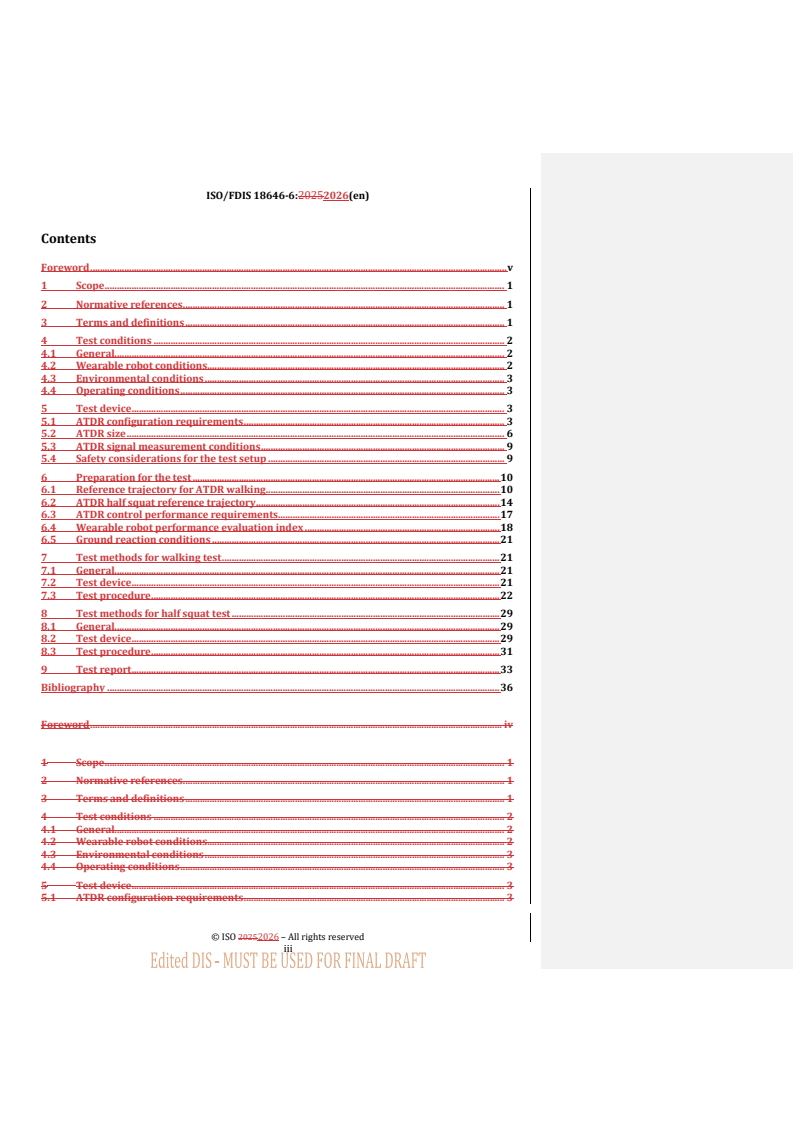
Contents Page
Foreword .iv
1 Scope . 1
2 Normative references . 1
3 Terms and definitions . 1
4 Test conditions . 2
4.1 General .2
4.2 Wearable robot conditions.2
4.3 Environmental conditions .3
4.4 Operating conditions .3
5 Test device . 3
5.1 ATDR configuration requirements .3
5.2 ATDR size .4
5.3 ATDR signal measurement conditions .6
5.4 Safety considerations for the test setup .6
6 Preparation for the test . 6
6.1 Reference trajectory for ATDR walking .6
6.1.1 Configuration of the ATDR reference trajectory.6
6.1.2 Design of ATDR walking reference trajectory .7
6.2 ATDR half squat reference trajectory .8
6.2.1 Configuration of the ATDR reference trajectory.8
6.2.2 Design of ATDR half squat reference trajectory .9
6.3 ATDR control performance requirements .10
6.4 Wearable robot performance evaluation index .11
6.5 Ground reaction conditions . 13
7 Test methods for walking test .13
7.1 General . 13
7.2 Test device . 13
7.3 Test procedure .14
7.3.1 Test principle .14
7.3.2 No-load walking test .16
7.3.3 Loaded walking test .17
8 Test methods for half squat test .18
8.1 General .18
8.2 Test device .18
8.3 Test procedure .19
8.3.1 Test principle .19
8.3.2 No-load half squat test .19
8.3.3 Loaded half squat test .21
9 Test report .21
Bibliography .24
iii
Foreword
ISO (the International Organization for Standardization) is a worldwide federation of national standards
bodies (ISO member bodies). The work of preparing International Standards is normally carried out through
ISO technical committees. Each member body interested in a subject for which a technical committee
has been established has the right to be represented on that committee. International organizations,
governmental and non-governmental, in liaison with ISO, also take part in the work. ISO collaborates closely
with the International Electrotechnical Commission (IEC) on all matters of electrotechnical standardization.
The procedures used to develop this document and those intended for its further maintenance are described
in the ISO/IEC Directives, Part 1. In particular, the different approval criteria needed for the different types
of ISO document should be noted. This document was drafted in accordance with the editorial rules of the
ISO/IEC Directives, Part 2 (see www.iso.org/directives).
ISO draws attention to the possibility that the implementation of this document may involve the use of (a)
patent(s). ISO takes no position concerning the evidence, validity or applicability of any claimed patent
rights in respect thereof. As of the date of publication of this document, ISO had received notice of (a)
patent(s) which may be required to implement this document. However, implementers are cautioned that
this may not represent the latest information, which may be obtained from the patent database available at
www.iso.org/patents. ISO shall not be held responsible for identifying any or all such patent rights.
Any trade name used in this document is information given for the convenience of users and does not
constitute an endorsement.
For an explanation of the voluntary nature of standards, the meaning of ISO specific terms and expressions
related to conformity assessment, as well as information about ISO's adherence to the World Trade
Organization (WTO) principles in the Technical Barriers to Trade (TBT), see www.iso.org/iso/foreword.html.
This document was prepared by Technical Committee ISO/TC 299, Robotics.
A list of all parts in the ISO 18646 series can be found on the ISO website.
Any feedback or questions on this document should be directed to the user’s national standards body. A
complete listing of these bodies can be found at www.iso.org/members.html.
iv
FINAL DRAFT International Standard ISO/FDIS 18646-6:2026(en)
Robotics — Performance criteria and related test methods for
service robots —
Part 6:
Lower-limb wearable robots
1 Scope
This document specifies performance index and related test methods to evaluate the assistance and
enhancement performance of lower-limb wearable robots by using an anthropomorphic test dummy robot
(ATDR).
This document applies to wearable robots that are operated by being attached to lower limbs regardless of
the purpose of use or the driving method (powered/non-powered, electric/hydraulic).
This document does not apply to lower-limb wearable robots that operate based on biosignals such as
electromyography.
2 Normative references
There are no normative references in this document.
3 Terms and definitions
For the purposes of this document, the following terms and definitions apply.
ISO and IEC maintain terminology databases for use in standardization at the following addresses:
— ISO Online browsing platform: available at https:// www .iso .org/ obp
— IEC Electropedia: available at https:// www .electropedia .org/
3.1
wearable robot
robot that supplements or augments physical capabilities by driving human body while attached to a human
Note 1 to entry: Wearable robots are referred to as restraint-type physical assistant robots in ISO 13482.
[SOURCE: ISO 18646-4:2021, 3.2, modified — The words “while attached to a human during use” have been
replaced with “by driving human body while attached to a human”.]
3.2
lower-limb wearable robot
wearable robot attached to (part of) human lower-limbs
3.3
anthropomorphic test dummy robot
ATDR
robot that has a similar configuration to the lower-limb skeleton of a human and actively performs
movements such as walking and half squats while wearing a lower-limb wearable robot
3.4
tester
person who manages and conducts performance evaluation tests, performs ATDR management and writes
up the test result during the test process
3.5
stance phase
period of time in which the foot is in contact with the ground, the state in which weight is exerted to the
ground
Note 1 to entry: Stance phase is divided into heel strike, single-limb support and double-limb support.
3.6
swing phase
period of time in which the foot is not in contact with the ground
3.7
single-limb support
state in which one leg supports the weight and the other leg performs the swing motion
3.8
double-limb support
state in which both legs are in contact with the ground and support the body weight
4 Test conditions
4.1 General
The lower-limb wearable robot (hereinafter referred to as the wearable robot) shall be completely assembled.
The battery shall be charged to a level sufficient for testing. All self-diagnostic tests, if applicable, shall be
satisfactorily completed. It should also be ensured that the robot operates in a safe manner throughout the
test so that no one is injured during the test.
The tests shall be preceded by the preparations for operation as specified by the manufacturer, including
calibration of any relevant sensors that can affect the test results.
All conditions specified in Clause 4 should be satisfied for the tests described in this document, unless stated
otherwise in the specific clauses.
4.2 Wearable robot conditions
The wearable robot shall satisfy the following conditions for the test:
a) The wearable robot used in the test shall be stored at room temperature and tested with sufficient
power required for each test.
b) All accessories required for the use of the wearable robot shall be available during the test.
c) The movable part of the wearable robot shall be warmed up to a state where it can perform the test
operation without difficulty.
d) Tests shall be performed only for:
1) the weight below the payload of the wearable robot;
2) the speeds below the maximum walking speed of the wearable robot;
3) the angles within the maximum range of joint motion of the wearable robot.
e) Before the test, the length of the link of the wearable robot shall be adjusted to ensure proper alignment
with the ATDR joint.
f) When fastening with the ATDR, apply the specified clamping pressure (or tension) of the cuff. If there is
no specified value, fasten it to the extent that two fingers (index and middle finger) can be inserted.
4.3 Environmental conditions
The following environmental conditions shall be maintained during all tests:
— ambient temperature: 10 °C to 30 °C;
— relative humidity: 0 % to 80 %.
If the environmental conditions specified by the manufacturer are outside the given conditions, then this
shall be declared in the test results.
4.4 Operating conditions
All performance shall be measured under normal operating conditions. When the performance is measured
under conditions outside the normal operating conditions, these conditions shall be specified along with the
test results.
5 Test device
5.1 ATDR configuration requirements
The ATDR shall satisfy the following requirements:
a) To connect the wearable robot, it shall consist of an upper body and two legs.
b) It shall be able to perform walking and a half-squat motion on a treadmill. These are the main test
motions.
c) A minimum of two degree of freedom (DOF) active rotational joints (one DOF knee joint, one DOF hip
joint) are required for each leg.
d) The ankle shall be made of rotational joint with one or more degrees of freedom. If the wearable robot
actively assists the ankle joint and its performance evaluation is required, the ankle joint shall be
manufactured as an active rotation joint.
e) To measure and control the joint angle, the rotation angle of the joint shall be measured with an
incremental or absolute encoder.
f) When the ATDR is supported by a harness or structure, the upper body (or neck joint) shall be able
to move up and down and forward and backward so that the upper body can move naturally while
walking. A rotational joint about an axis perpendicular to the sagittal plane for the point of support shall
be provided.
g) To determine the walking state or walking cycle and the suitability of the walking trajectory, it shall be
possible to measure the ground reaction force.
NOTE 1 The ground reaction force can be measured by installing two force sensors on the front and back of the
sole.
h) It shall be possible to measure the angle of the upper body to confirm the control stability of the ATDR
and the repeatability of the posture during the test.
NOTE 2 The posture can be measured with a tilt sensor or an inertial measurement sensor.
i) The ATDR shall be controlled to generate joint motion and a ground reaction force similar to those
generated by humans during walking.
j) The torque and angular velocity of the joint drive motor or the joint shall be measurable.
k) In all tests, a harness (or a device equivalent to the harness) shall be applied to secure the accuracy
and safety of the test and protect the ATDR and the wearable robot from damage. The harness shall
be firmly fixed by a support device. In addition, the harness support device shall be able to maintain
enough rigidity to prevent the ATDR from falling over.
Figure 1 is an example of an ATDR design implemented for testing.
Key
1 passive rotating joint
2 optional (active/passive) prismatic joint
3 active rotational joint
4 active rotational joint
5 optional (active/passive) rotational joint
Figure 1 — ATDR design example
5.2 ATDR size
The wearable robot user’s weight and body size are distributed over a wide range. In general, the wearable
robot can variably adjust the link length according to the body length. It is therefore not necessary to specify
the size of the ATDR by a representative value. In addition, since the ATDR walks while supporting its own
weight or operates with its own power, the weight does not have a significant effect on the test results.
However, in order to maximize the objectivity and universality of the test results, the dimension ratio of
each body part should be similar to IEC 60601-1:2005, Figure A.19. Each body part of the ATDR and its
corresponding height is shown in Figure 2. Table 1 shows example dimensions of body parts. Depending on
the geographical location, the size of the ATDR can vary to better represent the morphology of the users.
Key
1 shoulder height
2 waist height
3 hip height
4 knee height
5 shoulder
6 waist
7 hip
8 knee joint
9 ankle joint
10 waist circumference
11 hip circumference
12 thigh circumference
13 calf circumference
Figure 2 — Size of each body part of the ATDR
Table 1 — Example of ATDR size
Weight 75 ± 32 kg
Thigh circumference 496 ± 119 mm
Calf circumference 365 ± 83 mm
Hip circumference 948 ± 150 mm
Waist circumference 783 ± 200 mm
Shoulder height 1 336 ± 174 mm
Knee high 430 ± 60 mm
Hip height 807 ± 100 mm
Waist height 1 088 ± 108 mm
When measuring the ATDR, the height of the hip of the ATDR is considered to be equal to the height of the
hip joint. The waist of the ATDR is 100 mm to 200 mm above the hip axis of rotation. The circumferences of
the thigh and calf are measured at the midpoint of the ATDR thigh and calf lengths. The weight of the ATDR
is measured using a scale or plantar ground reaction force. The size of the ATDR can be adjusted to a range
outside the values given in Table 1 if there is difficulty in wearing the wearable robot.
5.3 ATDR signal measurement conditions
a) The accuracy of the joint angle measurement shall be 0,1 degrees or better.
b) The ground reaction force shall be measured to verify the similarity to human reference ground reaction
force (GRF) profile (see Reference [5]).
NOTE GRF can be measured either with two force sensors installed per sole or with instrumented treadmill.
c) The sensor for measuring the angle of the upper body shall be measurable in units of 0,5 degrees or less.
d) All sensor signals shall be measured at least 1 000 cycles per second for real-time control.
5.4 Safety considerations for the test setup
For the safety of the tester and to prevent damage to the test system, the test setup shall incorporate
appropriate safety measures. Such measures shall ensure that hazardous situations (e.g. excessive control
error, foot drag, falling of the ATDR or other abnormal operation) can be promptly detected and mitigated.
Examples of possible safety measures include, but are not limited to:
— provision of an emergency stop function that can immediately halt the ATDR and treadmill;
— protective structures or harness systems to prevent the ATDR from falling or causing injury;
— monitoring systems capable of detecting abnormal operation and initiating protective actions.
The specific implementation of safety measures is left to the test facility, as long as the measures provide
adequate protection for the tester and equipment during the tests.
6 Preparation for the test
6.1 Reference trajectory for ATDR walking
6.1.1 Configuration of the ATDR reference trajectory
The reference trajectory for the ATDR walking shall satisfy the following conditions:
a) The ATDR walking reference trajectory shall be divided into a stance phase and a swing phase in the
same way as human walking.
b) In the stance phase, the weight of the ATDR shall be supported by the leg. In the swing phase, the leg of
the ATDR should be moved in the direction of the ATDR walking without ground (or treadmill) contact.
c) The stance phase shall be divided into heel strike, single-limb support and double-limb support.
d) In the heel contact, the heel of the ATDR shall contact the ground (or treadmill) immediately after swing.
e) In the double-limb support, both legs shall be in contact with the ground (or treadmill), supporting the
ATDR weight with both legs. The double-limb support shall appear repeatedly immediately after the
heel strike and single-limb support
f) In the single-limb support, the weight of the ATDR shall be supported by one leg. The leg not supporting
the weight of the ATDR shall perform the swing motion.
NOTE More information on the biomechanics of human walking can be found in Reference [4].
Figure 3 is an example of the configuration of the ATDR walking reference trajectory.
a) Heel strike b) Single support c) Double support
Figure 3 — Example of ATDR walking reference trajectory configuration
6.1.2 Design of ATDR walking reference trajectory
The ATDR walking reference trajectory shall be composed of time trajectories of hip and knee joint angles.
It should be designed based on the trajectories obtained through the measurement of human walking
motion. However, human walking trajectories are diverse and the structure of the human skeleton and the
characteristics of the ATDR mechanism (degree of freedom, joint position and structure, etc.) are different.
This means it can be difficult to implement the human walking trajectory on the ATDR operating on a
treadmill. Therefore, a reference trajectory suitable for the ATDR can be designed and applied through
analysing dynamics and kinematics and by optimizing the gait trajectory to match ATDR’s treadmill walking
conditions.
The trajectories applicable for the ATDR shall be designed to prevent slip between the treadmill moving
at a constant speed and the feet of the ATDR. They shall also be designed to minimize damage to the ATDR
from the impulsive force at heel strike while following the characteristics of the human walking trajectory
(stride length, period, upper body height, sole angle, ground reaction force, etc.) as closely as possible. Such
trajectories can be designed through inverse kinematic analysis, dynamic analysis of the mass centres of the
ATDR parts and optimization to minimize the ground reaction force. The validity of the designed trajectories
can be verified by checking whether the requirements of 6.1.1 are met and the patterns of the joint angle
movement are reasonable for a gait. If the wearable robot to be tested has an active ankle, the ATDR walking
reference trajectory shall include the ankle angle trajectory also.
Figure 4 is an example of reference trajectory generation for the ATDR walking. Figure 4 b) shows the
generated reference trajectories based on the trajectory generation algorithm in Figure 4 a).
a) Reference trajectory generation b) Refe
...
ISO /TC 299
Secretariat: SIS
Date: 2025-11-112026-01-14
Robotics — Performance criteria and related test methods for
service robots — —
Part 6:
Lower-limb wearable robots
Robotique - ExigencesRobots et composants robotiques — Critères de sécurité pour les performance et
méthodes d'essai correspondantes pour robots de service —
Partie 6: Robot portable pour les membres inférieurs
FDIS stage
All rights reserved. Unless otherwise specified, or required in the context of its implementation, no part of this publication
may be reproduced or utilized otherwise in any form or by any means, electronic or mechanical, including photocopying,
or posting on the internet or an intranet, without prior written permission. Permission can be requested from either ISO
at the address below or ISO’s member body in the country of the requester.
ISO copyright office
CP 401 • Ch. de Blandonnet 8
CH-1214 Vernier, Geneva
Phone: + 41 22 749 01 11
Fax: +41 22 749 09 47
EmailE-mail: copyright@iso.org
Website: www.iso.orgwww.iso.org
Published in Switzerland
Fel! Hittar inte referenskälla.
ii
ii
Contents
Foreword . v
1 Scope . 1
2 Normative references . 1
3 Terms and definitions . 1
4 Test conditions . 2
4.1 General. 2
4.2 Wearable robot conditions . 2
4.3 Environmental conditions . 3
4.4 Operating conditions . 3
5 Test device . 3
5.1 ATDR configuration requirements . 3
5.2 ATDR size . 6
5.3 ATDR signal measurement conditions . 9
5.4 Safety considerations for the test setup . 9
6 Preparation for the test . 10
6.1 Reference trajectory for ATDR walking . 10
6.2 ATDR half squat reference trajectory . 14
6.3 ATDR control performance requirements. 17
6.4 Wearable robot performance evaluation index . 18
6.5 Ground reaction conditions . 21
7 Test methods for walking test . 21
7.1 General. 21
7.2 Test device . 21
7.3 Test procedure . 22
8 Test methods for half squat test . 29
8.1 General. 29
8.2 Test device . 29
8.3 Test procedure . 31
9 Test report . 33
Bibliography . 36
Foreword . iv
1 Scope . 1
2 Normative references . 1
3 Terms and definitions . 1
4 Test conditions . 2
4.1 General. 2
4.2 Wearable robot conditions . 2
4.3 Environmental conditions . 3
4.4 Operating conditions . 3
5 Test device . 3
5.1 ATDR configuration requirements . 3
iii
5.2 ATDR size . 5
5.3 ATDR signal measurement conditions . 7
5.4 Emergency stop function . 7
6 Preparation for the test . 7
6.1 Reference trajectory for ATDR walking . 7
6.1.1 Configuration of the ATDR reference trajectory . 7
6.1.2 Design of ATDR walking reference trajectory . 8
6.2 ATDR half squat reference trajectory . 9
6.2.1 Configuration of the ATDR reference trajectory . 9
6.2.2 Design of ATDR half squat reference trajectory . 10
6.3 ATDR control performance requirements. 11
6.4 Wearable robot performance evaluation index . 11
6.5 Ground reaction conditions . 13
7 Test methods for walking test . 13
7.1 General. 13
7.2 Test device . 14
7.3 Test procedure . 14
7.3.1 Test principle . 14
7.3.2 No-load walking test . 16
7.3.3 Loaded walking test . 17
8 Test methods for half squat test . 18
8.1 General. 18
8.2 Test device . 18
8.3 Test procedure . 19
8.3.1 Test principle . 19
8.3.2 No-load half squat test . 19
8.3.3 Loaded half squat test . 20
9 Test report . 21
9.1 General. 21
Bibliography . 25
Fel! Hittar inte referenskälla.
iv
iv
Foreword
ISO (the International Organization for Standardization) is a worldwide federation of national standards
bodies (ISO member bodies). The work of preparing International Standards is normally carried out through
ISO technical committees. Each member body interested in a subject for which a technical committee has been
established has the right to be represented on that committee. International organizations, governmental and
non-governmental, in liaison with ISO, also take part in the work. ISO collaborates closely with the
International Electrotechnical Commission (IEC) on all matters of electrotechnical standardization.
The procedures used to develop this document and those intended for its further maintenance are described
in the ISO/IEC Directives, Part 1. In particular, the different approval criteria needed for the different types of
ISO document should be noted. This document was drafted in accordance with the editorial rules of the
ISO/IEC Directives, Part 2 (see www.iso.org/directives).
ISO draws attention to the possibility that the implementation of this document may involve the use of (a)
patent(s). ISO takes no position concerning the evidence, validity or applicability of any claimed patent rights
in respect thereof. As of the date of publication of this document, ISO had received notice of (a) patent(s) which
may be required to implement this document. However, implementers are cautioned that this may not
represent the latest information, which may be obtained from the patent database available at
www.iso.org/patents.www.iso.org/patents. ISO shall not be held responsible for identifying any or all such
patent rights.
Any trade name used in this document is information given for the convenience of users and does not
constitute an endorsement.
For an explanation of the voluntary nature of standards, the meaning of ISO specific terms and expressions
related to conformity assessment, as well as information about ISO's adherence to the World Trade
Organization (WTO) principles in the Technical Barriers to Trade (TBT), see
www.iso.org/iso/foreword.htmlwww.iso.org/iso/foreword.html.
This document was prepared by Technical Committee ISO/TC 299, Robotics.
A list of all parts in the ISO 18646 series can be found on the ISO website.
Any feedback or questions on this document should be directed to the user’s national standards body. A
complete listing of these bodies can be found at www.iso.org/members.html.
Field Code Changed
v
DRAFT International Standard ISO/DIS 18646-6:2025(en)
Robotics — Performance criteria and related test methods for service
robots —
—
Part 6:
Lower-limb wearable robots
1 Scope
This document specifies performance index and related test methods to evaluate the assistance and
enhancement performance of lower-limb wearable robots by using an anthropomorphic test dummy robot
(ATDR).
This document applies to wearable robots that are operated by being attached to lower limbs regardless of
the purpose of use or the driving method (powered/non-powered, electric/hydraulic).
This document does not apply to lower-limb wearable robots that operate based on biosignals such as
electromyography.
2 Normative references
There are no normative references in this document.
3 Terms and definitions
For the purposes of this document, the following terms and definitions apply.
ISO and IEC maintain terminology databases for use in standardization at the following addresses:
— — ISO Online browsing platform: available at https://www.iso.org/obphttps://www.iso.org/obp
— — IEC Electropedia: available at https://www.electropedia.org/https://www.electropedia.org/
3.1 3.1
wearable robot
robot that supplements or augments physical capabilities by driving human body while attached to a human
Note 1 to entry: Wearable robots are referred to as restraint-type physical assistant robots in ISO 13482.
[SOURCE: ISO 18646-4:2021, 3.2, modified — The words “while attached to a human during use” have been
replaced with “by driving human body while attached to a human”.]
3.2 3.2
lower-limb wearable robot
wearable robot attached to (part of) human lower-limbs
3.3 3.3
anthropomorphic test dummy robot
ATDR
robot that has a similar configuration to the lower-limb skeleton of a human and actively performs movements
such as walking and half squats while wearing a lower-limb wearable robot
3.4 3.4
tester
person who manages and conducts performance evaluation tests, performs ATDR management and writes up
the test result during the test process
3.5 3.5
stance phase
period of time in which the foot is in contact with the ground, the state in which weight is exerted to the ground
Note 1 to entry: Stance phase is divided into heel strike, single-limb support and double-limb support.
3.6 3.6
swing phase
period of time in which the foot is not in contact with the ground
3.7 3.7
single-limb support
state in which one leg supports the weight and the other leg performs the swing motion
3.8 3.8
double-limb support
state in which both legs are in contact with the ground and support the body weight
4 Test conditions
4.1 General
The lower-limb wearable robot (hereinafter referred to as the wearable robot) shall be completely assembled.
And theThe battery shall be charged to a level sufficient for testing. All self-diagnostic tests, if applicable, shall
be satisfactorily completed. It should also be ensured that the robot operates in a safe manner throughout the
test so that no one will beis injured during the test.
The tests shall be preceded by the preparations for operation as specified by the manufacturer, including
calibration of any relevant sensors that can affect the test results.
All conditions specified in Clause 4Clause 4 should be satisfied for the tests described in this document, unless
stated otherwise in the specific clauses.
4.2 Wearable robot conditions
The wearable robot shall satisfy the following conditions for the test:
a) a) The wearable robot used in the test shall be stored at room temperature and tested with
sufficient power required for each test.
b) b) All accessories required for the use of the wearable robot shall be available during the test.
c) c) The movable part of the wearable robot shall be warmed up to a state where it can perform the
test operation without difficulty.
2 © ISO #### 2026 – All rights reserved
d) d) Tests shall be performed only for:
1) 1) the weight below the payload of the wearable robot;
2) 2) the speeds below the maximum walking speed of the wearable robot;
3) 3) the angles within the maximum range of joint motion of the wearable robot.
e) e) Before the test, the length of the link of the wearable robot shall be adjusted to ensure proper
alignment with the ATDR joint.
f) f) When fastening with the ATDR, apply the specified clamping pressure (or tension) of the cuff.
If there is no specified value, fasten it to the extent that two fingers (index and middle finger) can be
inserted.
4.3 Environmental conditions
The following environmental conditions shall be maintained during all tests:
— — ambient temperature: 10 °C to 30 °C;
— — relative humidity: 0 % to 80 %%.
If the environmental conditions specified by the manufacturer are outside the given conditions, then this shall
be declared in the test results.
4.4 Operating conditions
All performance shall be measured under normal operating conditions. When the performance is measured
under conditions outside the normal operating conditions, these conditions shall be specified along with the
test results.
5 Test device
5.1 ATDR configuration requirements
The ATDR shall satisfy the following requirements:
a) a) To connect the wearable robot, it shall consist of an upper body and two legs.
b) b) It shall be able to perform walking and a half-squat motion on a treadmill. These are the main
test motions.
c) c) A minimum of two degree of freedom (DOF) active rotational joints (one DOF knee joint, one
DOF hip joint) are required for each leg.
d) d) The ankle shall be made of rotational joint with one or more degrees of freedom. If the wearable
robot actively assists the ankle joint and its performance evaluation is required, the ankle joint shall be
manufactured as an active rotation joint.
e) e) To measure and control the joint angle, the rotation angle of the joint shall be measured with
an incremental or absolute encoder.
f) f) When the ATDR is supported by a harness or structure, the upper body (or neck joint) shall be
able to move up and down and forward and backward so that the upper body can move naturally while
walking. A rotational joint about an axis perpendicular to the sagittal plane for the point of support shall
be provided.
g) g) To determine the walking state or walking cycle and the suitability of the walking trajectory, it
shall be possible to measure the ground reaction force.
NOTE 1 The ground reaction force can be measured by installing two force sensors on the front and back of the
sole.
h) h) It shall be possible to measure the angle of the upper body to confirm the control stability of
the ATDR and the repeatability of the posture during the test.
NOTE 2 The posture can be measured with a tilt sensor or an inertial measurement sensor.
i) i) The ATDR shall be controlled to generate joint motion and a ground reaction force similar to
those generated by humans during walking.
j) j) The torque and angular velocity of the joint drive motor or the joint shall be measurable.
k) k) In all tests, a harness (or a device equivalent to the harness) shall be applied to secure the
accuracy and safety of the test and protect the ATDR and the wearable robot from damage. The harness
shall be firmly fixed by a support device. In addition, the harness support device shall be able to maintain
enough rigidity to prevent the ATDR from falling over.
Figure 1Figure 1 is an example of an ATDR design implemented for testing.
4 © ISO #### 2026 – All rights reserved
Key
1 passive rotating joint
2 optional (active/passive) prismatic joint
3 active rotational joint
4 active rotational joint
5 optional (active/passive) rotational joint
1 passive rotating joint
2 optional (active/passive) prismatic joint
3 active rotational joint
4 active rotational joint
5 optional (active/passive) rotational joint
Figure 1 — ATDR design example
5.2 ATDR size
The wearable robot user’s weight and body size are distributed over a wide range. In general, the wearable
robot can variably adjust the link length according to the body length. It is therefore not necessary to specify
the size of the ATDR by a representative value. In addition, since the ATDR walks while supporting its own
weight or operates with its own power, the weight does not have a significant effect on the test results.
However, in order to maximize the objectivity and universality of the test results, the dimension ratio of each
body part should be similar to IEC 60601-1:2005, Figure A.19. Each body part of the ATDR and its
corresponding height is shown in Figure 2. Table 1Figure 2. Table 1 shows example dimensions of body parts
. Depending on the geographical location, the size of the ATDR can vary to better represent the morphology of
the users.
6 © ISO #### 2026 – All rights reserved
Key
1 shoulder height 8 knee joint
2 waist height 9 ankle joint
3 hip height 10 waist circumference
4 knee height 11 hip circumference
5 shoulder 12 thigh circumference
6 waist 13 calf circumference
7 hip
1 shoulder height
2 waist height
3 hip height
4 knee height
5 shoulder
6 waist
7 hip
8 knee joint
9 ankle joint
10 waist circumference
11 hip circumference
12 thigh circumference
13 calf circumference
Figure 2 — Size of each body part of the ATDR
8 © ISO #### 2026 – All rights reserved
Table 1 — Example of ATDR size
Weight 75 ± 32 kg
Thigh circumference 496 ± 119 mm
Calf circumference 365 ± 83 mm
Hip circumference 948 ± 150 mm
Waist circumference 783 ± 200 mm
Shoulder height 1 336 ± 174 mm
Knee high 430 ± 60 mm
Hip height 807 ± 100 mm
Waist height 1 088 ± 108 mm
When measuring the ATDR, the height of the hip of the ATDR is considered to be equal to the height of the hip
joint. The waist of the ATDR is 100 mm to 200 mm above the hip axis of rotation. The circumferences of the
thigh and calf are measured at the midpoint of the ATDR thigh and calf lengths. The weight of the ATDR is
measured using a scale or plantar ground reaction force. The size of the ATDR can be adjusted to a range
outside the values given in Table 1Table 1 if there is difficulty in wearing the wearable robot.
5.3 ATDR signal measurement conditions
a) a) The accuracy of the joint angle measurement shall be 0,1 degrees or better.
b) b) The ground reaction force shall be measured to verify the similarity to human reference ground
reaction force (GRF) profile (see Reference [5]) . [5]).
NOTE GRF can be measured either with two force sensors installed per sole or with instrumented treadmill.
c) c) The sensor for measuring the angle of the upper body shall be measurable in units of
0,5 degrees or less.
d) d) All sensor signals shall be measured at least 1 000 cycles per second for real-time control.
5.4 Safety considerations for the test setup
For the safety of the tester and to prevent damage to the test system, the test setup shall incorporate
appropriate safety measures. Such measures shall ensure that hazardous situations (e.g. excessive control
error, foot drag, falling of the ATDR, or other abnormal operation) can be promptly detected and mitigated.
Examples of possible safety measures include, but are not limited to:
— — provision of an emergency stop function that can immediately halt the ATDR and treadmill;
— — protective structures or harness systems to prevent the ATDR from falling or causing injury;
— — monitoring systems capable of detecting abnormal operation and initiating protective actions.
The specific implementation of safety measures is left to the test facility, as long as the measures provide
adequate protection for the tester and equipment during the tests.
6 Preparation for the test
6.1 Reference trajectory for ATDR walking
6.1.1 Configuration of the ATDR reference trajectory
The reference trajectory for the ATDR walking shall satisfy the following conditions:
a) a) The ATDR walking reference trajectory shall be divided into a stance phase and a swing phase
in the same way as human walking.
b) b) In the stance phase, the weight of the ATDR shall be supported by the leg. In the swing phase,
the leg of the ATDR should be moved in the direction of the ATDR walking without ground (or treadmill)
contact.
c) c) The stance phase shall be divided into heel strike, single-limb support and double-limb
support.
d) d) In the heel contact, the heel of the ATDR shall contact the ground (or treadmill) immediately
after swing.
e) e) In the double-limb support, both legs shall be in contact with the ground (or treadmill),
supporting the ATDR weight with both legs. The double-limb support shall appear repeatedly
immediately after the heel strike and single-limb support
f) f) In the single-limb support, the weight of the ATDR shall be supported by one leg. The leg not
supporting the weight of the ATDR shall perform the swing motion.
NOTE More information on the biomechanics of human walking can be found in Reference [4]. [4].
Figure 3Figure 3 is an example of the configuration of the ATDR walking reference trajectory.
10 © ISO #### 2026 – All rights reserved
(a) Heel strike (b) Single support (c) Double support
a) Heel strike b) Single support c) Double support
Figure 3 — Example of ATDR walking reference trajectory configuration
6.1.2 Design of ATDR walking reference trajectory
The ATDR walking reference trajectory shall be composed of time trajectories of hip and knee joint angles. It
should be designed based on the trajectories obtained through the measurement of human walking motion.
However, human walking trajectories are diverse, and the structure of the human skeleton and the
characteristics of the ATDR mechanism (degree of freedom, joint position and structure, etc.) are different.
This means it can be difficult to implement the human walking trajectory on the ATDR operating on a
treadmill. Therefore, a reference trajectory suitable for the ATDR can be designed and applied through
analysing dynamics and kinematics, and by optimizing the gait trajectory to match ATDR’s treadmill walking
conditions.
The trajectories applicable for the ATDR shall be designed to prevent slip between the treadmill moving at a
constant speed and the feet of the ATDR. They shall also be designed to minimize damage to the ATDR from
the impulsive force at heel strike while following the characteristics of the human walking trajectory (stride
length, period, upper body height, sole angle, ground reaction force, etc.) as closely as possible. Such
trajectories can be designed through inverse kinematic analysis, dynamic analysis of the mass centres of the
ATDR parts and optimization to minimize the ground reaction force. The validity of the designed trajectories
can be verified by checking whether the requirements of 6.1.16.1.1 are met and the patterns of the joint angle
movement are reasonable for a gait. If the wearable robot to be tested has an active ankle, the ATDR walking
reference trajectory shall include the ankle angle trajectory also.
Figure 4Figure 4 is an example of reference trajectory generation for the ATDR walking. Figure 4(b)Figure 4
b) shows the generated reference trajectories based on the trajectory generation algorithm in
Figure 4(a).Figure 4 a).
(a) Reference trajectory generation algorithm (b) Reference trajectory generation result
Key
X time(sec)
Y1 hip joint angle (deg)
Y2 knee joint angle (deg)
1 left hip joint angle
2 right hip joint angle
3 left knee joint angle
4 right knee joint angle
Figure 4 — Example of the reference trajectory generation for ATDR walking
12 © ISO #### 2026 – All rights reserved
The reference trajectory applied to the test shall be specified in the test result report.
6.2 ATDR half squat reference trajectory
6.2.1 Configuration of the ATDR reference trajectory
The ATDR half squat reference trajectory shall satisfy the following conditions:
a) a) The soles of the feet shall remain in contact with the ground.
b) b) With the feet in contact with the ground, the ATDR shall support its weight with the legs and
move the upper body upward and downward.
c) c) As the upper body moves downward,
...
Questions, Comments and Discussion
Ask us and Technical Secretary will try to provide an answer. You can facilitate discussion about the standard in here.
Loading comments...