

ISO 22166-201:2024
(Main)Robotics — Modularity for service robots — Part 201: Common information model for modules
General Information
- Abstract
This document specifies requirements and guidelines for the common information model (CIM) for modules of service robots to achieve interoperability, reusability, and composability. This document specifies the structure of the CIM and details the intended use and meaning of its attributes and subclasses. This document applies to service robots.
- Status
- Published
- Publication Date
- 22-Feb-2024
- Technical Committee
- ISO/TC 299 - Robotics
- Drafting Committee
- ISO/TC 299 - Robotics
- Current Stage
- 6060 - International Standard published
- Start Date
- 23-Feb-2024
- Due Date
- 17-Mar-2024
- Completion Date
- 23-Feb-2024

Overview
ISO 22166-201:2024 - "Robotics - Modularity for service robots - Part 201: Common information model for modules" defines a Common Information Model (CIM) for modules used in service robots. The standard specifies the structure, required attributes and subclasses, and intended meanings to promote interoperability, reusability, and composability of hardware, software and hybrid modules. It applies to service robots and supports module design, selection, integration, operation and maintenance.
Key technical topics and requirements
- CIM structure and classes: The standard defines a meta-model composed of submodels including:
- Module ID (unique identifier for modules and composite modules)
- Properties (initialization and environmental constraints)
- Input and Output Variables (I/O interfaces)
- Status (runtime state and health)
- Services (capabilities) (exposed functions and APIs)
- Infrastructure (networking/communication context)
- Safety and Security (safety integrity, performance levels, protections)
- Modelling (behavioral and design metadata)
- Executable Form (packaging and runtime form of software/firmware)
- Mandatory vs optional items: Table 4.1 and related text identify which CIM items are mandatory for all module types and which are optional, depending on hardware/software characteristics.
- Naming and identifiers: Annex A provides naming rules; Annex B prescribes assignment rules for Module ID to guarantee unique identification (aligned with UUID practices referenced in RFC 4122).
- Representation and usage: Annex C shows representation examples (XML used illustratively); Annex D explains how CIM information is applied during design, integration, operation and maintenance. Annex E gives a class representation format.
- Normative references: ISO 22166-1:2021 (modularity principles), IETF RFC 4122 (UUID), and POSIX (IEEE 1003.1).
Practical applications and users
Who benefits:
- Module makers designing hardware, software or hybrid modules
- Robot integrators and system integrators assembling composite systems
- Robot manufacturers and developers who need consistent module descriptions
- Maintenance and operations teams using standardized status, safety and executable metadata
Practical uses:
- Standardized module catalogs for easier module selection and procurement
- Plug-and-play integration of modules across vendors to accelerate development
- Clear metadata for lifecycle management, diagnostics and software deployment
- Consistent safety/security descriptors to support compliance and risk assessment
Related standards
- ISO 22166-1:2021 - Modularity general requirements and nine modularity principles
- ISO 22166-202 (implementation model planned) - example implementation for software modules
- IETF RFC 4122 - UUID usage for unique Module IDs
- IEEE/Open Group 1003.1-2017 (POSIX) - referenced for runtime/executable considerations
ISO 22166-201:2024 provides a practical, vendor-neutral foundation for building modular, interoperable service-robot ecosystems through a shared common information model.
Get Certified
Connect with accredited certification bodies for this standard

DVS-ZERT GmbH
German welding certification society.
CARES (UK Certification Authority for Reinforcing Steels)
UK certification for reinforcing steels and construction.
EWF/IIW (European/International Welding Federation)
International welding personnel certification.
Sponsored listings
Frequently Asked Questions
ISO 22166-201:2024 is a standard published by the International Organization for Standardization (ISO). Its full title is "Robotics — Modularity for service robots — Part 201: Common information model for modules". This standard covers: This document specifies requirements and guidelines for the common information model (CIM) for modules of service robots to achieve interoperability, reusability, and composability. This document specifies the structure of the CIM and details the intended use and meaning of its attributes and subclasses. This document applies to service robots.
This document specifies requirements and guidelines for the common information model (CIM) for modules of service robots to achieve interoperability, reusability, and composability. This document specifies the structure of the CIM and details the intended use and meaning of its attributes and subclasses. This document applies to service robots.
ISO 22166-201:2024 is classified under the following ICS (International Classification for Standards) categories: 25.040.30 - Industrial robots. Manipulators. The ICS classification helps identify the subject area and facilitates finding related standards.
ISO 22166-201:2024 is available in PDF format for immediate download after purchase. The document can be added to your cart and obtained through the secure checkout process. Digital delivery ensures instant access to the complete standard document.
Standards Content (Sample)
International
Standard
ISO 22166-201
First edition
Robotics — Modularity for service
2024-02
robots —
Part 201:
Common information model for
modules
Robotique — Modularité des robots de service —
Partie 201: Modèle d'information commun pour les modules
Reference number
© ISO 2024
All rights reserved. Unless otherwise specified, or required in the context of its implementation, no part of this publication may
be reproduced or utilized otherwise in any form or by any means, electronic or mechanical, including photocopying, or posting on
the internet or an intranet, without prior written permission. Permission can be requested from either ISO at the address below
or ISO’s member body in the country of the requester.
ISO copyright office
CP 401 • Ch. de Blandonnet 8
CH-1214 Vernier, Geneva
Phone: +41 22 749 01 11
Email: copyright@iso.org
Website: www.iso.org
Published in Switzerland
ii
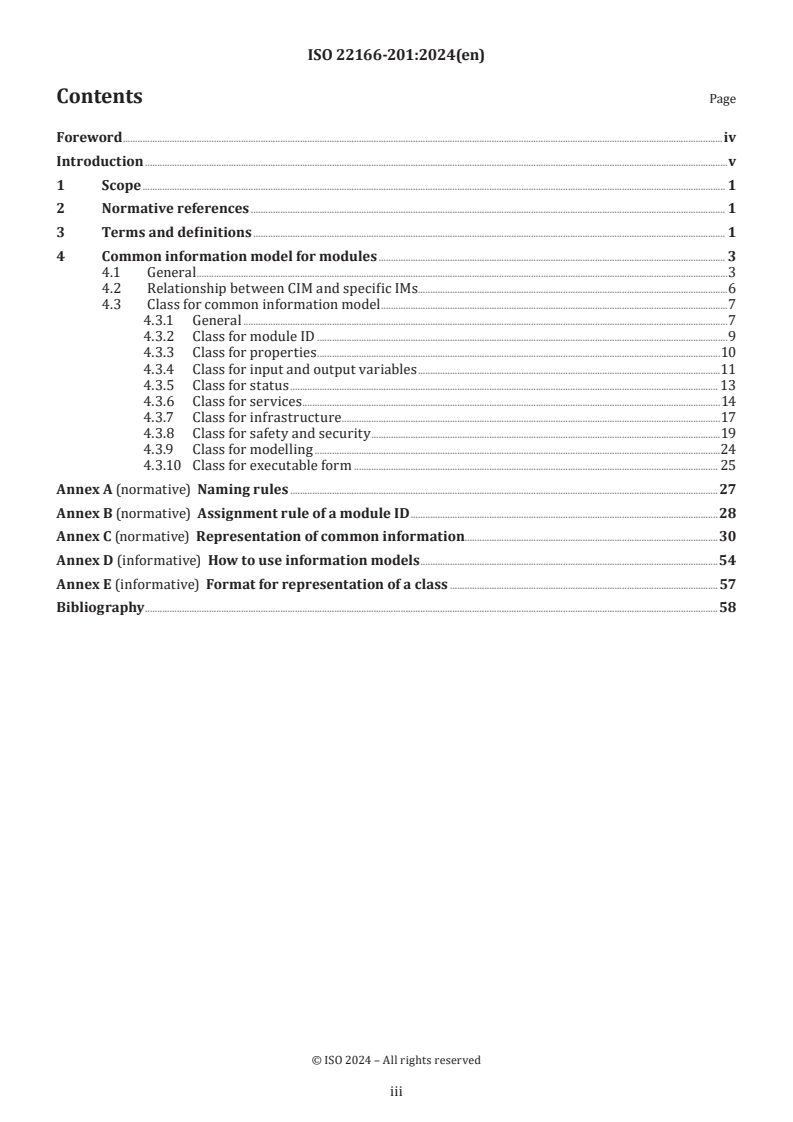
Contents Page
Foreword .iv
Introduction .v
1 Scope . 1
2 Normative references . 1
3 Terms and definitions . 1
4 Common information model for modules . 3
4.1 General .3
4.2 Relationship between CIM and specific IMs .6
4.3 Class for common information model .7
4.3.1 General .7
4.3.2 Class for module ID .9
4.3.3 Class for properties .10
4.3.4 Class for input and output variables .11
4.3.5 Class for status . 13
4.3.6 Class for services .14
4.3.7 Class for infrastructure . .17
4.3.8 Class for safety and security .19
4.3.9 Class for modelling .24
4.3.10 Class for executable form . 25
Annex A (normative) Naming rules .27
Annex B (normative) Assignment rule of a module ID .28
Annex C (normative) Representation of common information.30
Annex D (informative) How to use information models .54
Annex E (informative) Format for representation of a class .57
Bibliography .58
iii
Foreword
ISO (the International Organization for Standardization) is a worldwide federation of national standards
bodies (ISO member bodies). The work of preparing International Standards is normally carried out through
ISO technical committees. Each member body interested in a subject for which a technical committee
has been established has the right to be represented on that committee. International organizations,
governmental and non-governmental, in liaison with ISO, also take part in the work. ISO collaborates closely
with the International Electrotechnical Commission (IEC) on all matters of electrotechnical standardization.
The procedures used to develop this document and those intended for its further maintenance are described
in the ISO/IEC Directives, Part 1. In particular, the different approval criteria needed for the different types
of ISO document should be noted. This document was drafted in accordance with the editorial rules of the
ISO/IEC Directives, Part 2 (see www.iso.org/directives).
ISO draws attention to the possibility that the implementation of this document may involve the use of (a)
patent(s). ISO takes no position concerning the evidence, validity or applicability of any claimed patent
rights in respect thereof. As of the date of publication of this document, ISO had not received notice of (a)
patent(s) which may be required to implement this document. However, implementers are cautioned that
this may not represent the latest information, which may be obtained from the patent database available at
www.iso.org/patents. ISO shall not be held responsible for identifying any or all such patent rights.
Any trade name used in this document is information given for the convenience of users and does not
constitute an endorsement.
For an explanation of the voluntary nature of standards, the meaning of ISO specific terms and expressions
related to conformity assessment, as well as information about ISO's adherence to the World Trade
Organization (WTO) principles in the Technical Barriers to Trade (TBT), see www.iso.org/iso/foreword.html.
This document was prepared by Technical Committee ISO/TC 299, Robotics.
A list of all parts in the ISO 22166 series can be found on the ISO website.
Any feedback or questions on this document should be directed to the user’s national standards body. A
complete listing of these bodies can be found at www.iso.org/members.html.
iv
Introduction
This document provides a common information model (CIM) for modules which compose service robots
based on ISO 22166-1. Based on the CIM, modules can easily be connected and data exchanged between
them. It has been designed to enhance the interoperability, reusability, and composability of modules. CIM
is a meta-model and is a base model for all kinds of modules such as hardware modules, modules with
hardware and software aspects, software modules, and their composite modules. Hence CIM provides meta
characteristics that modules should possess.
Module makers, module integrators, robot makers, robot developers, and robot system integrators are
able to use CIM in order to obtain the necessary modules more easily, utilize various modules according to
function and budget, and develop a new (composite) module based on CIM. The CIM is able to make design of
modules, operation and maintenance of service robots help.
The CIM provides four information types:
— information for module identification;
— information for module selection;
— information for module integration;
— information for module operation and maintenance.
The CIM, as a meta model, consists of number of submodels, which are Module ID, Properties, Input and
Output Variables, Status, Services, Infrastructure, Safety and Security Level, Modelling, Executable Form.
The implementation model of CIM will be provided in upcoming standards, with an example being
ISO 22166-202 for software modules.
The ISO 22166 series applies to composite modules and various types of service robots.
This document presents requirements and guidelines on the information model of a service robot’s modules
for ensuring nine principles of modularity presented in ISO 22166-1.
v
International Standard ISO 22166-201:2024(en)
Robotics — Modularity for service robots —
Part 201:
Common information model for modules
1 Scope
This document specifies requirements and guidelines for the common information model (CIM) for modules
of service robots to achieve interoperability, reusability, and composability.
This document specifies the structure of the CIM and details the intended use and meaning of its attributes
and subclasses.
This document applies to service robots.
2 Normative references
The following documents are referred to in the text in such a way that some or all of their content constitutes
requirements of this document. For dated references, only the edition cited applies. For undated references,
the latest edition of the referenced document (including any amendments) applies.
ISO 22166-1:2021, Robotics — Modularity for service robots — Part 1: General requirements
IETF RFC 4122, A Universally Unique IDentifier (UUID) URN Namespace
IEEE/Open Group 1003.1-2017, IEEE Standard for Information Technology--Portable Operating System
Interface (POSIX(TM)) Base Specifications, Issue 7
3 Terms and definitions
For the purposes of this document, the following terms and definitions apply.
ISO and IEC maintain terminology databases for use in standardization at the following addresses:
— ISO Online browsing platform: available at https:// www .iso .org/ obp
— IEC Electropedia: available at https:// www .electropedia .org/
3.1
information model
IM
abstraction and representation of the entities in a managed environment, their properties, operations, and
the way that they relate to each other
[SOURCE: ISO 22166-1:2021, 3.1.11 — modified]
3.2
common information model
CIM
information model that modules most frequently use in service robots
3.3
module
component or assembly of components with defined interfaces accompanied with property profiles to
facilitate system design, integration, interoperability, and reuse
[SOURCE: ISO 22166-1:2021, 3.3.12]
3.4
module property
attribute or characteristic of a module
[SOURCE: ISO 22166-1:2021, 3.3.14]
3.5
software module
module whose implementation consists purely of programmed algorithms
[SOURCE: ISO 22166-1:2021, 3.4.4]
3.6
hardware module
module whose implementation consists purely of physical parts, including mechanical parts, electronic
circuits, and any software, such as firmware, not externally accessible through the communication interface
[SOURCE: ISO 22166-1:2021, 3.4.3]
3.7
module with hardware aspects and software aspects
hardware-software module
module whose implementation consists of physical parts, software, and a communication interface that
allows data exchange with other modules
3.8
module manager
functions for lifecycle management of module instances including instantiation of modules
3.9
instance
particular entity instantiated from a specific software module or particular entity of a specific module in
hardware aspects
Note 1 to entry: In object-oriented programming, instance means a specific realization of an object.
Note 2 to entry: In hardware aspects, instance means one of the same modules used in a composite module.
3.10
performance level
PL
discrete level used to specify the ability of safety-related parts of control systems to perform a safety
function under foreseeable conditions
[SOURCE: ISO 13849-1:2023]
3.11
safety integrity level
SIL
discrete level (one out of a possible three) for describing the capability to perform a safety function where
safety integrity level three has the highest level, and safety integrity level one has the lowest
[SOURCE: IEC 62061:2021, 3.11]
3.12
executable form
form of the code in which the software or firmware is managed and controlled completely by the operational
environment of the module and does not require compilation (e.g. no source code, object code, or just-in-time
compiled code)
Note 1 to entry: Its two primary types are compiled programs and scripts.
Note 2 to entry: It can include the set of files and/or directories that make up a complete module or be a single file.
[SOURCE: ISO/IEC 19790:2012, 3.42]
3.13
hardware aspects
information regarding properties and functions necessary for a module and its physical interconnection and
regarding the allowed range of physical properties of the operational environment
[SOURCE: ISO 22166-1:2021, 3.3.5]
3.14
software aspects
information regarding the external software properties necessary for a module and its interface and the
execution life cycle of that module’s function
[SOURCE: ISO 22166-1:2021, 3.3.21]
4 Common information model for modules
4.1 General
Common information for modules shall consist of the items in Table 4.1. The naming of properties and
classes used in the information model shall follow the naming rules in Annex A. In Table 4.1, the symbols
“M” and “O” denote mandatory and optional, respectively. CIM in Figure 4.1 is described in detail in 4.3. The
class models for CIM are drawn based on ISO/IEC 19505-1:2012. The information provided in Table 4.1 and
Figure 4.1 can be used in the design, development, operation, and maintenance stages and Annex D shows at
which stage the information provided by the information model is used.
NOTE 1 A CIM for managing the common information in Table 4.1 is illustrated in Figure 4.4.
NOTE 2 In this document, CIM representation in XML is used just as examples to help readers understand the
meaning of attributes in the class model.
“Module Name” of Item No. 1 in Table 4.1 is the name representing the module. Hereafter, Item No. “N” in
Table 4.1 is abbreviated as Item “N”.
“Description” of Item 2 provides the overview of the module, what the module is, what it does, and how it is
used.
“Manufacturer” of Item 3 provides contact information for the designer, developer, or manufacturer of the
module.
“Examples” of Item 4 provides typical use cases of the module.
“Information model version” of Item 5 is the version number of the information model that this document
specifies.
Table 4.1 — Common information for modules and the corresponding group tag (used in Figure 4.4)
c
Information models for modules
Common Related group/tag name
hard-
No. Item information (Abbreviation of each
ware-soft- hardware software
b
model group)
ware module module
module
1 Module Name M M M M
2 Description O O O O
GenInfo
3 Manufacturer M M M M
4 Examples O O O O
5 Information model version M M M M
6 Module ID M M M M
IDnType
7 Hardware Aspects O M M -
8 Software Aspects O M - M
a
9 Module properties M M M M Properties
10 Inputs O O O O
IOVariables
11 Outputs O O O O
12 Status O O O M —
13 Services (capabilities) O M O M Services
14 Infrastructure O O M M Infra
15 Safety/security O M O M SafeSecure
16 Modelling O O O O Modelling
17 ExecutableForm O O O M ExecutableForm
a
It is mandatory only to those which can be influenced (set) from the outside or at least to those which have an expected effect
on other modules.
b
All items are mandatory for CIM.
c
For information models such as hardware-software modules, hardware modules, or software modules, some types of items
can be omitted depending on their functionalities. In particular, for information models of hardware modules and software
modules, the items “software aspects” and “hardware aspects” are not included, respectively.
“Module ID” of Item 6 shall be the unique identifier of the module within a system as described in Annex B.
Module ID includes information such as which type a module is, hardware-software, hardware, or software,
and whether a module is a basic or a composite module.
“Hardware Aspects” of Item 7 and “Software Aspects” of Item 8 relate only to composite modules. If a module
is composed of two or more hardware-software modules, software modules, and/or hardware modules, the
module IDs are listed in “Hardware Aspects” if they are hardware or hardware-software modules, otherwise
(if they are software modules) the module IDs are listed in “Software Aspects”.
“Module properties” of Item 9 are values that are generally used in the initialization of modules. Module
properties are classified into mandatory and optional, and shall be listed. The relationship between
modules is represented in this item, whose detailed contents will be provided in upcoming standards such
as ISO 22166-202.
NOTE 3 Information about the relationships between modules can be provided differently depending on the module
type.
NOTE 4 Environment constraints are also considered as properties, examples of which are operating temperature,
operating humidity, and maximum allowed mechanical shock. These parameters related to the behaviours of
the module can be set in the properties. For example, each coefficient used in the PID (Proportional, Integral and
Differential) control algorithm is used once in initialization and is changed and used several times during the execution
of related software modules.
“Inputs/Outputs” of Items 10 and 11 describe the names of variables for data transfer into and/or out of a
module.
EXAMPLE 1 Inputs and outputs of a servo control software module are the encoder value and motor control values,
respectively.
NOTE 5 Properties are kinds of input values from the viewpoint of modules, but have to be distinguished in that
Inputs are related to the environment of the module, but Properties are related to parameters contained in the
module. For example, Inputs of the servo control software module are encoder values, but its Properties are P, I, and D
coefficients, where P, I, and D denote Proportional, Integral and Differential.
“Status” of Item 12 describes the status of a module that is operating.
NOTE 6 Status is not utilized at design and development stages.
“Services (capabilities)” of Item 13 describes the interfaces that a module provides and utilizes for robot
services.
NOTE 7 Service means performing one or more functions of a module for other modules via a pre-described
interface.
EXAMPLE 2 Examples of function format for software aspects are shown in Table 4.2. In this example, data types
such as int16 and unit 8 are defined in Table C.5.
Table 4.2 — Example of function format for software modules
Name Arguments Return value Description
Initialization using 2 arguments
Integer init_ival1,
Integer Return value:
Real init_rval2
(0: success, negative value: error type)
initialize
Integer init_ival1, Initialization using 3 arguments
Real init_rval2, Integer Return value:
Integer init_ival3 (0: success, negative value: error type)
EXAMPLE 3 An example of a function format for an electrical/electronic aspect is shown in Table 4.3, where the
arguments “connType”, “keying”, and “busProtocol” mean the type of connector, the gender of the connector, and the
protocol type that the module uses. The function is used to check that the peer module utilizes the proper electrical
aspects of the module. Values for connector type can be USB-A, RJ45, DB-9, etc. The value for keying is male or female.
Values for busProtocol can be USB, Ethernet, EtherCAT, RS232, etc.
Table 4.3 — Example of function format for electrical/electronic adaptability
Name Arguments Return value Description
Check electrical/electronic adaptability
String connType,
using 3 arguments
checkElecConnectivity String keying, Boolean
Return value:
String busProtocol
(True: success, False: error)
EXAMPLE 4 Examples of a function format for mechanical aspects are provided in Table 4.4. As in the electrical/
electronic aspect, the function is used to check that the peer module is utilizing the proper mechanical aspects of the
module. However, unlike the electrical/electronic aspect, the function format for the mechanical aspect can be more
complicated due to a huge variety being used in practice. Consequently, only two simplified categories are listed here,
joint and link.
Table 4.4 — Example of function format for mechanical adaptability
Name Arguments Return value Description
Real origin, Real mass, Real
Check mechanical link adaptability
Inertia[], String shape,
using 8 arguments
linkConnectivity Real size, Real axis[], Boolean
Return value:
String connection,
(True: success, False: error)
Real collision[]
Check mechanical joint adaptability
Real origin[], Real axis[],
using 5 arguments
jointConnectivity Real limits, Real damping, Boolean
Return value:
Real friction
(True: success, False: error)
“Infrastructure” of Item 14 lists hardware and/or software that the modules commonly use or connect to.
EXAMPLE 5 Examples of Infrastructure are power type, middleware type, databus type, and database type.
“Safety/Security” of Item 15 describes the safety-related performance level and the security information
provided by the module.
For the Safety/Security of a general service robot, a safety-related performance level is used for the module,
which is defined in ISO 13849-1, and the security-related level is listed for the module, where the security
level is “0 – 4”. Security level “0” means that there are no security measures. The security levels “1-4” are
defined in IEC 62443-4-2:2019. However, for specific robot types such as medical robots and physical
assistant robots, other safety-related standards and security standards should be utilized. A performance
level is generally provided for each single safety function. If a module has several safety functions, the
module shall provide a performance level of the module using the combination of the performance levels of
all the safety functions of the module or via verification and validation of the module’s overall safety-related
function. The details are provided in 4.3.8.
“Modelling” of Item 16 provides different kinds of models for simulation or design purposes.
“ExecutableForm” of Item 17 provides program codes executed to achieve or support the module’s purpose.
Classes provided in this document are able to be described using the table format in Annex E.
4.2 Relationship between CIM and specific IMs
The common information model for modules shall be used in information models for all types of modules,
which are hardware-software modules, software modules, and hardware modules. Their relationships are
shown in Figure 4.1. Hardware-software modules are composed of hardware aspects and software aspects.
The relationship between information models of hardware modules, software modules, and hardware-
software modules is illustrated in Figure 4.2.
Figure 4.1 — Relationships between information models for modules
Figure 4.2 — Example of relationships between information models of modules
4.3 Class for common information model
4.3.1 General
The common information model shall be grouped into 9 inner classes as illustrated in Figure 4.3, where
eight classes are suggested from Table 4.1 and an additional class, Status, is related to the status-related
information of a module. This class is mainly used during operation of the module. The four items of the
GenInfo group in Table 4.1, which are Module name, Description, Manufacturer, and Examples, become the
member attributes of the class Common Information Model (CIM).
Figure 4.3 — Classes of the common information model
The class CIM (Common Information Model) shall have attributes given in Figure 4.4 and Table 4.5 and
its attributes are based on ISO 22166-1:2021, Clauses 4 to 7. Values of attributes such as ModuleName,
Description, Manufacturer, and Examples are provided in Annex C. IDnType, Properties, IOVariables,
Status, services, infrastructure, SafeSecure, modelling, and ExecutableForm in Figure 4.4 refer to the class
described in 4.3.2 to 4.3.10.
NOTE 1 Attributes can be declared as one of the following: private (-), protected (*), or public (+). The name of an
attribute is given first and the data type of the attribute is defined next. The separation symbol between an attribute’s
name and its data type is a colon (:). If attributes are declared as public, it is not necessary to define the functions to
access those attributes.
NOTE 2 The four items moduleName, description, manufacturer, and examples are attributes of class CIM.
Figure 4.4 — Class diagram of class CIM
Table 4.5 — Class CIM
Description: The root class for the CIM (Common Information Model).
Derived From: N/A
Attributes:
moduleName String M 1 The name representing the module
description String O 1 The overview of the module, what the module is, what
it does, and how it is used.
manufacturer String M 1 The contact information for the designer, developer,
or manufacturer of the module
examples String O 1 Typical use cases of the module
idnType IDnType M 1 The module ID includes a unique identifier, instance
ID, and owned software/hardware aspects as their
IDs. See the details in 4.3.2.
properties Properties M 1 A list of configurable parameters of the module. See
the details in 4.3.3.
ioVariables IOVariables O 1 Information for Input and Output Variables of a module.
See the details in 4.3.4
status Status O 1 Information for the status and health condition of a
module. See the details in 4.3.5
services Services O 1 The interfaces that a module provides and utilizes for
robot services. See the details in 4.3.6.
infra Infrastructure O 1 Information for the infrastructure of a module includes
Electric Power, Data Bus, Database, and Ingress Pro-
tection. See the details in 4.3.7
TTabablele 4 4.55 ((ccoonnttiinnueuedd))
safeSecure SafeSecure O 1 The safety level and the security level that the module
provides. See the details in 4.3.8.
modelling Modelling O 1 The modelling-related information that the module
supports for simulation. See the details in 4.3.9.
execForm ExecutableForm O 1 The program-related information executed to achieve
or support the purpose of the module. See the details
in 4.3.10.
4.3.2 Class for module ID
Information for a Module ID shall be defined in class IDnType which shall have attributes given in Figure 4.5
and Table 4.6. Values of the attribute “moduleID” and other attributes in Table 4.6 are provided via Annex B
and Annex C. When the same type of modules are used in a composite module, the modules shall be identified
individually. For this purpose, an Instance ID (or IID) is needed. An IID for a software module is dynamically
assigned by the module manager. An IID for a module with hardware aspects is statically assigned by the
module manufacturer. An IID shall be unique if it is used. The information model version is the version
number of the information model used when the module is specified. The information model version is
upgraded whenever attributes (including methods) of the classes presented in this document are updated.
NOTE 1 A module with hardware aspects is a hardware module or a module with hardware and software aspects.
The attributes “hwAspects” and “swAspects” are lists of module IDs for hardware aspects and software
aspects, respectively.
On the instantiation of this class, the instanceID shall be set using its moduleID. If a module is added to
a composite module, the composite module shall check whether or not its moduleID is duplicated in the
composite module. If duplicated (or the same module exists), the module manager/composite module
manufacturer shall assign a new instance ID to the module.
NOTE 2 The Module ID is provided by the manufacturer of a module.
NOTE 3 The moduleID including IID is used in order to access the module. The default IID is “0”.
NOTE 4 The informationModelVersion is “1.0” when the information model defined in this document is used.
Figure 4.5 — Class diagram of class IdnType
Table 4.6 — Class IDnType
Description: Information for Module ID shall be defined in class IDnType.
Derived From: N/A
Attributes:
moduleID String M 1 See Annex B for the moduleID format
iID UnlimitedNatural M 1 Instance ID, default value = 0.
TTabablele 4 4.66 ((ccoonnttiinnueuedd))
informationModelVersion String M 1 Version number of the information model
hwAspects String O N List of module IDs for hardware modules and mod-
ules with hardware aspects and software aspects
swAspects String O N List of module IDs for software modules
4.3.3 Class for properties
Information for properties of a module shall be defined in class Properties which shall provide the properties
of a module as in Figure 4.6 and Tables 4.7 to 4.9, which include information necessary for the execution of
the module and information about the operating environment or condition of the module. Figure 4.6 is the
class diagram for class Properties and shows the relationship between classes given in Table 4.7 to Table 4.9.
These detailed attributes such as the member name and the related data type shall be defined using values
of the tag “Property” in Annex C.
The following examples are given in XML and have to be transformed as in Figure 4.6:
“maximum of rated current for motor” />
“Angle Resolution of Lidar Sensor” />
“minimum operation range of Lidar Sensor” />
operation range of Lidar Sensor” />
description = “communication protocol type of Lidar Sensor” />
Lidar Sensor” /> <-- example for hardware-software module -->
radius for Obstacle Avoidance” />
radius for Obstacle Avoidance” />
of the inertial reference frame, relative to the link reference frame including xyz and
rpy” value=“[0 0 0 0 0 0]” />
/>
properties of the link, 3x3 matrix” value =“[1 0 0; 0 1 0; 0 0 1]” />
value =cylinder />
lengths of the box” value =“[100; 200; 100]” />
Figure 4.6 — Class diagram for class Properties
Table 4.7 — Class DataProfile
Description: Class for data profiles
Derived From: N/A
Attributes:
description String M 1 Explanation of the property
name String M 1 Name of the property
type String M 1 Data type of the property
unit String O 1 Unit of the property. If no unit, unit is null.
Table 4.8 — Class Property
Description: Class for a property
Derived From: DataProfile
Attributes:
value any M 1 Value of the property
Table 4.9 — Class Properties
Description: Defines information for properties of a module
Derived From: N/A
Attributes:
property Property M N List of attributes generated according to the class Property
4.3.4 Class for input and output variables
Information for Input and Output Variables of a module shall be defined in the class IOVariables as in
Figure 4.7 and Tables 4.10 to 4.15. The class IOVariables shall provide variables used within the module,
which include information necessary for the execution of the module. These variables shall be defined
using the class Variable specified in Table 4.12. The class Variable inherits from the class VariableProfile in
Table 4.11, which, in turn, inherits from the class DataProfile in Table 4.7. For storing additional information,
the class NVList in Table 4.14 can be utilized as a container. The NVList is a list of NameValue objects, where
the class NameValue is defined in Table 4.15. The values IN, OUT, and INOUT are defined as enumeration
data types in Table 4.10. The detailed attributes such as the member name and the related data type shall be
defined using values of the tag IOVariables as in Annex C. Figure 4.7 shows the relationships between classes
for the class IOVariables.
The following examples are given in XML and have to be transformed to the form of Figure 4.12:
motor” />
encoder’s value” />
From these tags, the following member variables and their data types are generated.
+ controlValue : float32 // or public float32 controlValue; current control command to motor, input
+ encoder=0 : uint32 // or public uint32 encoder=0; value of absolute encoder, output
+ state=0 : uint8 // or public uint8 state=0; reset or read status of motor, input and output
Figure 4.7 — Relationships between classes for class IOVariables
Table 4.10 — Enumeration InOutType
Description: Types of input and output variables
Attributes:
IN Used for variables to which external modules write data
OUT Used for variables from which external modules reads data
INOUT Used for variables which external modules read from or write data to.
Table 4.11 — Class VariableProfile
Description: Class for a profile of variables
Derived From: DataProfile (see Table 4.7)
Attributes:
ioType InOutType M 1 One of {IN, OUT, INOUT}. See Table 4.10
The class NVList serves as a container for additional information across
additionalInfo NVList O 1
various classes. See Table 4.14
Table 4.12 — Class Variable
Description: Class for a variable
Derived From: VariableProfile (see Table 4.11)
Attributes:
value any M 1 Value of the variable
Table 4.13 — Class IOVariables
Description: Class for input and output variables of a module
Derived From: N/A
Attributes:
variable Variable O N List of attributes generated according to the tag Variable
Table 4.14 — Class NVList
Description: A list for NameValue for additional information across various classes.
Derived From: N/A
Attributes:
nv NameValue O N A list of NameValue. See Table 4.15
Table 4.15 — Class NameValue
Description: A list for NameValue for additional information across various classes.
Derived From: N/A
Attributes:
name String M 1 Name of additional information
value any M 1 Value of additional information
4.3.5 Class for status
Information for the status and health condition of a module shall be defined in class Status as in Figure 4.8
and Table 4.17. Class Status provides the status of a module which represents the health condition of the
module if the hardware information model exists, the status of the execution life cycle if the software
information model exists, and the error type that may have occurred in operation.
Error numbers shall use those defined in IEEE/Open Group 1003.1-2017. Additional error numbers may be
defined for each software module, which shall not conflict with error numbers in POSIX.1003.1.
NOTE 1 Examples of HealthCond are as follows: GH (good health), H1 (Health1), H2 (Health2), and Fa (Failure).
NOTE 2 Examples of errors used in ErrorType are as follows: Operation not permitted, Authentication Error, Bad
Parameter, Unsupported Service, out of Range, and Precondition not met. Values of ErrorType will be defined in detail
in ISO 22166-202 and other documents.
NOTE 3 ExeStatus is defined in ISO 22166-1 and shall be one of following: CREATED, IDLE, EXECUTING,
DESTRUCTED, and ERROR. These values are defined as enumeration data types in Table 4.16.
Figure 4.8 — Class diagram for class Status
Table 4.16 — Enumeration ExeStatus
Description: Defines types of execution status
Attributes:
CREATED Created State
IDLE Idle sate
EXECUTING Executing State
DESTRUCTED Destroy state
ERROR Error state
Table 4.17 — Class Status
Description: Class for the status of a module
Derived From: N/A
Attributes:
healthCond HealthCond O 1 In some modules, HealthCond has no values. This enumeration
type is as follows: {GH, H1, H2, Fa} where GH, H1, H2, and Fa mean
good health, Health type 1, Health type 2, and Failure.
executionStatus ExeStatus O 1 In some modules, ExeStatus can get no values (see Table 4.16)
errorType Integer M 1 Depending on module type. See NOTE 2.
4.3.6 Class for services
Information for Services of a Module shall be defined in class Services which provides the methods (or
functions) that the module supports, as in Figure 4.9 and Table 4.18. Attributes and methods in Table 4.18
shall be obtained from CIMServicePackage, defined in IDL, as provided below or obtained from classes
defined in Tables 4.19 to 4.24. Figure 4.9 shows the relationships between classes for class Services, which
are provided in Tables 4.18 - 4.24.
NOTE Services in this subclause are defined using ISO/IEC 19516.
Figure 4.9 — Relationships between classes for class Services
CIMServicePackage written in IDL:
Module CIMServicePackage {
interface CIMService; // abstract declaration
struct NameValue
{
string name;
any value; // “any” means any data type
};
// Mandatory/Optional enum type
enum MOType
{
MANDATORY,
OPTIONAL
};
struct ArgSpec {
string type; // argument type
string valueName; // argument name
InOut inout; // enumeration {IN, OUT, INOUT}
NVList additionalInfo; // additional information
} ;
typedef sequence ArgSpecList; //sequence means a list or vector of
// given data
struct ServiceMethod
{
string methodName;
ArgSpecList argType;
string retType;
MOType moType; // enumeration {“MANDATORY”, “OPTIONAL”}
ReqProvType reqProvType; // Provided or required method.
NVList additionalInfo; // additional information
};
typedef sequence NVList;
typedef sequence MethodList;
enumeration PhysicalVirtual
{
PHYSICAL,
VIRTUAL
};
// ServiceProfile
struct ServiceProfile
{
string id;
PhysicalVirtual pvType; // Enumeration PHYSICAL, VIRTUAL
MethodList methodList; // mandatory/optional method defined in CIMService
MOTypr moType; // MOType: {MANDATORY, OPTIONAL}.
NVList additionalInfo; // additional information
};
interface CIMService
{
// define here for prototypes of methods for CIM Service
// format: ( )
// ::=
// ::= <”in”|”out”|”inout”>
// example:
// uint8 initialize(in int16 val1, in float64 val2);
// boolean checkElecConnectivity(string connType, string keying,
// string busProtocol)
// boolean linkConnectivity(array origin, float mass, array inertia,
// string shape, array size,array axis,string connection,array collision)
};
};
Table 4.18 — Class Services
Description: Class for services of a module
Derived From: N/A
Attributes:
NoOfBasicService UnlimitedNatural M 1 Number of Basic services provided
NoOfOptionalService UnlimitedNatural M 1 Number of Optional services provided
serviceProfile ServiceProfile O N Prototype for basic (mandatory) Services, serviceProfile can
be a list. See Table 4.20.
Table 4.19 — Enumeration PhysicalVirtual
Description: Defines type of interface
Attributes:
Physical Physical interface such as a mechanical or electrical interface
Virtual Virtual interface such as a software interface
Table 4.20 — Class ServiceProfile
Description: Class for a profile of services
Derived From: N/A
Attributes:
id String M 1 Name of service profile. One or more service profiles can be
provided.
ifURL String O 1 URL/path of file defined in IDL(see CIMServicePackage) for
service.
methodList ServiceMethod O N List of methods for service, defined in XML. See Table 4.23.
Only one type of two types of ifURL and methodLis
...