

ISO/IEC 7776:1995
(Main)Information technology — Telecommunications and information exchange between systems — High-level data link control procedures — Description of the X.25 LAPB-compatible DTE data link procedures
General Information
- Abstract
Cancels and replaces the first edition (1986). Defines an application of certain HDLC standards. Also defines the structure, elements and procedures for the operation of a DTE using the X.25 LAPB protocol. The procedures are applicable to data interchange between a DTE and a DCE, or between two DTEs. The procedures are defined for use on duplex links, using synchronous transmission or start/stop transmission.
- Status
- Published
- Publication Date
- 21-Jun-1995
- Drafting Committee
- ISO/IEC JTC 1/SC 6/WG 1 - Physical and data link layers
- Current Stage
- 9093 - International Standard confirmed
- Start Date
- 28-Jun-2001
- Completion Date
- 29-Aug-2026
Buy Documents

ISO/IEC 7776:1995 - Information technology — Telecommunications and information exchange between systems — High-level data link control procedures — Description of the X.25 LAPB-compatible DTE data link procedures Released:6/22/1995
Overview
ISO/IEC 7776:1995 - "Information technology - Telecommunications and information exchange between systems - High-level data link control procedures - Description of the X.25 LAPB‑compatible DTE data link procedures" - defines the HDLC-based data link behavior for Data Terminal Equipment (DTE) using the X.25 LAPB protocol. This second edition (1995) cancels and replaces the 1986 edition and consolidates later amendments. It specifies frame structures, elements and procedures for DTE↔DCE and DTE↔DTE exchanges over duplex links using synchronous or start/stop transmission.
Key Topics
- Frame structure: Defines basic (modulo‑8) and extended (modulo‑128) frame formats, including address, control, information and FCS fields, with frame delimiting via flag sequences (e.g., 0 1111110).
- Classes of operation: Basic (modulo‑8, BAC, optional functions 2 & 8) and extended (modulo‑128, optional function 10) modes and rules for selecting modes (subscription‑time or bilateral agreement).
- Elements of procedure: Link initialization, flow control, and error control mechanisms (sequence numbers, retransmission, CRC‑based Frame Check Sequence).
- Transparency and encoding:
- Synchronous bit‑stuffing transparency (insert/discard “0” after five contiguous ones).
- Start/stop options: seven‑bit data path transparency (SBDPT) and control‑escape transparency for octet‑based encodings.
- Single Link Procedure (SLP) and Multilink Procedure (MLP): SLP for single links; optional MLP to combine parallel SLPs for resilience and improved throughput.
- Conformance and testing: Static and dynamic conformance requirements and a Protocol Implementation Conformance Statement (PICS) proforma to specify implemented options.
Applications & Who Uses It
ISO/IEC 7776:1995 is used where reliable X.25 LAPB data‑link behavior is required:
- Network equipment vendors implementing legacy X.25 DTE or DCE interfaces.
- Telecommunications engineers maintaining packet‑switching systems or integrating with public data networks that support X.25.
- Protocol developers and testers using the PICS proforma and conformance criteria for interoperability testing.
- System integrators connecting DTEs directly (DTE↔DTE) or via DCEs over duplex synchronous or start/stop links.
Practical benefits include standardized flow control, error detection/recovery, and framing/encoding rules to ensure interoperability across implementations and compatibility with ITU‑T X.25 environments.
Related Standards
ISO/IEC 7776 references and applies several HDLC and conformance standards, including:
- ISO/IEC 3309 (Frame structure)
- ISO/IEC 4335 (Elements of procedure)
- ISO 7478 (Multilink procedures)
- ISO/IEC 7809 (Classes of procedures)
- ISO/IEC 9646‑1 / 9646‑2 (Conformance testing / PICS)
- ITU‑T Recommendation X.25 (DTE↔DCE interface)
- ISO/IEC 646 (7‑bit character set)
Keywords: ISO/IEC 7776:1995, X.25 LAPB, HDLC, DTE, DCE, data link procedures, frame structure, multilink, conformance, PICS, synchronous transmission, start/stop transmission.
Relations
- Effective Date
- 06-Jun-2022
- Effective Date
- 06-Jun-2022
- Effective Date
- 16-Oct-2025
- Effective Date
- 15-Apr-2008
- Effective Date
- 15-Apr-2008
Buy Documents
ISO/IEC 7776:1995 - Information technology — Telecommunications and information exchange between systems — High-level data link control procedures — Description of the X.25 LAPB-compatible DTE data link procedures Released:6/22/1995
Get Certified
Connect with accredited certification bodies for this standard

BSI Group
BSI (British Standards Institution) is the business standards company that helps organizations make excellence a habit.

NYCE
Mexican standards and certification body.
Sponsored listings
Frequently Asked Questions
ISO/IEC 7776:1995 is a standard published by the International Organization for Standardization (ISO). Its full title is "Information technology — Telecommunications and information exchange between systems — High-level data link control procedures — Description of the X.25 LAPB-compatible DTE data link procedures". This standard covers: Cancels and replaces the first edition (1986). Defines an application of certain HDLC standards. Also defines the structure, elements and procedures for the operation of a DTE using the X.25 LAPB protocol. The procedures are applicable to data interchange between a DTE and a DCE, or between two DTEs. The procedures are defined for use on duplex links, using synchronous transmission or start/stop transmission.
Cancels and replaces the first edition (1986). Defines an application of certain HDLC standards. Also defines the structure, elements and procedures for the operation of a DTE using the X.25 LAPB protocol. The procedures are applicable to data interchange between a DTE and a DCE, or between two DTEs. The procedures are defined for use on duplex links, using synchronous transmission or start/stop transmission.
ISO/IEC 7776:1995 is classified under the following ICS (International Classification for Standards) categories: 35.100.20 - Data link layer. The ICS classification helps identify the subject area and facilitates finding related standards.
ISO/IEC 7776:1995 has the following relationships with other standards: It is inter standard links to ISO 9707:2008, ISO/IEC 7776:1995/Amd 1:1996, ISO 7776:1986/Amd 1:1992, ISO 7776:1986; is excused to ISO/IEC 7776:1995/Amd 1:1996. Understanding these relationships helps ensure you are using the most current and applicable version of the standard.
ISO/IEC 7776:1995 is available in PDF format for immediate download after purchase. The document can be added to your cart and obtained through the secure checkout process. Digital delivery ensures instant access to the complete standard document.
Standards Content (Sample)
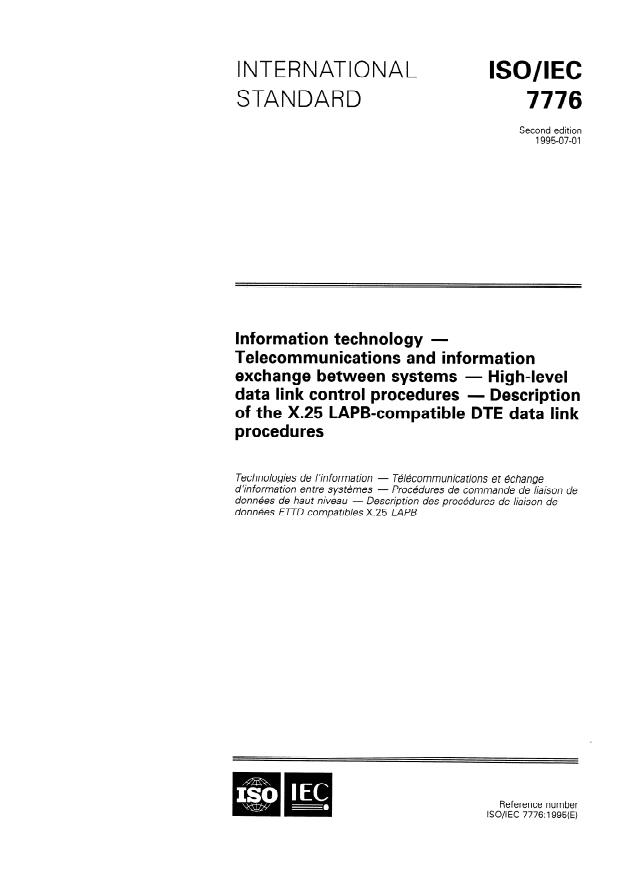
INTERNATIONAL
ISO/IEC
STANDARD 7776
Second edition
1995-07-01
Information technology -
Telecommunications and information
exchange between Systems - High-level
data link control procedures - Description
of the X.25 LAPB-compatible DTE data link
procedures
Technologies de I ’informa tion - T6kcommunica tions et Gchange
d ‘in forma tion en tre sys tkmes - Prockdures de commande de liaison de
donnees de haut niveau - Description des procedures de liaison de
donnees ETTD compatibles X.25 LAPB
.
Reference number
ISO/1 EC 7776: 1995(E)
ISOhEC 7776 : 1995 (E)
Page
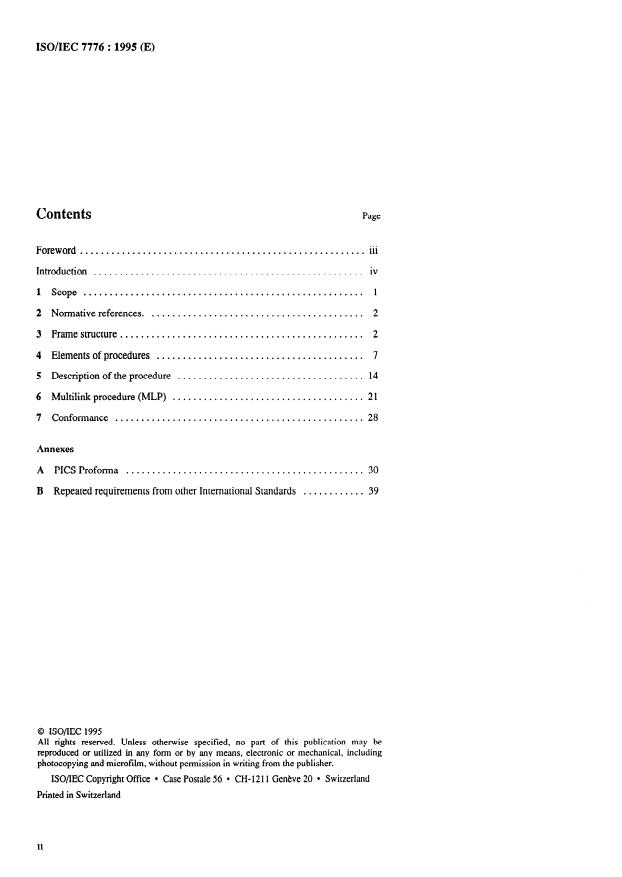
Contents
Foreword. iii
iv
Introduction . . . . . . . . . . . . . . . . . . . . . . . . . . . . . . . . . . . . . . . . . . . . . . . . . . . .
Scope .
Normative references. .
Framestructure .
Elements of procedures . . . . . . . . . . . . . . . . . . . . . . . . . . . . . . . . . . . . . . . . 7
Description of the procedure . . . . . . . . . . . . . . . . . . . . . . . . . . . . . . . . . . . . 14
Multilink procedure (MLP) . . . . . . . . . . . . . . . . . . . . . . . . . . . . . . . . . . . . . 2 1
Conformance . . . . . . . . . . . . . . . . . . . . . . . . . . . . . . . . . . . . . . . . . . . . . . . . 28
Annexes
A PICS Proforma . . . . . . . . . . . . . . . . . . . . . . . . . . . . . . . . . . . . . . . . . . . . . . 30
B Repeated requirements from other International Standards . . . . . . . . . . . . 39
0 ISOAEC 1995
All rights reserved. Unless otherwise specified, no part of this publication may be
reproduced or utilized in any form or by any means, electronie or mechanical, including
photocopying and microfilm, without Permission in writing from the publisher.
ISO/IEC Copyright Office l Case Postale 56 l CH-121 1 Geneve 20 l Switzerland
Printed in Switzerland
ii
0 ISO/IEC
ISO/IEC 7776 : 1995 (E)
Foreword
ISO (the International Organization for Standardization) and IEC (the Inter-
national Electrotechnical Commission) form the specialized System for worldwide
standardization. National bodies that are members of ISO or IEC participate in the
development of International Standards through technical committees established
by the respective organization to deal with particular fields of technical activity.
ISO and IEC technical committees collaborate in fields of mutual interest. Other
international organizations, governmental and non-governmental, in liaison with
ISO and IEC, also take part in the work.
In the field of information technology, ISO and IEC have established a joint
technical committee, ISO/IEC JTC 1. Draft International Standards adopted by the
joint technical committee arc circulated to national bodies for voting. Publication
as an International Standard requires approval by at least 75 % of the national
bodies casting a vote.
International Standard ISOLIEC 7776 was prepared by Joint Technical Committee
ISO/IEC JTC 1, Information technology.
This second edition cancels and replaces the first edition (ISO 7776:1986), and
consolidates Amendment 1: 1992, as well as Technical Corrigenda 1, 2 and 3.
Annex A forms an i
ntegral part of this International Standard. Annex B is for
information only
. . .
0 ISO/IEC
ISOIIEC 7776 : 1995 (E)
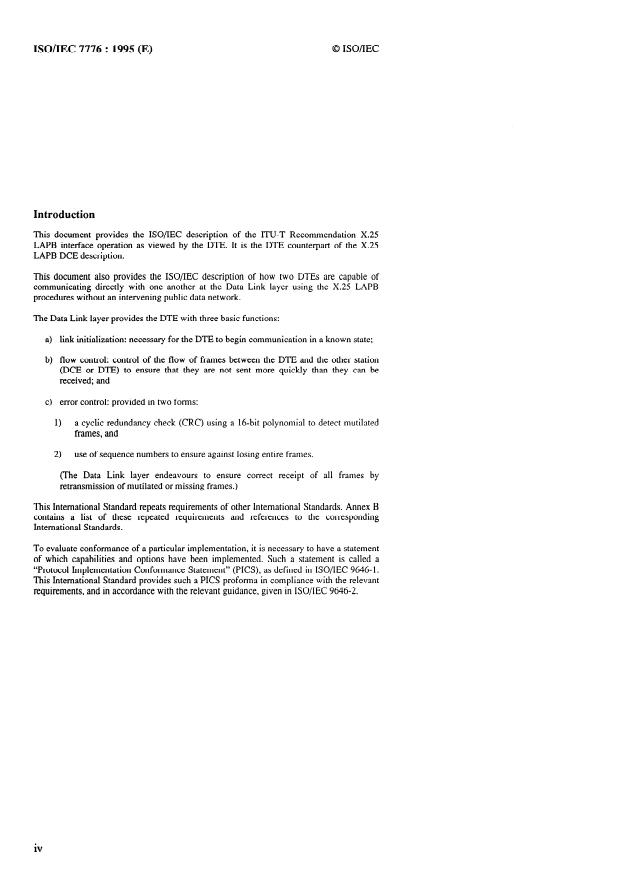
Introduction
This document provides the ISO/IEC description of the ITU-T Recornmendation X.25
LAPB interface Operation as viewed by the DTB. It is the DTE counterpart of the X.25
LAPB DCE description.
This document also provides the ISO/IEC description of how two DTEs are capable of
communicating directly with one another at the Data Link Iayer using the X.25 LAPB
procedures without an intervening public data network.
The Data Link layer provides the DTE with three basic functions:
a) link initialization: necessary for the DTE to begin communication in a known state;
b) flow control: control of the flow of frames between the DTE and the other Station
@CE or DTE) to ensure that they are not sent more quickly than they tan be
received; and
c) error control: provided in two forrns:
a cyclic redu ndancy check using a Io-bit polynomial to detect mutilated
1) OW
frames, and
2) use of sequence numbers to ensure against losing entire frames.
(The Data Link layer endeavours to ensure correct receipt of all frames by
retransmission of mutilated or missing frames.)
This International Standard repeats requirements of other International Standards. Annex B
contains a list of these repeated requirements and references to the corresponding
International Standards.
To evaluate conformance of a particular implementation, it is necessary to have a Statement
of which capabilities and Options have been implemented. Such a Statement is called a
“Protocol Implementation Conformance Statement” (PICS), as defined in ISO/IEC 9646-1.
This International Standard provides such a PICS proforma in compliance with the relevant
requirements, and in accordance with the relevant guidance, given in ISO/IEC 9646-2.
iv
INTERNATIONAL STANDARD @ ISOmC ISOhEC 7776 : 1995 (E)
Information technology - Telecommunications and
information exchange between Systems - High-level data
Description of the X.25 LAPB-
link control procedures -
compatible DTE data link procedures
1 Scope
This International Standard defines an application of the following HDLC Standards: ISO/IEC 3309, ISO/IEC 4335, ISO 7478, and ISO/IEC
7809. When there is difficulty in the interpretation of a reworded requirement from one of the other International Standards, the original
requirement of ISO/IEC 3309, ISO/IEC 4335, ISO 7478 or ISO/IEC 7809 is definitive. It also defines the structure, elements and procedures
for the Operation of a DTE using the X.25 LAPB protocol as specified in ITU-T Recommendation X.25.1) The procedures are applicable to
data interchange between a DTE and a DCE, or between two DTEs. The procedures are defined for use on duplex links, using synchronous
transmission or start/stop transmission.
Clause 3 describes two frame structures: one for basic (modulo 8) Operation and one for extended (modulo 128) Operation. Basic (modulo 8)
Operation is the ISO/IEC balanced asynchronous class of procedure with optional functions 2 and 8 (BAC, 2, 8). Extended (modulo 128)
Operation is the ISO/IEC balanced asynchronous class of procedure with optional functions 2, 8 and 10 (BAC, 2, 8, 10). For those DTE/DCE
connections that support both basic (modulo 8) Operation and extended (modulo 128) Operation, the choice is made at subscription-time only.
For those DTE/remote DTE connections that support both basic (modulo 8) Operation and extended (modulo 128) Operation, the choice is
made by bilateral agreement.
NOTE - The procedure herein described as basic (modulo 8) Operation is the only one available in all public data networks.
Clause 3 also describes two methods for encoding the frames, as sequences of bits when synchronous transmission is used, and as sequences
of octets when start/stop transmission is used. The start/stop encoding specifies optional mechanisms, for use in environments that are
sensitive to transmission of octets with values that could be interpreted as ISO/IEC 646 control characters, a.nd/or in environments that
support transfer of only seven data bits per start/stop Character. The choice of encoding is made by bilateral agreement, or other suitable
means, to suit the data transmission characteristics of the environment.
Clause 4 describes the elements of procedures. Same aspects are only operable for the basic (modulo 8) Operation and some for the extended
(modulo 128) Operation.
Clauses 5 and 6 describe the Single link procedure (SLP) which is derived fror-n the frame structure and the elements of procedures, and an
optional multilink procedure (MLP), respectively. The SLP is used for data interchange over a Single data link and the MLP is used for data
interchange over a multiple of parallel SLPs. An MLP is required if the effects of individual SLP failures are not to disrupt the higher layer
Operation. An MLP tan also be used over a Single SLP by Prior bilateral agreement. For DTE/DCE connections the choice of an MLP
Operation or not is made at subscription-time only. For DTE/remote DTE connections, the choice is made by bilateral agreement.
Where choices among alternative actions are indicated in the procedures, a recommended choice is usually indicated. Unless specifically
stated otherwise, the choice of action does not affect interoperability with other implernentations of this International Standard although
efficiency of Operation may be affected. Where such choices do affect interoperability, the procedures explicitly state that Prior bilateral
1) Future revisions of this International Standard will be made in accordance with revisions of KU-T Recommendation X.25. The pre.sent Version is based
on the 1993 ITU-T Recommendation X.25
0 ISO/IEC
ISO/IEC 7776 : 1995 (E)
agreement on the choice of procedure with the remote end is needed. An attempt has been made to minimize such choices consistent with the
need to satisfy a broad range of applications. A basic requirement for all implernentations of this International Standard is that they be
capable of responding, as specified, to any actions taken at the remote end that are permitted by this International Standard (except possibly
for those procedures whose use involves Prior bilateral agreement.)
Clause 7 covers the Static Conformance requirements, the Dynamit Conformance requirements, and the Protocol Implementation
Conformance Statement (PICS).
2 Normative references.
The following Standards contain provisions which, through reference in this text, constitute provisions of this International Standard. At the
time of publication, the editions indicated were valid. All Standards are subject to revision, and Parties to agreements based on this
International Standard are encouraged to investigate the possibility of applying the most recent editions of the Standards listed below.
Members of IEC and ISO maintain registers of currently valid International Standards.
ISO/IEC 646: 199 1, Information technology -ISO 7-bit coded Character set for iriformation interchange.
ISOfIEC 3309: 1993, Information technology - Telecommunications and information exchange between Systems - High-level data link
control (HDLC) procedures -Frame structure.
ISO/IEC 4335: 1993, Information technology - Telecommunications and information exchange between Systems - High-level data link
control (HDLC) procedures - Elements of procedure.
ISO 7478: 1987, Information processing Systems - Data communicatiorr - Multilink procedures.
ISO/IEC 7809: 1993, Information technology - Telecommurrications and information cxchange bctween systems - High-level data link
control procedures (HDLC) - Classes of procedures.
ISO/IEC 9646- 1: 1994, Information technology - Open Systems Interconnection - Conformance testing methodology and framework -
Part 1: General concepts.
ISO/IEC 9646-2: 1994, Information technology - Open Systems Interconnection - Conformance testing methodology and framework -
Part 2: Abstract Test Suite specijication.
ITU-T Recommendation X.25, Interface between data terminal equipment (DTE) and data circuit-terminating equi ’lment (DCE) for
terminals operating in the packet nzode and connected to public duta networks by dedicated circuit.
3 Frame structure
All transmissions on a SLP are in frames conforrning to one of the fomlats of table 1 for basic (modulo 8) Operation, or altematively one of
the formats of table 2 for extended (modulo 128) Operation. The flag preceding the address Geld is defined as the opening flag. The flag
following the FCS field is defined as the closing flag.
All transmissions from the DCE/remote DTE are expected to use this frame structure.
TabIe 1 - Frame formats - Basic (nnodulo 8) Operation
Bit Order of
transmission 12345678 12345678 12345678 16to 1 12345678
Flag Address Control FCS Flag
F A C FCS F
8-bi ts 16-bits 01111110
01111110 8-bits
FCS = Frame Check Sequence
Bit Order of
transmission 12345678 12345678 12345678 16to 1 12345678
Control Information FCS Flag
Flag Address
F A C 1 FCS F
01111110 8-bits 8-bits N-bits 16-bits 01111110
.
FCS = Frame Check Sequence
0 ISO/IEC ISOhEC 7776 : 1995 (E)
Table 2 - Frame formats - Extended (modulo 128) Operation
Bit Order of
transmission 12345678 12345678 1 to * 16to 1 12345678
Address Control
FCS
nag I nag 1
I I I I
/ olllF1llo / 8-tts mpmmr.h,,, 1 lZts 1 OlllF1l10 /
FCS = Frame Check Sequence
Bit Order of
transmission 12345678 12345678 12345678 16to 1 12345678
Flag Address Control Information FCS Flag
F A F
C 1 FCS
01111110 8-bits 8-bits N-bits 16-bits 01111110
I
.
FCS = Frame Check Sequence
I
16 for frame formats that contain sequence numbers; 8 for frame formats that do not contain sequence numtxrs.
3.1 Flag sequence
All frames shall Start and end with the flag sequence consisting of one “0” bit followed by six contiguous “1” bits and one “0” bit. The DTE
hunts continuously for this sequence on a bit-by-bit basis, and thus uses the flag sequence for frame synchronization. The DTE/DCE/remote
DTE may send one or more complete frag sequences between frames. The DTE shall only send complete eight-bit flag sequences when
sending multiple flag sequences (see 3.10). A Single flag may be used as both the closing flag for one frame and the opening flag for the next
frame.
3.2 Address field
The address field shall consist of one octet. The address field identifies the intended receiver of a command frame and the transmitter of a
response frame. The coding of the address field is described in 5.1.
3.3 Control field
For basic (modulo 8) Operation, the control field shall consist of one octet. For extended (modulo 128) Operation, the control field shall
consist of two octets for frame formats that contain sequence nurnbers, and one octet for frame formats that do not contain sequence
numbers. The content of this field is described in 4.1.
3.4 Information field
The information field of a frame, when present, follows the control Geld (see 3.3) and precedes the frame check sequence (see 3.6). (See
4.3.9 and 6.2 for the various codings and groupings of bits in the infomjation field that are defined for use in this International Standard.) The
coding and grouping of bits received from a higher layer are unrestricted, except for requirements that are imposed by the higher layer itself.
For start/stop transmission there shall be eight (8) infom-tation bits between the Start element and the stop element: the information field is
therefore constrained to be octet-aligned.
See 4.3.9 and 5.7.3 with regard to the maximum infomjation field length.
3.5 Transparency
3.5.1 Synchronous transmission
A DTE, when transmitting, shall examine the frame content between the two flag sequences including the address, control, inforrnation and
FCS fields and shall insert a “0” bit after all sequences of five contiguous ” 1” bits (including ehe last five bits of the FCS) to ensure that a flag
sequence is not simulated. A DTE, when receiving, shall exanline the frame content and shall discard any “0” bit which directly follows five
contiguous ” 1” bits.
3.5.2 Startktop transmission
Two principal levels of transparency processing are specified for use with start/stop transmission. These are seven-bit data path transparency
(SBDPT), specified in 3.5.2.1, and control-escape transparency, specified in 3.5.2.2. Control-escape transparency shall always be performed.
SBDPT is an Option, use or non-use of which is selected for a given data link by means outside the scope of this International Standard (for
example, a priori knowledge, bilateral agreement, heuristic implementation techniques). The control-escape transparency processing may
optionally be extended in its application in one of the two ways specified in 3.5.2.3; use or non-use of either of these for a given data link is
again selected by means outside the scope of this International Standard.
0 ISO/IEC
ISO/IEC 7776 : 1995 (E)
3.5.2.1 Seven-bit data path transparency
When SBDPT is selected, the content of each frame - from Address f ’ield to FCS field inclusive - shall be transferred between sender and
receiver as a frame-image derived from the original frame as follows.
with
The sequence of octets making up the frame content is considered as div fided into a sequence of contiguous seven-octet Segments,
possibly a final Segment having length between one and six octets inclusive. These segm .ents are referred to as original Segments.
The frame-image consists of a sequence of image Segments defiied, in one-to-one correspondence with the original Segments, as follows:
a) image Segments occur in the same Order as the corresponding original Segments;
b) each image Segment is one octet langer than its original Segment;
c) the first part of each image Segment is a copy of its original Segment, but with the most significant bit (MSB) of each octet set to Zero;
d) the remaining, final, octet of each image Segment has its least significant bit set to the value of the MSB of the last octet of the
original Segment, its next to least significant bit set to the value of the MSB of the next to last octet (if any) of the original Segment,
and so on;
e) in the fmal octet of each image Segment, all higher Order bits for which no corresponding octet exists in the original Segment are set to
Zero.
NOTES
At the transmitter, the final octet of each image segment tan be generated by shifting left the MSB of each octet in the original Segment, in
sequence, into an initially zero octet: this achieves the correct bit-positioning both for complete Leven-octet segments and for any short segment at the end of a
frame.
2 The MSB of each image-segment octet is defined as zero only for uniqueness of the mapping: because its value is known and plays no part in the
reconstruction of the original segment at the receiver, it need not actually be transrnitted as a zero bit value. This allows image .segments to be transferred
across data paths that, for example, forte parity setting of the MSB of each octet.
3.5.2.2 Control-escape transparency
The following transparency mechanism shall be applied to each frame-image: a frame-image is as defined in 3.5.2.1 when SBDPT is
selected, and otherwise is identical to the frame content from Address field to FCS field inclusive.
The control escape octet identifies an octet occurring within a frame-image to which the following transparency procedure is applied. The
encoding of the control escape octet is:
1 2 3 4 5 6 7 8 Bit Position in octet
Low Order bit, first bit transmitted / received
The transmitter shall examine each octet of the frame-image between the two flag octets and shall:
a) upon the occurrence of the flag sequence or a control escape octet, complement the sixth bit of the octet, and
b) insert a control escape octet immediately preceding the octet resulting from the above, Prior to transmission.
examine the frame-im age between the two flag octets and shall, upon receipt of a control escape octet and Prior to FCS
The receiver shall
calculation:
a) discard the control escape octet, and
b) restore the immediately following octet by complementing its sixth bit.
Extended transparency
3.5.2.3
transparency
The transmitter may apply the above control-escape procedure (3.5.2.2) to octets in the groups defined below, in addition to the
and control escape octets.
fl%
0 ISO/IEC
ISO/IEC 7776 : 1995 (E)
3.5.2.3.1 Flow-control transparency
The flow-control transparency Option provide transparency processing for the DCl/XON and DC3/XOFF control characters defined in ISO/
IEC 646: that is, for the octet values 1000100x and 1100100x, respectively, where the 8th bit “x” represents either “0” or “1 ”. This has the
effect of assuring that the octet stream does not contain values that could be interpreted by intermediate equipment as flow control characters
(regardless of parity).
3.5.2.3.2 Control-Character ocfet transparency
The control-Character octet transparency Option provides transparency processing for all octets in which both the 6th and 7th bit are “0” (i.e.,
or
xxxxxOOx, where each “x” represents either “0” or “l”), and for the DELETE Character octet (i.e., 111111 IX, where “x” represent “0”
“1 ”). This has the effect of assuring that the octet stream does not contain values that could be interpreted by intermediate equipment as the
control characters or DELETE Character defined by ISO/IEC 646 (regardless of parity).
3.6 Frame check sequence (FCS) field
The FCS field shall be a 16-bit sequence. It shall be the ones complement of the sum (modulo 2) of
a) the remainder of
+ ,II + XI0 + x9 + J+ + x ’7 + Al+ + xj + AI + xj’ + x2 + x + 1)
$(xIJ + XI4 + x*3 + x*2
divided (modulo 2) by the generator polynomial
x ’6 + XI2 + x5 + 1
where k is the number of bits in the frame existing between, but not including, the final bit of the opening flag and the first bit of the
FCS, excluding Start and stop elements (start/stop transmission) and bits (synchronous transmission) or octets (start/stop transmission)
inserted for transparency, and
b) the remainder of the division (modulo 2) by the generator polynomial
,16+-J+ +x5+ 1
of the product of x ~6 by the content of the frame existing between, but not including, the final bit of the opening flag and the first bit
of the FCS, excluding Start and stop elements (start/stop transmission) and bits (synchronous transmission) or octets (start/stop
transmission) inserted for transparency.
As a typical implementation, at the transmitter, the initial content of the register of the device computing the remainder of the division is
preset to all ones and is then modified by division by the generator polynomial (as described above) of the address, control and inforrnation
fields; the ones complement of the resulting rernainder is transmitted as the 16-bit FCS.
receiver, the ln1t1 al content remainder is preset to all ones. The fmal remainder
At the of the register of the device computing the
ication by x16 and then divisi on (modulo 2) by the generator polynomial
multipl
XI6 +x12 + x5 + 1
of the serial incoming protected bits and the FCS will be
0001110100001111 (~ ‘5 through ~8, respectively)
in the absence of transmission errors.
3.7 Transmission considerations
3.7.1 Order of bit transmission
Addresses, commands, responses and sequence numbers shall be transmitted with the low-Order bit fkst (for example, the first bit of the
sequence number that is transmitted shall have the weight 29.
The Order of transmitting bits within the information field is specified for specific information Geld formats as defmed elsewhere in this
International Standard.
The FCS shall be transmitted to the line commencing with the coefficient of the highest term, which is found in bit Position 16 of the FCS
field (see tables 1 and 2).
NOTE - The low-Order bit is defined as bit 1, as depicted in tables 1 to 8.
ISO/IEC 7776 : 1995 (E)
0 ISO/IEC
3.7.2 Starthtop transmission
For startstop transmission, each octet is delimited by a Start element and a stop element. Mark-hold (continuous logical “1” state) is used for
inter-octet time fill if required. Typical octet transmission is as shown in Figure 1.
octet n +1 octet n + 2
octet n
Obbbbbbbbl Obbbbbbbblobbbbbbbbl
A
I
A
W ’[*4 1 *’ t Octetdatabit(Opr1)
Mark-hold (contmuous mark condition) as required
Stop element (logical 1: marking condition)
c
Data bits (low Order first transmitted)
Start element (logical0: spacing condition)
Figure 1 - Startktop transmission
3.8 Invalid frames
3.8.1 Synchronous transmission
An invalid frame is defined as one which
a) is not properly bounded by two flags;
contains fewer than 32 bits between flags;
b)
c) contains a Frame Check Sequence (FCS) error; or
d) contains an address field encoding other than that defined in 5.1.
NOTE - For those DTEs and DCEs that at-e octet-aligned, a detection of non-octet alignment may be made at the Data Link layer or in the higher layer.
Detection at the Data Link layer, while not required, is accomplished by adding a frame validity check that requires the number of bits between the opening
flag and the closing tlag, excluding bits inserted for transparency, to be an integral number of octets in length, or the frame is considered invalid.
3.8.2 Startktop transmission
An invalid frame is one:
a) containing fewer than four octets between flags, excluding octets inserted for transparency;
b) in which octet framing is violated (i.e., a “0” bit occurs where a stop element is expected); or
c) ending with a control escape - closing flag sequence.
3.9 Frame abortion
3.9.1 Synchronous transmission
“ 1” bits (with no inserted “0” bits).
Aborting a frame is performed by transmitting at least seven contiguous
3.9.2 Startktop transmission
Aborting a frame is performed by transmitting the two-octet sequence “control escape - closing flag ”.
3.10 Interframe time fill
3.10.1 Synchronous transmission
Interframe time fill is accomplished by transrnitting contiguous flags between frames (i.e., multiple IJ-bit flag sequences).
3.10.2 Startktop transmission
Interframe time fill is accomplished by transmitting either successive flags (with mark-hold for inter-octet time fill if required) or a
continuous mark condition (logical “ 1” state) between fr-armes.
0 ISO/IEC
ISOIIEC 7776 : 1995 (E)
3.11 Data link channel states
3.11.1 Synchronous transmission
3.11.1.1 Active channel state
The DTE outgoing channel is in active condition when the DTE is actively transmitting a frame, an abortion sequence or interframe time fill.
The DTE incoming channel is defined to be in an active condition when the DTE is actively receiving a frame, an abortion sequence or
interframe time fill.
3.11.1.2 Idle channel state
The DTE outgoing channel is in an idle condition when the DTE Causes a continuous “1” state that persists for at least 15 bit times. The DTE
incoming channel is defined to be in an idle condition when the DTE detects that a continuous “1” state has persisted for at least 15 bit times.
The action to be taken by a DCE upon detection of the idle channel state is not defiied at this time. The DTE, upon detection of the idle
channel state, may interpret the idle condition as an indication that the DCE is not able to support set up of the data link.
NOTE - Upon detection of the idle channel state for at least T3, the DTE should consider the data link to be in the disconnected state. T3 is as defhed in
5.7.1. .3.
3.11.2 Startktop transmission
3.11.2.1 Active channel state
The DTE outgoing channel is in active condition when the DTE is actively transmitting a frame, an abortion sequence, or interframe time fill
consisting of flag octets separated by inter-octet time fill not greater than the timeout value for idle channel state (see 3.11.2.2). The DTE
incoming channel is defined to be in an active condition when the DTE is actively receiving a frame, an abortion sequence, or interframe
time fill as just specified for the outgoing channel.
3.61.2.2 Idle channel state
The DTE outgoing channel is in an idle condition when the DTE Causes a continuous ” 1” state that persists for a period of time determined
by the timeout value T5 at the DCE/remote DTE. The DTE incoming channel is defined to be in an idle condition when the DTE detects that
a continuous “1” state has persisted for a period of time exceeding the DTE timeout value T5. T5 is as defined in 5.7.1.5.
be taken by a DCE upon detection of the idle state is not defined at this time. The DTE, upon detection of the idle
The action to channel
channel state, may interpret the idle condition as an indication that the DCE is not able to support set up of the data link.
NOTE - Upon detection of the idle channel state for at least T3, the DTE should consider the data link to be in the disconnected state. T3 is as defined in
5.7.1.3.
4 Elements of procedures
The elements of procedures arc defined in terms of actions that occur at the DTE on receipt of commands from the DCE/remote DTE.
The elements of procedures speci fied below contain a selection of commands and response relevant to the data link and System configuration
described in clause 1.
4.1 Control field formats and state variables
4.1.1 Control field formats
The control field indicates the type of commands or responses, and contains sequence numbers where applicable.
Three types of control field formats are used to perform numbered information transfer (1 format), numbered supervisory functions (S
format) and unnumbered control functions (U format). The control field formats for basic (modulo 8) Operation are depicted in table 3 and
the control field fomlats for extended (modulo 128) Operation at-e depicted in table 4.
0 ISO/IEC
ISOIIEC 7776 : 1995 (E)
Table 3 - Control field formats - Basic (modulo 8) Operation
Control field bits
Control field
2 3 4 5 6 7 8
format 1
1 format 0 NW P N(R)
S format 1 0 s s P/F
N(R)
U format 1 1 M M P/F M M M
,
= transmitter send sequence number (bit 2 = low-Order bit)
N(S)
N(R) = transmitter receive sequence number (bit 6 = low-Order bit)
S = supervisory function bit
M = modifier function bit
= po11 bit when issued as a command; final bit when issued as a
PE
response (1
= Poll/Final)
P = po11 bit (1 = Pall)
Table 4 - Control field formats - Extended (modulo 128) Operation
Control field bits
Control field
1st octet 2nd octet
format
1 2 3
4 5 6 7 8 9 10 11 12 13 14 15 16
1 format 0 NO P N(R)
S format 1 0 s s x x x x P/F
NR)
U format 1 1 M M P/F M M M
N(S) = transmitter send sequence number (bit 2 = low-Order bit)
N(R) = transmitter receive sequence number (bit 6 = low-Order bit)
=
S supervisory function bit
M = modifier function bit
x = reserved and set to “0”
P/F =
po11 bit when issued as a command; final bit when issued as a response (1 = Poll/Final)
P =
po11 bit (1 = Pall)
4.1.1.1 Information transfer format - 1
The 1 format is used by the DTE to perform an information transfer. The functions of N(S), N(R) and P are independent; i.e., each 1 frame
shall have an N(S), an N(R) which may or may not acknowledge additional 1 frames received by the DTE, and a P bit that may be set to “0”
or “1 ”.
4.1.1.2 Supervisory format - S
The S format is used by the DTE to perform data link supervisory control functions such as acknowledging 1 frames, requesting
retransmission of 1 frames, and requesting a temporar-y Suspension of transmission of 1 frames. The functions of N(R) and P/F are
independent; i.e., each supervisory frame shall have an N(R) which may or may not acknowledge additional 1 frames received by the DTE,
and a P/F bit that may be set to “0” or ” 1 ”.
4.1.1.3 Unnumbered formst - U
The U format is used by the DTE to provide additional data link control functions. This formst shall contain no sequence numbers, but shall
include a P/F bit that may be set to “0” or “1 ”. The unnumbered frames shall have the same control field length (one octet) in both basic
(modulo 8) and extended (modulo 128) Operation.
4.1.2 Control field Parameters
The various Parameters associated with the control field formats are described below.
4.1.2.1 Modulus
Esch 1 frame shall be sequentially numbered and may have the value 0 through modulus minus one (where “modulus” is the modulus of the
sequence numbers). The modulus equals 8 or 128 and the sequence numbers cycle through the entire range.
0 ISO/IEC ISO/IEC 7776 : 1995 (E)
4.1.2.2 Frame variables and sequence numbers
4.1.2.2.1 Send state variable V(S)
The DTE send state variable, V(S), denotes the sequence number of the next in-sequence 1 frame to be transmitted by the DTE. The send
state variable tan take on the value 0 through modulus minus one. The value of the DTE send state variable shall be incremented by one with
each successive 1 frame transmission, but shall not exceed N(R) of the last received 1 or S frame by more than the maximum number of
outstanding 1 frames (k). The value of k is defined in 5.7.4.
4.1.2.2.2 Send sequence number N(S)
Only 1 frames contain N(S), the send sequence number of transmitted 1 frames. Prior to transmission of an in-sequence 1 frame by the DTE,
the value of N(S) shall be set equal Qo the value of the DTE send state variable.
4.1.2.2.3 Receive state variable V(R)
The DTE receive state variable denotes the sequence number of the next in-sequence 1 frame expected to be received by the DTE. The
receive state variable tan take on the value 0 through modulus minus one. The value of the DTE receive state variable shall be incremented
by one on receipt of an error-free, in-sequence 1 frame whose send sequence number N(S) equals the DTE receive state variable.
4.1.2.2.4 Receive sequence number N(R)
All 1 frames and supervisory frames shall contain N(R), the expected sequence number of the next received 1 frame. Prior to transmission of
a frame of the above types by the DTE, the value of N(R) shall be set equal to the current value of the DTE receive staee variable. N(R)
indicates that the transmitter of the N(R) has correctly received all 1 frames numbered up to N(R) - 1 inclusive.
4.1.2.2.5 Poll/Final bit P/F
All frames contain P/F, the poll/final bit. In command frames the P/F bit is referred to as the P bit. In response frames the P/F bit is referred
to as the F bit.
4.2 Functions of tke poll/final bit
The po11 (P) bit set to ” 1” shall be used by the DTE to solicit (~011) a response from the DCE/remote DTE. The final (F) bit set to “1” shall be
used by the DTE to indicate the response frame transmitted by the DTE as a result of a soliciting (~011) command received from the DCE/
remote DTE.
The use of the P/F bit is described in 5.2.
4.3 Commands and responses
The commands and responses supported b, ,e DTE are represented in table 5 for basic (modulo 8) Operation and in table 6 for extended
(modulo 128) Operation. For purposes of this International Standard, the Supervisor-y function bit encoding “11” and those encodings of the
modifier function bits in tables 3 and 4 not identified in tables 5 and 6 are identified as “undefined or not implemented” command and
response control fields. The commands and responses in tables 5 and 6 are defined as follows:
Table 5 - Commands and responses - Basic (modulo 8) Operation
Encoding
,
Format Commands Responses
12 34 5 6 7 8
I
Information transfer
1 (information) 0 P
N(S) NW
Supervisory RR (receive ready)
RR (receive ready) 1 0 0 0 P/F NW
RNR (receive not ready) RNR (receive not ready) 1 0 1 0 P/F MN
REJ (reject) REJ (reject) 1 0 0 1 P/F
N(R)
Unnumbered SABM (set asynchronous 1 1 1 1 P
1 0 0
balanced mode)
DISC (disconnect) 11 00 P 0 1 0
UA (unnumbered acknowledge)
11 00 F 1 1 0
,
DM (disconnected mode) 1 1 1 1 F 0 0 0
FRMR (frame reiect) 11 10F 0 0 1
ISOIIEC 7776 : 1995 (E) 0 ISO/IEC
Table 6 - Commands and responses - Extended (modulo 128) Operation
Encoding
Format Commands Responses
12 34 5 6 7 8 9 10 to 16
Information transfer 1 (information)
N(S)
Supervisory
RR (receive ready) 10 00 0 0 0 0
RNR (receive not ready) RNR (receive not ready) 10 1 10 / 0 0 0 0
REJ (reject)
10 0 1 0 0 0 0
SABME (set asynchronous
Unnumbered
balanced mode)
I
DISC (disconnect) 1 110 OIPIO 1 0
I
UA (unnumbered acknowledge) 1 1 1 1 0
I 00 F
DM (disconnected mode) F 0 0 0
I
1 F ’RMR (frame reject) 1 11 1 OlFIO 0 1
4.3.1 Information (1) command
The function of the Information (1) command shall be to transfer across a data link sequentially numbered frames containing an information
field.
4.3.2 Receive ready (RR) command and response
The receive ready (RR) supervisory frame shall be used by the DTE to
a) indicate that the DTE is ready to receive an 1 frame, and
b) acknowledge previously received 1 frames numbered up to N(R) - 1 inclusive.
An RR frame may be used to indicate the clearance of a busy condition that was reported by the earlier transmission of an RNR frame by that
same Station (DTE or DCE/remote DTE). In addition to indicating the DTE Status, the RR command with the P bit set to “1” may be used by
the DTE to ask for the Status of the DCE/remote DTE.
4.3.3 Receive not ready (RNR) command and response
The receive not ready (RNR) supervisory frame shall be used by the DTE to indicate a busy condition; i.e., temporar-y inability to accept
additional incoming 1 frames. 1 frames numbered up to and including N(R) - 1 shall be acknowledged. 1 frame N(R) and subsequent 1 frames
received, if any, shall not be acknowledged; the acceptance Status of these 1 frames will be indicated in subsequent exchanges.
In addition to indicating the DTE Status, the RNR command with the P bit set to “1” may be used to ask for the Status of the DCE/remote
DTE.
4.3.4 Reject (REJ) command and response
The reject (RET) supervisory frame shall be used by the DTE to request retransmission of 1 frames starting with the frame numbered N(R). 1
frames numbered N(R) - 1 and below shall be acknowledged. Additional 1 frames pending initial transmission may be transmitted following
the retransmitted 1 frames(s).
Only one REJ exception condition for a given direction of information transfer may be established at any time. The REJ exception condition
shall be cleared (reset) upon the receipt of an 1 frame with an N(S) equal to the N(R) of the RE!J frame. (A REJ frame may be retransmitted,
however, if the REJ exception condition is not cleared within the acknowledgement time-limit Tl, see 4.4.2.2.)
An REJ frame may be used to indicate the clearance of a busy condition that was reported by the earlier transmission of an RNR frame by
that same Station. In addition to indicating the DTE Status, the REJ command with the P bit set to ” 1” may be used to ask for the Status of the
DCE/remote DTE.
4.3.5 Set asynchronous balanced mode (SABM) command/Set asynchronous balanced mode extended (SABME) command
The SABM unnumbered command shall be used to place the addressed DCE or DTE in an asynchronous balanced mode (ABM) information
transfer Phase where all command/response control fields shall be one octet in length.
The SABME unnumbered command shall be used to place the addressed DCE or DTE in an asynchronous balanced mode (ABM)
information transfer Phase where numbered command/response control fields shall be two octets in length, and umrumbered command/
response control fields shall be one octet in length.
0 ISO/IEC ISO/IEC 7776 : 1995 (E)
NOTE - For DTE/DCE connections, the mode of Operation of the data link [basic (modulo 8) or extended (modulo 128)] shall be determined at subscription
time and shall only be changed by going through a new subscription process. For DTE/DTE connections, the mode of Operation of the data link [basic (modulo
8) or extended (modulo 128)] shall be determined by bilateral agreement.
No information field shall be permitted with the SABM or SABME command. The transmission of a SABM/SABME command shall
indicate the clearance of a busy condition that was reported by the earlier transmission of an RNR frame by that same Station. The DTE
confirms acceptance of SABM/SABME [basic (modulo 8) operationlextended (modulo 128) Operation] command by the transmission at the
first opportunity of a UA response. Upon acceptance of this command, the DTE send state variable V(S) and receive state variable V(R) shall
be set to “0 ”.
Previously transmitted 1 frames that are unacknowledged when this command is actioned shall remain unacknowledged (i.e., they are not
retransmitted following link set-up). It shall be the responsibility of a higher-layer protocol (for example, Network Layer or MLP) to recover
from the possible loss of the contents (data units) of such 1 frames.
4.3.6 Disconnect (DISC) command
The DISC unnumbered command shall be used by the DTE to terminate the mode previously set. It shall inform the DCE/remote DTE
receiving the DISC command that the DTE sending the DISC command is suspending Operation. No information Geld shall be permitted
with the DISC command. Prior to actioning the command, the DCE/remote DTE receiving the DISC command shall tonfirm the acceptance
of the DISC command by the transmission of a UA response. The DTE sending the DISC command shall enter the disconnected Phase when
it receives the acknowledging UA response.
Previously transmitted 1 frames that are unacknowledged when this command is actioned shall remain unacknowledged (i.e., they are not
retransmitted following link set-up). It shall be the responsibility of a higher-level protocol (for example, Network Layer or MLP) to recover
from the possible loss of the contents (data units) of such 1 frames.
4.3.7 Unnumbered acknowledgment (UA) response
The UA unnumbered response shall be used by the DTE to acknowledge the receipt and acceptance of the SABM/SABME and DISC
unnumbered commands. No information field shall be pemlitted with the UA response. The transmission of a UA response shall indicate the
clearance of a busy condition that was reported by the earlier transmission of an RNR frame by the same Station.
4,3.8 Disconnected mode (DM) response
The DM response shall be used by the DTE to report a Status where the DTE is logically disconnected from the link, and is in the
disconnected Phase. The DM response may be sent in this Phase to request a set mode command, or, if sent in response to the reception of a
set mode command, to inform the DCE/remote DTE that the DTE is still in the disconnected Phase and cannot action the set mode command.
No information field shall be permitted with the DM response.
A DTE in the disconnected Phase shall monitor received commands, react to a SABM/SABME command as outlined in 5.3 and respond with
a DM response with the F bit set to “1” to any other command received with the P bit set to “1 ”.
4.3.9 Frame reject (FRMR) response
The FRMR response shall be used by a DTE to report an error condition not recoverable by retransmission of the identical frame by the
DCE/remote DTE; i.e., at least one of the following conditions, which results from the receipt of a valid frame:
a) the receipt of a command or response control field that is undefined or not implemented;
b) the receipt of an 1 frame with an information field which exceeds the maximum established length;
c) the receipt of an invalid N(R); or
d) the receipt of a frame with an information field which is not pemlitted or the receipt of a Supervisor-y frame with incorrect length
(comprising between 32 and 39 bits inclusive).
An undefined or not implemented control field shall be any of the control field encodings that are not identified in tables 5 or 6.
An invalid N(R) is defined as one which Points to an 1 frame which has previously been transmitted and acknowledged or to an 1 frame
which has not been transmitted and is not the next sequential 1 frame awaiting transmission. A valid N(R) shall be within the range from the
lowest send sequence number, N(S), of the still unacknowledged frame(s) to the current DTE send state variable inclusive.
An information field which immediately follows the control field, and consists of 3 octets [basic (modulo 8) Operation] or 5 octets [extended
(modulo 128) Operation], shall be returned with this response to provide the reason for the FRMR response. These formats arc given in table
7 and table 8.
ISO/IEC 7776 : 1995 (E)
0 ISO/IEC
Table 7 - FRMR information field formt - Basic (modulo 8) Operation
Information field bits
1 to 8 9 10to 12 14 to 16 17 18 19 20 21 22 23 24
Rejected
frame
C/R
...