

ISO/IEC 10742:1994/Amd 3:1996
(Amendment)Information technology — Telecommunications and information exchange between systems — Elements of management information related to OSI Data Link Layer standards — Amendment 3: Addition of new counter attributes
General Information
- Abstract
Adds specifications answering to requirements for Counter Attributes from ITU-T SG 7.
- Status
- Published
- Publication Date
- 25-Dec-1996
- Current Stage
- 6060 - International Standard published
- Start Date
- 26-Dec-1996
- Completion Date
- 29-Aug-2026
Buy Documents



ISO/IEC 10742:1994/Amd 3:1996 - Information technology — Telecommunications and information exchange between systems — Elements of management information related to OSI Data Link Layer standards — Amendment 3: Addition of new counter attributes Released:12/26/1996
Overview
ISO/IEC 10742:1994/Amd 3:1996 is an important amendment to the international standard ISO/IEC 10742:1994, focusing on information technology and telecommunications. Specifically, it addresses the management information related to the OSI (Open Systems Interconnection) Data Link Layer standards. This third amendment introduces new counter attributes to enhance the management capabilities for OSI Data Link Layer entities, based on requirements from the ITU-T SG 7 working group.
The amendment specifies additional attributes for tracking communication performance metrics related to the LAPB (Link Access Procedure, Balanced) Data Link Entity. These additions improve monitoring and diagnostic functions essential for network communications management and troubleshooting.
Key Topics
- OSI Data Link Layer Management: Extends ISO/IEC 10742 with new attributes tailored to OSI Data Link Layer objects.
- Counter Attributes: Introduces three specific counters:
- mlpFramesReceived: Counts the total number of MLP frames received.
- mlpFramesSent: Counts the total number of MLP frames sent.
- mlpFramesOutsideWindowGuard: Counts MLP frames received outside the window guard, highlighting potentially problematic transmissions.
- LAPB Data Link Entity Enhancements: These attributes are integrated into the LAPB Data Link Entity management objects, expanding monitoring accuracy and scope.
- Compliance with ITU-T SG 7 Requirements: Reflects coordination with international telecommunication standards body ITU-T, ensuring interoperability.
- Object Identifier (OID) Allocation: Defines unique OIDs for the new attributes to maintain consistency in management information structure.
Applications
This amendment is crucial in several practical contexts:
- Network Management Systems (NMS): Enables network administrators to monitor OSI Data Link Layer performance with finer granularity using enhanced counters.
- Telecommunication Equipment Vendors: Helps manufacturers implement standardized management interfaces that comply with international standards.
- OSI Data Link Layer Troubleshooting: Supports diagnostics by tracking frame reception and transmission issues, including anomalies such as frames received outside the transmission window.
- Protocol Performance Analysis: Facilitates detailed statistics collection for the LAPB protocol, improving quality of service (QoS) management on telecommunications networks.
- Interoperability Assurance: Ensures consistency across multi-vendor network components through adherence to an internationally recognized specification.
Related Standards
- ISO/IEC 10742:1994: The base standard defining management information for OSI Data Link Layer.
- ITU-T SG 7 Recommendations: Provides underlying requirements and guidance for telecommunications management information.
- ISO/IEC 9595: Covers telecommunications management network (TMN) concepts and architecture, complementing management interface standards.
- OSI Reference Model Standards (ISO/IEC 7498 series): Foundation for open systems interconnection, contextualizing the Data Link Layer.
- ISO/IEC 10164: Management functions and services for OSI, related to comprehensive network management.
By implementing ISO/IEC 10742:1994/Amd 3:1996, organizations benefit from enhanced network monitoring capabilities that facilitate improved communication reliability, easier fault localization, and alignment with global telecommunications management standards. This amendment supports ongoing evolution in information exchange and management for the OSI Data Link Layer within modern network infrastructures.
Relations
- Effective Date
- 06-Jun-2022
- Effective Date
- 15-Apr-2008
Buy Documents
ISO/IEC 10742:1994/Amd 3:1996 - Information technology — Telecommunications and information exchange between systems — Elements of management information related to OSI Data Link Layer standards — Amendment 3: Addition of new counter attributes Released:12/26/1996
Get Certified
Connect with accredited certification bodies for this standard

BSI Group
BSI (British Standards Institution) is the business standards company that helps organizations make excellence a habit.

NYCE
Mexican standards and certification body.
Sponsored listings
Frequently Asked Questions
ISO/IEC 10742:1994/Amd 3:1996 is a standard published by the International Organization for Standardization (ISO). Its full title is "Information technology — Telecommunications and information exchange between systems — Elements of management information related to OSI Data Link Layer standards — Amendment 3: Addition of new counter attributes". This standard covers: Adds specifications answering to requirements for Counter Attributes from ITU-T SG 7.
Adds specifications answering to requirements for Counter Attributes from ITU-T SG 7.
ISO/IEC 10742:1994/Amd 3:1996 is classified under the following ICS (International Classification for Standards) categories: 35.100.20 - Data link layer. The ICS classification helps identify the subject area and facilitates finding related standards.
ISO/IEC 10742:1994/Amd 3:1996 has the following relationships with other standards: It is inter standard links to ISO/IEC 10742:1994; is excused to ISO/IEC 10742:1994. Understanding these relationships helps ensure you are using the most current and applicable version of the standard.
ISO/IEC 10742:1994/Amd 3:1996 is available in PDF format for immediate download after purchase. The document can be added to your cart and obtained through the secure checkout process. Digital delivery ensures instant access to the complete standard document.
Standards Content (Sample)
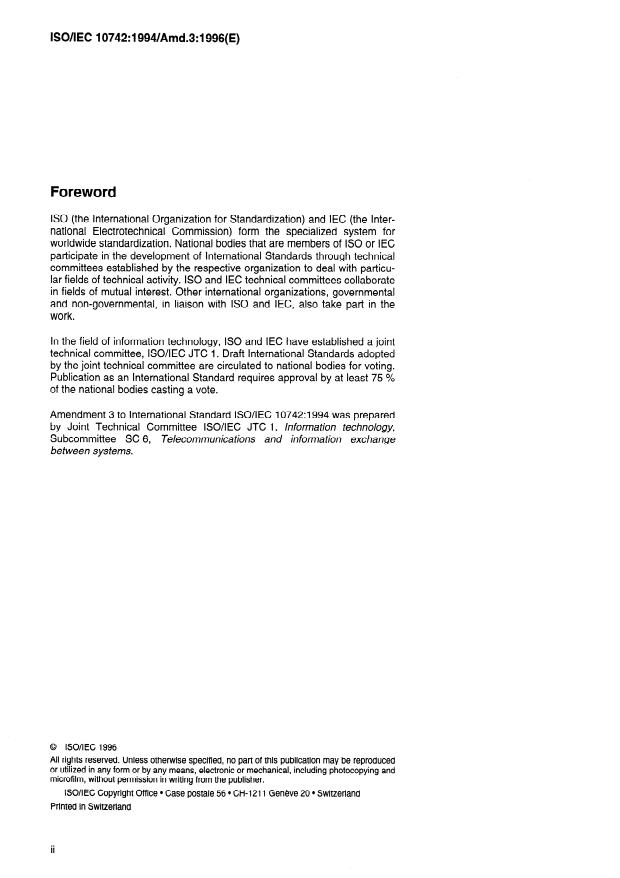
ISO/IEC 10742:1994/Amd.3:1996(E)
Foreword
IS0 (the International Organization for Standardization) and IEC (the Inter-
national Electrotechnical Commission) form the specialized system for
worldwide standardization. National bodies that are members of IS0 or IEC
participate in the development of International Standards through technical
committees established by the respective organization to deal with particu-
lar fields of technical activity. IS0 and IEC technical committees collaborate
in fields of mutual interest. Other international organizations, governmental
and non-governmental, in liaison with IS0 and IEC, also take part in the
work.
In the field of information technology, IS0 and IEC have established a joint
technical committee, ISO/IEC JTC 1. Draft International Standards adopted
by the joint technical committee are circulated to national bodies for voting.
Publication as an International Standard requires approval by at least 75 %
of the national bodies casting a vote.
Amendment 3 to International Standard ISO/IEC 10742:1994 was prepared
by Joint Technical Committee ISO/IEC JTC 1, information technology,
Subcommittee SC 6, Telecommunications and information exchange
between systems.
0 ISO/IEC 1996
All rights reserved. Unless otherwise specified, no part of this publication may be reproduced
or utilized in any form or by any means, electronic or mechanical, including photocopying and
microfilm, without permission in writing from the publisher.
ISO/IEC Copyright Office l Case postale 56 l C.H-1211 Geneve 20 l Switzerland
Printed in Switzerland
ii
0 ISOAEC ISO/IEC 10742: 1994/Amd.3: 1996(E)
Introduction
This Amendment to ISO/IEC 10742 adds specifications answering to requirements for
Counter Attributes from ITU-T SG 7.
These new specifications came out of the comments to ISO/IEC 10742 DAM 1. They will be
merged into the base document ISO/IEC 10742:1994 at the next revision.
This page intentionally left blank
---------------------- Page
...