

ISO/IEC 10118-4:1998/Amd 1:2014
(Amendment)Information technology — Security techniques — Hash-functions — Part 4: Hash-functions using modular arithmetic — Amendment 1: Object identifiers
General Information
- Abstract
- Status
- Published
- Publication Date
- 16-Nov-2014
- Drafting Committee
- ISO/IEC JTC 1/SC 27/WG 2 - Cryptography and security mechanisms
- Current Stage
- 6060 - International Standard published
- Start Date
- 17-Nov-2014
- Due Date
- 12-Jul-2015
- Completion Date
- 12-Jul-2015

Overview
ISO/IEC 10118-4:1998/Amd 1:2014 is an important amendment to the international standard ISO/IEC 10118-4:1998, focusing on information technology security techniques related to hash-functions using modular arithmetic. This amendment introduces object identifiers (OIDs) specific to the hash-functions defined in Part 4 of the ISO/IEC 10118 series, enabling standardized and unambiguous referencing of these cryptographic algorithms in security applications and protocols.
Published by ISO (International Organization for Standardization) and IEC (International Electrotechnical Commission), the document reflects global consensus and technical rigor in the field of cryptographic hash functions. It complements existing standards by enhancing identification mechanisms required for secure communications and cryptographic interoperability.
Key Topics
- Hash-functions using modular arithmetic: Part 4 of ISO/IEC 10118 outlines hash functions that leverage modular arithmetic principles for secure hashing operations.
- Addition of Object Identifiers (OIDs): This amendment provides a normative annex that assigns specific OIDs to the hash-functions outlined in the standard, facilitating their use in cryptographic protocols and systems.
- Standardized ASN.1 Module: The document defines an ASN.1 (Abstract Syntax Notation One) module for object identifiers related to these hash-functions, improving integration for system developers.
- Maintaining Bibliography: The amendment reorganizes the standard by relocating the bibliography annex to the end, following ISO/IEC documentation practices.
- Security technology focus: It addresses security techniques relevant to safeguarding data integrity via reliable hash functions.
Applications
ISO/IEC 10118-4:1998/Amd 1:2014 serves critical roles in multiple practical areas:
- Digital signatures and authentication: Hash-functions using modular arithmetic are employed in generating digital signatures, ensuring message authenticity and integrity.
- Secure communication protocols: The assigned OIDs enable secure identification of hash algorithms within protocols like TLS, VPNs, and secure email.
- Cryptographic libraries and toolkits: Developers incorporate these OIDs and hash-functions into cryptographic APIs for consistent hashing mechanisms worldwide.
- Standards compliance and interoperability: Organizations implementing security specifications benefit from standardized identifiers, reducing ambiguity in multi-vendor environments.
- Public Key Infrastructure (PKI): The standardized hash-functions and their OIDs support certificate generation and validation processes critical for trusted digital identities.
Related Standards
Understanding ISO/IEC 10118-4:1998/Amd 1:2014 is enhanced by familiarity with related international standards:
- ISO/IEC 10118 series: This broader family of standards covers different types of hash-functions under various parts, providing comprehensive guidelines for cryptographic hashing.
- ISO/IEC 7816: Covers smart card security, often utilizing hash-function identifiers for secure transactions.
- ISO/IEC 11770: Addresses key management techniques, wherein hash functions play a role in key derivation and management.
- ITU-T X.509: Standard for public key certificates referencing OIDs for hash algorithms during digital certificate operations.
- NIST FIPS 180: Specifies the Secure Hash Standard (SHA), complementary to ISO standards for cryptographic hashing.
By defining object identifiers for modular arithmetic-based hash-functions, ISO/IEC 10118-4:1998/Amd 1:2014 significantly enhances cryptographic interoperability and security. This amendment supports developers, system architects, and security professionals in implementing reliable, standardized hashing within secure IT infrastructures. For organizations seeking to align with global best practices in cryptographic security, this standard forms a vital reference point.
Relations
- Consolidated By
ISO 22870:2016 - Point-of-care testing (POCT) — Requirements for quality and competence - Effective Date
- 06-Jun-2022
- Effective Date
- 14-Jul-2018
Get Certified
Connect with accredited certification bodies for this standard

BSI Group
BSI (British Standards Institution) is the business standards company that helps organizations make excellence a habit.

Bureau Veritas
Bureau Veritas is a world leader in laboratory testing, inspection and certification services.

DNV
DNV is an independent assurance and risk management provider.
Sponsored listings
Frequently Asked Questions
ISO/IEC 10118-4:1998/Amd 1:2014 is a standard published by the International Organization for Standardization (ISO). Its full title is "Information technology — Security techniques — Hash-functions — Part 4: Hash-functions using modular arithmetic — Amendment 1: Object identifiers". This standard covers: Information technology — Security techniques — Hash-functions — Part 4: Hash-functions using modular arithmetic — Amendment 1: Object identifiers
Information technology — Security techniques — Hash-functions — Part 4: Hash-functions using modular arithmetic — Amendment 1: Object identifiers
ISO/IEC 10118-4:1998/Amd 1:2014 is classified under the following ICS (International Classification for Standards) categories: 35.030 - IT Security; 35.040 - Information coding. The ICS classification helps identify the subject area and facilitates finding related standards.
ISO/IEC 10118-4:1998/Amd 1:2014 has the following relationships with other standards: It is inter standard links to ISO 22870:2016, ISO/IEC 10118-4:1998. Understanding these relationships helps ensure you are using the most current and applicable version of the standard.
ISO/IEC 10118-4:1998/Amd 1:2014 is available in PDF format for immediate download after purchase. The document can be added to your cart and obtained through the secure checkout process. Digital delivery ensures instant access to the complete standard document.
Standards Content (Sample)
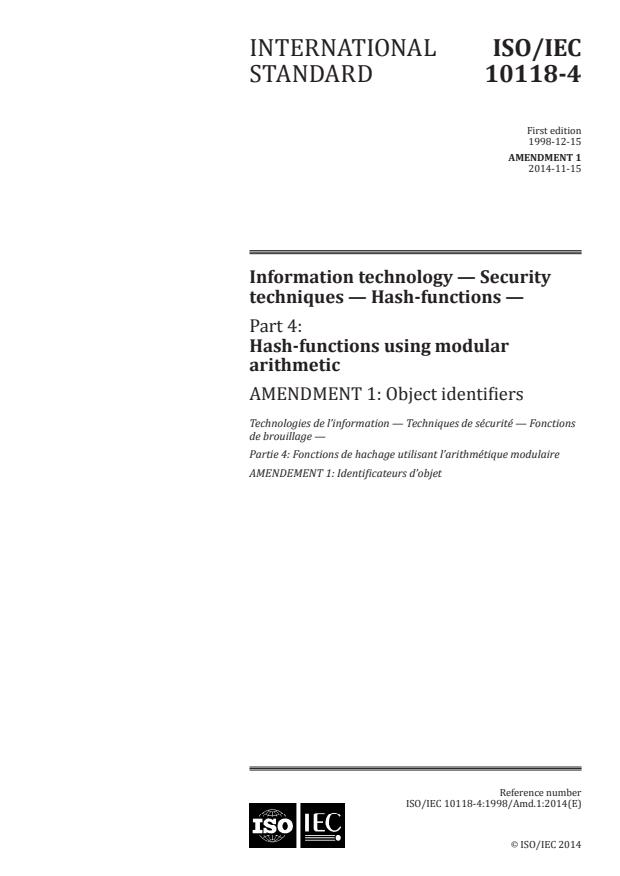
INTERNATIONAL ISO/IEC
STANDARD 10118-4
First edition
1998-12-15
AMENDMENT 1
2014-11-15
Information technology — Security
techniques — Hash-functions —
Part 4:
Hash-functions using modular
arithmetic
AMENDMENT 1: Object identifiers
Technologies de l’information — Techniques de sécurité — Fonctions
de brouillage —
Partie 4: Fonctions de hachage utilisant l’arithmétique modulaire
AMENDEMENT 1: Identificateurs d’objet
Reference number
ISO/IEC 10118-4:1998/Amd.1:2014(E)
©
ISO/IEC 2014
ISO/IEC 10118-4:1998/Amd.1:2014(E)
© ISO/IEC 2014
All rights reserved. Unless otherwise specified, no part of this publication may be reproduced or utilized otherwise in any form
or by any means, electronic or mechanical, including photocopying, or posting on the internet or an intranet, without prior
written permission. Permission can be requested from either ISO at the address below or ISO’s member body in the country of
the requester.
ISO copyright office
Case postale 56 • CH-1211 Geneva 20
Tel. + 41 22 749 01 11
Fax + 41 22 749 09 47
E-mail copyright@iso.org
Web www.iso.org
Published in Switzerland
ii © ISO/IEC 2014 – All rights reserved
ISO/IEC 10118-4:1998/Amd.1:2014(E)
Foreword
ISO (the International Organization for Standardization) and IEC (the International Electrotechnical
Commission) form the specialized system for worldwide standardization. National bodies that are
members of ISO or IEC participate in the development of International Standards through technical
committees established by the respective organization to deal with particular fields of technical
activity. ISO and IEC technical committees collaborate in fields of mutual interest. Other international
organizations, governmental and non-governmental, in liaison with ISO and IEC, also take part in the
work. In the field of information technology, ISO and IEC have established a joint technical committee,
ISO/IEC JTC 1.
International Standards are drafted in accordance with the rules given in the ISO/IEC Directives, Part 2.
The main task of the joint technical committee is to prepare International Standards. Draft International
Standards adopted by the joint technical committee are circulated to national bodies for voting.
Publication as an International Standard requires approval by at least 75 % of the national bodies
casting a vote.
Attention is drawn to the possibility that some of the elements of this document may be the subject of
patent rights. ISO and IEC shall not be held responsible for identifying any or all such patent r
...