

ISO/IEC 22603-1:2021
(Main)Information technology — Digital representation of product information — Part 1: General requirements
General Information
- Abstract
This document establishes the general requirements for electronic product labelling which can be applicable to all types of product regardless of industry.
- Status
- Published
- Publication Date
- 27-Sep-2021
- Technical Committee
- ISO/IEC JTC 1/SC 31 - Automatic identification and data capture techniques
- Drafting Committee
- ISO/IEC JTC 1/SC 31/WG 8 - Application of AIDC standards
- Current Stage
- 9020 - International Standard under periodical review
- Start Date
- 15-Jul-2026
- Completion Date
- 15-Jul-2026
Buy Documents


ISO/IEC 22603-1:2021 - Information technology -- Digital representation of product information
ISO/IEC 22603-1:2021 - Information technology — Digital representation of product information — Part 1: General requirements/28/2021
Overview
ISO/IEC 22603-1:2021, titled Information technology - Digital representation of product information - Part 1: General requirements, is an international standard developed by ISO and IEC. This standard specifies the general requirements for electronic product labelling applicable across all industries. It outlines how product compliance and other product information can be digitally represented, enhancing traditional physical labelling methods. The implementation of electronic product labelling aims to improve clarity, flexibility, regulatory compliance, and access to product information while reducing physical labelling limitations.
Key Topics
Electronic Product Labelling
ISO/IEC 22603-1 defines electronic product labels as digitally stored and displayed compliance markings, statements, and relevant product data accessible via web addresses or machine-readable codes such as barcodes or QR codes.General Requirements and Maintenance
Manufacturers or responsible parties are accountable for ensuring the electronic product label remains accessible for the product's useful life. The information must be continuously maintained and updated to reflect current compliance statuses and product details.Access Instructions
Clear guidance on accessing the electronic label must accompany the product through printed instructions on the product itself, packaging, or product documentation.Label Structure
The electronic product label is structured in six parts:- Manufacturer identity (name, trademark, contact details)
- Product identity (unique product identifier)
- Installation information (e.g., electrical ratings, installation instructions)
- Technical and regulatory information (certifications, compliance marks)
- Responsible party details
- Archive of compliance updates
Machine-Readable Codes and Web Access
Access to electronic labels via machine-readable codes must be straightforward, publicly available, and free of restrictions. Codes must be scannable with common devices like smartphones, supporting quick and convenient retrieval of product information online. URLs should also be provided in human-readable and machine-readable formats.
Applications
ISO/IEC 22603-1:2021 applies to a wide range of products and industries, including but not limited to:
- Consumer electronics
- Electrical equipment
- Medical devices
- Industrial machinery
- Environmental compliance products
This standard supports regulatory authorities, manufacturers, retailers, and end-users by:
- Facilitating regulatory compliance and product conformity verification efficiently
- Reducing physical label clutter and material waste, contributing to environmental sustainability
- Providing rapid access to product technical data, manuals, and certifications enhancing customer experience
- Helping manufacturers update compliance information without redesigning physical labels, thus reducing cost and time to market
- Supporting global trade by harmonizing electronic labelling practices amid diverse regulatory requirements
Related Standards
- ISO/IEC 19762 - Information technology - Automatic identification and data capture (AIDC) techniques - Harmonized vocabulary, which provides terminology supporting ISO/IEC 22603-1.
- Other ISO/IEC standards on digital product identification and data capture methods relevant for implementation of electronic labelling solutions.
By adopting ISO/IEC 22603-1:2021, organizations gain a consistent framework for implementing digital product labelling, enhancing product transparency, streamlining compliance management, and contributing to sustainable practices in product information dissemination. For more information and updates, visit the ISO website at www.iso.org.
Relations
- Effective Date
- 06-Jun-2022
Buy Documents
ISO/IEC 22603-1:2021 - Information technology -- Digital representation of product information
ISO/IEC 22603-1:2021 - Information technology — Digital representation of product information — Part 1: General requirements/28/2021
Get Certified
Connect with accredited certification bodies for this standard

BSI Group
BSI (British Standards Institution) is the business standards company that helps organizations make excellence a habit.

NYCE
Mexican standards and certification body.
Sponsored listings
Frequently Asked Questions
ISO/IEC 22603-1:2021 is a standard published by the International Organization for Standardization (ISO). Its full title is "Information technology — Digital representation of product information — Part 1: General requirements". This standard covers: This document establishes the general requirements for electronic product labelling which can be applicable to all types of product regardless of industry.
This document establishes the general requirements for electronic product labelling which can be applicable to all types of product regardless of industry.
ISO/IEC 22603-1:2021 is classified under the following ICS (International Classification for Standards) categories: 35.040.50 - Automatic identification and data capture techniques. The ICS classification helps identify the subject area and facilitates finding related standards.
ISO/IEC 22603-1:2021 has the following relationships with other standards: It is inter standard links to ISO 13506-2:2024. Understanding these relationships helps ensure you are using the most current and applicable version of the standard.
ISO/IEC 22603-1:2021 is available in PDF format for immediate download after purchase. The document can be added to your cart and obtained through the secure checkout process. Digital delivery ensures instant access to the complete standard document.
Standards Content (Sample)
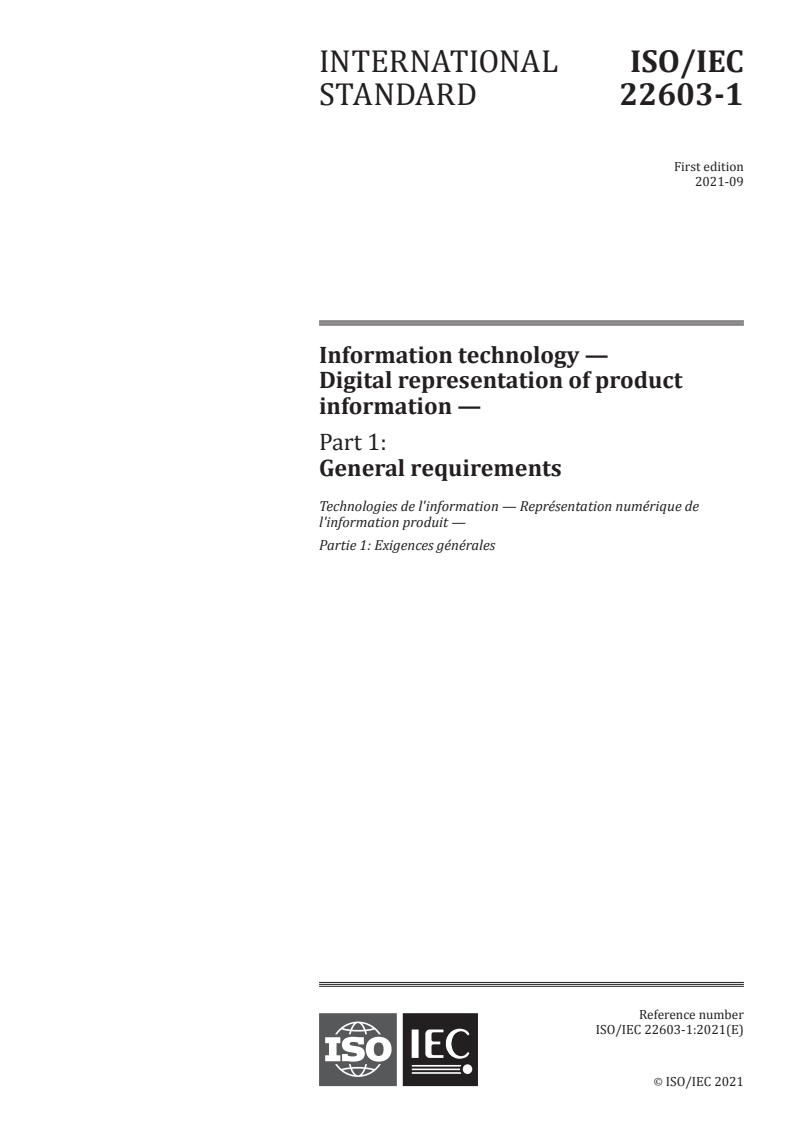
INTERNATIONAL ISO/IEC
STANDARD 22603-1
First edition
2021-09
Information technology —
Digital representation of product
information —
Part 1:
General requirements
Technologies de l'information — Représentation numérique de
l'information produit —
Partie 1: Exigences générales
Reference number
©
ISO/IEC 2021
© ISO/IEC 2021
All rights reserved. Unless otherwise specified, or required in the context of its implementation, no part of this publication may
be reproduced or utilized otherwise in any form or by any means, electronic or mechanical, including photocopying, or posting
on the internet or an intranet, without prior written permission. Permission can be requested from either ISO at the address
below or ISO’s member body in the country of the requester.
ISO copyright office
CP 401 • Ch. de Blandonnet 8
CH-1214 Vernier, Geneva
Phone: +41 22 749 01 11
Email: copyright@iso.org
Website: www.iso.org
Published in Switzerland
ii © ISO/IEC 2021 – All rights reserved
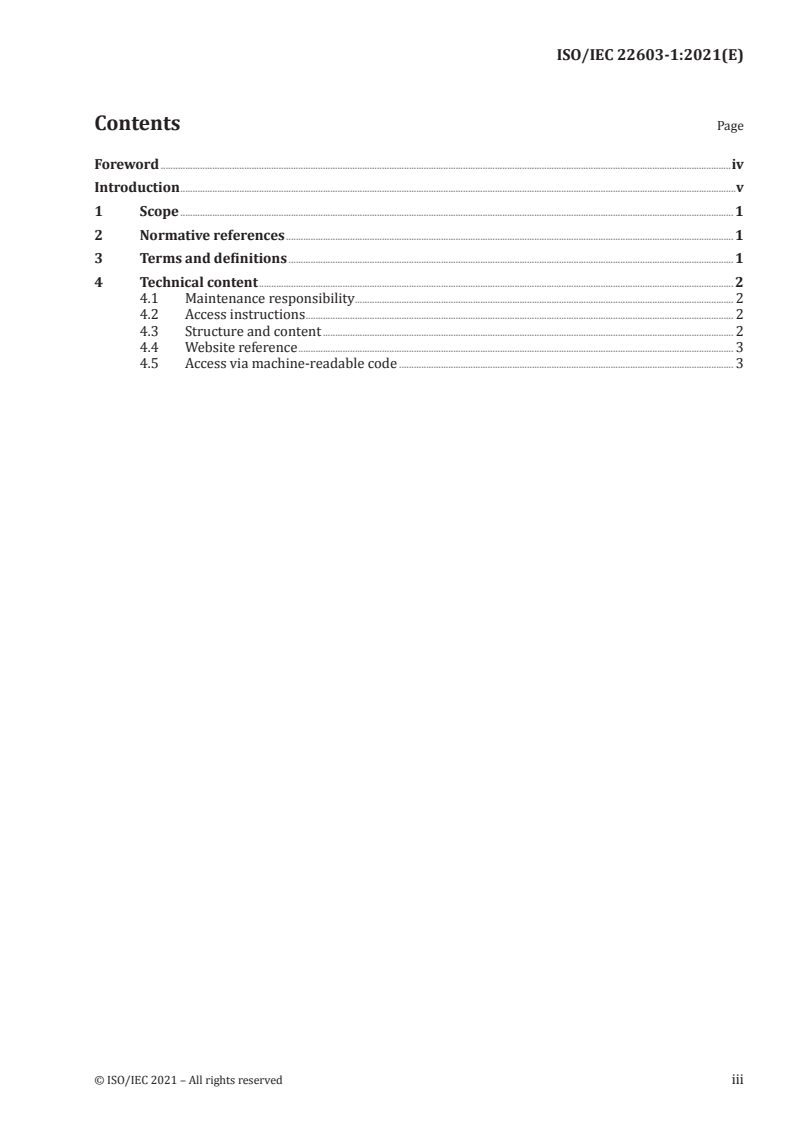
Contents Page
Foreword .iv
Introduction .v
1 Scope . 1
2 Normative references . 1
3 Terms and definitions . 1
4 Technical content . 2
4.1 Maintenance responsibility . 2
4.2 Access instructions . 2
4.3 Structure and content . 2
4.4 Website reference . 3
4.5 Access via machine-readable code . 3
© ISO/IEC 2021 – All rights reserved iii
Foreword
ISO (the International Organization for Standardization) and IEC (the International Electrotechnical
Commission) form the specialized system for worldwide standardization. National bodies that are
members of ISO or IEC participate in the development of International Standards through technical
committees established by the respective organization to deal with particular fields of technical
activity. ISO and IEC technical committees collaborate in fields of mutual interest. Other international
organizations, governmental and non-governmental, in liaison with ISO and IEC, also take part in the
work.
The procedures used to develop this document and those intended for its further maintenance are
described in the ISO/IEC Directives, Part 1. In particular, the different approval criteria needed for
the different types of document should be noted. This document was drafted in accordance with the
editorial rules of the ISO/IEC Directives, Part 2 (see www .iso .org/ directives or www .iec .ch/ members
_experts/ refdocs).
Attention is drawn to the possibility that some of the elements of this document may be the subject
of patent rights. ISO and IEC shall not be held responsible for identifying any or all such patent
rights. Details of any patent rights identified during the development of the document will be in the
Introduction and/or on the ISO list of patent declarations received (see www .iso .org/ patents) or the IEC
list of patent declarations received (see patents.iec.ch).
Any trade name used in this document is information given for the convenience of users and does not
constitute an endorsement.
For an explanation of the voluntary nature of standards, the meaning of ISO specific terms and
expressions related to conformity assessment, as well as information about ISO's adherence to the
World Trade Organization (WTO) principles in the Technical Barriers to Trade (TBT) see www .iso .org/
iso/ foreword .html. In the IEC, see www .iec .ch/ understanding -standards.
This document was prepared by Joint Technical Committee ISO/IEC JTC 1, Information technology,
Subcommittee SC 31, Automatic identification and data capture techniques.
A list of all parts in the ISO/IEC 22603 series can be found on the ISO and IEC websites.
Any feedback or questions on this document should be directed to the user’s national standards body. A
complete listing of these bodies can be found at www .iso .org/ members .html and www .iec .ch/ national
-committees.
iv © ISO/IEC 2021 – All rights reserved
Introduction
ISO/IEC 22603 is a multi-part International Standard that establishes the requirements for electronic
product labelling. Electronic product labelling is an alternative to having a product’s compliance
markings and other product information used to communicate product conformance to stated national
standards and regulations on the product’s nameplate or product label. Electronic product labelling can
exist in combination with traditional physical product markings and statements.
Electronic product labelling can be applicable to any type of product.
Product markings and technical statements can communicate product conformance to national
standards and regulations. While many products are decreasing in physical size, mandatory
requirements for additional product compliance markings and documents are growing, in part because:
— regulators are increasing the required number of product markings and statements on products to
designate compliance with the mandatory product regulations;
— third party test or certification organizations are developing registered trademark symbols to be
affixed on products that they have tested/certified;
— product conformance to new standards and regulations on domains, such as “Environmental,” leads
to new categories of product marks and statements;
— a growing number of global regulators each with unique labelling requirements.
The physical limitations to accommodate the proliferation of printed compliance labels and information
cause confusion among regulators and end-users. An alternative method using an electronic system to
communicate product compliance information, used in conjunction with existing labelling practices or
as an alternative to them, allows the regulatory objectives to be achieved with better uniformity of
execution, clarity of language, greater flexibility and control.
Some expected benefits include:
— environmental gains from less reducing labelling material usage or wastage from label obsolescence;
— less visual clutter on the product by achieving improved aesthetics and clarity;
— facilitates faster end-user access to relevan
...
INTERNATIONAL ISO/IEC
STANDARD 22603-1
First edition
2021-09
Information technology —
Digital representation of product
information —
Part 1:
General requirements
Technologies de l'information — Représentation numérique de
l'information produit —
Partie 1: Exigences générales
Reference number
©
ISO/IEC 2021
© ISO/IEC 2021
All rights reserved. Unless otherwise specified, or required in the context of its implementation, no part of this publication may
be reproduced or utilized otherwise in any form or by any means, electronic or mechanical, including photocopying, or posting
on the internet or an intranet, without prior written permission. Permission can be requested from either ISO at the address
below or ISO’s member body in the country of the requester.
ISO copyright office
CP 401 • Ch. de Blandonnet 8
CH-1214 Vernier, Geneva
Phone: +41 22 749 01 11
Email: copyright@iso.org
Website: www.iso.org
Published in Switzerland
ii © ISO/IEC 2021 – All rights reserved
Contents Page
Foreword .iv
Introduction .v
1 Scope . 1
2 Normative references . 1
3 Terms and definitions . 1
4 Technical content . 2
4.1 Maintenance responsibility . 2
4.2 Access instructions . 2
4.3 Structure and content . 2
4.4 Website reference . 3
4.5 Access via machine-readable code . 3
© ISO/IEC 2021 – All rights reserved iii
Foreword
ISO (the International Organization for Standardization) and IEC (the International Electrotechnical
Commission) form the specialized system for worldwide standardization. National bodies that are
members of ISO or IEC participate in the development of International Standards through technical
committees established by the respective organization to deal with particular fields of technical
activity. ISO and IEC technical committees collaborate in fields of mutual interest. Other international
organizations, governmental and non-governmental, in liaison with ISO and IEC, also take part in the
work.
The procedures used to develop this document and those intended for its further maintenance are
described in the ISO/IEC Directives, Part 1. In particular, the different approval criteria needed for
the different types of document should be noted. This document was drafted in accordance with the
editorial rules of the ISO/IEC Directives, Part 2 (see www .iso .org/ directives or www .iec .ch/ members
_experts/ refdocs).
Attention is drawn to the possibility that some of the elements of this document may be the subject
of patent rights. ISO and IEC shall not be held responsible for identifying any or all such patent
rights. Details of any patent rights identified during the development of the document will be in the
Introduction and/or on the ISO list of patent declarations received (see www .iso .org/ patents) or the IEC
list of patent declarations received (see patents.iec.ch).
Any trade name used in this document is information given for the convenience of users and does not
constitute an endorsement.
For an explanation of the voluntary nature of standards, the meaning of ISO specific terms and
expressions related to conformity assessment, as well as information about ISO's adherence to the
World Trade Organization (WTO) principles in the Technical Barriers to Trade (TBT) see www .iso .org/
iso/ foreword .html. In the IEC, see www .iec .ch/ understanding -standards.
This document was prepared by Joint Technical Committee ISO/IEC JTC 1, Information technology,
Subcommittee SC 31, Automatic identification and data capture techniques.
A list of all parts in the ISO/IEC 22603 series can be found on the ISO and IEC websites.
Any feedback or questions on this document should be directed to the user’s national standards body. A
complete listing of these bodies can be found at www .iso .org/ members .html and www .iec .ch/ national
-committees.
iv © ISO/IEC 2021 – All rights reserved
Introduction
ISO/IEC 22603 is a multi-part International Standard that establishes the requirements for electronic
product labelling. Electronic product labelling is an alternative to having a product’s compliance
markings and other product information used to communicate product conformance to stated national
standards and regulations on the product’s nameplate or product label. Electronic product labelling can
exist in combination with traditional physical product markings and statements.
Electronic product labelling can be applicable to any type of product.
Product markings and technical statements can communicate product conformance to national
standards and regulations. While many products are decreasing in physical size, mandatory
requirements for additional product compliance markings and documents are growing, in part because:
— regulators are increasing the required number of product markings and statements on products to
designate compliance with the mandatory product regulations;
— third party test or certification organizations are developing registered trademark symbols to be
affixed on products that they have tested/certified;
— product conformance to new standards and regulations on domains, such as “Environmental,” leads
to new categories of product marks and statements;
— a growing number of global regulators each with unique labelling requirements.
The physical limitations to accommodate the proliferation of printed compliance labels and information
cause confusion among regulators and end-users. An alternative method using an electronic system to
communicate product compliance information, used in conjunction with existing labelling practices or
as an alternative to them, allows the regulatory objectives to be achieved with better uniformity of
execution, clarity of language, greater flexibility and control.
Some expected benefits include:
— environmental gains from less reducing labelling material usage or wastage from label obsolescence;
— less visual clutter on the product by achieving improved aesthetics and clarity;
— facilitates faster end-user access to relevan
...