

ISO/IEC TR 18781:2015
(Main)Identification cards — Laundry testing of ID Cards
General Information
- Abstract
ISO/IEC TR 18781:2015 gives guidance on the principles and methods of testing ID cards to simulate accidental exposure to conditions encountered during the washing and drying of clothing. The physical properties of a card may degrade after exposure and the test methods described may be useful for comparing different card materials or types. Although there are many variations in the design and operation of washing machines, the operation of washing, rinsing, and water removal is common to all types of machine. For simplicity, one washing and drying cycle is specified, which is thought to be typical, according to industry sources. Additional wash cycles and/or different temperature conditions can be used for comparative purposes if desired.
- Status
- Published
- Publication Date
- 12-Oct-2015
- Technical Committee
- ISO/IEC JTC 1/SC 17 - Cards and security devices for personal identification
- Current Stage
- 6060 - International Standard published
- Start Date
- 13-Oct-2015
- Due Date
- 16-Aug-2016
- Completion Date
- 16-Aug-2016
Buy Documents
ISO/IEC TR 18781:2015 - Identification cards -- Laundry testing of ID Cards
ISO/IEC TR 18781:2015 - Identification cards — Laundry testing of ID Cards/13/2015
Overview
ISO/IEC TR 18781:2015 provides guidance on laundry testing of identification (ID) cards, focusing on simulating accidental exposure to washing and drying processes commonly encountered when cards are washed with clothing. This international technical report defines standardized methods to evaluate the durability and physical integrity of various ID card materials after laundering, a scenario not normally covered under routine wear and usage tests. The goal is to assist manufacturers, specifiers, and users in understanding how ID cards withstand typical laundry conditions such as water exposure, detergents, mechanical agitation, and heat from drying cycles.
Key Topics
- Laundry Test Simulation: The standard specifies one typical washing and drying cycle to replicate common household laundry conditions. This includes washing at approximately 40°C with detergent for about one hour, followed by tumble drying at temperatures not exceeding 60°C.
- Physical and Functional Testing: Cards are assessed for changes in visual appearance (legibility of text, portrait clarity) and compliance with physical standards (ISO 7810). Cards with integrated chips, magnetic stripes, or optical memory media are verified for continued functionality post-test.
- Test Parameters and Conditions:
- Use of ballast materials such as cotton towels or denim jeans to fill the washing machine.
- Detergents: commercial non-biological detergents or reference detergents like ATCC 1993 or ECE/IEC detergent A.
- Water hardness controlled to ≤20 ppm calcium carbonate, with possible use of water softeners.
- Exposure to water, detergent solution, washing machine mechanical action, and heat from drying.
- Test Setup: Cards placed in garment pockets (minimum four cards per test load), secured to prevent loss during washing, and spaced to avoid contact. Metal components such as zippers or buttons must not touch cards during testing.
Applications
- Material Comparison: Enables manufacturers and product developers to compare the resilience of different card substrates or laminates under simulated laundry conditions.
- Quality Assurance: Helps organizations verify that ID cards maintain usability and readability even after accidental laundering, crucial for driver’s licenses, access cards, and financial cards.
- Standardization of Testing: Provides a harmonized method for laboratories and quality control teams to evaluate card durability consistently.
- Risk Assessment: Assists card issuers in assessing the risk and impact of accidental washing, particularly in regions where cards are commonly carried in trouser pockets.
- Extended Card Lifecycle Evaluation: Complements existing service life and durability standards for cards by addressing accidental damage not considered in normal use profiles.
Related Standards
- ISO 7810: Defines physical characteristics of ID cards, referenced for compliance checks post-laundry testing.
- ISO/IEC 10373-1: Covers general test methods to verify card functionality including electronic components.
- ISO/IEC 24789-1 & 24789-2: Provide application profiles and evaluation methods for overall card service life.
- ISO 6330: Domestic washing and drying procedures for textile testing, used as a reference for selecting washing machine settings.
- ISO 6059: Water quality testing method, applied for controlling water hardness during the test.
- AAMVA DL/ID Card Design Standard: North American specification also referencing laundry and durability considerations.
- ANSI INCITS 322: Laundry test guidelines that complement this report for technical assessments.
Keywords: ISO/IEC TR 18781, laundry testing, identification cards, ID card durability, card washing simulation, card testing standards, physical card degradation, card service life, laundry damage to ID cards, washing machine test protocols
Buy Documents
ISO/IEC TR 18781:2015 - Identification cards -- Laundry testing of ID Cards
ISO/IEC TR 18781:2015 - Identification cards — Laundry testing of ID Cards/13/2015
Frequently Asked Questions
ISO/IEC TR 18781:2015 is a technical report published by the International Organization for Standardization (ISO). Its full title is "Identification cards — Laundry testing of ID Cards". This standard covers: ISO/IEC TR 18781:2015 gives guidance on the principles and methods of testing ID cards to simulate accidental exposure to conditions encountered during the washing and drying of clothing. The physical properties of a card may degrade after exposure and the test methods described may be useful for comparing different card materials or types. Although there are many variations in the design and operation of washing machines, the operation of washing, rinsing, and water removal is common to all types of machine. For simplicity, one washing and drying cycle is specified, which is thought to be typical, according to industry sources. Additional wash cycles and/or different temperature conditions can be used for comparative purposes if desired.
ISO/IEC TR 18781:2015 gives guidance on the principles and methods of testing ID cards to simulate accidental exposure to conditions encountered during the washing and drying of clothing. The physical properties of a card may degrade after exposure and the test methods described may be useful for comparing different card materials or types. Although there are many variations in the design and operation of washing machines, the operation of washing, rinsing, and water removal is common to all types of machine. For simplicity, one washing and drying cycle is specified, which is thought to be typical, according to industry sources. Additional wash cycles and/or different temperature conditions can be used for comparative purposes if desired.
ISO/IEC TR 18781:2015 is classified under the following ICS (International Classification for Standards) categories: 97.060 - Laundry appliances. The ICS classification helps identify the subject area and facilitates finding related standards.
ISO/IEC TR 18781:2015 is available in PDF format for immediate download after purchase. The document can be added to your cart and obtained through the secure checkout process. Digital delivery ensures instant access to the complete standard document.
Standards Content (Sample)
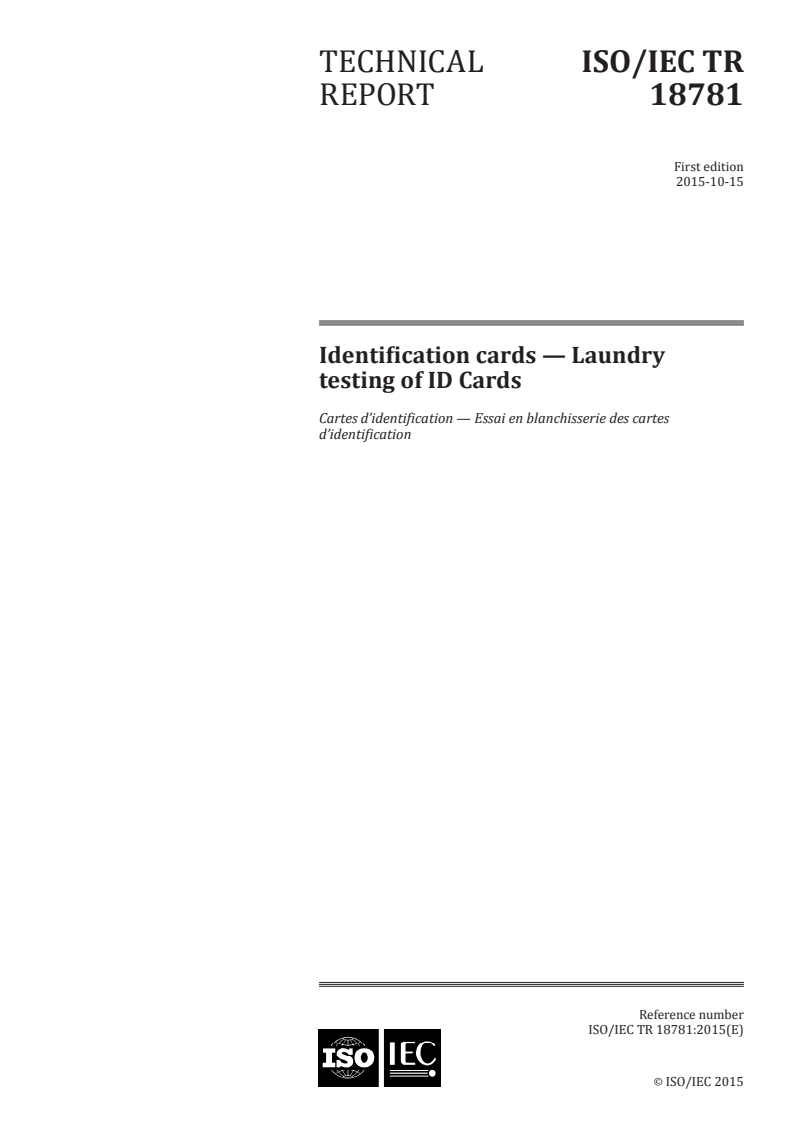
TECHNICAL ISO/IEC TR
REPORT 18781
First edition
2015-10-15
Identification cards — Laundry
testing of ID Cards
Cartes d’identification — Essai en blanchisserie des cartes
d’identification
Reference number
©
ISO/IEC 2015
© ISO/IEC 2015, Published in Switzerland
All rights reserved. Unless otherwise specified, no part of this publication may be reproduced or utilized otherwise in any form
or by any means, electronic or mechanical, including photocopying, or posting on the internet or an intranet, without prior
written permission. Permission can be requested from either ISO at the address below or ISO’s member body in the country of
the requester.
ISO copyright office
Ch. de Blandonnet 8 • CP 401
CH-1214 Vernier, Geneva, Switzerland
Tel. +41 22 749 01 11
Fax +41 22 749 09 47
copyright@iso.org
www.iso.org
ii © ISO/IEC 2015 – All rights reserved
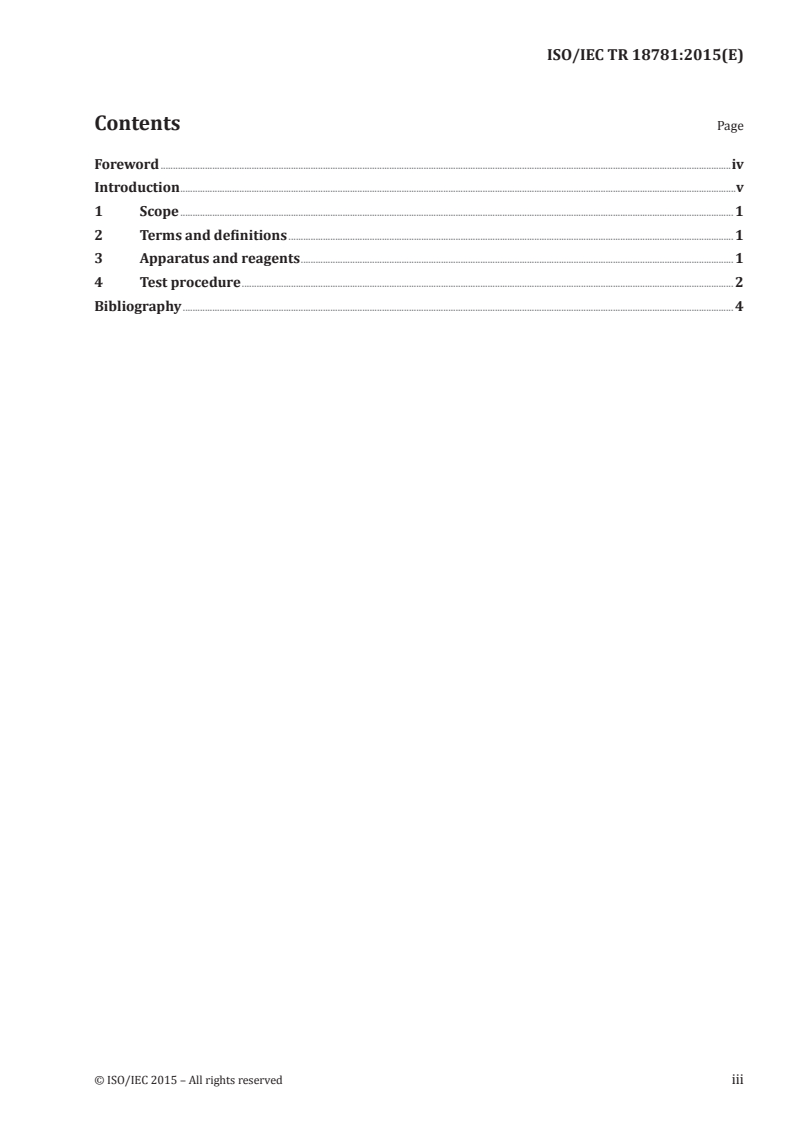
Contents Page
Foreword .iv
Introduction .v
1 Scope .1
2 Terms and definitions .1
3 Apparatus and reagents .1
4 Test procedure . 2
Bibliography .4
© ISO/IEC 2015 – All rights reserved iii
Foreword
ISO (the International Organization for Standardization) and IEC (the International Electrotechnical
Commission) form the specialized system for worldwide standardization. National bodies that are
members of ISO or IEC participate in the development of International Standards through technical
committees established by the respective organization to deal with particular fields of technical
activity. ISO and IEC technical committees collaborate in fields of mutual interest. Other international
organizations, governmental and non-governmental, in liaison with ISO and IEC, also take part in the
work. In the field of information technology, ISO and IEC have established a joint technical committee,
ISO/IEC JTC 1.
The procedures used to develop this document and those intended for its further maintenance are
described in the ISO/IEC Directives, Part 1. In particular the different approval criteria needed for
the different types of document should be noted. This document was drafted in accordance with the
editorial rules of the ISO/IEC Directives, Part 2 (see www.iso.org/directives).
Attention is drawn to the possibility that some of the elements of this document may be the subject
of patent rights. ISO and IEC shall not be held responsible for identifying any or all such patent
rights. Details of any patent rights identified during the development of the document will be in the
Introduction and/or on the ISO list of patent declarations received (see www.iso.org/patents).
Any trade name used in this document is information given for the convenience of users and does not
constitute an endorsement.
For an explanation on the meaning of ISO specific terms and expressions related to conformity
assessment, as well as information about ISO’s adherence to the WTO principles in the Technical
Barriers to Trade (TBT) see the following URL: Foreword - Supplementary information
The committee responsible for this document is ISO/IEC JTC 1, Information Technology, Subcommittee
SC 17, Cards and personal identification.
iv © ISO/IEC 2015 – All rights reserved
Introduction
Test methods developed in ISO/IEC 24789 are intended to reflect the factors affecting the life of
a card in normal use. Accidental exposure such as laundering is not considered to be normal use.
Nevertheless, many card specifiers and users are concerned that a test procedure should be drawn up
and published as a recognised method. SC 17 agreed at meeting No 62 that this Technical Report was
the most appropriate format for such a test. It can be used in conjunction with tests described in the
base standard.
The risk of cards being laundered varies according to geographical region and national norms. In the
US, for example, it is thought that most people carry their cards in a trouser pocket giving the possibility
that cards are laundered with clothing. In Japan and northern Europe, cards are mainly carried in
wallets with a lower risk of laundering damage.
There are a number of factors that can potentially affect cards during laundering:
— exposure to water plus detergent solution for a period of up to 2,5 hours;
— exposure to washing cycle temperatures of up to 90 °C for part of that time;
— exposure to dryer temperatures of up to 80 °C.
During the process, most cards will remain within the pocket of the garment so there is likely to be
some minor physical stress due to tumbling or spinning.
In seeking to propose a test that may be considered representative of the range of conditions a card
may encounter, some statistics were obtained on the current trends in laundering.
Globally, 38% of laundry loads are done with cold water (source: P&G). This proportion has not
increased in spite of the introduction of new cold water detergents, although there is a trend towards
the use of lower temperatures for environmental reasons.
In the USA, most users still use hot washes. Cold water detergent represents less than 15 % of US
detergent sales.
Washing machines are commonly programmed to work at 30 °C, 40 °C, 60 °C, and 90 °C
The most common washing temperature used in the UK is 40 °C. 60 °C is used for heavily soiled items
and 90 °C is used only rarely (source: Which magazine).
© ISO/IEC 2015 – All rights reserved v
TECHNICAL REPORT ISO/IEC TR 18781:2015(E)
Identification cards — Laundry testing of ID Cards
1 Scope
This Technical Report gives guidance on the principles and methods of testing ID cards to simulate
accidental exposure to conditions encountered during the washing and drying of clothing. The physical
properties of a card may degrade after exposure and the test methods des
...
TECHNICAL ISO/IEC TR
REPORT 18781
First edition
2015-10-15
Identification cards — Laundry
testing of ID Cards
Cartes d’identification — Essai en blanchisserie des cartes
d’identification
Reference number
©
ISO/IEC 2015
© ISO/IEC 2015, Published in Switzerland
All rights reserved. Unless otherwise specified, no part of this publication may be reproduced or utilized otherwise in any form
or by any means, electronic or mechanical, including photocopying, or posting on the internet or an intranet, without prior
written permission. Permission can be requested from either ISO at the address below or ISO’s member body in the country of
the requester.
ISO copyright office
Ch. de Blandonnet 8 • CP 401
CH-1214 Vernier, Geneva, Switzerland
Tel. +41 22 749 01 11
Fax +41 22 749 09 47
copyright@iso.org
www.iso.org
ii © ISO/IEC 2015 – All rights reserved
Contents Page
Foreword .iv
Introduction .v
1 Scope .1
2 Terms and definitions .1
3 Apparatus and reagents .1
4 Test procedure . 2
Bibliography .4
© ISO/IEC 2015 – All rights reserved iii
Foreword
ISO (the International Organization for Standardization) and IEC (the International Electrotechnical
Commission) form the specialized system for worldwide standardization. National bodies that are
members of ISO or IEC participate in the development of International Standards through technical
committees established by the respective organization to deal with particular fields of technical
activity. ISO and IEC technical committees collaborate in fields of mutual interest. Other international
organizations, governmental and non-governmental, in liaison with ISO and IEC, also take part in the
work. In the field of information technology, ISO and IEC have established a joint technical committee,
ISO/IEC JTC 1.
The procedures used to develop this document and those intended for its further maintenance are
described in the ISO/IEC Directives, Part 1. In particular the different approval criteria needed for
the different types of document should be noted. This document was drafted in accordance with the
editorial rules of the ISO/IEC Directives, Part 2 (see www.iso.org/directives).
Attention is drawn to the possibility that some of the elements of this document may be the subject
of patent rights. ISO and IEC shall not be held responsible for identifying any or all such patent
rights. Details of any patent rights identified during the development of the document will be in the
Introduction and/or on the ISO list of patent declarations received (see www.iso.org/patents).
Any trade name used in this document is information given for the convenience of users and does not
constitute an endorsement.
For an explanation on the meaning of ISO specific terms and expressions related to conformity
assessment, as well as information about ISO’s adherence to the WTO principles in the Technical
Barriers to Trade (TBT) see the following URL: Foreword - Supplementary information
The committee responsible for this document is ISO/IEC JTC 1, Information Technology, Subcommittee
SC 17, Cards and personal identification.
iv © ISO/IEC 2015 – All rights reserved
Introduction
Test methods developed in ISO/IEC 24789 are intended to reflect the factors affecting the life of
a card in normal use. Accidental exposure such as laundering is not considered to be normal use.
Nevertheless, many card specifiers and users are concerned that a test procedure should be drawn up
and published as a recognised method. SC 17 agreed at meeting No 62 that this Technical Report was
the most appropriate format for such a test. It can be used in conjunction with tests described in the
base standard.
The risk of cards being laundered varies according to geographical region and national norms. In the
US, for example, it is thought that most people carry their cards in a trouser pocket giving the possibility
that cards are laundered with clothing. In Japan and northern Europe, cards are mainly carried in
wallets with a lower risk of laundering damage.
There are a number of factors that can potentially affect cards during laundering:
— exposure to water plus detergent solution for a period of up to 2,5 hours;
— exposure to washing cycle temperatures of up to 90 °C for part of that time;
— exposure to dryer temperatures of up to 80 °C.
During the process, most cards will remain within the pocket of the garment so there is likely to be
some minor physical stress due to tumbling or spinning.
In seeking to propose a test that may be considered representative of the range of conditions a card
may encounter, some statistics were obtained on the current trends in laundering.
Globally, 38% of laundry loads are done with cold water (source: P&G). This proportion has not
increased in spite of the introduction of new cold water detergents, although there is a trend towards
the use of lower temperatures for environmental reasons.
In the USA, most users still use hot washes. Cold water detergent represents less than 15 % of US
detergent sales.
Washing machines are commonly programmed to work at 30 °C, 40 °C, 60 °C, and 90 °C
The most common washing temperature used in the UK is 40 °C. 60 °C is used for heavily soiled items
and 90 °C is used only rarely (source: Which magazine).
© ISO/IEC 2015 – All rights reserved v
TECHNICAL REPORT ISO/IEC TR 18781:2015(E)
Identification cards — Laundry testing of ID Cards
1 Scope
This Technical Report gives guidance on the principles and methods of testing ID cards to simulate
accidental exposure to conditions encountered during the washing and drying of clothing. The physical
properties of a card may degrade after exposure and the test methods des
...