


ISO 16745:2015
(Main)Environmental performance of buildings — Carbon metric of a building — Use stage
Environmental performance of buildings — Carbon metric of a building — Use stage
ISO 16745:2015 provides requirements for determining and reporting a carbon metric of an existing building, associated with the operation of the building. It sets out methods for the calculation, reporting, communication, and verification of a set of carbon metrics for GHG emissions arising from the measured energy use during the operation of an existing building, the measured user-related energy use, and other relevant GHG emissions and removals. These carbon metrics are separated into three measures designated CM1, CM2, and CM3. ISO 16745:2015 follows the principles set out in ISO 15392 and those described in Clause 4 of the Standard. Where deviations from the principles in ISO 15392 occur, or where more specific principles are stated, ISO 16745:2015 takes precedence. The carbon metrics CM1 and CM2 are not quantified based on life cycle assessment (LCA) methodology. Carbon metric CM3 may include partial quantification based on the results of LCA. ISO 16745:2015 does not include any method of modelling of the operational energy use of the building but follows the conventions provided by other International Standards, as given in relevant clauses. ISO 16745:2015 is not an assessment method for evaluating the overall environmental performance of a building or a building-rating tool and does not include value-based interpretation of the carbon metric(s) through weightings or benchmarking. ISO 16745:2015 deals with the application of the carbon metric(s) for an existing building, either residential or commercial, or a building complex. It does not include provisions for regional and/or national building stock.
Performance environnementale des bâtiments — Métrique du carbone des bâtiments — Phase opérationnelle
General Information
- Status
- Withdrawn
- Publication Date
- 12-Feb-2015
- Withdrawal Date
- 12-Feb-2015
- Technical Committee
- ISO/TC 59/SC 17 - Sustainability in buildings and civil engineering works
- Drafting Committee
- ISO/TC 59/SC 17/WG 4 - Environmental performance of buildings
- Current Stage
- 9599 - Withdrawal of International Standard
- Start Date
- 17-May-2017
- Completion Date
- 12-Feb-2026
Relations
- Effective Date
- 05-Nov-2015
- Effective Date
- 05-Nov-2015


Get Certified
Connect with accredited certification bodies for this standard

ICC Evaluation Service
Building products evaluation and certification.

QAI Laboratories
Building and construction product testing and certification.

Aboma Certification B.V.
Specialized in construction, metal, and transport sectors.
Sponsored listings
Frequently Asked Questions
ISO 16745:2015 is a standard published by the International Organization for Standardization (ISO). Its full title is "Environmental performance of buildings — Carbon metric of a building — Use stage". This standard covers: ISO 16745:2015 provides requirements for determining and reporting a carbon metric of an existing building, associated with the operation of the building. It sets out methods for the calculation, reporting, communication, and verification of a set of carbon metrics for GHG emissions arising from the measured energy use during the operation of an existing building, the measured user-related energy use, and other relevant GHG emissions and removals. These carbon metrics are separated into three measures designated CM1, CM2, and CM3. ISO 16745:2015 follows the principles set out in ISO 15392 and those described in Clause 4 of the Standard. Where deviations from the principles in ISO 15392 occur, or where more specific principles are stated, ISO 16745:2015 takes precedence. The carbon metrics CM1 and CM2 are not quantified based on life cycle assessment (LCA) methodology. Carbon metric CM3 may include partial quantification based on the results of LCA. ISO 16745:2015 does not include any method of modelling of the operational energy use of the building but follows the conventions provided by other International Standards, as given in relevant clauses. ISO 16745:2015 is not an assessment method for evaluating the overall environmental performance of a building or a building-rating tool and does not include value-based interpretation of the carbon metric(s) through weightings or benchmarking. ISO 16745:2015 deals with the application of the carbon metric(s) for an existing building, either residential or commercial, or a building complex. It does not include provisions for regional and/or national building stock.
ISO 16745:2015 provides requirements for determining and reporting a carbon metric of an existing building, associated with the operation of the building. It sets out methods for the calculation, reporting, communication, and verification of a set of carbon metrics for GHG emissions arising from the measured energy use during the operation of an existing building, the measured user-related energy use, and other relevant GHG emissions and removals. These carbon metrics are separated into three measures designated CM1, CM2, and CM3. ISO 16745:2015 follows the principles set out in ISO 15392 and those described in Clause 4 of the Standard. Where deviations from the principles in ISO 15392 occur, or where more specific principles are stated, ISO 16745:2015 takes precedence. The carbon metrics CM1 and CM2 are not quantified based on life cycle assessment (LCA) methodology. Carbon metric CM3 may include partial quantification based on the results of LCA. ISO 16745:2015 does not include any method of modelling of the operational energy use of the building but follows the conventions provided by other International Standards, as given in relevant clauses. ISO 16745:2015 is not an assessment method for evaluating the overall environmental performance of a building or a building-rating tool and does not include value-based interpretation of the carbon metric(s) through weightings or benchmarking. ISO 16745:2015 deals with the application of the carbon metric(s) for an existing building, either residential or commercial, or a building complex. It does not include provisions for regional and/or national building stock.
ISO 16745:2015 is classified under the following ICS (International Classification for Standards) categories: 91.040.01 - Buildings in general. The ICS classification helps identify the subject area and facilitates finding related standards.
ISO 16745:2015 has the following relationships with other standards: It is inter standard links to ISO 16745-2:2017, ISO 16745-1:2017. Understanding these relationships helps ensure you are using the most current and applicable version of the standard.
ISO 16745:2015 is available in PDF format for immediate download after purchase. The document can be added to your cart and obtained through the secure checkout process. Digital delivery ensures instant access to the complete standard document.
Standards Content (Sample)
INTERNATIONAL ISO
STANDARD 16745
First edition
2015-02-01
Environmental performance of
buildings — Carbon metric of a
building — Use stage
Performance environnementale des bâtiments — Métrique du
carbone des bâtiments — Phase opérationnelle
Reference number
©
ISO 2015
© ISO 2015
All rights reserved. Unless otherwise specified, no part of this publication may be reproduced or utilized otherwise in any form
or by any means, electronic or mechanical, including photocopying, or posting on the internet or an intranet, without prior
written permission. Permission can be requested from either ISO at the address below or ISO’s member body in the country of
the requester.
ISO copyright office
Case postale 56 • CH-1211 Geneva 20
Tel. + 41 22 749 01 11
Fax + 41 22 749 09 47
E-mail copyright@iso.org
Web www.iso.org
Published in Switzerland
ii © ISO 2015 – All rights reserved
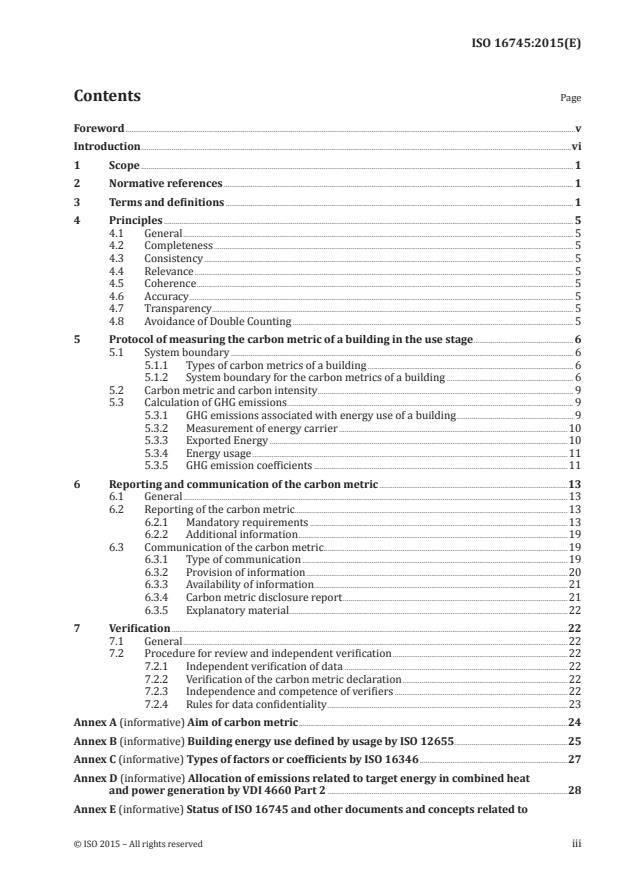
Contents Page
Foreword .v
Introduction .vi
1 Scope . 1
2 Normative references . 1
3 Terms and definitions . 1
4 Principles . 5
4.1 General . 5
4.2 Completeness . 5
4.3 Consistency . 5
4.4 Relevance . 5
4.5 Coherence . 5
4.6 Accuracy . 5
4.7 Transparency . 5
4.8 Avoidance of Double Counting . 5
5 Protocol of measuring the carbon metric of a building in the use stage .6
5.1 System boundary . 6
5.1.1 Types of carbon metrics of a building . 6
5.1.2 System boundary for the carbon metrics of a building . 6
5.2 Carbon metric and carbon intensity . 9
5.3 Calculation of GHG emissions . 9
5.3.1 GHG emissions associated with energy use of a building . 9
5.3.2 Measurement of energy carrier .10
5.3.3 Exported Energy .10
5.3.4 Energy usage .11
5.3.5 GHG emission coefficients .11
6 Reporting and communication of the carbon metric .13
6.1 General .13
6.2 Reporting of the carbon metric.13
6.2.1 Mandatory requirements .13
6.2.2 Additional information .19
6.3 Communication of the carbon metric.19
6.3.1 Type of communication .19
6.3.2 Provision of information .20
6.3.3 Availability of information .21
6.3.4 Carbon metric disclosure report .21
6.3.5 Explanatory material.22
7 Verification .22
7.1 General .22
7.2 Procedure for review and independent verification .22
7.2.1 Independent verification of data .22
7.2.2 Verification of the carbon metric declaration .22
7.2.3 Independence and competence of verifiers .22
7.2.4 Rules for data confidentiality .23
Annex A (informative) Aim of carbon metric .24
Annex B (informative) Building energy use defined by usage by ISO 12655 .25
Annex C (informative) Types of factors or coefficients by ISO 16346 .27
Annex D (informative) Allocation of emissions related to target energy in combined heat
and power generation by VDI 4660 Part 2 .28
Annex E (informative) Status of ISO 16745 and other documents and concepts related to
the description and assessment of greenhouse gas emissions caused by buildings .34
Bibliography .38
iv © ISO 2015 – All rights reserved
Foreword
ISO (the International Organization for Standardization) is a worldwide federation of national standards
bodies (ISO member bodies). The work of preparing International Standards is normally carried out
through ISO technical committees. Each member body interested in a subject for which a technical
committee has been established has the right to be represented on that committee. International
organizations, governmental and non-governmental, in liaison with ISO, also take part in the work.
ISO collaborates closely with the International Electrotechnical Commission (IEC) on all matters of
electrotechnical standardization.
The procedures used to develop this document and those intended for its further maintenance are
described in the ISO/IEC Directives, Part 1. In particular the different approval criteria needed for the
different types of ISO documents should be noted. This document was drafted in accordance with the
editorial rules of the ISO/IEC Directives, Part 2 (see www.iso.org/directives).
Attention is drawn to the possibility that some of the elements of this document may be the subject of
patent rights. ISO shall not be held responsible for identifying any or all such patent rights. Details of
any patent rights identified during the development of the document will be in the Introduction and/or
on the ISO list of patent declarations received (see www.iso.org/patents).
Any trade name used in this document is information given for the convenience of users and does not
constitute an endorsement.
For an explanation on the meaning of ISO specific terms and expressions related to conformity
assessment, as well as information about ISO’s adherence to the WTO principles in the Technical Barriers
to Trade (TBT) see the following URL: Foreword - Supplementary information
The committee responsible for this document is ISO/TC 59, Buildings and civil engineering works,
Subcommittee SC 17, Sustainability in buildings and civil engineering works.
Introduction
Buildings contribute approximately one-third of global greenhouse gas (GHG) emissions. With its
high share of emissions, the building and construction sector has the responsibility to take the global
lead in implementing strategies to reduce GHG emissions. The building and construction sector has
more potential and opportunity to deliver quick, deep, and cost-effective GHG mitigation than any
other sectors. Carbon dioxide (CO ) emissions contribute to global warming, which is one of the most
recognized environmental impacts attributable to buildings.
In this context, measurement and reporting of GHG emissions from existing buildings are critical for
enabling significant and cost-effective GHG mitigation. Currently, there has not been a globally agreed
method established to measure, report, and verify potential reductions of GHG emissions from existing
buildings in a consistent and comparable way. If such a method existed, it could be used as a universal tool
for measurement and reporting of GHG emissions, providing the foundation for accurate performance
baselines of buildings to be drawn, national targets to be set, and carbon trading to occur on a level
playing field.
In principle, accurate and precise reporting can only be achieved if GHG emissions (and removals) from
all life cycle stages of buildings are measured and/or quantified. However, not all countries in the world
have sufficient capacity or resources to use and apply life cycle assessment (LCA) methodologies.
Respecting the need for collaboration on a global scale, the need exists for a metric that is usable not only
in countries with sufficient number of experts and a precise database, but also in those countries where
experts’ services are limited and databases have considerable gaps. For instance, with the potential for
global scale carbon trading within building-related sectors, a method that is consistently usable in both
the well-developed and developing world is needed.
Operational energy use in buildings typically accounts for 70 %–80 % of energy use over the building
life cycle. Therefore, the operating stage of the building’s life cycle is the focus of measurement and
reporting of direct and indirect GHG emissions.
This International Standard aims to set out a globally applicable common method of measuring and
reporting of associated GHG emissions (and removals) attributable to existing buildings, by providing
requirements for the determining and reporting of a carbon metric(s) of a building.
The carbon metric is a measure (a partial carbon footprint) that is based on energy use data and
related building information for an existing building in operation. It provides information related to
the calculation of GHG emissions and can be used as an environmental indicator. Using this approach,
the metric and its protocol can be applied by all stakeholders in both developing and well-developed
countries, where building energy consumption and other relevant data can be retrieved or collected,
making it useful and globally transferable.
This International Standard aims to be practical for many stakeholders (i.e. not only for the building
profession), who are expected to use the carbon metric of a building as reference for decision making in
their business activities, governmental policies, and as a baseline for benchmarking.
The simplicity of approach provides applicability at all scales, ranging from cities and building portfolios
to individual buildings.
vi © ISO 2015 – All rights reserved
INTERNATIONAL STANDARD ISO 16745:2015(E)
Environmental performance of buildings — Carbon metric
of a building — Use stage
1 Scope
This International Standard provides requirements for determining and reporting a carbon metric of an
existing building, associated with the operation of the building. It sets out methods for the calculation,
reporting, communication, and verification of a set of carbon metrics for GHG emissions arising from the
measured energy use during the operation of an existing building, the measured user-related energy
use, and other relevant GHG emissions and removals. These carbon metrics are separated into three
measures designated CM1, CM2, and CM3 (see 5.1.1).
This International Standard follows the principles set out in ISO 15392 and those described in Clause 4.
Where deviations from the principles in ISO 15392 occur, or where more specific principles are stated,
this International Standard takes precedence.
The carbon metrics CM1 and CM2 are not quantified based on life cycle assessment (LCA) methodology.
Carbon metric CM3 may include partial quantification based on the results of LCA.
This International Standard does not include any method of modelling of the operational energy use of the
building but follows the conventions provided by other International Standards, as given in relevant clauses.
This International Standard is not an assessment method for evaluating the overall environmental
performance of a building or a building-rating tool and does not include value-based interpretation of
the carbon metric(s) through weightings or benchmarking.
This International Standard deals with the application of the carbon metric(s) for an existing building,
either residential or commercial, or a building complex. It does not include provisions for regional and/or
national building stock.
2 Normative references
The following documents, in whole or in part, are normatively referenced in this document and are
indispensable for its application. For dated references, only the edition cited applies. For undated
references, the latest edition of the referenced document (including any amendments) applies.
ISO 6707-1:2014, Buildings and civil engineering works — Vocabulary — Part 1: General terms
ISO 12655, Energy performance of buildings — Presentation of measured energy use of buildings
ISO 14050, Environmental management — Vocabulary
ISO 15392, Sustainability in building construction — General principles
ISO/TR 16344:2012, Energy performance of buildings — Common terms, definitions and symbols for the
overall energy performance rating and certification
3 Terms and definitions
For the purposes of this document, the terms and definitions given in ISO 6707-1, ISO 12655, ISO 14050,
ISO 15392, ISO/TR 16344, and the following apply. Where differences or conflicts occur, the definitions
given below shall take precedence.
NOTE A number of terms and definitions from these other sources have been repeated below, for ease of reference.
3.1
building services
services provided by technical building systems (3.19) and by appliances (ISO 6707-1:2014, 5.4.7) to
provide indoor climate conditions, domestic hot water, illumination levels, and other services related to
the use of the building (ISO 6707-1:2014, 3.1.3)
[SOURCE: ISO/TR 16344:2012, 2.1.10]
3.2
carbon intensity
carbon metric (3.3) expressed in relation to a specific reference unit related to the function
(ISO 15686-10:2010, 3.10) of the building (ISO 6707-1:2014, 3.1.3)
Note 1 to entry: Examples of reference units may include per unit area, per person, per kilobyte, per unit
output, and per GDP.
3.3
carbon metric
sum of annual greenhouse gas emissions (ISO 14064-1:2006, 2.5) and removals (ISO 14064-1:2006,
2.6), expressed as CO equivalents (ISO 14064-1:2006, 2.19), associated with the use stage of a building
(ISO 6707-1:2014, 3.1.3)
3.4
cooling
removal of latent and/or sensible heat
[SOURCE: ISO 16818:2008, 3.47]
3.5
delivered energy
energy (3.6), expressed per energy carrier (3.7), supplied to the technical building systems (3.19) through
the system boundary (3.18), to satisfy the uses taken into account [heating, cooling (3.4), ventilation
(3.20), domestic hot water, lighting, appliances (ISO 6707-1:2014, 5.4.7), etc.], or to produce electricity
Note 1 to entry: Delivered energy can be calculated for defined energy uses or it can be measured.
[SOURCE: ISO/TR 16344:2012, 2.1.33, modified by deleting the Note 1 related to active solar and wind
energy systems.]
3.6
energy
capacity for doing work; having several forms that may be transformed from one to another, such as
thermal (heat), mechanical (work), electrical, or chemical
[SOURCE: ISO 16818:2008, 3.74]
3.7
energy carrier
substance or phenomenon that can be used to produce mechanical work or heat (ISO 16818:2008, 3.117)
or to operate chemical or physical processes
Note 1 to entry: The energy content (ISO 13602-2:2006, 3.1) of fuels (3.10) is given by their gross calorific value
(ISO/TR 16344:2012, 2.1.78).
[SOURCE: ISO/TR 16344:2012, 2.1.46]
3.8
energy source
source from which useful energy (3.6) can be extracted or recovered either directly or by means of a
conversion or transformation process
Note 1 to entry: Examples include oil or gas fields, coal mines, sun, forests, etc.
2 © ISO 2015 – All rights reserved
[SOURCE: ISO/TR 16344:2012, 2.1.62]
3.9
exported energy
energy (3.6), expressed per energy carrier (3.7), delivered by the technical building systems (3.19) through
the system boundary (3.18) and used outside the system boundary
Note 1 to entry: It can be specified by generation types [e.g. combined heat and power (CHP), photovoltaic (PV)]
in order to apply different weighting factors.
[SOURCE: ISO/TR 16344:2012, 2.1.72]
3.10
fuel
material that can be used to produce heat (ISO 16818:2008, 3.117) or generate power by combustion
[SOURCE: ISO/TR 16344:2012, 2.1.74]
3.11
functional equivalent
quantified functional requirements and/or technical requirements for a building (ISO 6707-1:2014,
3.1.3) or part thereof for use as a reference basis for comparison
[SOURCE: ISO 21931-1:2010, 3.7, modified to add reference to part of a building.]
3.12
greenhouse gas emission coefficient
coefficient that describes the amount of a specific greenhouse gas (ISO 14064-1:2006, 2.1) that is released
from doing a certain activity, such as burning one tonne of fuel (3.10) in a furnace
Note 1 to entry: In general, GHG emission coefficients from specific energy consumption (ISO 50001:2011, 3.7) are
quantified based on GHG emission factors (ISO 14064-1:2006, 2.7) for use of the energy (3.6).
Note 2 to entry: Greenhouse gas emission coefficients can differ by year.
3.13
greenhouse gas reservoir
physical unit or component of the biosphere, geosphere, or hydrosphere with the capability to store or
accumulate a GHG (ISO 14064-1:2006, 2.1) removed from the atmosphere by a greenhouse gas sink (3.14)
or a GHG captured from a greenhouse gas source (3.15)
Note 1 to entry: The total mass of carbon contained in a GHG reservoir at a specified point in time could be
referred to as the carbon stock of the reservoir.
Note 2 to entry: A GHG reservoir can transfer greenhouse gases to another GHG reservoir.
Note 3 to entry: The collection of a GHG from a GHG source before it enters the atmosphere and storage of the
collected GHG in a GHG reservoir could be referred to as GHG capture and storage.
[SOURCE: ISO 14064-1:2006, 2.4]
3.14
greenhouse gas sink
physical unit or process that removes a GHG (ISO 14064-1:2006, 2.1) from the atmosphere
[SOURCE: ISO 14064-1:2006, 2.3]
3.15
greenhouse gas source
physical unit or process that releases a GHG (ISO 14064-1:2006, 2.1) into the atmosphere
[SOURCE: ISO 14064-1:2006, 2.2]
3.16
gross floor area
sum of the floor areas of the conditioned spaces (ISO 16818:2008, 3.38) within the building
(ISO 6707-1:2014, 3.1.3), including basements, mezzanine and intermediate floor tiers, and penthouses,
of headroom height 2,2 m or as specified in national or regional codes and standards
Note 1 to entry: It is measured from the exterior faces of exterior walls or from the centreline of walls separating
buildings, but excluding covered walkways, open roofed-over areas, porches and similar spaces, pipe trenches,
exterior terraces or steps, chimneys, roof overhangs, and similar features.
[SOURCE: ISO/TR 16344:2012, 2.1.79]
3.17
renewable energy
energy (3.6) from an energy source (3.8) that is not depleted by extraction
[SOURCE: ISO/TR 16344:2012, 2.1.123, modified—specific reference to energy source added and the
examples and explanatory note were removed.]
3.18
system boundary
boundary that includes within it all areas associated with a building (ISO 6707-1:2014, 3.1.3) (both inside
and outside the building) where energy (3.6) is consumed or produced
Note 1 to entry: Inside the system boundary, the system losses are taken into account explicitly, while outside the
system boundary, they are taken into account in the conversion factor.
[SOURCE: ISO/TR 16344:2012, 2.1.142]
3.19
technical building system
technical equipment for heating, cooling (3.4), ventilation (3.20), domestic hot water, lighting, and
electricity production
Note 1 to entry: A technical building system can refer to one or to several building services (3.1) [e.g. heating
system, heating, and domestic hot water system (ISO 6707-1:2014, 5.4.48)].
Note 2 to entry: A technical building system is composed of different sub-systems.
Note 3 to entry: Electricity production can include cogeneration (ISO/TR 16344:2012, 2.1.20) and photovoltaic
(PV) systems.
[SOURCE: ISO/TR 16344:2012, 2.1.146]
3.20
ventilation
process of supplying or removing air by natural means or mechanical means to or from a space for the
purpose of controlling air contaminant levels, humidity, odours, or temperature within the space
[SOURCE: ISO 16818:2008, 3.242]
3.21
verifier
party who makes sure or demonstrates that the process of measurement of a carbon metric (3.3) is true,
accurate, and justified
4 © ISO 2015 – All rights reserved
4 Principles
4.1 General
The application of the following principles is fundamental to ensuring that GHG-related information
presented through the carbon metric represents a true and fair measure. These principles provide
the basis for the application of the requirements in this International Standard by the organization or
individual determining the carbon metric.
4.2 Completeness
Include all relevant GHG emissions and removals (see 5.1) that provide a significant contribution to the
carbon metric.
4.3 Consistency
Apply assumptions, methods, and data in the same way throughout the carbon metric determination to
arrive at conclusions in accordance with the needs of the intended user and intended use (see 5.1).
4.4 Relevance
Select the GHG sources, GHG sinks, GHG reservoirs, data, and methodologies appropriate to the needs of
the intended user and the intended use (see 5.3.4).
4.5 Coherence
Select methodologies, standards, and guidance documents already recognized and adopted for energy
measurement and consumption to enhance comparability between common carbon metrics (see 5.3.2)
4.6 Accuracy
Ensure that the carbon metric quantification and communication are accurate, verifiable, relevant, and
not misleading and that bias is avoided and uncertainties are minimised (see 5.3.4).
4.7 Transparency
Address and document all relevant issues in an open, comprehensive, and understandable presentation
of information.
Disclose any relevant assumptions and make appropriate references to the methodologies and data
sources used. Clearly explain any estimates and avoid bias so that the carbon metric faithfully represents
what it purports to represent.
Ensure that the carbon metric communication is available to the intended audience and its intended
meaning is presented in a way that is clear, meaningful, and understandable. Include information on
the functional equivalent, data assumptions, calculation methods, and other characteristics to make
the limitations in the comparisons of carbon metrics transparent and clear to the target group (see 6).
4.8 Avoidance of Double Counting
Avoid counting of greenhouse gas emissions and removals that have already been allocated within other
carbon metrics (see 5.3).
NOTE This list of principles has been adapted based on the principles described in ISO/TS 14067, 5.
5 Protocol of measuring the carbon metric of a building in the use stage
5.1 System boundary
5.1.1 Types of carbon metrics of a building
A carbon metric shall be measured by quantifying the direct and indirect GHG emissions and removals
associated with a building in-use.
The three types of carbon metrics of a building are defined as follows:
a) Carbon metric 1 (CM1) is the sum of annual GHG emissions, expressed as CO equivalents, from
building-related energy use (see 5.3.4.1);
b) Carbon metric 2 (CM2) is the sum of annual GHG emissions, expressed as CO equivalents, from
building- and user-related energy use (see 5.3.4.2);
c) Carbon metric 3 (CM3) is the sum of annual GHG emissions and removals, expressed as CO
equivalents, from building- and user-related energy use, plus other building-related sources of GHG
emissions and removals.
5.1.2 System boundary for the carbon metrics of a building
5.1.2.1 System boundary for the carbon metrics CM1 and CM2
The system boundary for the CM1 and CM2 of a building is shown in Figure 1. It consists of the equipment
to operate the building fulfilling the demand as energy end use and the technical building system(s) to
deliver, convert, and generate energy for the energy end use.
CM1 and CM2 of a building are determined based on the following:
a) delivered energy for the building and for other energy use within the building’s site (curtilage);
NOTE Delivered energy includes energy provided by the local or national utility supplier and any
remotely generated energy [e.g. from photovoltaic (PV), wind power, or combined heat and power (CHP) etc.]
that is directly connected to the building.
b) total on-site energy generated and used in the building and for other energy use within the building’s
site (curtilage).
NOTE Examples of sources of on-site energy generation can be solar power [photovoltaic (PV) panel], wind
turbine power, biomass fuel, combined heat and power (CHP), fuel cell, and others.
The system boundary shall include all the energy consuming and generating systems that are within the
building‘s site (curtilage) and that support operation of the building.
All building-related energy end use (as indicated in the pale grey boxes in Figure 1) shall be taken
into account for the carbon metric (CM1), even when energy for these services is separately measured
through sub-metering.
Lighting (including plug-in lighting necessary for the basic function of the building) and controls
(including systems for daylight control) shall be included in the CM1. (see 5.3.4.1).
User-related energy use (as indicated in the dotted box in Figure 1) shall be included in the CM2, including
energy for supplementary lighting installed by building users (see 5.3.4.2).
6 © ISO 2015 – All rights reserved
Delivered to or exported from
Energy usage
technical building system
(5.3.4)
HVAC and domestic
hot water
Systems part
=Conversion factors,
Spaceheating
needed to aggregate
Space cooling
energy to one numerical
indicator as CO
Air movement
equivalent.
Domestic hot
water
Lighting and plug -in
Deliveredenergy
Fixed lighting
Input dh/dc
(district heating
Plug -in lighting
and cooling)
Plug -in
District heating
heating/cooling
or cooling
Supplementary
Heating/cooling
plug-in lighting
Gas, oil, coal, wood, …
systems
(incl. BCHP*)
Household/ofi ce
appliances
Solar thermal
Electricity
Other ultimate usage
Indoor
PV**, local
transportation
Renewable
Building auxiliary
devices
Other special usages
Cooking
Exported energy (outside
Refrigeration
the system boundary)
Devices in data
Thermal (heat and coolth)
centre
Other speci ic
Electricity
functional devices
Building/CURTILAGE
*Biomass CHP (combined heat and power)
**Photovoltaic Panel
Figure 1 — Boundary and energy flows —
Main energy flows within and crossing the boundaries for energy use of a building
It is NOT necessary to separately measure the amount of energy generated, converted, or consumed
within the system boundary by each individual system, piece of equipment, or machine.
Exported energy is outside the system boundary but may be reported as additional information where
appropriate (see 6.2.2).
Figures 2, 3, and 4 show examples of the system boundary for CM1.
EXAMPLE 1 Only the energy carrier for the delivered energy and energy generated by the PV panels and used
within the system boundary are required to be measured for CM1.
Distribution
SYSTEM BOUNDARY
Required to be
Energy end use
measured PV,
Electricity: 120 (kWh/y)
Electricity:
40 (kWh/y)
E
del,c1
Lighting
E
site,c2
100 (kWh/y)
HVAC
…….
[energy carrier]
E NOT required to be
exp,c1
Systems part
c1:electricity
measured for CM1
20 (kWh/y)
c2:electricity on site
Figure 2 — Examples of energy flow measuring by energy carriers (Ex.1)
EXAMPLE 2 Only the energy carriers for the delivered energy are required to be measured when a cogeneration
system is installed and used within the system boundary for CM1.
Required to be
measured
Systems part
Energy end use
E
del,c2 Electricity: 120 (kWh/y)
-
Cogene
ration Heat: 40 (MJ/y)
100 (m /y)
Electricity: 30 (kWh/y)
Heat: 40 (MJ/y)
E
del,c1
Lighting
100 (kWh/y)
HVA
…….
NOT required to be
[energy carriers]
measured for CM1
E
exp,c1
c1:electricity
10 (kWh/y)
c2:gas
Figure 3 — Examples of energy flow measuring by energy carriers (Ex.2)
EXAMPLE 3 The energy carrier for the delivered energy and biomass fuel (wood, waste, etc.) harvested within
the system boundary are measured when biomass cogeneration system is installed and used within the system
boundary for CM1.
8 © ISO 2015 – All rights reserved
Biomass
E
site,c 3
Required to be
130 (kg/y)
measured
Systems part
Energy end use
Electricity: 120 (kWh/y)
Cogene
Heat: 40 (MJ/y)
ration
Electricity:
30(kWh/y)
E
Lighting
del,c1
Heat: 40 (MJ/y)
100 (kWh/y)
HVA
…….
[energy carriers] NOT required to be
c1:electricity measured for CM1
E
exp,c1
c3:biomass
10 (kWh/y)
Figure 4 — Examples of energy flow measuring by energy carriers (Ex.3)
5.1.2.2 System boundary for the carbon metric CM3
The system boundary for the carbon metric CM3 shall include all the elements within the system
boundary for CM2 plus other processes and activities (including upstream and downstream processes),
causing GHG emissions and removals associated with the use stage of the building and other systems
within the building’s site (curtilage). These shall include, where significant, maintenance, including
cleaning, repair, replacement and refurbishment, water use, waste treatment and disposal, and emissions
of refrigerant from building air cooling systems.
5.2 Carbon metric and carbon intensity
The carbon metric is a measure of total GHG emissions attributed to the use of a building in operation,
over a one year period. For more detailed analysis or comparison, the carbon metric may be denoted
relative to a specific measure of carbon intensity, e.g. per unit area, per person, per kilobyte, per unit
output, and/or per GDP.
5.3 Calculation of GHG emissions
5.3.1 GHG emissions associated with energy use of a building
The emitted mass of GHG, expressed as kg CO equivalent per kg emission, shall be calculated from the
delivered energy for each energy carrier plus the on-site energy, if any, produced without using delivered
energy and used in the building and/or for other energy use within the building’s site, multiplied by the
respective GHG emission coefficient.
mE⋅=co ×KE+×K
()
2eqvd∑( el,cidel,cis()ite,ci site,ci )
where
E is the delivered energy for energy carrier del,ci;
del,ci
E is the energy produced onsite for the energy carrier site,ci;
site,ci
K is the GHG emission coefficient for delivered energy carrier del,ci (see 5.3.5);
del,ci
K is the GHG emission coefficient for on-site energy carrier site,ci.
site,ci
Where the sum of energy produced on-site is estimated to be is less than 2 % of the total energy, E
site,ci
should be ignored.
NOTE Energy produced on site does not include cogeneration by delivered energy sources.
5.3.2 Measurement of energy carrier
Where the energy carrier(s) provides energy to support the operation of the building and/or other on-
site facilities, measurement of the energy carrier shall take account of all the sources delivered to and
generated within the system boundary including
— electricity,
— fuels (e.g. gas, oil, wood, and other biomass waste), and
— imported coolth/steam/heat.
Data for nominal delivered energy is available from the following sources:
a) Utility provider reports and contracts;
b) Electricity bills;
c) Invoices for fuel deliveries;
d) Gas bills;
e) Meter readings (estimated from invoices, if meter readings are not available);
f) Pipeline measurements;
g) Energy management software.
The sum of these data shall include all of the energy usage described in 5.3.4.
Data for the on-site generated energy shall be based on the following:
a) Meter readings;
b) Measured amount of biomass consumed (kg).
NOTE Further information for the method of measuring and calculation of energy in the use stage of a
building is available from ISO 12655, ISO 16343, and ISO 16346.
5.3.3 Exported Energy
Exported energy, i.e. energy produced on-site, but not used for the building or other on-site facilities, is
not included in the carbon metric but can be reported as additional information.
Where exported energy is reported as additional information, the GHG emissions from the exported
energy shall be calculated from the amount of energy generated, multiplied by the respective GHG
emission coefficient.
mE⋅=co ×K
()
2eqve∑ xp,ciexp,ci
where
E is the exported energy for energy carrier ci;
exp,ci
K is the GHG emission coefficient for delivered energy carrier ci.
exp,ci
NOTE Annex D presents examples of allocation rules that can be used for combined heat power.
10 © ISO 2015 – All rights reserved
5.3.4 Energy usage
5.3.4.1 Building-related energy use
For CM1, building-related energy use shall be determined as follows (see Annex B for the classification):
a) Energy for HVAC and domestic hot water:
1) energy for space heating;
2) energy for space cooling;
3) energy for air movement;
4) energy for domestic hot water.
b) Energy for fixed lighting
c) Energy for plug-in equipment for basic building services:
1) plug-in lighting;
2) plug-in heating;
3) plug-in cooling.
d) Energy for other usage:
1) energy for indoor transportation;
2) energy for building auxiliary devices.
For purposes of determining the carbon metric, all building-related energy use shall be included, even
for services not typically sub-metered or separately measured.
5.3.4.2 User-related energy use
For CM2, user-related energy use is determined as follows (see Annex B for the classification):
a) Energy for lighting and plug-in equipment:
1) energy for supplementary lighting installed by building users;
2) energy for household/office appliances.
b) Energy for other special usages:
1) energy for cooking;
2) energy for refrigeration (cooling and storage);
3) energy for devices in data centres;
4) energy for other specific functional devices.
5.3.5 GHG emission coefficients
5.3.5.1 General
The greenhouse gas emissions from energy consumption are quantified by using GHG emission
coefficients. GHG emission coefficients characterize the amount of a specific GHG that is released from
doing a certain activity, such as burning one tonne of fuel in a furnace.
The GHG emission coefficient(s) used is based on the type of delivered energy carrier.
For the purpose of this International Standard, the following information shall be stated regarding the
type of GHG emission coefficient used to determine carbon metric:
— sources of information (e.g. national, international);
— greenhouse gasses included in CO equivalent (e.g. following Kyoto protocol, Montreal protocol, or
other protocols);
— included elements in supply chain (e.g. on-site or on-site plus upstream processes);
— time frame of impacts on environment (100 years);
— year of reference of emission coefficient data.
The choice of the source of the GHG emission coefficient used for calculating a carbon metric shall be
appropriate for the intended use of the carbon metric.
GHG emission coefficients shall be obtained from, in the following order of priority:
— nationally agreed data;
— independently provided information;
— internationally agreed data.
NOTE 1 There are some usable databases as officially agreed (approved) GHG emission coefficients (see
References [14], [15], [16]).
NOTE 2 GHG emission coefficients for each fuel type may be the same as those used under national reporting
for flexible mechanisms for the Kyoto Protocol for the six major greenhouse gases.
NOTE 3 Because some officially agreed (approved) GHG emission coefficients are based on default emissions, they
may not necessarily reflect the specific types of fuel combustion and emissions control technologies at each building.
NOTE 4 Additional geographically- or technologically-specific GHG emission factors may result in more accurate
calculations and can be used as long as they are credible and as long as the sources are documented and reported.
NOTE 5 For certain sources, GHG emissions may be calculated in different ways to accommodate differences in
the type of GHG activity data available to individual reporting offices or to help ensure that the calculations are
as accurate as possible.
NOTE 6 For international carbon trading mechanisms (such as the Clean Development Mechanism), it is
recommended that the source of the GHG emission coefficient(s) be the internationally agreed sources appropriate
to the fuel that is being consumed and the technology used for the energy carrier.
NOTE 7 This International Standard includes the principle of avoidance of double-counting. This is considered
especially in some situations where supplier/generator-specific emission factors for electricity are used. For
example, where:
— the process which used the electricity (or used an equivalent amount of electricity of the same type to that
generated) and another process did not claim the generator-specific emission factors for that electricity; and
— the generator-specific electricity production does not influence the emission factors of any other process or
organization.
— some electricity attributes such as green certificates are sold without direct coupling to the electricity itself.
In some countries, parts of the electricity from renewable energy sources might already be sold/exported as
renewable electricity without being excluded from the supplied mix.
5.3.5.2 Treatment of delivered energy
The GHG emission coefficients associated with the use of delivered energy shall take into account, where
relevant, GHG emissions arising from the energy supply system.
12 © ISO 2015 – All rights reserved
When a supplier of energy delivers a specific energy product with a specific GHG emission coefficient
and guarantees that the energy sale and the associated GHG emissions are not double counted, the GHG
emission coefficient for that specific energy product shall be used. When the supplier of energy does not
provide a specific GHG emission coefficient for the specific energy product delivered, the GHG emission
coefficient associated with the
...
Questions, Comments and Discussion
Ask us and Technical Secretary will try to provide an answer. You can facilitate discussion about the standard in here.
Loading comments...