


ISO/IEC 18031:2011
(Main)Information technology — Security techniques — Random bit generation
Information technology — Security techniques — Random bit generation
ISO/IEC 18031:2011 specifies a conceptual model for a random bit generator for cryptographic purposes, together with the elements of this model. ISO/IEC 18031:2011 specifies the characteristics of the main elements required for a non-deterministic random bit generator, specifies the characteristics of the main elements required for a deterministic random bit generator, establishes the security requirements for both the non-deterministic and the deterministic random bit generator. Where there is a requirement to produce sequences of random numbers from random bit strings, ISO/IEC 18031:2011 gives guidelines on how this can be performed. Techniques for statistical testing of random bit generators for the purposes of independent verification or validation, and detailed designs for such generators, are outside the scope of ISO/IEC 18031:2011.
Technologies de l'information — Techniques de sécurité — Génération de bits aléatoires
General Information
- Status
- Published
- Publication Date
- 07-Nov-2011
- Drafting Committee
- ISO/IEC JTC 1/SC 27/WG 2 - Cryptography and security mechanisms
- Current Stage
- 9599 - Withdrawal of International Standard
- Start Date
- 03-Feb-2025
- Completion Date
- 12-Feb-2026
Relations
- Effective Date
- 09-Feb-2026
- Effective Date
- 09-Feb-2026
- Effective Date
- 09-Feb-2026
- Referred By
CEN ISO/TS 19299:2015 - Electronic fee collection - Security framework (ISO/TS 19299:2015) - Effective Date
- 09-Feb-2026
- Effective Date
- 09-Feb-2026
- Effective Date
- 26-Nov-2021
- Effective Date
- 06-Jun-2022
- Effective Date
- 08-Aug-2009
Overview
ISO/IEC 18031:2011, "Information technology - Security techniques - Random bit generation", defines a conceptual model and security requirements for random bit generators (RBGs) used for cryptographic purposes. The standard covers both non‑deterministic random bit generators (NRBGs) and deterministic random bit generators (DRBGs), describes their main components (entropy sources, internal state, state transition and output generation functions, support and health tests), and gives guidelines for producing random numbers from random bit strings. Detailed statistical test techniques and full generator designs are explicitly out of scope.
Key Topics and Requirements
- RBG conceptual model: functional components and interactions required for secure random bit generation.
- Entropy sources: characteristics and roles of primary, physical and non‑physical entropy inputs; hybrid architectures.
- Internal state & transitions: requirements for maintaining and updating internal state securely.
- Output generation: requirements for deterministic and non‑deterministic output functions that produce cryptographic-quality bits.
- Additional inputs and support functions: use of personalization strings, reseeding, and auxiliary inputs to strengthen security.
- Health tests: continuous and startup checks for entropy sources and deterministic components to detect failures or degradation.
- Annexes and examples: normative guidance on combining RBGs, conversion methods for random numbers, and example DRBG mechanisms including Hash_DRBG, HMAC_DRBG, CTR_DRBG, Dual_EC_DRBG, MS_DRBG and others.
Practical Applications
ISO/IEC 18031 is essential for anyone designing, evaluating, or deploying cryptographic systems that require trustworthy randomness:
- Security architects & crypto engineers: design secure key generation, nonces, IVs, session keys and digital signature randomness.
- Hardware RNG designers: specify entropy source requirements and health monitoring for physical random generators.
- Software developers: build or select DRBG implementations that meet cryptographic requirements for applications (TLS, VPNs, PKI, secure tokens, IoT).
- Auditors and evaluators: assess RBG designs and operational practices against recognized security criteria. Using ISO/IEC 18031 helps reduce risks from poor randomness, such as predictable keys or repeated nonces that can compromise confidentiality and integrity.
Related Standards
ISO/IEC 18031 is typically used alongside other cryptographic and validation frameworks. Implementers often reference guidance from national standards bodies (for example, NIST DRBG recommendations and FIPS guidance) and other ISO/IEC security standards when selecting or certifying RBG implementations.
Keywords: ISO/IEC 18031, random bit generator, cryptographic RNG, entropy source, NRBG, DRBG, random number generation standard, security techniques.



Get Certified
Connect with accredited certification bodies for this standard

BSI Group
BSI (British Standards Institution) is the business standards company that helps organizations make excellence a habit.

Bureau Veritas
Bureau Veritas is a world leader in laboratory testing, inspection and certification services.

DNV
DNV is an independent assurance and risk management provider.
Sponsored listings
Frequently Asked Questions
ISO/IEC 18031:2011 is a standard published by the International Organization for Standardization (ISO). Its full title is "Information technology — Security techniques — Random bit generation". This standard covers: ISO/IEC 18031:2011 specifies a conceptual model for a random bit generator for cryptographic purposes, together with the elements of this model. ISO/IEC 18031:2011 specifies the characteristics of the main elements required for a non-deterministic random bit generator, specifies the characteristics of the main elements required for a deterministic random bit generator, establishes the security requirements for both the non-deterministic and the deterministic random bit generator. Where there is a requirement to produce sequences of random numbers from random bit strings, ISO/IEC 18031:2011 gives guidelines on how this can be performed. Techniques for statistical testing of random bit generators for the purposes of independent verification or validation, and detailed designs for such generators, are outside the scope of ISO/IEC 18031:2011.
ISO/IEC 18031:2011 specifies a conceptual model for a random bit generator for cryptographic purposes, together with the elements of this model. ISO/IEC 18031:2011 specifies the characteristics of the main elements required for a non-deterministic random bit generator, specifies the characteristics of the main elements required for a deterministic random bit generator, establishes the security requirements for both the non-deterministic and the deterministic random bit generator. Where there is a requirement to produce sequences of random numbers from random bit strings, ISO/IEC 18031:2011 gives guidelines on how this can be performed. Techniques for statistical testing of random bit generators for the purposes of independent verification or validation, and detailed designs for such generators, are outside the scope of ISO/IEC 18031:2011.
ISO/IEC 18031:2011 is classified under the following ICS (International Classification for Standards) categories: 35.030 - IT Security; 35.040 - Information coding. The ICS classification helps identify the subject area and facilitates finding related standards.
ISO/IEC 18031:2011 has the following relationships with other standards: It is inter standard links to CEN/TS 16702-2:2020, EN ISO 19299:2020, CEN/TS 16439:2013, CEN ISO/TS 19299:2015, CEN/TS 16702-2:2015, ISO/IEC 18031:2011/Amd 1:2017, ISO/IEC 18031:2025, ISO/IEC 18031:2005. Understanding these relationships helps ensure you are using the most current and applicable version of the standard.
ISO/IEC 18031:2011 is available in PDF format for immediate download after purchase. The document can be added to your cart and obtained through the secure checkout process. Digital delivery ensures instant access to the complete standard document.
Standards Content (Sample)
INTERNATIONAL ISO/IEC
STANDARD 18031
Second edition
2011-11-15
Information technology — Security
techniques — Random bit generation
Technologies de l'information — Techniques de sécurité — Génération
de bits aléatoires
Reference number
©
ISO/IEC 2011
© ISO/IEC 2011
All rights reserved. Unless otherwise specified, no part of this publication may be reproduced or utilized in any form or by any means,
electronic or mechanical, including photocopying and microfilm, without permission in writing from either ISO at the address below or
ISO's member body in the country of the requester.
ISO copyright office
Case postale 56 CH-1211 Geneva 20
Tel. + 41 22 749 01 11
Fax + 41 22 749 09 47
E-mail copyright@iso.org
Web www.iso.org
Published in Switzerland
ii © ISO/IEC 2011 – All rights reserved
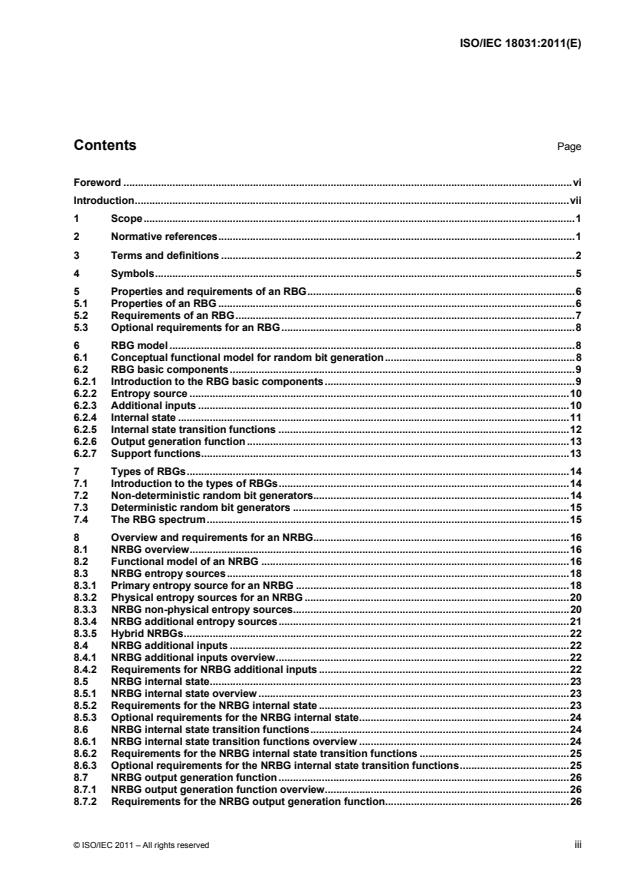
Contents Page
Foreword . vi
Introduction . vii
1 Scope . 1
2 Normative references . 1
3 Terms and definitions . 2
4 Symbols . 5
5 Properties and requirements of an RBG . 6
5.1 Properties of an RBG . 6
5.2 Requirements of an RBG . 7
5.3 Optional requirements for an RBG . 8
6 RBG model . 8
6.1 Conceptual functional model for random bit generation . 8
6.2 RBG basic components . 9
6.2.1 Introduction to the RBG basic components . 9
6.2.2 Entropy source . 10
6.2.3 Additional inputs . 10
6.2.4 Internal state . 11
6.2.5 Internal state transition functions . 12
6.2.6 Output generation function . 13
6.2.7 Support functions . 13
7 Types of RBGs . 14
7.1 Introduction to the types of RBGs . 14
7.2 Non-deterministic random bit generators . 14
7.3 Deterministic random bit generators . 15
7.4 The RBG spectrum . 15
8 Overview and requirements for an NRBG . 16
8.1 NRBG overview . 16
8.2 Functional model of an NRBG . 16
8.3 NRBG entropy sources . 18
8.3.1 Primary entropy source for an NRBG . 18
8.3.2 Physical entropy sources for an NRBG . 20
8.3.3 NRBG non-physical entropy sources . 20
8.3.4 NRBG additional entropy sources . 21
8.3.5 Hybrid NRBGs . 22
8.4 NRBG additional inputs . 22
8.4.1 NRBG additional inputs overview . 22
8.4.2 Requirements for NRBG additional inputs . 22
8.5 NRBG internal state . 23
8.5.1 NRBG internal state overview . 23
8.5.2 Requirements for the NRBG internal state . 23
8.5.3 Optional requirements for the NRBG internal state . 24
8.6 NRBG internal state transition functions . 24
8.6.1 NRBG internal state transition functions overview . 24
8.6.2 Requirements for the NRBG internal state transition functions . 25
8.6.3 Optional requirements for the NRBG internal state transition functions . 25
8.7 NRBG output generation function . 26
8.7.1 NRBG output generation function overview. 26
8.7.2 Requirements for the NRBG output generation function . 26
© ISO/IEC 2011 – All rights reserved iii
8.7.3 An optional requirement for the NRBG output generation function .26
8.8 NRBG health tests .26
8.8.1 NRBG health tests overview .26
8.8.2 General NRBG health test requirements .27
8.8.3 NRBG health test on deterministic components .27
8.8.4 NRBG health tests on entropy sources .28
8.8.5 NRBG health tests on random output .29
8.9 NRBG component interaction .31
8.9.1 NRBG component interaction overview .31
8.9.2 Requirements for NRBG component interaction .31
8.9.3 Optional requirements for NRBG component interaction .31
9 Overview and requirements for a DRBG .31
9.1 DRBG overview .31
9.2 Functional model of a DRBG .32
9.3 DRBG entropy source .34
9.3.1 Primary entropy source for a DRBG .34
9.3.2 Generating seed values for a DRBG .36
9.3.3 Additional entropy sources for a DRBG .36
9.3.4 Hybrid DRBG .37
9.4 Additional inputs for a DRBG .37
9.5 Internal state for a DRBG .37
9.6 Internal state transition function for a DRBG .38
9.7 Output generation function for a DRBG .39
9.8 Support functions for a DRBG .39
9.8.1 DRBG support functions overview .39
9.8.2 DRBG health test .39
9.8.3 DRBG deterministic algorithm test .40
9.8.4 DRBG software/firmware integrity test .40
9.8.5 DRBG critical functions test .40
9.8.6 DRBG software/firmware load test .40
9.8.7 DRBG manual key entry test .40
9.8.8 DRBG continuous random bit generator test .40
9.9 Additional requirements for DRBG keys .41
Annex A (normative) Combining RBGs .43
Annex B (normative) Conversion methods .44
B.1 Random number generation .44
B.1.1 Techniques for generating random numbers .44
B.1.2 The simple discard method .44
B.1.3 The complex discard method .44
B.1.4 The simple modular method .45
B.1.5 The complex modular method .45
B.2 Extracting bits in the Dual_EC_DRBG .46
B.2.1 Potential bias in an elliptic curve over a prime field F .46
p
B.2.2 Adjusting for the missing bit(s) of entropy in the x coordinates .47
B.2.3 Values for E .48
B.2.4 Observations .50
Annex C (normative) DRBGs .51
C.1 DRBG mechanism examples .51
C.2 DRBGs based on hash-functions .51
C.2.1 Introduction to DRBGs based on hash-functions .51
C.2.2 Hash_DRBG .51
C.2.3 HMAC_DRBG .59
C.3 DRBGs based on block ciphers .65
C.3.1 Introduction to DRBGs based on block ciphers .65
C.3.2 CTR_DRBG .65
C.3.3 OFB_DRBG .74
C.4 DRBGs based on number theoretic problems .76
C.4.1 Introduction to DRBGs based on number theoretic problems .76
iv © ISO/IEC 2011 – All rights reserved
C.4.2 Dual Elliptic Curve DRBG (Dual_EC_DRBG) . 76
C.4.3 Micali Schnorr DRBG (MS_DRBG) . 85
C.5 DRBG based on multivariate quadratic equations . 95
C.5.1 Introduction to a DRBG based on multivariate quadratic equations . 95
C.5.2 Multivariate Quadratic DRBG (MQ_DRBG) . 95
Annex D (normative) Application specific constants . 107
D.1 Constants for the Dual_EC_DRBG . 107
D.1.1 Introduction to Dual_EC_DRBG required constants . 107
D.1.2 Curves over prime fields. 107
D.1.3 Curves over binary fields . 110
D.2 Default moduli for the MS_DRBG (…) . 120
D.2.1 Introduction to MS_DRBG default moduli . 120
D.2.2 Default modulus n of size 1024 bits . 120
D.2.3 Default modulus n of size 2048 bits . 120
D.2.4 Default modulus n of size 3072 bits . 120
D.2.5 Default modulus n of size 7680 bits . 120
D.2.6 Default modulus n of size 15360 bits . 121
Annex E (informative) NRBG examples . 123
E.1 Canonical coin tossing example . 123
E.1.1 Overview . 123
E.1.2 Description of basic process . 123
E.1.3 Relation to standard NRBG components . 123
E.1.4 Optional variations . 124
E.1.5 Peres unbiasing procedure . 124
E.2 Hypothetical noisy diode example . 125
E.2.1 Overview . 125
E.2.2 General structure . 125
E.2.3 Details of operation . 126
E.2.4 Failsafe design consequences . 130
E.2.5 Modified example . 130
E.3 Mouse movement example . 130
Annex F (informative) Security considerations . 132
F.1 Attack model . 132
F.2 The security of hash-functions . 132
F.3 Algorithm and key size selection . 132
F.3.1 Introduction . 132
F.3.2 Equivalent algorithm strengths . 133
F.3.3 Selection of appropriate DRBGs . 134
F.4 The security of block cipher DRBGs . 135
F.5 Conditioned entropy sources and the derivation function . 135
Annex G (informative) Discussion on the estimation of entropy . 136
Annex H (informative) RBG assurance . 137
Annex I (informative) RBG boundaries . 138
Annex J (informative) Rationale for the design of statistical tests . 140
J.1 Introduction . 140
J.2 Runs test . 140
J.3 Long runs test . 140
Bibliography . 142
© ISO/IEC 2011 – All rights reserved v
Foreword
ISO (the International Organization for Standardization) and IEC (the International Electrotechnical
Commission) form the specialized system for worldwide standardization. National bodies that are members of
ISO or IEC participate in the development of International Standards through technical committees
established by the respective organization to deal with particular fields of technical activity. ISO and IEC
technical committees collaborate in fields of mutual interest. Other international organizations, governmental
and non-governmental, in liaison with ISO and IEC, also take part in the work. In the field of information
technology, ISO and IEC have established a joint technical committee, ISO/IEC JTC 1.
International Standards are drafted in accordance with the rules given in the ISO/IEC Directives, Part 2.
The main task of the joint technical committee is to prepare International Standards. Draft International
Standards adopted by the joint technical committee are circulated to national bodies for voting. Publication as
an International Standard requires approval by at least 75 % of the national bodies casting a vote.
Attention is drawn to the possibility that some of the elements of this document may be the subject of patent
rights. ISO and IEC shall not be held responsible for identifying any or all such patent rights.
ISO/IEC 18031 was prepared by Joint Technical Committee ISO/IEC JTC 1, Information technology,
Subcommittee SC 27, IT Security techniques.
This second edition cancels and replaces the first edition (ISO/IEC 18031:2005), which has been technically
revised. It also incorporates the Technical Corrigendum ISO/IEC 18031:2005/Cor.1:2009.
vi © ISO/IEC 2011 – All rights reserved
Introduction
This International Standard sets out specific requirements that when met will result in the development of a
random bit generator that may be applicable to cryptographic applications.
Numerous cryptographic applications require the use of random bits. These cryptographic applications include
the following:
random keys and initialisation values (IVs) for encryption;
random keys for keyed MAC algorithms;
random private keys for digital signature algorithms;
random values to be used in entity authentication mechanisms;
random values to be used in key establishment protocols;
random PIN and password generation;
nonces.
The purpose of this International Standard is to establish a conceptual model, terminology, and requirements
related to the building blocks and properties of systems used for random bit generation in or for cryptographic
applications.
It is possible to categorize random bit generators into two types. This International Standard identifies the two
types as non-deterministic and deterministic random bit generators.
A non-deterministic random bit generator can be defined as a random bit generating mechanism that uses a
source of entropy to generate a random bit stream.
A deterministic random bit generator can be defined as a bit generating mechanism that uses deterministic
mechanisms, such as cryptographic algorithms, to generate a random bit stream. In this type of bit stream
generation, there is a specific input (normally called a seed) and perhaps some optional input, which,
depending on its application, may or may not be publicly available. The seed is processed by a function which
provides an output.
NOTE This International Standard also recognizes and discusses the existence of Hybrid Random Bit Generators.
© ISO/IEC 2011 – All rights reserved vii
INTERNATIONAL STANDARD ISO/IEC 18031:2011(E)
Information technology — Security techniques — Random bit
generation
1 Scope
This International Standard specifies a conceptual model for a random bit generator for cryptographic
purposes, together with the elements of this model.
This International Standard
specifies the characteristics of the main elements required for a non-deterministic random bit generator,
specifies the characteristics of the main elements required for a deterministic random bit generator,
establishes the security requirements for both the non-deterministic and the deterministic random bit
generator.
Where there is a requirement to produce sequences of random numbers from random bit strings, Annex B
gives guidelines on how this can be performed.
Techniques for statistical testing of random bit generators for the purposes of independent verification or
validation, and detailed designs for such generators, are outside the scope of this International Standard.
2 Normative references
The following referenced documents are indispensable for the application of this document. For dated
references, only the edition cited applies. For undated references, the latest edition of the referenced
document (including any amendments) applies.
ISO/IEC 9797-2, Information technology — Security techniques — Message Authentication Codes (MACs) —
Part 2: Mechanisms using a dedicated hash-function
ISO/IEC 10116, Information technology — Security techniques — Modes of operation for an n-bit block cipher
ISO/IEC 10118-3, Information technology — Security techniques — Hash-functions — Part 3: Dedicated
hash-functions
ISO/IEC 18032, Information technology — Security techniques — Prime number generation
ISO/IEC 18033-3, Information technology — Security techniques — Encryption algorithms — Part 3: Block
ciphers
ISO/IEC 19790, Information technology — Security techniques — Security requirements for cryptographic
modules
© ISO/IEC 2011 – All rights reserved 1
3 Terms and definitions
For the purposes of this document, the following terms and definitions apply.
3.1
algorithm
clearly specified mathematical process for the computation of a set of rules that, if followed, will give a
prescribed result
3.2
backward secrecy
assurance that previous values cannot be determined from knowledge of the current value or subsequent
values
3.3
biased source
source of bit strings (or numbers) from a sample space where some bit strings (or numbers) are more likely to
be chosen than some other bit strings (or numbers)
NOTE 1 Equivalently, if the sample space consists of r elements, some elements will occur with probability different
from 1/r.
NOTE 2 This term can be contrasted with unbiased source (3.35).
3.4
bit stream
continuous output of bits from a device or mechanism
3.5
bit string
finite sequence of ones and zeroes
3.6
black box
idealized mechanism that accepts inputs and produces outputs, but is designed such that an observer cannot
see inside the box or determine exactly what is happening inside that box
NOTE This term can be contrasted with glass box (3.14).
3.7
block cipher
symmetric encipherment system with the property that the encryption operates on a block of plaintext, i.e. a
string of bits of a defined length, to yield a block of ciphertext
[ISO/IEC 18033-1]
3.8
cryptographic boundary
explicitly defined continuous perimeter that establishes the physical bounds of a cryptographic module and
contains all the hardware, software and/or firmware components of a cryptographic module
[ISO/IEC 19790]
3.9
deterministic algorithm
characteristic of an algorithm that states that given the same input, the same output is always produced
2 © ISO/IEC 2011 – All rights reserved
3.10
deterministic random bit generator
DRBG
random bit generator that produces a random-appearing sequence of bits by applying a deterministic
algorithm to a suitably random initial value called a seed and, possibly, some secondary inputs upon which the
security of the random bit generator does not depend
NOTE In particular, non-deterministic sources may also form part of these secondary inputs.
3.11
entropy
measure of the disorder, randomness or variability in a closed system
NOTE The entropy of a random variable X is a mathematical measure of the amount of information provided by an
observation of X.
3.12
entropy source
component, device or event which produces outputs which, when captured and processed in some way,
produce a bit string containing entropy
3.13
forward secrecy
assurance that the knowledge of subsequent (future) values cannot be determined from current or previous
values
3.14
glass box
idealized mechanism that accepts inputs and produces outputs and is designed such that an observer can
see inside and determine exactly what is going on
NOTE This term can be contrasted with black box (3.6).
3.15
hash-function
function which maps strings of bits to fixed-length strings of bits, satisfying the following two properties.
It is computationally infeasible to find for a given output, an input that maps to this output.
It is computationally infeasible to find for a given input, a second input, which maps to the same output
NOTE Computational feasibility depends on the specific security requirements and environment.
[ISO/IEC 10118-1]
3.16
human entropy source
entropy source that has some kind of random human component
3.17
hybrid DRBG
DRBG that uses a non-deterministic entropy source as an additional entropy source
3.18
hybrid NRBG
NRBG that takes a seed value as an additional entropy source
NOTE Hybrid NRBG may be physical or non-physical.
© ISO/IEC 2011 – All rights reserved 3
3.19
initialisation value
value used in defining the starting point of a cryptographic algorithm
NOTE An example of where an initialisation value is used is in a hash-function or an encryption algorithm.
3.20
Kerckhoffs box
idealized cryptosystem where the design and public keys are known to an adversary, but in which there are
secret keys and/or other private information that is not known to an adversary
NOTE A Kerckhoffs box lies between a black box and a glass box in terms of the knowledge of an adversary.
3.21
known-answer test
method of testing a deterministic mechanism where a given input is processed by the mechanism and the
resulting output is then compared to a corresponding known value
NOTE Known-answer testing of a deterministic mechanism may also include testing the integrity of the software
which implements the deterministic mechanism. For example, if the software implementing the deterministic mechanism is
digitally signed, then the signature can be recalculated and compared to the known signature value.
3.22
min-entropy
lower bound of entropy that is useful in determining a worst-case estimate of sampled entropy
NOTE The bit string X (or more precisely, the corresponding random variable that models random bit strings of this
-k
type) has min-entropy k if k is the largest value such that Pr [X = x] 2 . That is, X contains k bits of min-entropy or
randomness.
3.23
non-deterministic random bit generator
NRBG
RBG whose security depends upon sampling an entropy source
NOTE The entropy source will be sampled whenever the RBG produces output, and possibly more often.
3.24
one-way function
function with the property that it is easy to compute the output for a given input, but it is computationally
infeasible to find for a given output an input which maps to this output
[ISO/IEC 11770-3]
3.25
output generation function
function in an RBG that computes the output of the RBG from the internal state of the RBG
3.26
pseudorandom sequence of bits
sequence of bits or a number that appears to be selected at random even though the selection process is
done by a deterministic algorithm
3.27
pure DRBG
DRBG whose entropy sources are seeds
3.28
pure NRBG
NRBG whose entropy sources are non-deterministic
4 © ISO/IEC 2011 – All rights reserved
NOTE The pure NRBG may be physical or non-physical.
3.29
random bit generator
RBG
device or algorithm that outputs a sequence of bits that appears to be statistically independent and unbiased
3.30
reseeding
specialised internal state transition function which updates the internal state in the event that a new seed
value is supplied
NOTE The usage of the term 'reseeding' is not unique in the literature. Some authors denote as 'reseeding' each
mechanism that replaces the current value of the internal state by a fresh value. This International Standard follows this
terminology. However, often one distinguishes between 'reseeding' and 'seed update'. The term 'reseeding' then only
comprises mechanisms that replace the internal state by a new value, which does not depend on the current value
(essentially a new seeding process). In contrast 'seed update' denotes a mechanism that computes the new internal state
from its current value and other (usually non-deterministic) data (cf. 9.6, item 3).
3.31
secret parameter
input to the RBG during initialisation, which provides additional entropy in the case of an entropy source failure
or compromise
3.32
seed
string of bits that is used as input to a DRBG
NOTE The seed will determine a portion of the state of the DRBG.
3.33
seedlife
period of time between initialising the DRBG with one seed and reseeding (fully initialising) that DRBG with
another seed
3.34
state
condition of a random bit generator or any part thereof with respect to time and circumstance
3.35
unbiased source
source of bit strings (or numbers) from a sample space where all potential bit strings (or numbers) have the
same possibility of being chosen
NOTE 1 Equivalently, if the sample space consists of r elements, all elements will occur with probability 1/r.
NOTE 2 This term can be contrasted with biased source (3.3).
4 Symbols
For the purposes of this document, the following symbols apply.
Symbol Meaning
Pr[x] Probability of occurrence of x.
IV Initialisation Value.
© ISO/IEC 2011 – All rights reserved 5
X. For example, 5 =
Ceiling: the smallest integer greater than or equal to
X
5, and 5.3 = 6.
X Y Bitwise exclusive-or (also bit wise addition mod 2) of two bit strings X and Y
of the same length.
X || Y Concatenation of two bit strings X and Y in that order.
The length in bits of string a.
| a |
x mod n The unique remainder r, 0 r n-1, when integer x is divided by n. For
example, 23 mod 7 = 2.
Used in a figure to illustrate a “switch” between sources of input.
5 Properties and requirements of an RBG
5.1 Properties of an RBG
The properties of randomness may be demonstrated by tossing a coin in the air and observing which side is
uppermost when it lands, where one side is called “a head” (H) and the other is called “a tail” (T). A coin also
has a rim, but the probability that a coin might land on its rim is so unlikely an occurrence that for the purpose
of this demonstration it may be ignored.
Flipping a coin multiple times produces an ordered series of coin flip results denoted as a series of H(s) and
T(s). For example, the sequence “HTTHT” (reading left to right) indicates a head followed by a tail, followed by
a tail, followed by a head, followed by a tail. This coin flip sequence can be translated into a binary string in a
straightforward manner by assigning H to a binary one ('1’) and T to a binary zero ('0’); the resulting example
bit string is '10010’.
The required properties of randomness can be examined using the example of the idealized coin toss
described above. The result of each coin flip is:
1. Unpredictable: Before the flip, it is unknown whether the coin will land showing a head or a tail. Also, if
that flip is kept secret, it is not possible to determine what the flip was if any subsequent flip outcome is
known. The unpredictability after the flip depends on whether the observer can observe the coin flip or not.
The notion of entropy quantifies the amount of unpredictability or uncertainty relative to an observer and
will be discussed more thoroughly later in this International Standard;
2. Unbiased: That is, each potential outcome has the same chance of occurring; and
3. Independent: The coin flip is said to be memoryless; whatever happened before the current flip does not
influence it.
Such a series of idealized coin flips is directly applicable to an RBG. The RBGs specified in this International
Standard will try to simulate a series of idealized coin flips.
As indicated above, unpredictability is a required property of an RBG. It should not be possible to predict the
output of a properly implemented and working RBG. Forward secrecy refers to the inability to predict future
output of the RBG based on the knowledge of previous output values and/or internal states. The inability to
determine prior output of an RBG, given knowledge of the current or any future output of the RBG, is known
as backward secrecy.
6 © ISO/IEC 2011 – All rights reserved
The decision whether to incorporate backward and/or forward secrecy is determined by the requirements of
the consuming application.
The following factors should be considered when deciding to incorporate backward and/or forward secrecy.
1. In some instances, achieving backward secrecy is more important than achieving forward secrecy. For
example, if a cryptosystem is stolen, an adversary may attempt to read the old messages processed by
that system. Forward secrecy is not really a concern, since the system is no longer in use by the original
owner. Achieving backward secrecy is straightforward (for example by the appropriate use of a one-way
function in the design), although there may be a performance cost associated with providing this property,
depending on the design.
2. Trying to achieve forward secrecy may not be appropriate for some cryptosystems. For example, a smart
card may be initialised at the point of manufacture with sufficient entropy in the seed and is set to expire
after a limited time (e.g., two or three years). In this case, it may be much easier to replace the card with a
new smart card that is seeded with a different seed than it is to build forward secrecy into the RBG design.
3. In some instances, achieving forward secrecy may be more important than achieving backward secrecy.
Consider, for example, the secure generation of nonces. It is not necessary for a random bit generation
algorithm to have backward secrecy as all of the previous outputs will be known. However, forward
secrecy may be useful to prevent an adversary with knowledge of the generator from being able to predict
later outputs.
5.2 Requirements of an RBG
The following requirements apply to all RBGs, both deterministic and non-deterministic.
The requirements provided below are fundamental to the security of cryptographic mechanisms that require
random input.
The threshold between feasible and infeasible shall be determined by the overall requirement for the minimum
acceptable strength of cryptographic security required by the application.
1. Under reasonable assumptions, it shall not be feasible to distinguish the output of the RBG from true
random bits that are uniformly distributed. Informally, all possible outputs occur with equal probability and
a series of outputs appears to conform to the uniform distribution.
2. Given a sequence of output bits, it shall not be known to be feasible to compute or predict any other
output bit, either past or future.
3. Throughout the lifetime of the RBG, it shall not be possible to predict output stream sequence repeats.
4. The RBG shall not leak relevant secret information (e.g., internal state of a DRBG) through the output of
the RBG.
5. The RBG shall not leak secret information from the perspective of an adversary.
NOTE 1 An example of when this could happen would be a timing attack.
6. The RBG shall not generate bits unless the generator has been assessed to possess sufficient entropy.
The criteria for sufficiency shall be the greater of the requirements of this International Standard and the
requirements of the consuming application.
7. On detection of an error, the RBG shall either (a) enter a permanent error state, or (b) be able to recover
from a loss or compromise of entropy if the permanent error state is deemed unacceptable for the
application requirements. These requirements may be satisfied procedurally or innately in the design.
NOTE 2 See 8.8 and 9.8 for NRBG and DRBG information on RBG errors and health tests.
© ISO/IEC 2011 – All rights reserved 7
8. The design and implementation of an RBG shall have a defined protection boundary. The protection
boundary shall be as specified in ISO/IEC 19790 (see Annex I).
9. The probability that the RBG can “misbehave” in some pathological way that vi
...
Questions, Comments and Discussion
Ask us and Technical Secretary will try to provide an answer. You can facilitate discussion about the standard in here.
Loading comments...