


ISO 16571:2014
(Main)Systems for evacuation of plume generated by medical devices
Systems for evacuation of plume generated by medical devices
ISO 16571:2014 specifies requirements and guidelines for the design, manufacture, installation, function, performance, maintenance, servicing, documentation, testing, and commissioning of equipment for evacuation of plume generated by medical devices. ISO 16571:2014 is applicable to a) portable and mobile plume evacuation systems, b) local stationary plume evacuation systems, c) dedicated central pipeline systems for plume evacuation systems, and d) plume evacuation systems integrated into other equipment (e.g. laser equipment).
Systèmes de gaz médicaux — Systemes d'évacuation des effluents gazeux générés par l'utilisation de dispositifs medicaux
General Information
- Status
- Withdrawn
- Publication Date
- 10-Mar-2014
- Technical Committee
- ISO/TC 121/SC 6 - Medical gas supply systems
- Drafting Committee
- ISO/TC 121/SC 6 - Medical gas supply systems
- Current Stage
- 9599 - Withdrawal of International Standard
- Start Date
- 28-Mar-2024
- Completion Date
- 12-Feb-2026
Relations
- Effective Date
- 09-Feb-2026
- Effective Date
- 09-Feb-2026
- Effective Date
- 06-Jun-2022


Get Certified
Connect with accredited certification bodies for this standard

BSI Group
BSI (British Standards Institution) is the business standards company that helps organizations make excellence a habit.

TÜV Rheinland
TÜV Rheinland is a leading international provider of technical services.

TÜV SÜD
TÜV SÜD is a trusted partner of choice for safety, security and sustainability solutions.
Sponsored listings
Frequently Asked Questions
ISO 16571:2014 is a standard published by the International Organization for Standardization (ISO). Its full title is "Systems for evacuation of plume generated by medical devices". This standard covers: ISO 16571:2014 specifies requirements and guidelines for the design, manufacture, installation, function, performance, maintenance, servicing, documentation, testing, and commissioning of equipment for evacuation of plume generated by medical devices. ISO 16571:2014 is applicable to a) portable and mobile plume evacuation systems, b) local stationary plume evacuation systems, c) dedicated central pipeline systems for plume evacuation systems, and d) plume evacuation systems integrated into other equipment (e.g. laser equipment).
ISO 16571:2014 specifies requirements and guidelines for the design, manufacture, installation, function, performance, maintenance, servicing, documentation, testing, and commissioning of equipment for evacuation of plume generated by medical devices. ISO 16571:2014 is applicable to a) portable and mobile plume evacuation systems, b) local stationary plume evacuation systems, c) dedicated central pipeline systems for plume evacuation systems, and d) plume evacuation systems integrated into other equipment (e.g. laser equipment).
ISO 16571:2014 is classified under the following ICS (International Classification for Standards) categories: 11.040.10 - Anaesthetic, respiratory and reanimation equipment. The ICS classification helps identify the subject area and facilitates finding related standards.
ISO 16571:2014 has the following relationships with other standards: It is inter standard links to EN ISO 11197:2019, EN ISO 11197:2016, ISO 16571:2024. Understanding these relationships helps ensure you are using the most current and applicable version of the standard.
ISO 16571:2014 is available in PDF format for immediate download after purchase. The document can be added to your cart and obtained through the secure checkout process. Digital delivery ensures instant access to the complete standard document.
Standards Content (Sample)
INTERNATIONAL ISO
STANDARD 16571
First edition
2014-03-15
Systems for evacuation of plume
generated by medical devices
Systèmes de gaz médicaux — Systemes d’évacuation des effluents
gazeux générés par l’utilisation de dispositifs medicaux
Reference number
©
ISO 2014
© ISO 2014
All rights reserved. Unless otherwise specified, no part of this publication may be reproduced or utilized otherwise in any form
or by any means, electronic or mechanical, including photocopying, or posting on the internet or an intranet, without prior
written permission. Permission can be requested from either ISO at the address below or ISO’s member body in the country of
the requester.
ISO copyright office
Case postale 56 • CH-1211 Geneva 20
Tel. + 41 22 749 01 11
Fax + 41 22 749 09 47
E-mail copyright@iso.org
Web www.iso.org
Published in Switzerland
ii © ISO 2014 – All rights reserved
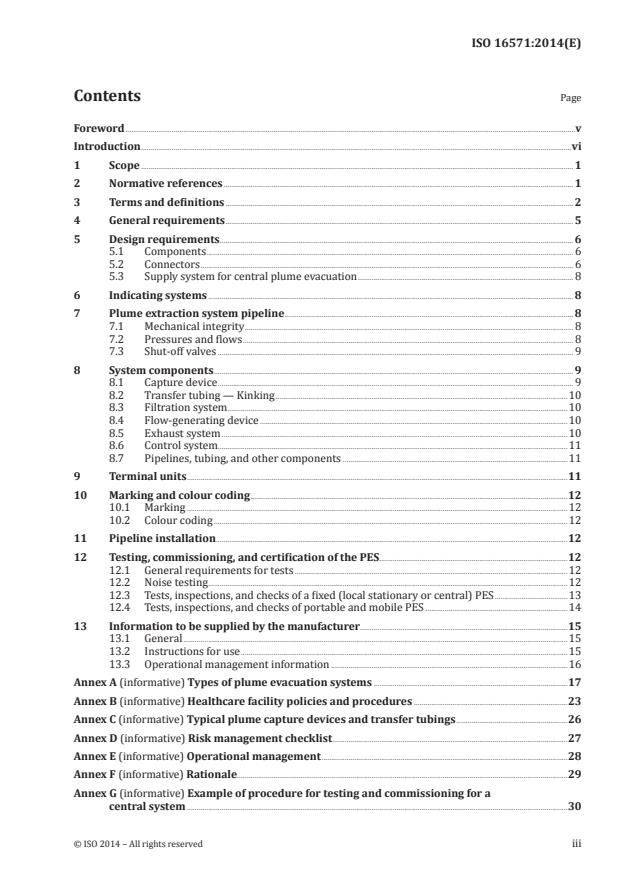
Contents Page
Foreword .v
Introduction .vi
1 Scope . 1
2 Normative references . 1
3 Terms and definitions . 2
4 General requirements . 5
5 Design requirements . 6
5.1 Components . 6
5.2 Connectors . 6
5.3 Supply system for central plume evacuation . 8
6 Indicating systems . 8
7 Plume extraction system pipeline . 8
7.1 Mechanical integrity . 8
7.2 Pressures and flows . 8
7.3 Shut-off valves . 9
8 System components . 9
8.1 Capture device . 9
8.2 Transfer tubing — Kinking .10
8.3 Filtration system .10
8.4 Flow-generating device .10
8.5 Exhaust system .10
8.6 Control system.11
8.7 Pipelines, tubing, and other components .11
9 Terminal units .11
10 Marking and colour coding .12
10.1 Marking .12
10.2 Colour coding .12
11 Pipeline installation .12
12 Testing, commissioning, and certification of the PES.12
12.1 General requirements for tests .12
12.2 Noise testing .12
12.3 Tests, inspections, and checks of a fixed (local stationary or central) PES .13
12.4 Tests, inspections, and checks of portable and mobile PES .14
13 Information to be supplied by the manufacturer .15
13.1 General .15
13.2 Instructions for use .15
13.3 Operational management information .16
Annex A (informative) Types of plume evacuation systems .17
Annex B (informative) Healthcare facility policies and procedures .23
Annex C (informative) Typical plume capture devices and transfer tubings .26
Annex D (informative) Risk management checklist .27
Annex E (informative) Operational management .28
Annex F (informative) Rationale .29
Annex G (informative) Example of procedure for testing and commissioning for a
central system .30
Annex H (informative) Guidelines for flow-generating devices consisting of fans or blowers .32
Bibliography .33
iv © ISO 2014 – All rights reserved
Foreword
ISO (the International Organization for Standardization) is a worldwide federation of national standards
bodies (ISO member bodies). The work of preparing International Standards is normally carried out
through ISO technical committees. Each member body interested in a subject for which a technical
committee has been established has the right to be represented on that committee. International
organizations, governmental and non-governmental, in liaison with ISO, also take part in the work.
ISO collaborates closely with the International Electrotechnical Commission (IEC) on all matters of
electrotechnical standardization.
The procedures used to develop this document and those intended for its further maintenance are
described in the ISO/IEC Directives, Part 1. In particular the different approval criteria needed for the
different types of ISO documents should be noted. This document was drafted in accordance with the
editorial rules of the ISO/IEC Directives, Part 2 (see www.iso.org/directives).
Attention is drawn to the possibility that some of the elements of this document may be the subject of
patent rights. ISO shall not be held responsible for identifying any or all such patent rights. Details of
any patent rights identified during the development of the document will be in the Introduction and/or
on the ISO list of patent declarations received (see www.iso.org/patents).
Any trade name used in this document is information given for the convenience of users and does not
constitute an endorsement.
For an explanation on the meaning of ISO specific terms and expressions related to conformity
assessment, as well as information about ISO’s adherence to the WTO principles in the Technical Barriers
to Trade (TBT) see the following URL: Foreword - Supplementary information
The committee responsible for this document is ISO/TC 121, Anaesthetic and respiratory equipment,
Subcommittee SC 6, Medical gas systems.
Introduction
Certain surgical, diagnostic, and therapeutic techniques can generate noxious airborne contaminants
(plume) as by-products, particularly from procedures that include the cutting, ablation, cauterization,
or mechanical manipulation of target tissue by energy-based devices such as lasers, electrosurgical
generators, broadband light sources, ultrasonic instruments, etc. or mechanical surgical tools such
as bone saws, high speed drills, and reamers. New technologies in cutting and sealing can result in
[85]
less plume generation (see Reference ) but plume remains a hazard. Energy-based contact with
articles such as tubing, swabs, and skin preparation solutions will produce additional chemicals. This
International Standard was developed in response to awareness of the potential hazards to patients and
staff of plume generated by these techniques in healthcare settings.
Plume can contain a variety of contaminants: viable bacteria (including multi-resistant strains), viruses,
cellular debris (including DNA), airborne chemicals, particulates, ultrafine particles, aerosols, gases,
vapours, and fumes (including fumes from metals). In vitro studies of bacterial and viral contamination
have found viable Escherichia coli, Staphylococcus aureus, human papillomavirus (HPV), hepatitis viruses
(HVB, HVC), and human immunodeficiency virus (HIV) in plume. The gases in plume can include toxic
substances such as benzene, formaldehyde, and hydrogen cyanide. Plume can also contain aerosolized
blood (plasma, cells, or fragments of cells) and blood-borne pathogens.
Plume thus poses a hazard to exposed persons. It can transmit infection, or have mutagenic or carcinogenic
effects. Plume can also cause irritation of the mucous membranes, eyes, respiratory system, and skin.
Additionally, plume reduces the clinician’s ability to clearly see the operative field, resulting in unsafe
operating conditions.
This International Standard specifies requirements for systems for evacuation of plume generated in
healthcare facilities. It is intended for those persons involved in the design, construction, inspection,
and operation of healthcare facilities. Those persons involved in the design, manufacture, installation,
testing, and use of equipment and components for plume evacuation systems should also be aware of the
contents of this International Standard.
This International Standard seeks to ensure that plume generated in healthcare facilities is not
evacuated through the medical vacuum or anaesthetic gas scavenging systems. For this reason, type-
specific components are specified for terminal units and for other connectors which are intended to be
used by the operator.
The objectives of this International Standard are to ensure the following:
a) non-interchangeability with other products or pipeline systems by design;
b) continuous extraction at specified pressures and flows;
c) use of suitable materials for all components of the system;
d) provision of monitoring indicators and alarm systems;
e) correct rating of filtration systems;
f) correct indication of filter life;
g) correct marking and labelling;
h) electrical and environmental testing;
i) correct installation;
j) testing, commissioning, and certification;
k) provision of guidance on operational management;
l) appropriate manufacturer’s instructions for use, training, service, and maintenance.
vi © ISO 2014 – All rights reserved
Annex F contains rationale statements for some of the requirements of this International Standard.
It is included to provide additional insight into the reasoning that led to the requirements and
recommendations that have been incorporated into this International Standard. The clauses and
subclauses marked with * after their number have corresponding rationale contained in Annex F. It
is considered that knowledge of the reasons for the requirements will not only facilitate the proper
application of this International Standard, but will expedite any subsequent revisions.
INTERNATIONAL STANDARD ISO 16571:2014(E)
Systems for evacuation of plume generated by medical
devices
1 Scope
1.1 This International Standard specifies requirements and guidelines for the design, manufacture,
installation, function, performance, maintenance, servicing, documentation, testing, and commissioning
of equipment for evacuation of plume generated by medical devices.
NOTE A plume evacuation system (PES) can be a functionally independent component of a medical device
that has other functions.
1.2 This International Standard is applicable to
a) portable and mobile plume evacuation systems,
b) local stationary plume evacuation systems,
c) dedicated central pipeline systems for plume evacuation systems, and
d) plume evacuation systems integrated into other equipment (e.g. laser equipment).
1.3* This International Standard does not apply to active and passive devices used to evacuate plume
generated during invasive (e.g. laparoscopic or endoscopic) procedures.
1.4 This International Standard does not apply to the following:
a) anaesthetic gas scavenging systems (AGSSs) which are covered in ISO 7396-2;
b) medical vacuum systems which are covered in ISO 7396-1;
c) heating, ventilation, and air-conditioning (HVAC) systems;
d) aspects of laser safety other than airborne contamination;
[7]
NOTE Some other aspects of laser safety are covered by IEC 60825 (see Reference ).
e) aspects of electrosurgery, electrocautery, and mechanical surgical tools other than airborne
contamination produced by such equipment resulting from interaction with tissue or materials.
2 Normative references
The following documents, in whole or in part, are normatively referenced in this document and are
indispensable for its application. For dated references, only the edition cited applies. For undated
references, the latest edition of the referenced document (including any amendments) applies.
ISO 3744:2010, Acoustics — Determination of sound power levels and sound energy levels of noise sources
using sound pressure — Engineering methods for an essentially free field over a reflecting plane
ISO 5359, Low-pressure hose assemblies for use with medical gases
ISO 7396-1:2007, Medical gas pipeline systems — Part 1: Pipelines for compressed medical gases and vacuum
ISO 11197, Medical supply units
ISO 14971, Medical devices — Application of risk management to medical devices
IEC 60601-1, Medical electrical equipment — Part 1: General requirements for basic safety and essential
performance
IEC 61672-1, Electroacoustics — Sound level meters — Part 1: Specifications
IEC 62366, Medical devices — Application of usability engineering to medical devices
EN 1041, Information supplied by the manufacturer of medical devices
EN 1822-1, High efficiency air filters (HEPA and ULPA) — Classification, performance testing, marking
EN 13348, Copper and copper alloys — Seamless, round copper tubes for medical gases or vacuum
3 Terms and definitions
For the purposes of this document, the following terms and definitions apply.
3.1
adsorber
device that removes volatile organic compounds and odours from a gas stream
EXAMPLE Activated carbon filter.
3.2
capture device
hose, tube, funnel, or other accessory that provides the inlet to the plume evacuation system at the site
of plume generation
3.3
central plume evacuation system
permanently installed PES which includes a supply system, a pipeline system, and terminal unit(s), and
that conveys the plume to the outside of the building
3.4
diversity factor
factor which represents the maximum proportion of terminal units in a defined clinical area which will
be used at the same time, at flow rates defined in agreement with the management of the healthcare
facility and according to this International Standard
3.5
electrocautery
surgical technique that uses an electrically heated device to cut, ablate, or coagulate tissue for therapeutic
purposes
Note 1 to entry: Electrosurgery is also known as high frequency (HF) surgery or surgical diathermy.
3.6
electrosurgery
surgical technique that uses a radiofrequency electric current passing through the patient to cut, ablate,
or coagulate tissue for therapeutic purposes
3.7
flow-generating device
part of a plume evacuation system that provides flow and vacuum for evacuating plume
3.8
junction point
connection point between the inlet tubing to the flow-generating device and the PES pipeline
Note 1 to entry: See Figure A.3.
2 © ISO 2014 – All rights reserved
3.9
local stationary plume evacuation system
permanently installed PES that includes a flow-generating device and terminal unit and that vents the
filtered plume inside the room
3.10
manufacturer
natural or legal person with responsibility for the design, manufacture, packaging, and labelling of a
device before it is placed on the market under his own name, regardless of whether these operations are
carried out by that person himself or on his behalf by a third party
3.11
medical device
any instrument, apparatus, appliance, software, material, or other article, whether used alone or in
combination, including the software intended by its manufacturer to be used specifically for diagnostic
and/or therapeutic purposes and necessary for its proper application, and intended by the manufacturer
to be used for human beings for the purpose of
— diagnosis, prevention, monitoring, treatment, or alleviation of disease,
— diagnosis, monitoring, treatment, alleviation of, or compensation for an injury or handicap,
— investigation, replacement, or modification of the anatomy or of a physiological process, and
— control of conception,
and which does not achieve its principal intended action in or on the human body by pharmacological,
immunological, or metabolic means, but which can be assisted in its function by such means
3.12
medical supply unit
permanently installed medical electrical equipment intended to supply electric power, lighting, and/or
medical gases and/or liquids, plume evacuation systems, and anaesthetic gas scavenging systems to
medical areas of a healthcare facility
Note 1 to entry: Medical supply units can include medical electrical equipment or medical electrical systems or
parts thereof. Medical supply units can also consist of modular sections for electrical supply, lighting for therapy
or illumination, communication, supply of medical gases and liquids, plume evacuation systems, and anaesthetic
gas scavenging systems. Some typical examples of medical supply units are bed head services modules, ceiling
pendants, beams, booms, columns, pillars, cabinetry, concealed compartments on or in a wall, and prefabricated
walls.
Note 2 to entry: Detailed information about medical supply units can be found in ISO 11197.
3.13
mobile
referring to transportable equipment intended to be moved from one location to another while supported
by its own wheels or equivalent means
3.14
pipeline system
portion of a central PES between the terminal unit(s) and the supply system
3.15
plume
noxious airborne contaminants generated as by-products, particularly by procedures that rely on the
ablation, cauterization, mechanical manipulation, or thermal desiccation of target tissue by devices such
as lasers, electrosurgical or electrocautery devices, broadband light sources, ultrasonic instruments, or
surgical tools such as bone saws, high speed drills, and reamers
Note 1 to entry: Plume can include visible or invisible aerosol particles, smoke, or gases.
3.16
plume evacuation system
PES
device for capturing, transporting, and filtering plume and exhausting the filtered product
Note 1 to entry: Plume evacuation systems can also be called smoke evacuators, laser plume evacuators, plume
scavengers, and local exhaust ventilators (LEVs).
Note 2 to entry: Diagrams of typical PESs are found in Annex A.
3.17
portable
referring to transportable equipment intended to be moved from one location to another while being
carried by one or more persons
3.18
pre-filter
device intended to protect filtration equipment from damage by preventing the intake of large particles
and/or moisture
3.19
single fault condition
condition in which a single means for protection against a safety hazard in equipment is defective or a
single external abnormal condition is present
3.20
single use
referring to a product intended to be used once and then discarded
3.21
source of supply
portion of the supply system with associated control equipment which supplies the pipeline system
[SOURCE: ISO 7396-1]
3.22
supply system
assembly which supplies the pipeline system and which includes all sources of supply
[SOURCE: ISO 7396-1]
3.23
system design flow
flow calculated from the maximum flow requirement of the healthcare facility and corrected by the
diversity factor(s)
[SOURCE: ISO 7396-1]
3.25
terminal unit
inlet assembly in a plume evacuation system at which the operator makes connections and disconnections
Note 1 to entry: See Figure 1.
3.26
transfer tubing
tubing between the capture device and the filtration system
4 © ISO 2014 – All rights reserved
3.27
transportable
referring to equipment that is intended to be moved from one place to another, whether or not connected
to a supply and without any appreciable restriction of range
EXAMPLE Mobile equipment and portable equipment.
3.28
ultra-low penetration (or particulate) air (ULPA) filter
filter with an overall particulate efficiency of not less than 99,999 5 % as determined by EN 1822-1
3.29
ultrasonic surgical device
surgical device that utilizes high frequency vibration to enable hemostatic cutting or cautery, created by
thermal effects, coupled with fragmentation of tissue
4 General requirements
All pressures in this International Standard are gauge pressures (i.e. relative to local atmospheric
pressure) and are measured in kPa.
4.1 PESs shall, when installed, extended, modified, commissioned, operated, and maintained
in accordance with the instructions of the manufacturer, present no risks that are not reduced to
an acceptable level using risk management procedures in accordance with ISO 14971 and which are
connected with their intended application, in normal condition and in single fault condition.
NOTE 1 A situation in which a fault is not detected is considered a normal condition. Fault conditions/hazardous
situations can remain undetected over a period of time and as a consequence can lead to an unacceptable risk. In
that case, a subsequent detected fault condition needs to be considered as a single fault condition. Specific risk
control measures need to be determined within the risk management process to deal with such situations.
NOTE 2 Typical safety hazards are listed in Annex D.
4.2 The manufacturer can use type tests different from those described in this International
Standard, if an equivalent degree of compliance can be demonstrated. However, in the event of dispute,
the test arrangements and methods described in this International Standard shall be used as the
reference methods.
4.3 When used in accordance with the manufacturer’s instructions, the efficiency of plume removal
shall be at least 90 %.
Evidence shall be provided by the manufacturer.
4.4* A PES shall not be connected to any pipeline system for medical gases and/or vacuum, an
anaesthetic gas scavenging system (AGSS), or a heating and recirculating ventilation system.
4.5 Portable and mobile plume evacuation systems shall comply with the applicable requirements
for basic safety and essential performance specified in IEC 60601-1.
NOTE National or regional regulations can specify additional requirements.
4.6 The sound pressure level emitted by the PES shall be measured in accordance with 12.2 and shall
be disclosed in the instructions for use.
NOTE National and regional regulations concerning noise levels within the medical environment can exist.
4.7* Enclosures of portable and mobile plume evacuation systems shall provide at least an IP31
degree of protection when tested according to 12.4.1.
4.8 The manufacturer shall evaluate usability in accordance with IEC 62366. Check compliance by
inspection of the usability engineering file.
5 Design requirements
5.1 Components
A PES shall include at least the following elements (see figures in Annexes A and C):
a) a capture device with an inlet that can be effectively positioned near the operative site;
b) transfer tubing;
c) a filtration system;
NOTE A filtration system can include a pre-filter, final filter and indication(s) of filter life(s) or the need
for replacement, and an adsorber.
d) a flow-generating device;
e) an exhaust system which extends from the flow-generating device to room air (in the case of a local,
portable, or mobile PES) or the outside of the building (in the case of a central system);
f) a control system;
g) connectors.
NOTE The arrangement of these components can vary and a single device can incorporate multiple functions.
5.2 Connectors
5.2.1* User-detachable connectors shall not be connectable with connectors in ISO 5356-1 or
ISO 80369-1.
NOTE See Figures A.1, A.2, and A.3 for the location of connectors.
5.2.2 For the terminal unit connector, the connecting force shall be a minimum of 25 N and a maximum
of 40 N.
5.2.3 For the terminal unit connector, the disconnecting force shall be a minimum of 25 N and a
maximum of 40 N.
5.2.4 A terminal unit is shown in Figure 1.
6 © ISO 2014 – All rights reserved
Dimensions in millimetres
Key
1 lid on terminal unit with automatic closing device
2 PES terminal
Figure 1 — Plume evacuation system terminal unit
5.3 Supply system for central plume evacuation
5.3.1 A supply system for a central stationary PES shall comprise at least two sources of supply, typically
blowers or pumps.
5.3.2* The supply system shall be capable of maintaining the design flow rate of the system when any
single source of supply has been removed from service.
5.3.3 The supply system shall be designed so that during maintenance on any source of supply or
system component or during a single fault condition on any component of the system, the remaining
sources and components shall be capable of supplying the system design flow.
5.3.4 Each source of supply shall have a control circuit arranged so that shutting off, or failure, of one
source will not affect the operation of other source(s). The controls shall be arranged so that all the
sources of supply service the system in turn or simultaneously. This requirement shall be met in normal
condition and in single fault condition.
5.3.5 The supply system for a central PES should be connected to the emergency power supply.
5.3.6 The exhaust(s) from the supply system shall be piped to the outside of the building and shall
be provided with means to prevent the ingress of, for example, insects, debris, and precipitation. The
location of the exhaust outlet should be remote from the air intake for medical air compressor systems,
air intakes, doors, windows, or other openings in buildings. Consideration should be given to the
potential effects of prevailing winds on the location of the exhaust(s).
5.3.7 If necessary, means to prevent the transmission of vibration from the supply system to the
pipeline shall be provided.
5.3.8 Means to regulate flow to terminal unit(s) can be provided in order to meet the requirements in
7.2.
5.3.9 The ambient temperature in rooms for supply systems shall be in the range specified by the
manufacturer.
6 Indicating systems
Means shall be provided to indicate to the operator that the PES is operating.
7 Plume extraction system pipeline
7.1 Mechanical integrity
The pipeline distribution system shall maintain its mechanical integrity at a pressure of −30 kPa.
7.2 Pressures and flows
7.2.1 The vacuum level at the inlet to the capture device shall be no less than −15 kPa (i.e. between
0 kPa and −15 kPa).
NOTE This is to avoid trauma to the patient’s tissues.
7.2.2 The pressure at any terminal unit shall not be less than 110 % of the nominal pressure with all
terminal units closed. The pressure at any terminal unit shall not be less than −10 kPa with the system
operating at system design flow.
7.2.3 The PES shall be capable of providing a flow of at least 500 l/minute at the terminal unit with no
load.
8 © ISO 2014 – All rights reserved
7.2.4 The system design flow shall be determined by the designer of the PES after consultation with
the healthcare institution.
EXAMPLE System design flow can be calculated using a diversity factor based on a single theatre design
flow of 500 l/min for the first two theatres and 25 % of the single theatre design flow for each of the remaining
theatres.
7.3 Shut-off valves
7.3.1 Where needed, shut-off valves shall be provided to isolate sections of the pipeline distribution
system for maintenance, repair, or planned future extensions and to facilitate periodic testing. The
nomenclature for shut-off valves shall be as follows:
a) source shut-off valve;
b) main shut-off valve;
c) riser shut-off valve;
d) branch shut-off valve;
e) ring shut-off valve;
f) maintenance shut-off valve.
7.3.2 If not specified, the location of all shut-off valves and the extent of the area served by each shut-
off valve shall be determined by the system designer together with the healthcare facility management,
using risk analysis procedures in accordance with ISO 14971. Consideration should be given to providing
a shut-off valve at the point where the pipeline enters a building unless the main, riser, or branch shut-off
valve is accessible within the building.
7.3.3 All shut-off valves shall be identified
a) to indicate the service name or symbol, and
b) to indicate the risers, branches, or areas controlled.
This identification shall be secured to the valve or the pipeline and be readily visible at the valve site.
7.3.4 For all manual shut-off valves in a PES, it shall be apparent by observation whether the valve is
open or closed.
7.3.5 It shall be possible to isolate each source of supply for maintenance, repair, or planned future
extensions and to facilitate periodic testing.
7.3.6 Shut-off valves which cannot be locked in the open or closed position shall be protected from
operation by unauthorized personnel.
8 System components
8.1 Capture device
NOTE A capture device can be single use or reusable.
8.1.1 The capture device shall comply with relevant clauses for fire prevention in IEC 60601-1.
Evidence shall be provided by the manufacturer.
8.1.2 Capture devices shall be provided with a means to prevent tissue and other material from the
surgical site being drawn into the transfer tubing.
8.1.3 The capture device shall include a means to prevent attachment to intact tissue or a means to
break the vacuum.
8.2 Transfer tubing — Kinking
The transfer tubing shall not kink when tested according to ISO 5359.
8.3 Filtration system
8.3.1 The filtration system shall be designed to minimize biohazards and other contamination in the
exhaust air. This can be accomplished by using a single multi-purpose filter or more than one filter.
8.3.2 The filtration system shall include an ULPA filter in accordance with EN 1822-1.
8.3.3 The filtration system can contain a pre-filter and/or an adsorber.
NOTE A hydrophobic element is not a necessary component of a pre-filter. A fluid drop out, suction catheter,
and labelling to not aspirate fluids are current control methods.
8.3.4 Means shall be provided to indicate when a filter or adsorber change is required according to the
manufacturer’s instructions.
NOTE This can be accomplished through e.g. pressure drop monitoring or indication, a visual indicator, an
audible indicator, or labelling indicating a date for replacement.
8.3.5 The filters shall be designed such that during routine maintenance, there is no biohazard to
the user during filter removal and installation (i.e. the user should not be directly in contact with the
contaminated filter components).
8.3.6 Local, mobile, and portable PESs shall contain an adsorber when the outlet flow is into the
operating room.
8.4 Flow-generating device
8.4.1 Provided that unacceptable risk is not introduced and the PES continues to meet the requirements
of this International Standard, the flow-generating device can be used to power other systems.
Check compliance by examination of the risk management file.
NOTE 1 The flow-generating device is usually used only to power the plume evacuation system.
NOTE 2 See Annex H for guidelines for flow-generating devices consisting of fans, blowers, or dedicated pumps.
8.4.2 A flow-generating device shall be provided downstream of the filtration system.
8.4.3 Means shall be provided in the PES for the operator to adjust the flow.
8.4.4 Flow-generating devices for a central PES consisting of fans, blowers, or dedicated pumps shall
not be located in the same room as gas and non-cryogenic liquid cylinder supply systems.
8.4.5 The locations of flow-generating devices for a central PES shall be decided by a risk management
process in accordance with ISO 14971.
8.5 Exhaust system
The exhaust port on PESs shall be marked as such and shall include a warning that the exhaust port
should not be blocked.
10 © ISO 2014 – All rights reserved
8.6 Control system
The control system shall include an ON-OFF device.
NOTE 1 It can also include one or more of the following:
a) flow control;
b) means to control how long the PES continues to evacuate plume after it is turned off (delay control);
c) a standby mode.
NOTE 2 A wide range of control devices (e.g. electronic footswitches, pneumatic footswitches, sensor devices,
and direct cable connections) can be used with PESs. A remote control feature can be coupled with the activation
device of the laser or electrosurgical unit.
8.7 Pipelines, tubing, and other components
8.7.1 The materials used for pipelines and other components of the PES shall be corrosion resistant
and compatible with plume under the operating conditions specified by the manufacturer.
NOTE 1 Corrosion resistance includes resistance against the influence of moisture and the surrounding
materials.
Evidence shall be provided by the manufacturer.
NOTE 2 Regional or national requirements can require the provision of evidence to the competent authority or
a conformity assessment body, e.g. notified body in the European Economic Area (EEA), upon request.
8.7.2 If copper pipes are used, they shall comply with the requirements given in EN 13348 or national
standards/regulations (e.g. ASTM B819) that can apply.
Evidence shall be provided by the manufacturer.
NOTE 1 Regional or national regulations can require the provision of evidence to the competent authority or a
conformity assessment body, e.g. notified body in the European Economic Area (EEA), upon request.
NOTE 2 The use of the same stock of copper pipes as is used for the installation of pipeline systems for
compressed medical gases and vacuum is in accordance with ISO 7396-1.
8.7.3 The potential hazards arising from the use of non-metallic pipes and components shall be taken
into account, using risk management procedures in accordance with ISO 14971.
NOTE Experience shows that non-metallic pipes and their junctions used in PESs need to be carefully
evaluated for their durability following exposure to plume.
8.7.4 If lubricants are used, they shall be compatible with plume under the operating conditions
specified by the manufacturer.
Evidence shall be provided by the manufacturer.
NOTE Regional or national regulations can require the provision of evidence to the competent authority or a
conformity assessment body, e.g. notified body in the European Economic Area (EEA), upon request.
8.7.5 Precautions shall be taken to maintain the cleanliness of components during transportation,
storage, and installation.
9 Terminal units
9.1 Each central PES shall have a PES-specific terminal unit, complying with Figure 1.
9.2 The terminal unit shall have an automatic closing device that seals when not connected.
10 Marking and colour coding
10.1 Marking
10.1.1 Pipelines shall be marked “PES” or the national equivalent and shall have arrows denoting the
direction of flow adjacent to valves (if fitted) at junctions and changes of direction, before and after
walls and partitions, etc., at intervals of no more than 10 m and adjacent to terminal units.
10.1.2 Marking shall be durable and with letters not less than 6 mm high.
10.1.3 The exhaust outlet of a central plume evacuation system shall be marked as such.
10.2 Colour coding
10.2.1 If colour coding is used, it shall be in accordance with national standards.
10.2.2 The test for durability of markings and colour coding is given in 12.3.10.
11 Pipeline installation
When a PES is in a medical supply unit, it shall be installed in accordance with the relevant clauses of
ISO 11197.
NOTE 1 Regional or national regulations which apply to electrical installations in buildings can exist.
NOTE 2 Regional or national regulations which apply to continuity of earthing across all joints within the same
building and to electrical isolation of different buildings from each other can exist.
12 Testing, commissioning, and certification of the PES
The resolution and accuracy of all measuring devices used for testing shall be appropriate for the values
to be measured. All measuring devices used for certification shall be calibrated at appropriate intervals.
12.1 General requirements for tests
Before any testing is carried out, every terminal unit in a central system under test shall be labelled to
indicate that the system is under test and shall not be used.
12.2 Noise testing
12.2.1 For portable or mobile PES, place the PES on a sound-reflecting plane and attach the least
favourable capturing device with respect to noise, as indicated in the instructions for use. Set the PES
flow rate that creates the maximum sound level. Using a microphone of the sound level meter complying
with the requirements of type 1 instruments specified in IEC 61672-1, measure the sound pressure
levels at 10 positions in a hemisphere with a radius 1 m from the sound generating source.
12.2.2 For local or central PES, place the PES capturing device on a sound-reflecting plane and attach
the least favourable capturing device with respect to noise, as indicated in the instructions for use. Set
the PES flow rate that creates the maximum sound level. Using a microphone of the sound level meter
complying with the requirements of type 1 instruments specified in IEC 61672-1, measure the sound
pressure levels at 10 positions in a hemisphere with a radius 1 m from the sound generating source.
12.2.3 Calculate the A-weighted sound pressure level averaged over the measurement surface according
to 8.2.2 of ISO 3744:2010.
12.2.4 Verify that the A-weighted background level of extraneous noise, including any information
signals, is at least 6 dB below that measured during the test.
12 © ISO 2014 – All rights reserved
12.2.5 Include the measured sound pressure level in the instructions for use.
12.3 Tests, inspections, and checks of a fixed (local stationary or central) PES
12.3.1 General
Tests after completion of installation of a local stationary or central PES system shall be carried
...
Questions, Comments and Discussion
Ask us and Technical Secretary will try to provide an answer. You can facilitate discussion about the standard in here.
Loading comments...